
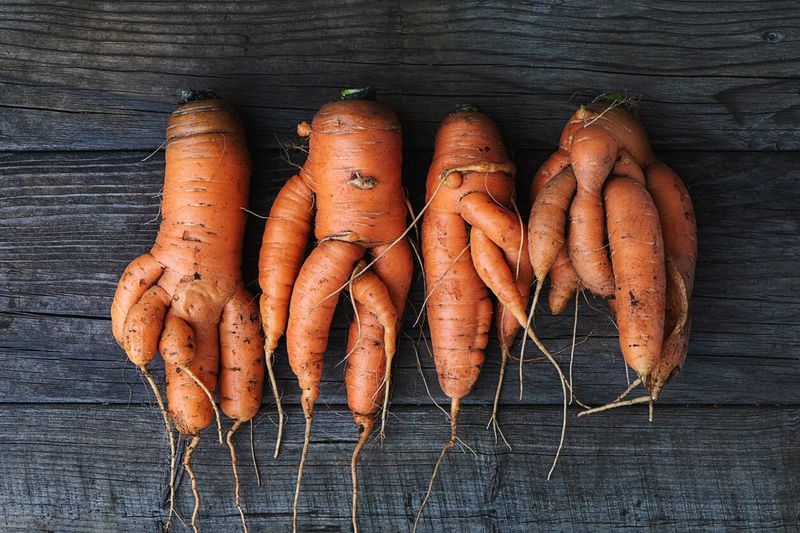
Pulling a handful of forked, twisted carrots out of the garden after months of patient waiting is genuinely frustrating. Most gardeners assume the seed was bad or the variety just grows that way, but the real story usually starts underground, long before harvest. A poorly prepared or obstructed seedbed is a leading place to look, though several other conditions can produce misshapen roots too. Understanding what actually happens to a developing carrot taproot makes it much easier to fix the problem before the next sowing.
A developing taproot can fork before harvest
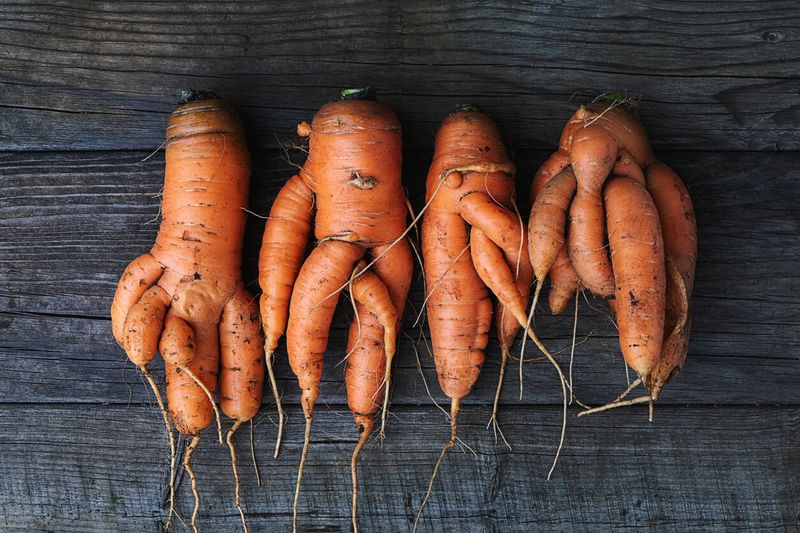
A carrot starts forming its taproot almost as soon as it germinates, and that early growth stage is when the most consequential damage can happen. When the young taproot meets a rock, a dense clod, a pocket of compacted soil, or a hardpan layer, it has two options: stop growing or grow around the obstacle. Either response produces secondary roots that spread outward, and those secondary roots are what you see as forking or branching at harvest. University of Illinois Extension identifies poorly prepared soil as a frequent cause of forked carrots, while University of Minnesota Extension points to rocky, heavy, or compacted soil as a primary disorder.
Variety does matter when it comes to a carrot’s normal mature shape and length. Long Imperator types need deep, loose soil to reach their full size, while shorter Chantenay or Nantes types are more forgiving in shallower beds. But variety alone does not explain abnormal forking or branching. A carrot grown in ideal soil for its type should produce a reasonably straight root, while even a short-rooted variety can come out twisted if it encounters an obstruction early on.
Forking is the most common shape problem, but twisted and misshapen roots are a broader category. Research on soil compaction and carrot roots found that increasing soil strength produced thickened, convoluted, branched, short, or blunt roots, showing how physical resistance alone can create a range of deformities. Crowding, cultivation injury, excess moisture, pests, and disease can all contribute additional or overlapping symptoms.
A poorly prepared bed can create several problems at once
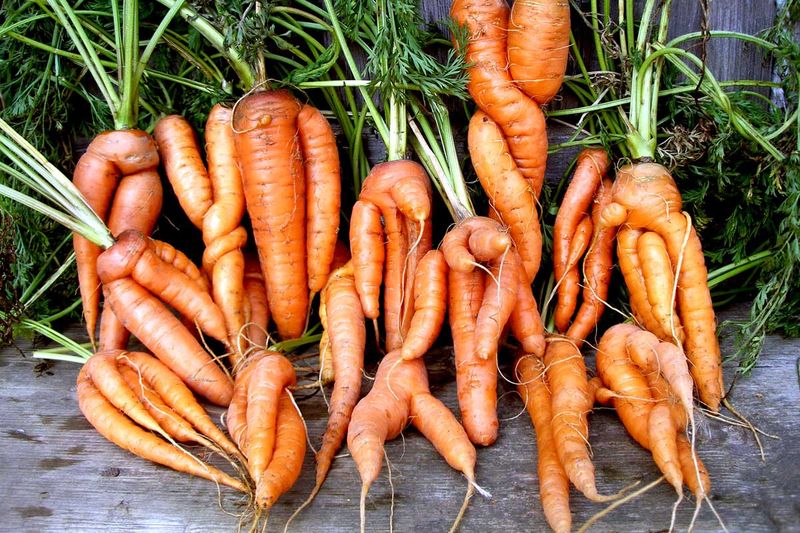
Several pre-plant conditions can obstruct or injure a developing carrot taproot, and they often appear together in the same bed. Rocks and large clods are the most obvious culprits, but compacted soil and hardpan layers can be just as damaging because the taproot cannot push through dense material easily. Fertilizer pellets placed directly against roots, excess nitrogen, and recently incorporated woodchips, sticks, tree roots, or other undecomposed woody material are also worth investigating. Illinois Extension specifically warns that excess organic debris such as recently incorporated woodchips can interfere with root penetration and produce forked or twisted roots.
Fresh manure and partially decomposed organic material are a separate concern from finished compost or well-rotted manure. Utah State University Extension lists fresh manure, excess nitrogen, and root injury as possible causes of branching in carrots. Raw or partially decomposed amendments can also carry excessive salts or ammonium, and Minnesota Extension notes that too much of any amendment can create nutrient imbalances that affect root development.
There is also a food-safety dimension. Penn State Extension recommends incorporating raw manure at least 120 days before harvest for crops that contact the soil directly, which carrots certainly do. Finished compost and well-rotted manure do not carry the same pathogen risk and are the appropriate choice for amending a carrot bed. No single amendment is the universal cause of forked carrots in every garden, but a bed that contains multiple raw or undecomposed materials is giving the taproot several reasons to branch.
Prepare a deep, clean root zone before sowing
Good seedbed preparation is the most reliable investment you can make for the next carrot crop. Loosen the soil to a depth of about 8 to 10 inches, breaking up any clods and working out stones, sticks, and undecomposed debris as you go. Illinois Extension recommends preparing the soil 8 to 10 inches deep before sowing carrots, and that depth gives the taproot room to develop without encountering resistance during its most vulnerable early stage. The goal is a firm but loose, obstruction-free channel, not a bed of pure dust or sand.
Carrots do not require perfectly sandy soil to grow well. Heavier soil can work if it is not compacted and drains adequately. Incorporating finished compost or well-rotted manure improves structure in both sandy and clay-heavy beds without the risks that come with raw amendments. Minnesota Extension recommends well-rotted manure or compost for soil improvement, and that distinction from fresh or partially decomposed material matters for both root quality and food safety.
When existing soil remains too shallow, rocky, or compacted to loosen reliably, a raised bed or container filled with a deep, well-drained growing medium is often more practical than repeatedly fighting the same ground. RHS guidance on growing carrots recommends raised beds or containers as effective alternatives for restrictive soils, and they allow you to control the root zone completely. Preparation must happen before direct sowing because the taproot begins developing almost immediately after germination, and there is no opportunity to improve the soil around a root that is already growing.
Protect the taproot after seedlings emerge
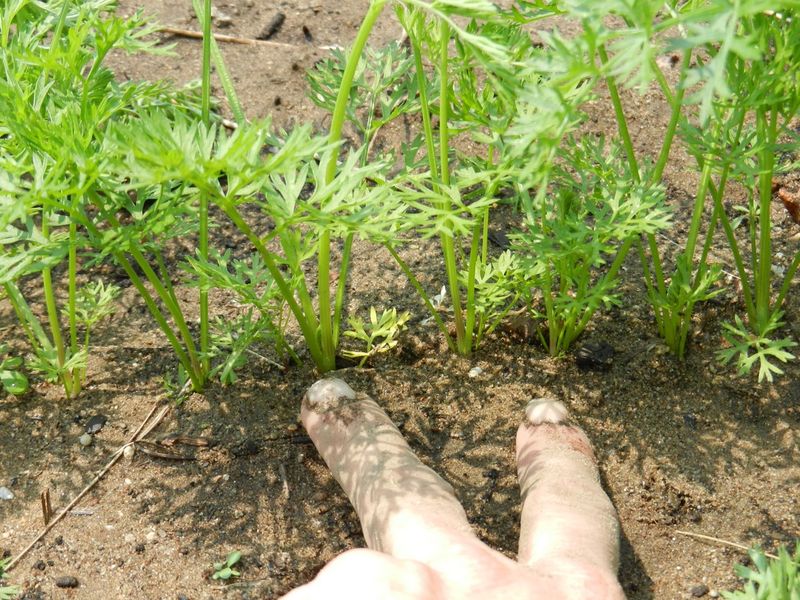
Seedbed preparation handles the conditions before germination, but several crop-management choices after emergence can still damage or distort a developing taproot. Carrots should always be direct-sown rather than transplanted. The taproot begins forming very early, and moving a seedling, even carefully, can misdirect or injure that root in ways that lead to branching later. Minnesota Extension recommends thinning seedlings to roughly 2 to 4 inches apart, depending on variety, and notes that overcrowding and inadequate thinning can produce twisted, intertwined, or misshapen roots.
Thinning feels wasteful when you have a dense stand of seedlings, but crowded roots compete for space and physically push against each other as they expand. The result at harvest is a tangle of undersized, twisted roots that are harder to use in the kitchen. Thin early, before roots have had a chance to develop significant size, and use scissors to cut seedlings at the soil line rather than pulling them out, which disturbs neighboring roots.
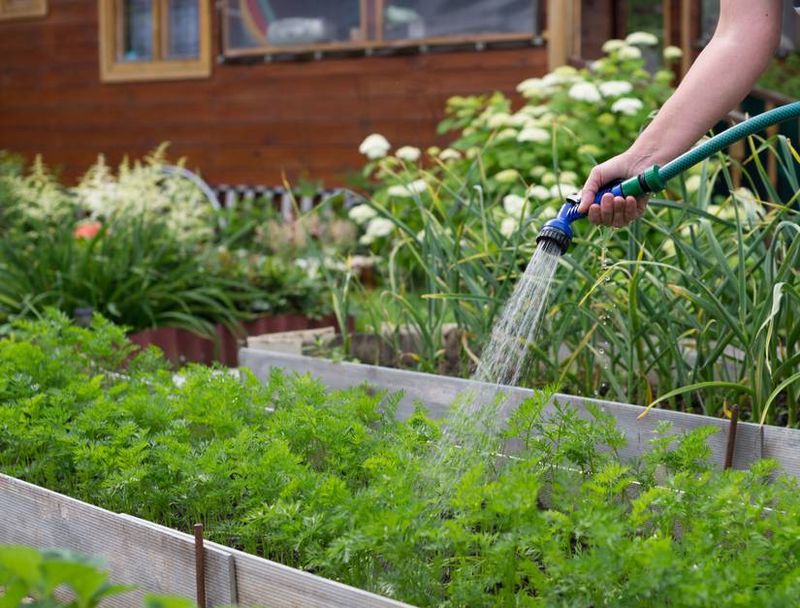
Weeding and cultivation deserve the same careful approach. Deep or close cultivation around carrot roots can nick or bruise the taproot, and a damaged taproot may respond by branching. Keep cultivation shallow and work a few inches away from the row. Consistent moisture also matters: irregular watering and saturated soil both affect root development.
UC IPM notes that overwatering can produce hairy, forked, or misshapen carrot roots, and very wet conditions also favor disease problems that further complicate root shape. Aim for steady, even soil moisture and good drainage throughout the growing season.
Use symptom clues before blaming the soil
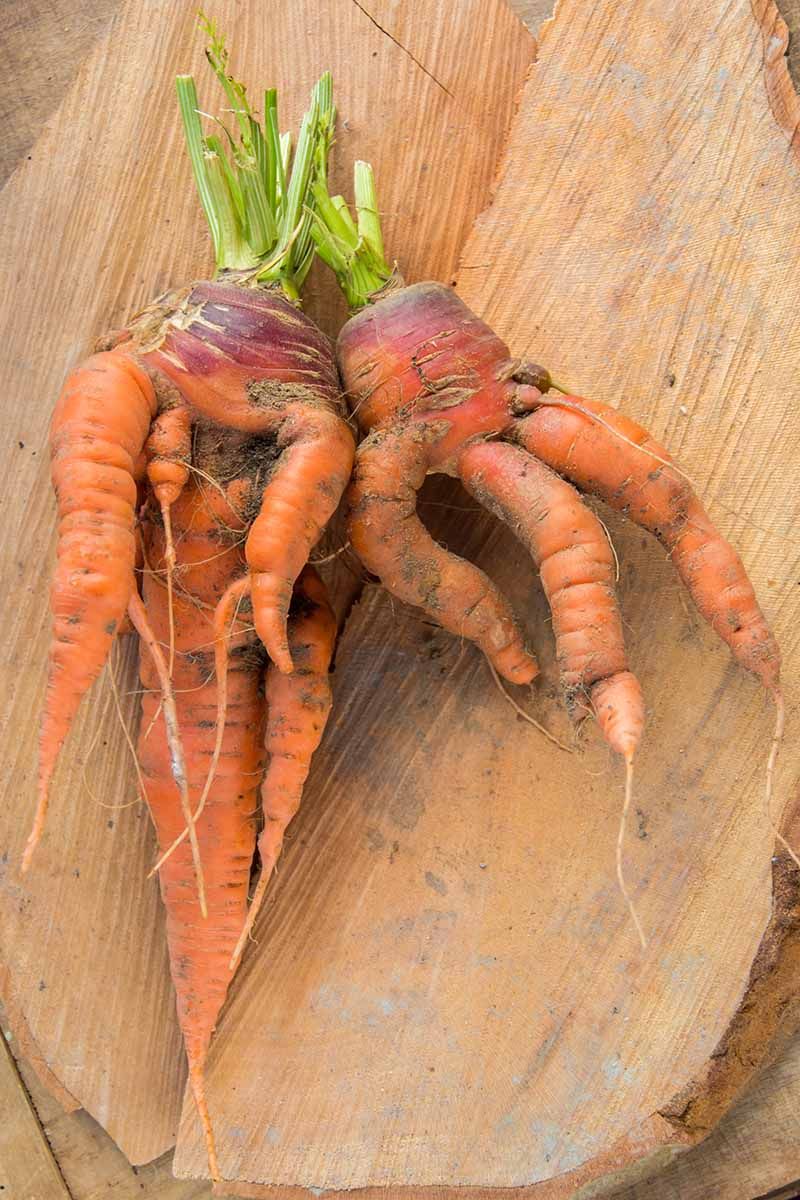
Not every misshapen carrot has the same story, and reading the symptom pattern carefully can point you toward the right explanation. Ordinary forking, where the root splits into two or more branches, is most consistent with early taproot obstruction or injury in a poorly prepared bed. Stubby or blunt roots that seem to stop growing before reaching full length raise a different set of questions. Utah State University Extension treats forked, twisted, hairy, and split roots as distinct symptoms with different contributing causes, not interchangeable descriptions of the same problem.
Short, stubby, or branched roots combined with a history of very wet soil or poor drainage can raise concern about Pythium root dieback, a soilborne disease that kills young taproot tissue and stimulates secondary root development. UC IPM’s guidance on root dieback, forking, and stubbing notes that this condition is more likely in poorly drained beds and is not corrected simply by adding compost. Drainage, watering practices, and crop rotation are more relevant responses.
Beadlike galls or swellings on the roots, many fine secondary roots, stunted tops, or midday wilting can point toward root-knot nematodes. UC IPM’s carrot nematode guidance makes clear that forking alone does not reliably diagnose nematodes, and their presence cannot be confirmed without additional symptoms, crop history, or laboratory testing. Similarly, hairy roots may reflect overwatering, nematode activity, or disease rather than simple physical obstruction. A misshapen root by itself is not a reason to apply pesticides or nematicides.
Require a clearer pattern of additional symptoms before moving to any treatment decision.
Choose a carrot that fits the available soil
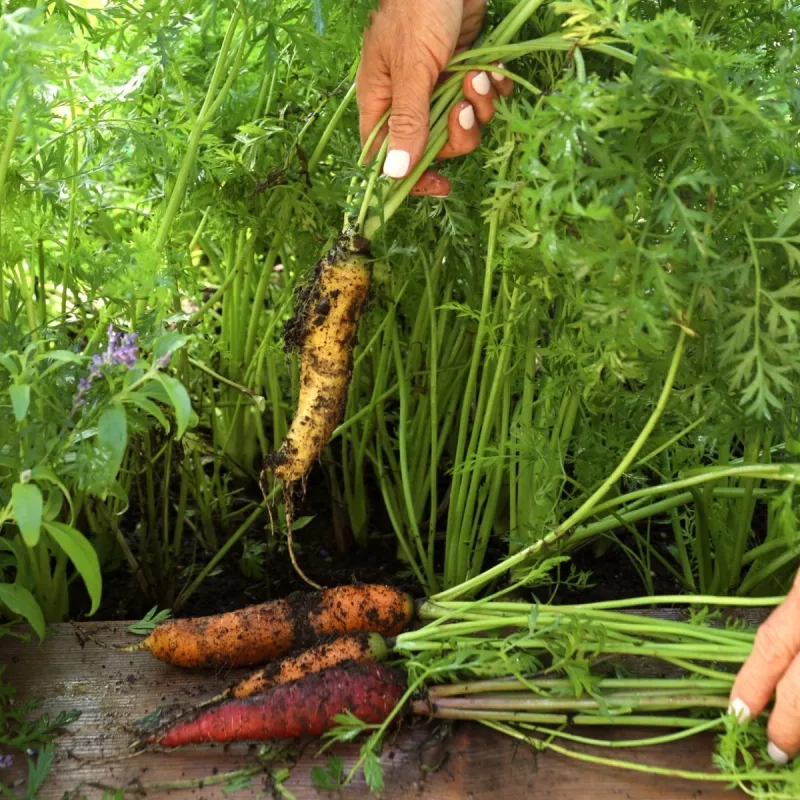
Some gardens simply cannot provide a deep, clean, loose bed no matter how much preparation goes into them. Rocky ledge close to the surface, heavy clay that recompacts quickly, or shallow topsoil over hardpan can all limit how far a taproot can grow before hitting resistance. In those situations, choosing a variety matched to the soil is more practical than fighting conditions that do not change easily. Short-rooted types such as Chantenay, Danvers, or round-rooted varieties are better suited to restrictive soils than long Imperator-type carrots that need 10 or more inches of clear, loose depth to develop properly.
RHS growing guidance for carrots recommends short-rooted varieties for heavier or shallower soils and notes that raised beds and containers offer a reliable alternative when ground conditions stay restrictive. A container filled with a purpose-mixed growing medium gives you complete control over depth, drainage, and composition, which is sometimes more efficient than amending a difficult native soil season after season. Varieties like Daucus carota ‘Bangor’ are specifically noted for performing well in containers, illustrating that variety selection and growing method can work together.
Choosing a shorter variety does reduce the mismatch between root length and available soil depth, but it does not remove all risk. Minnesota Extension notes that any variety can be affected by crowding, poor drainage, cultivation injury, pests, or disease. Variety selection is a practical fallback, not a guarantee, and it works best when combined with the seedbed preparation and crop-management steps described throughout this guide.
Plan the next sowing instead of trying to straighten this one
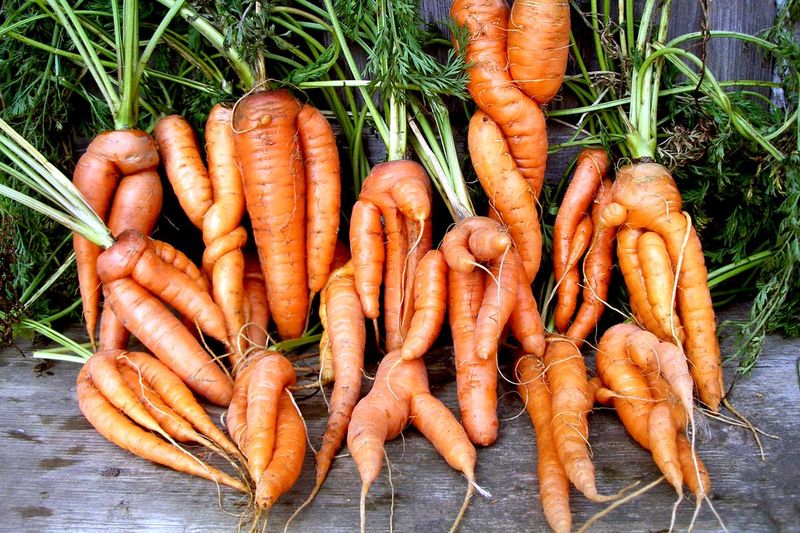
Once a carrot’s taproot has been damaged or deflected, it will not straighten before harvest. Loosening the soil around growing roots or adding amendments mid-season can improve future conditions, but the current root’s shape is already set. The most useful thing to do with this year’s forked carrots is treat them as diagnostic information, then direct that energy toward the next sowing. Utah State University Extension frames physiological root problems in carrots as largely preventable through correct pre-plant preparation rather than in-season correction.
Before the next crop, loosen the bed to at least 8 to 10 inches, remove stones and undecomposed debris, and use only finished compost or well-rotted manure as amendments. Direct-sow the seed, thin seedlings early to the correct spacing, cultivate shallowly and carefully, and maintain steady moisture with good drainage. Illinois Extension and Minnesota Extension both support these steps as the foundation of a healthy carrot crop. If the bed stays difficult, switch to a short-rooted variety or move to a raised bed or container.
Forked or twisted carrots are generally a cosmetic and usability issue, not a safety problem, unless the roots show rot, pest damage, disease, or signs of contamination. Peel and cut them as needed, and use them just as you would a straight one. Seedbed preparation is the leading place to investigate when roots come out misshapen, but no single soil habit explains every forked carrot in every garden, and that honest uncertainty is actually good news: it means there are several fixable factors worth checking.