
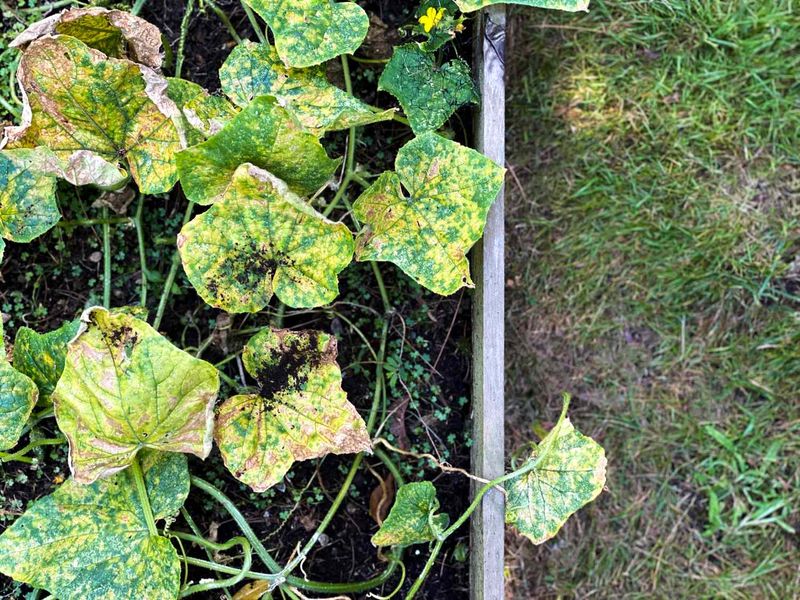
Yellow leaves creeping up from the bottom of your cucumber plant are easy to misread, especially when the thermometer has been pushing triple digits for weeks. That pattern is a clue worth following, not a verdict pointing to one obvious fix.
Several very different problems, from nutrient shortfalls and fungal disease to spider mites, watering mistakes, and root damage, can all show up first on the oldest, lowest leaves. Knowing how to read the pattern before reaching for fertilizer or the hose is what separates a rescued plant from one that keeps declining.
Bottom-up yellowing is a clue, not a diagnosis
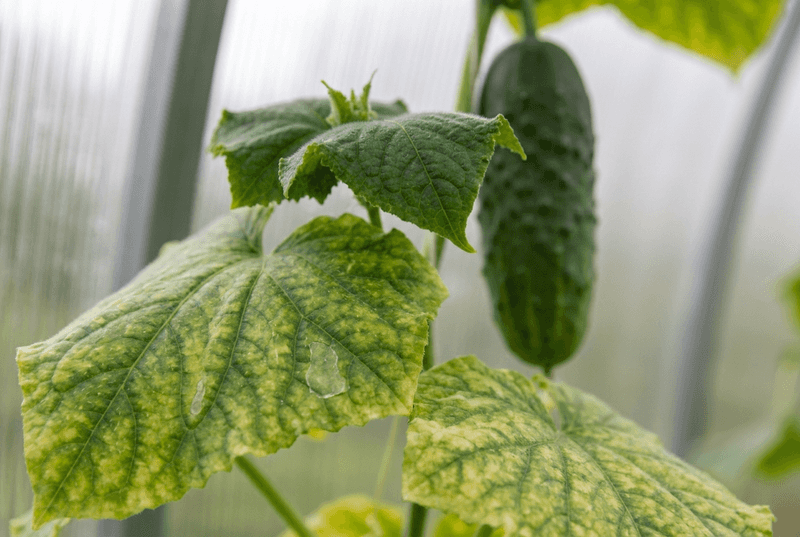
Older leaves at the base of a cucumber plant are the first to show stress for a straightforward reason: they are the most expendable tissue on the vine. When a plant reallocates mobile nutrients like nitrogen and potassium toward younger, more productive growth, the oldest leaves can pale and fade as those nutrients move upward.
Colorado State University Extension’s plant nutrition guidance explains that mobile nutrients are actively moved from older tissue to support new growth, which is why deficiency symptoms tend to appear on older leaves first.
The catch is that mobile nutrient movement is not the only reason lower leaves yellow. Downy mildew, spider mites, waterlogging, drought, root injury, and plain old leaf aging can all concentrate damage on older foliage without any nutrient deficiency being involved.
Heat alone is not a reliable explanation either. According to Virginia Cooperative Extension’s plant problem diagnosis guide, heat and drought injury more commonly appear as wilting, leaf-edge scorch, or symptoms spread across plants in a similar location, rather than as a tidy bottom-up yellowing pattern.
A cucumber with a handful of yellow lower leaves during a late-summer heat wave could be dealing with any of several problems. University of Delaware Cooperative Extension notes that ordinary leaf aging in cucurbits can look similar to mite or disease damage.
The right move is to inspect the pattern carefully before choosing a response.
Compare the yellowing patterns before adding fertilizer
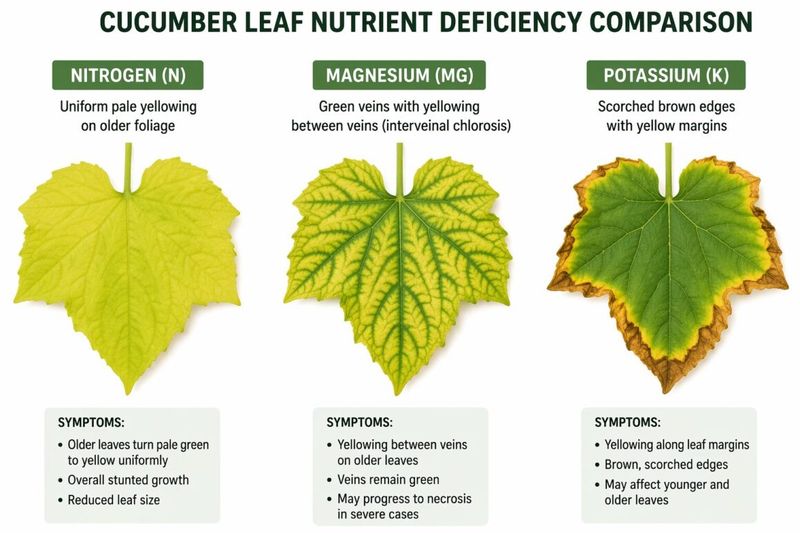
Two nutrient problems show up fairly often on late-summer cucumbers, and they look different enough that comparing the pattern carefully can point you in the right direction. Broadly pale older leaves, where the entire leaf surface loses color uniformly, combined with slowed growth or smaller-than-expected fruit, fits the picture of nitrogen deficiency.
Texas A&M AgriLife’s cucurbit problem-solver describes nitrogen deficiency as producing general yellowing that can progress to browning and leaf death, often accompanied by stunting.
Potassium deficiency tells a different story. The yellowing tends to start along the outer edges of older leaves and then work its way inward between the veins.
As it advances, the leaf margins may turn brown and dry out, producing what looks like edge scorch or dead tissue. Texas A&M AgriLife’s potassium deficiency page and University of Kentucky e-GRO research on potassium deficiency in greenhouse cucumbers both describe this margin-first progression as characteristic of potassium shortage in cucumbers.
Gardeners in Florida and Texas with sandy soils face an added wrinkle: heavy rain or over-irrigation can leach both nitrogen and potassium out of the root zone quickly, as UF/IFAS soil and fertilizer management guidance points out. Even so, neither pattern alone is enough to justify adding fertilizer.
Visual symptoms narrow the list of possibilities; a soil or tissue test is what confirms a deficiency and tells you what, if anything, to apply.
Inspect leaf surfaces for mildew or mites
Whole-leaf color tells part of the story, but the marks on the leaf surface and what you find underneath are what separate the most common late-summer threats from each other. Flip a yellowing leaf over and look closely.
Angular yellow or tan patches that stop sharply at the leaf veins, rather than bleeding across them, are a signature feature of downy mildew. On the underside of those same patches, you may find gray, purple, or fuzzy sporulation.
University of Maryland Extension’s downy mildew guide and UF/IFAS management guidance for cucurbit downy mildew in Florida both identify those angular, vein-bounded lesions as the key distinguishing feature.
Powdery mildew looks completely different. Instead of angular spots, you see white, talc-like patches on the upper or lower leaf surface.
Severely infected leaves can yellow, wither, and drop, but the white coating appears before the yellowing becomes severe. University of Illinois Extension’s powdery mildew resource makes clear that the two mildews are unrelated diseases requiring different management approaches, so treating one as if it were the other wastes time and money.
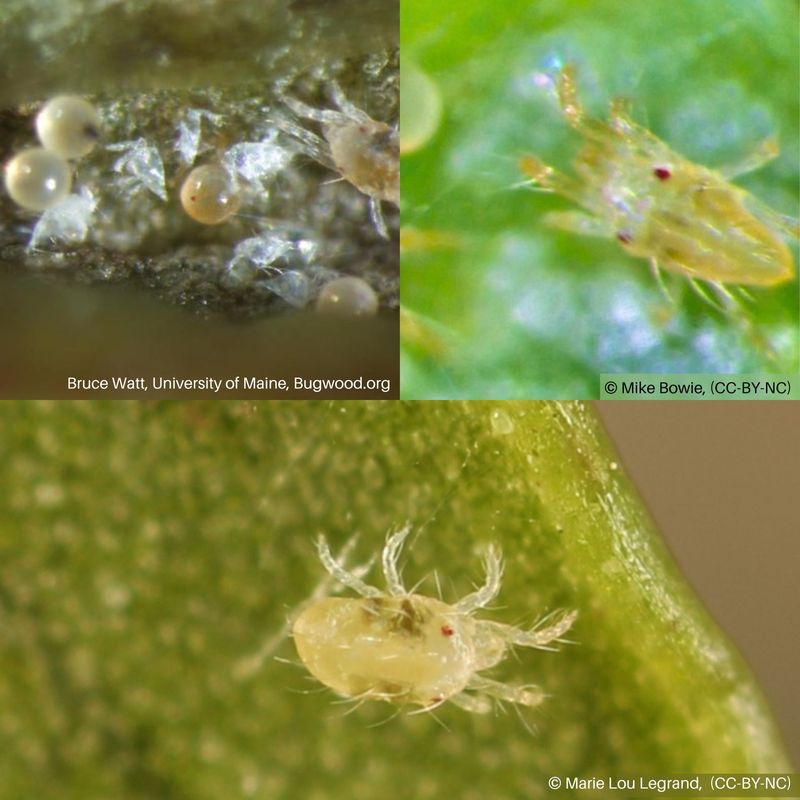
Spider mites produce yet another pattern. Rather than patches or lesions, mite feeding creates fine, widespread stippling, tiny white or yellow dots scattered across the leaf surface.
Heavy infestations can make foliage look dusty or bronzed, and fine webbing may appear on the undersides or between leaves. University of Illinois Extension’s twospotted spider mite guide notes that hot, dry weather strongly favors mite population explosions.
Use a hand lens to inspect leaf undersides before drawing any conclusions, and resist the urge to call every yellow spot mildew.
Adjust watering without assuming the plant needs more
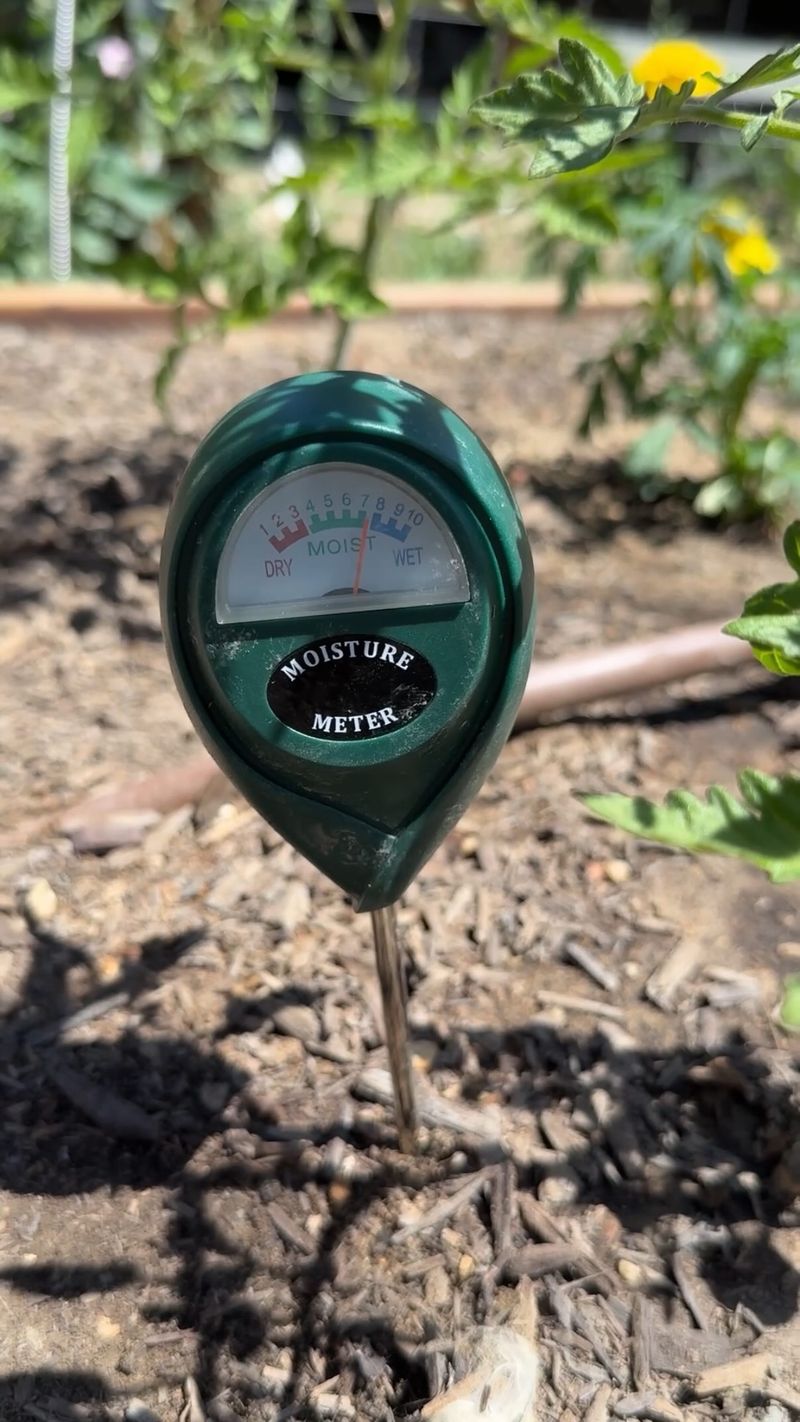
Hot weather does increase how fast cucumbers use water, and dry soil can absolutely cause lower leaves to look stressed. However, the reflex to water more whenever leaves yellow can make things worse if the root zone is already saturated.
Before adjusting your irrigation schedule, push a finger or a screwdriver several inches into the soil near the root zone. Dry and crumbly soil several inches down signals a real moisture deficit; wet and soggy soil at that depth is a warning that the plant may already have too much water sitting around its roots.
University of Minnesota Extension’s cucumber growing guide and Iowa State University Extension’s vegetable garden watering guidance both present roughly 1 inch of water per week from rain and irrigation as a reasonable starting point, not a fixed rule. Sandy soil drains faster and may need more frequent applications.
A large, heavily fruiting plant on a trellis in a Texas or Florida summer wind can pull moisture from the soil far faster than a smaller plant in a sheltered spot.
Slow, deep watering at soil level gives roots time to absorb moisture without leaving foliage wet, which matters because wet leaf surfaces encourage fungal diseases. Drip irrigation and soaker hoses accomplish both goals.
UC IPM’s cultural tips for growing cucumbers recommend keeping foliage dry and improving air circulation to reduce the leaf wetness that promotes disease. A 2-to-3-inch layer of mulch around the base of the plant, kept away from the stem, can slow evaporation and moderate soil temperature.
UF/IFAS vegetable garden watering guidance and Iowa State both note that mulched beds hold moisture longer, which means mulched plants may need less frequent irrigation than unmulched ones in the same conditions.
Inspect the roots when the plant keeps declining
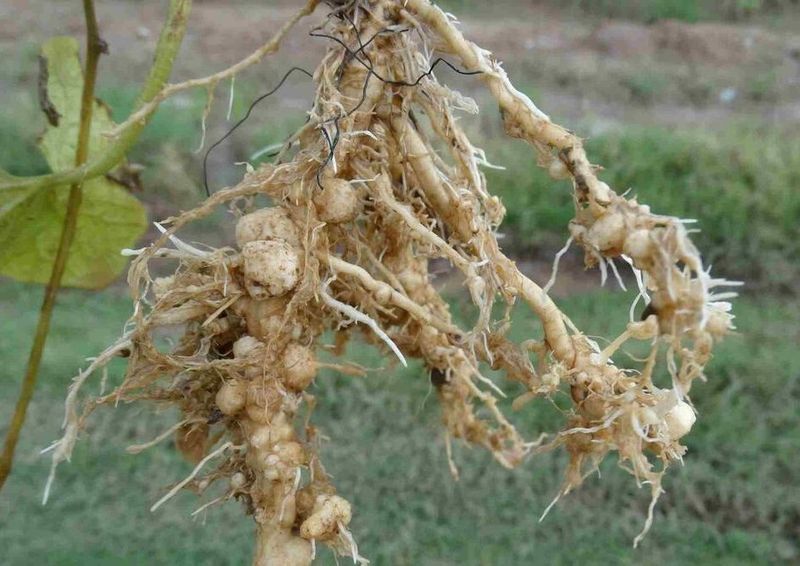
When the soil is consistently moist, the leaves are not showing mildew or mite damage, and the plant still keeps yellowing, wilting, stalling in growth, or producing misshapen fruit, the next logical step is to look below the soil surface. Root damage can produce symptoms that look almost identical to nutrient deficiency or water stress because damaged roots cannot deliver water and nutrients effectively, even when both are present in the soil.
Root-knot nematodes are a particular concern in Florida and other states with warm, sandy soils. These microscopic roundworms infect roots and cause the plant to form characteristic galls or knots along the root system.
UF/IFAS nematode management guidance for cucurbit crops describes how nematode damage can cause yellowing, wilting, stunting, chlorosis, dieback, and fruit malformation, all of which can look like other common problems without a root inspection. Visible galls are a warning sign, but they are not a complete home diagnosis on their own.
Roots can also be damaged by waterlogging, soil compaction, root rots caused by soilborne pathogens, or physical injury from cultivation. Virginia Cooperative Extension’s plant problem diagnosis guide emphasizes that overlapping symptoms require a systematic check of the root zone rather than assuming a single cause.
If you find suspicious galls or severe root deterioration, contact your local Cooperative Extension office about soil and root testing options, which are the appropriate way to confirm nematodes or soilborne pathogens before choosing a management response.
A few old leaves may simply be aging
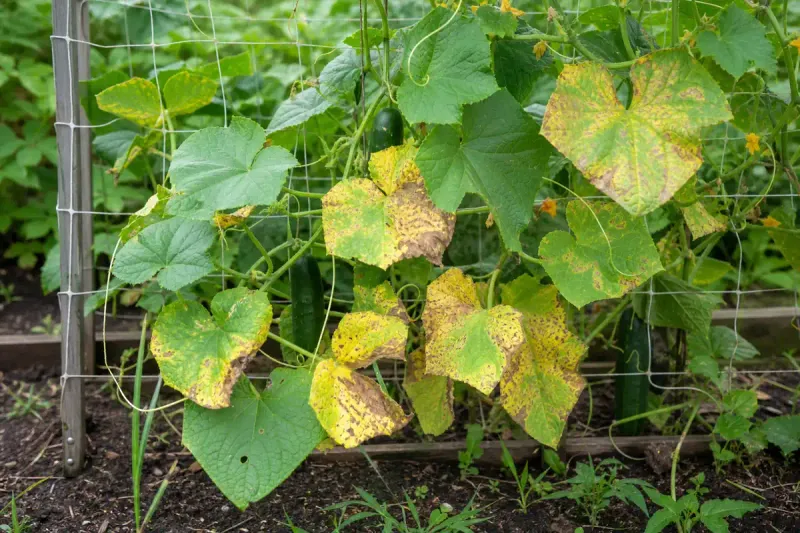
Not every yellow lower leaf signals a crisis. Cucumber plants are vigorous summer vines that set a lot of leaves quickly, and the oldest ones at the base naturally lose their usefulness as the plant matures and the canopy above shades them out.
A brittle, discolored leaf at the very bottom of an otherwise healthy, actively fruiting vine may simply have run its course. University of Delaware Cooperative Extension notes that leaf aging in cucurbits can resemble mite or disease damage closely enough to be misidentified.
Before escalating to a treatment, look at the whole plant. New growth at the tips should be firm and green.
Fruit should be sizing normally. The yellowing should be limited to a few of the oldest leaves rather than spreading steadily up the vine.
University of Delaware’s cucurbit update resource suggests comparing the overall vigor and growth pattern of the plant before deciding whether isolated lower-leaf decline warrants intervention.
Isolated old-leaf decline calls for monitoring and basic sanitation, not an emergency response. Remove leaves that are fully dead or severely discolored, dispose of them away from the garden bed, and keep watching.
If yellowing moves upward, if new leaves begin to pale or spot, if growth slows, or if fruiting drops off, those are the signals that a fuller investigation is needed. Reacting to two or three aging leaves with fertilizer or pesticide can create new problems without solving anything.
Follow an evidence-based rescue sequence
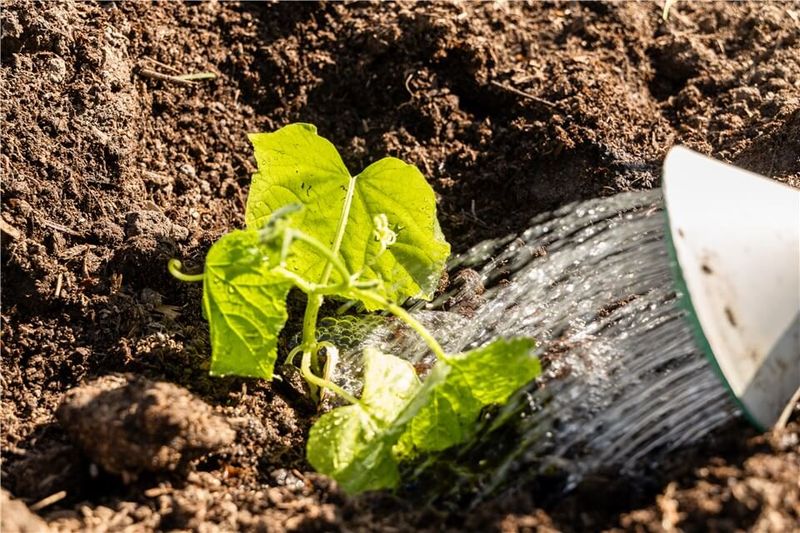
When yellowing is spreading or the plant is clearly struggling, an ordered approach keeps you from making things worse. Start by photographing the affected leaves from above and below in good light, then compare the color, shape, and location of the damage against what you have read here.
Angular vein-bounded lesions, white powder, fine stippling, and uniform paling each point in different directions. University of Maryland Extension’s key to common cucumber problems is a useful reference for matching symptoms to likely causes.
Next, check the soil moisture several inches down and review your watering history. Think back over the past two to three weeks: Has the plant received consistent moisture, or have there been long dry spells followed by heavy watering?
Has it been sitting in soggy soil after heavy rain? Then review your fertilizer history.
If you have not applied any fertilizer since planting and growth has been slow, a nutrient shortfall is plausible. If you fertilized recently, adding more without a soil or tissue test is unlikely to help and could cause salt burn or other damage.
Texas A&M AgriLife and their potassium deficiency guidance both recommend soil or foliar analysis before applying corrective nutrients.
If soil and leaf inspection do not explain the decline, pull back the mulch and inspect the roots as described in the previous section. Remove leaves that are severely diseased or completely dead and dispose of them away from the garden rather than composting them.
Improving plant spacing or adjusting trellising to increase airflow and reduce leaf wetness can also help when disease is suspected, as UC IPM’s downy mildew guidance recommends. Avoid overhead irrigation when disease is present.
And resist automatic pesticide use: any product decision should follow accurate identification of the pest or disease, label review, and attention to pre-harvest intervals. Removing old leaves can improve airflow and sanitation, but it will not correct a nutrient deficiency, root problem, or ongoing watering issue on its own.
Refer to UF/IFAS nematode management guidance if root galls are found.
Use the pattern to decide what to check next
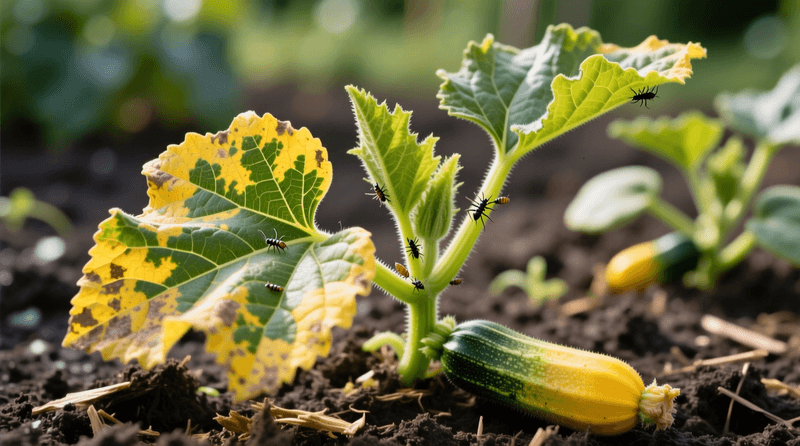
Lower-leaf yellowing on a late-summer cucumber is a starting point for investigation, not a self-contained answer. The color, shape, and location of the damage tell you where to look next: leaf undersides for mildew sporulation or mite webbing, the soil profile for moisture problems, the root zone for galls or rot, and the plant’s overall growth pattern for signs of nutrient shortfall or disease spread.
As Colorado State University Extension and Virginia Cooperative Extension both make clear, plant symptoms require cross-referencing multiple observations before a cause can be named with any confidence.
Match what you find to the descriptions in this guide, consult your local Cooperative Extension office when symptoms are unclear, and use soil or tissue testing before applying any corrective nutrient. University of Maryland Extension’s cucumber problem key is a practical tool for narrowing possibilities by symptom type.
Already-yellowed leaves will not turn green again; the goal is to protect the healthy canopy and new growth still on the vine. A cucumber plant that tells you something is wrong is giving you a chance to act before the problem reaches the fruit.