
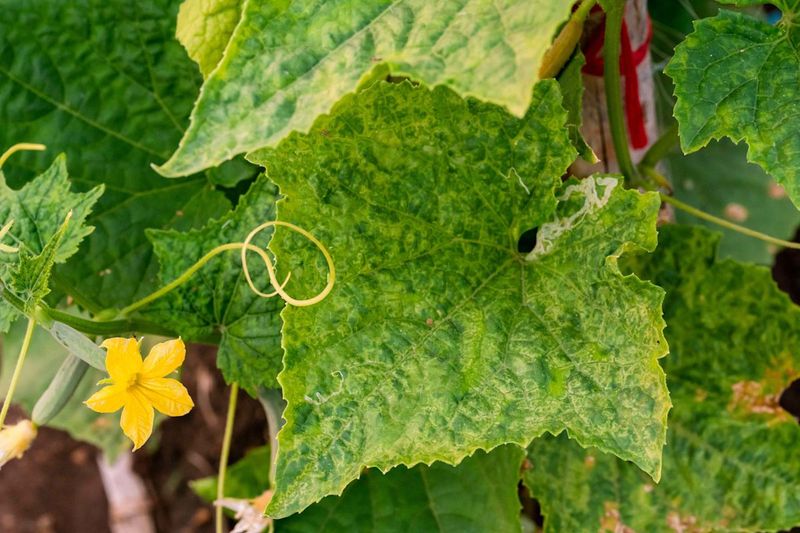
Watching the lower leaves on your cucumber vine turn yellow one by one can feel alarming, especially when the rest of the plant looks perfectly fine. The good news is that this pattern does not automatically signal a dying plant or a serious disease.
Late-summer heat sets the scene, but it does not tell you what is actually causing the color change. Knowing what to look for, and what to rule out, makes all the difference between a quick fix and an unnecessary panic.
Late-summer heat is context, not the diagnosis
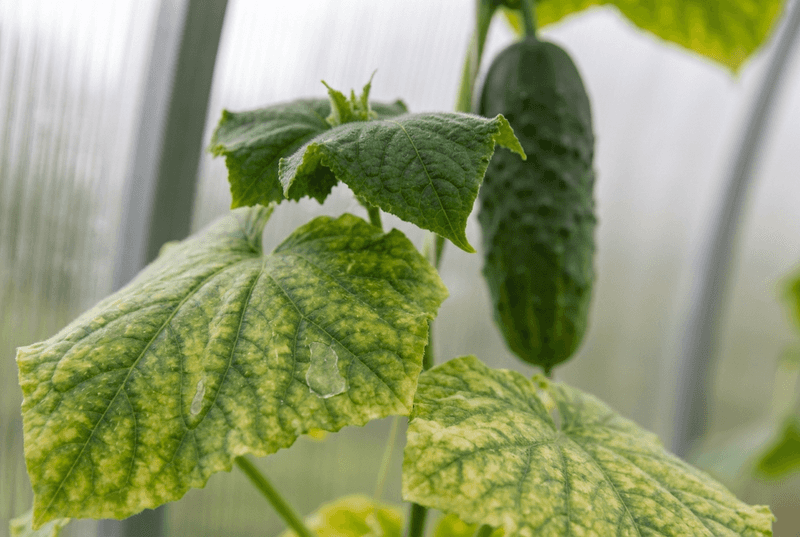
Bottom-up yellowing on a cucumber vine can come from several very different sources: normal leaf aging, inconsistent watering, waterlogged roots, nutrient shortages, spider mites, fungal disease, or bacterial infection. As University of Maryland Extension guidance on yellowing vegetable leaves makes clear, yellowing is a generic symptom rather than a specific diagnosis, and the cause matters enormously for choosing a response.
Late-summer heat does play a role, but only indirectly. High temperatures raise a plant’s water demand and can favor certain pests, yet heat alone does not explain why the lowest leaves are fading.
Colorado State University Extension’s guidance on water and plant growth notes that drought stress, waterlogged soil, and heat can all produce overlapping symptoms, which means treating the season as a diagnosis leads growers in the wrong direction.
The most reassuring version of this pattern looks like this: only the oldest, lowest leaves fade gradually while the growing tips stay green, the vine keeps pushing new growth, and no spots, webbing, wilt, or distortion appear anywhere. That picture points toward natural leaf aging, but it only holds if none of the warning signs described in the sections below are present.
Use the whole plant’s condition as your guide, not just the color of a few leaves near the ground.
Older leaves can fade while a productive vine keeps growing
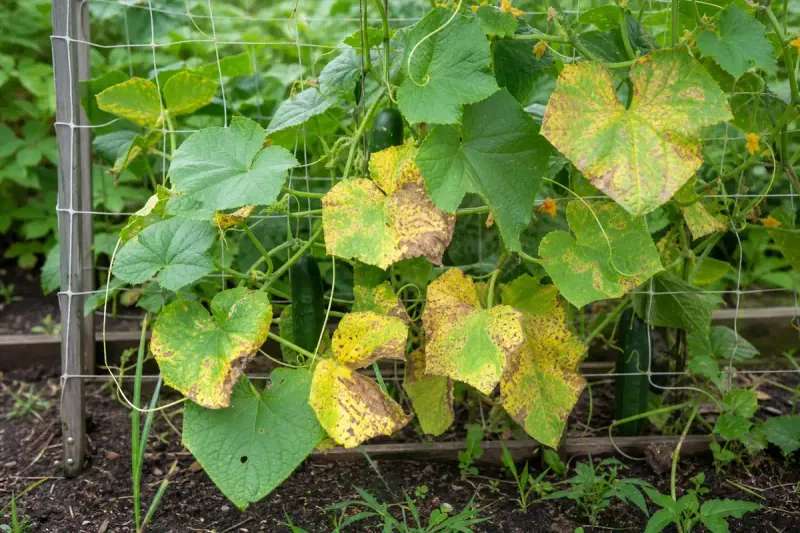
Cucumber plants shed their oldest foliage as they mature, and the leaves most likely to go first are the ones at the very base of the vine, especially those shaded out by newer growth above them. University of Maryland Extension describes this as a normal process in which older lower leaves yellow and decline while the rest of the plant stays healthy and keeps producing.
One or two faded leaves near the ground, on a vine that is actively flowering and setting fruit, fit this picture well.
The key comparison is between what the oldest leaves are doing and what the newest growth is doing. Vigorous green tips, fresh flowers, and developing cucumbers all point toward a plant that is still thriving.
Contrast that with a vine whose yellowing is climbing steadily upward, whose new leaves look pale or distorted, whose growth has slowed noticeably, or whose stems appear to wilt during the day. Those differences matter far more than the number of yellow leaves near the soil.
One caution worth keeping in mind: healthy new growth does not guarantee that every serious problem is off the table. University of Minnesota Extension’s cucumber diagnostic guide notes that some diseases and pests begin in older foliage before spreading.
A single yellow leaf is not proof of disease, but it is a prompt to look more carefully before assuming everything is fine.
Check the root zone before blaming the weather
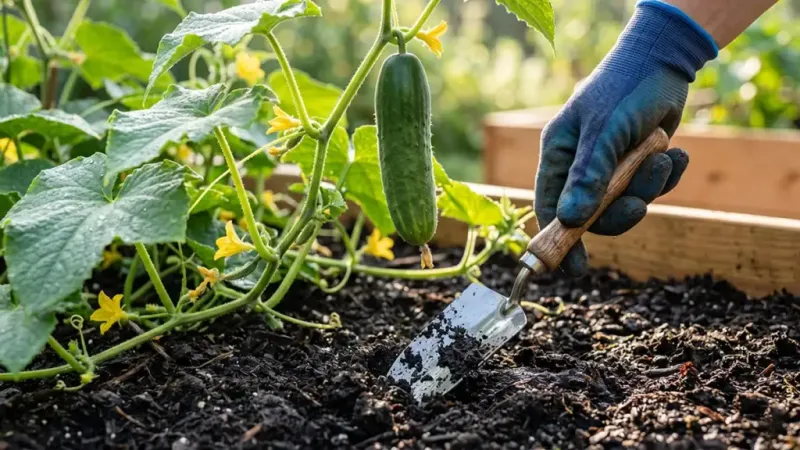
Heat and drought are not the same thing, and treating them as identical leads to watering decisions that can make the problem worse. A stretch of hot days raises the amount of water a cucumber plant needs, but it does not confirm that the soil is actually dry at root depth.
Checking moisture a few inches down with a finger or a trowel gives a far more reliable answer than checking the surface or guessing based on the temperature.
Cucumbers need consistent moisture while they are actively fruiting, and both extremes cause trouble. Colorado State University Extension’s overview of water in plant growth explains that waterlogged or poorly draining soil can impair root function just as effectively as dry soil, sometimes producing yellowing or wilting symptoms that look identical to drought stress.
If water sits around the base of the plant for extended periods, the roots may be struggling even when the soil feels moist.
When the soil genuinely needs water, apply it thoroughly at the root zone and let excess drain away rather than watering shallowly and frequently at the surface. University of Georgia Cooperative Extension’s guide to growing cucumbers recommends organic mulch to help conserve moisture and moderate soil temperature between watering sessions.
Keep mulch pulled back a few inches from the stem so it does not hold moisture directly against the base of the plant, and understand that mulch supports consistent soil conditions rather than curing an existing problem.
Inspect leaf undersides for spider-mite evidence
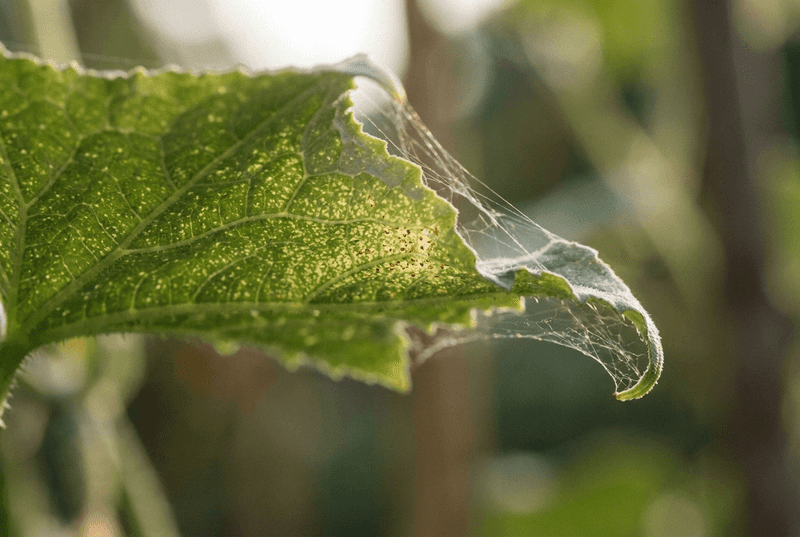
Hot, dry stretches can encourage spider-mite populations to build up faster than usual, but that connection does not mean every yellowing leaf in summer heat has a mite problem. The only reliable way to tell is to look.
Flip the affected leaves over and examine both surfaces carefully, paying attention to the texture of the leaf tissue as well as what is sitting on it.
Spider-mite feeding produces a recognizable set of clues. Fine yellow or white stippling across the leaf surface, a bronzed or dusty appearance, and thin webbing stretched between the leaf and the stem are the signs to look for.
University of Minnesota Extension’s cucumber discoloration diagnostic guide identifies stippling, bronzing, and webbing as distinguishing features of mite activity. Tiny moving specks visible to the naked eye or with a hand lens confirm the pest is present.
These physical clues are what separate mite damage from ordinary leaf aging, not the season or the temperature. Confirm the pest before selecting any control.
If mites are confirmed, use only a product that is labeled for use on cucumbers and specifically for spider mites, follow the directions exactly, and observe any preharvest interval listed on the label. EPA guidance on pesticide label compliance makes clear that the label is a legal document specifying safe and effective use, and no household substitute such as dish soap or vinegar should be assumed to be equivalent or safe for foliage.
Angular spots and progressive wilt require action
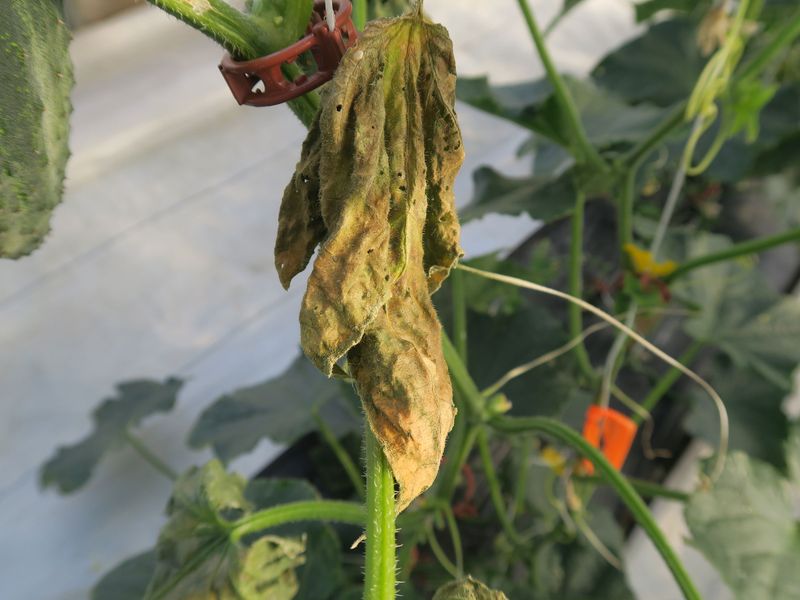
Two disease patterns stand apart from normal aging and deserve immediate attention. The first is downy mildew, which tends to appear as yellow or pale-green angular spots that are bounded by the leaf veins rather than spreading in soft, irregular shapes.
Cornell University’s downy mildew resource for cucurbits describes possible gray or purplish fuzz on the underside of the lesion as a distinguishing characteristic. Downy mildew can spread quickly under favorable humidity and leaf-wetness conditions, defoliate plants, and cut yields significantly even when temperatures are high.
The second pattern is bacterial wilt, which typically begins with a section of the vine looking dull, grayish-green, or slightly limp during the day, sometimes recovering overnight in the early stages. As the disease progresses, yellowing, browning, and eventual collapse follow.
University of Minnesota Extension’s bacterial wilt guide notes that striped or spotted cucumber beetles may be present, since they are a common vector, but their absence does not rule out the disease. Bacterial wilt cannot be treated with pesticides once a plant is infected, and removal of a collapsing or strongly suspected plant may be necessary to limit spread.
Sanitation has a legitimate role in both situations. Removing leaves that are clearly diseased or fully dead reduces the amount of infectious material in the garden.
University of Georgia’s home vegetable garden disease management guide recommends disposing of suspect plant material rather than leaving it beneath the vine. Pruning does not cure an active infection, however, and it will not reverse wilt caused by bacteria, viruses, or root problems already underway.
Do not fertilize until the evidence points to a nutrient problem
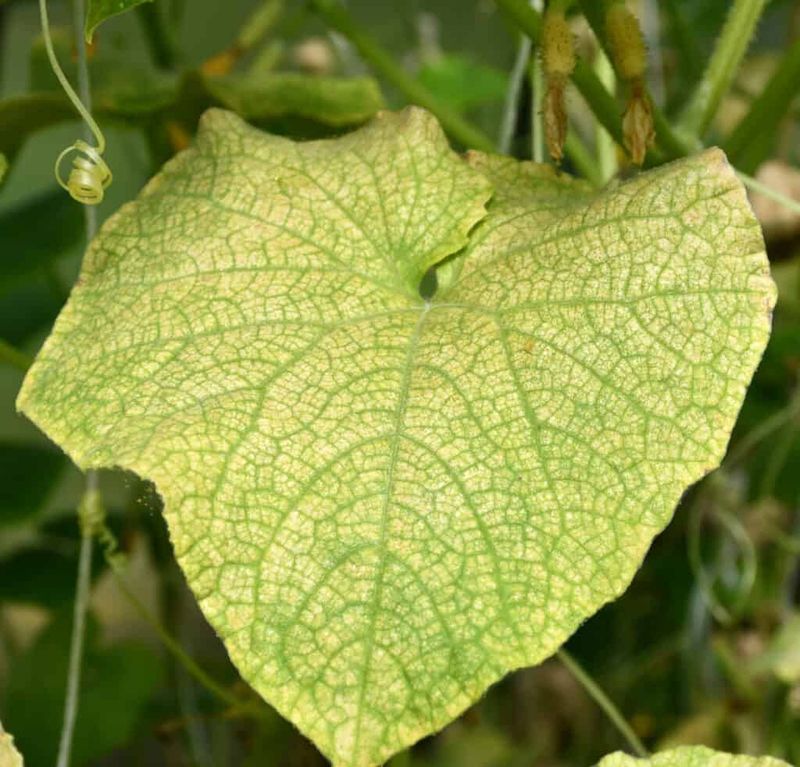
Nitrogen deficiency is one of several things that can cause the older, lower leaves of a cucumber plant to turn uniformly yellow, and it is easy to assume that a bag of fertilizer is the answer. The problem is that water stress, root damage, pest feeding, and normal aging can all produce the same general appearance.
Reaching for fertilizer without confirming the cause risks adding to a problem rather than fixing it.
Nitrogen deficiency tends to show up as a broader, more uniform yellowing across older leaves, sometimes accompanied by noticeably thin stems or a general slowdown in vine growth. A still-productive vine whose only issue is a few fading lower leaves looks quite different from a plant that is visibly running out of fuel.
University of Minnesota Extension’s fertilizing guide cautions that nutrient symptoms overlap with water, root, and disease problems, making a soil test the more reliable path to a real answer.
Excess fertilizer carries its own risks. Adding nitrogen to a vine that does not actually need it can push excessive leafy growth at the expense of fruit production, and it will not correct an underlying watering problem, root issue, or pest infestation.
University of Georgia’s soil testing guide explains how a basic soil test removes the guesswork by showing what the soil actually contains and what, if anything, is missing. Until those results are in hand, adding nutrients based on leaf color alone is more likely to create new imbalances than to solve the existing one.
Use a simple watch-or-intervene checklist
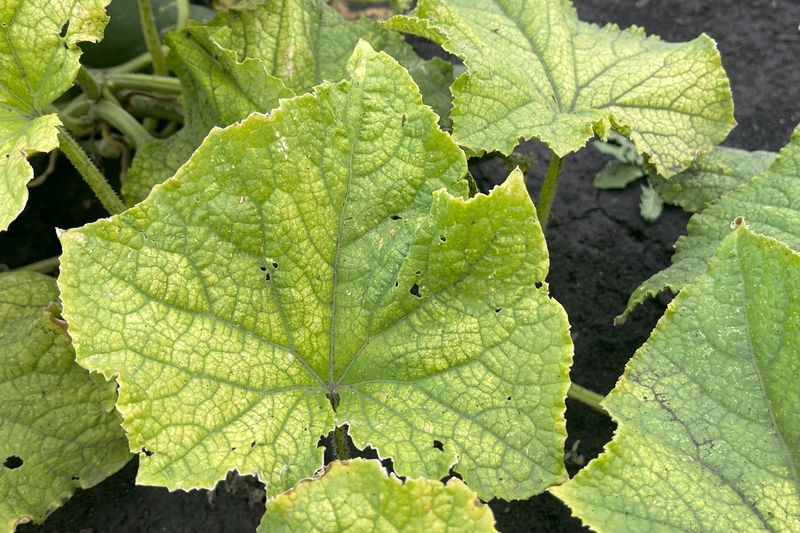
Running through a short inspection takes only a few minutes and gives a much clearer picture than staring at one yellow leaf. Start at the growing tips.
If the newest growth is green, vigorous, and producing flowers or fruit, the vine is not in crisis. Then trace the yellowing: if it is limited to the very oldest leaves at the base and is not climbing upward or jumping to new growth, normal aging remains the most plausible explanation.
University of Maryland Extension supports monitoring a vine in this condition while removing leaves only once they are fully dead.
Next, check the soil a few inches down and evaluate drainage. Water thoroughly if the root zone is dry, and address any standing water or compaction that could be suffocating roots.
University of Georgia Cooperative Extension’s cucumber growing guide recommends consistent moisture at root depth with good drainage as a baseline for healthy production. Then flip the affected leaves over and check for stippling, bronzing, or webbing that would point toward mites, and scan for angular, vein-bounded lesions that suggest downy mildew.
Watch for daytime wilt that does not fully resolve, progressive browning moving up the vine, or the presence of cucumber beetles alongside those symptoms, any of which raises the concern for bacterial wilt. University of Minnesota Extension notes that a collapsing plant with a well-supported bacterial wilt diagnosis may need removal to protect nearby plants.
Remove clearly diseased material for sanitation, as recommended by UGA’s home vegetable garden disease management resource, and if a pest is confirmed and a pesticide is needed, choose only a product labeled for cucumbers and that specific pest, follow the directions, and respect the preharvest interval as required by EPA label compliance standards. A vine that passes every check on this list is almost certainly aging gracefully, not failing.