
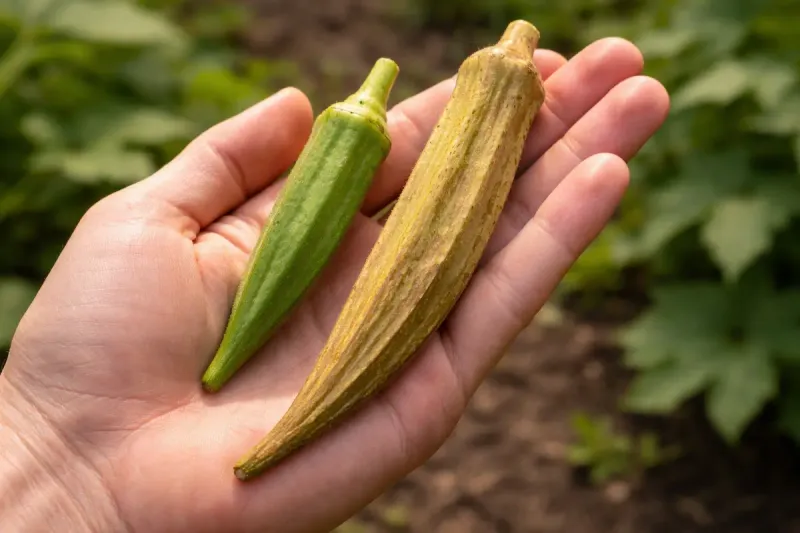
Reach into your okra row on a sweltering August afternoon and you already know the feeling: pods that looked perfect yesterday are stiff, stringy, and impossible to chew today. Texas summers are exactly the climate okra loves, which also means the plants push out new pods at a pace that catches even experienced gardeners off guard. The frustration is real, but the cause is more predictable than it seems, and so is the fix.
Texas heat can make the tender harvest window easy to miss
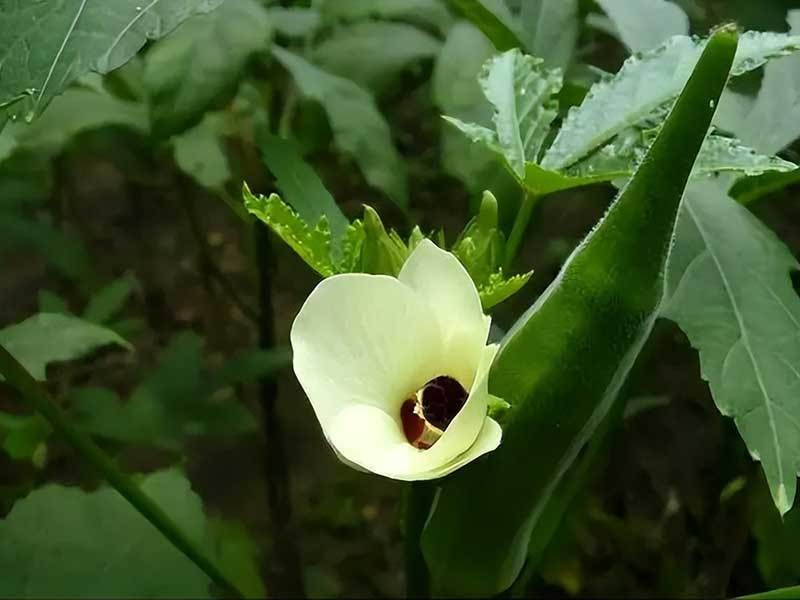
Okra is one of the few vegetables that genuinely thrives when a Texas summer turns brutal. Texas A&M AgriLife Extension notes that okra is a heat-loving, warm-season crop that keeps producing long after other summer vegetables have given up. That tolerance for punishing conditions is a big reason the plant shows up in so many Texas backyard gardens, from the Panhandle down to the Gulf Coast.
What that heat tolerance also means is that pods can develop quickly when temperatures are high. Warm weather accelerates growth throughout the plant, and a pod that is just beginning to swell one morning can be well along by the following afternoon. The window between tender-crisp and fibrous-tough can shrink noticeably during a heat wave, making timing feel more urgent than it does in cooler conditions.
Here is the key correction worth stating plainly: pods become tough primarily because they remain on the plant past tender maturity, not simply because the air temperature is high. Heat can speed up pod growth and compress the time you have to harvest, but triple-digit temperatures alone do not make a young, properly sized pod woody. Texas A&M AgriLife Extension recommends harvesting every one to two days and keeping pods at roughly three to four inches to maintain eating quality.
A missed harvest can certainly let a pod pass from tender to fibrous, especially when August heat is pushing rapid growth. But the evidence does not establish that one skipped inspection usually triggers the whole process or that every pod crosses the quality threshold within a single 24-hour period. The exact timing depends on cultivar, pod size, flowering date, and plant water status, not on heat alone. Managing that window starts with understanding what actually happens inside the pod as it matures.
Pod age drives fiber and hardening
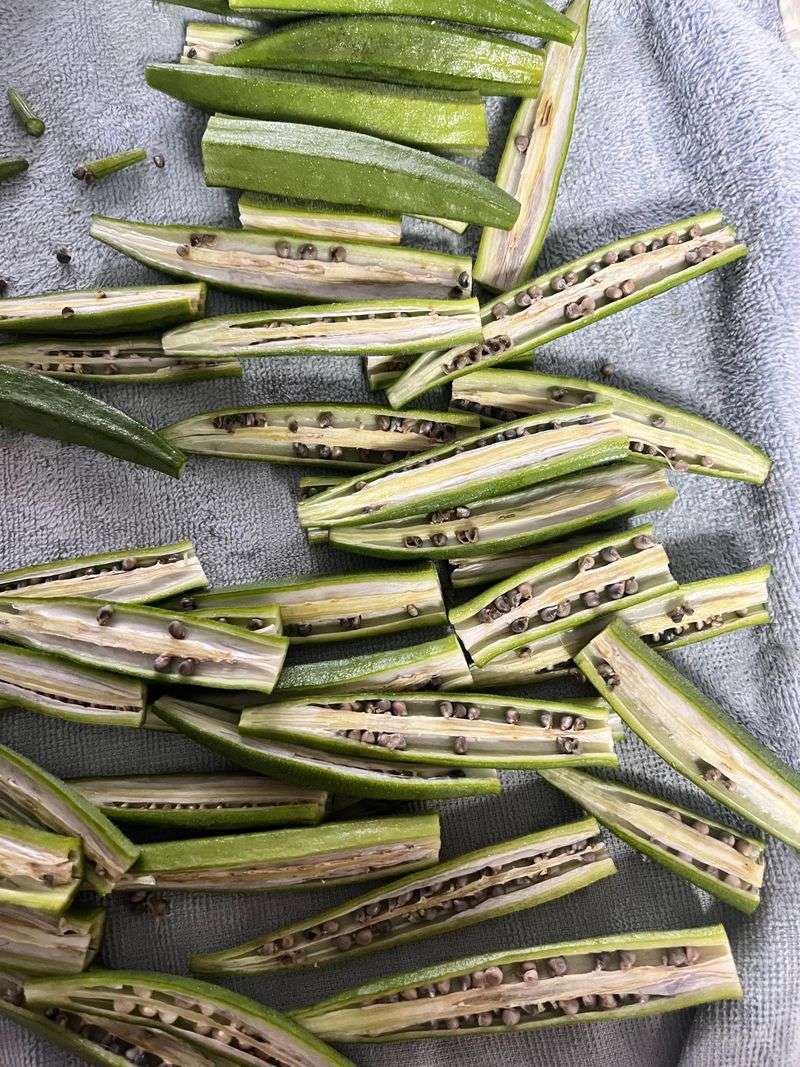
Cut a young okra pod in half and the walls are thin, moist, and almost silky. Cut one that stayed on the plant three or four days too long and the difference is immediate: the walls are thick, the fibers run like cords, and the knife meets real resistance. That texture shift is not a heat injury. It is what happens as the pod matures past its eating window.
Research published in Experimental Agriculture found that increasing pod age after pod set is directly associated with higher crude fiber content and declining eating quality. As a pod ages, structural compounds build up in the pod walls, the seeds harden and enlarge, and the overall texture becomes progressively less suitable for fresh use.
A separate body of research has examined how decreased cellulose-degrading enzyme activity contributes to pod hardening as okra matures. In simple terms, the enzymes that help keep cell walls pliable become less active as the pod ages, allowing structural material to accumulate and the pod to stiffen. This is a biological process driven by maturity, not by outdoor temperature directly.
Temperature and water availability do interact with pod development. Research on temperature and water stress in okra found that high temperatures and drought conditions can affect growth, yield, and quality. What that means practically is that heat may speed the pace at which a pod moves through its developmental stages, compressing the tender window rather than creating fiber independently.
Once a pod has hardened, no amount of extra watering will reverse the fiber. Water stress is a separate variable that can affect overall plant health and pod development, but it is not the same mechanism as maturity-driven toughening. The pod that is already woody will stay woody regardless of how much you irrigate after the fact.
Flowering gives you a useful harvest clock
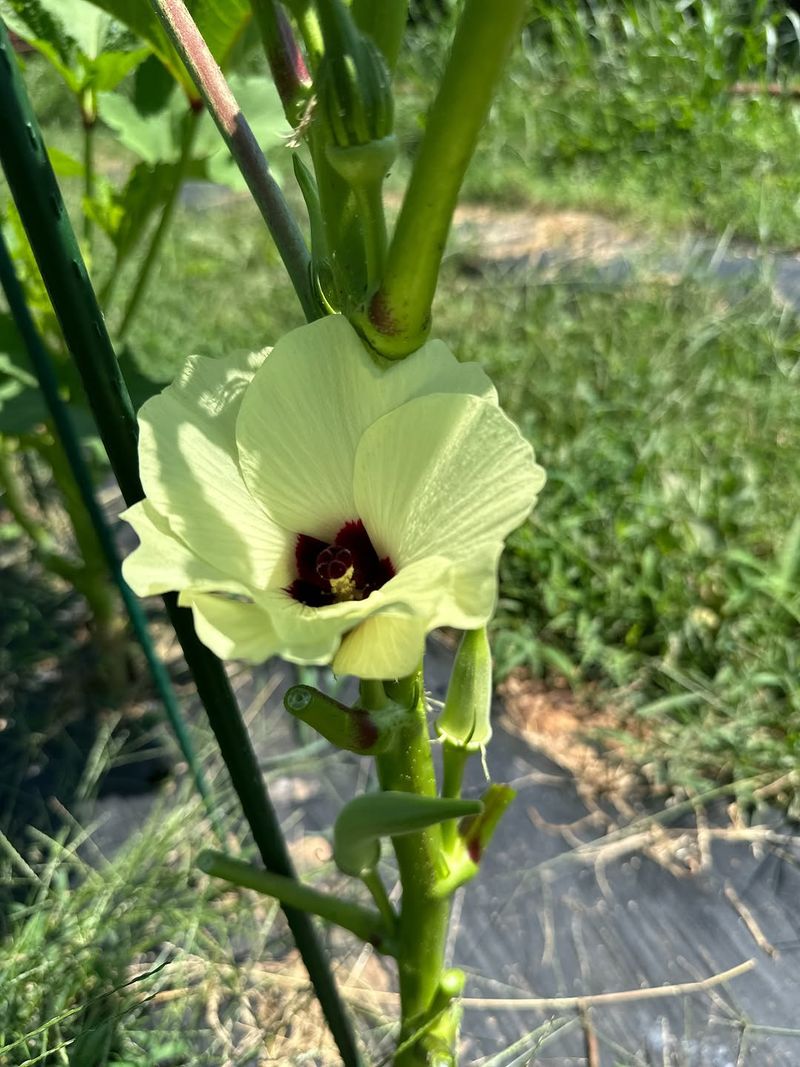
One of the most practical tracking tools available to any okra grower costs nothing and requires no special equipment: pay attention to when the flowers open. Each okra blossom opens for roughly a single day, and the pod that forms in its place begins its growth clock from that moment. Knowing approximately when a flower opened gives you a head start on knowing when the resulting pod will be ready.
Texas A&M AgriLife Extension places tender harvest maturity at about three to four days after flowering for common Texas varieties. Oklahoma State University Extension puts the range at four to six days after flowering, and postharvest research from Osaka Metropolitan University also identifies four to six days after flowering as the optimum maturity window. Taken together, the reasonable working range for most gardeners is approximately three to six days post-flowering, with the exact timing shifting based on cultivar, temperature, and growing conditions.
During a Texas August heat wave, lean toward the shorter end of that range. Warm nights and consistently high daytime temperatures push pod development faster than the same variety would grow in milder weather. A pod that might take five or six days to reach tender maturity in early summer can be ready, and then past ready, in closer to three or four days when the thermometer stays above 100 degrees.
A simple way to use this information is to mark or mentally note which nodes have open flowers on a given morning. Two to three days later, check those specific nodes first. You are not waiting for every pod on the plant to reach the same size at the same time. Individual pods set at different times, so inspecting by flowering date rather than by size alone gives you a more accurate picture of which ones are approaching their peak.
Daily checks during extreme heat are the most reliable way to keep up with this pace. Harvesting at least every one to two days when pods are developing quickly prevents the situation where a pod slides past its tender window between visits.
Use pod size as a guide, not a rigid rule
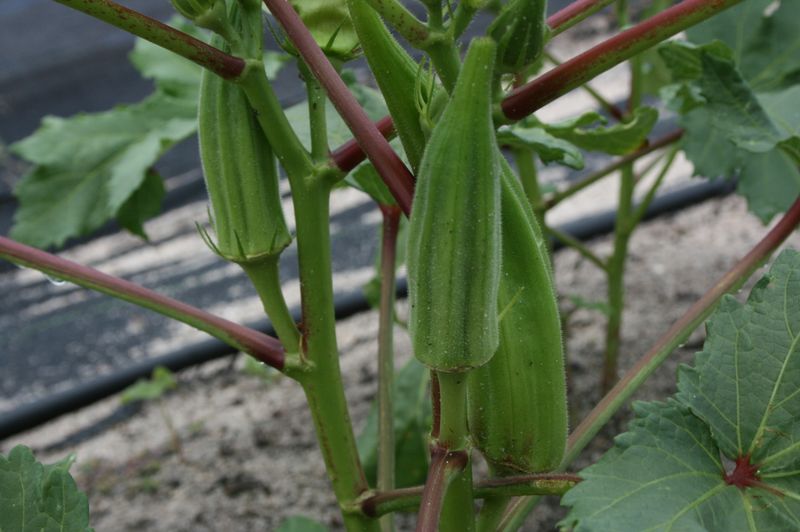
Measuring pods by length is a convenient shortcut, and for most Texas home-garden varieties it works well. Texas A&M AgriLife Extension commonly recommends harvesting at roughly three to four inches for fresh eating, and that range holds up well as a starting point across many standard varieties. When a pod reaches that length and still feels firm but pliable, it is usually in good eating shape.
The problem with treating three to four inches as a universal cutoff is that it was never meant to cover every cultivar. Oklahoma State University Extension notes that some long-podded cultivars remain tender at larger lengths than the standard recommendation. University of Georgia Extension similarly points out that round-podded varieties may stay tender at sizes that would indicate over-maturity in a standard long-podded type. If you are growing a specialty or heirloom variety, the three-to-four-inch rule may send you harvesting too early or cause you to discard pods that are still perfectly good.
Getting to know your specific variety takes a few harvests but pays off quickly. Pick a pod at three inches, cut it open, and note how easily the knife passes through and how the walls feel. Pick another from the same plant at five inches a few days later and compare. You will build a reliable mental picture of where your particular variety holds its quality and where it starts to slide.
For pods that are already suspiciously large or that have been on the plant longer than expected, Texas A&M’s gardening guidance notes that difficulty cutting through a pod with a sharp knife is a reliable sign of toughness and poor eating quality. The knife test takes seconds and removes the guesswork. A pod that your sharpest kitchen knife struggles to slice cleanly is not going to improve on the plate, regardless of how it looks from the outside.
Use size as the first filter, then confirm with feel and, when in doubt, a quick cut test. That combination will serve you better across a season than any single measurement.
Build a frequent August harvest routine
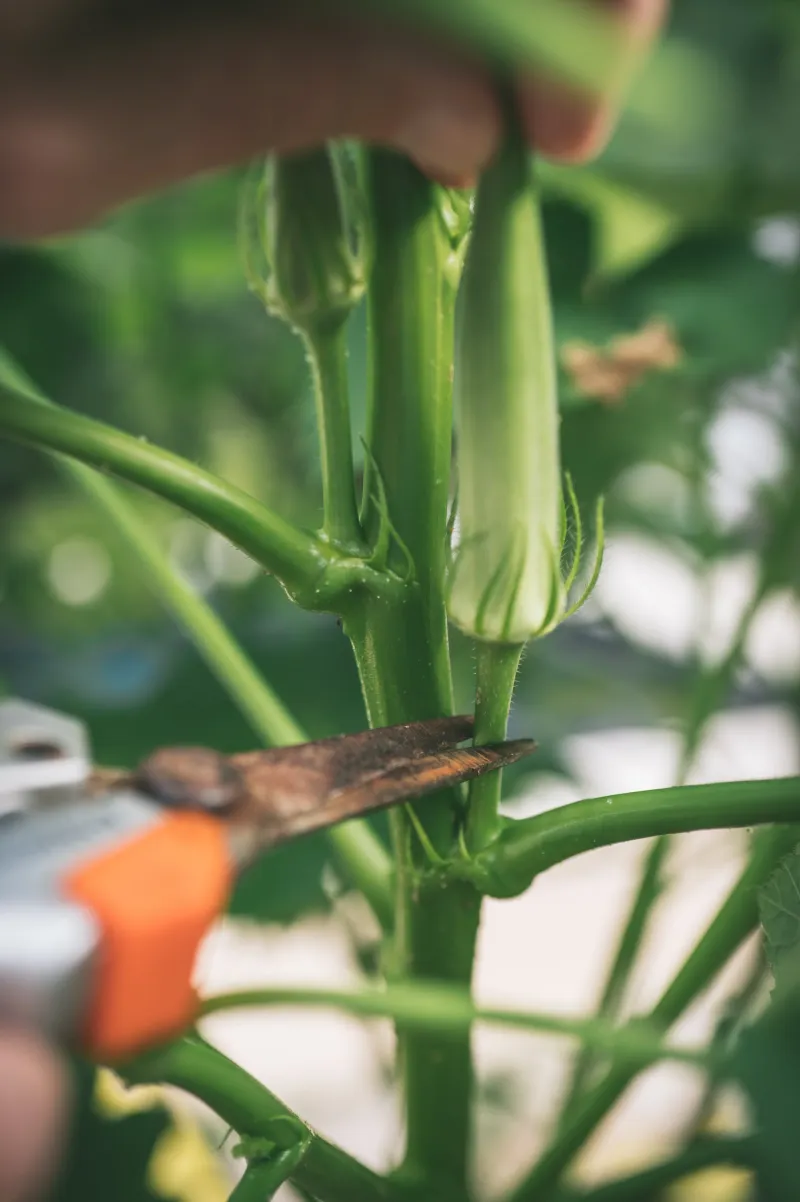
A consistent field routine matters more in August than in any other month. The combination of rapid pod development and relentless heat means that a casual once-a-week check is almost guaranteed to produce a basket full of oversized, fibrous pods. Building a short, repeatable walk-through into your morning schedule is the single most effective thing you can do to protect tender okra through the hottest part of the season.
Texas A&M AgriLife Extension recommends checking plants daily during active production and harvesting at least every one to two days when pods are developing quickly. Oklahoma State University Extension suggests roughly three harvests per week as a baseline, with every-other-day picking sometimes necessary depending on weather and how fast pods are sizing up. During a Texas heat wave with overnight lows still above 80 degrees, lean toward the more frequent end of that range.
When you walk the row, work from the base of each plant upward. Pods set lower on the plant are usually older and need attention first. Inspect each node, note any flowers that opened recently, and cut pods that have reached your target size or that feel firm and properly sized when you bend them gently. A pod at the right stage bends slightly without snapping immediately; one that is already past its prime often feels rigid and woody before you even cut it.
Cutting tools make a real difference. A sharp pair of garden shears or a small harvest knife cuts cleanly through the stem without pulling or twisting the plant, which can stress the node and slow new pod development. Pulling pods by hand risks damaging the stem or the node where the next flower will form.
Okra stems, leaves, and pods are covered with fine hairs or short spines that can irritate sensitive skin. Wearing gloves and a long-sleeved shirt during harvest is a sensible precaution, especially during repeated daily sessions in hot weather.
Harvesting in the morning carries a practical advantage: pods picked before the day’s heat peaks carry less field heat into storage. Morning harvesting does not prevent maturity-related fiber from forming inside a pod that has already aged past its peak, but it does help preserve the quality of tender pods you have correctly timed.
Remove over-mature pods to protect future production
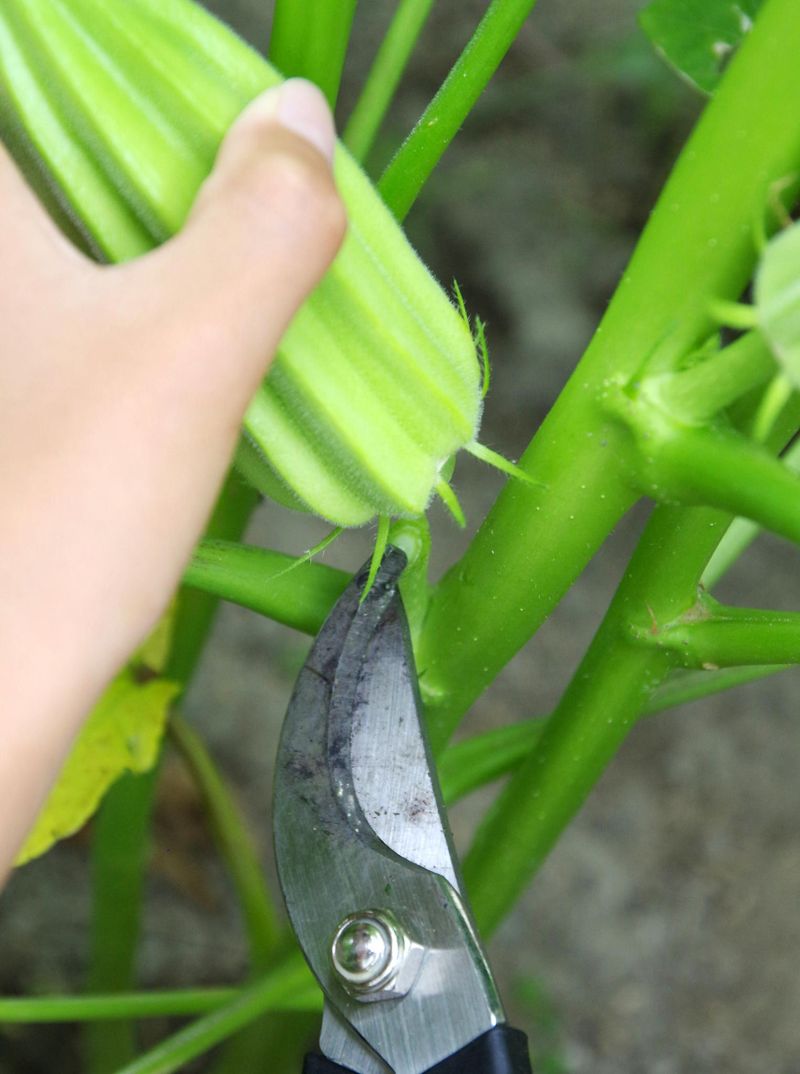
Finding a pod that got away from you is not a reason to feel discouraged. Every gardener who grows okra through a Texas August will miss one eventually. The question is what to do with it, and the answer is straightforward: remove it from the plant.
Texas A&M AgriLife Extension states that yields decrease when pods are not harvested every one to two days, and Oklahoma State University Extension explains that over-mature pods left on the plant can reduce flowering and fruiting. The plant reads a mature, seed-filled pod as a signal that its reproductive work is done, and it responds by slowing down the production of new flowers and pods. Removing that signal keeps the plant focused on generating the next round of growth.
There is no treatment that restores a fibrous pod to tender eating quality. Longer cooking may soften the texture somewhat, but the structural fiber and the hardened seeds remain. If the pod fails the knife test, set it aside rather than adding it to a fresh-eating harvest. Trying to salvage it by cooking it longer is more likely to produce an unpleasant result than a satisfying one.
Over-mature pods do have a legitimate second use: seed saving. An okra pod left intentionally on the plant until it is fully dry, tan, and papery has matured its seeds to the point where they can be saved for next season’s planting. That is a deliberate choice made with a specific pod, not a consolation prize for a missed harvest. If seed saving is your goal, mark those pods early so you do not confuse them with pods you intend to harvest for eating.
Removing tough pods promptly, even if you cannot use them, keeps the plant productive and gives you more tender pods to work with through the remainder of August and into early fall.
Store harvested okra carefully
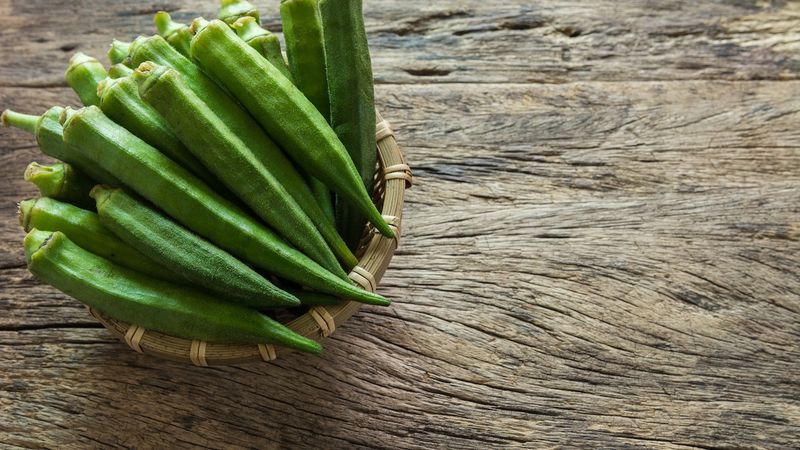
Getting the timing right in the garden means little if the pods deteriorate before you use them. Proper storage after harvest protects the quality you worked to preserve, though no storage method can undo maturity-related toughness that was already present when you picked the pod.
UC Davis Postharvest Research and Extension Center recommends storing okra at approximately 45 to 50 degrees Fahrenheit with very high relative humidity for best postharvest quality. The UC Davis guidance also warns that temperatures below that range can cause chilling injury, producing discoloration, surface pitting, and accelerated decay. Many household refrigerators run colder than 45 degrees, particularly in the back or in the coldest crisper settings, which means storing okra in the most frigid spot available can actually shorten its usable life rather than extend it.
Texas A&M AgriLife Extension suggests a shorter home-storage estimate of about three to five days in the refrigerator under ordinary conditions. That practical guidance acknowledges that home refrigerators are not precision-controlled postharvest environments. For most Texas gardeners harvesting small batches frequently, using okra within two to three days of picking and keeping it toward the warmer end of the refrigerator is a reasonable approach.
Before cooking or eating, wash fresh okra under cool running water. USDA Food Safety and Inspection Service guidance is clear that produce should never be washed with soap, detergent, or any commercial produce wash. Running water and light rubbing are sufficient to remove surface dirt and residue. Once okra has been cut, refrigerate it promptly rather than leaving it at room temperature, where bacterial growth accelerates quickly in summer heat.
Storing okra dry rather than wet also helps. Pat pods dry after rinsing if you wash them before refrigerating, or wait and rinse right before use. Excess moisture in the bag or container speeds surface decay and can make the pods slimy faster than they would otherwise become.
Prevent tough pods with faster inspections, not rescue treatments
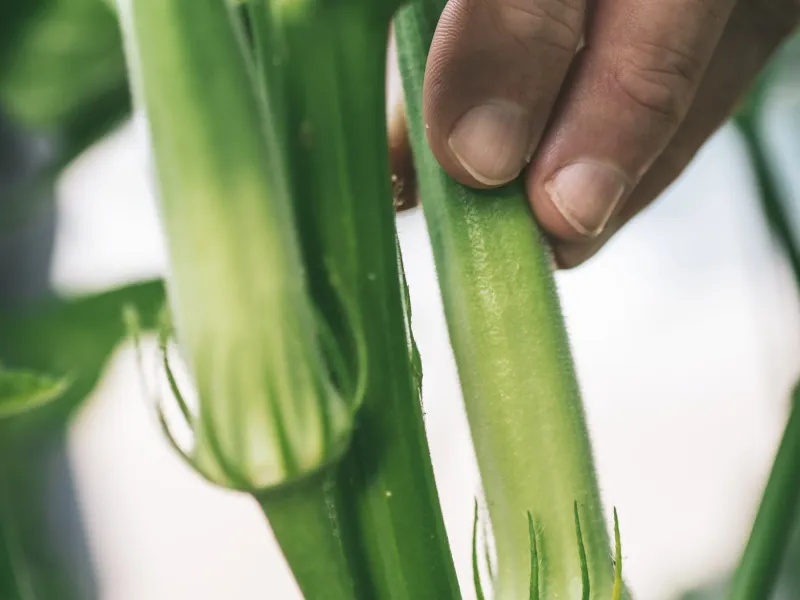
The clearest takeaway from a season of growing okra through Texas August heat is that prevention beats any attempt at rescue. Once fiber has built up inside a pod wall, nothing in the garden or the kitchen reverses it. The only reliable strategy is catching pods before that point.
Check your plants daily during extreme heat, and plan to harvest tender pods at least every one to two days when growth is rapid. Use flowering date and pod size together as your guide, remembering that Texas A&M AgriLife recommends roughly three to four inches as a starting point for standard varieties, while Oklahoma State notes that long-podded and round-podded types can remain tender at larger sizes. Remove any pods that have already hardened so the plant keeps producing new flowers.
Heat does compress the tender window and can make a missed inspection costly, but the evidence does not support the idea that one skipped harvest always starts the toughening process or that every pod transforms overnight. Consistent attention to your plants, matched to the pace of an August Texas garden, is what keeps the harvest tender all the way to the end of the season.