
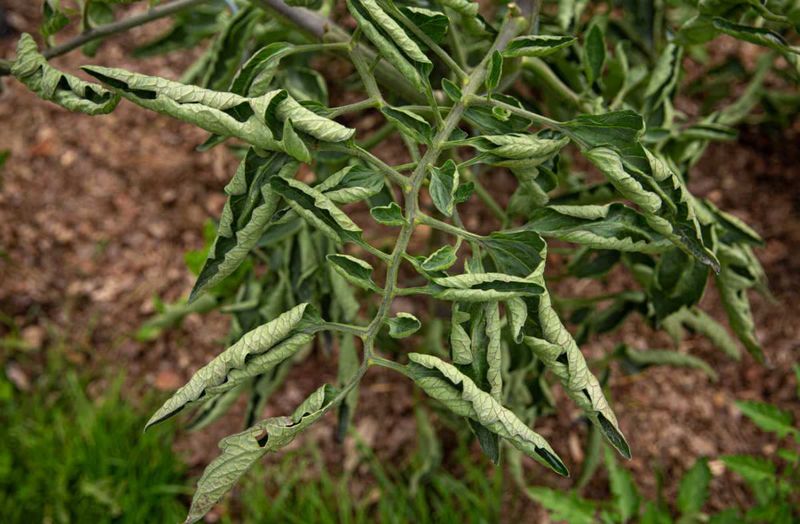
Walking out to your tomato plants on a hot August morning and finding the leaves rolled tight like little cigars is genuinely alarming. Before you assume the worst, though, most late-summer leaf curl on otherwise healthy-looking tomatoes turns out to be a noninfectious stress response rather than a disease. Understanding what you are actually seeing, and what to check first, can save you a lot of worry and help you make the right call for your plants.
Upward curl can signal heat stress, but the symptom is not diagnostic
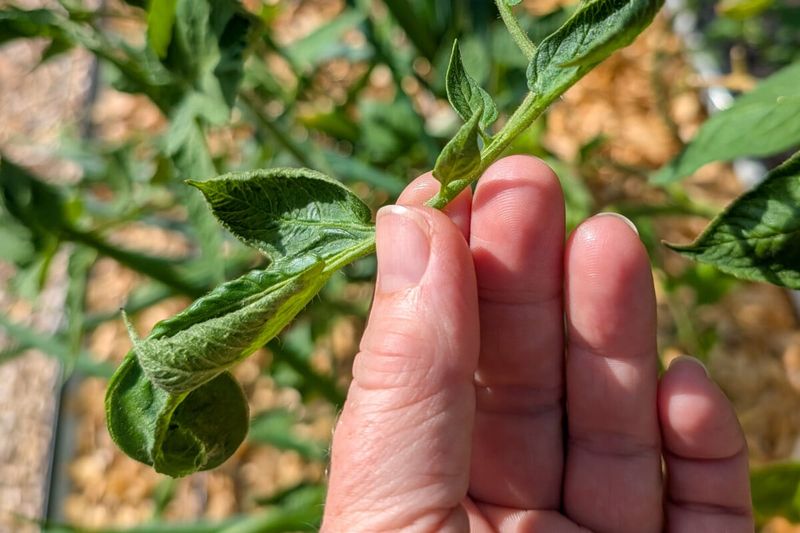
Hot-weather leaf curl on tomatoes tends to send gardeners straight to the worst-case scenario, but the angle of a leaf alone cannot tell you what is causing the problem. What you are likely seeing is physiological leaf roll, a noninfectious response that tomatoes can show when heat, drought, wind, rapid growth, or several other stresses push the plant to conserve moisture. UC IPM guidance on physiological leaf roll describes this as a common, typically harmless condition, not a disease.
The pattern that fits physiological leaf roll most closely is curling that begins on the lower or older leaves, with affected leaves staying green, firm, thickened, or leathery rather than turning yellow or spotted. The plant continues to grow and set fruit. If that description matches what you are seeing, the picture is more reassuring than alarming, though you should still check the whole plant before drawing conclusions.
Look at the newest leaves near the top of the plant. University of Minnesota’s tomato leaf curl diagnostic tool and UMN’s overview of tomato disorders both point out that small, crumpled, or discolored new growth, along with stunting, mottling, purple veins, or abnormal fruit, shifts the picture toward disease or herbicide injury. Watering is one possible contributor to stress-related curl, but heat, wind, root disturbance, pruning, and other factors can all play a role too.
Several stresses can contribute to physiological leaf roll
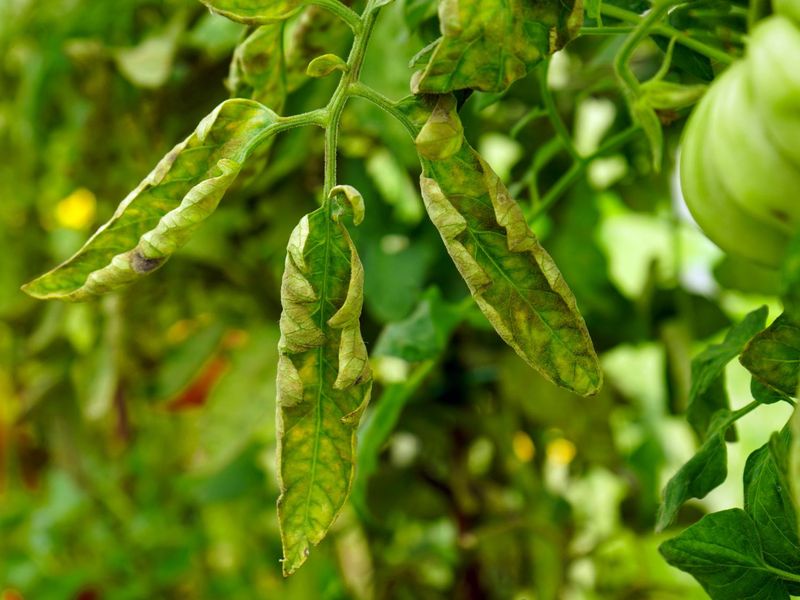
Shallow or inconsistent watering can leave a tomato more vulnerable during a heat spell, but it is far from the only path to rolled leaves. Oregon State University’s extension publication on physiological leaf roll lists heat, drought, wind, rapid vegetative growth, and pruning as recognized contributors, while also noting that excess soil moisture combined with high temperatures can trigger the same response.
Root disturbance from transplanting, cultivation too close to the stem, or physical damage can reduce a plant’s ability to move water efficiently, leading to upward curl as the leaves try to limit moisture loss. High nitrogen fertilization encourages fast, leafy growth that outpaces the root system’s water delivery, which can produce similar results. Washington State University’s guide to physiological leaf roll confirms that cultivar susceptibility also matters, so some varieties simply roll more readily than others under the same conditions.
Ask Extension’s compiled guidance on tomato leaf curl reinforces that transplant shock and root stress are common triggers as well. The practical takeaway is to think about recent conditions across the board rather than pinning the problem on a single watering mistake. Ask yourself whether you recently pruned heavily, disturbed roots, applied fertilizer, or experienced unusual wind before assuming the irrigation schedule is the sole culprit.
Check root-zone moisture before adding more water
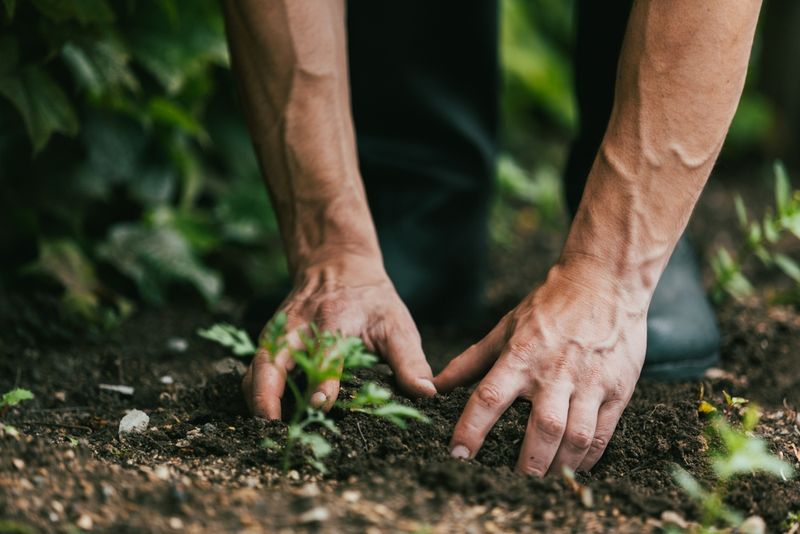
Reaching for the hose the moment you spot curled leaves can make things worse if the soil is already wet. Before watering, push your finger or a trowel about one to two inches into the soil near the plant. If the surface feels dry, that is a signal to keep going deeper. Oregon State University’s extreme-heat plant care guidance recommends checking whether previous irrigation actually reached the root zone rather than just wetting the top layer.
University of Minnesota’s tomato growing guide suggests verifying how far water penetrates after each irrigation, since a brief surface watering can leave the root zone several inches below completely dry. The goal is to confirm that moisture is present several inches down where the roots are actively feeding, not just at the surface where it evaporates quickly.
Soil that feels wet or cool several inches down tells a different story. In that situation, adding more water can deprive roots of oxygen and compound the stress you are trying to fix. Poor drainage, heavy clay soil, or containers without adequate holes can all keep roots saturated longer than expected. Base the next watering decision on what you find in the soil, not on the calendar, the temperature, or the appearance of the leaves alone.
Irrigate deeply while adapting to soil and drainage
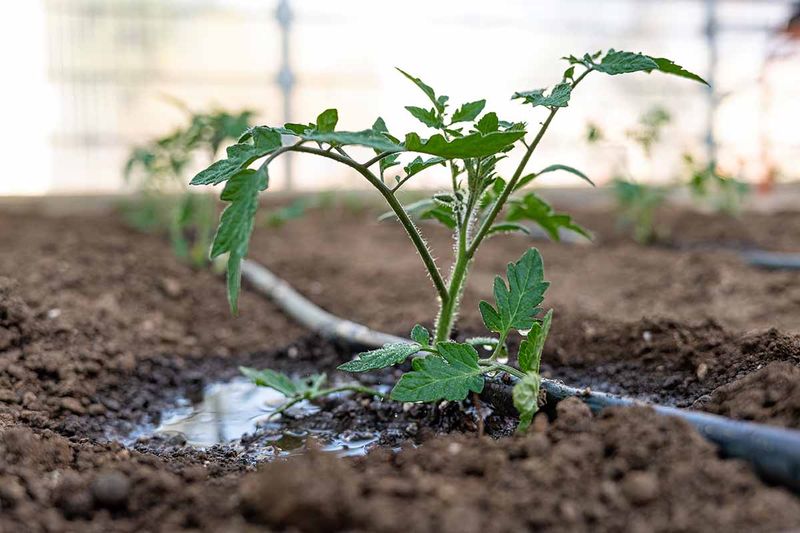
When the root zone is genuinely dry, the correction is to water slowly and thoroughly enough to wet the soil several inches deep, then let the soil partially dry before repeating. UMN’s tomato growing guide uses roughly one inch of rainfall or irrigation per week as a general benchmark, while noting that sandy soils may need more frequent attention because they drain quickly and hold less moisture between waterings.
That one-inch figure is a starting point, not a fixed rule. UMN’s hot-weather gardening guide and Oregon State’s growing-your-own vegetable guide both recognize that containers, large established plants, strong wind, and extended heat waves can push watering needs well beyond that amount. During extreme heat, daily or every-other-day watering may be appropriate for some plants, but checking the soil before each application prevents you from overwatering.
Heavy or poorly drained soil requires a slower delivery rate and longer intervals so the root zone does not stay waterlogged. Applying water at the soil surface, rather than overhead, reduces evaporation and keeps foliage drier, which limits some disease risks. Morning is generally the preferred time for irrigation, but OSU’s extreme-heat guidance advises watering a visibly wilted plant as soon as reasonably possible rather than waiting for the next morning window. A plant stressed to the point of wilting needs water now, not at a scheduled time.
Mulch and careful timing can limit further heat stress
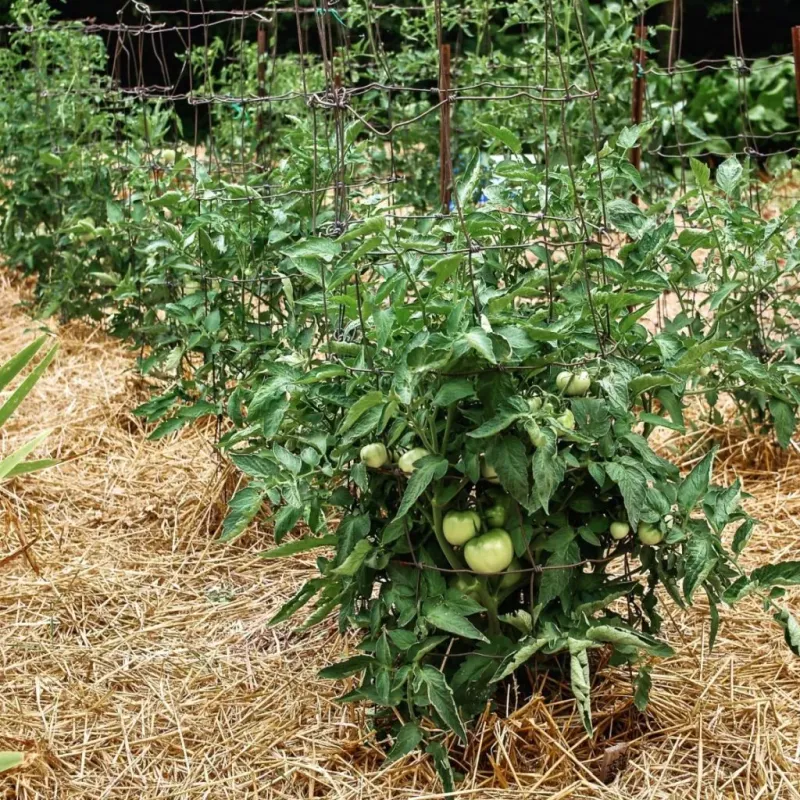
A two-to-three-inch layer of straw, wood chips, or shredded leaves spread around the plant can make a real difference during a heat spell. Mulch slows evaporation from the soil surface and moderates soil temperature, giving roots a more stable environment. OSU’s heat-wave garden guide recommends mulching as a practical protective step, and UMN’s watering tips for fruit crops support the same practice. Keep the mulch a few inches away from the stem to avoid trapping moisture against the base of the plant.
Timing matters for other tasks, too. Pruning removes leaf area that the plant uses for cooling and energy production, so postponing heavy pruning during a heat wave reduces additional stress. The same applies to cultivating close to the stem, which can nick roots and interrupt water uptake at exactly the wrong moment. OSU’s physiological leaf roll publication notes that avoiding these disturbances during stress periods is a reasonable precaution.
Strong nitrogen fertilizer pushes rapid new growth, which can outpace water delivery and contribute to leaf roll, so hold off on feeding until the heat breaks. Drip or soaker irrigation delivers water efficiently at soil level, as noted in OSU’s tomato and tomatillo growing guide. Skip foliar sprays, neem oil, and general chemical treatments during high temperatures; they do not address physiological leaf roll and can injure heat-stressed foliage.
Escalate when new growth or fruit shows warning signs
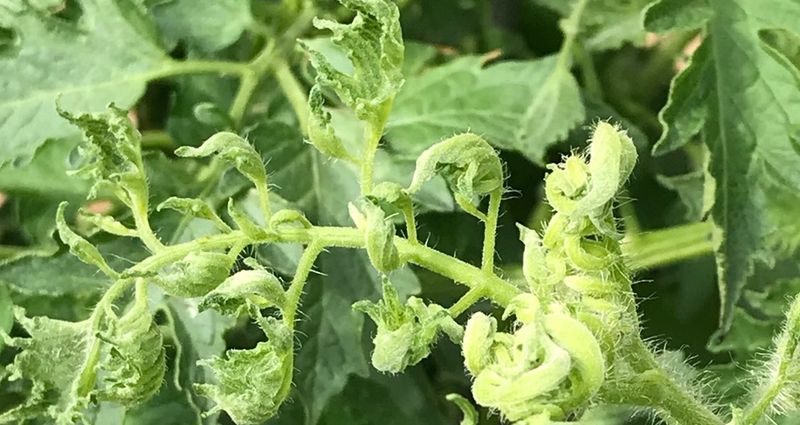
Rolled lower leaves on an otherwise vigorous plant call for monitoring. A different set of symptoms calls for action. Stunting, small or crumpled new leaves, yellowing, mottling, purple veins, necrotic patches, flower drop, abnormal fruit, or a plant that keeps declining despite corrected watering all point toward something that moisture management alone cannot fix. UMN’s tomato virus guide notes that leaf curl cannot reliably identify a virus on its own; laboratory testing is the only way to confirm a viral diagnosis.
Two viruses are worth knowing by name. Tomato yellow leaf curl virus, spread by certain whiteflies, produces strongly crumpled small leaves, upward curl, yellow leaf margins or interveinal yellowing, shortened stem segments, and severe yield loss. Beet curly top virus, transmitted by beet leafhoppers and particularly common in parts of the western United States, causes stunting, leathery leaves, purple veins, downward-curving leaf stalks, premature fruit ripening, and a failure to recover as conditions improve. Neither responds to changes in your watering schedule.
Herbicide injury can look surprisingly similar to virus damage. Twisted or cupped new growth, narrow leaves with prominent veins, brittle or distorted stems, and malformed fruit – especially when symptoms are concentrated near a treated lawn or where grass-clipping mulch was used – should prompt questions about chemical exposure. UMN’s tomato disorders overview and the UMN diagnostic tool for curled tomato leaves both cover herbicide injury as a distinct possibility. University of Arizona’s tomato challenges publication reinforces that a severely declining plant with disease-specific signs should be submitted to a local extension diagnostic service rather than kept in the garden while you wait for improvement.
Judge recovery by healthy new growth, not a perfect old leaf
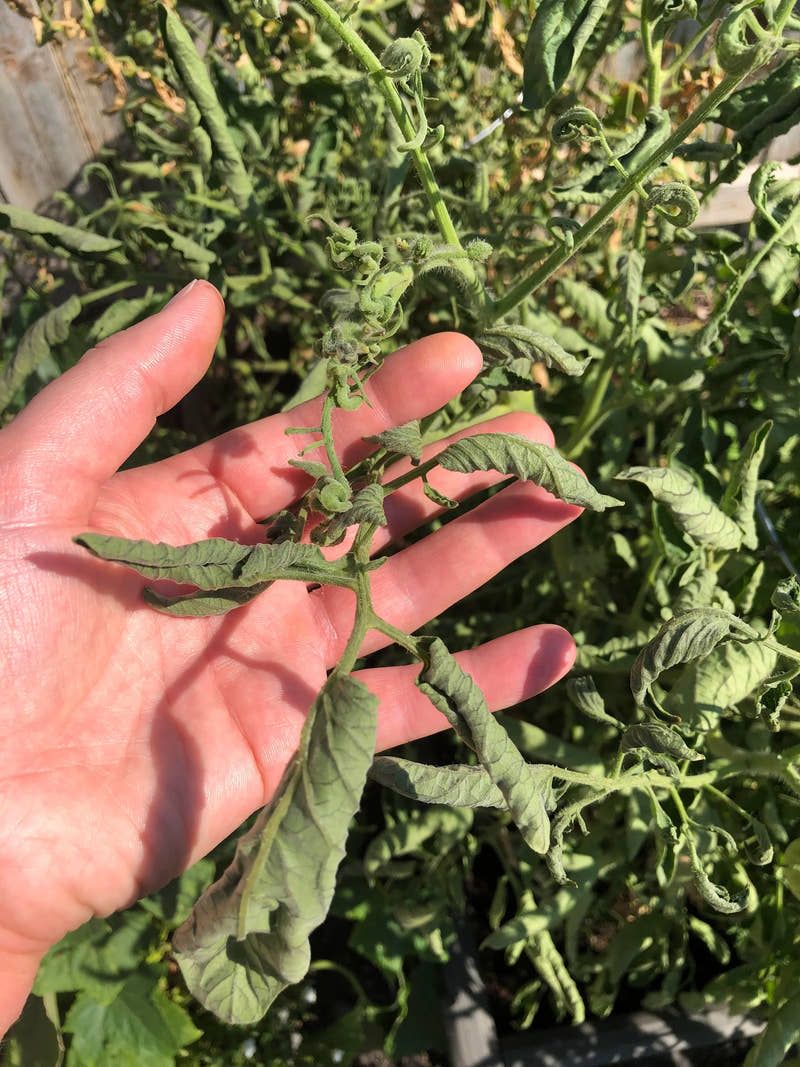
Mild physiological leaf roll that fits the expected pattern, green firm lower leaves, continued fruiting, no stunting or discoloration, generally calls for observation and stress reduction rather than a product or a cure. UC IPM’s guidance on physiological leaf roll states that no action is needed when the condition is clearly noninfectious and nondamaging. Maintain appropriate root-zone moisture, keep mulch in place, and hold off on pruning and fertilizing until conditions ease.
Watch the newest leaves at the top of the plant rather than waiting for the rolled ones lower down to straighten. UMN’s tomato disorders resource notes that individual affected leaves may stay curled even after weather cools and moisture returns, while USU’s vegetable IPM advisory supports the same cautious framing. Healthy new growth, continued flowering, and normal fruit development are the signals that tell you the plant has turned a corner.
If new leaves come in crumpled, discolored, or abnormally small, or if the plant keeps losing ground despite corrected watering and reduced stress, do not keep waiting. Contact your local cooperative extension office or a plant diagnostic lab for help. A plant that recovers teaches you something useful; a plant that keeps declining despite good care deserves a real diagnosis.