
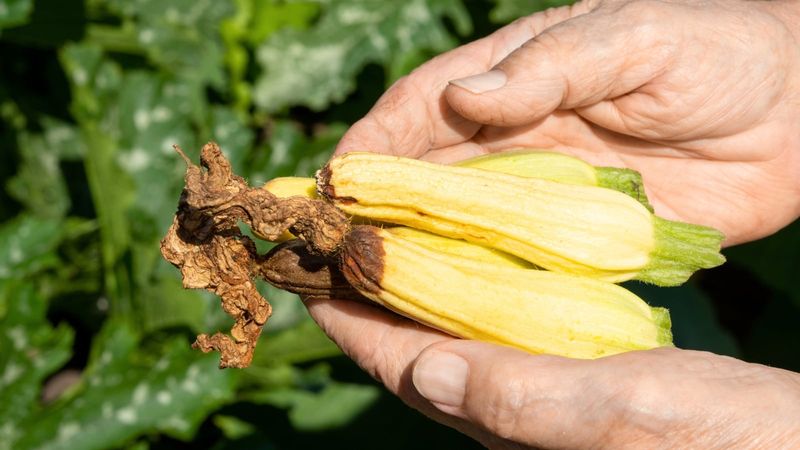
Watching tiny zucchini shrivel and rot before they ever get going is one of summer’s most frustrating garden failures, especially when the plant itself looks perfectly fine. The good news is that most cases point to a handful of diagnosable problems, and knowing which one you are dealing with makes a real difference in how you respond. Before you add anything to the soil or spray anything on the leaves, take a close look at exactly where and how that baby fruit is failing.
Start with the fruit, not the size of the plant
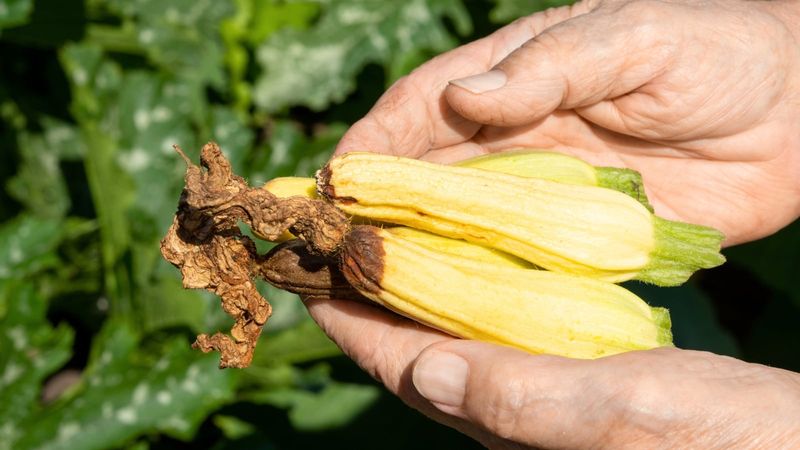
A big, lush zucchini plant can fool you. All those broad leaves and sprawling vines suggest everything is working, but vigorous foliage and successful fruit development are two separate things. A plant can push out impressive canopy growth while its developing fruit quietly fails for reasons that have nothing to do with overall plant health.
The most useful first step is to pick up the failed fruit and look at the end opposite the stem, where the blossom was attached. Utah State University Extension describes blossom-end rot as beginning at that flower end, often starting as a water-soaked or tan spot before becoming sunken, dark, leathery, and sometimes secondarily infected by fungi or bacteria. That specific pattern is a meaningful diagnostic clue.
Contrast that with a different scenario: a tiny zucchini that turns yellow, stays mostly firm, and simply drops without any dark or sunken area at the tip. University of Minnesota Extension notes that poor pollination can cause fruit to abort or fail to enlarge normally, which looks very different from a blossom-end lesion. These two patterns call for different responses, so matching the symptom to the cause is where any diagnosis should begin, not with a bag of fertilizer or a spray bottle.
When moisture swings fit blossom-end rot
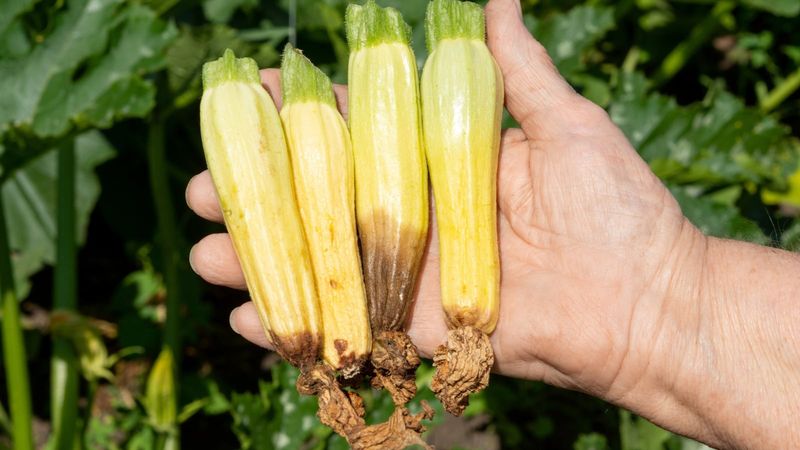
Repeated severe drying followed by a heavy soak is a strong practical suspect when young zucchini develops that characteristic sunken, dark lesion at the blossom end. The pattern is not simply about the soil being too dry or too wet at any one moment. The problem is the swing between extremes, which stresses roots and disrupts normal water and nutrient movement through the plant.
Calcium is delivered to developing fruit primarily through water movement in the plant. When moisture fluctuates sharply, that delivery to fast-growing tissue can be impaired. Penn State Extension explains that the disorder is associated with impaired calcium accumulation in fruit tissue, and a peer-reviewed research review notes that the precise physiological mechanism remains actively debated. Importantly, blossom-end rot can appear even when the soil contains adequate calcium, so the symptom alone does not prove a soil-calcium shortage.
The foliage often looks perfectly fine at the same time because leaves are established sinks with their own supply routes, while the newest, fastest-growing fruit tissue is most vulnerable. A thriving canopy is not evidence that fruit development is proceeding normally. This is why the size and apparent health of your zucchini plant cannot be used as a reliable indicator of what is happening at the blossom end of a small, developing fruit.
August heat can raise demand and disrupt flowers
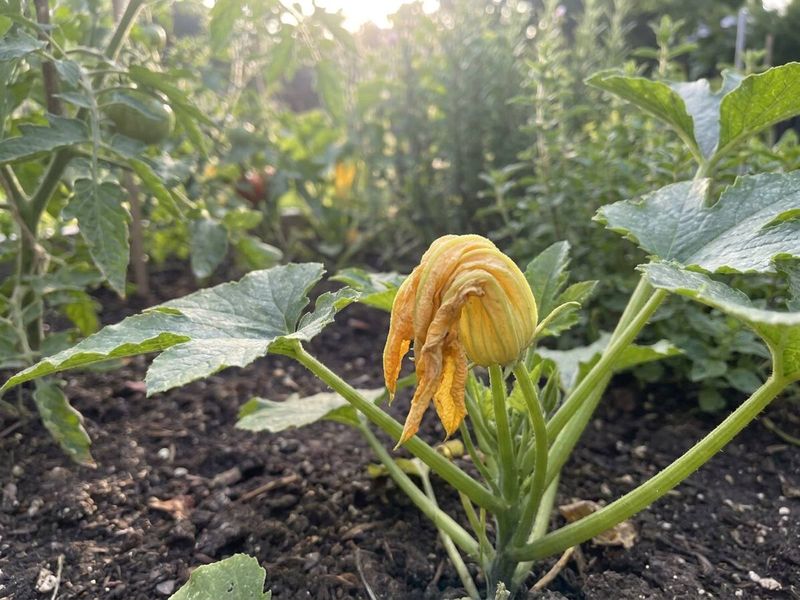
Hot August weather complicates diagnosis because it can contribute to more than one problem at once. Higher temperatures push plants to transpire faster, which means the root zone needs more water to keep up. If irrigation does not increase proportionally, even a garden that seemed adequately watered in June can run short in August, making moisture swings more likely and blossom-end damage more noticeable.
Heat can also affect the flowers themselves. University of Minnesota Extension fruit and vegetable IPM guidance reports that temperatures above approximately 90 degrees F during the day and 70 degrees F at night can favor production of male flowers in some cucurbits, resulting in many blooms but fewer harvestable female flowers. These figures are worth knowing, but they are a possible contributor for some varieties and conditions, not a universal threshold that applies identically to every zucchini in every region.
Oregon State University Extension points out that heat stress can affect both water uptake and overall plant function. In August, heat may accompany blossom-end damage, poor fruit set, or general stress at the same time, which is why symptoms still need to be matched to their specific pattern rather than blamed on one blanket cause.
Steady the root zone for developing fruit
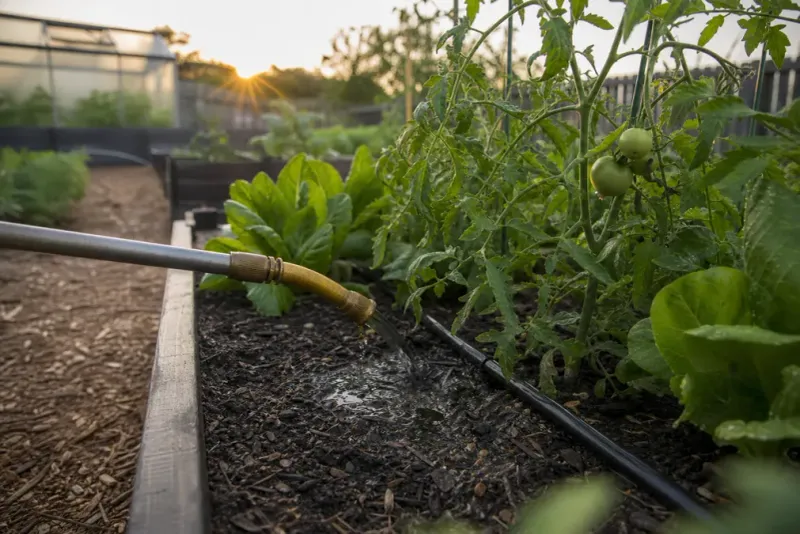
When the symptom points toward blossom-end rot, the practical response starts at the soil. Before reaching for any product, check soil moisture by pressing a finger two inches into the ground near the plant. Watering slowly and deeply at the root zone is more effective than frequent, shallow sprinkling because it encourages roots to access moisture from a larger volume of soil rather than waiting for the next surface pass.
University of Illinois Extension suggests approximately 1 inch of water per week from rain or irrigation as a home-garden starting point. That figure needs real adjustment based on your situation. Sandy soils drain faster and may need more frequent watering. Heavy clay holds moisture longer but can become waterlogged.
Containers dry out quickly and often need attention more than once a week. High heat, strong wind, and large plants all increase demand beyond what a single weekly inch can cover.
A 2 to 3 inch layer of mulch around the base of each plant, kept a few inches away from the stem, can meaningfully reduce evaporation and moderate the soil-temperature swings that contribute to uneven moisture. University of Minnesota Extension cautions against deep cultivation close to zucchini stems, because root injury can worsen the same water and nutrient uptake problems you are trying to correct. Fruit already showing a blossom-end lesion will not recover, and removing it is reasonable for sanitation or practicality. Correcting the moisture stress may help later fruit, though that outcome is not guaranteed.
Test before adding calcium or lime
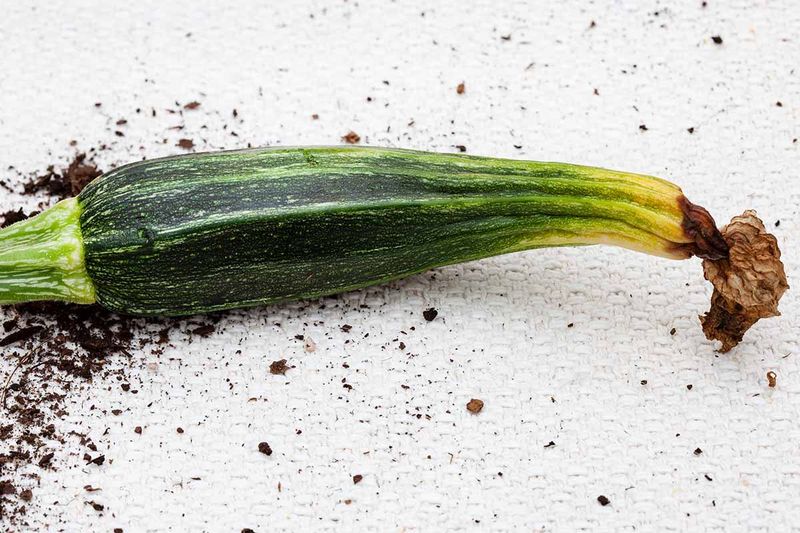
Blossom-end rot looks like a calcium problem, and the packaging on many garden products is happy to confirm that impression. The reality is more complicated. The disorder often involves impaired calcium delivery under stress conditions rather than a straightforward shortage of calcium in the soil. Adding lime or calcium fertilizer without knowing your soil’s current calcium level and pH can create new imbalances without fixing the underlying issue.
Penn State Extension’s soil testing program explains how a basic soil test can reveal whether calcium or pH actually needs correction. Most US garden soils that have been maintained reasonably well are not calcium-deficient. Peer-reviewed research notes that the connection between localized low calcium in fruit tissue and overall soil calcium levels is not fully settled, which means a soil test result showing adequate calcium does not completely rule out the disorder.
Extension recommendations on emergency foliar calcium applications differ. Oregon State University Extension describes calcium chloride sprays as a possible option in some situations, while University of Illinois Extension emphasizes that foliar calcium is generally poorly absorbed and that correcting moisture stress is the more reliable path. No spray will rescue fruit that already has a lesion. The most defensible first move is a soil test, not an amendment.
Yellow, firm fruit often calls for a pollination check
Fruit that turns yellow, stays mostly firm, fails to enlarge, and drops without any dark or sunken lesion at the blossom end is telling a different story. This pattern points toward failed pollination rather than a nutrient delivery problem. Zucchini produces separate male and female flowers on the same plant, and the distinction matters for diagnosing fruit loss.
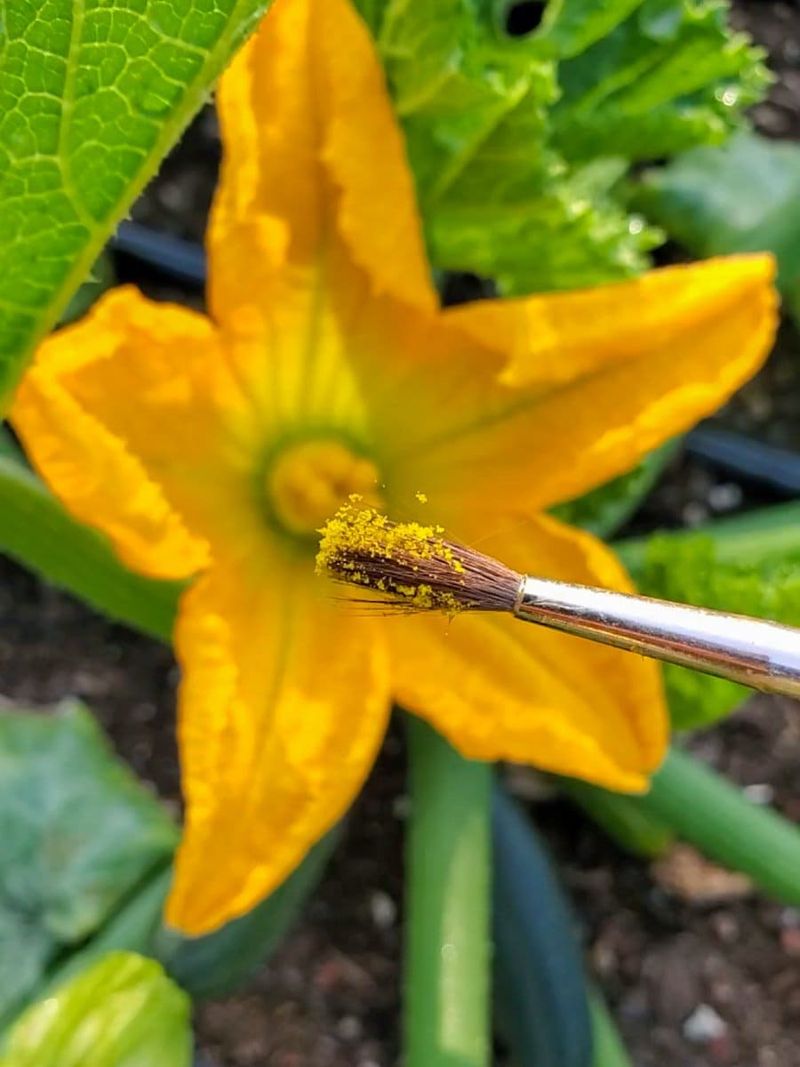
A female flower is identifiable by the small, swollen ovary at its base, which looks like a tiny zucchini even before the flower opens. A male flower sits on a slender, plain stem with no swelling. Pollen from a male flower must reach the stigma inside a female flower before that ovary can develop into harvestable fruit. University of Minnesota Extension notes that the first flowers on a zucchini plant are commonly male, and early flushes of female flowers can fail when pollination is poor.
The window for pollination is short. Cucurbit flowers open briefly, usually in the morning, and are receptive for only a few hours. Cold, rainy, cloudy, or excessively hot weather can reduce bee activity or pollen viability during that window. Penn State Extension’s integrated pollination guidance explains that a poorly pollinated fruit may be misshapen or abort early, and cutting it open may reveal few or poorly developed seeds.
If this pattern fits what you are seeing, hand-pollination is worth trying as a morning experiment: use pollen from a freshly opened male flower to brush the stigma inside a female flower. Oregon State University Extension guidance on growing zucchini supports this as a reasonable rescue approach, though it will not fix every case of fruit loss.
White or fuzzy decay signals another problem
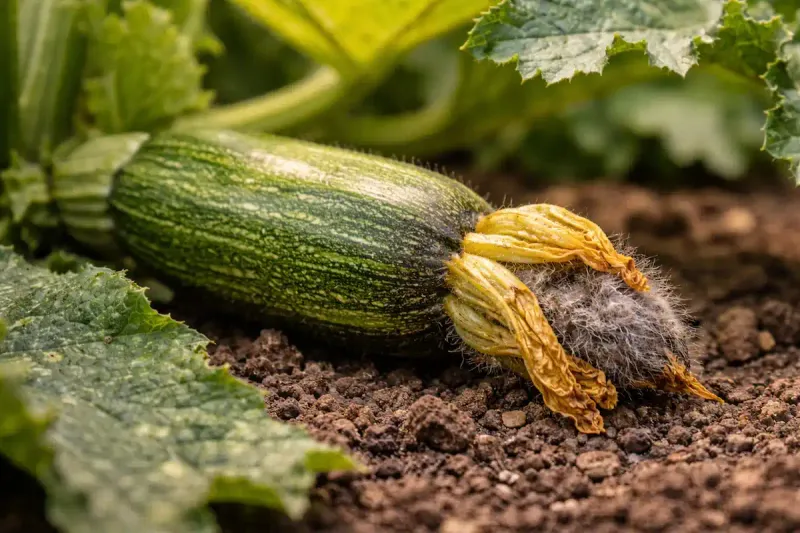
Not every soft or blackened tip on a young zucchini is blossom-end rot. Wet weather, overhead watering, crowded foliage, and fruit resting against wet soil can create conditions that favor a different problem entirely. University of Illinois Extension’s guide to cucurbit troubles describes Choanephora rot as a fungal disease that can affect squash blossoms and young fruit, producing white fungal growth that turns purplish-black and gives affected tissue a soft, fuzzy appearance.
This is a meaningfully different progression from the dry, sunken, leathery texture associated with blossom-end rot. Where blossom-end damage tends to be firm at first and darkens progressively from the tip inward, Choanephora rot is typically soft and wet, often starting in the blossom itself before spreading to the young fruit. Secondary fungal or bacterial infection can also colonize tissue that was already damaged by blossom-end rot, which can blur the appearance and make diagnosis harder.
Color alone is not a reliable guide. A dark or blackened tip can reflect blossom-end rot, secondary infection on top of blossom-end damage, or a wet-weather fungal rot. Texture, the presence of fuzzy growth, and the overall wetness or dryness of the affected area all provide better diagnostic information than color. Applying one universal treatment without distinguishing between these causes is unlikely to help and may waste time and resources.
Match the symptom to the next safe step
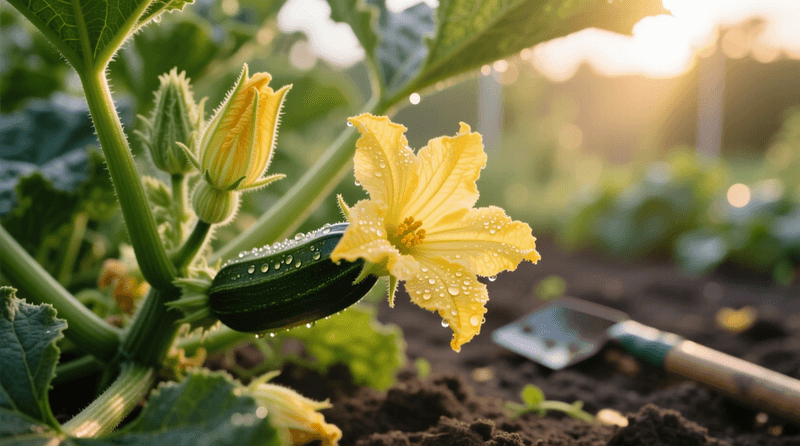
A sunken, dark, leathery lesion at the blossom end points toward steadying root-zone moisture and monitoring new fruit as conditions improve. Yellow or mostly firm fruit that drops without that characteristic lesion calls for a close look at flowers, bee activity, and the morning pollination window. Soft, fuzzy, wet decay on blossoms or young fruit suggests a wet-weather rot concern rather than a nutrient delivery problem, and the growing conditions, not a spray, need attention first.
Fruit that has already developed a lesion or begun to rot will not recover. Removing it is reasonable for sanitation or practicality, and correcting the underlying stress may give later fruit a better chance, though no outcome is guaranteed. University of Illinois Extension confirms that affected fruit should be removed once damage is established.
Resist the impulse to apply insecticide in hopes of improving fruit set. Zucchini depends on insect pollination, and EPA pollinator protection guidance emphasizes following product labels, observing bloom restrictions, and avoiding applications while bees and other pollinators are actively foraging. A plant that looks robust and full of flowers is not proof that pollination, moisture uptake, or fruit development are working correctly. The fruit itself is the most honest reporter in the garden.