
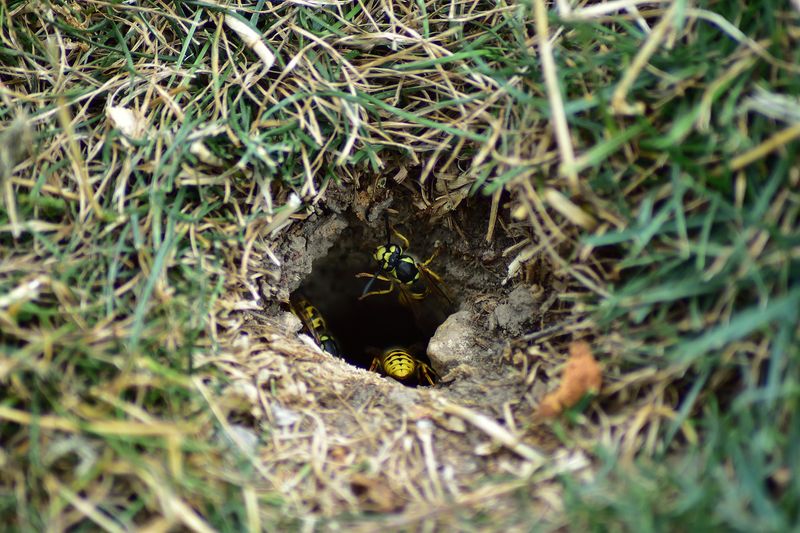
Yellowjackets can turn a relaxing afternoon in the yard into a painful surprise, especially when a colony is already tucked under your lawn without you knowing it. A bare or sandy patch in your grass is not a guaranteed sign of a nest, but it can be a useful cue to slow down and take a closer look before you start mowing or let the kids run outside.
Catching a suspected nest early, by watching from a safe distance for wasp traffic, gives you time to act thoughtfully instead of reacting to an angry swarm. This guide walks through what to look for, when to look, and how to protect your family and pets while respecting the role yellowjackets play in your yard’s ecosystem.
A dry patch is a clue, not a prevention method
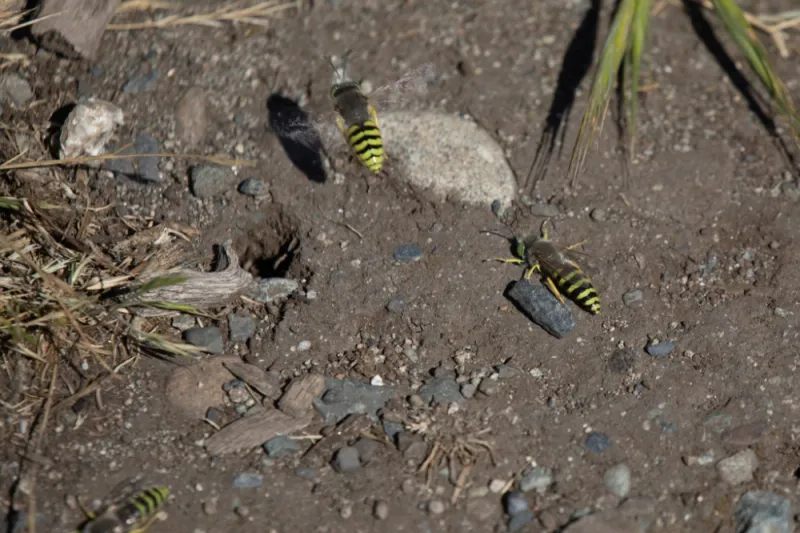
Bare, sandy, or thin-turf patches in a North Carolina lawn can prompt a useful second look before you fire up the mower, but a dry spot alone does not tell you much. Yellowjackets do not choose nesting sites based on soil moisture the way a plant roots itself in good soil.
NC State Extension guidance on turfgrass arthropod pests identifies lawns, particularly sandy exposed areas and the bases of trees or shrubs, as common yellowjacket nesting locations, with no single patch type serving as a universal indicator.
The practical goal of any pre-mowing check is to detect an existing hazard before foot traffic or equipment disturbs it. Inspection does not prevent yellowjackets from building a nest; colonies choose their own sites, often in pre-existing cavities, and nothing a homeowner does during a quick walk-around will stop that process.
What a careful look can do is reveal a colony that is already there, giving you the chance to respond safely rather than accidentally rolling a mower over an active entrance.
Think of a dry or bare patch as a starting point for observation, not a diagnosis. Sandy soil, thin turf, lawn edges, suspicious low spots, and the bases of trees or shrubs are all worth scanning.
NC State’s yellowjacket-in-turf resource notes that underground nests may have a small opening at the soil surface, and that the real confirmation comes from watching, not from the appearance of the soil itself. A dry patch that shows no wasp activity after a brief, distant observation is probably just dry grass, and you can move on with your routine.
Late summer and fall often bring higher activity
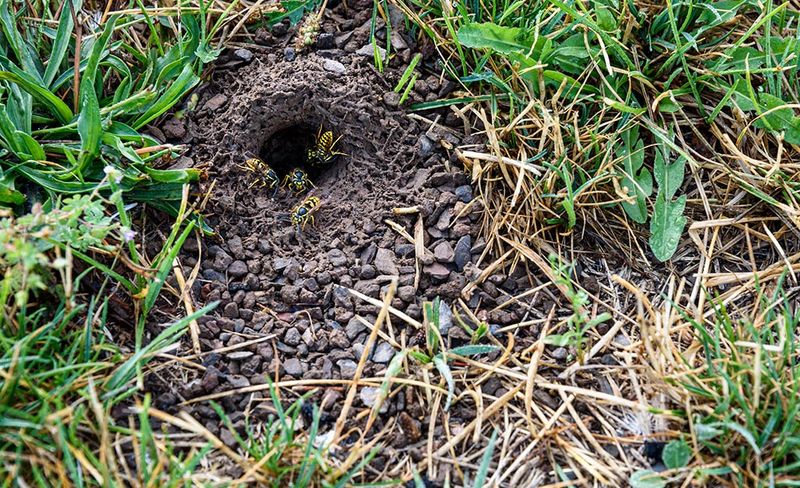
By the time August fades into September across North Carolina, yellowjacket colonies have spent months growing. Workers have been hatching, foraging, and expanding the nest since spring, and University of Georgia Extension research on home pest management confirms that colonies reach their peak population size in fall, which also increases the consequences of stumbling into one during routine yard work.
A colony that held a few hundred workers in June may hold several thousand by October.
That population surge matters because more workers means a faster and larger defensive response if the nest is disturbed. Late summer and fall also tend to bring more aggressive foraging behavior, as colonies shift their diet toward carbohydrates to support the next generation of queens.
Outdoor meals, fallen fruit, and open garbage cans attract more yellowjackets during this window, which puts them closer to the places people spend time.
The seasonal pattern is real, but it is not perfectly uniform across the state. NC State’s turfgrass arthropod pest guide notes that yellowjackets are most active in late summer and fall, yet weather, elevation, and species differences can shift that timing.
A mountain property at 4,000 feet may see peak activity weeks earlier than a coastal plain yard near Wilmington. A mild fall can extend colony activity later than usual in any region.
The practical takeaway for pre-mowing inspection is to treat late summer and fall as the window when a missed nest carries the highest consequence, while staying alert to local conditions rather than assuming a fixed calendar date. If yellowjackets are still foraging actively in your yard, the colony is still worth finding before your lawn equipment does.
Inspect exposed soil and likely cavities from a distance
Before mowing, edging, or weed-whacking, walk the perimeter of your lawn from a comfortable distance and focus on the locations most likely to shelter a ground nest. Sandy exposed areas, thin or patchy turf, lawn edges where grass meets a bed or fence line, and the bases of trees or shrubs are the spots worth your attention.
University of Minnesota Extension’s guide to yard wasps and bees explains that yellowjackets commonly build their paper nests underground, often in old rodent burrows or other pre-existing cavities that require little excavation.
Old vole runs, chipmunk burrows, and soft spots left by decaying roots are all candidates. Penn State Extension’s overview of stinging insect nesting behavior notes that some species also use wall voids, hollow logs, landscape timbers, and other protected spaces above or at ground level, so your scan does not need to stop at the soil surface.
Check low spots along fence lines, gaps at the base of retaining walls, and any opening in a landscape timber or railroad tie.
The key word in this scouting routine is “distance.” Stand back several feet from any suspicious opening and observe rather than approach. Do not lean over a hole, poke at it with a stick, stomp near it to test for activity, or probe the surrounding soil.
You do not need to get close to see yellowjacket traffic; workers flying in and out of an entrance are visible from a safe viewing position.
A good habit is to complete this walk-around before every mowing session during late summer and fall, not just when you notice something unusual. Lawns change week to week, and a nest entrance that was not there last month may have appeared since your last cut.
Making the scan a standing part of your pre-mowing routine takes less than five minutes and costs nothing.
Repeated traffic is stronger evidence than a hole alone
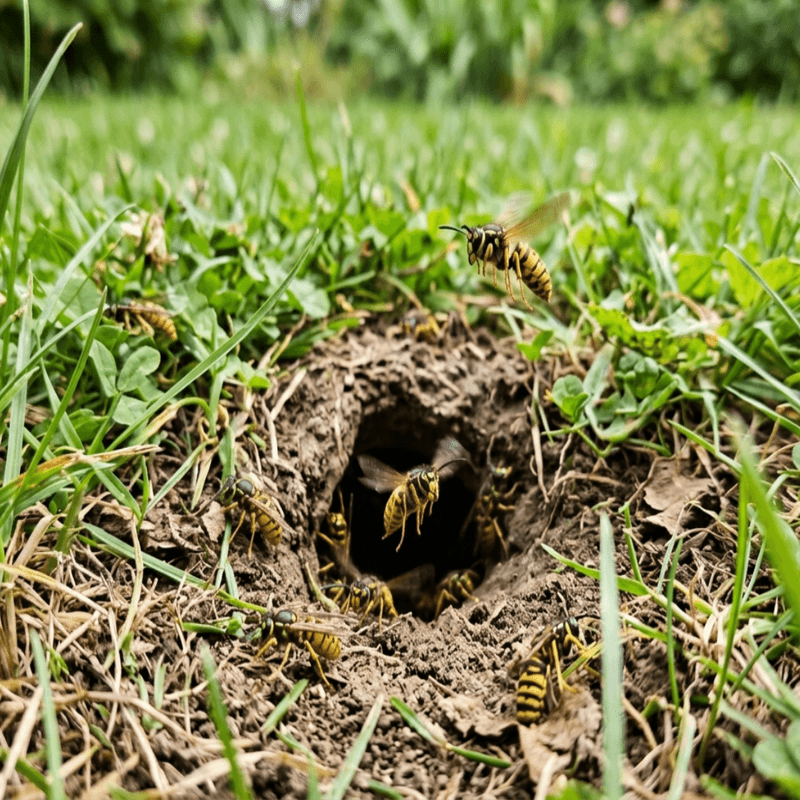
Plenty of things make holes in a North Carolina lawn, and most of them have nothing to do with yellowjackets. University of Minnesota Extension’s lawn-hole diagnostic tool lists ants, cicada killers, squirrels, skunks, raccoons, earthworms, and other animals as common sources of soil openings.
A hole by itself tells you very little. What separates a suspected yellowjacket entrance from an unrelated lawn cavity is the behavior you observe around it.
Watch from a safe distance for workers repeatedly entering and leaving a single small opening. Penn State Extension’s stinging insect management guide states that the only visible evidence of an underground yellowjacket nest may be a small entrance hole with workers flying in and out.
Repeated, purposeful traffic through one point is the observation that matters, not the size or shape of the hole itself. A steady stream of wasps disappearing into the ground and emerging again within seconds is the clearest field sign available to a homeowner watching from a distance.
Even that observation does not tell you everything. Watching traffic through an entrance does not reveal the exact location of the nest cavity below ground, the colony’s size, or the precise species involved.
Entrance tunnels can run several feet before reaching the main nest chamber, which is one reason why the visible hole and the actual colony may be farther apart than they appear.
Cicada killers are a common source of confusion. Penn State Extension’s cicada killer fact sheet describes them as much larger, solitary wasps that create conspicuous soil mounds, usually in sandy or bare areas.
They are not colony-forming insects and do not pose the same sting hazard as a yellowjacket colony. If the wasp you see is roughly the size of a large hornet with yellow and black markings but appears to be working alone and carrying prey, cicada killer is a more likely explanation than a yellowjacket colony.
Positive identification of a yellowjacket nest rests on observing multiple small, fast-moving wasps using the same entrance repeatedly.
Pause yard work and keep people away
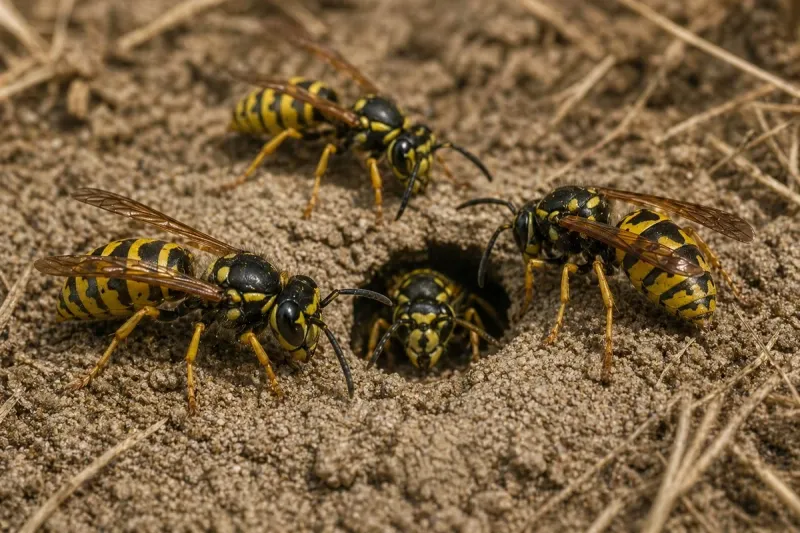
Seeing repeated yellowjacket traffic around a lawn opening calls for one immediate response: stop what you are doing and create distance. Do not finish the current mowing pass, do not edge that row, and do not let a weed-whacker get any closer to the suspected entrance.
Penn State Extension’s stinging insect safety guide explains that vibration from mowing equipment can disturb an underground colony, triggering a defensive response even when the entrance itself has not been directly struck.
Children and pets need to be moved away from the area promptly and calmly. Kids running across a lawn do not know to avoid a small hole in the grass, and a dog following a scent trail will not hesitate before putting its nose near an entrance.
Once people and animals are clear, mark the area from a distance using a visible object, a lawn chair, a small flag, or anything that signals to others not to walk through that section. You do not need to stand over the entrance to mark it.
Postpone all yard activity near the suspected nest until you have decided how to respond. That means mowing, edging, string-trimming, aerating, and any play or sports activity in that part of the lawn.
NC State’s yellowjacket-in-turf resource supports avoiding disturbance as the correct immediate step, with any treatment or further assessment coming after a deliberate decision rather than an accidental encounter.
Separation is the goal at this stage, not testing or confirming the nest. Resist the urge to walk closer for a better look, toss something near the hole, or run the mower quickly past it to see what happens.
A colony that has not been disturbed is a manageable situation. One that has been accidentally provoked is considerably harder to deal with safely.
An isolated nest may not need treatment
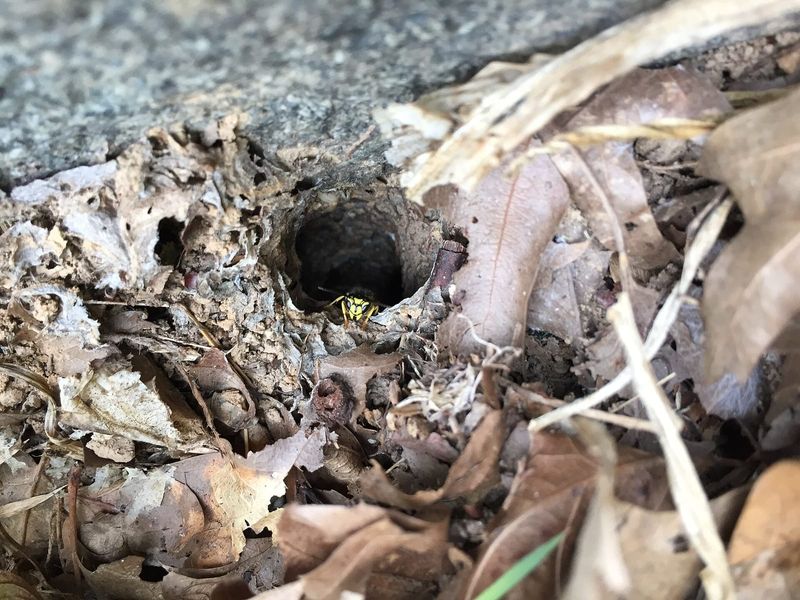
Not every yellowjacket nest in a North Carolina yard requires immediate intervention. Location is the deciding factor.
NC State’s yellowjacket-in-turf resource notes that yellowjackets are predators of other insects, providing a real ecological benefit in the landscape, and that colonies die out seasonally rather than being reused the following year. A nest tucked into a back corner of the property, well away from foot traffic, play areas, and home entrances, may not pose a meaningful risk to anyone.
Leaving an isolated nest undisturbed is a legitimate option when the colony is not in a location where people or pets regularly pass. Once cold weather arrives, the colony will collapse on its own.
The overwintered queens will start new nests in new locations the following spring, so the abandoned cavity will not attract the same colony again. Filling the old entrance after the colony has died is a reasonable step to discourage future use by any ground-nesting insect.
The calculation changes when the nest sits beside a play area, along a walkway, near a home entrance, or anywhere that people and pets move through regularly. Those locations create repeated opportunities for accidental disturbance, and a colony in a high-traffic spot warrants a deliberate response rather than a wait-and-see approach.
Reducing what draws yellowjackets close to people is a reasonable supporting step regardless of nest location. University of Minnesota Extension’s fall yard pest guidance recommends removing fallen fruit promptly, securing garbage cans with tight lids, and covering outdoor food and drinks.
These habits reduce foraging activity around people but cannot eliminate an established underground colony. They work best as a complement to managing the nest itself, not as a substitute for it.
Choose professional help when the nest creates a real hazard
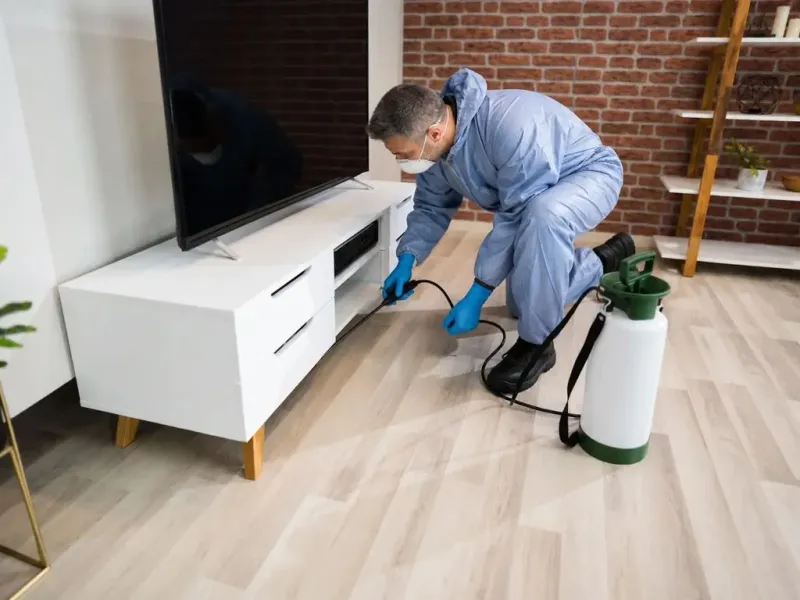
Some nest situations call for professional treatment rather than a homeowner response. University of Georgia Extension’s home pest management bulletin recommends professional treatment when a nest is large, difficult to locate, close to a structure or high-traffic area, or when anyone in the household has a history of severe insect-sting allergy.
A household with a known allergy history should not attempt any form of nest treatment independently, regardless of how accessible the entrance appears.
Large or concealed colonies present a particular challenge because the visible entrance may sit several feet from the main nest chamber. Penn State Extension’s stinging insect management guide notes that some aerosol products provide rapid knockdown of workers near the entrance but may not penetrate a deeper or larger underground cavity reliably.
Treating only the hole you can see does not guarantee that the colony has been reached. A professional has the equipment, protective gear, and product access to address the nest more thoroughly and with less personal risk.
CDC guidance for outdoor workers on stinging insects reinforces that high-risk situations warrant professional handling rather than improvised solutions. Gasoline, boiling water, flooding, and digging are all unsafe approaches that can provoke a colony and cause serious injury.
These methods are not recommended under any circumstances.
If you decide to use a labeled pesticide product as a homeowner, the EPA’s pesticide label information makes clear that the current product label is a legal document. Follow it exactly, including any restrictions on application near water, blooming plants, drains, or areas where children and pets have not been excluded.
Do not broadcast pesticide across the lawn in hopes of reaching the nest. Apply only to the confirmed entrance, at the time and in the manner the label specifies, and keep everyone away from the treated area until conditions described on the label are met.
When in doubt, a licensed pest control professional is the more reliable and safer choice.
Use the lawn check to prevent surprises, not nests
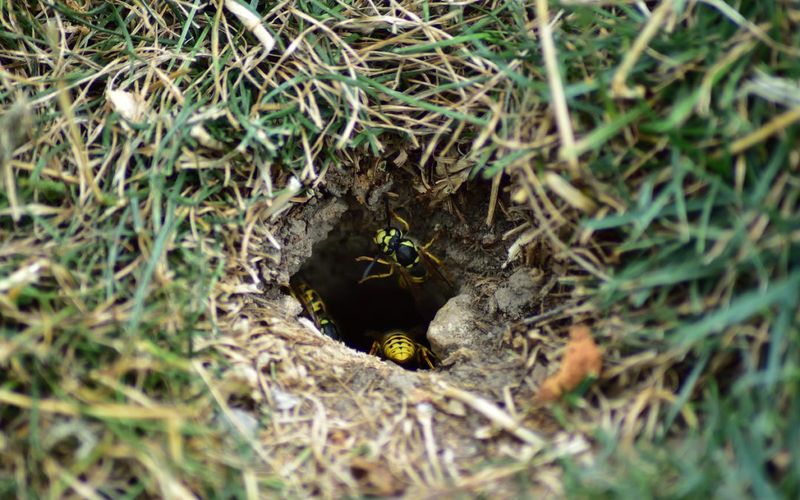
The pre-mowing scan is a simple habit with a clear purpose: find a hazard before equipment or foot traffic finds it for you. Scan sandy exposed areas, thin turf, lawn edges, cavities, and the bases of trees or shrubs.
If you see repeated yellowjacket traffic entering and leaving a single opening, stop all yard activity in that section, move children and pets away, and mark the area from a distance. Then decide calmly whether the nest’s location warrants leaving it alone until the colony dies out naturally, or whether its proximity to regular human activity calls for professional treatment or careful label-compliant action.
Inspection will not stop yellowjackets from choosing your yard as a nesting site. Colonies select locations on their own schedule, and no walk-around prevents that.
What the check does accomplish is giving you the information to respond deliberately rather than stumbling into a situation mid-mow. NC State’s turfgrass arthropod pest guide and related extension resources consistently point to late summer and fall as the period when colonies are largest and disturbance carries the highest consequence, which is exactly when the habit matters most.
If a sting does occur and symptoms include trouble breathing, swelling of the lips, face, tongue, or throat, dizziness, fainting, widespread hives, vomiting, or diarrhea, call 911 immediately. MedlinePlus emergency guidance on insect stings and CDC stinging insect safety guidance both confirm that anyone with a prescribed epinephrine auto-injector should use it as directed and receive emergency care without delay.
A five-minute walk around the lawn before each mowing session is a small investment, and the one time it reveals active wasp traffic, it will have been worth every second.