
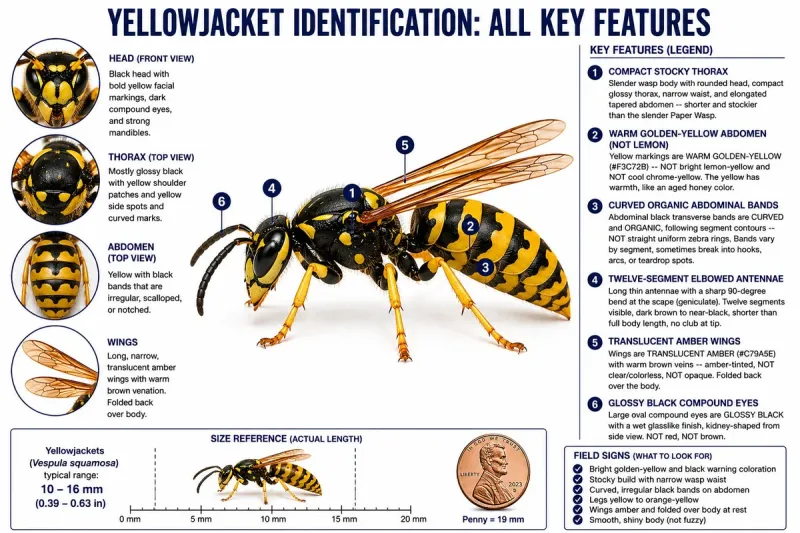
Every August and September, Texas yards seem to fill up with aggressive yellow-and-black wasps hovering around trash cans, fruit trees, and backyard cookouts. What you are seeing is a normal late-summer pattern, not necessarily a new invasion, but that does not make it any less dangerous when a nest sits close to where your family spends time outside.
Understanding what is actually happening, and what steps genuinely reduce the risk, can make the difference between a manageable situation and a painful emergency.
Late-season activity does not prove a Texas-wide outbreak
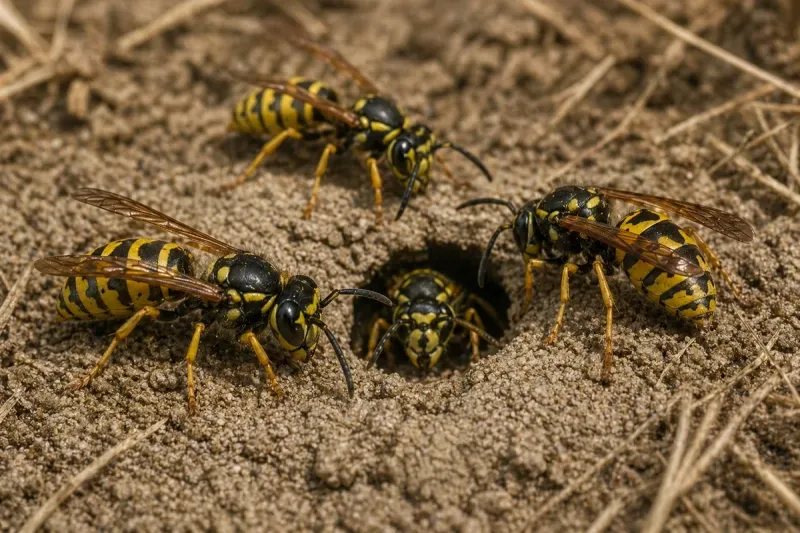
Yellowjacket colonies begin each spring with a single queen and a handful of workers. By late summer, a successful colony can hold thousands of workers, all of them foraging for food and water to sustain a nest that has grown steadily for months.
That growth is why Texas A&M Insects in the City identifies late summer and fall as the period when yellowjacket problems become most noticeable, and why University of Minnesota Extension similarly reports late-summer population peaks across yellowjacket species.
What you are seeing around your patio or garbage cans is almost certainly the product of that seasonal build-up, not evidence of a statewide outbreak or an unusually bad year. Current regional climate data from sources such as the National Weather Service Fort Worth drought page and Drought.gov Texas data do not establish a verified statewide yellowjacket surge in 2026.
Texas conditions also vary widely by region, so a dry summer in one county and a wet one in another can produce very different local wasp activity.
Calling this a “swarm” can also mislead. A concentrated group of flying insects near your yard may be foraging workers, nest defenders, mating activity, or even a different species entirely.
This guide uses “late-season activity” throughout because that is what the evidence actually supports. The seasonal hazard is real and can create serious local problems, especially near structures and high-traffic outdoor areas, and that is exactly what the sections below address.
Southern yellowjackets are the leading Texas suspect
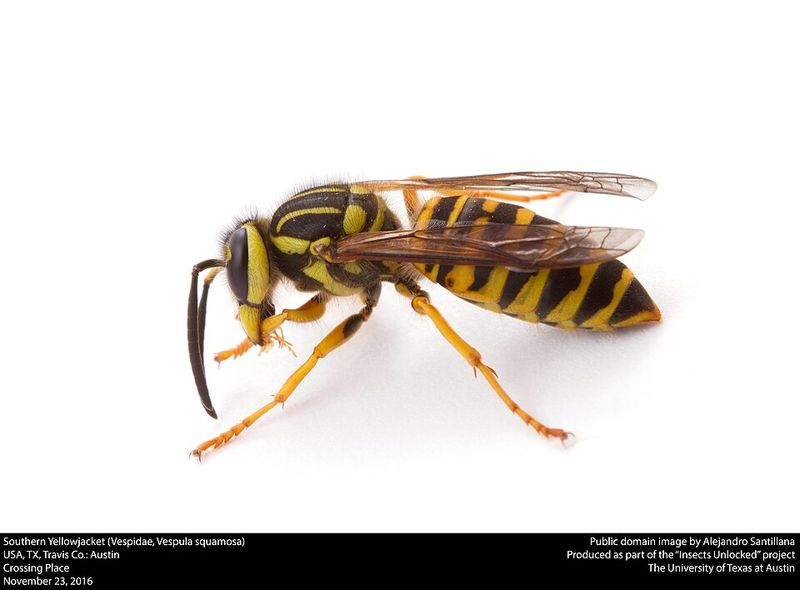
When Texans spot a yellow-and-black wasp buzzing persistently around their yard, the southern yellowjacket, Vespula squamosa, is the strongest local candidate. Texas A&M’s field guide to southern yellowjackets describes them as abundant urban pests across the state, commonly found nesting underground or inside structural cavities.
Workers are smooth-bodied, roughly half an inch long, and carry the bold black-and-yellow banding that most people associate with the word “yellowjacket.”
Color alone, though, is not enough to pin down the species. The Texas Apiary Inspection Service notes that multiple species share similar markings, and the Texas A&M Extension yellowjackets and hornets guide points out that eastern yellowjackets, Vespula maculifrons, are generally associated with eastern Texas and can look nearly identical.
Paper wasps, cicada killers, and even honey bees get labeled as yellowjackets regularly, and each of those insects calls for a different response.
One useful distinction is nest shape. Texas A&M AgriLife’s wasp publication explains that paper wasps build open, single-comb nests visible under eaves or on fence rails, while yellowjackets construct enclosed paper nests, often hidden underground or inside a wall void.
If you can see an open honeycomb structure without any outer covering, you are probably looking at a paper wasp nest, not a yellowjacket colony. When you are uncertain about what you have, that uncertainty itself is a reason to keep your distance and consult a professional before deciding on any treatment.
Inspect possible nest entrances without provoking an attack
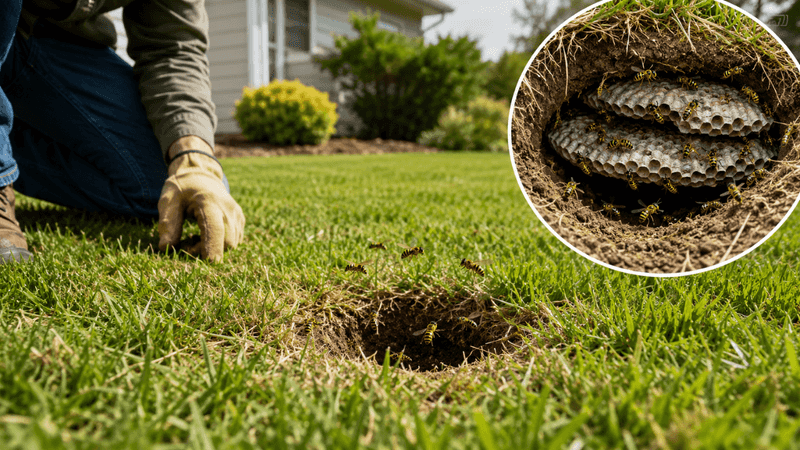
Finding a nest entrance is useful information, but the inspection itself carries real risk if you get too close or disturb the area. The safest method is to stand well back during daylight hours and watch for repeated wasp traffic entering and exiting a single point.
A small hole in bare soil, a gap along a railroad tie, a crack near a shed foundation, or an opening in a wall or eave can all serve as entrances. Oregon State University Extension notes that nests may also be concealed under shrubs, decks, landscaping timbers, or other protected cavities that are easy to stumble across while gardening or mowing.
Once you have spotted a likely entrance, stop there. Do not poke at the hole with a stick, kick the surrounding soil, flood the opening with a hose, or attempt to seal it.
Penn State Extension is direct on this point: disturbing the nest entrance is one of the fastest ways to provoke a defensive response from dozens or hundreds of workers at once. A lone forager away from the nest is generally far less defensive than the colony at its entrance.
The Texas A&M southern yellowjacket page and the Texas Apiary Inspection Service both emphasize that southern yellowjackets may nest in wall voids, garages, and other structural cavities in addition to the ground. If you suspect a nest inside a wall or other enclosed structure but cannot confirm the entrance point, that uncertainty is enough reason to call a licensed pest professional rather than attempt any treatment on your own.
Mark the area with a flag or a piece of tape so household members and pets stay clear, and treat that zone as off-limits until the nest has been professionally evaluated.
Remove the food and water sources that attract workers
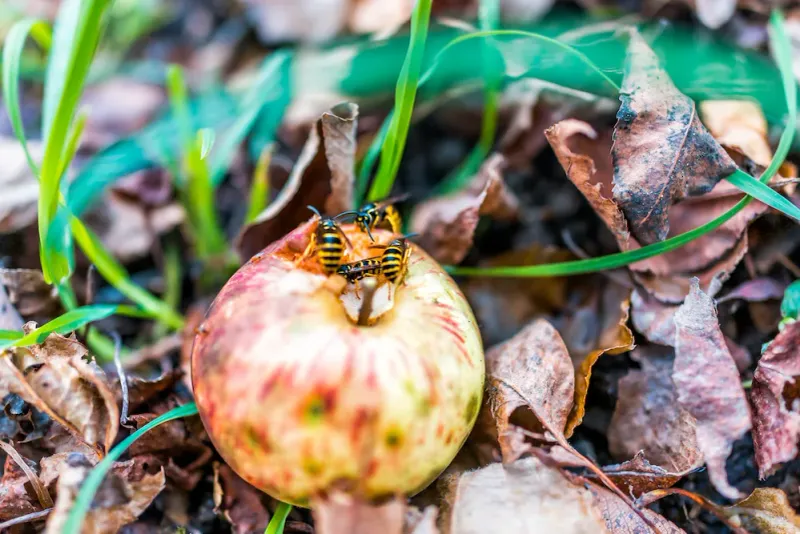
Foraging yellowjackets follow carbohydrate sources, and late-summer Texas yards tend to offer several at once: ripe or dropped fruit, sugary drink spills, open garbage, pet food left outside, and even the honeydew secreted by aphids on garden plants. University of Minnesota Extension’s fall pest guidance recommends collecting fallen fruit promptly, cleaning up spills before they dry, covering outdoor food and drinks, and keeping garbage containers tightly closed as the first practical steps for reducing wasp activity near people.
Penn State Extension adds that water can be just as attractive as food, particularly during hot, dry Texas summers. Leaky irrigation heads, dripping outdoor faucets, bird baths placed close to seating, and standing water in planters all give wasps a reason to linger near the spaces where people and pets spend time.
Fixing irrigation leaks and moving nonessential water sources away from patios and play areas reduces encounters without requiring any chemical treatment at all.
One clarification worth making: workers visiting your yard for food or water are not necessarily nesting there. Oregon State University Extension points out that yellowjackets forage widely from their nest, sometimes traveling a considerable distance.
Removing attractants reduces the number of wasps you encounter, but it does not locate or eliminate a colony. Think of attractant control as a way to lower the daily friction between your household and the local wasp population, not as a substitute for finding and addressing an active nest that poses a real encounter risk.
Decide whether the nest poses an unavoidable risk
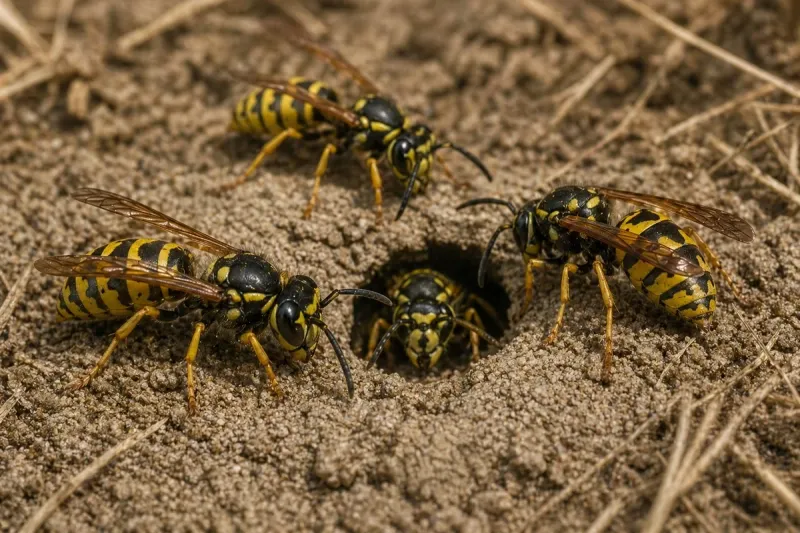
Not every yellowjacket nest in your yard requires treatment. A colony located in a far corner of the property, away from paths, play areas, pets, and doorways, may be left alone, particularly if its entrance is easy to avoid and mark.
Oregon State University Extension suggests that remote nests with low encounter risk can simply be monitored rather than treated, since disturbing them creates its own hazards.
The calculus changes completely when a nest sits beside a doorway, under a deck people use daily, near a play structure, along a pet run, or anywhere that household members cannot reasonably avoid. In those situations, Texas A&M AgriLife Extension’s wasp and yellowjacket guide recommends prompt professional evaluation rather than a wait-and-see approach.
Yellowjackets do prey on other insects and can provide some ecological benefit, but reducing dangerous encounters takes clear priority over ecological considerations when a colony occupies a high-traffic location.
Texas adds a specific wrinkle that northern-climate advice often misses. The Texas Apiary Inspection Service and the Texas A&M southern yellowjacket field guide both note that some southern yellowjacket colonies in Texas can survive for multiple years rather than dying off after the first cold season.
Texas A&M AgriLife’s wasp publication reinforces this point. Assuming that a troublesome nest will simply disappear by November is not a safe bet in this state, which is one more reason that a location-based decision, rather than a seasonal one, is the right framework for Texas homeowners.
Use traps only for limited peripheral relief
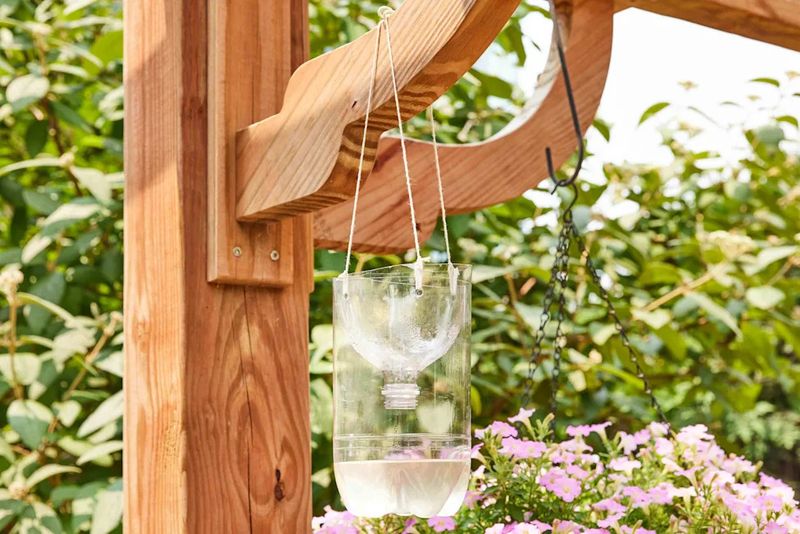
Commercial yellowjacket traps use a liquid or dry lure to attract and capture foraging workers. They can reduce the number of wasps you see in a specific area over a short period, and that localized reduction has real value when you are trying to make a patio or outdoor eating space more comfortable.
Penn State Extension is clear, though, that traps generally do not eliminate an established colony. A healthy nest replaces captured workers continuously, so a trap that fills up quickly is a sign of a large, active colony nearby, not evidence that the problem is being solved.
Placement matters more than most people realize. Oregon State University Extension’s honey bee protection guide warns that placing a trap near a patio, door, play area, or eating space can pull foraging wasps toward those same locations rather than away from them.
Set traps at the perimeter of your yard or near known foraging routes, not adjacent to the spaces you are trying to protect.
The University of Kentucky Entomology yellowjacket control fact sheet echoes this framing: traps are a supplementary tool for reducing peripheral encounters, not a stand-alone nest management strategy. If your trap is filling quickly and you are still seeing heavy wasp traffic around your yard, that pattern is a signal to shift from trap use to professional nest evaluation.
Think of traps as a way to lower daily encounter rates while you work through the decision process, not as a replacement for addressing the colony itself.
Choose professional treatment for active or concealed nests
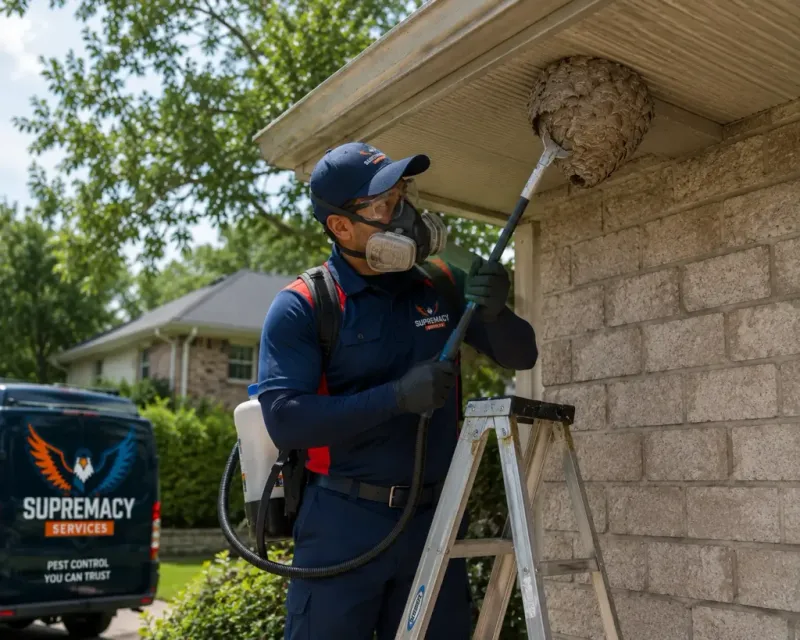
Some nest situations are simply beyond safe homeowner management, and recognizing them early prevents injuries. A licensed pest professional is the right call when the nest occupies a wall void, sits under a deck or porch, lies near a doorway or frequently used path, borders a play area or pet run, or cannot be avoided during normal household activity.
Oregon State University Extension recommends professional control as the safest approach for active nests in these situations, and that recommendation applies with particular force in Texas, where colonies may be large and multi-year.
If chemical treatment does become part of the plan, only use a product whose current EPA label specifically permits the intended yellowjacket or wasp use and the application site where you plan to apply it. The EPA’s Citizen’s Guide to Pest Control and Pesticide Safety and the agency’s pesticide safety tips page both stress reading and following the label exactly, keeping children and pets away until conditions specified on the label are met, and preventing product drift onto flowers, water sources, edible crops, and beneficial insects.
A sample EPA-registered wasp and yellowjacket killer label shows how detailed those site and use restrictions can be.
Several popular improvised approaches carry serious risks and should not be used. Gasoline, kerosene, diesel, fire, boiling water, and flooding are environmentally harmful, potentially illegal as improvised pesticides, and dangerous to the person applying them.
OSU Extension’s September Brambles publication addresses this directly. Peppermint oil, vinegar, dryer sheets, and similar home remedies are not supported by evidence as nest control methods.
Nighttime treatment is also not automatically safe; wasps can still emerge, and pesticide exposure, falls in the dark, and drift onto pollinators remain real risks regardless of the hour.
One critical structural warning: do not seal a wall-void entrance before the colony inside has been eliminated. Texas A&M Extension’s E-239 wasp guide warns that surviving wasps will look for another exit and may force their way into the living space of the home.
A professional can treat the colony first and advise on sealing afterward, in the right sequence.
Respond correctly after a sting
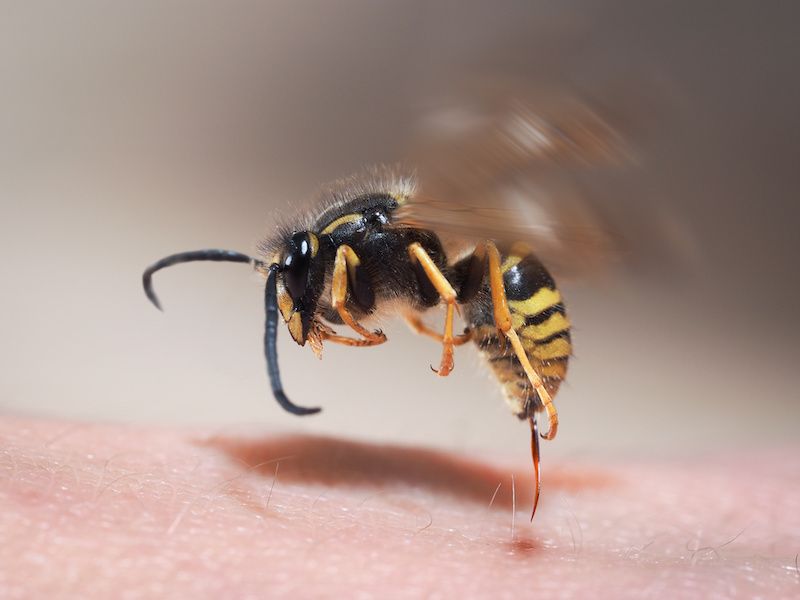
A yellowjacket sting away from the nest is usually the result of a worker that felt trapped, grabbed, or pressed against skin. Penn State Extension advises against swatting at or crushing a foraging yellowjacket against the body.
Moving calmly away from the area is the most effective immediate response, both for a lone forager and especially near a nest entrance where defensive behavior is far more intense.
For a mild sting with no sign of a severe reaction, the steps are straightforward. Wash the site with soap and water, then apply a cold compress or ice pack wrapped in cloth to reduce pain and swelling.
MedlinePlus wasp sting guidance and the Mayo Clinic first aid page both recommend over-the-counter antihistamines or hydrocortisone cream for itching and localized swelling if needed. One thing worth knowing: yellowjackets can sting repeatedly and generally do not leave a stinger behind the way a honey bee typically does, so stinger removal is not usually the first concern after a yellowjacket encounter.
Emergency symptoms require a completely different response. The American Academy of Allergy, Asthma and Immunology lists trouble breathing, swelling of the throat or tongue, dizziness, fainting, widespread hives, vomiting, and diarrhea as signs of anaphylaxis.
Call 911 immediately if any of these symptoms appear. Anyone with a known severe allergy should use their prescribed epinephrine auto-injector right away and still call 911, because epinephrine buys time but does not replace emergency medical care.
The University of Kentucky Entomology fact sheet and the Texas Apiary Inspection Service both emphasize that the repeated-sting capacity of yellowjackets makes a nest encounter especially dangerous for anyone with a venom allergy.
Make the yard safer without chasing every wasp
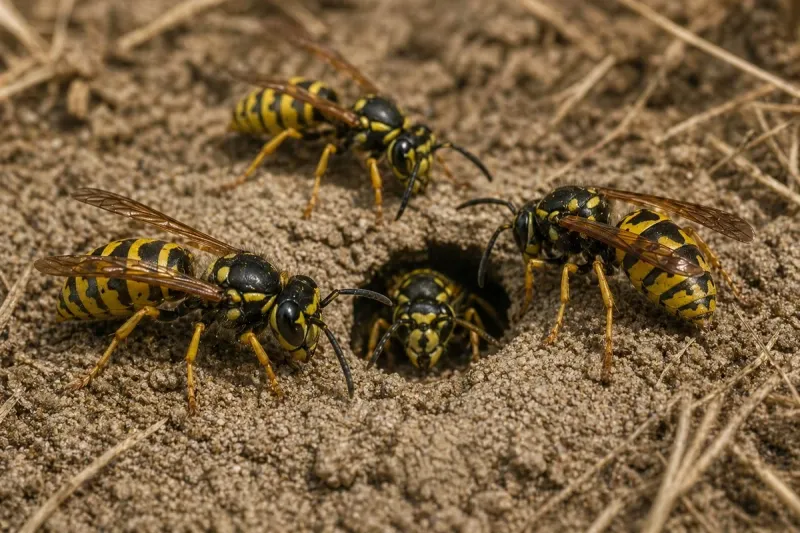
Managing yellowjacket activity in a Texas yard comes down to a practical sequence rather than an all-out elimination campaign. Start by identifying cautiously: watch for repeated wasp traffic at a single point from a safe distance, and recognize that color alone does not confirm the species.
The Texas A&M southern yellowjacket field guide identifies this wasp as the strongest local candidate for late-summer activity, but paper wasps, eastern yellowjackets, and other insects can look similar and require different responses.
Remove food and water attractants as a first low-risk step, then keep household members and pets away from any suspected nest entrance. If you use a trap, place it at the perimeter of the yard rather than near occupied spaces.
When a nest sits close to unavoidable activity, contact a licensed pest professional rather than attempting improvised treatment. Penn State Extension and Oregon State University Extension both frame professional treatment as the safest route for active nests near structures or high-traffic areas.
What is actually happening in your yard is most likely a normal seasonal increase in colony size and foraging visibility, not a confirmed statewide outbreak. The goal is not to remove every wasp from your property.
A yard that reduces dangerous encounters through smart attractant management and professional nest control when needed is a yard where people and pets can move around safely, which is the only outcome that really matters.