
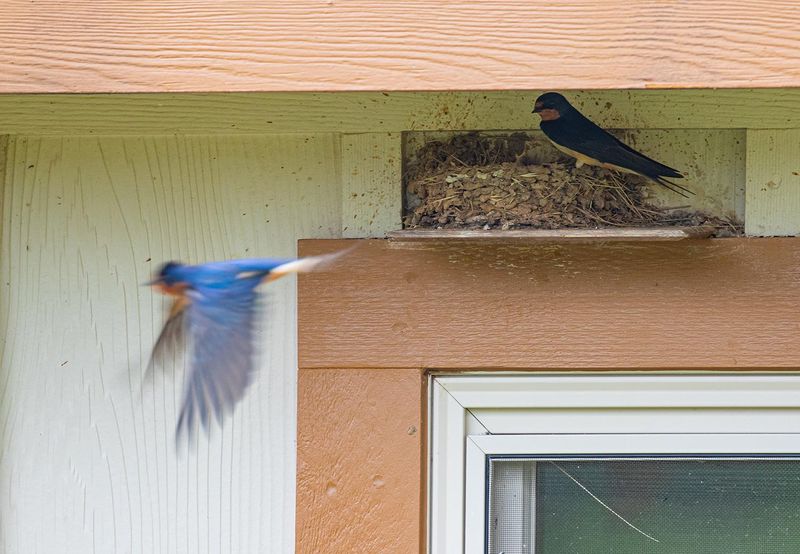
Barn Swallows are among the most recognizable summer birds in Central Texas, swooping low over lawns and nesting under eaves with a confidence that makes them feel like they belong right alongside you. They do eat flying insects, and having them nearby adds real wildlife value to any property.
What they cannot do is reliably clear your porch of mosquitoes or gnats, so knowing what to expect before you roll out the welcome mat makes the whole experience more rewarding.
Meet the Barn Swallow Under the Eaves
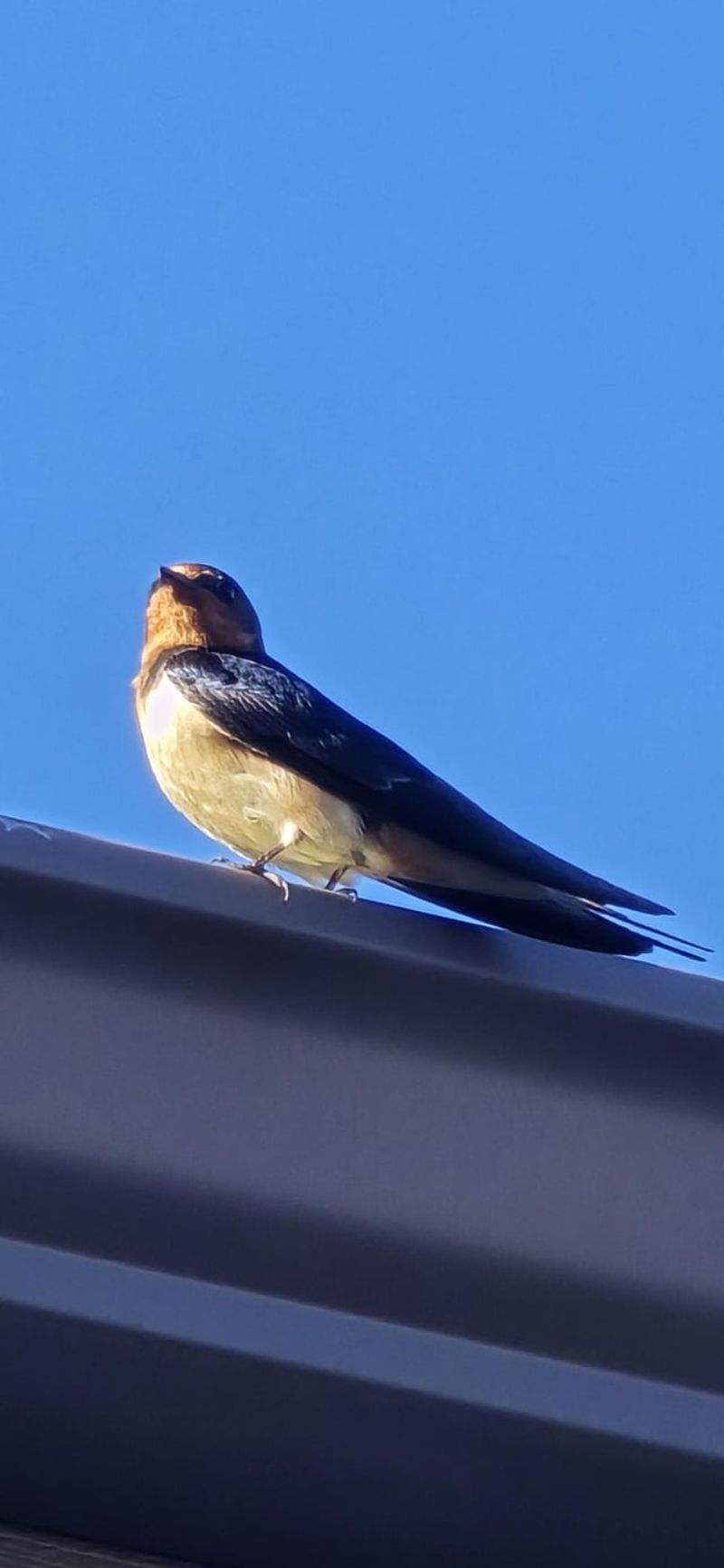
Spend a summer evening on almost any Central Texas porch near open land, and there is a good chance something small and fast will arc past at eye level. That bird, with its long, deeply forked tail trailing behind it like an open scissor, is almost certainly a Barn Swallow.
Adults show a glossy blue-black back, a brick-red to buffy-orange throat and forehead, and a pale underside. The tail fork is the easiest field mark: no other common Texas swallow has a split that deep.
Cornell Lab’s Barn Swallow identification guide lists the long outer tail feathers as the clearest way to separate this species from lookalikes at a glance.
Porches, barn eaves, bridges, and the undersides of highway overpasses all attract nesting pairs because these structures mimic the sheltered cliff ledges the species used before human buildings became available. The nest itself is a shallow, open cup of mud pellets and dry grass, plastered against a vertical surface where a roof keeps rain off.
Finding one of those rough, half-bowl shapes stuck to a beam or rafter is a reliable confirmation that Barn Swallows, and not a similar species, are using the space.
Cliff Swallows, which also nest in colonies on Texas structures, are the species most often confused with Barn Swallows. Side-by-side identification notes show that Cliff Swallows have a squared-off tail, a pale forehead patch, and a distinctly different nest: an enclosed, gourd- or bottle-shaped mud structure with a small round entrance hole.
If the nest has a roof and a doorway, it belongs to a Cliff Swallow. The open bowl is the Barn Swallow’s signature, and recognizing it matters before making any changes to your property.
Texas Parks and Wildlife notes that both species commonly use human-made structures, so a quick look at tail shape and nest design saves a lot of guesswork.
What Barn Swallows Eat—and What They Cannot Promise
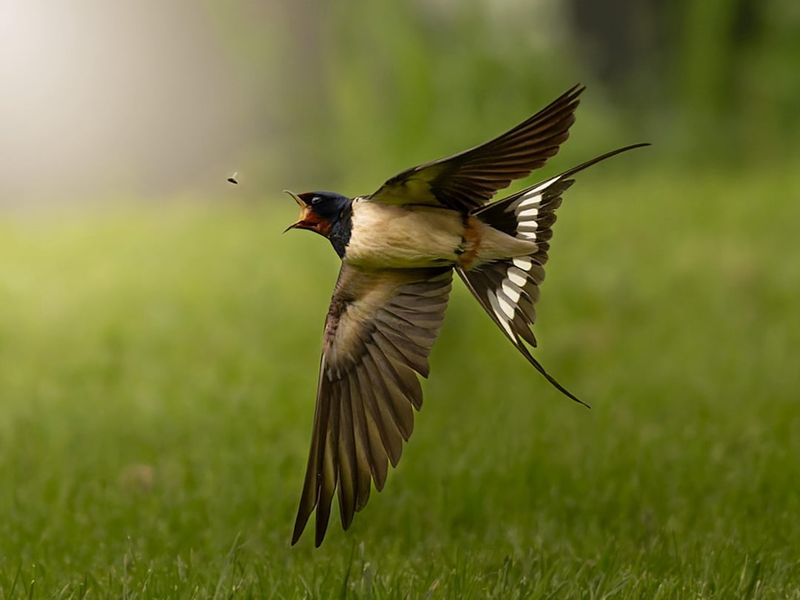
Barn Swallows feed entirely on the wing, snatching individual flying insects out of the air rather than gleaning them from leaves or soil. Flies make up the largest share of their recorded diet, but life history data from the Cornell Lab shows that beetles, bees, wasps, ants, moths, butterflies, and other winged prey also appear regularly.
The mix shifts with whatever is available locally, which means a pair nesting on your porch is eating whatever happens to be flying nearby, not necessarily the insects bothering you at the dinner table.
Prey size plays a measurable role in what a swallow actually picks up. A diet study of Barn Swallows at Vancouver International Airport found that the birds selected against the smallest insects and favored prey roughly 4 to 8 millimeters long.
Many mosquitoes fall at the lower end or below that range, which partly explains why swallows do not function as reliable mosquito-reduction tools even when they are actively feeding nearby. A separate study using DNA metabarcoding found that Barn Swallow nestling diets spanned 130 insect families, confirming a broad and flexible appetite rather than a targeted one.
“Gnats” is worth pausing on, because the word covers several different insects. Nonbiting midges, fungus gnats, black flies, and biting midges are all called gnats in everyday conversation, and they differ considerably in size, habitat, and how often they turn up in swallow diets.
Treating gnats as a single, reliably hunted category overstates what the evidence actually shows.
The mosquito-control question deserves a straight answer: Barn Swallows eat some mosquitoes, but mosquito-management reviews note that feeding observations and gut-content studies do not support the idea that swallows or Purple Martins provide effective biological control of mosquitoes. The birds forage over fields, ponds, roads, and open lawns, not exclusively around your seating area, so their presence nearby does not translate to a measurable drop in porch-level bites.
The EPA’s joint statement on mosquito control identifies source reduction, larval control, and targeted treatments as the proven methods. Barn Swallows are a genuine ecological asset and a pleasure to watch, but they work alongside those methods rather than replacing them.
Timing and Nearby Habitat Both Shape Porch Use
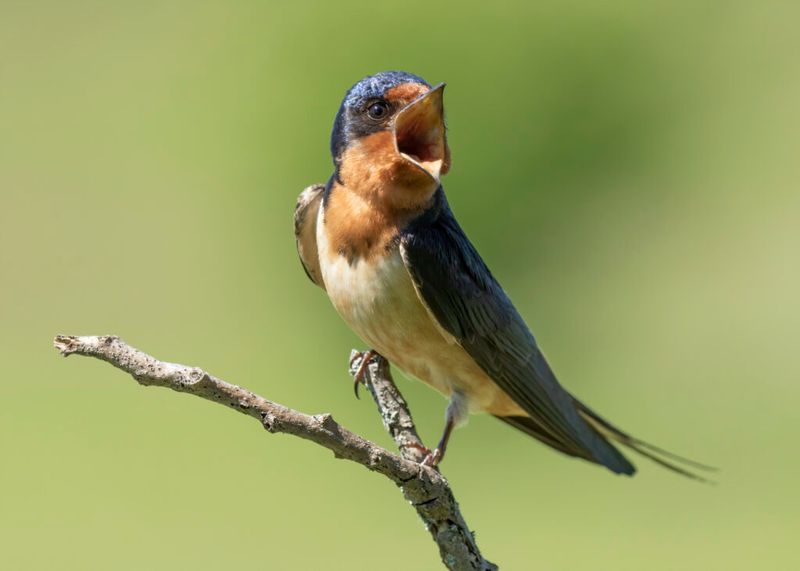
Central Texas sits squarely in the Barn Swallow’s spring migration corridor. Texas Parks and Wildlife migration timing data places the bulk of spring swallow movement between early March and early April across most of the state, though actual arrival at any specific property depends on local weather, habitat conditions, and where individual birds settled the previous season.
Some pairs show up earlier in mild years; others trickle in weeks later. Treat the window as a general expectation rather than a fixed date on the calendar.
A porch can supply one important ingredient: a sheltered surface for nesting. What it cannot supply on its own is foraging habitat.
Barn Swallows forage over open areas such as fields, parks, roadway edges, marshes, ponds, and coastal waters where flying insects congregate. A covered ledge under an eave gives birds a place to raise young, but they will still range across the surrounding landscape to find food.
Properties surrounded by mowed turf with little insect activity, or hemmed in by dense development, may see fewer swallows simply because the nearby foraging ground does not support much aerial prey.
NestWatch’s case study on making space for Barn Swallows describes increased nesting after several changes to a single property, not from one universal fix. Shelter, mud access, open foraging ground, adequate flying insects, and tolerable disturbance levels all interact.
A property near a pond, a pasture, or a lightly managed lawn is likely to offer more of those interacting conditions than a property without them. None of those factors alone determines whether swallows use a site, and no combination guarantees it.
Offer an Open Shelf Instead of a Birdhouse
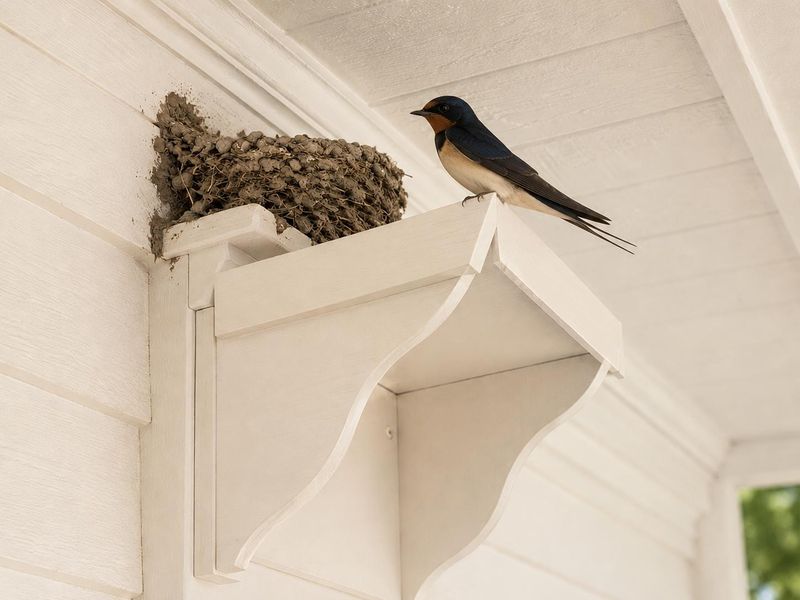
A standard enclosed birdhouse with a round entry hole will not attract Barn Swallows. The species builds open cup nests against sheltered surfaces and has no use for a cavity with a roof and a doorway.
Putting up the wrong structure wastes effort and can end up hosting house sparrows or other cavity nesters instead. The correct invitation is an open-sided nesting shelf or pre-formed nest cup mounted beneath a roof overhang, porch ceiling, barn eave, or shed soffit where rain cannot reach the nesting surface directly.
Texas Parks and Wildlife’s nest box and nesting structure guide recommends placing sheltered shelves under barn eaves, porches, and other out-of-the-way locations. The shelf itself can be simple: a flat platform roughly six inches square with a small lip to keep nest material from slipping off, positioned where an existing roof or overhang provides overhead protection.
NestWatch’s free Barn Swallow shelf plan provides exact dimensions and construction details for anyone who wants a tested design rather than improvising.
Location within the property matters as much as the shelf itself. A spot near a seldom-used side door, a garage end wall, or a barn interior reduces the chance that constant foot traffic, door slams, or pets will push nesting birds to abandon the site.
Texas Parks and Wildlife specifically notes that swallow colonies can become a nuisance near frequently used doors and walkways because of droppings, so steering nesting toward a quieter corner serves both the birds and the household.
A shelf is an invitation, not a guarantee. Barn Swallows may inspect a structure and move on, or arrive one season and skip the next.
Pairs that successfully raised young at a site do sometimes return and reuse the old nest, adding fresh mud to the rim, but individual birds relocate or fail to return for reasons unrelated to the shelf’s presence. Install the structure before the spring migration window and keep the area reasonably undisturbed, then let the birds decide.
Supply Mud and Protect the Property’s Insect Habitat
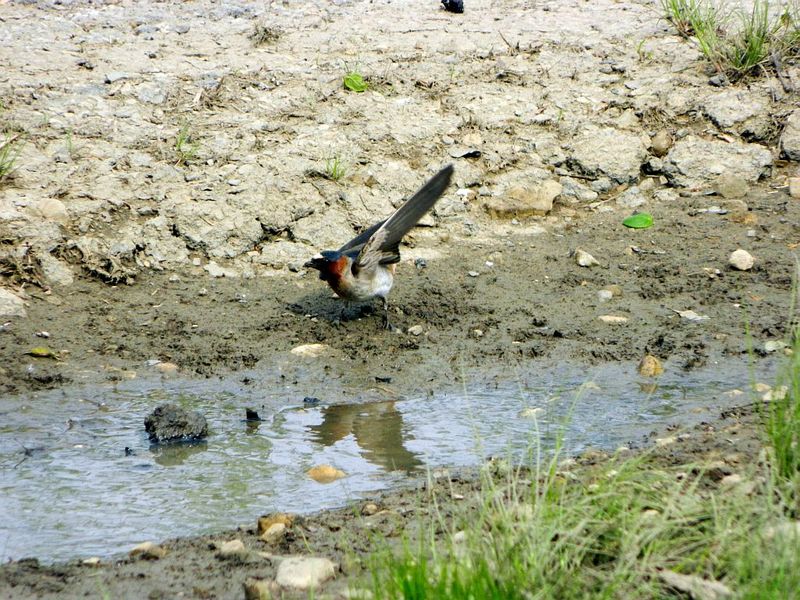
Mud is a non-negotiable building material for Barn Swallows. A pair constructing a new nest can make hundreds of trips to a mud source, carrying small pellets back to the nesting surface one at a time.
If suitable wet soil is not available within a reasonable distance, nest construction slows or stalls. NestWatch’s case study describes creating a shallow, lined depression filled with wet soil and natural clay and reports that Barn Swallows used that mud source at the monitored site.
That is supportive evidence, not a promise: providing mud can make a property more usable, but it does not guarantee that birds will arrive and build.
A practical mud station is straightforward to set up. Use a shallow container or a dug depression lined with plastic sheeting to hold moisture, fill it with garden soil mixed with clay-heavy subsoil, and keep it consistently damp during the nesting season.
Place it in an open, accessible spot not far from the intended nesting surface. Refresh it after dry spells, and empty and refill it if it starts to smell or develop algae.
Protecting the insect life on and around the property is just as relevant as providing mud. Research on Barn Swallow nestling diets confirms that the species depends on a broad, locally available supply of flying insects to feed young successfully.
Broad-spectrum insecticide applications, including yard foggers and perimeter sprays timed during the nesting season, can reduce that prey base significantly. Avoiding unnecessary pesticide use near swallow nesting and foraging areas is one of the more practical steps a homeowner can take to support the birds already present.
Water on the property can play a supporting role, but only if managed carefully. Texas Parks and Wildlife habitat guidance recommends shallow, naturalistic water features cleaned regularly to prevent mosquito establishment.
A bucket, birdbath left unchanged for a week, or a small pond with no circulation can become a mosquito-breeding site faster than most people expect, which works directly against the goal of reducing biting insects around the porch.
Plan for Droppings, Noise, and Protected Active Nests
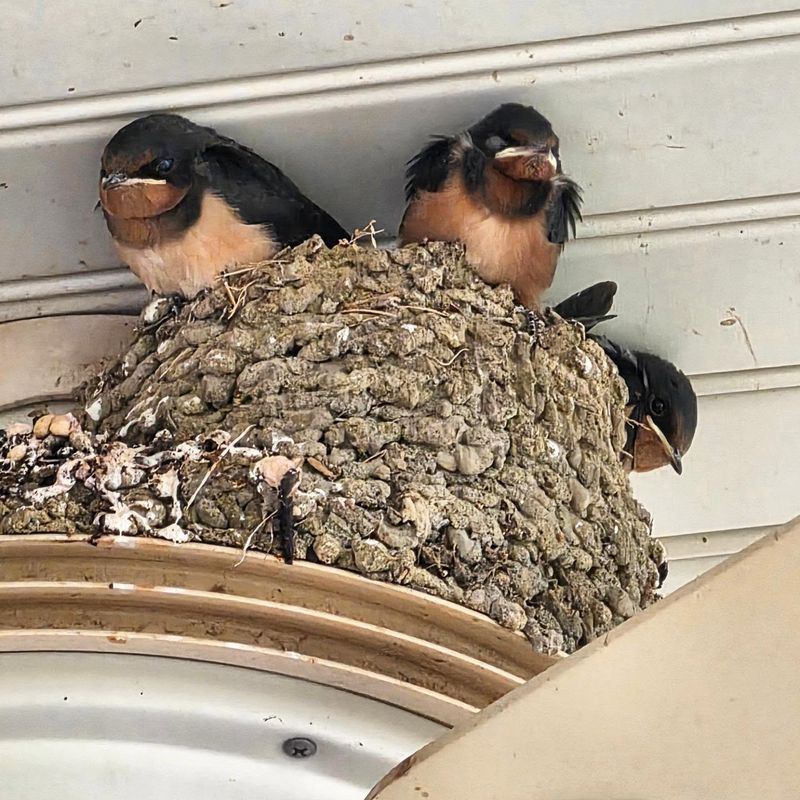
Barn Swallows are appealing neighbors in many ways, and genuinely messy ones in a few others. A nesting pair produces droppings throughout the season, and a colony of several pairs can leave a noticeable accumulation on surfaces below the nest.
Mud smeared during construction, the noise of adults calling at perceived threats, and the persistent activity near a door or walkway are all realistic tradeoffs that come with porch nesting. Knowing about them in advance makes them easier to manage without reacting in a way that harms the birds.
The most important legal point: active nests cannot be removed or disturbed. Barn Swallows are protected migratory birds listed under the Migratory Bird Treaty Act, and the federal list of protected species includes the species by name.
U.S. Fish and Wildlife Service guidance on bird nests makes clear that nests containing eggs or dependent young should not be touched.
Violations can carry significant penalties. Once a nest is empty and young birds are fully independent, the legal status changes, but homeowners should verify current federal, state, and local requirements before handling or removing an inactive nest rather than assuming what was allowed previously still applies.
Conflict prevention works better when it starts before nesting begins. If a particular spot above the front door is a perennial problem area, physical barriers such as netting or angled boards installed before birds arrive can redirect them toward a less-used location.
The U.S. Fish and Wildlife Service’s nuisance swallow guidance recommends lawful, nonlethal deterrents and cautions against chemical repellents, which can create risks for birds, pets, and people and are not appropriate for a wildlife-friendly approach.
Dropping cleanup requires a bit of care. CDC guidance on histoplasmosis prevention advises against dry sweeping or shoveling bird droppings because disturbing dry material can aerosolize fungal spores.
Wetting the area thoroughly before cleaning reduces that risk considerably. For large accumulations under a colony or any work involving demolition or renovation near old nesting sites, professional advice is worth seeking before starting.
Welcome the Bird, Not a Mosquito-Control Guarantee
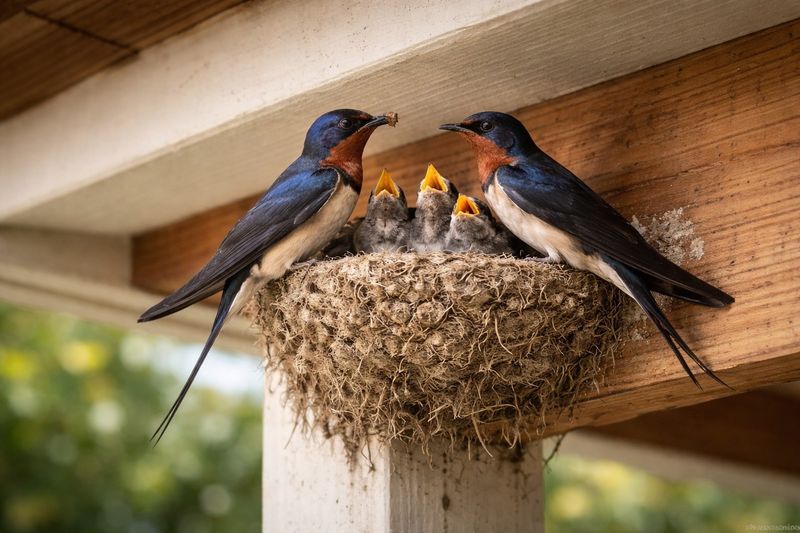
Putting all of this into practice comes down to a short, repeatable checklist. Confirm the species by tail shape and nest style before making any changes.
Mount an open-sided shelf or nest cup in a sheltered, lower-traffic spot before spring migration arrives. Keep a shallow, consistently wet mud source nearby during the nesting season.
Avoid broad-spectrum insecticide applications that would reduce the flying prey the birds need. And read up on your legal responsibilities before the season starts, because an active nest changes what you can and cannot do on your own property.
Barn Swallows are genuine aerial insectivores that consume a wide range of flying insects and add real ecological interest to a Central Texas yard. What they do not do is reliably suppress mosquito populations or reduce biting pressure around a specific porch.
Measure success by whether birds are using the habitat you provided, not by whether you notice fewer bites on a given evening.
Mosquito management still needs its own approach. The EPA’s joint mosquito control statement points to source reduction, larval control, and targeted treatments as the methods with a documented track record.
A Barn Swallow nesting under your eave is worth welcoming on its own terms, and on a quiet summer evening, watching one bank and sweep across the yard is its own reward.