

Scorpions near the front door are a real concern for Texas homeowners, and the idea of a fragrant porch plant that keeps them away sounds almost too good to be true. One laboratory study did find that striped bark scorpions avoided sand treated with rosemary essential oil, which is worth knowing about.
But a lab experiment with oil-treated sand is a long way from a potted plant on your porch, and the gap between those two things matters when you are making decisions about your home. Growing rosemary near your entryway can still make sense, as long as you understand what the research actually shows and pair that choice with the habitat and exclusion steps that pest-management experts actually recommend.
Rosemary is a research lead, not a foundation shield
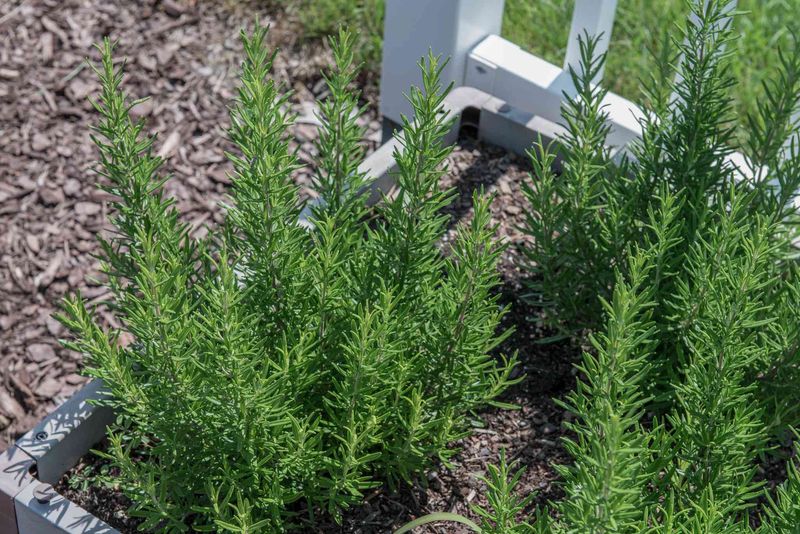
Somewhere between hopeful gardening advice and solid pest-control science, rosemary occupies an interesting but limited position. A 2019 study published in the Journal of ArachnologyCentruroides vittatus tested rosemary essential oil against 16 striped bark scorpions () that had been collected near Norman, Oklahoma.
The researchers applied rosemary oil to mineral-oil-treated sand inside a controlled laboratory arena and observed that the scorpions spent significantly more time on the untreated side. That finding is genuinely interesting, and it is the reason rosemary keeps coming up in conversations about natural scorpion deterrents.
The problem is what the study did not test. That laboratory experiment did not involve a living rosemary plant, a container on a porch, a Texas home, outdoor foundation conditions, long-term performance, or scorpion species beyond the one collected in Oklahoma.
The researchers themselves noted that future work would be needed to identify which components of rosemary oil caused the avoidance response. That is the language of a research lead, not a finished homeowner treatment.
Rosemary essential oil making scorpions uncomfortable in a controlled arena does not translate automatically to a potted plant creating a protective boundary around your foundation. Scent dispersal outdoors, soil and weather variables, and the behavioral differences between individual scorpion populations all complicate any direct comparison.
Established pest-management guidance does not include rosemary planting as a standard scorpion-exclusion practice.
The more useful question for Texas homeowners is not whether rosemary repels scorpions but how to grow a rosemary container near the porch without accidentally creating better scorpion habitat in the process. Enjoyed as an attractive, fragrant accent plant with an intriguing but unproven supplemental angle, rosemary earns a spot by the front door.
Relied on as a substitute for proven management steps, it leaves real gaps in your approach.
Choose a sunny, well-drained rosemary container
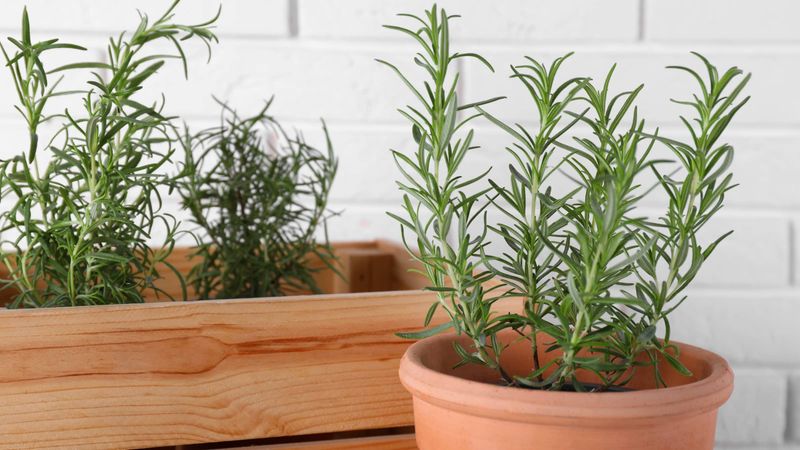
Getting rosemary to thrive in Texas comes down to two non-negotiable conditions: full sun and excellent drainage. Texas A&M AgriLife Extension identifies overwatering and poor drainage as the most common reasons rosemary fails in Texas gardens.
A container with drainage holes and a fast-draining potting mix solves most of that problem, which is one reason a pot on a sunny porch actually suits rosemary better than a soggy in-ground spot.
Rosemary comes in upright and prostrate forms, and the choice matters for placement. Upright varieties grow tall and columnar, making them easier to tuck beside a door or step without sprawling.
Prostrate types spread low and wide, which can look attractive cascading from a raised planter but may require more lateral space. Texas A&M’s herb guidance notes that both forms are available and that variety selection, soil, and local climate all influence how well any rosemary planting performs.
Position the container in a spot that gets at least six to eight hours of direct sun each day. Texas summers push temperatures well past what many herbs tolerate, but rosemary handles heat well when air circulates freely around the foliage.
Avoid tucking the pot into a shaded corner or pressing it flush against the house wall, where moisture can collect and airflow drops.
Leave a visible gap between the container and the foundation, wide enough that you can see and inspect the strip of ground along the base of the house. Texas A&M’s herb landscape guide reinforces that climate and drainage conditions vary across the state, so growers in humid East Texas may need to be more aggressive about drainage than those in drier West Texas.
Treat the container as an accent in a deliberate, open placement, not as part of a dense planting cluster that obscures the foundation edge.
Keep the foundation edge clear of hiding places
A rosemary container placed thoughtfully near the porch can look great and carry that unproven supplemental angle. One placed carelessly, surrounded by stacked pots, old boards, or a pile of firewood, cancels out any possible benefit and actively creates better scorpion habitat.
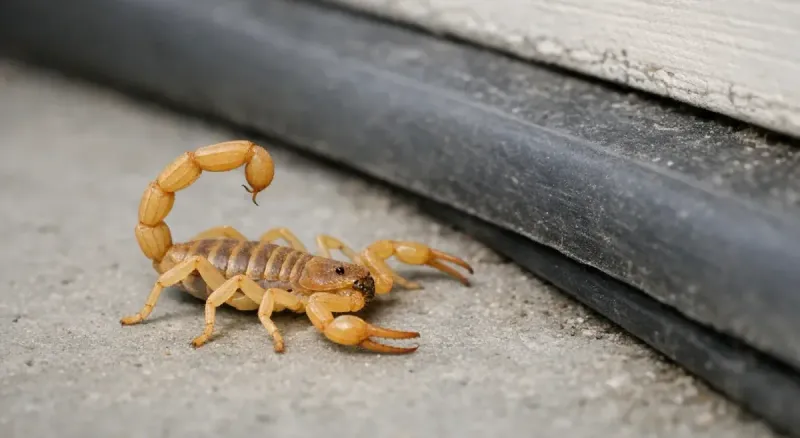
Scorpions are daytime hiders. They shelter under boards, stones, bricks, logs, leaf litter, and debris, then come out at night to hunt.
UC IPM’s scorpion guidance specifically recommends removing trash, logs, boards, stones, and bricks from around the foundation as a primary management step.
Walk the perimeter of your house and pull anything away from the base of the wall that a scorpion could hide beneath or behind. Firewood stacked against the house is a common problem.
Move it to a rack away from the structure, ideally elevated off the ground. Stones used decoratively along a foundation bed create exactly the kind of cool, shaded hiding spots that scorpions use during the heat of a Texas afternoon.
If you want a border, keep it sparse and inspectable rather than dense and covered.
University Extension scorpion research confirms that scorpions feed on insects, spiders, centipedes, and other arthropods, so areas with abundant insect activity near the house attract scorpion foraging. Dense, shaded, or damp planting near the foundation creates exactly those conditions.
A rosemary container kept well-drained and positioned with airflow around it does not add the kind of moist, shaded cover that makes foundation edges attractive to scorpions, but any plant placed poorly can.
The goal is a foundation strip that stays open, dry, and visible. You should be able to run a flashlight along the base of your house at night and see clearly what is there.
Anything that breaks up that sightline, whether a dense shrub, a stack of empty pots, or a bag of mulch leaning against the wall, is worth relocating. Rosemary earns its spot at the porch by fitting into that open, inspectable setup rather than cluttering it.
Seal the routes that bring scorpions indoors
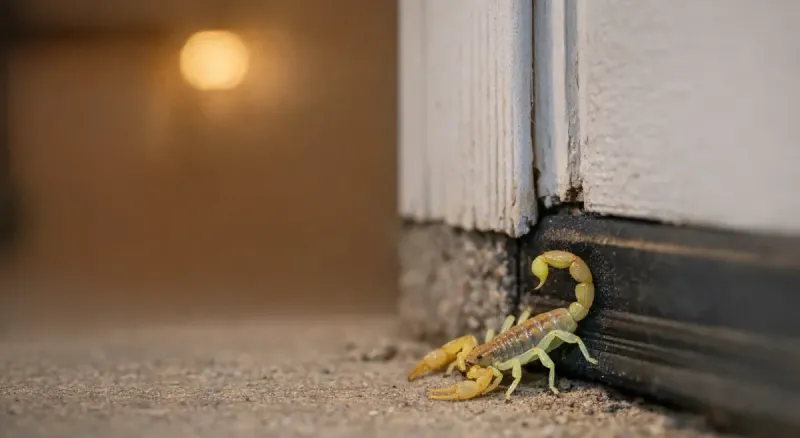
Cleaning up the foundation edge reduces the places scorpions shelter near your house. Sealing the house itself reduces how often one makes it inside.
Both steps work on different parts of the same problem, and the sealing side is where a lot of Texas homeowners find the most direct payoff.
Caulk every gap you can find around the foundation, along the base of exterior walls, around pipe and conduit penetrations, and along eaves where materials meet at angles. Weatherstrip the bottom of exterior doors so there is no visible gap when the door closes.
Repair or replace any window or door screen that has holes or does not seat tightly in the frame. UC IPM recommends all of these exclusion steps as part of a complete approach to keeping scorpions out of structures.
Outdoor lighting is worth adjusting as well. Standard white bulbs attract flying insects at night, and more insects near the house means more prey for scorpions foraging along the foundation.
Switching to yellow outdoor bulbs in areas where scorpions are common is a practical, low-effort change that makes the porch edge less attractive to the insect activity that draws scorpions in the first place. Extension scorpion guidance identifies prey reduction as part of a sound management approach.
Tree branches that reach the roofline are another entry route worth checking. Scorpions can travel along branches and access the roof, then find their way down through gaps around eaves or attic vents.
Pruning branches back from the house removes that pathway without any chemical involvement.
The EPA’s integrated pest management framework emphasizes identifying the pest, preventing conditions that support it, monitoring for activity, and acting based on actual need rather than treating automatically on a schedule. Applying that approach to scorpions means doing the habitat and exclusion work first, monitoring regularly, and treating only when monitoring shows a real and persistent problem.
These are the recommended, better-supported practices for reducing scorpion encounters around the home.
Monitor the porch after dark and remove visitors safely
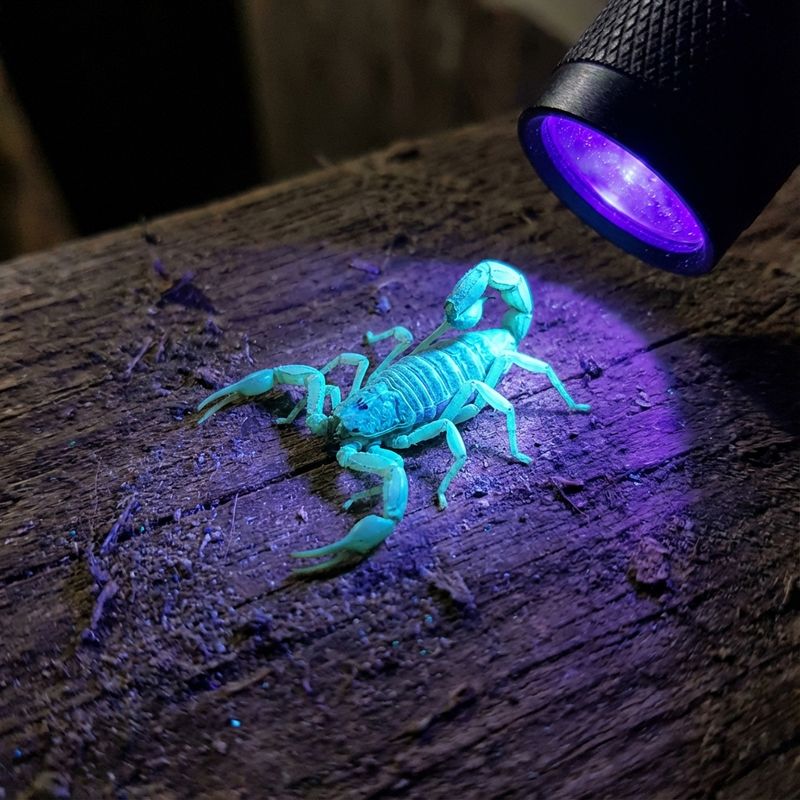
Scorpions are nocturnal, which means the most useful inspection of your porch and foundation happens after sunset. A portable ultraviolet light makes that job much easier.
Scorpions fluoresce under UV light, glowing a distinctive greenish color against the ground, and that glow is visible from several feet away in the dark. UC IPM identifies UV flashlights as a practical tool for locating scorpions during nighttime surveys around the home.
An inexpensive UV flashlight from a hardware store is all you need.
Walk the foundation perimeter, the porch, the area around any containers or plantings, and any spots where debris might have accumulated. Make a habit of doing this a few times per season, especially during the warmer months when scorpions are most active in Texas.
If you find one, do not pick it up. Place a glass jar over the scorpion, then slide a piece of heavy cardstock or stiff paper underneath to trap it, and carry it well away from the house before releasing it.
Long forceps or another long-handled mechanical tool work equally well for anyone who prefers more distance.
Yard work in areas where scorpions might shelter deserves the same caution. Wear gloves and closed-toe shoes whenever you are moving debris, turning over boards, or working in dense ground cover near the foundation.
University Extension guidance recommends gloves and protective footwear as standard practice for this kind of work. Scorpions hide well and strike quickly when disturbed, so protective gear is a simple and reliable precaution.
If a sting does occur, the reaction matters. Most healthy adults experience local pain and swelling that resolves on its own.
However, anyone with severe symptoms, unusual neurological effects, difficulty breathing, or symptoms that worsen rather than improve should contact Poison Control (1-800-222-1222) or seek emergency medical care right away. Children, older adults, and anyone with underlying health conditions face greater risk and should receive prompt medical evaluation after any sting.
Do not wait to see how it develops if the symptoms seem serious.
Build a scorpion-aware entryway without overpromising
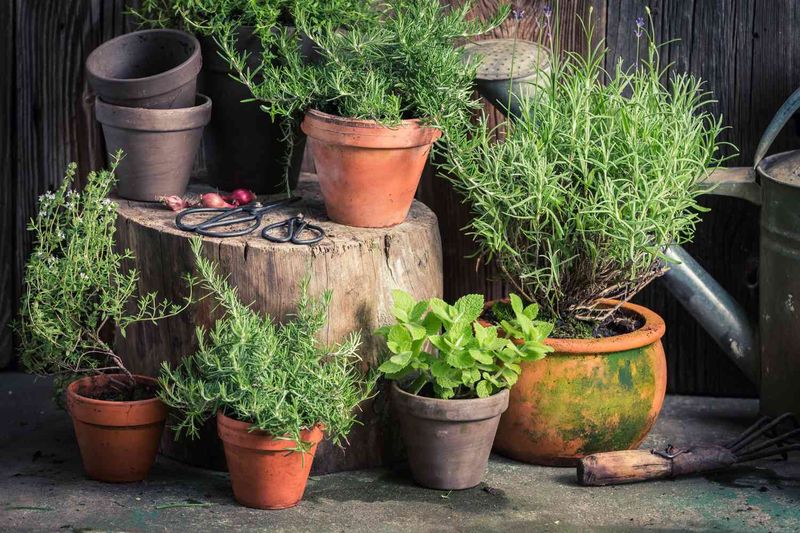
Putting this all together at the front door looks like a specific set of choices rather than a single hero plant doing all the work. Grow rosemary in a sunny, well-drained container positioned near but not against the porch, where it gets good airflow and leaves the foundation strip open and inspectable.
Enjoy it for what it genuinely offers: a hardy, fragrant Texas-appropriate plant with an intriguing laboratory finding behind it and no field evidence that it changes scorpion behavior outdoors.
Pair that container with a foundation edge that is clear of debris, boards, stones, and stacked objects. Seal the cracks and gaps around your foundation, pipes, and door frames.
Switch to yellow outdoor lighting near the porch. Check the area with a UV flashlight a few times each warm-season month.
EPA’s integrated pest management approach frames all of this correctly: monitor, prevent, and act based on what you actually find rather than treating on a fixed schedule.
The rosemary-oil laboratory result supports curiosity and further research, not a guarantee. The realistic goal here is fewer unwanted encounters near the home, not a scorpion-free yard.
Scorpions are predators with an ecological role, consuming insects and other arthropods well beyond your porch, and a well-managed entryway simply makes your foundation edge a less convenient place for them to spend time. A rosemary plant that smells good, grows well in Texas sun, and sits in an open, clean, well-lit entry does exactly what the evidence supports, which turns out to be plenty.