
English ivy looks tidy when you first plant it along a fence, but it has a way of turning into a serious problem before most homeowners realize what happened. Across North Carolina, this invasive vine spreads into natural areas, smothers native plants, and climbs trees in ways that can stress or damage them over time.
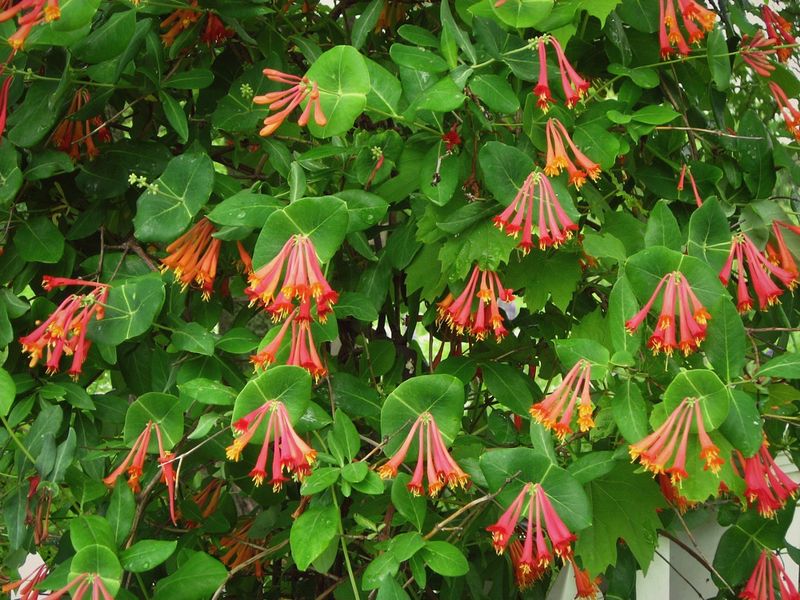
Coral honeysuckle (Lonicera sempervirens) offers a more regionally appropriate native alternative that attracts hummingbirds, feeds songbirds, and stays on a support structure without the same invasive footprint. Swapping one for the other takes some planning, but the payoff for your yard and local wildlife is worth understanding.
English Ivy Creates an Invasive Fence-Line Problem
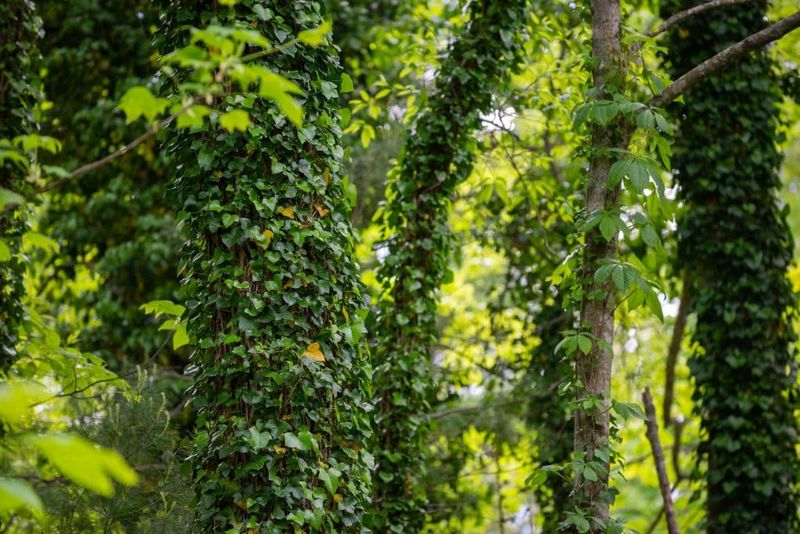
Few plants look as reliably green as English ivy (Hedera helix) crawling along a fence in early spring, but that tidy appearance hides a growing management burden. The North Carolina Forest Service lists English ivy as an invasive vine, meaning it competes with native vegetation rather than supporting the regional ecosystem.
The groundcover problem develops quickly. Ivy spreads by rooted stem pieces and by seeds dispersed in bird droppings, so a fence planting can become a dense mat across the yard, garden beds, and into neighboring natural areas before a homeowner notices.
That thick mat shades out native wildflowers, ferns, and seedlings that would otherwise support local insects and wildlife.
Tree climbing is where the risks become more visible. Ivy attaches to bark using adhesive rootlets, and once established in the canopy it adds weight, increases wind resistance, and shades the tree’s own foliage.
U.S. Forest Service research on Hedera helix documents these stresses, though outcomes vary with tree condition, vine load, and site.
Not every ivy-covered tree will fail, but heavy infestations raise the risk of branch damage and windthrow.
Fence management is its own headache. Ivy’s adhesive rootlets grip wood, paint, and metal fasteners, making the vine difficult to remove cleanly and sometimes concealing deterioration underneath.
Replacing a fence section that has been covered for years often reveals rotted rails or rusted hardware that the ivy hid from view.
Some birds do eat English ivy’s late-season berries, so calling it completely worthless to wildlife would be inaccurate. Still, its invasive status and the management burdens it creates make it a poor choice for a North Carolina fence line when a native alternative exists.
Choose Coral Honeysuckle by Its Scientific Name
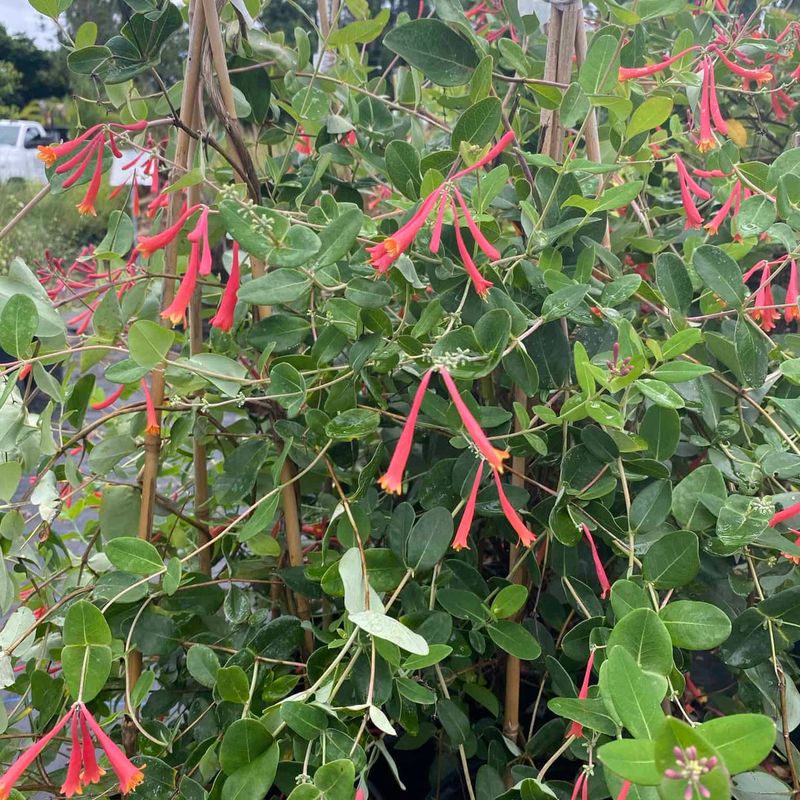
Coral honeysuckle (Lonicera sempervirens) is the vine to look for when you want a native replacement for English ivy on a North Carolina fence. Native to the state and perennial across the Coastal Plain, Piedmont, and Mountains, it climbs by twining its stems around a support rather than gripping surfaces with adhesive rootlets the way English ivy does.
That difference matters: a twining vine can be unwound and redirected, while an adhesively attached vine leaves marks and damage behind when removed.
NC State Extension describes coral honeysuckle as a vigorous perennial that typically reaches 10 to 20 feet and suits fences, trellises, and arbors. Vigorous is the right word: this vine grows with purpose, and it needs a defined support structure and periodic attention to stay where you want it.
Twining does not mean tame, and the vine should not be planted and forgotten.
One buying caution deserves emphasis. The common name “honeysuckle” covers several species, and not all of them belong in a North Carolina yard.
Japanese honeysuckle (Lonicera japonicaLonicera sempervirens) is invasive in North Carolina and can cause the same kind of ecological disruption as English ivy. When you shop at a nursery or order online, confirm the label reads before purchasing.
A friendly common name on a tag is not enough to verify you have the right plant.
Coral honeysuckle is also sometimes sold as trumpet honeysuckle or woodbine, so keeping the scientific name in mind protects against mix-ups. A reputable native-plant nursery or NC State Extension Master Gardener program can help verify the species before you bring it home.
Coral Honeysuckle Offers Native Nectar and Fruit
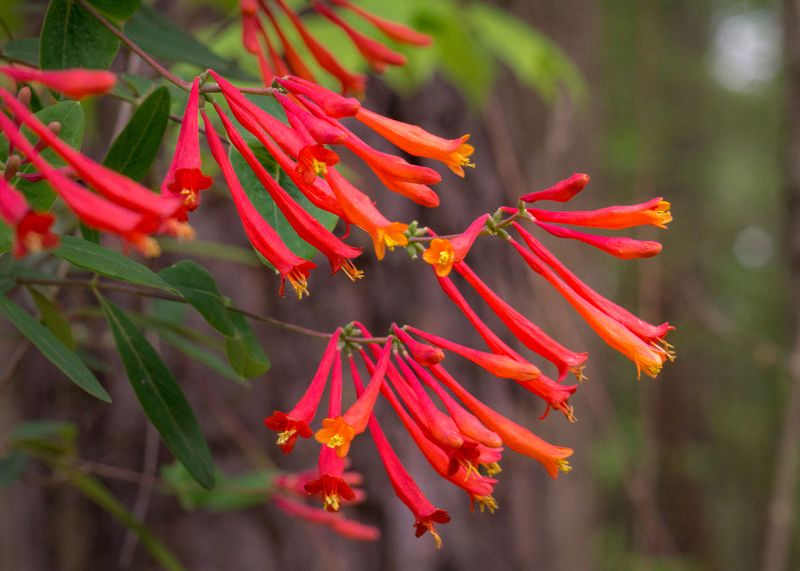
The flowers are the first thing most people notice. Coral honeysuckle (Lonicera sempervirens) produces clusters of red to orange-red tubular blooms that are shaped almost perfectly for a ruby-throated hummingbird’s bill.
Audubon recognizes coral honeysuckle as a documented hummingbird plant, and the flowers also attract bees, butterflies, and some moths that forage for nectar. Bloom time typically runs from spring into summer, with repeat flowering possible on established vines.
After the flowers drop, small red berries follow in summer or fall. NC State Extension identifies the berries as a food source for songbirds, and Audubon specifically names finches and American robins among the birds that may eat them.
The berries are not edible for people, and they should not be presented as a garden food crop. Their value is wildlife-facing, not culinary.
A fair comparison with English ivy is worth making here. Ivy does produce berries that certain birds eat, so saying it has no wildlife value would be misleading.
U.S. Forest Service species review material notes that European starlings are among the primary consumers of ivy fruit in the literature, and the overall native wildlife value is characterized as limited.
Coral honeysuckle provides nectar and fruit that are more regionally appropriate for North Carolina’s native hummingbirds and songbirds.
One vine will not create complete bird habitat by itself. NC State Extension’s wildlife landscaping guidance emphasizes using a range of native species alongside water sources, shelter plantings, and insect-supporting vegetation.
Coral honeysuckle contributes one useful piece of that habitat puzzle, particularly for hummingbirds and berry-eating songbirds, but a diverse native yard will always do more for wildlife than any single plant.
Match the Vine to the Fence and North Carolina Site
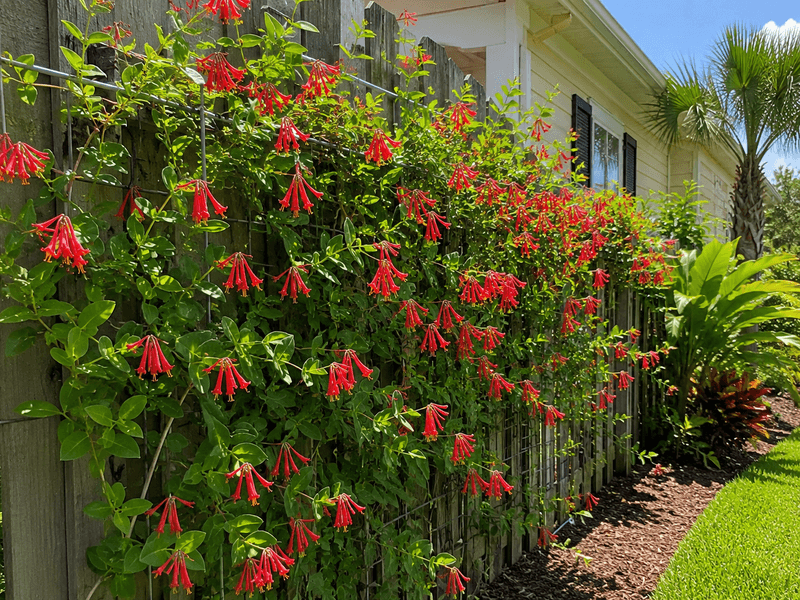
Placing coral honeysuckle (Lonicera sempervirens) in the right spot determines how well it performs. Full sun produces the strongest flowering, so a fence with at least six hours of direct light daily is the best starting point.
NC State Extension confirms the vine tolerates some shade but notes that flowering declines as light decreases, which means a shaded fence section may support the vine without producing the hummingbird-attracting bloom display you want.
Soil preference is medium moisture with good drainage. Coral honeysuckle handles the clay-heavy soils common in the NC Piedmont reasonably well, and it grows across the Coastal Plain and Mountains too, making it broadly adaptable across the state’s regions.
Avoid low spots where water pools after rain, because consistently wet roots can weaken the plant over time.
Plan for reach. The vine typically grows 10 to 20 feet, so a short decorative fence may not contain it without regular trimming.
A taller privacy fence, a sturdy post-and-rail structure, or a dedicated trellis gives the vine room to grow without immediately spilling into adjacent beds or shrubs. Think about what sits on either side of the fence before you plant.
Screening expectations need to be set honestly. Coral honeysuckle behaves as an evergreen in warm-winter Deep South conditions, but across much of North Carolina it is likely to drop some or most of its leaves during winter.
Gardeners who want a solid year-round privacy wall will need a different plant or a structural fence behind the vine. Coral honeysuckle works best as a seasonal feature that delivers its strongest show during the warmer months when hummingbirds are present.
Train and Prune the Twining Growth
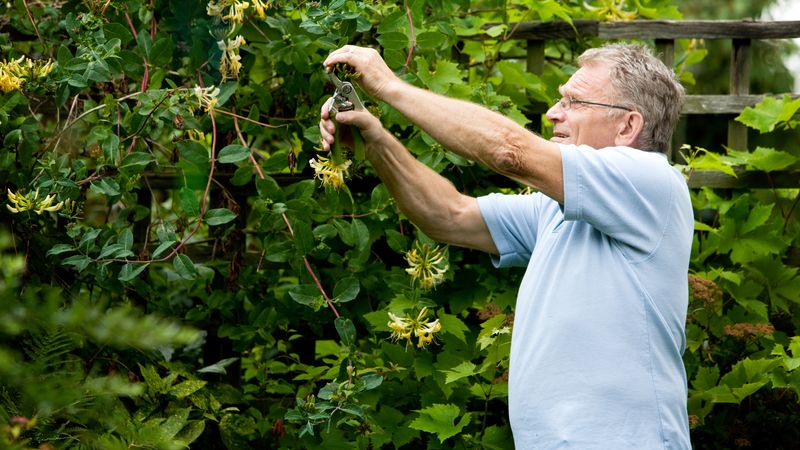
Coral honeysuckle (Lonicera sempervirens) described as low-maintenance is accurate compared to fighting English ivy’s invasive spread, but low-maintenance is not the same as no maintenance. The vine twines actively and will reach for whatever is closest, including nearby shrubs, small trees, and adjacent fence sections.
Regular attention keeps it on its intended support rather than tangling into surrounding plants.
Start by providing a sturdy structure. Lightweight wire or thin wooden stakes will not hold a mature vine that has been growing for several seasons.
A solid fence, a wood or metal trellis anchored to posts, or a well-built arbor gives the stems something substantial to grip. NC State Extension advises pruning coral honeysuckle after flowering because the plant blooms on new growth, and cutting before flowering would remove the buds you are waiting for.
During the growing season, check the vine every few weeks and redirect any stems that have wandered off the support. Gently unwinding a new stem and guiding it back to the fence takes a minute or two and prevents the tangled mess that develops when growth goes unchecked for months.
Training and trimming help reduce unwanted tangling but cannot guarantee the vine will never reach a neighboring plant, especially in a season with strong growth.
NC State Extension notes that even native vines, including trumpet creeper and greenbrier, can become troublesome when they tangle through shrubs and trees. Coral honeysuckle is better-behaved than many, but it shares the same basic vine habit.
A light trim once or twice a season, combined with consistent training of new stems, is a realistic maintenance commitment for a healthy fence planting.
Remove English Ivy Without Pulling at Bark or Structures
Before planting coral honeysuckle (Lonicera sempervirens), most North Carolina homeowners with an existing ivy problem need a removal plan. Start at the fence itself.
Pull or cut ivy away from posts, rails, fasteners, and any painted surfaces, then inspect what the vine was hiding. Oregon State University Extension’s ivy-removal guidance warns that long-established ivy can conceal or contribute to structural deterioration, so check for rotted wood, rusted hardware, and peeling paint before assuming the fence is still sound.
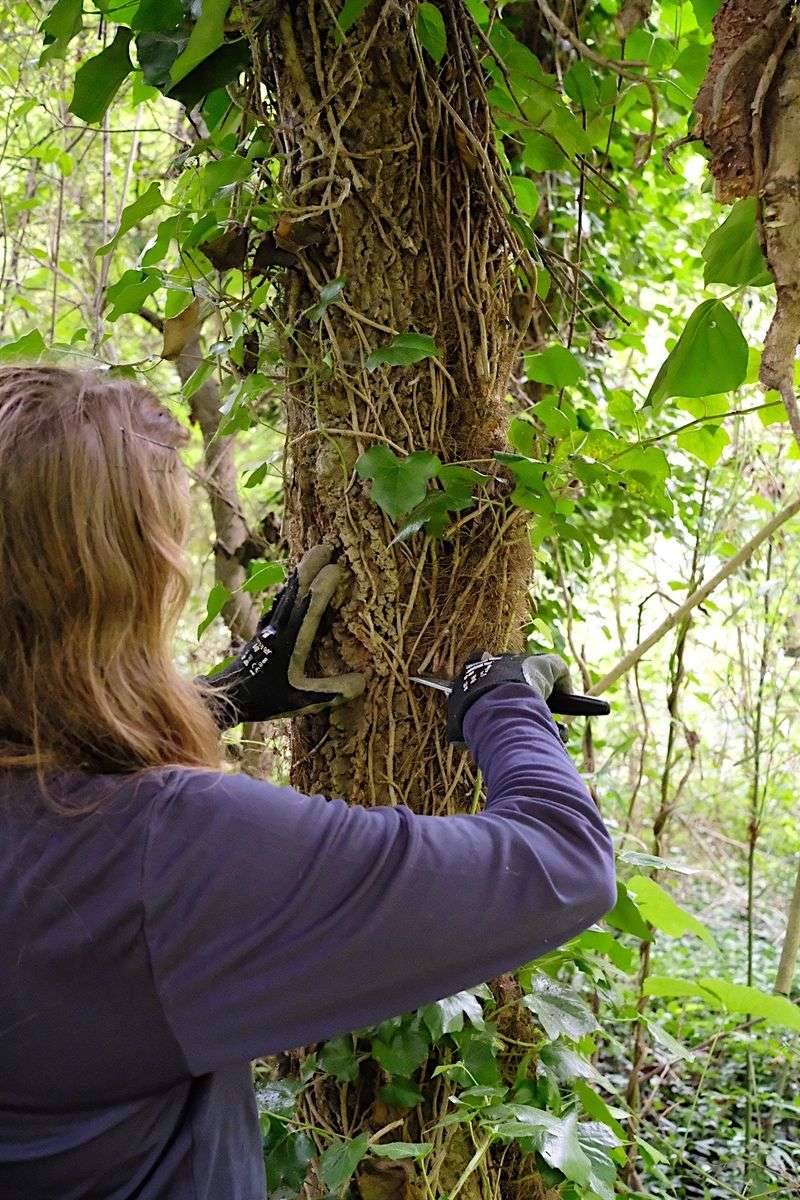
For ivy that has climbed a tree, the removal sequence matters. NC State Extension’s urban ivy management guidance instructs homeowners to cut the climbing stems at the base of the tree, creating a gap that starves the upper growth.
Remove only the vines you can safely reach from the ground or a stable ladder. Vines already in the canopy should be left to dry out and die rather than forcibly pulled from the bark.
Yanking established stems from a tree can strip bark, damage cambium, and create wounds that invite disease or pest problems.
Wear gloves throughout this process. Some people develop a contact rash from English ivy’s sap, and gloves also protect hands from sharp hardware you may encounter under the ivy mat.
Long sleeves are a reasonable precaution for sensitive skin.
Disposal requires care. Ivy cuttings can reroot from stem pieces, so placing them in a home compost pile risks spreading the plant rather than eliminating it.
Bag the cuttings or pile them for municipal yard-waste pickup, where commercial composting temperatures are high enough to prevent rerooting. Where yard-waste pickup is not available, check with your county extension office for approved disposal options before leaving piles on the ground.
Set Fire-Safety and Species Boundaries
Buying the correct plant is the first boundary to set. Japanese honeysuckle (Lonicera japonica) is invasive in North Carolina and causes many of the same ecological problems as English ivy, including dense groundcover, competition with native plants, and rapid spread.
Nursery tags sometimes read only “honeysuckle,” which is not specific enough. Confirm the label says Lonicera sempervirens before purchasing, and buy from a reputable native-plant nursery whenever possible.
Native status does not make a vine automatically tame. NC State Extension points out that native vines including trumpet creeper and poison ivy can become troublesome when they are not managed.
Coral honeysuckle (Lonicera sempervirens) is a more appropriate and regionally valuable choice than English ivy, but it still needs a defined support and regular pruning to stay manageable.
Fire safety is a non-negotiable placement concern. NC State Extension rates coral honeysuckle as highly flammable, and the NC Forest Service fire-resistant landscaping guidance advises keeping flammable vegetation out of a home’s defensible space.
Do not plant coral honeysuckle directly against a house wall, immediately beside a wooden deck, or near propane tanks or outdoor grills. A fence line at the yard’s perimeter, well away from structures, is a safer placement than a trellis attached to the siding.
Two additional facts help set realistic expectations. The berries are inedible for people and should not be tasted or presented as a garden food source.
Coral honeysuckle also offers no documented pest-control benefit: its value to the yard is nectar for hummingbirds and pollinators, fruit for some songbirds, and native-plant contribution to the local ecosystem, not tick or mosquito reduction.
Make the Native Swap With Realistic Expectations
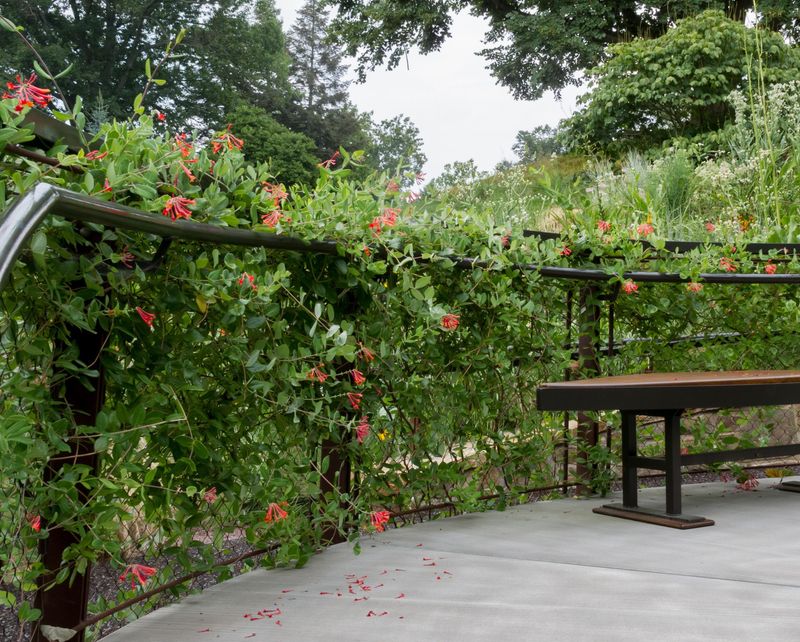
The decision rule for this swap is straightforward. Remove or contain existing English ivy, choose coral honeysuckle (Lonicera sempervirens) from a labeled native-plant source, give it a sturdy support and a sunny, well-drained site, and commit to training new growth and pruning after flowering each season.
NC State Extension confirms coral honeysuckle suits all three of North Carolina’s major regions, so the vine works whether you garden in the Coastal Plain, Piedmont, or Mountains.
The honest payoff is a native fence vine that provides nectar for ruby-throated hummingbirds and pollinators, fruit for some songbirds, and a growth habit that does not spread invasively through your yard and into natural areas. It is not a perfect privacy screen, it is not maintenance-free, and one vine will not build complete bird habitat on its own.
Those are the right expectations to carry into the project.
NC State Extension’s native landscaping guidance encourages pairing vines like coral honeysuckle with a broader mix of native shrubs, trees, perennials, water sources, and insect-supporting plants to build a yard that genuinely supports local wildlife. Coral honeysuckle is a good starting point for the fence line, but the more native diversity you add around it, the more your yard works for North Carolina’s birds, pollinators, and broader ecosystem.
A fence covered in a regionally native vine, trained and tended with some care, is already a meaningful step in the right direction.