
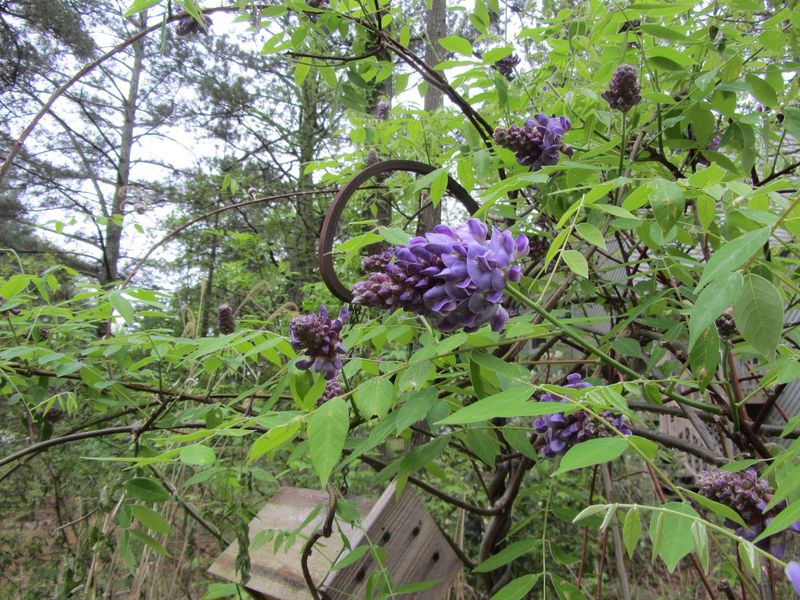
Every spring, those long purple flower clusters on wisteria vines make homeowners want to fill their own arbors and fences with the same look. The problem is that the most common wisterias sold for years, Chinese wisteria and Japanese wisteria, are invasive in North Carolina and can take over a yard far beyond any trellis.
Fortunately, a native alternative gives you a similar ornamental effect without the same runaway risk, and a second native vine adds serious wildlife value to the mix.
Invasive Asian wisterias can overwhelm the planting site
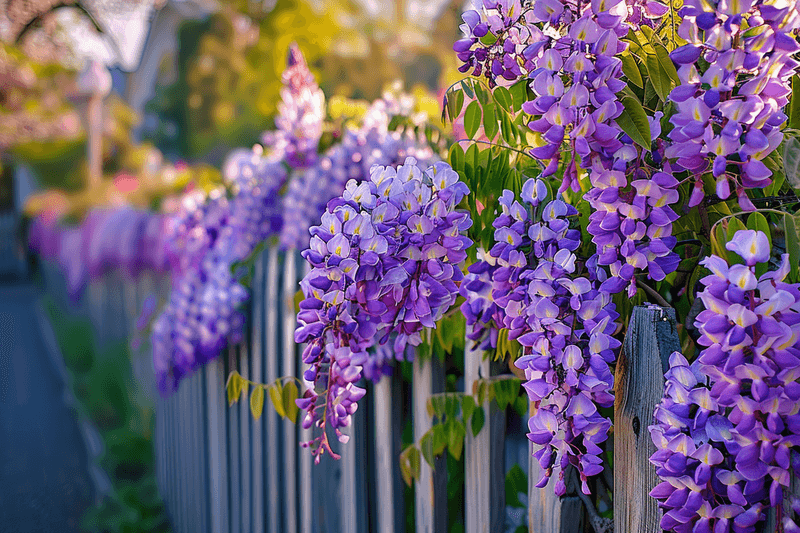
Few ornamental vines have the visual pull of a wisteria in full bloom. The long, cascading flower clusters, the way they drape over an arbor or fence, and the heady fragrance make Chinese wisteria (Wisteria sinensis) and Japanese wisteria (Wisteria floribunda) perennial favorites at garden centers.
The appeal is real, and it explains why so many North Carolina homeowners planted them for decades without a second thought.
The documented problems, though, are serious enough to warrant a different choice. NC State Extension identifies Chinese wisteria as invasive in North Carolina, describing it as a rapid-growing vine that can form dense thickets and requires regular pruning just to keep it from spreading beyond its intended spot.
Left unchecked, it does not simply fill a trellis and stop there.
The reach of invasive Asian wisterias goes well beyond a garden boundary. USDA Forest Service research on nonnative wisterias describes how these high-climbing vines can cover shrubs and trees entirely, spread through runners that root at nodes, and form growth dense enough to shade and smother the vegetation underneath.
A vine that looks contained on a fence in year three may be climbing a nearby oak by year seven.
NC State’s wildlife landscaping publication lists both Chinese and Japanese wisteria among invasive vines that can displace native plants and reduce the habitat value of a landscape over time. The practical lesson here is that a vine can provide striking visual coverage while simultaneously exceeding every boundary a homeowner intended.
Choosing the right species from the start is far easier than managing an established invasive one later.
American wisteria offers the closest native wisteria-like alternative

When the goal is a native vine that echoes the ornamental character of wisteria without the invasive track record, American wisteria (Wisteria frutescens) is the strongest candidate. Native from Virginia and Illinois south through Florida and Texas, it grows naturally across much of the Southeast, including North Carolina.
NC State Extension describes American wisteria as less aggressive than Chinese wisteria and suitable for trellises, arbors, and fences where a large, ornamental vine is wanted.
One regional detail matters before planting: NC State reports that American wisteria is common on the Coastal Plain but relatively rare in the Piedmont. That does not make it a wrong choice for Piedmont gardeners, but it does mean site conditions, specifically full sun and moist, well-drained soil, matter more than simply knowing the plant is native to the state.
Match the plant to the actual conditions of your yard, not just to a state boundary.
NC Sea Grant’s Plant This Instead guide specifically names American wisteria as the recommended swap for invasive Chinese and Japanese wisteria, listing it at roughly 15 to 40 feet tall and describing it as nonaggressive compared with its invasive relatives. That range is wide enough to make it a genuinely large vine, not a token substitute, but the nonaggressive label is meaningful.
It does not self-propagate through a landscape the way Chinese wisteria does through suckering runners.
For gardeners who want a more compact footprint or a vine with somewhat less pruning pressure, the cultivar ‘Amethyst Falls’ is worth seeking out. NC State’s Extension Gardener profile of ‘Amethyst Falls’ presents it as having a more restrained growth habit than Chinese wisteria, making it a practical option for homeowners working with a smaller support or a tighter space.
It still needs training and pruning, but its footprint is easier to manage than the straight species at its upper size range.
Replace the promise of fast coverage with realistic growth expectations
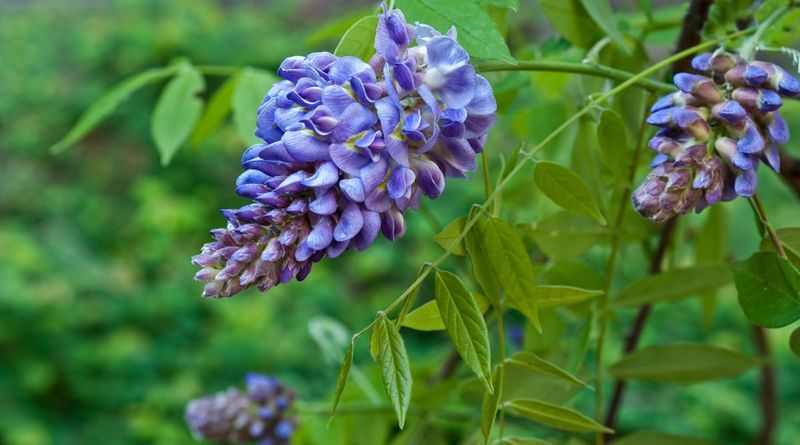
American wisteria is a vigorous vine that can provide substantial coverage over time, and that is a genuinely useful quality. What the evidence does not support is promising that it will cover a structure as quickly as invasive Asian wisteria or deliver the kind of instant privacy that some homeowners picture when they hear the word “wisteria.” Separating those two ideas, growth potential versus growth speed, helps set realistic expectations before the plant goes in the ground.
NC State’s profile of American wisteria notes that flowering may begin in the second or third year, and sometimes later, depending on the plant’s size at purchase, the cultivar, sun exposure, soil moisture, and how well it establishes in its first season. A vine that is putting energy into root development in year one is not going to race up a 10-foot trellis by fall.
That is normal, not a failure.
Vegetative coverage and flowering are also two separate timelines. A plant can leaf out and begin climbing well before it produces its first bloom, so a vine that looks healthy and is covering its support may still be a year or more away from flowering.
NC State’s overview of the wisteria genus notes that American wisteria’s flower clusters appear after the foliage develops, unlike the before-leaf bloom that makes Asian wisterias so visually dramatic in early spring. The clusters are also shorter than those of Chinese or Japanese wisteria, which is worth knowing if the cascading-flower look is a primary goal.
Chinese wisteria is documented as rapid-growing, and that speed is part of what makes it so problematic as an invasive. American wisteria’s more measured pace is a feature, not a flaw, but it does mean patience is part of the planting plan.
Think of it as a multi-season project rather than a same-year transformation.
Give American wisteria sun, moisture, and a support built for weight
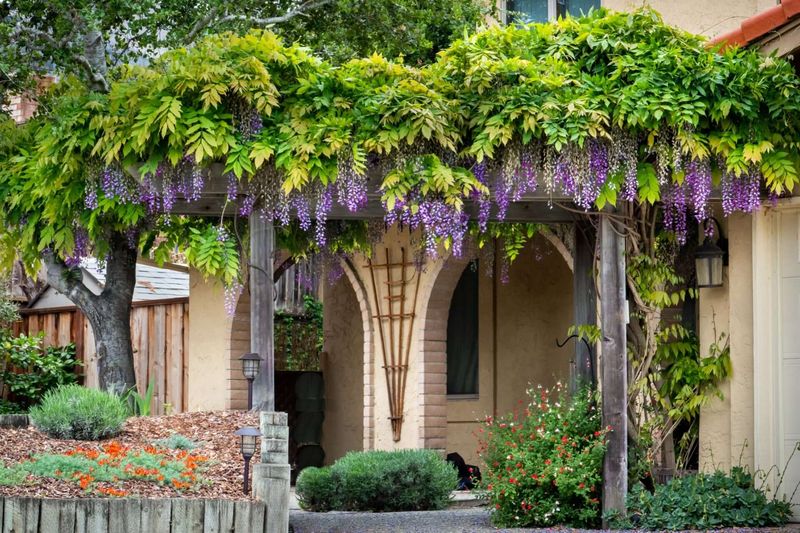
Getting the planting conditions right from the start determines how well American wisteria performs over the years. NC State Extension specifies full sun and moist, well-drained soil as the key requirements.
A spot with less than six hours of direct sun daily will limit growth and reduce flowering significantly. American wisteria cannot grow in full shade, so a shady fence line or a north-facing wall is the wrong location regardless of how sturdy the support is.
The support structure itself deserves as much planning as the planting location. A vine that can reach 40 feet or more and carry years of accumulated woody growth is heavy, and a lightweight trellis or a fence not built for that load will eventually show the strain.
A sturdy freestanding pergola, a heavy timber arbor, or a reinforced fence designed for climbing plants gives the vine a framework it can use for decades without buckling. Build or select the support with the vine’s mature size in mind, not just its size at planting.
One of the most important placement decisions is keeping the support away from the house itself. NC State warns that heavy wisteria growth can strain structures and that vines trained directly onto a building may damage gutters, shutters, awnings, siding, and other components over time.
A freestanding structure positioned several feet away from the house preserves the visual effect of a large, flowering vine without putting the building at risk.
NC Sea Grant’s eco-friendly planting guide reinforces the moist-soil requirement and notes the plant’s preference for conditions common in the Coastal Plain. If your Piedmont or mountain site has drier or heavier clay soil, amending the planting area and maintaining consistent moisture during establishment will improve the vine’s chances of thriving on its support rather than struggling in the ground beneath it.
Regular pruning keeps native vigor manageable
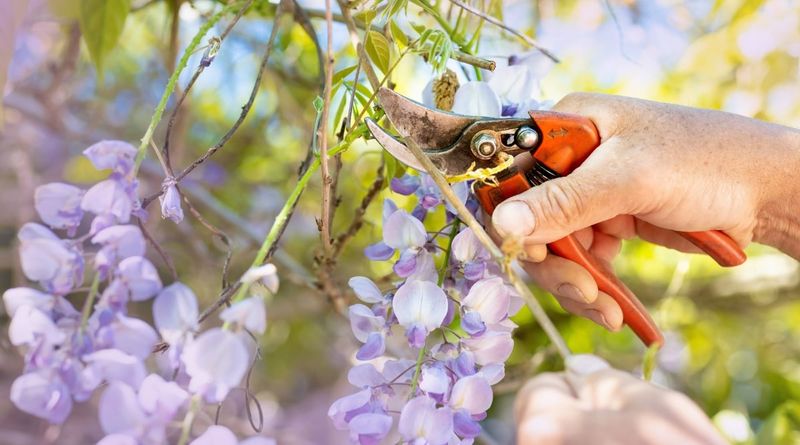
American wisteria being less aggressive than Chinese wisteria does not mean it runs itself. Without regular pruning and training, a vigorous vine that can exceed 40 feet will eventually reach beyond its support, work into nearby shrubs or trees, and become harder to manage than it was in its first few seasons.
Lower aggression is a relative term, not a guarantee of low maintenance.
NC State’s American wisteria profile makes clear that the plant requires regular pruning to keep it in bounds and performing well. Pruning serves two purposes at once: it keeps the vine within the footprint of its support, and it directs the plant’s energy toward flowering rather than endless vegetative spread.
A vine that is allowed to run unchecked will put most of its resources into new shoots rather than blooms.
The ‘Amethyst Falls’ cultivar profile from NC State Extension presents it as a choice that reduces some of the pruning pressure compared with Chinese wisteria, but the underlying expectation of ongoing maintenance still applies. Choosing a more restrained cultivar buys you a more forgiving vine, not a hands-off one.
Training matters alongside pruning. NC State’s wisteria genus overview notes that vines should be guided onto their support from the start rather than left to find their own path.
Redirecting a shoot early takes seconds; cutting back a thick, misdirected stem that has grown into a fence or wrapped around a downspout takes considerably more effort. The practical habit to build is checking the vine a few times during the growing season and redirecting or trimming any growth heading somewhere it should not go.
Choose coral honeysuckle for a different native screening role
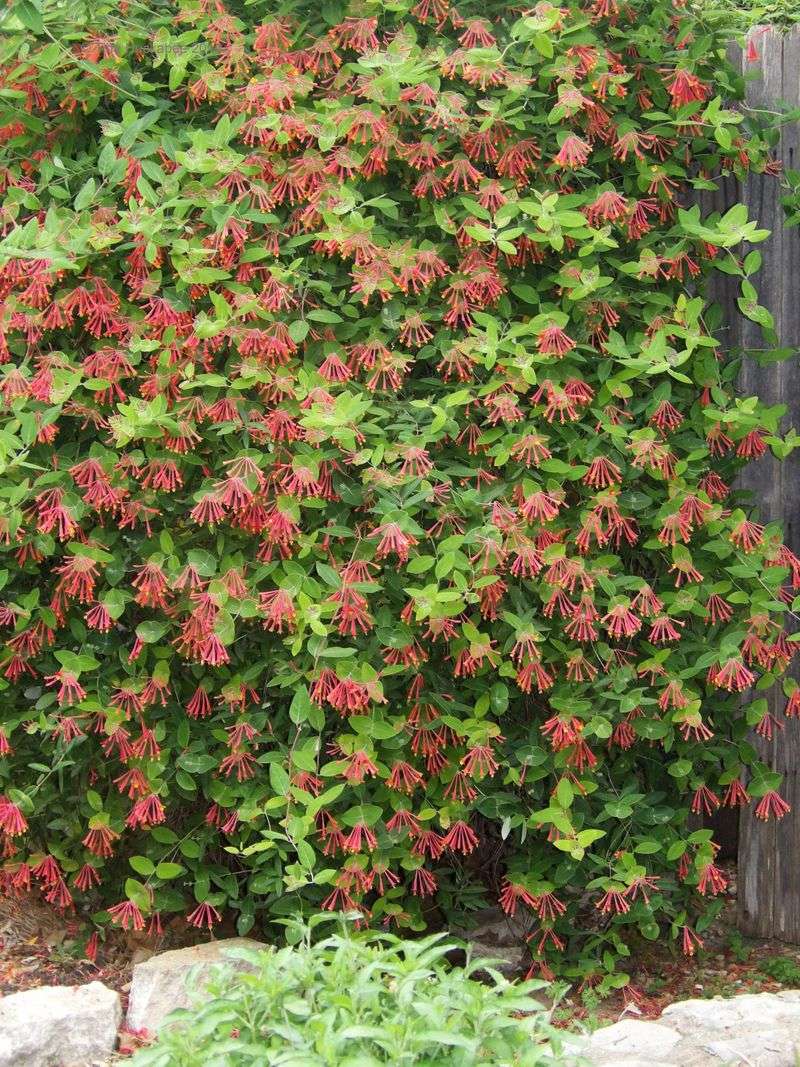
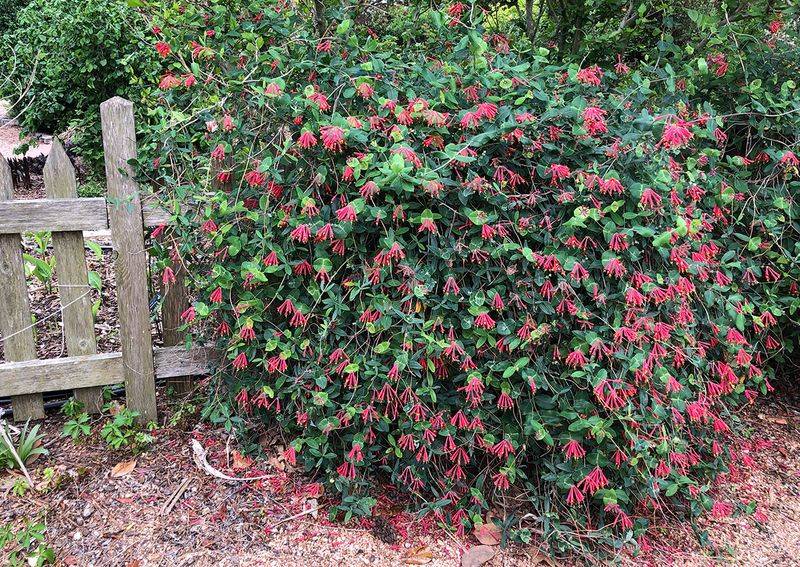
Coral honeysuckle (Lonicera sempervirens) fills a different role than American wisteria, and understanding that distinction helps you choose the right plant for your actual goal. NC State describes coral honeysuckle as a vigorous, twining, perennial native vine suited to trellises, arbors, and fences, reaching approximately 10 to 20 feet.
Its tubular, red-to-coral flowers are built for hummingbirds, not for replicating wisteria’s cascading clusters. If the primary goal is duplicating that long-cluster wisteria look, coral honeysuckle is the wrong match.
If hummingbird activity and a different kind of flowering screen matter more, it becomes a strong candidate.
The decision rule is straightforward: choose American wisteria when you want the closest native approximation of wisteria’s ornamental effect. Choose coral honeysuckle when wildlife value and a distinctly different flower form take priority.
Full sun produces the best flowering for coral honeysuckle, though it tolerates some shade, and NC State lists it as useful in native, pollinator, butterfly, and wildlife gardens. Planting it as part of a broader wildlife-friendly landscape, rather than as a single-vine solution, reflects how the source presents its value.
Maintenance for coral honeysuckle includes pruning after flowering, since it blooms on new growth. Excess nitrogen fertilizer may push the plant toward foliage at the expense of flowers, so a light hand with fertilizing is wise.
Aphids, powdery mildew, and leaf spots can appear, particularly during hot and humid North Carolina summers, so periodic monitoring during the growing season is part of the care routine.
One safety qualification applies specifically to placement near the home. NC State’s Plant Toolbox gives coral honeysuckle a high flammability rating and does not recommend planting it within the defensible space immediately surrounding a house.
A trellis at the back of the garden, a fence along the property line, or a freestanding arbor well away from the structure are appropriate placements. Against a porch post or along foundation plantings, the flammability concern is real enough to steer the vine elsewhere.
Check the scientific name before buying or removing a vine
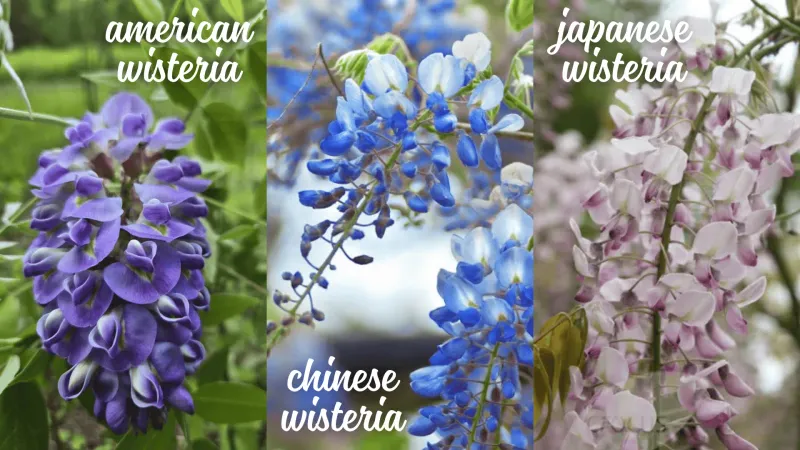
At the nursery, the common name “wisteria” appears on plants that are genuinely different species with very different behaviors in a North Carolina landscape. Picking up the tag and reading the scientific name takes about five seconds and can save years of invasive-control headaches.
Wisteria frutescens is the native American wisteria. Wisteria sinensis is Chinese wisteria.
Wisteria floribunda is Japanese wisteria. If the tag says only “wisteria” without a species name, ask before you buy.
The same principle applies to honeysuckle. Coral honeysuckle’s scientific name is Lonicera sempervirens, and it is native and non-invasive.
Japanese honeysuckle, Lonicera japonica, is invasive in North Carolina and sold under the same general common name. The two plants look different in flower and growth habit, but a casual glance at a plant labeled “honeysuckle” at a discount garden center is not enough to tell them apart.
The scientific name on the tag is the only reliable checkpoint at the point of purchase.
For an established vine in the yard that you are trying to identify before removing or keeping, twining direction alone is not a reliable test. NC State notes that American wisteria and Chinese wisteria both twine counterclockwise, while Japanese wisteria generally twines clockwise, but naturalized Asian hybrids documented in the Southeast can complicate that rule further.
USDA research on the identity of naturalized exotic wisteria in the Southeast confirms that hybridization among Asian species makes single-trait identification unreliable. Use multiple characteristics, including flower timing, pod texture, leaf shape, and twining direction together, or consult a local NC Cooperative Extension agent for confirmation before deciding whether to remove or keep a vine.
Established invasive wisteria takes more than one cut to control
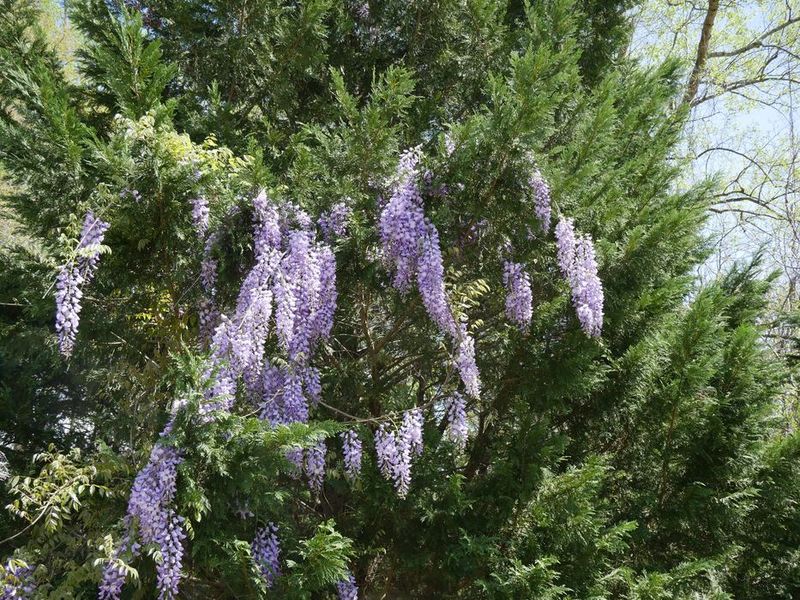
Replacing an invasive vine starts with removing the existing one, and that job is usually harder than it looks. Cutting Chinese or Japanese wisteria at the base of a tree or along a fence line does relieve immediate pressure and can prevent further girdling of branches, but the root system does not die from a single cut.
Regrowth from established roots is the norm, not the exception, and expecting one pruning session to solve the problem leads to frustration when new shoots emerge weeks later.
NC Cooperative Extension’s guidance on Chinese wisteria in Moore County makes clear that controlling established plants requires a sustained effort. Repeated cutting over multiple seasons can gradually weaken the root system by denying the plant the photosynthesis it needs to store energy.
That approach takes time and consistent follow-through, but it avoids the complications that come with chemical treatments in sensitive areas near water, wildlife habitat, or desirable plants.
When repeated cutting alone is not making progress, herbicide treatment is an option, but it needs to be handled carefully. NC State Extension’s guidance on controlling vines in landscapes advises following herbicide label directions precisely and, when the situation involves large established plants or proximity to other vegetation, seeking professional guidance.
A label is a legal document, and applying herbicide outside its directions is both ineffective and potentially harmful to surrounding plants, soil, and water.
The practical takeaway is to treat invasive wisteria removal and native vine planting as two separate projects that happen on overlapping timelines. Start cutting back the invasive plant while planning the new planting location, and expect the removal process to extend across at least one full growing season before the root system is fully exhausted.
Match the native vine to the job
Narrowing the choice comes down to what the vine needs to accomplish. American wisteria is the right pick when the goal is a large, native vine with a wisteria-like ornamental effect on a sturdy freestanding support.
The cultivar ‘Amethyst Falls’ suits sites where a more restrained footprint or a slightly smaller support makes the straight species impractical. Coral honeysuckle fits best when hummingbird value and a different screening appearance take priority over recreating wisteria’s cascading flower clusters.
A few nonnegotiables apply to both vines. Use a support strong enough for a vine that may grow for decades.
Keep both plants away from house siding, gutters, and building components, and keep coral honeysuckle outside the defensible space around the home given its high flammability rating. Verify the scientific name at purchase, plan for regular pruning and training every season, and allow realistic time for establishment rather than expecting same-year coverage.
NC Sea Grant’s plant-swap guide frames the swap well: the goal is not to find a native vine that behaves exactly like an invasive one. The goal is to find one that does the job you actually need, on a timeline you can work with, without taking over the landscape in the process.
A vine chosen with that standard in mind tends to stay a garden asset rather than becoming next season’s removal project.