
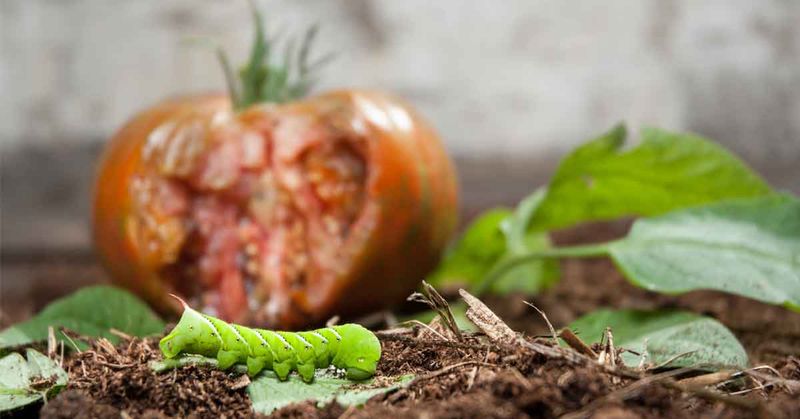
Walk out to your tomato patch one morning and you might find whole branches stripped bare, with dark pellets scattered across the mulch below. Tomato or tobacco hornworms can feed surprisingly fast, and by the time most Central Texas gardeners notice the damage, the caterpillar is already well-hidden inside the foliage.
Catching these pests early and responding the right way can protect what is left of a fall crop before cooler weather shuts the growing season down.
Dark Frass Can Signal Damage Before You See the Caterpillar
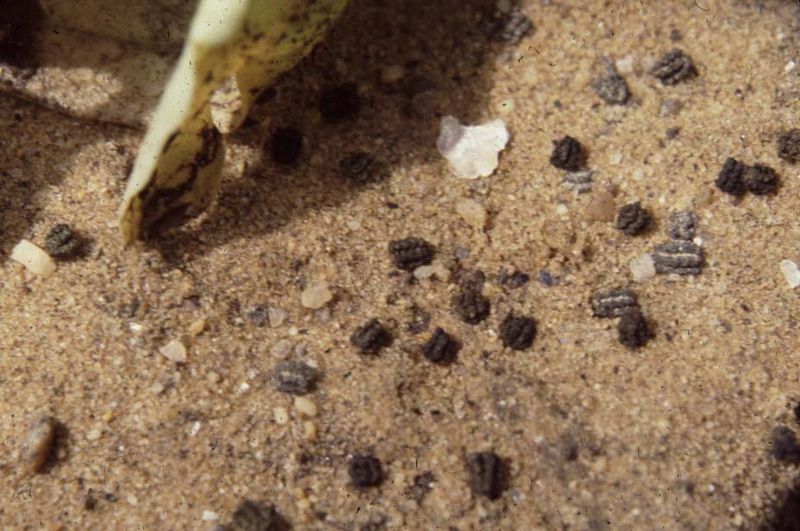
Fresh defoliation on a tomato plant often shows up before the caterpillar does. When you notice missing leaf sections, bare stems, or large dark pellets sitting on the mulch, soil, or lower foliage, those are the first signs to take seriously.
Texas A&M AgriLife Extension guidance describes large hornworms as capable of defoliating a tomato plant very quickly, which is exactly why frass spotted early can save you from waking up to bare stems.
The dark pellets are digested plant material expelled by caterpillars feeding overhead. Larger, more rectangular pellets generally point to a larger larva, and finding several pellets clustered in one area often means the caterpillar is somewhere directly above.
Check the mulch surface, the crowns of lower leaves, and any horizontal surface where droppings can collect.
Here is the important qualification: frass is a strong clue, not a confirmed diagnosis. Many caterpillar species produce dark droppings, and UC IPM’s hornworm guidance identifies missing leaf tissue plus dark droppings as characteristic signs worth investigating, but the caterpillar itself must be found and confirmed before you decide how to respond.
Other insects and environmental damage can cause leaf loss too, so resist the urge to spray based on frass alone.
Fruit damage is another clue worth knowing. Hornworms occasionally feed on blossoms and green tomatoes in addition to leaves, and heavy feeding can leave surviving fruit exposed to sunscald.
UC IPM’s sphinx moth resource notes that severe defoliation can expose fruit to sun damage, making early detection more than just a cosmetic concern. Treat fresh frass as a prompt to inspect the whole plant, not as proof that hornworms are present.
How to Confirm a Tomato or Tobacco Hornworm
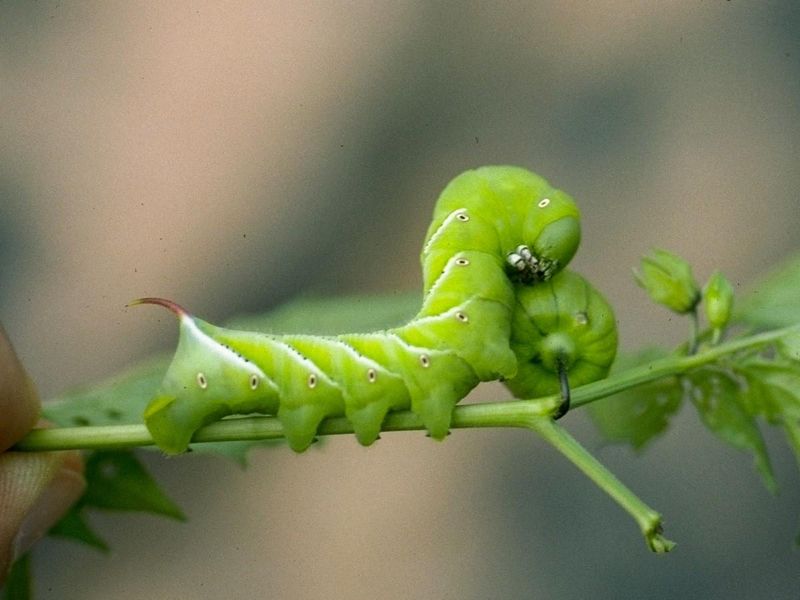
Spotting the caterpillar itself is the only reliable way to confirm what you are dealing with. Both the tomato hornworm and the tobacco hornworm are large, bright green caterpillars that feed on tomato and other nightshade-family plants, including pepper and eggplant.
UC IPM’s tomato pest management guidelines explain that the two species look similar but differ in their stripe pattern and horn color, details that help with identification but do not change the removal decision when a larva is actively stripping your plant.
Tomato hornworms generally carry eight white V-shaped markings along each side of the body, with a dark horn at the rear. Tobacco hornworms typically show seven diagonal white stripes per side and a reddish horn instead of a dark one.
Both caterpillars can grow to three inches or longer and are stout enough to be startling when you finally locate one tucked against a stem.
Camouflage is their main defense. The green body blends almost perfectly with tomato foliage, and the caterpillar often presses itself flat against a stem or the underside of a leaf.
UF/IFAS entomology documentation on tomato hornworms confirms that the caterpillars can be extremely difficult to spot even at close range, which is why gardeners frequently find frass before they find the larva itself.
The rear horn is a visual identification feature, not a weapon. Extension sources describe it as a projection used to startle predators, and it is not a stinger or a venomous structure.
That said, avoid handling any unknown caterpillar carelessly. You do not need to identify the species down to a scientific certainty before removing a large, confirmed larva that is actively feeding on your tomato plant.
If it is green, large, has a rear horn, and is eating your tomato, that is enough information to act.
Search the Whole Plant at Dusk or Dawn
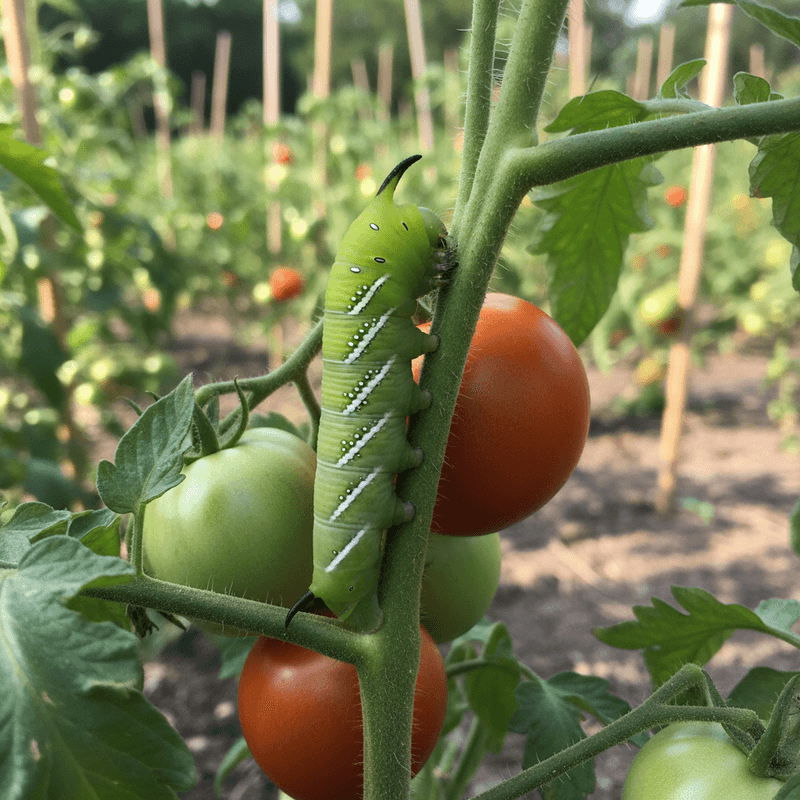
One of the most common scouting mistakes is checking only the leaves that already look damaged. Hornworms move along stems and often rest away from the most obviously chewed spots, so a search limited to tattered leaves can miss the caterpillar entirely.
Build a repeatable inspection habit instead: start at the base of the plant and work upward, checking every stem, the undersides of leaves, and the dense interior foliage where caterpillars frequently hide during the day.
UC IPM recommends beginning an inspection after noticing missing leaf sections, stripped stems, damaged fruit, or large dark pellets on soil or mulch. The search should cover the entire plant, not just the area immediately above where frass was found.
A caterpillar that fed near the top of the plant last night may have moved down the stem by morning.
Timing the search around dusk or early dawn improves your odds considerably. UF/IFAS entomology guidance notes that hornworm larvae are often easier to spot while actively feeding, and activity tends to increase during cooler parts of the day.
The green body that disappears against daytime foliage becomes easier to see when the caterpillar is moving or positioned against a stem in lower light.
A handheld flashlight or headlamp makes a real difference. Scanning along stems from a low angle can reveal the caterpillar’s outline against the sky or against a lighter background.
UC IPM’s sphinx moth page also notes that hornworms blend into foliage so well that the frass is often the easier find. Repeat the full inspection any time you notice new defoliation, freshly stripped stems, or a new cluster of pellets, because one search does not rule out additional larvae that hatched or moved in later.
Why Rapid Removal Matters on a Central Texas Fall Tomato

Hornworm activity is most common during midsummer, with a possible late-season population that can persist into late summer and early fall. UC IPM’s tomato pest management guidelines place the main activity window in summer, but Central Texas conditions extend the relevant threat window.
Heat in this region can persist well into September and sometimes into October, keeping fall tomato plants actively growing and vulnerable long after gardeners in cooler regions have already harvested.
The fall timing matters for a straightforward horticultural reason. A summer tomato plant that loses foliage in July still has several months to push new growth before frost.
A fall tomato plant that loses foliage in late September or early October has far less time to recover before shortening days slow growth and the first freeze arrives. Texas A&M AgriLife’s fall vegetable gardening guide identifies tomato as a frost-susceptible crop with a planting and harvest window that varies by region across the state, so the urgency of protecting late-season foliage is real even if the timing is not identical everywhere in Texas.
Prompt removal is a reasonable response, presented here as a horticultural inference rather than a measured study result. A plant that keeps more of its canopy intact through September has a better chance of setting and maturing fruit before the season ends.
Texas A&M’s September gardening checklist for Austin and Central Texas notes that fall growth slows as days shorten, reinforcing why preserving productive foliage in early fall matters more than it might seem.
None of this means hornworms are uniquely or universally a fall pest. The framing here is specific to Central Texas, where the seasonal window is long enough that late-summer larval activity can overlap with a crop that gardeners are still counting on.
If your fall tomatoes are still flowering and setting fruit in September, losing foliage to a feeding caterpillar at that point is a genuine setback worth acting on quickly.
Handpicking Is Often Enough for a Small Infestation
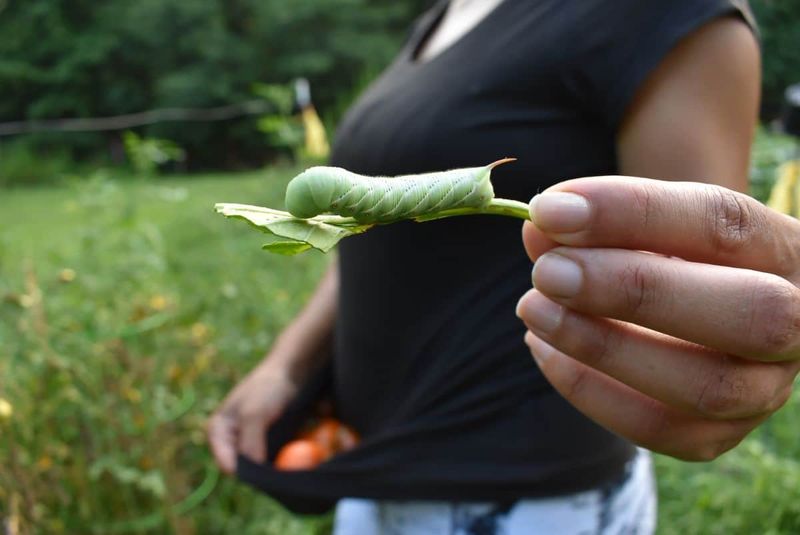
For a home gardener dealing with one or a few caterpillars, hand removal is the most direct response and is often sufficient. Texas A&M AgriLife Extension identifies hand removal as a practical control option for hornworms in home-garden settings, and the approach has the advantage of being immediate, targeted, and free of any chemical exposure to the plant or surrounding area.
Wear garden gloves and grip the caterpillar firmly near the middle of the body to detach it from the stem. Drop it into a container of soapy water, seal it in a bag, or place it in the trash away from the garden.
The rear horn is not a stinger and extension sources do not describe tomato or tobacco hornworms as venomous. That said, avoid handling any caterpillar you cannot positively identify, because some species do have defensive structures or irritating hairs.
University of Minnesota Extension guidance recommends handpicking as an effective management approach for small infestations, and it works best when combined with a thorough inspection so that all larvae present are found in the same pass. One removal session does not guarantee the problem is solved, because eggs laid by adult moths can hatch into new larvae days or weeks later.
Before removing any caterpillar, look for white rice-like structures attached to its body. Those are the cocoons of parasitoid wasps, and University of Georgia Cooperative Extension July gardening guidance advises leaving a parasitized caterpillar in place so the beneficial wasps can complete their life cycle.
A hornworm carrying cocoons is already dying and will not survive to reproduce. UC IPM notes that natural enemies often suppress hornworm populations on their own, so preserving these wasps actively helps protect your garden going forward.
Continue checking the plant every few days for fresh frass or new larvae, because monitoring after removal is what catches the next wave before it becomes a larger problem.
Use Bt or Other Labeled Products Only When Monitoring Justifies Them
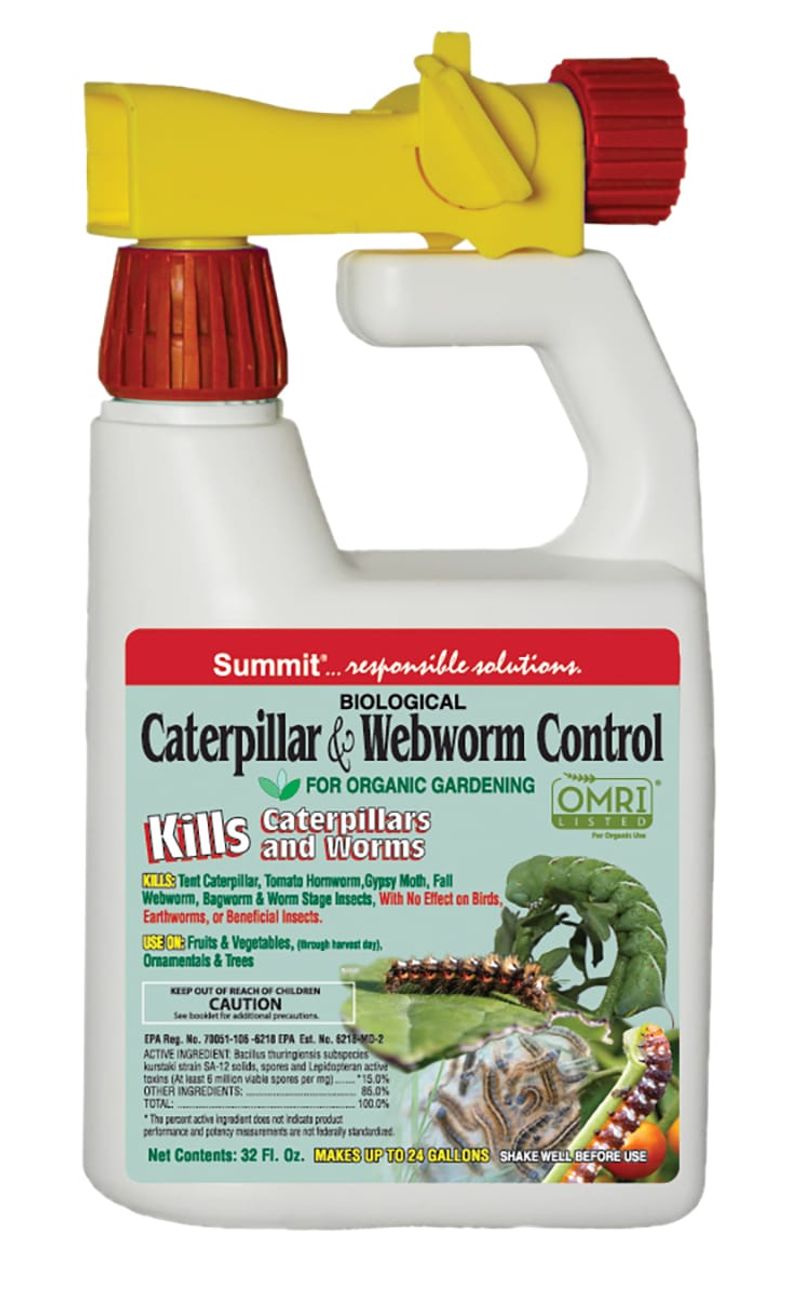
When handpicking is not practical, such as when larvae are small and numerous or when the plant is large enough that a full search would miss many caterpillars, a labeled biological insecticide becomes a reasonable next step. Bacillus thuringiensis var. kurstaki, commonly called Bt kurstaki, is a naturally occurring bacterium that targets susceptible caterpillars.
University of Minnesota Extension identifies Bt kurstaki as an appropriate lower-impact option for hornworm control in home gardens when the product label lists tomatoes and the relevant caterpillar species.
The mechanism matters for understanding when it works best. The caterpillar must eat treated foliage for Bt to be effective, and younger, smaller larvae are generally easier to control than large, late-instar caterpillars that have already done most of their feeding.
If you are finding large caterpillars close to full size, handpicking may be more immediately effective than waiting for Bt to act.
Bt breaks down in sunlight and can be washed off by rain or overhead irrigation. UF/IFAS guidance on natural pest management products confirms that repeat applications may be necessary, but the reapplication interval and maximum number of applications must come from the specific product label you are using, not from a generic rule.
Pesticide labels are legally enforceable documents, and the directions on the current label for the product in your hand are the ones that govern use.
Spinosad is another option that may be justified when Bt has not provided adequate control or when larval pressure is high. UC IPM’s sphinx moth resource notes that spinosad can harm bees while wet, so any labeled spinosad product should be applied when bees are not actively foraging, commonly in the evening, and only according to the label directions for edible tomatoes.
Do not treat spinosad as inherently stronger or safer than Bt; both require label compliance and both have conditions under which they are more or less appropriate. Fixed weekly spraying is not supported by extension guidance and risks exceeding maximum application limits or creating unnecessary pesticide exposure.
Treat only when monitoring shows a genuine need, and always check the current label for preharvest intervals before applying anything to a crop you plan to eat.
Keep Monitoring After Treatment and at Season’s End

Treatment is not the end of the process. Fresh frass or newly stripped foliage after handpicking or spraying means the inspection needs to start again, because new larvae can hatch from eggs already on the plant or arrive from adult moths flying in from nearby host plants.
Check the full plant every few days, looking at stems, leaf undersides, and interior foliage rather than just the most visibly damaged spots.
When you find larvae during follow-up inspections, apply the same decision process: remove unparasitized caterpillars by hand, leave any bearing white cocoons in place, and use a labeled product only when the number or size of larvae makes hand removal impractical. UC IPM hornworm guidance notes that natural enemies often suppress populations over time, which is another reason to preserve parasitized larvae rather than clearing every caterpillar you encounter.
At the end of the season, a few optional steps can modestly reduce the number of overwintering pupae in your garden soil. Removing spent tomato plants, clearing crop debris, and lightly disturbing the soil around former tomato beds may expose pupae to predators and drying conditions.
UC IPM’s sphinx moth resource acknowledges that soil disturbance can reduce overwintering populations, but these measures are not guaranteed prevention. Adult moths can fly in from well beyond your property, so reinvasion next season remains possible regardless of how thoroughly you clean up.
Texas A&M’s Central Texas fall checklist frames end-of-season tasks as preparation for the next growing window, and that is the right spirit here. The gardeners who catch problems early, confirm before treating, and protect their beneficial insects tend to finish the season with more fruit and a healthier yard to start from next year.