
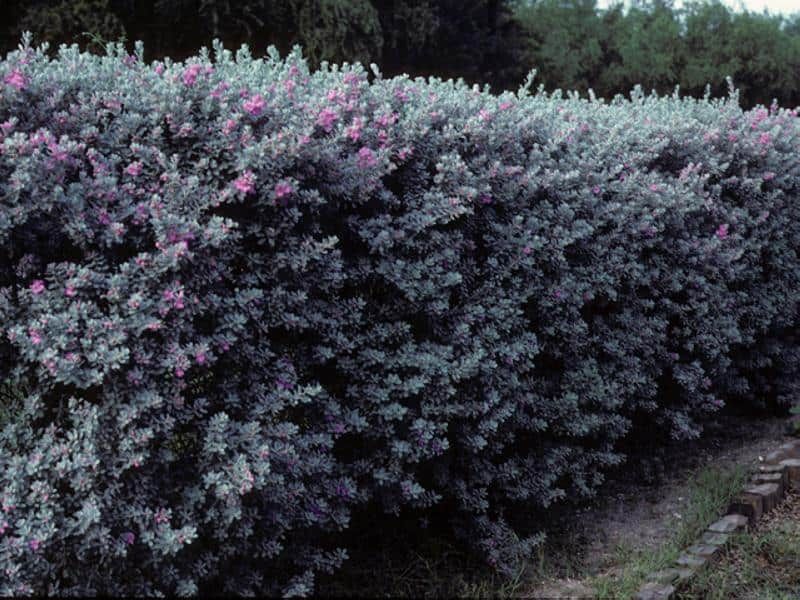
Central Texas summers push plants hard, and most foundation shrubs struggle to keep up. Texas sage, also called cenizo, is a native shrub built for exactly that punishment – full sun, poor soil, and months without rain.
Plenty of homeowners have heard it keeps scorpions away, but the research tells a more complicated story. Understanding what this plant actually does well, and where pest control really happens, will help you make smarter choices around your home.
Texas sage is a native shrub suited to Central Texas yards
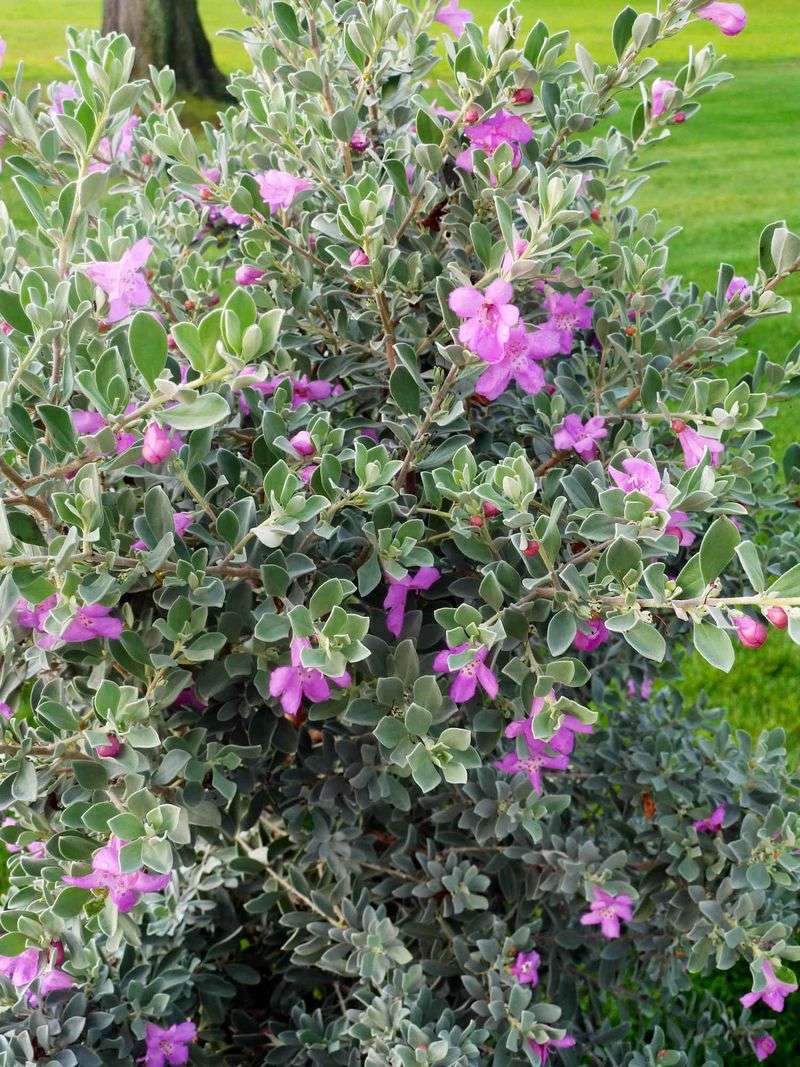
Cenizo, the plant most Texans call Texas sage, carries the scientific name Leucophyllum frutescens and belongs to the figwort family, not the culinary sage family. That distinction matters because culinary sages fall under the genus Salvia and have a completely different chemistry, growth form, and landscape role.
When a neighbor says “Texas sage,” they almost certainly mean the silver-leafed, purple-blooming shrub that erupts in color after summer rains, not the herb you dry for cooking.
The Native Plant Society of Texas profile for Leucophyllum frutescens maps the species to Central Texas ecoregions including the Balcones Canyonlands, Edwards Plateau, Llano Uplift, and Edwards Plateau Woodland. That nativity is a genuine advantage.
A plant that evolved in these conditions does not need coaxing to survive triple-digit summers, alkaline soils, or extended dry spells that would kill most nursery imports.
Austin Watershed Protection describes Texas sage as a low-water evergreen shrub that thrives in full sun and well-drained soil. The Austin plant guide for Texas sage lists mature dimensions of roughly 5 to 8 feet tall and 4 to 5 feet wide for standard forms, which means you are selecting a substantial landscape shrub, not a knee-high accent plant.
Compact cultivars exist and may stay smaller, but the standard species earns its space.
The University of Arizona Campus Arboretum, which maintains a detailed entry on Leucophyllum frutescens, confirms its Texas nativity and low-water credentials, and notes its suitability for foundation planting in hot, arid landscapes. For Central Texas gardeners dealing with water restrictions, rocky caliche, and relentless heat, those traits make Texas sage one of the more practical choices available from a native nursery.
Research does not prove that living Texas sage repels scorpions
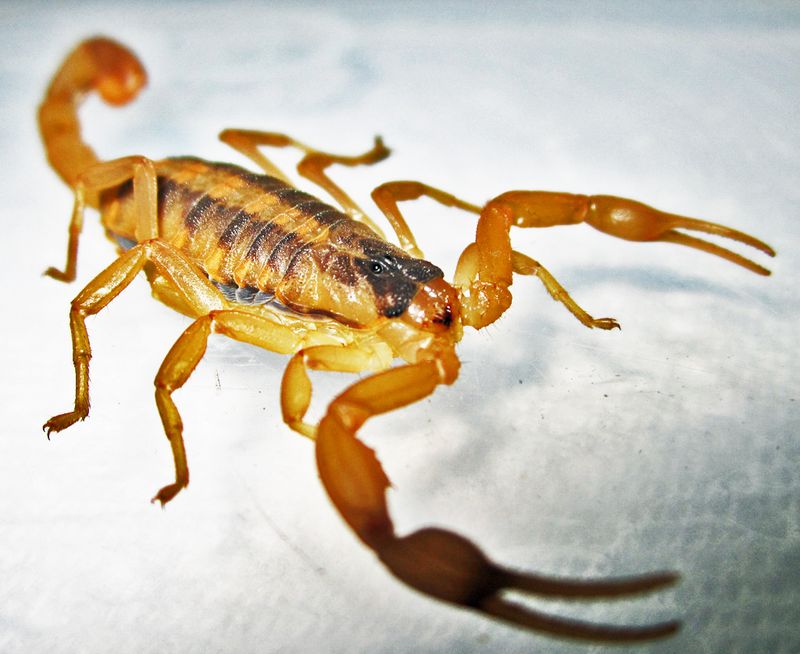
A lot of online gardening content suggests that Texas sage keeps scorpions away from your yard. The available science does not back that up.
No peer-reviewed study located for this article tested living Texas sage against scorpions under field conditions or even in a laboratory setting. The plant’s horticultural credentials are real; the scorpion-repellent claim is not.
The most relevant study on record involved rosemary oil, not Texas sage. That 2019 Journal of Arachnology study placed 16 adult striped bark scorpions (Centruroides vittatus) in an arena where one half of the sand was treated with concentrated rosemary oil and the other half was treated with mineral oil.
The scorpions spent more time on the mineral-oil side. That is a meaningful result for rosemary-oil research, but it tells you nothing about Texas sage, because rosemary and Texas sage are different species with different chemistry.
It also tells you nothing about what a living, uncut shrub does in a yard, because the study used extracted oil applied to a test surface, not an intact plant releasing compounds naturally through its leaves.
The gap between concentrated oil on sand and a shrub growing beside your house is significant. A planted shrub releases far smaller quantities of volatile compounds than a laboratory application of extracted oil, especially when the leaves are not crushed or processed.
Treating those two things as equivalent overstates what the research actually found.
A 2024 study in the Journal of Comparative Physiology A added another layer of complexity by finding that rosemary oil repelled one scorpion species but had no repellent effect on a second species, confirming that scorpion responses to plant-derived compounds are not universal. Other research has identified repellent activity from Cymbopogon-derived compounds against certain urban arthropods, documented in a 2022 PMC study on plant-derived arthropod repellents.
That line of research is genuinely interesting, but it does not validate Texas sage as a perimeter treatment. Texas sage is worth planting for its looks, its drought tolerance, and its regional fit.
Expecting it to guard your house from scorpions sets it up to fail a job it was never tested for.
Plan for the shrub’s mature size beside the house
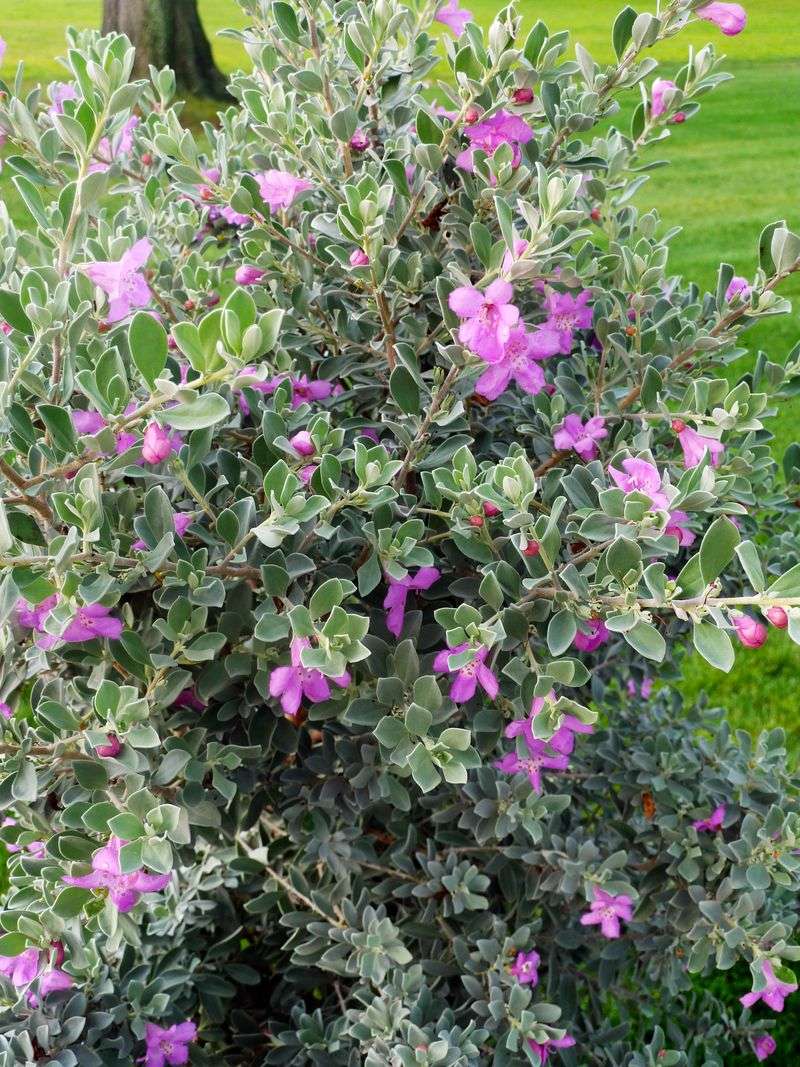
Most planting mistakes with Texas sage happen at the nursery. A compact one-gallon container sitting on a shelf gives no hint of what the plant becomes in three to five years.
Standard forms of Leucophyllum frutescens can reach 5 to 8 feet tall and spread 4 to 5 feet wide at maturity. Compact cultivars generally stay smaller, but “compact” is relative, and the plant tag on the specific form you buy is the most reliable guide to its expected size.
The Austin Watershed Protection plant guide recommends allowing Texas sage to develop naturally rather than shearing it. That guidance matters for placement because a shrub given room to reach its natural form stays open and airy.
One planted too close to a wall will eventually push branches against siding, screens, vents, and window frames, creating contact points that are hard to inspect and easy for pests to exploit. The goal at planting time is to position the shrub so that even at full size, its outermost branches clear the wall by a comfortable margin.
A practical approach: measure from the foundation out to the expected mature width of the specific form you are buying, then add a few extra inches of buffer. For a compact form expected to reach 4 feet wide, that puts the planting hole at least 2 to 2.5 feet from the wall.
For a standard form expected to reach 5 feet wide, move the hole farther out. Branches that touch walls, rooflines, eaves, or window screens give scorpions and other pests a bridge to the structure, so clearance is not just an aesthetic preference.
Access for inspection and occasional maintenance is another reason to give the shrub space. A shrub pressed against the foundation hides the base of the wall, making it harder to spot cracks, gaps, or harborage that needs attention.
An appropriately placed Texas sage lets you walk the perimeter, check the foundation, and act on what you find.
Keep the foundation bed open and free of harborage
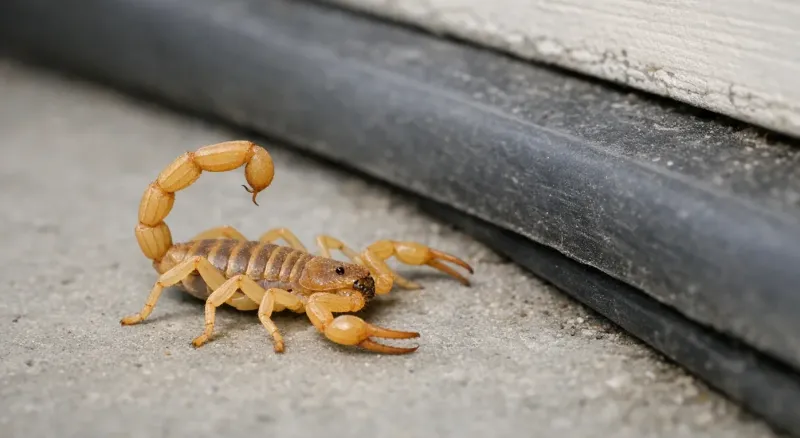
A foundation bed can work against you if it becomes a collection point for materials scorpions use as shelter. Boards, firewood stacks, loose rocks, stacked landscaping pavers, leaf litter, and general outdoor debris are all common harborage sites.
Texas A&M reporting on summer scorpion activity confirms that scorpions commonly shelter under rocks, boards, wood piles, and similar materials before moving indoors when temperatures spike. Keeping those materials away from the foundation removes the stepping stones scorpions use to reach the house.
Mulch is a specific consideration. A thin layer of mulch helps retain soil moisture and regulate temperature, which benefits Texas sage during establishment.
Deep or packed mulch against the foundation wall is a different matter. It holds moisture against the structure, can hide cracks or gaps at the base, and provides cover that makes inspection difficult.
Keep mulch shallow near the wall and pull it back periodically to check what is underneath.
The Texas A&M IPM action plan for bark scorpions identifies removal of harborage materials as a primary habitat-reduction step, listing clutter, debris, and shelter near the structure as key targets. That guidance applies directly to foundation beds.
A bed planted with appropriately spaced Texas sage, kept free of debris, and mulched lightly near the wall is a genuinely different environment from a dense hedge packed against the foundation with wood, rocks, and leaf litter at its base.
The Texas A&M integrated pest management booklet also recommends keeping the area around the structure open enough to allow inspection and treatment access. An attractive, low-water planting and a scorpion-friendly accumulation of cover are not the same thing.
The difference is in how you manage the bed once the plant is in the ground.
Seal entry points that landscaping cannot block

A well-chosen, properly placed shrub addresses one piece of the perimeter. It does nothing for the cracks in your foundation, the gap around a pipe chase, the weep holes in a brick course, or the window screen with a torn corner.
Those openings are where scorpions actually enter a house, and closing them is the most directly supported defense available to a Central Texas homeowner.
Texas A&M AgriLife Extension’s scorpion guidance recommends sealing cracks around roof eaves, pipes, and other openings, plugging weep holes where structurally appropriate, maintaining tight window screens, and treating likely entry points as the primary structural response to scorpion pressure. Those steps work whether or not you have any plants in the ground, because they address the actual access routes scorpions use.
A practical inspection covers the full perimeter at ground level, looking for cracks in the slab or foundation, gaps around conduit, plumbing, or gas lines entering the structure, and any point where the wall meets a different material. Roof eaves deserve attention too, since scorpions are capable climbers and can reach upper entry points through vegetation or rough exterior surfaces.
Weep holes in brick veneer can be fitted with mesh inserts designed to allow drainage while blocking pest entry.
Window and door screens are worth a close look before summer heat pushes scorpion activity indoors. A small tear or a frame that does not seat tightly against the sill is enough of a gap to allow entry.
The bark scorpion IPM action plan lists screen maintenance alongside crack sealing as standard exclusion steps. Think of Texas sage as one element in a broader yard-and-house approach.
The shrub belongs in the bed; the caulk gun and the screen repair kit belong in the garage, ready to use on the structure itself.
Reduce the clutter and insects around entryways
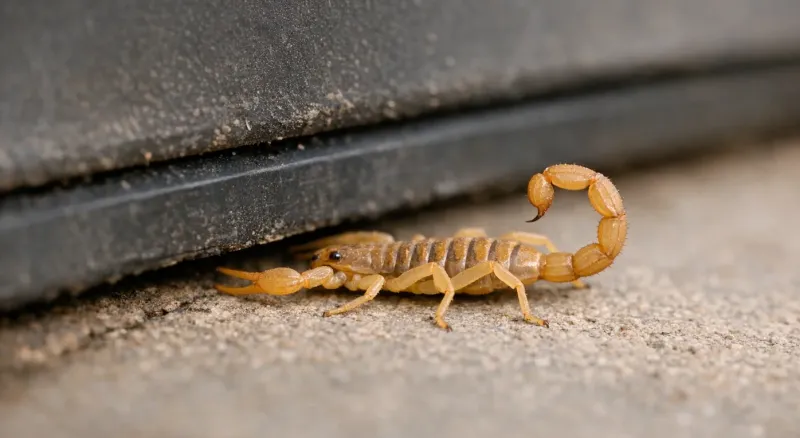
Scorpions are predators, not random wanderers. They follow food, and their food is insects.
Conditions that support insect activity near doors, windows, and other entryways also support scorpion activity in the same areas. Addressing what draws insects to your entryways is a practical complement to exclusion work, and it connects the condition of your foundation bed to the broader yard.
The Texas A&M IPM booklet recommends reducing outdoor clutter and pruning branches and bushes that touch the structure or provide access to the roof. Vegetation that bridges the gap between the yard and the building gives scorpions a route that bypasses your foundation bed entirely.
Keeping shrubs, tree limbs, and ground cover trimmed back from walls, soffits, and eaves removes that route.
Outdoor lighting is worth reconsidering near entryways. Bright white lights attract the insects scorpions hunt.
Switching to yellow or amber bulbs near doors reduces insect congregation without eliminating the light you need for safety. Texas A&M’s reporting on summer scorpion pressure notes that hot, dry conditions push scorpions toward structures, making the combination of insect activity and easy access particularly risky during Central Texas summers.
Clutter on porches, in garages, and along the side of the house gives scorpions daytime shelter close to entry points. Cardboard boxes, stored lumber, loose tarps, and garden equipment left against the wall are all usable harborage.
The bark scorpion IPM action plan treats clutter reduction as a standard habitat step alongside structural exclusion. A tidy entryway, trimmed vegetation, and reduced insect attraction work together in ways that no single plant in the ground can replicate.
Use Texas sage for its landscape strengths, not pest-control promises
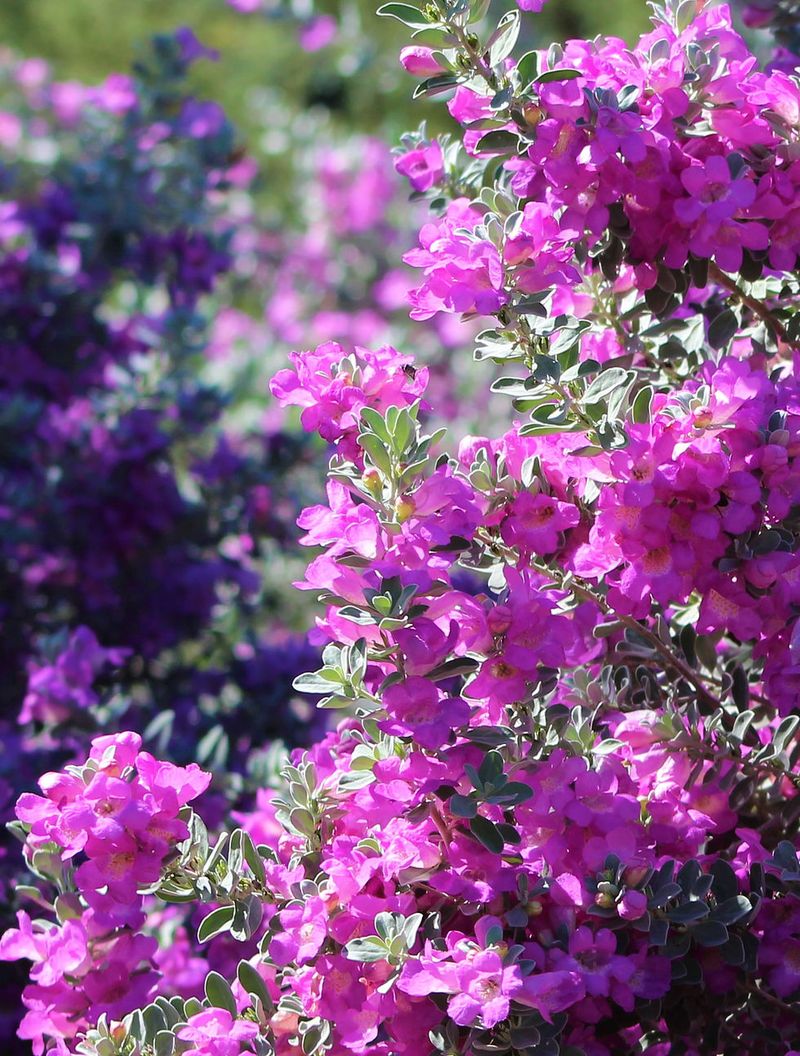
Putting Texas sage in your foundation bed is a sound decision for Central Texas. It handles full sun, survives water restrictions, tolerates alkaline soils, and rewards you with purple blooms after summer rains.
The Austin plant guide and the Native Plant Society of Texas both confirm its regional fit. Those are real reasons to plant it, and they hold up regardless of any pest-related claims.
Select a form sized for your bed, position it with mature-width clearance from the wall, and let it develop naturally without shearing. Keep the surrounding bed open, free of debris, rocks, wood, and deep mulch, and preserve a clear line of sight to the base of the foundation.
Those steps make your bed both attractive and inspectable, which matters more than what species you planted.
The research available does not show that scorpions avoid living Texas sage or that the shrub protects a house perimeter. For that job, Texas A&M AgriLife’s scorpion guidance and the bark scorpion IPM action plan point to sealing cracks and openings, maintaining screens, pruning vegetation that touches the structure, and eliminating harborage and insect activity near entryways.
Texas sage earns its place in a Central Texas yard on its own terms – a shrub that genuinely thrives where others give up is worth more than one that merely promises to scare something away.