
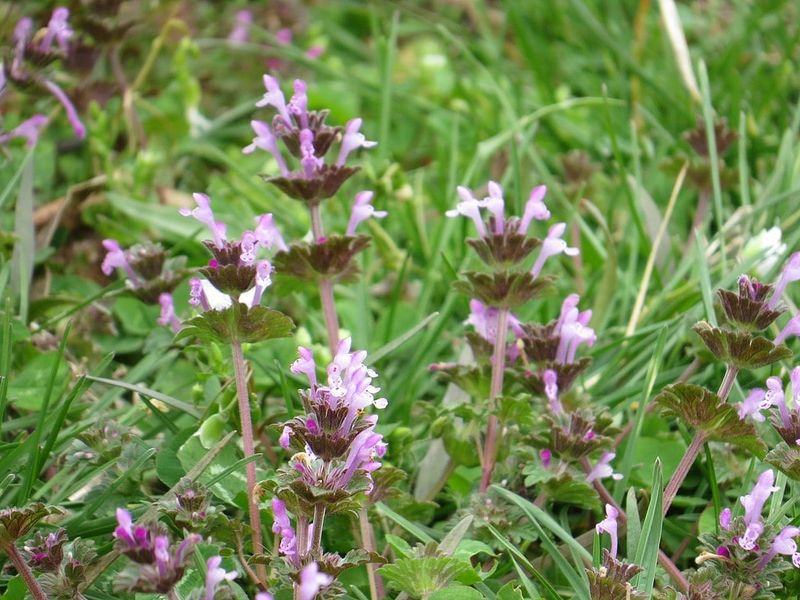
Every spring, Central Texas lawns light up with clusters of tiny purple flowers, and most homeowners reach for the weed puller without a second thought. Before you do, it helps to know what you are actually looking at, because the answer changes everything about how you should handle it.
Some of those purple bloomers are nonnative annuals that quietly feed early bees, while others may be true Texas natives that support butterfly caterpillars. Getting the identification right first is the single most useful thing you can do for your lawn and your local pollinators.
Purple flowers do not identify themselves
A lawn full of purple blooms can look like one thing when it is actually three or four completely different plants. Texas A&M AggieTurf’s turfgrass weed guide makes species-level identification a starting point for any management decision, because control methods, native status, and wildlife value all differ by plant.
Calling something a “purple weed” tells you almost nothing useful.
Central Texas lawns can harbor henbit, purple deadnettle, violet woodsorrel, true violets, or some combination of all four. Henbit and purple deadnettle are related winter annuals that often get lumped together, but they are separate species with slightly different leaf shapes and management windows.
Violet woodsorrel is an entirely different plant with clover-like leaves, native to Texas, and not a violet at all despite its name.
The practical takeaway is straightforward: look at the leaves, stems, and flower shape before deciding anything. Tubular flowers and square stems point toward henbit or deadnettle.
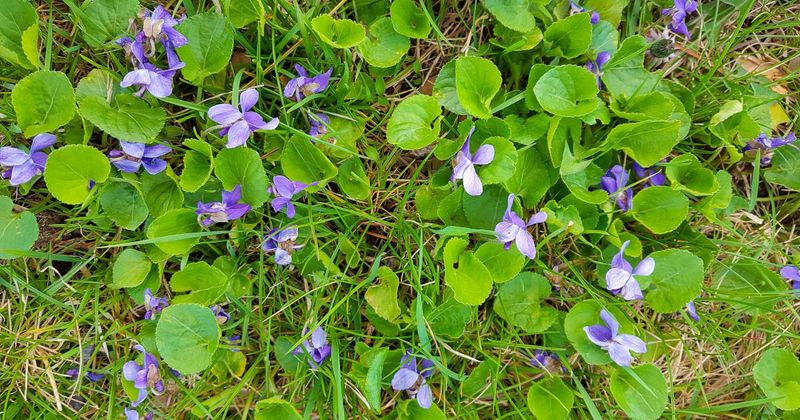
Flat, five-petaled flowers and heart-shaped leaves suggest a true violet. Three-leaflet, clover-shaped foliage with small rosy-purple blooms signals woodsorrel.
When the plant is unclear, a photo submitted to a local Texas A&M AgriLife Extension office or a plant-ID app can give you a confident answer. No management decision, whether that means leaving a patch alone or removing it, should come before knowing what you have.
Henbit follows a winter-to-spring schedule
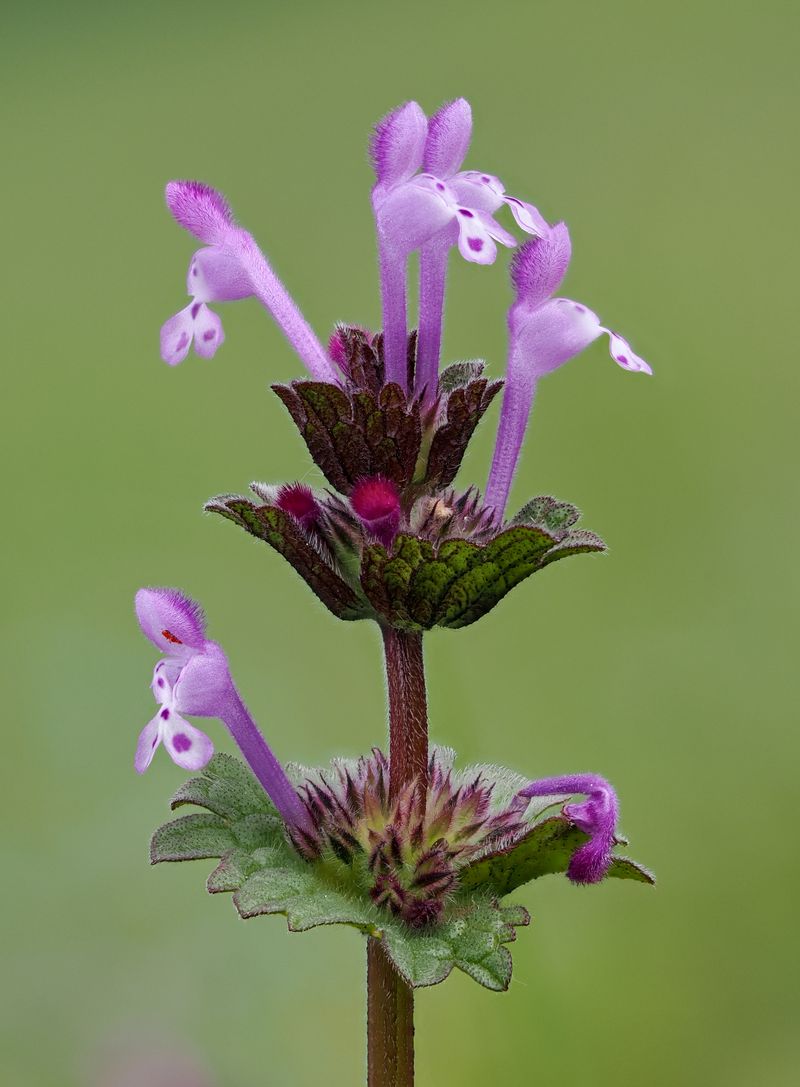
Henbit has a look that sets it apart once you know the clues. The stem is square rather than round, the flowers are pink-purple and tubular, and the upper leaves wrap directly around the stem without a visible stalk, a trait called sessile or clasping.
Lower leaves, by contrast, have short petioles that hold them away from the stem. Texas A&M AggieTurf’s henbit profile and the NC State Extension henbit entry both describe those clasping upper leaves as one of the most reliable field markers.
Its seasonal pattern in Central Texas follows a predictable loop. Seeds germinate in late summer or fall when soil temperatures cool, the plant grows through winter as a low rosette, then pushes up flowering stems in late winter and early spring.
After flowering and setting seed, henbit dies as temperatures climb into summer. That entire above-ground life span is finished before bermudagrass fully greens up, which is part of why it can seem to vanish on its own.
One fact that matters for how you talk about this plant: the USDA NRCS henbit fact sheet documents it as a species introduced from Europe and the Mediterranean region. Henbit is not a Texas native.
That distinction does not make its flowers worthless to pollinators, but it does mean calling it a native plant is inaccurate. The Texas A&M AgriLife bermudagrass management calendar treats henbit as a routine cool-season broadleaf weed, which reflects its status as an introduced annual rather than a desirable native component of Texas ecosystems.
Understanding that cycle also sets up the timing for every management option discussed later. Whether you plan to mow before seed set, hand-pull, or leave a defined patch, the window is short and tied directly to that winter-annual schedule.
A nonnative weed can still offer early forage
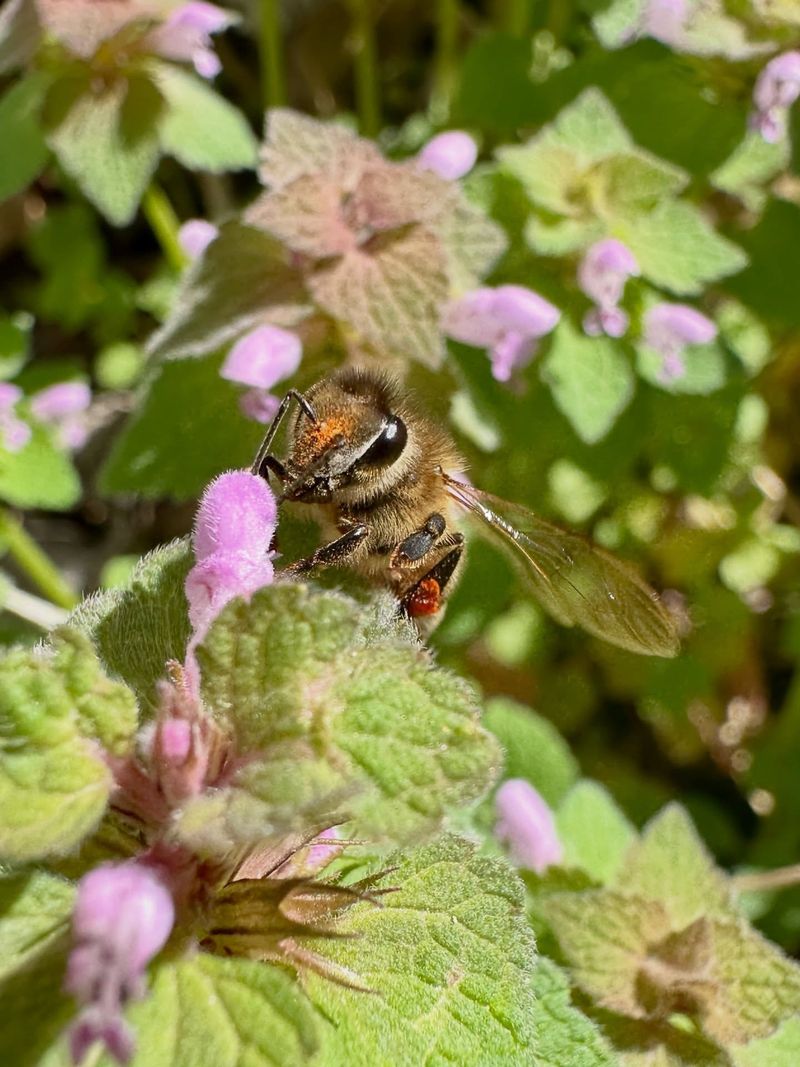
Nonnative and useful are not mutually exclusive, and henbit is a fair example of that. Its flowers open in late winter and early spring, a period when relatively few other plants are blooming and foraging options for bees are genuinely limited.
Texas A&M’s Central Texas bee-friendly plant list includes henbit as a spring-flowering source of nectar and pollen, which is meaningful recognition from a regional university extension program.
That said, “appears on a bee-friendly list” is a narrower claim than “significantly boosts pollinator populations.” The honest description of henbit’s value is that it supplies temporary early-season forage, not that retaining it will transform a lawn into a pollinator refuge or substitute for a planned native planting. NC State Extension’s henbit profile notes its value to early pollinators without making broader conservation claims, and that measured framing is the right one to carry forward.
The practical implication is simple. A patch of henbit flowering in February or March may be visited by bumblebees, native solitary bees, and honey bees looking for early food.
That is worth knowing before pulling every plant on sight. At the same time, a lawn full of henbit is not doing the work of a diverse pollinator garden with blooms spread across multiple seasons.
Henbit’s contribution is real but brief, tied entirely to its short flowering window, and limited to nectar and pollen rather than any nesting or caterpillar-host function.
Missouri violet makes a specific native-plant case
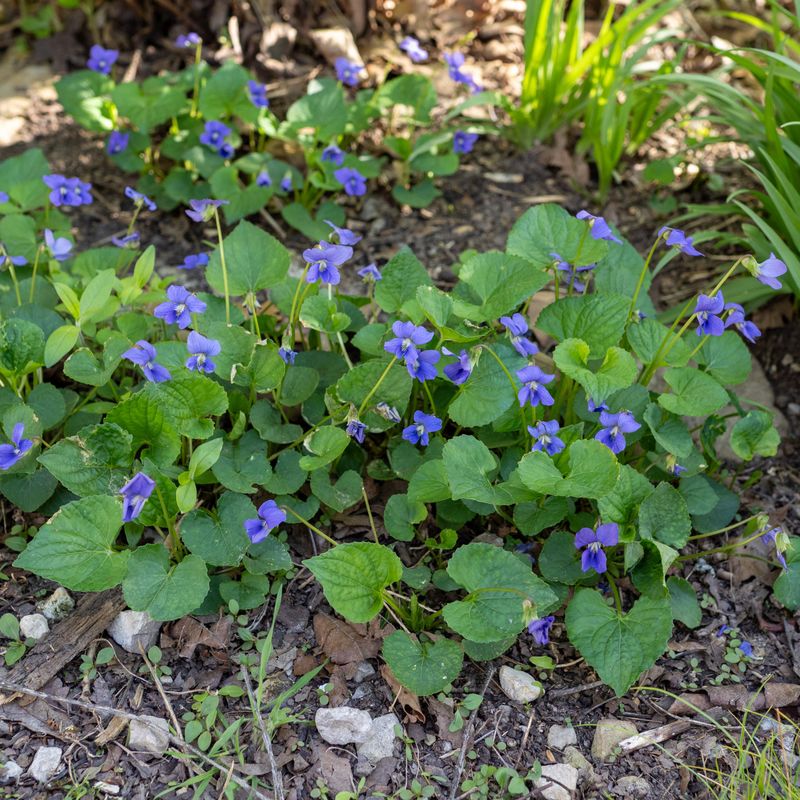
True violets look nothing like henbit once you compare them side by side. Heart-shaped leaves, flat five-petaled blue-purple flowers, and a preference for shady, moist lawn areas are the markers to look for.
Where henbit stands upright on a square stem, violets grow in low clusters and spread outward over time through both seeds and underground rhizomes. University of Minnesota Extension’s wild violet guide describes that rhizome-driven spread as one reason violets can persist and expand even after the above-ground foliage is removed.
The native-plant case for violets is real but specific. The Native Plant Society of Texas documents Missouri violet (Viola sororia var. missouriensis) as a native across several Central Texas ecoregions.
More importantly, it identifies this species as a larval host plant for the variegated fritillary butterfly, meaning female fritillaries lay eggs on the leaves and caterpillars feed on the foliage. That host-plant relationship is a meaningful ecological contribution that goes beyond providing nectar.
Spring bloom timing adds another layer of value. Missouri violet flowers appear in spring when fritillaries are active, connecting the plant’s phenology directly to the butterfly’s life cycle.
That documented relationship is what earns the “native pollinator gem” framing, but only when the plant has been accurately identified as Missouri violet or the Viola sororia group, not just any purple-flowering plant sold or found under the common name violet.
A word of caution: native status does not guarantee that a violet patch will stay manageable. Rhizome spread means a small cluster can widen gradually, and violets can outcompete turf in shady, moist conditions where grass already struggles.
The habitat value is genuine, but so is the potential for expansion, and both facts belong in any honest assessment of whether to keep a patch.
The right compromise is a defined patch
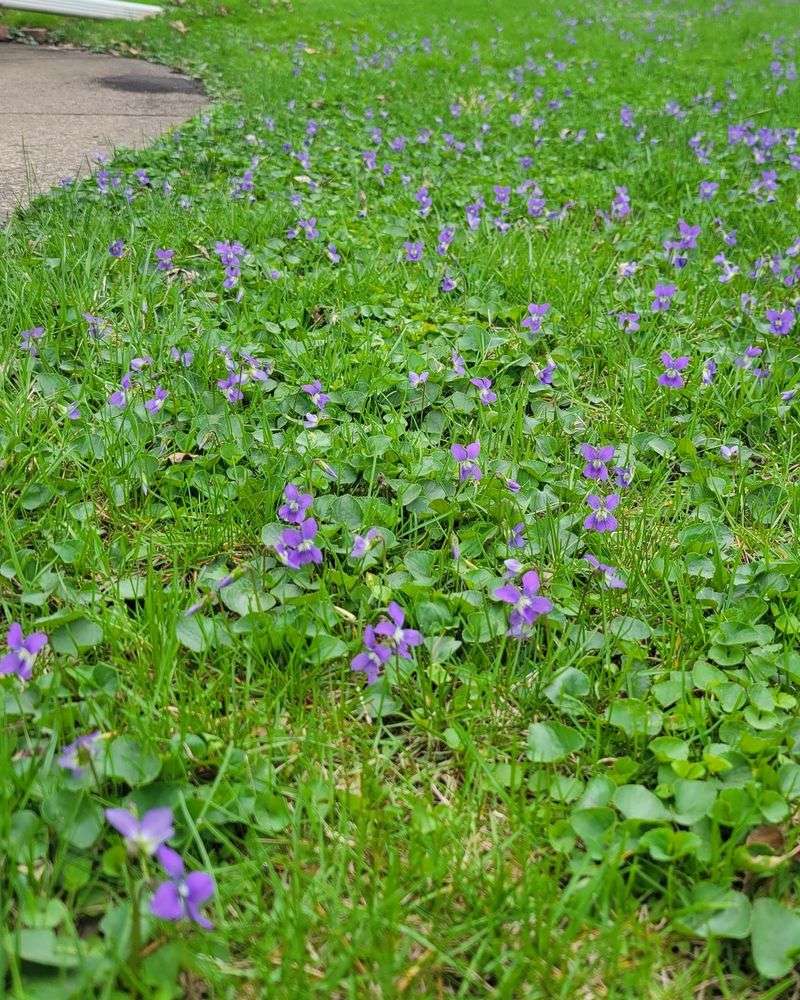
Knowing what the plant is opens up a practical middle ground that neither “spray everything” nor “leave it all alone” captures well. Retaining a small, clearly bounded patch of flowering henbit or violet can make sense when the location works, the spread is still contained, and the appearance fits the property.
A corner bed, a shaded strip under a tree, or a low-traffic edge along a fence are all spots where a limited patch is unlikely to crowd out the lawn you actually want.
The tradeoffs are worth naming plainly. NC State Extension notes that henbit reseeds, so a patch left to flower and set seed will likely return next winter, possibly in a larger area.
University of Minnesota Extension explains that violets spread through rhizomes in addition to seeds, which means removal requires getting underground growth, not just cutting the tops. Either plant can crowd turf or push into garden beds if the patch expands without check.
One patch is also not a pollinator garden. University of Minnesota Extension’s bee lawn guidance describes how meaningful pollinator habitat depends on diverse flowers blooming across a longer season, not a single short-lived species.
Henbit’s window closes as spring warms; violets bloom briefly in spring and then mostly stop. A homeowner who wants to support pollinators beyond that narrow window will need additional plants with staggered bloom times.
The defined-patch approach is a reasonable compromise, not a complete habitat strategy, and keeping those expectations realistic is what makes it worth trying.
Control henbit before it completes its cycle
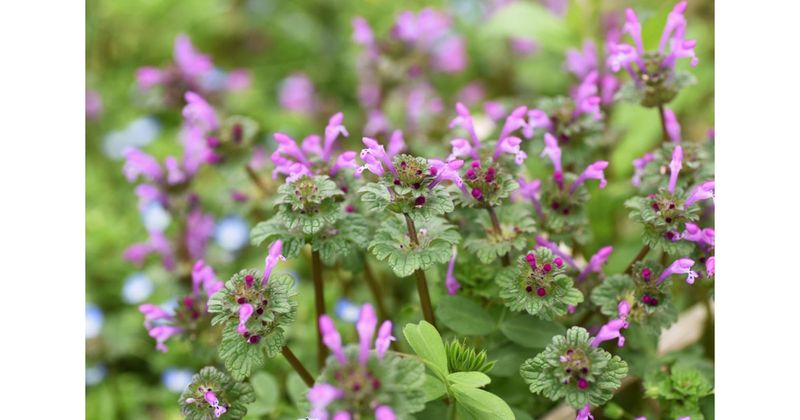
Mowing is the most accessible nonchemical option for homeowners who want a cleaner lawn without reaching for a spray bottle. The key is timing.
Henbit flowers and sets seed in late winter and early spring, then dies on its own as temperatures rise. Mowing before those flowers fully open and before seed is produced interrupts the reproductive cycle and reduces how many seeds drop into the soil for next year’s germination.
The Texas A&M AgriLife bermudagrass management calendar specifically recommends mowing winter annuals to prevent flowering, which lines up directly with that window.
A few realistic expectations help set the right goal. Mowing addresses the plants currently above ground and limits the new seeds they would otherwise add to the soil.
It does not eliminate seeds already in the ground from prior seasons, so some henbit will likely return the following winter. The Texas A&M bermudagrass calendar PDF frames this as a seasonal management step rather than a one-time fix, which is the right way to think about a plant that germinates fresh from the soil bank each fall.
This mowing strategy applies specifically to henbit and its winter-annual life cycle. Purple deadnettle follows a similar pattern and responds to the same timing, but true violets are perennials that regrow from rhizomes regardless of what happens above ground.
Mowing a violet patch does not set it back the way mowing henbit does. Keeping the identification clear before choosing a control method prevents wasted effort and keeps management matched to the actual plant in the lawn.
Violets require a different removal strategy
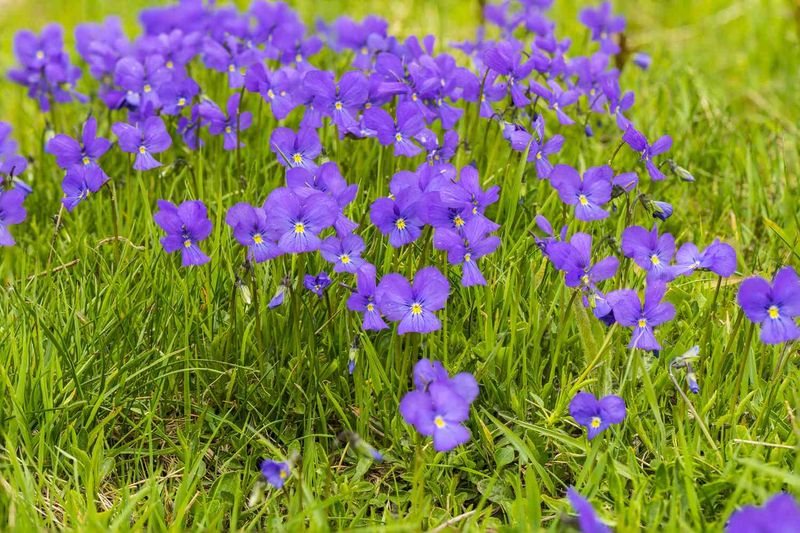
Wild violet control cannot follow the same playbook as henbit control, and treating both plants with one generic approach wastes time and misses the biology. Violets are perennials.
They regrow from underground rhizomes each season, which means cutting or mowing the foliage does not stop them the way it interrupts a winter annual like henbit. University of Minnesota Extension’s wild violet management guidance describes hand-digging as the practical nonchemical approach for small patches, with the goal of removing as much rhizome as possible.
Repeated removal over multiple seasons is usually necessary because fragments left in the soil will resprout.
Cultural prevention is more effective than repeated removal after the fact. Texas A&M AggieTurf’s weed management resources consistently point to dense, healthy turf as the best defense against broadleaf weed establishment.
Violets tend to move into shady, moist lawn areas where grass is already thin or stressed, so improving drainage, overseeding thin spots, and choosing a grass variety suited to shade conditions all reduce the foothold violets need to spread.
When cultural and mechanical methods are not enough and a homeowner considers a chemical option, the process must start with identification of both the weed and the turfgrass. Products effective on violets in one turf type may injure another, and no herbicide should be applied without confirming that the label specifically lists both the target weed and the turf variety in the lawn.
The EPA’s pesticide label guidance is clear that the label is a legally enforceable document, and following it exactly is not optional. Timing matters too: avoid spraying during bloom when pollinators are actively foraging, and follow any pollinator-protection language printed on the label.
Choose the patch or the turf deliberately
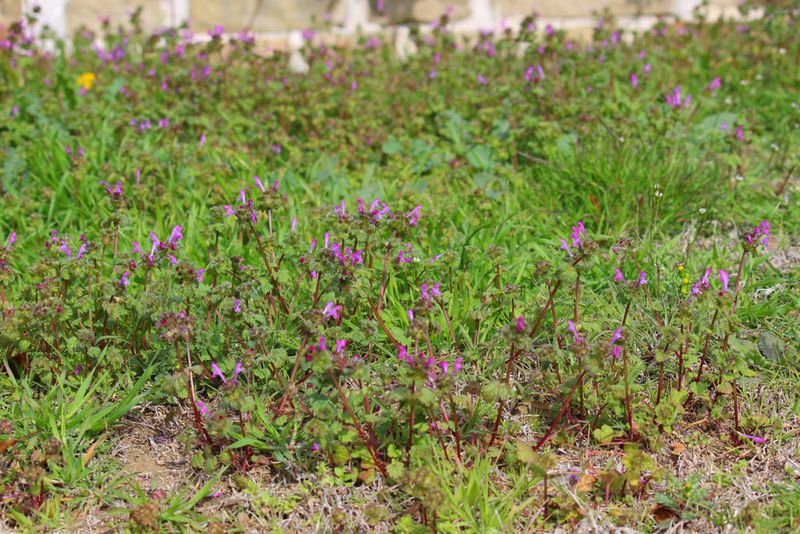
Every decision about a purple lawn flower comes down to one prior step: know what it is. Once you have a confident identification, the path forward is straightforward.
If the plant is henbit, you have a nonnative cool-season annual that provides genuine early-season nectar and pollen, appears on Texas A&M’s Central Texas bee-friendly plant list, and will die on its own when heat arrives. Retaining a contained patch is a reasonable choice if the spread and appearance suit the yard; managing it with pre-bloom mowing is equally reasonable if a cleaner lawn matters more.
If the plant is accurately identified as Missouri violet, the Native Plant Society of Texas documents it as a Central Texas native that blooms in spring and serves as a larval host for the variegated fritillary butterfly. That documented relationship is a stronger case for keeping a defined patch in a suitable spot.
When spread or turf competition becomes a problem, hand-digging with rhizome removal or a label-compliant herbicide applied outside of bloom are both legitimate responses.
Whatever you decide, EPA guidance on reducing pesticide impacts on wildlife recommends avoiding unnecessary spraying during bloom, treating only the areas that need it, and following all pollinator-protection directions on the label. The purple flowers in your lawn are not all the same plant, and they are not all the same problem.
Treating them that way is the one approach most likely to cost you something worth keeping.