
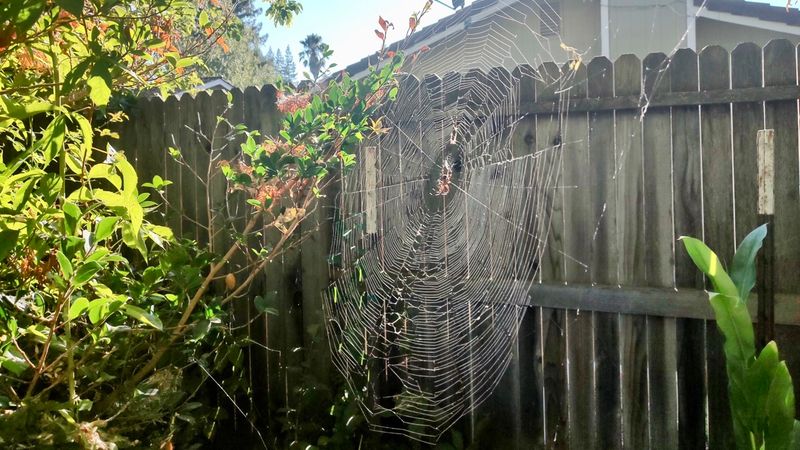
Every fall, colorful orb-weaver spiders show up in California yards and start spinning large, circular webs across garden beds, fences, and patio corners. Many homeowners sweep those webs away without a second thought, not realizing the spider was quietly catching insects nearby. Keeping a harmless web in place costs nothing and takes zero effort, but the story of what these spiders can and cannot do for your yard is more complicated than the headlines suggest. Understanding the difference can help you make smarter choices about your garden without feeling guilty every time you clear a path.
The California garden spider is not one statewide species
When neighbors or social media posts mention a “California garden spider,” they are usually describing a whole family of orb-weavers rather than a single, precisely defined species. The phrase is a casual label, and it can refer to several spiders that build large circular webs in California yards. Knowing which spider you are actually looking at changes what you can reasonably expect from it.
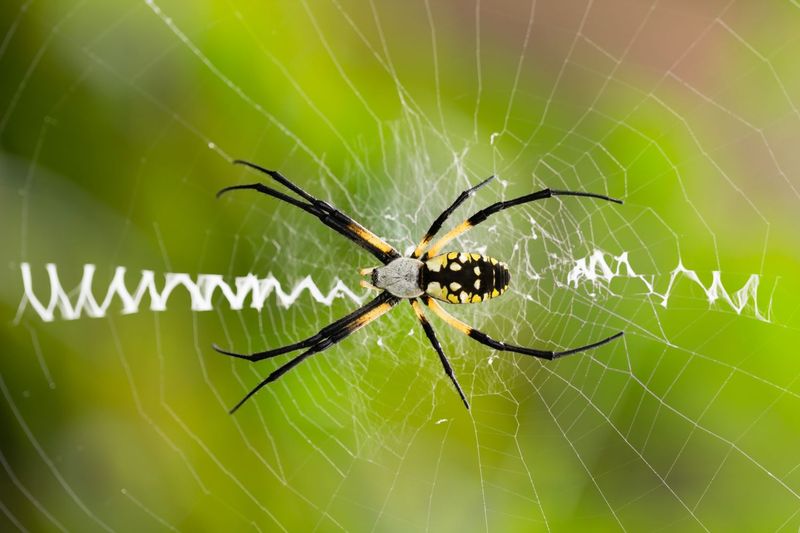
Southern California yards, for example, may host the yellow garden spider (Argiope aurantia), recognized by its bold yellow and black abdomen and the white zigzag silk band running down the center of its web. The silver garden orb-weaver (Argiope argentata) has a more silvery, angular body and turns up frequently in coastal and inland areas. The banded garden spider (Argiope trifasciata) shows pale horizontal stripes, while the western spotted orb-weaver (Neoscona oaxacensis) is more muted in color and often active at night. The Natural History Museum of Los Angeles County’s Spider Pavilion has documented the variety of orb-weavers present across the region.
Species identification matters here for a practical reason. An exposed orb-weaver sitting in the middle of a large circular web in full daylight presents a very different identification and safety question from a spider hiding in a dark corner of a garage or under a porch ledge. UC IPM’s guide to common garden spiders helps homeowners sort these categories without guesswork.
Throughout this article, “garden orb-weavers” or “garden-orb-weaver webs” refers to these several species collectively, not a single spider with uniform behavior. Generalizations about what any one web will do for your yard should be read with that variety in mind.
An orb web catches accessible moving prey
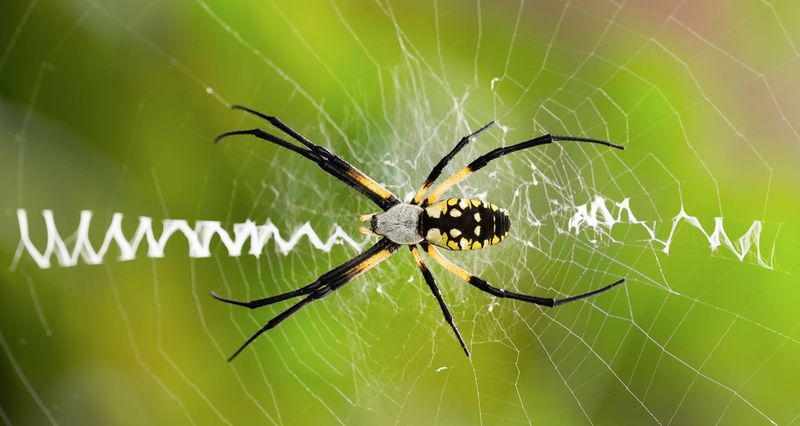
Orb-weavers are sit-and-wait hunters. A spider builds its large, circular web, then positions itself in the center or retreats to a nearby anchor point and waits. When an insect flies or walks into the sticky spiral threads, the vibration signals the spider to move in quickly. The web does the work of interception; the spider handles what arrives.
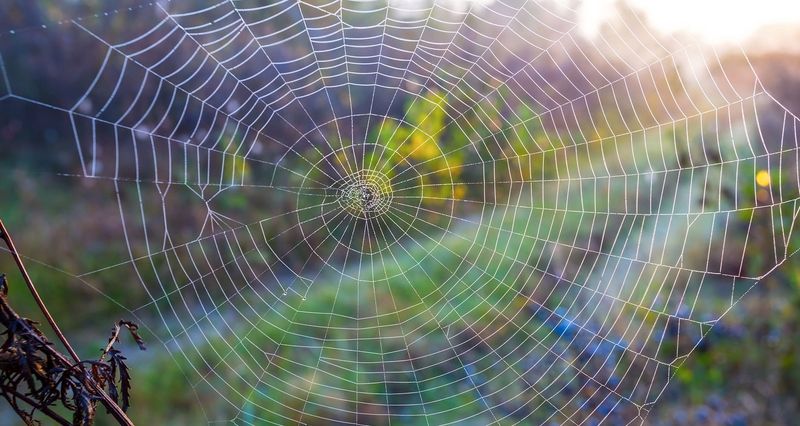
Argiope aurantia builds one of the most recognizable versions of this structure. Its web can span several inches across and often features a vertical band of white, zigzag silk called a stabilimentum running through the hub. The University of Michigan’s Animal Diversity Web profile of Argiope aurantia notes that individuals may rebuild or repair the web regularly, which means a web you see today may be replaced by a fresh one tomorrow morning.
That rebuilding habit is worth keeping in mind when you think about removing a web. Clearing one from a spot the spider likes does not necessarily drive the spider away from your yard; it may simply prompt a new web in roughly the same location.
What the web cannot do is equally important to understand. UC IPM’s common garden spiders resource describes orb-weavers as predators of insects and other arthropods that become entangled in their webs. The key phrase is “become entangled.” The web intercepts prey that flies or moves through a particular zone of air space. It does not search plant stems for stationary colonies, patrol the soil, or extend its reach across an entire yard.
A web near your roses might catch a few passing insects, but the orb-weaver is not patrolling your rose bed the way a gardener with a hose would.
Thinking of an orb-weaver as a passive trap set in one location, rather than an active hunter covering your property, gives you an accurate picture of what preserving that web actually provides.
Garden spiders may reduce some insect pressure
Orb-weavers are generalist predators, meaning they eat whatever the web intercepts rather than targeting one specific insect. Documented prey for Argiope aurantia includes aphids, flies, grasshoppers, wasps, and bees, according to the Animal Diversity Web’s species account. That list covers both pest insects and beneficial ones, which is a useful reminder that the spider is not selectively removing only the insects you dislike.
Broader research on spiders as a group does support the idea that they can contribute to reducing insect pressure in some settings. A large meta-analysis examining 58 studies on spider biocontrol found that higher spider density was associated with pest suppression in 79% of the agricultural cases analyzed. That figure sounds encouraging, but the study’s own findings show that outcomes varied considerably depending on the crop, climate, spider community, and pest group being measured. The research was conducted in agricultural systems, not suburban yards, and it examined spider communities as a whole rather than any single species building a single web.
Translating that finding to a homeowner’s garden requires caution. One orb-weaver web near your vegetable bed may catch some insects that would otherwise have landed on your plants. It is a reasonable contribution to the garden food web, and UC IPM’s biological control guidance recognizes spiders among the natural enemies worth protecting in California landscapes.
What that web will not do is deliver consistent, measurable pest control the way a targeted treatment would. Framing the spider as one useful participant in a yard full of interacting organisms is accurate. Framing it as a stand-alone solution to a pest problem is not. Keeping the web in place is a low-effort, no-cost choice that supports a healthy garden food web, and that is genuinely worth something, even if the results are not predictable or dramatic.
Aphid predation does not cure an infestation
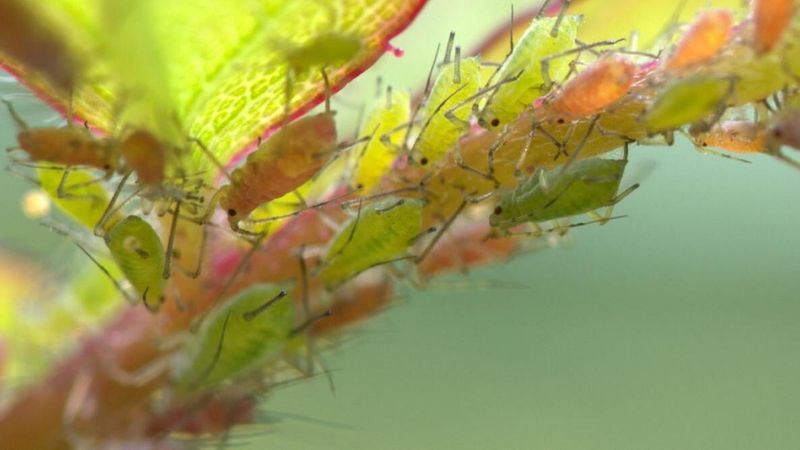
Aphids cluster on stems and new growth, feeding in dense, stationary colonies. A web strung nearby might intercept an aphid that happens to become airborne during dispersal, and the documented prey list for Argiope aurantia does include aphids. But orb-weaver webs are built to catch what moves through open air space, not to comb plant surfaces where aphid populations actually live and grow.
An orb-weaver sitting near your aphid-covered squash or roses is not inspecting every leaf. The spider waits for prey to come to the web, which means the hundreds of aphids feeding on a stem two feet away are largely outside its reach. Counting on that web to reverse a developing infestation sets up an expectation the spider cannot meet.
A more practical approach pairs tolerance for beneficial predators with regular plant inspection. Walk through your beds weekly during the growing season and check the undersides of leaves and the tips of new stems where aphids congregate first. Catching a small colony early gives you options: a firm spray of water from a hose can knock aphids off many plants without harming the orb-weaver nearby. UC IPM’s natural enemies guidance encourages supporting a range of beneficial predators, including lady beetles, lacewings, and parasitic wasps, because no single predator handles every pest situation.
Leaving a harmless orb-weaver web in place is still worth doing. The spider may catch some insects, and it costs you nothing to leave it alone. Just do not let the presence of that web replace the hands-on inspection and early action that actually keep aphid populations from becoming a serious problem on your plants.
Mosquito control starts with standing water
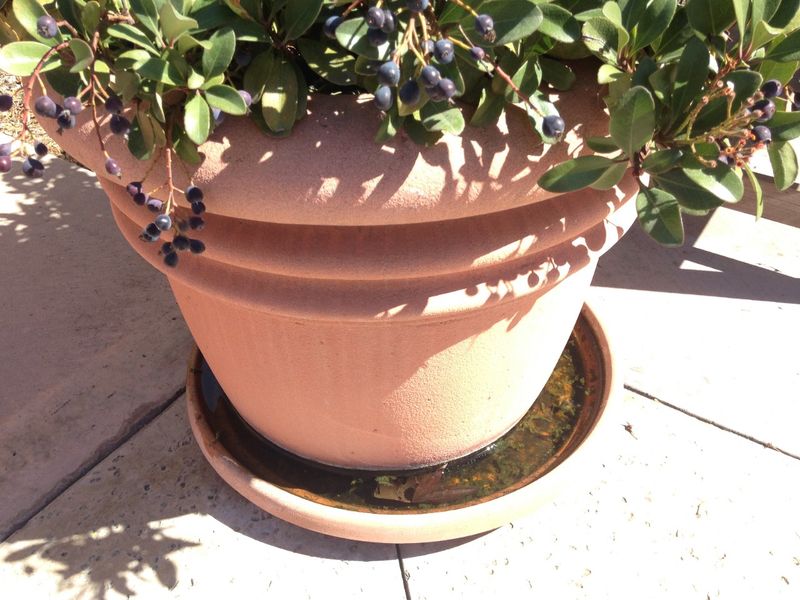
Mosquitoes spend their larval and pupal stages entirely underwater. A female lays eggs in standing water, and the larvae that hatch stay submerged until they emerge as adults. An orb-weaver web strung between your patio posts cannot reach into a flower-pot saucer, a plugged gutter, or a forgotten bucket to intercept mosquitoes at that stage. Web-building spiders hunt above the ground surface, and mosquito larvae are simply not accessible to them.
Adult mosquitoes can fly into a web, and an orb-weaver may occasionally catch one. But that occasional capture does not add up to meaningful population control when a single container of standing water can produce dozens of new mosquitoes within a week. Relying on a garden spider to handle your mosquito problem while leaving breeding sites intact will not produce results you can measure.
UC IPM’s mosquito guidance is direct on this point: the most effective step a California homeowner can take is eliminating the standing water where mosquitoes breed. Go through your yard at least once a week and empty, scrub, cover, or turn over anything that holds water. Common sources include plant saucers, pet water dishes, bird baths, tarps, wheelbarrows, and low spots in lawns where water pools after irrigation.
CDC guidance on home mosquito control adds that even very small amounts of water, as little as a bottle cap’s worth, can support mosquito development in warm weather. California’s Department of Pesticide Regulation mosquito IPM page reinforces this with a weekly drain-and-scrub recommendation, since scrubbing removes the egg masses that cling to container walls above the waterline.
After eliminating standing water, layer in window and door screens, use EPA-registered repellents when spending time outdoors at dusk and dawn, and contact your local vector-control district if you notice persistent mosquito activity. These steps do far more for mosquito management than any number of garden spider webs.
Broad-spectrum sprays can remove beneficial predators
Broad-spectrum insecticides do not distinguish between the aphid you want gone and the orb-weaver you just decided to leave alone. When a general spray reaches a garden spider’s web or the vegetation around it, the spider is exposed to the same chemistry as the target pest. California’s Department of Pesticide Regulation backyard garden IPM factsheet specifically recommends encouraging beneficial predators and avoiding broad-spectrum insecticide applications that can harm them.
This matters because beneficial predators do some of their best work quietly and continuously. An orb-weaver catching insects over weeks contributes more to a garden’s ecological balance than a single spray event that also removes the predators keeping smaller pest populations in check. Once a broad spray has cleared an area, pest insects often recolonize faster than their predators return, which can leave you in a worse position than before.
UC IPM’s biological control and natural enemies resource outlines an integrated approach: start with inspection, support habitat for natural enemies, and choose the most targeted treatment available when intervention is genuinely needed. San Diego County’s IPM spider program echoes this, recommending habitat creation and minimal pesticide use as the two practical steps for homeowners who want to keep beneficial spiders present in their yards.
None of this means abandoning treatment when a pest problem genuinely needs intervention. A heavy aphid infestation on a young tree, a fungal outbreak, or a pest that is causing real plant damage may warrant action beyond observation. The goal is to avoid reaching for a broad spray as the first response to any insect sighting, and to factor in the predators that are already working on your behalf when you weigh your options.
Leave harmless webs and remove only real obstructions
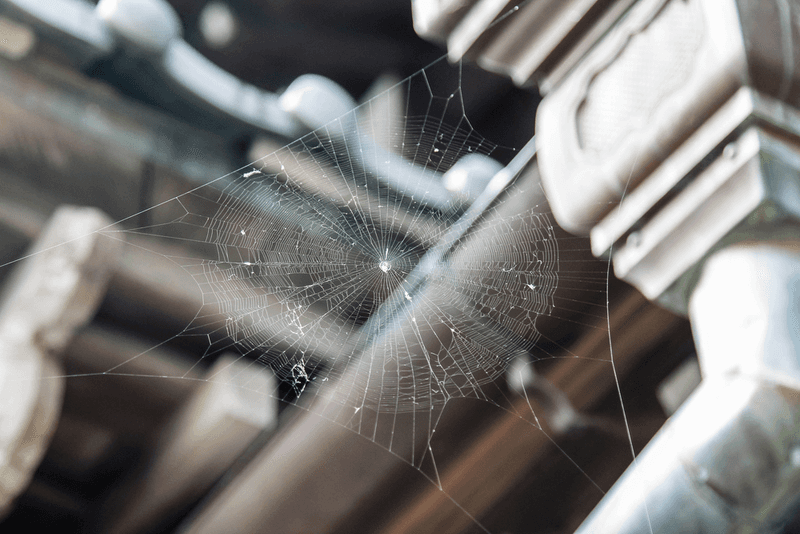
Most orb-weaver webs in a California yard are genuinely out of the way. A web stretched between two shrubs in a planting bed, anchored along a back fence, or suspended in the corner of a garden arch poses no real inconvenience and costs nothing to leave in place. Preserving these webs is the simplest thing you can do to support a beneficial predator, and San Diego County’s IPM spider program lists not removing spider webs as one of the core habitat-support recommendations for homeowners.
A web across a front doorway, a walkway you use every day, a stairway railing, a child’s play structure, or a piece of garden equipment you handle regularly is a different situation. Removing that web is a reasonable choice, and there is no obligation to work around a spider in a location that creates a genuine inconvenience or safety concern. The key is how you remove it.
Work from a comfortable distance using a long-handled broom, a bamboo cane, or a similar tool to sweep the web aside or detach its anchor threads. University of Maryland Extension’s spider web guidance notes that many spiders rebuild webs regularly, so clearing one is often a temporary measure. Repeated disturbance of the same location may eventually cause the spider to move elsewhere on its own, though there is no reliable method to direct where it goes.
Do not attempt to pick up the spider or carry the web to a new spot. The Argiope aurantia species profile supports removing and rebuilding as normal spider behavior, but it does not describe a safe or predictable relocation technique. Avoid bare-handed contact with any spider you have not positively identified, and let the spider find its own new location if repeated web removal discourages it from staying.
Use distance when identification is uncertain
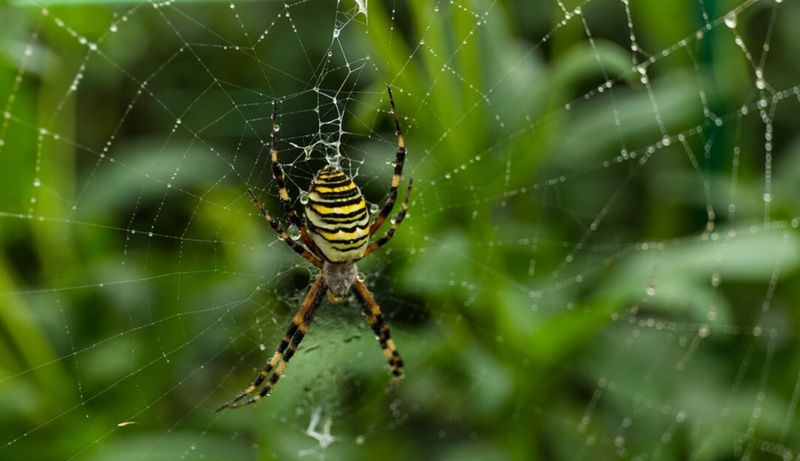
A large, colorful spider sitting in the open center of a circular web on a sunny afternoon is almost certainly an orb-weaver, not a black widow. UC IPM’s common garden spiders guide notes that most spiders encountered openly during the day are unlikely to bite or cause lasting harm to a healthy adult. That is reassuring context, but it is not a license to handle any unknown spider bare-handed.
California’s medically significant black widows behave quite differently from orb-weavers. UC IPM’s widow spider resource explains that black widows generally occupy concealed, undisturbed locations: the underside of a patio chair, the inside of a rarely used glove, the dark corner behind a stored pot, or a gap in a wooden retaining wall. Their webs are irregular and tangled rather than the clean, circular spiral of an orb-weaver. Finding a messy web in a dark, sheltered spot warrants more caution than finding a large circular web in full sun.
Size and color alone are not reliable identification tools. Some orb-weavers are large and strikingly patterned, while some dangerous spiders are small and dull. If you are not certain what you are looking at, maintain distance and use a tool rather than your hand to move the web or any debris near it.
The practical rule is straightforward: an exposed, patterned spider in a circular web in your garden bed during the day is most likely a harmless orb-weaver, but uncertainty should lead to cautious distance rather than direct contact. If you need to remove the web, use a long-handled tool and avoid touching the spider regardless of how confident you feel about the identification.
Choose tolerance with limits
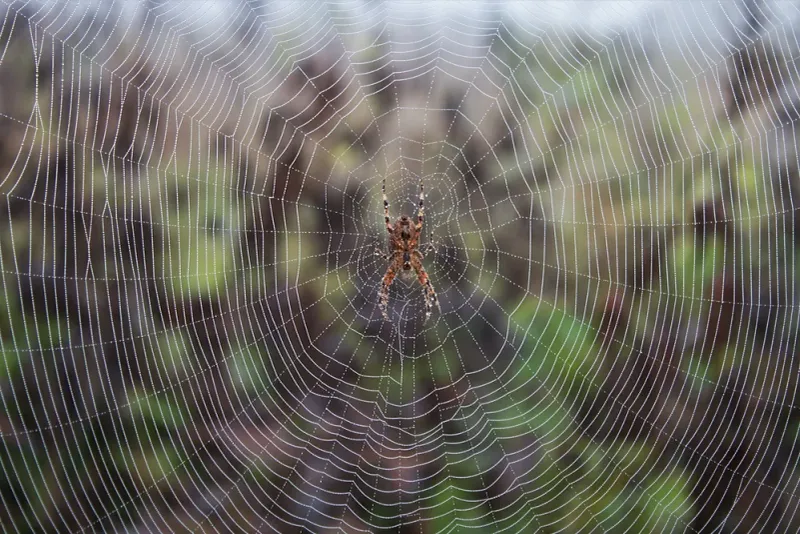
Orb-weaver webs in California yards are worth keeping when they are out of the way. These spiders may consume some insects, they cost nothing to support, and California’s Department of Pesticide Regulation garden IPM guidance specifically recommends protecting beneficial predators and reducing unnecessary broad-spectrum insecticide use. Leaving a harmless web alone is one of the easiest things a homeowner can do for a healthier yard.
What that web will not do is eliminate an aphid infestation or suppress mosquitoes around your home. Aphid colonies live on plant surfaces the web does not reach, and mosquitoes breed in standing water that no garden spider can access. UC IPM’s mosquito guidance and the CDC both point to weekly standing-water removal as the foundational mosquito-control step, and that job belongs to you, not to the spider on your fence.
When a web blocks a path, a doorway, or a space you use regularly, removing it with a long-handled tool is a reasonable and practical choice. University of Maryland Extension’s web removal guidance notes that repeated disturbance may prompt the spider to move on its own. A web worth saving and a web worth removing are not the same thing, and knowing the difference is the whole skill. A harmless web between two shrubs deserves to stay; a web across your front door every morning is fair to clear.