
If your crape myrtle has been leaving a sticky, black-coated mess on your patio furniture every summer, you are not alone. The culprit is usually crape-myrtle aphids, tiny insects that coat leaves with honeydew and set the stage for sooty mold.
Toyon, a California native shrub that can be trained into a small patio tree, may help you sidestep that specific problem while feeding pollinators and birds through the seasons. The catch is that toyon works best in the right site, needs water to get started, and comes with its own honest list of trade-offs.
Toyon may fit the patio better than a universal replacement
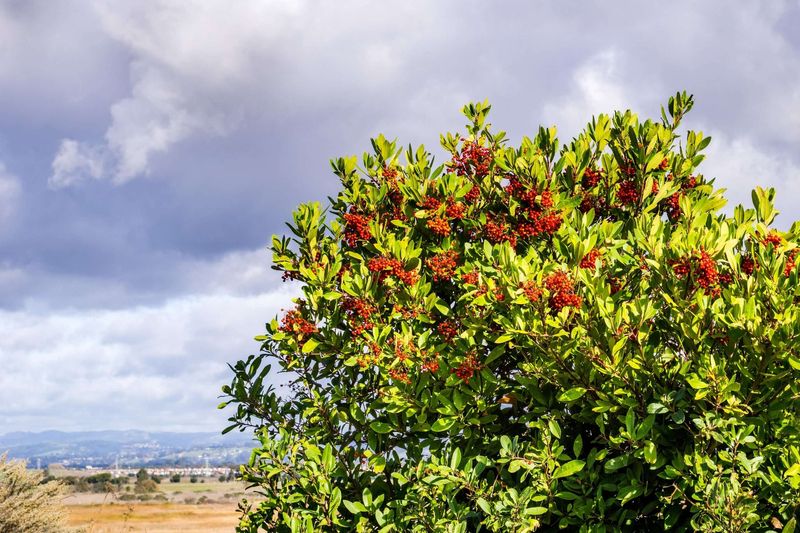
Heteromeles arbutifolia goes by several names, including toyon, California holly, and Christmas berry, but its role in a patio garden depends almost entirely on how it is sited and pruned. UC IPM’s toyon profile describes it as an evergreen California native that tolerates dry summers, blooms in June and July, and produces red berries that carry wildlife through winter.
Those qualities make it a genuinely appealing candidate for many coastal, foothill, and Mediterranean-climate gardens, but the word “candidate” is doing real work here.
Toyon is not a statewide cure-all or a guaranteed cleaner patio. Left to its own devices, it typically grows as a large, rounded shrub, not a tidy shade tree.
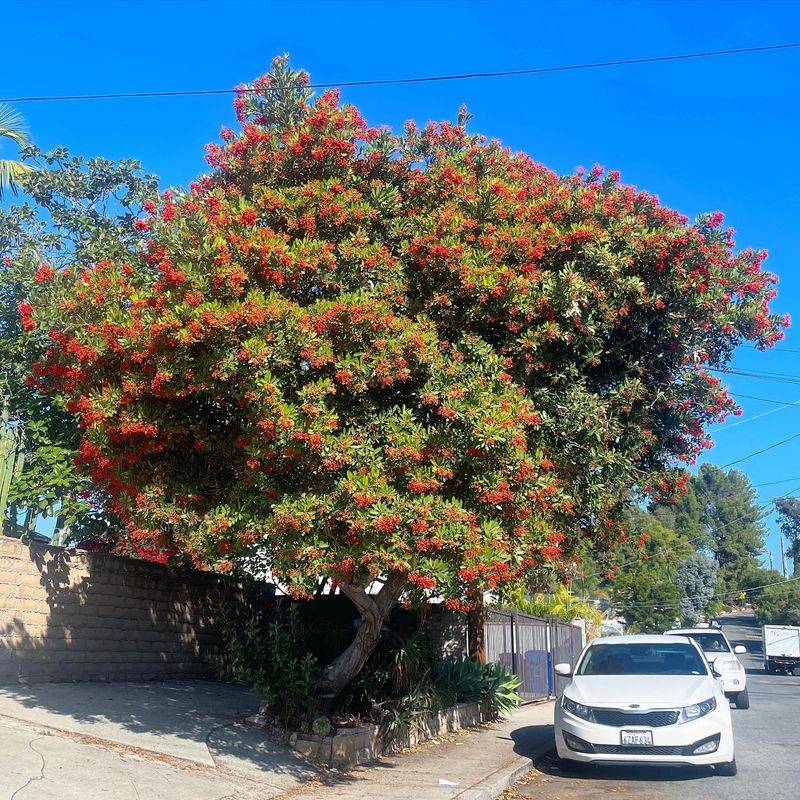
Trained with selective pruning over several seasons, it can become a small, multi-trunked tree that provides filtered or dappled shade, which is useful but different from the broad, dense canopy a mature coast live oak or valley oak delivers. Homeowners expecting an instant, deep-shade replacement may find themselves recalibrating expectations.
The comparison with crape myrtle is also narrower than the headline suggests. The practical trade-off is that toyon may avoid the specific crape-myrtle aphid association that produces honeydew and sooty mold.
It does not eliminate aphids, honeydew, or maintenance as categories. UC Master Gardeners of Sonoma County note that toyon can revert toward shrub form if basal shoots go unaddressed, and UC ANR’s Christmas berry overview confirms its documented pest list.
Treat toyon as a strong option for the right yard, not a universal fix, and the trade-off becomes genuinely useful.
Crape-myrtle honeydew explains the familiar patio mess
Crape myrtle is extensively planted across Southern California and the San Joaquin Valley, and in many of those yards it performs without noticeable problems. The sticky, black-coated mess that gives the tree a bad reputation traces back to a specific pest: the crape-myrtle aphid.
UC Master Gardeners’ crape myrtle overview explains that these small, pale insects cluster on leaf undersides and stems, feeding on plant sap and excreting a sugary liquid called honeydew.
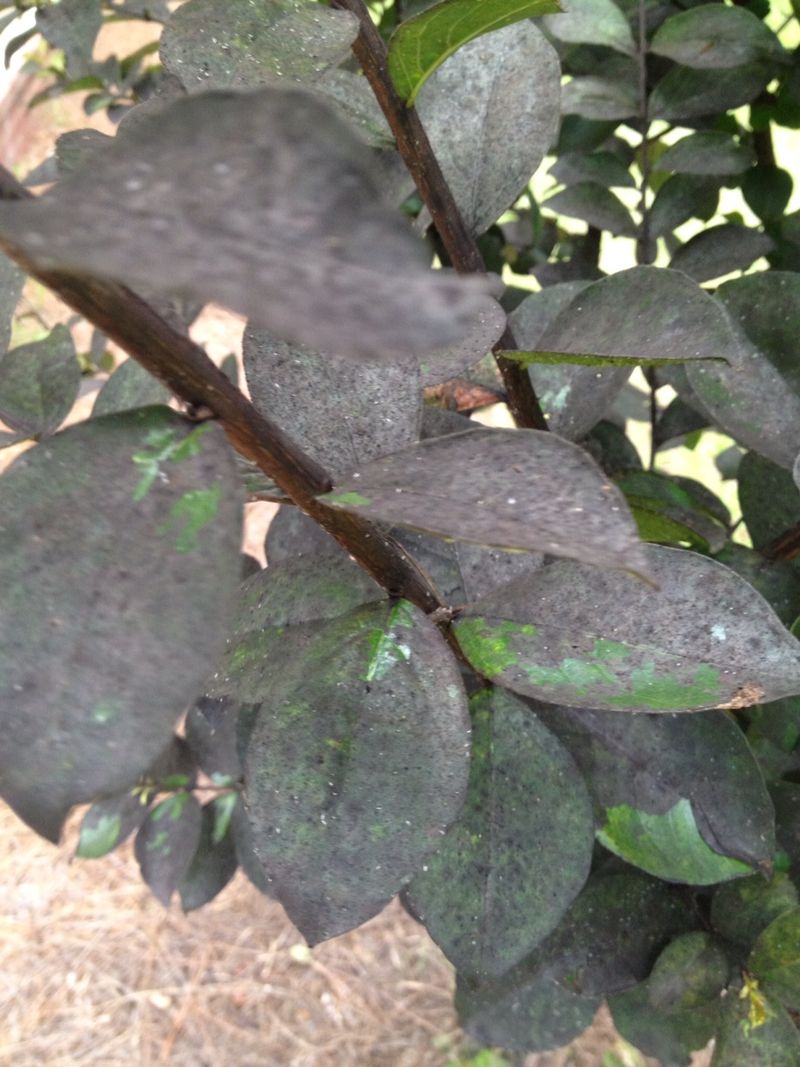
Honeydew itself is the first problem: it coats leaves, furniture, and pavement with a tacky film. The second problem arrives shortly after.
University of Georgia Extension’s sooty mold explainer describes how airborne fungi colonize honeydew deposits and produce the familiar black coating. Sooty mold is a secondary growth feeding on insect waste, not a disease attacking the tree’s tissue directly.
Established crape myrtles usually tolerate light-to-moderate aphid pressure without permanent harm, and the pest does not infest every tree in every yard every year.
The bounded comparison with toyon matters here. Toyon is not a documented host for the crape-myrtle aphid, so planting it may remove that particular honeydew source from your patio.
UC IPM’s aphid guidance makes clear, though, that many other sap-feeding insects produce honeydew, and toyon has its own documented pest issues. Switching trees may reduce one specific risk, but it does not guarantee a clean patio or a pest-free yard.
Understanding that distinction helps set realistic expectations before the first shovel goes in the ground.
Flowers and berries add habitat without solving every wildlife need
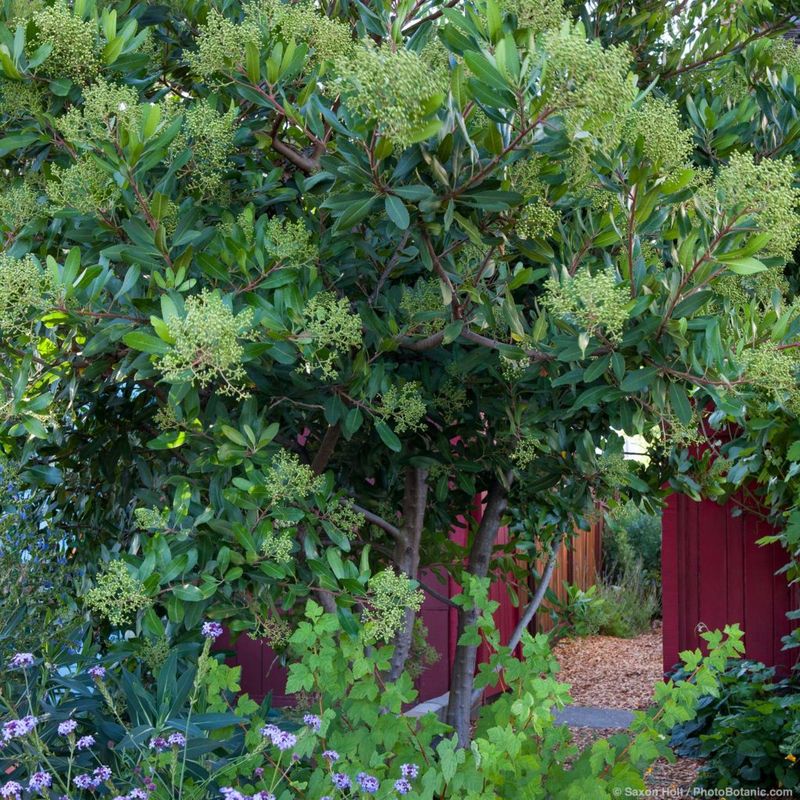
One of toyon’s strongest arguments for a California patio garden is the seasonal sequence it offers beyond shade. UC IPM’s toyon profile notes that the tree blooms in June and July, producing clusters of small white flowers that attract bees and other pollinators during a period when many summer-flowering plants have already faded or have not yet peaked.
That timing fills a gap in the dry-season food supply that genuinely matters for foraging insects.
After flowering, toyon shifts roles again. Its berries ripen to red in fall and persist through winter, providing food for cedar waxwings, American robins, mockingbirds, and other birds that depend on persistent fruit when other sources are scarce.
UC Master Gardeners of Sonoma County and UC ANR’s Christmas berry overview both describe this winter wildlife value as one of the plant’s most distinctive traits. The berries are a genuine ecological asset, with one important caveat: they are not safe for people to eat raw.
UC Master Gardener sources warn that the berries contain cyanogenic compounds and should not be consumed raw or prepared without expert knowledge, so keep that context clear if children or foragers spend time in your yard.
Even with all of that wildlife value, one toyon tree is not a complete habitat solution. UC ANR’s native plant landscape guide recommends pairing any anchor tree with locally appropriate flowering plants that extend bloom across seasons, from early spring through late fall.
Adding companions such as native sages, buckwheats, or coyote brush stretches the food supply further and reduces the pressure any single plant carries. Limiting pesticide use in the same area protects the beneficial insects that the flowers attract, which closes the loop on what a genuinely wildlife-friendly patio garden can look like.
UC’s winter berries roundup offers additional context on pairing berry-producing natives for extended seasonal benefit.
Pruning turns toyon’s shrub habit into usable patio clearance
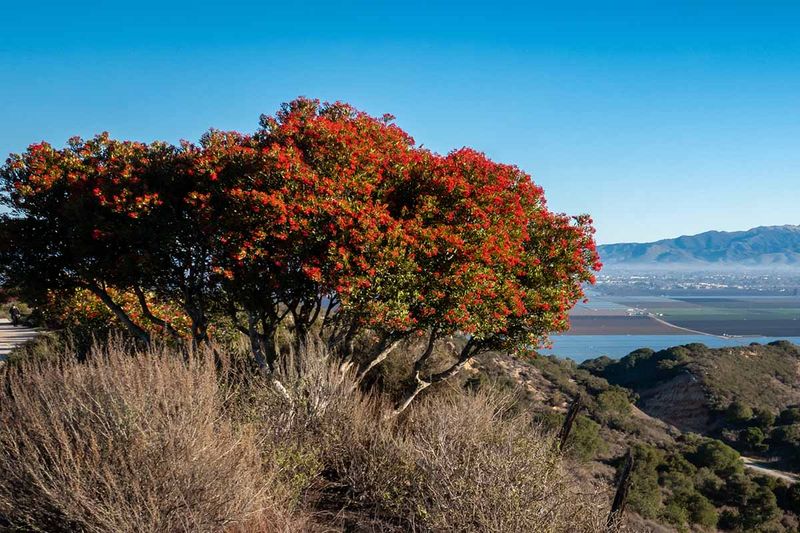
Toyon does not arrive at the nursery as a ready-made patio tree. Most plants sold in one- or five-gallon containers show the dense, multi-stemmed shrub form that toyon naturally prefers, and that form will reassert itself if pruning stops.
Turning it into something useful for patio clearance requires a deliberate, multi-season approach rather than a single aggressive cut.
The process starts in the first or second year after planting. UC Master Gardeners of Sonoma County describe selecting one to several permanent trunks and removing competing stems at the base.
Once the trunks are chosen, lower side branches are removed gradually, raising the canopy a foot or two at a time over multiple growing seasons. Rushing this process by stripping too many branches at once can stress the plant and reduce its flowering and vigor.
Basal shoots are the main ongoing task. Toyon pushes new growth from the root crown regularly, and those shoots will thicken into competing trunks if left unchecked.
A seasonal sweep, typically in late winter before new growth flushes, keeps the tree form intact without requiring constant attention. The goal is not a perfectly symmetrical canopy but a structure that provides filtered, dappled shade at patio height while maintaining the plant’s health and flower production.
Before choosing a planting spot, measure the mature footprint carefully. Toyon can reach 6 to 15 feet or more in height and spread depending on site conditions and whether you are working with the wild-type species or a nursery cultivar.
Allow clearance from paving, roof overhangs, and utilities so that the canopy has room to develop without creating future conflicts. A tree that requires heavy annual cutting to stay out of gutters or off a fence is not providing shade efficiently and is being set up for a management problem the homeowner did not plan for.
Match toyon to the region instead of trusting the native label
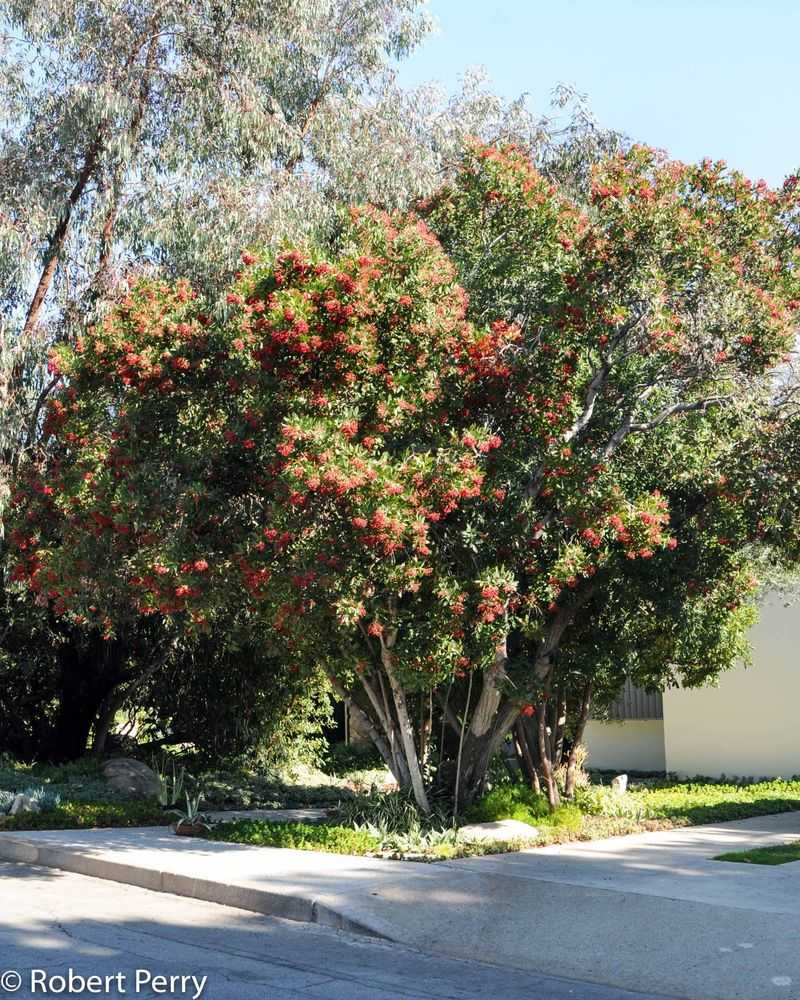
California native does not mean California everywhere. Toyon performs reliably across many coastal, foothill, and Mediterranean-climate gardens, but the same label covers plants adapted to the foggy coast, the chaparral, and the high desert, and those environments are not interchangeable.
Before ordering a toyon, assess your specific site conditions rather than assuming that native origin equals automatic success.
UC IPM’s toyon profile and UC Master Gardeners of Sonoma County both describe toyon as preferring full sun to light shade and well-drained soil. Heavy clay that stays saturated through winter can contribute to root disease, so drainage matters as much as rainfall totals.
Planting in heavy shade reduces flowering and berry production and encourages the leggier, less structured growth that makes patio training harder.
Summer heat is the other variable to weigh carefully. Toyon is well adapted to California’s Mediterranean dry summers, but extreme inland heat combined with reflected heat from pavement or walls can stress a young plant and slow establishment.
For many hot inland valleys and desert gardens, desert willow (Chilopsis linearis) is a more regionally appropriate choice. UC ANR’s desert willow profile describes it as drought-resistant, blooming through summer, and attractive to hummingbirds and bees.
The trade-off is shade: desert willow has an open, wispy canopy that delivers light shade at best, and UC ANR’s Plants We Love feature notes it can become leggy in part shade. For a homeowner whose primary goal is patio coverage, desert willow is a habitat asset but not a dense overhead solution.
Cultivars and hybrids add another layer of complexity. A nursery-selected toyon cultivar may differ from the wild-type species in mature height, canopy spread, bloom timing, berry production, and growth rate.
UC ANR’s native plant landscape guide recommends confirming the specific cultivar’s expected performance before purchasing, particularly if wildlife value or a specific mature size is a priority. A compact cultivar bred for smaller gardens may produce fewer berries; a larger selection may outgrow the patio space within a decade.
Establish the tree before expecting dry-summer resilience
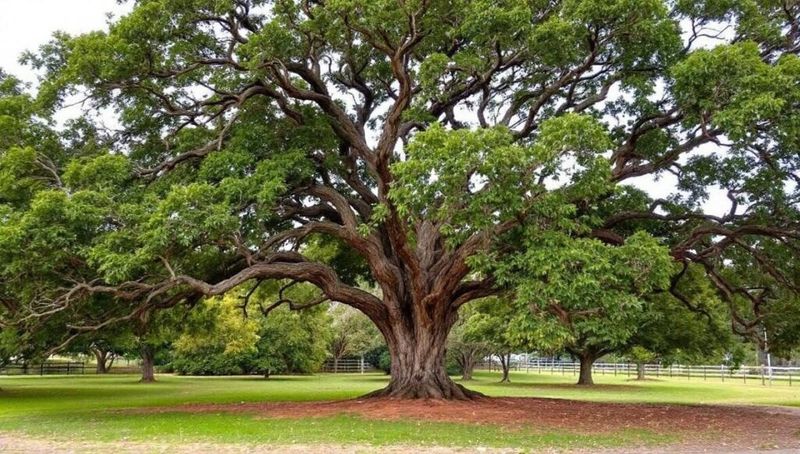
Drought tolerance is a destination, not a starting point. Toyon earns its water-wise reputation after its root system has spread into surrounding soil and learned to draw on stored moisture, a process that typically takes one to two full years of supplemental irrigation.
Planting it and walking away in the first summer is one of the most reliable ways to lose the tree before it ever becomes a patio asset.
UC ANR’s fall planting guide for California natives recommends fall planting when possible, usually October through December in most California climate zones. Fall planting lets winter rainfall do much of the establishment work, reducing the amount of supplemental irrigation needed in the first critical season.
Even so, newly planted toyon still needs regular deep watering through the first dry season and likely the second as well. UC Master Gardeners’ natives garden guidance and UC’s summer care guide for California native plants both emphasize that even established plants may need carefully timed supplemental water during exceptional heat events or multi-year drought.
Check local water restrictions before setting an irrigation schedule, since many California water districts impose seasonal limits that affect how much supplemental water is allowed.
Fire-prone sites add a separate layer of planning that tree selection alone cannot address. CAL FIRE’s defensible space guidelines require removing dead vegetation, maintaining spacing between plants and structures, and pruning lower branches to reduce ladder fuels, regardless of whether the tree is native or exotic.
A toyon trained as a patio tree still needs defensible-space clearance from the house, and dead leaves or spent flower clusters should be removed regularly, particularly heading into fire season. Being a California native does not make any tree automatically fire-resistant; plant condition, spacing, and fuel management matter far more than species origin.
Use observation and low-impact controls before reaching for pesticides
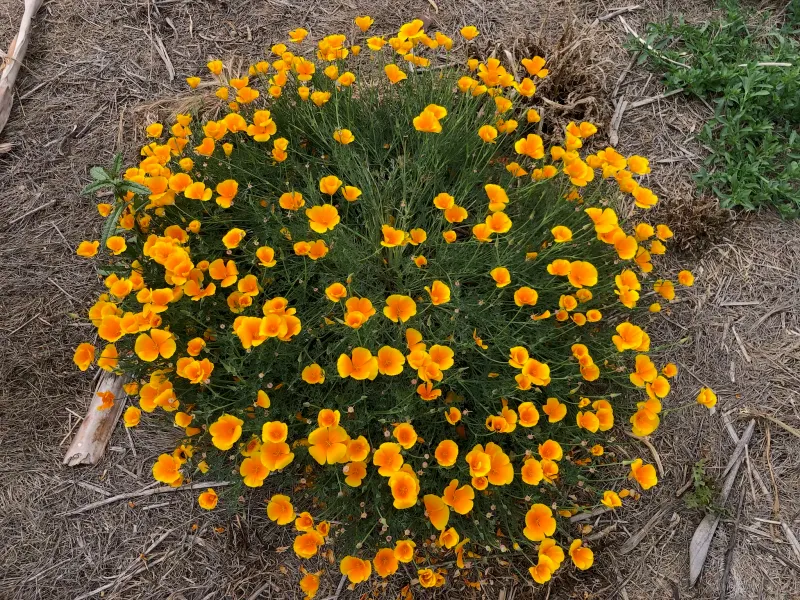
Toyon brings real ecological value to a patio garden, but it is not a maintenance-free plant. UC IPM’s toyon profile lists scales, whiteflies, thrips, lace bugs, and caterpillars among the pests that can affect the plant, along with the possibility of root disease in poorly drained soil.
Most of these problems respond to early detection and low-impact responses rather than immediate chemical treatment. A monthly walk-around during the growing season, checking leaf undersides and new growth for discoloration, stippling, or sticky residue, catches problems while they are still manageable.
For an existing crape myrtle dealing with aphids, the same patient approach applies. UC IPM’s aphid management guidance recommends starting with a strong stream of water directed at infested foliage, which dislodges aphids without harming the plant or its surroundings.
Pruning out heavily infested branch tips removes concentrated populations before they spread. Avoiding excess nitrogen fertilizer is equally important: lush, fast-growing tissue is exactly what aphids prefer, so a lean fertilization program reduces their food supply.
Lady beetles, lacewings, syrphid fly larvae, and parasitic wasps are natural predators that keep aphid populations in check when left undisturbed, and their presence is worth actively protecting.
Broad-spectrum insecticides disrupt that natural balance by killing predators alongside pests, often leading to larger aphid rebounds a few weeks later. Systemic insecticides carry an additional concern: they move through plant tissue and can appear in pollen and nectar, where they harm bees and other pollinators.
California has tightened its rules on this front. California Department of Pesticide Regulation guidance on neonicotinoids restricts many outdoor tree applications to licensed professionals, so homeowners reaching for systemic products may be working outside current law without realizing it.
The practical decision rule for the whole article comes down to honest site assessment. Choose trained toyon where its regional fit, filtered shade, summer flowers, and winter berries suit the yard and the homeowner’s maintenance capacity.
Where the site runs too hot, too shady, too wet, or too exposed for toyon to thrive, choose a different tree rather than forcing the plant into conditions it cannot handle. A well-matched native tree in the right spot will always outperform an overmatched one fighting its environment, and that is the version worth planting.