
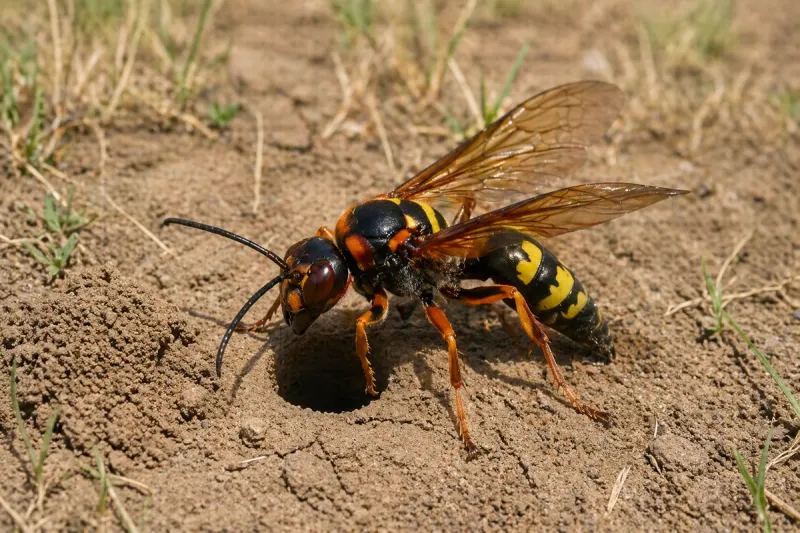
Something large and buzzing is excavating your lawn right now, and the sight of it can stop a Central Texas homeowner cold. A wasp the size of your thumb, hovering over a pile of fresh dirt, looks like serious trouble.
Knowing what you are probably looking at, and how to respond, can turn a scary summer mystery into something you can handle calmly and confidently.
Those giant wasps fit a familiar Texas summer pattern
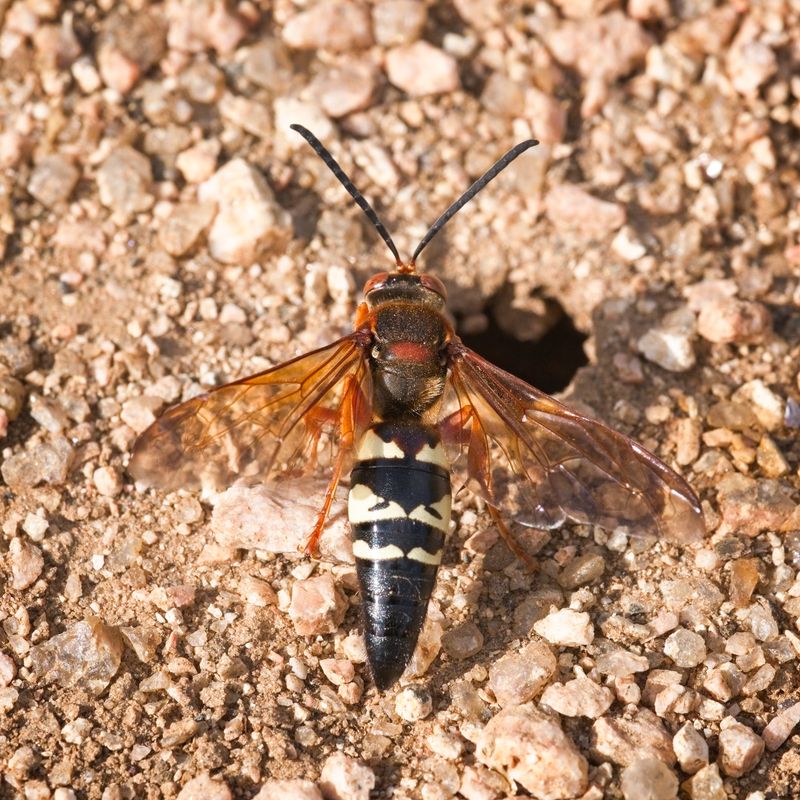
Seeing a wasp the size of a hummingbird hovering over fresh soil in July or August is unsettling, but the combination of clues you are watching can point toward a likely identity. Texas A&M AgriLife Extension’s field guide to common Texas insects identifies the eastern cicada killer, Sphecius speciosus, as a Central Texas resident active mainly during those two months, which matches the late-summer timing most homeowners notice.
The visual markers are fairly distinctive when you see them together. Look for a very large wasp, reaching about one and a half inches in length, with a rusty-red head and thorax, a dark or rusty abdomen crossed with yellow bands, and wings that carry a warm russet tint.
Size alone is not enough to call it, but that color combination narrows things considerably.
The setting matters as much as the appearance. Cicada killers favor sunny spots with bare, loose, well-drained soil, the kind of sandy or compacted-but-friable ground that shows up in neglected lawn patches, gravel borders, and sandy garden beds across Central Texas.
Each female digs her own burrow, and the excavated soil typically forms a noticeable mound or a U-shaped collar around the entrance hole.
The strongest single clue is behavior. A large wasp wrestling a paralyzed cicada across the ground or carrying one in flight toward a hole is a very good indicator you are watching a cicada killer at work.
Other ground-nesting wasps can look similar at a glance, so the full picture, including the season, the soil, the location, and especially the cicada cargo, builds a more reliable case than any one detail on its own.
If they are cicada killers, the holes are solitary nurseries—not a hive
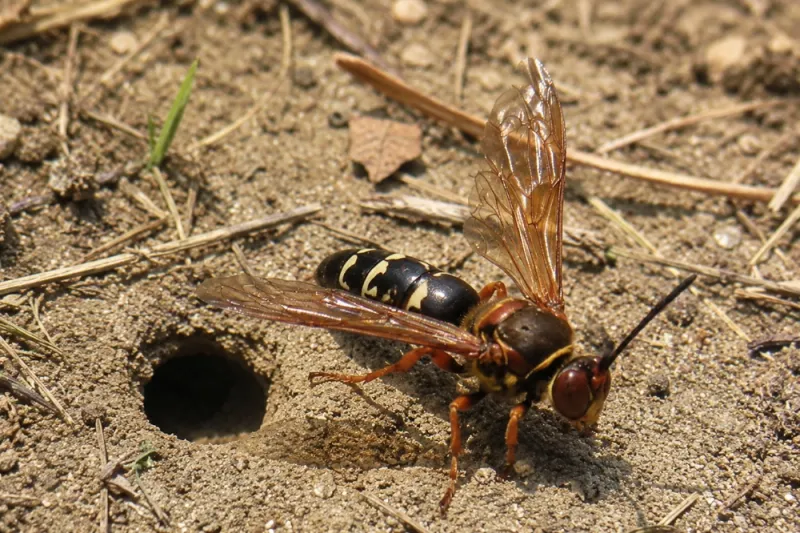
Assuming the appearance and behavior match the full profile above, the biology of what is happening underground is genuinely different from what most people fear. Female cicada killers do not build a shared nest or answer to a queen.
Each female digs her own burrow, excavates a series of side chambers, stocks each one with one or more paralyzed cicadas, and lays a single egg on the prey before sealing the chamber. The larva hatches and feeds on the cicada, completing its development underground before emerging the following summer.
Adults, meanwhile, are not feeding on your lawn or garden plants at all. Texas A&M’s cicada killer profile notes that adult wasps consume flower nectar, so the activity at the burrow entrance is purely about reproduction, not foraging on your plants.
The larvae consume cicadas; the adults visit flowers. That is the full scope of what they eat.
When several females choose the same sunny patch of loose soil, the result can look alarming, with multiple mounds and wasps coming and going in all directions. That clustering is not a colony or a hive.
Each wasp is maintaining her own separate nest in soil that happens to appeal to multiple individuals. There is no shared queen, no workers, and no coordinated nest defense.
That said, the digging itself is not consequence-free. Soil mounds can smother turf, and repeated burrowing can disturb grass roots or make a patch of lawn uneven and harder to use.
In unusual cases near sandy patios or pathways, concentrated burrowing can affect the ground surface in ways that go beyond aesthetics. The damage is usually manageable, but describing these wasps as completely harmless to the yard oversimplifies the situation.
Why likely cicada killers are usually low-risk—but not sting-proof
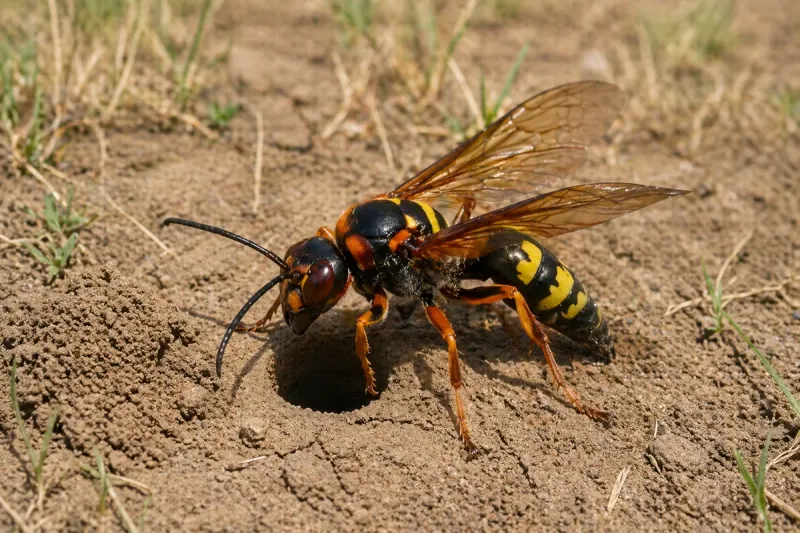
The word “harmless” in conversations about cicada killers deserves a careful correction. A more accurate phrase is usually low-risk, and the distinction matters for anyone sharing a yard with these wasps.
Male cicada killers are the ones most likely to get in your face. They patrol territories near burrows and will fly directly at people, pets, and each other in an assertive display.
The intimidation factor is real, but males have no stinger and cannot sting. Every hovering, dive-bombing male you encounter is physically incapable of stinging you, no matter how threatening it looks.
Females are a different calculation. Texas A&M’s extension guidance and University of Kentucky entomology resources both describe females as rarely stinging people, but the key word is rarely, not never.
A female that is grabbed, stepped on with bare feet, or trapped against skin can sting defensively. The sting is a protective response to direct contact, not an unprovoked attack launched from a distance.
Practical behavior adjustments make a real difference here. Do not swat at the wasps, try to catch them, or walk barefoot directly over active burrows where females are working.
Keep a calm, unhurried pace when moving through an area where they are nesting. Children who might be tempted to investigate or poke at a burrow are at higher risk, simply because they are more likely to make the kind of contact that triggers a defensive sting.
Distance and noninterference are your best tools. Watching from a few feet away carries very little risk.
Getting hands-on with these wasps, even accidentally, changes the equation.
A lawn hole alone does not identify the wasp
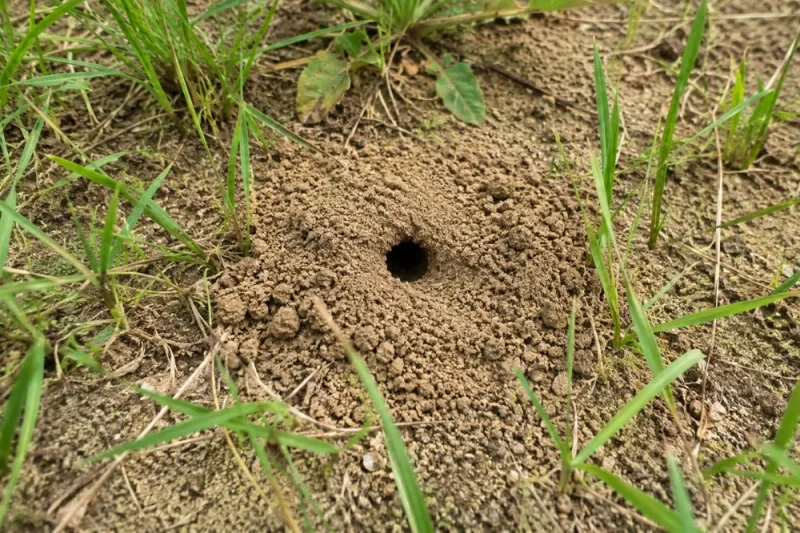
A hole in the yard is not a diagnosis. Central Texas yards host a range of ground-nesting and ground-hunting wasps, and treating every burrow as a cicada killer can lead to a seriously wrong response, especially when the actual resident is something far more defensive.
Sand wasps, great golden digger wasps, and tarantula hawks all appear in Texas yards and can be confused with cicada killers at first glance. Texas A&M’s field guide specifically lists related and lookalike species alongside the cicada killer profile.
Size and a hole are not enough to confirm the species. You need the full combination of appearance, behavior, season, and soil type before landing on a likely identification.
The most important safety distinction involves underground yellowjackets. University of Georgia Cooperative Extension guidance on southeastern neighborhood insect pests explains that yellowjackets are social wasps that defend their nest actively and can sting repeatedly when the entrance is disturbed.
If you kick, mow over, or step on an underground yellowjacket nest, the reaction from the colony can be swift and painful. Their behavior and risk profile are meaningfully different from the solitary, generally low-key cicada killer.
A hole with heavy traffic and small, bright-yellow wasps, especially one that triggers an aggressive response when approached, warrants much more caution than a cicada-killer burrow.
Some Central Texas homeowners also worry about northern giant hornets, the species formerly called “murder hornets.” USDA APHIS notes that cicada killers are among the northern giant hornet’s lookalikes, but the two can be separated: cicada killers have a reddish thorax, a smaller head relative to body size, and round eyes, while northern giant hornets have a large orange head, teardrop-shaped eyes, and a different banding pattern. Confirmed U.S. detections of northern giant hornets have been limited to northwest Washington state, not Central Texas.
Even so, the broader point stands: a large wasp anywhere in North America is not automatically benign, and correct identification always comes before a response decision.
When leaving likely cicada-killer burrows alone makes sense
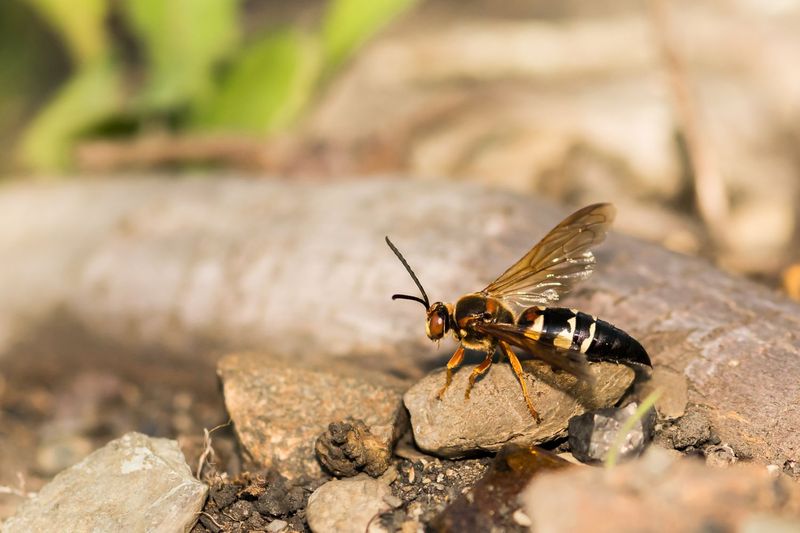
For most Central Texas homeowners, the best first response to a strongly suspected cicada-killer nesting area is to do nothing. Texas A&M AgriLife Extension describes management as generally unnecessary when these wasps are not interfering with people’s use of the yard.
If the burrows are in a back corner, a sunny strip along a fence, or another spot that does not sit under a play structure or across a main walking path, leaving them alone through the season is a reasonable choice.
Rerouting foot traffic is simple and effective. Temporarily moving a garden hose, repositioning lawn chairs, or placing a visual marker near an active area can redirect people and pets without any chemical intervention.
The active period at a given site is often just a few weeks, so a modest detour costs very little over the course of a summer.
Children need a specific explanation, not just a general warning. Tell them these wasps are working insects that will not chase them, but that stepping on or grabbing one could cause a sting.
Curiosity is natural, but hands-off observation from a few feet away is the rule. The same logic applies to pets, with an added complication: University of Kentucky entomology guidance notes that a dog or cat that catches or bites a female cicada killer can be stung, and a sting inside an animal’s mouth warrants immediate veterinary attention.
Swelling in the mouth or throat can become a breathing emergency for a pet very quickly.
The season is short. Most Central Texas sites see activity concentrated in July and August, and individual sites often quiet down in two to three weeks.
Patience is frequently the lowest-effort solution available.
Change the site only when the yard needs a practical fix
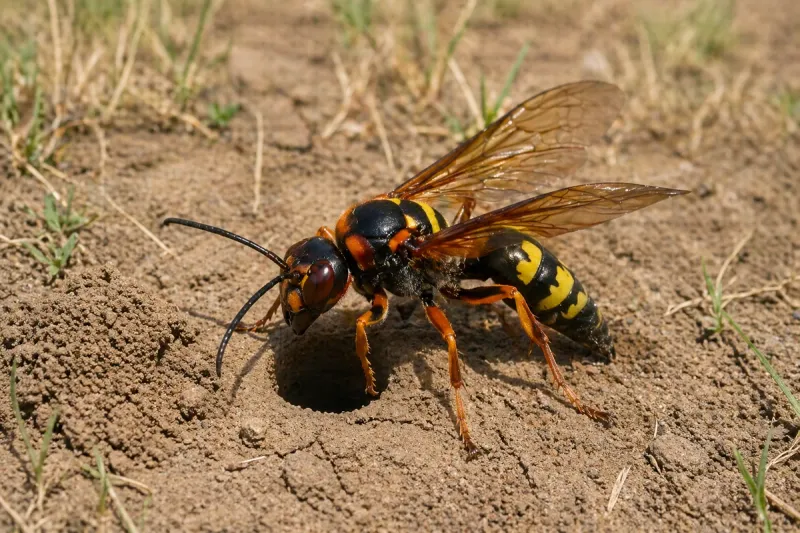
Bare, dry, sun-baked soil is the main attraction for ground-nesting wasps like cicada killers. Reducing that habitat does not guarantee the wasps will disappear, but it can make a patch of yard less appealing over time, and it addresses a real lawn-health problem at the same time.
Improving turf coverage in thin or bare patches removes the loose, exposed soil that females prefer for digging. Overseeding with a heat-tolerant grass variety suited to Central Texas conditions, or laying sod in a heavily used area, gives the ground a root structure and surface cover that discourages burrowing.
Where grass is difficult to establish, a layer of mulch or a low-growing ground cover can accomplish a similar result. University of Kentucky entomology resources describe these site modifications as measures that may reduce nesting activity, with the honest caveat that wasps can simply relocate to another favorable spot nearby rather than leaving the property entirely.
Shading a sunny nesting area or adding localized moisture may also discourage activity, but both require careful judgment in Central Texas. Drought conditions, municipal watering restrictions, drainage patterns, and the needs of nearby plants all factor into whether increased irrigation makes sense in a specific spot.
Recommending heavy watering as a blanket fix ignores real constraints that Texas homeowners face every summer.
When burrows are making a playground, path, or lawn section genuinely unusable, targeted treatment of individual burrows is the proportional next step. The standard approach is to treat each active burrow entrance at night, when the wasps are inactive, using only a product whose current label specifically permits that use, application method, and site.
Blanket lawn spraying is not the right tool here and is likely to be less effective while creating unnecessary pesticide exposure across the yard.
On the legal side, the EPA is explicit that pesticide labels are legally enforceable documents, and using any product in a way that conflicts with its label violates federal law. Read the full label before purchasing and again before applying.
Product registrations, permitted sites, and application restrictions vary by state, so a product recommended in another state’s extension guide may not be registered for the same use in Texas.
A sting needs basic first aid—and sometimes emergency care
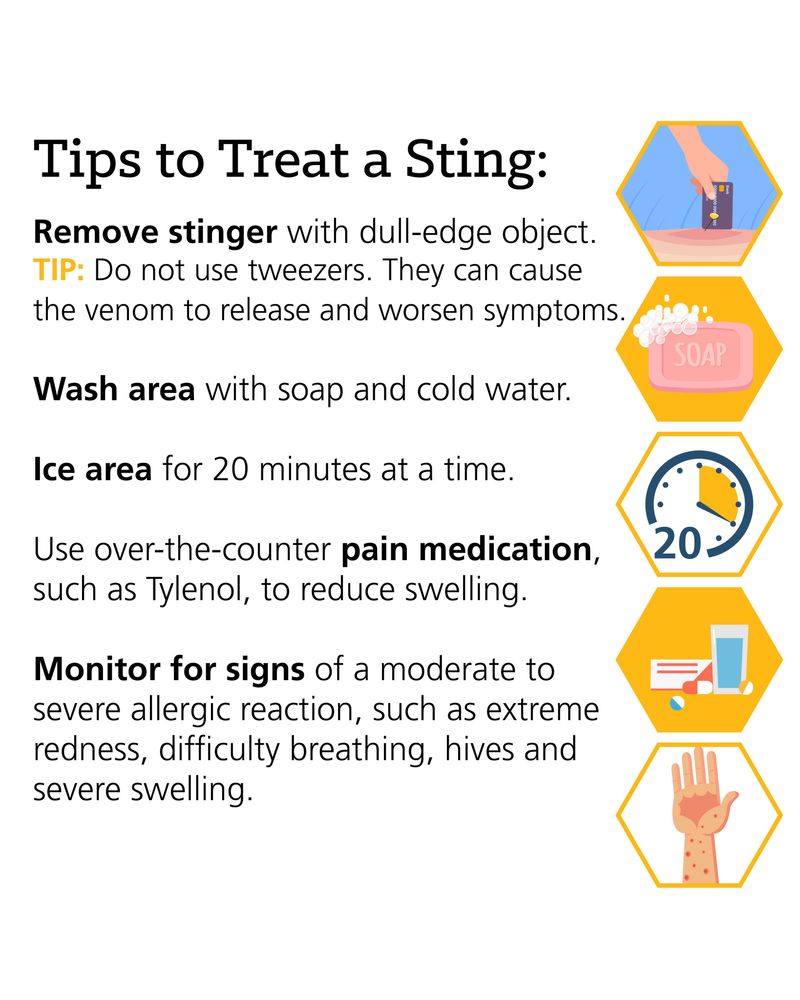
Most cicada-killer stings, when they happen, produce a reaction that stays local. Pain at the site, redness, and some swelling are normal responses to any bee or wasp sting and do not by themselves signal a medical emergency.
American College of Allergy, Asthma and Immunology guidance on insect sting allergies recommends washing the sting area with soap and water and applying a cold pack to reduce swelling for a local reaction.
The warning signs that require immediate action are a different matter entirely. Hives or itching in a part of the body away from the sting site, swelling of the lips, tongue, or throat, difficulty breathing or swallowing, dizziness, nausea, vomiting, or a sudden drop in blood pressure leading to collapse are all possible signs of anaphylaxis.
Any one of these symptoms following a sting is a reason to act fast.
If someone with a known sting allergy is stung and has a prescribed epinephrine auto-injector, use it immediately and call emergency services. Do not wait to see whether the symptoms improve on their own.
Anaphylaxis can escalate rapidly, and epinephrine buys time for professional medical care to arrive.
This guidance applies to any stinging insect, not just cicada killers. A person who has never had a severe reaction before can still develop one, and a first serious reaction can be just as dangerous as a known allergy.
The low-risk profile of cicada killers does not make them a safe encounter for someone with a sting-allergy history, and it does not eliminate the small but real possibility of a first-time severe reaction in anyone else.
Identify first, then disturb less
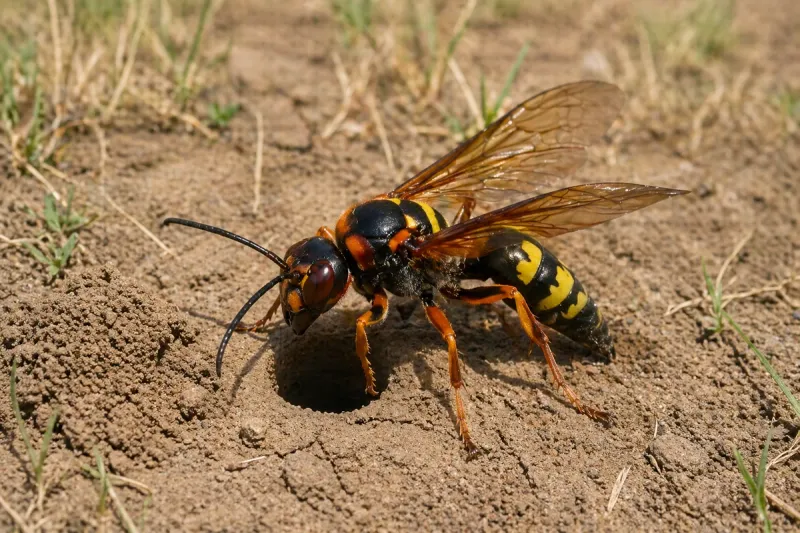
A large rusty-and-black wasp digging individual holes in sunny, loose Central Texas soil during midsummer fits the profile of a cicada killer well enough to take seriously as a working hypothesis. Confirm the broader pattern before acting: the rusty-red head and thorax, the yellow-banded abdomen, the russet wings, the July-August timing, the loose soil, and ideally a wasp carrying a cicada.
Texas A&M’s field guide is a reliable starting point for that checklist.
When the identification fits, observe from a distance and leave the burrows alone if they are not in the way of daily yard use. Protect children and pets from direct contact, and consider label-compliant, targeted treatment only when a burrow creates a real access or safety problem.
If a sting produces symptoms beyond the immediate site, including hives, throat swelling, or trouble breathing, treat it as a possible emergency and follow the ACAAI’s urgent guidance on anaphylaxis. The wasps will be gone in a few weeks; the yard will still be there.