

Rosemary shows up on a lot of Texas patios, and it earns its spot. It handles brutal summer heat, smells great, and goes straight from the pot to the kitchen.
But if you planted it hoping to push mosquitoes off your outdoor furniture, the science tells a different story than the garden-center signage. Here is what rosemary can actually do for a Texas patio, and what you will need alongside it if mosquitoes are the real problem.
Rosemary fits the Texas patio—but not the mosquito-shield claim

Rosemary is almost certainly the herb behind the bold mosquito-repellent premise you have seen floating around gardening circles. It thrives in full sun, handles triple-digit Texas heat better than most culinary herbs, and stays green year-round in many parts of the state.
Texas A&M AgriLife Extension guidance on rosemary confirms it is well suited to Texas gardens when given full sun, well-drained soil, and careful watering, making it a practical candidate for patio containers and raised beds alike.
What rosemary cannot do, at least based on the best available direct evidence, is reliably clear mosquitoes from a patio. A peer-reviewed 2026 field and laboratory study put that claim to the test by placing potted prostrate rosemary in real outdoor conditions and measuring whether mosquito captures dropped around the plants.
That published rosemary repellency study found no significant reduction in mosquito captures compared with untreated controls. In some comparisons after the plants were mechanically damaged, mosquito captures were actually higher, not lower.
A few important limits apply to those findings. The study tested prostrate rosemary specifically, under particular field and laboratory conditions.
It does not automatically settle the question for every rosemary cultivar, every patio layout, or every set of outdoor variables. What it does establish is that the broad claim about living rosemary plants creating a dependable outdoor mosquito barrier is not supported by direct testing.
Rosemary belongs on a Texas patio for its heat tolerance, evergreen form, fragrance, and kitchen usefulness, with separate mosquito management handled by methods that have stronger evidence behind them.
Why a fragrant plant does not create an outdoor repellent barrier
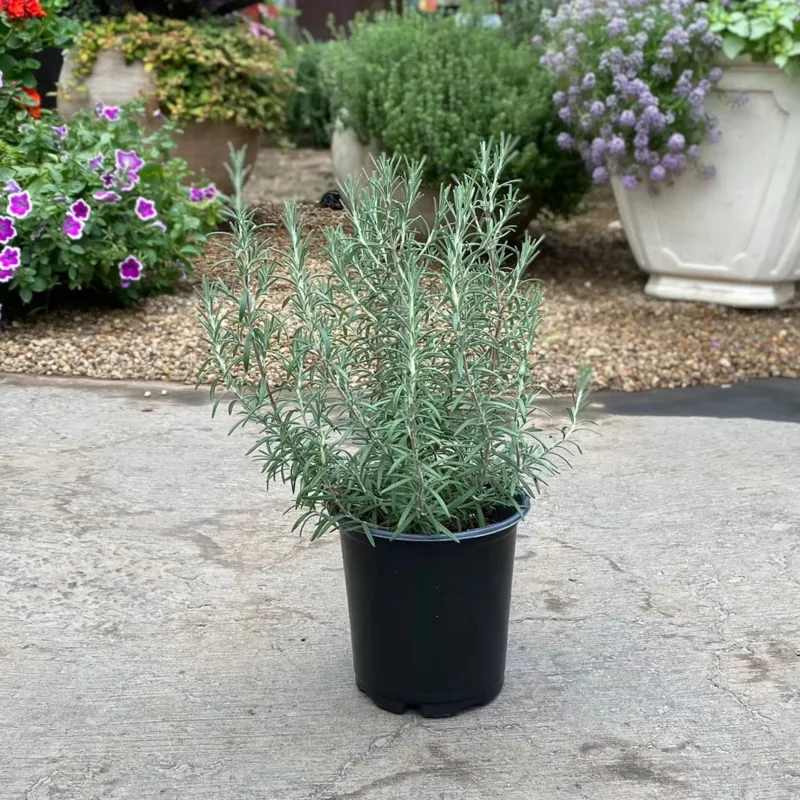
Smelling rosemary from a foot away and being protected from mosquitoes across a 20-foot patio are two very different things. A plant’s fragrance reaches your nose because you are close to it, the air is still, or you have brushed the leaves.
Mosquitoes flying in from a neighboring yard, a drainage ditch, or a stand of tall grass are operating in open air with wind, heat, and competing odors pulling their flight behavior in multiple directions.
The 2026 study addressed this directly. Researchers tested potted prostrate rosemary both as an intact plant and after mechanical damage meant to release more volatile compounds.
Neither condition produced a significant reduction in mosquito captures in field settings. The authors concluded that volatile emissions from living plants were not sufficient to create a meaningful outdoor repellent barrier.
That is a specific finding under specific conditions, but it directly challenges the assumption that planting a few rosemary pots will push mosquitoes away from a sitting area.
Rosemary essential oil and rosemary extracts are a separate matter. Laboratory studies have found repellent or larvicidal activity from concentrated rosemary preparations.
One published study on rosemary oil repellency and a second study examining rosemary extract effects on mosquito larvae both worked with formulated concentrations, controlled cage conditions, or topical applications, not with undisturbed plants sitting outdoors. Those results should not be read as proof that an uncut rosemary plant on your porch does the same job.
Mosquito response also shifts with species, wind speed, temperature, and plant condition. UF/IFAS mosquito management guidance makes clear that variables like these mean findings from one test setting rarely transfer cleanly to a different environment.
A fragrant plant is a sensory pleasure. Treating it as a spatial repellent requires evidence the current research has not supplied.
Give rosemary the growing conditions Texas heat demands

Getting rosemary through a Texas summer is straightforward once you understand what kills it. Excess moisture and poor drainage are the two most common reasons rosemary fails in Texas gardens, and both are easy to prevent with a little planning.
AgriLife Extension’s rosemary growing guide emphasizes sharp drainage and careful irrigation as the foundation of a healthy plant, whether in a container or in the ground.
Full sun is non-negotiable. Rosemary planted in partial shade produces weaker growth and becomes more vulnerable to root rot when soil stays damp.
Choose the sunniest spot on your patio or in your garden bed, and if you are growing in a container, use a potting mix formulated for cacti or add coarse perlite to improve drainage. Water deeply but infrequently, letting the soil dry out between waterings rather than keeping it consistently moist.
Texas is not one climate, and rosemary does not perform identically across the state. Texas A&M Aggie Horticulture herb growing materials and the companion guide to growing herbs in Texas both note that rosemary grows as a hardy evergreen shrub in most of the state, but winter conditions still matter.
North Texas gardeners face occasional hard freezes that can kill less cold-tolerant cultivars. Gardeners near the Gulf Coast deal with high humidity that encourages fungal issues if air circulation is poor.
West Texas soils and rainfall patterns differ again.
Cultivar selection helps. Upright varieties like ‘Tuscan Blue’ tend to be more cold-tolerant than prostrate or trailing types.
If you are in a borderline freeze zone, growing rosemary in a container you can move under cover during a hard freeze gives you more control than planting it in the ground. Heat alone is rarely the problem in Texas.
Wet soil, poor airflow, and unexpected winter cold are the conditions that cut a rosemary plant’s life short.
Place the pot where its real patio benefits matter
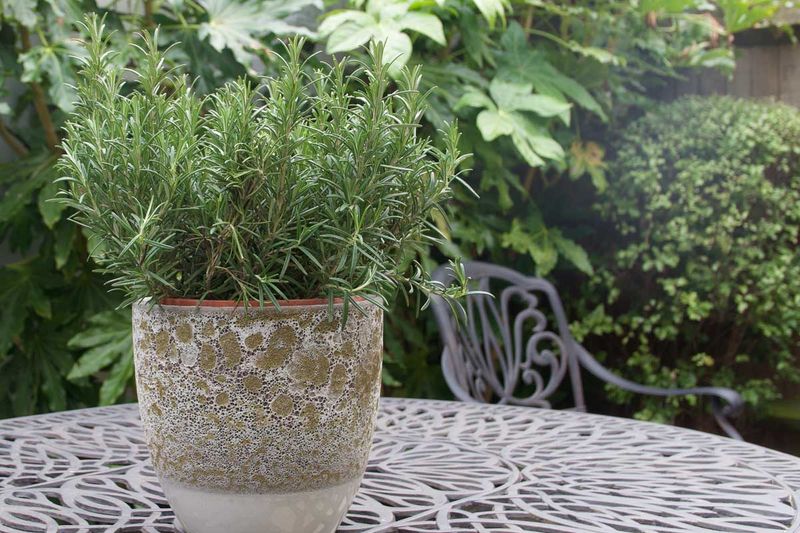
Location shapes how much you actually use and enjoy a rosemary plant. Tucked in a back corner of the yard, it becomes background greenery that you water occasionally and mostly forget.
Positioned near a patio chair, a grill, or a walkway you use every day, it becomes a plant you interact with regularly, which is where its real value shows up.
AgriLife Extension recommends placing rosemary near walkways or sitting areas where the foliage can be brushed for fragrance and clippings can be grabbed easily for cooking. That guidance is about convenience and sensory enjoyment, not pest control.
Brushing the leaves releases aromatic oils and makes the plant more pleasant to have nearby, but there is no evidence from field testing that bruising rosemary foliage reduces mosquito activity across the surrounding patio space.
What good placement does accomplish is practical. You are more likely to harvest rosemary regularly when it is within arm’s reach of the grill or the kitchen door, which keeps the plant trimmed and bushy rather than leggy.
A container positioned in the sunniest, best-drained corner of a patio also gets the growing conditions it needs. Drainage from a pot should never pool in a saucer, both because standing water shortens the plant’s life and because any standing water on your patio is a potential mosquito breeding spot.
Think of rosemary placement as a gardening and lifestyle decision. Put it where it looks good, where you will use it, and where it gets the sun and airflow it needs to stay healthy.
Those goals align naturally. The mosquito situation on your patio will need a separate plan.
Remove the water that keeps mosquitoes coming back

Before adding any plant, spray, or device to your mosquito-management routine, walk your patio and yard and look for standing water. Mosquitoes breed in remarkably small amounts of water, and they can complete their development cycle fast enough that a container you ignore for a week becomes a source of new adults by the following weekend.
This is the step that makes the biggest difference, and it costs nothing but time.
CDC mosquito prevention guidance recommends emptying and scrubbing, turning over, covering, or discarding any item that holds water at least once a week. The list includes flowerpot saucers, buckets, toys, old tires, birdbaths, tarps, and any other container that collects rain.
Scrubbing matters because mosquito eggs can cling to container walls and survive drying, then hatch when water returns. Rinsing alone does not remove them reliably.
Texas-specific guidance from Texas DSHS similarly advises dumping standing water around homes and using a commercially available larvicide in water that cannot be drained, such as ornamental ponds, rain barrels, or low-lying areas that hold water after heavy rain.
Bti, short for Bacillus thuringiensis israelensis, is the active ingredient in several widely available larvicide products, including Mosquito Dunks and similar tablet formulations. EPA information on Bti for mosquito control explains that Bti works by killing mosquito larvae in standing water.
It does not affect adult mosquitoes already flying around your patio. EPA notes that Bti has no toxicity to people when used as directed and has minimal toxicity to honey bees, but you must follow the product label and use it only in appropriate water sources, not in drainage ditches or moving water without checking local regulations first.
Source reduction, meaning getting rid of the water entirely, is always the first goal. Larvicide fills the gap for water you genuinely cannot eliminate.
What actually protects people on the patio?
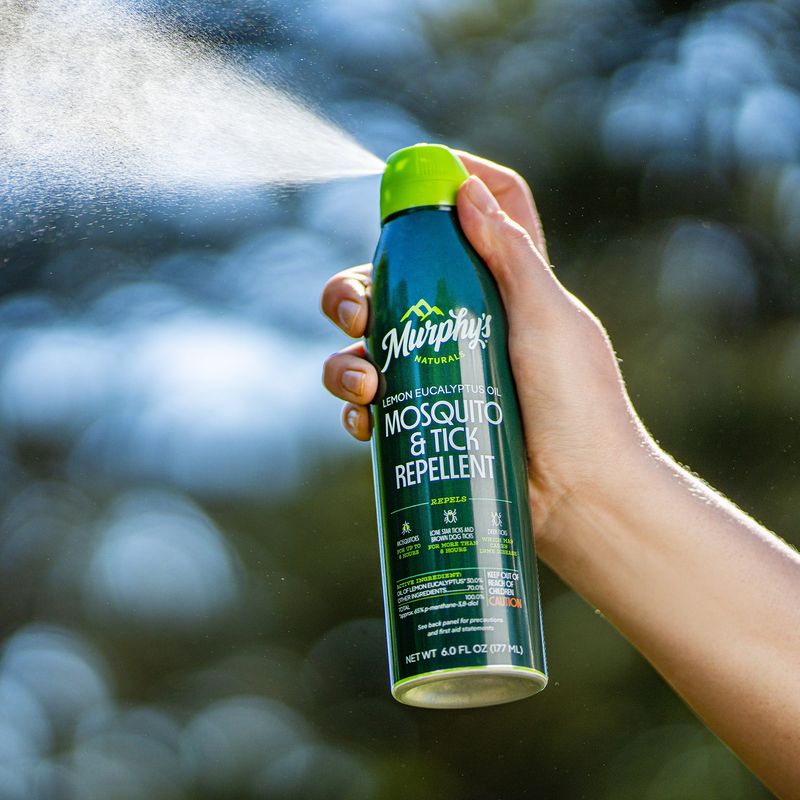
Once you have handled standing water, personal protection is the next practical layer. EPA-registered repellents are the most direct way to reduce mosquito bites while you are actually outside.
CDC recommends repellents containing DEET, picaridin, IR3535, oil of lemon eucalyptus, PMD, or 2-undecanone, applied according to label directions. Each of these active ingredients has been evaluated for both effectiveness and safety before receiving EPA registration.
Choosing a product can feel overwhelming when the store shelf has two dozen options. EPA’s repellent search tool lets you filter by active ingredient and see estimated protection times for specific products, which makes it easier to match the repellent to how long you plan to be outside.
A product designed for an hour on the back porch is a different choice than one meant for a full afternoon in the yard. Follow label directions for reapplication, especially after sweating or getting wet.
Physical barriers and airflow round out a layered patio plan. Screens on a porch or pergola cut exposure significantly because mosquitoes have to find a gap to get through.
Lightweight long-sleeved shirts and pants provide coverage without much added heat discomfort in the evening hours when mosquito activity peaks. Loose-weave fabrics let air circulate while still reducing exposed skin.
A strong fan is a practical and underrated option for open patios. UF/IFAS extension guidance on mosquito control notes that mosquitoes are weak fliers and struggle to navigate in strong wind, so a box fan or oscillating fan aimed at the sitting area can make landing noticeably harder for them.
None of these measures guarantees a mosquito-free evening, but stacking them together, repellent, screens or clothing, and airflow, produces meaningfully better results than any single method alone. No plant, spray, or device is a universal solution, and no combination eliminates all risk entirely.
Rosemary earns its place as a patio herb, not a mosquito cure

Rosemary is a genuinely good Texas patio plant. Grow it for the right reasons and it will reward you with evergreen structure, a fragrance that improves every time you walk past, and fresh sprigs for roasted vegetables, grilled meats, and herbed oils.
Texas A&M AgriLife Extension’s rosemary guidance gives it a clear endorsement for Texas conditions when the basics of sun, drainage, and watering are met.
Mosquito management is a separate job. The 2026 field and laboratory testing of potted prostrate rosemary found no significant reduction in mosquito captures under the study’s conditions, and those published findings do not support treating any living rosemary plant as a reliable patio-wide barrier.
That conclusion applies to the tested cultivar and conditions rather than being a universal verdict on every possible arrangement, but it is enough to set aside the idea that rosemary pots replace a real mosquito plan.
The practical approach is to use each tool for what it actually does. Rosemary handles the heat, anchors a container planting, and feeds the kitchen.
Source reduction, registered repellents, and physical barriers handle the mosquitoes. A patio that has both is a better place to spend a Texas summer evening than one that bets everything on a single fragrant plant.