
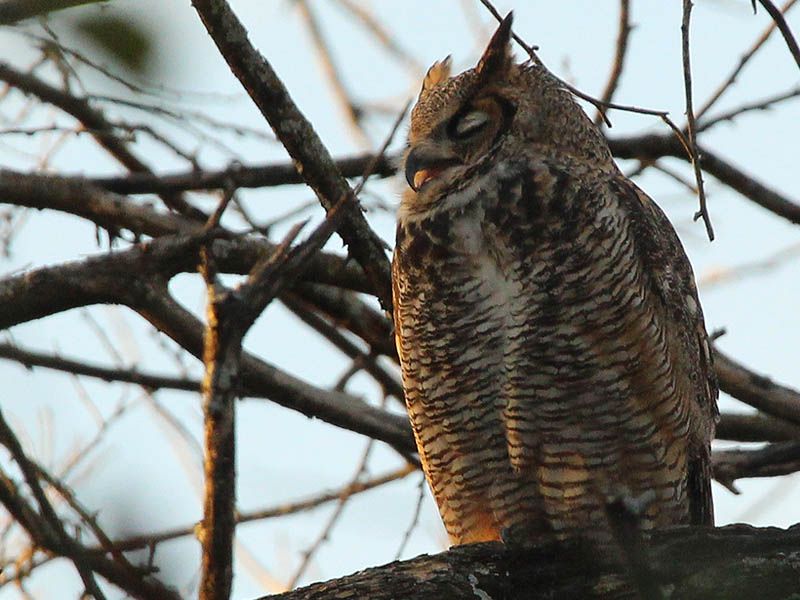
Spotting a Great Horned Owl perched in your yard as the sun goes down over Central Texas is one of those moments that stops you in your tracks. These large, powerful birds are a common part of the Texas landscape, yet a close-up visit still raises real questions about what drew the owl to your specific yard.
Understanding what that landing actually means, and what it does not mean, helps you respond in a way that is good for the bird and good for your property.
Dusk Is Ordinary Hunting Time for a Great Horned Owl
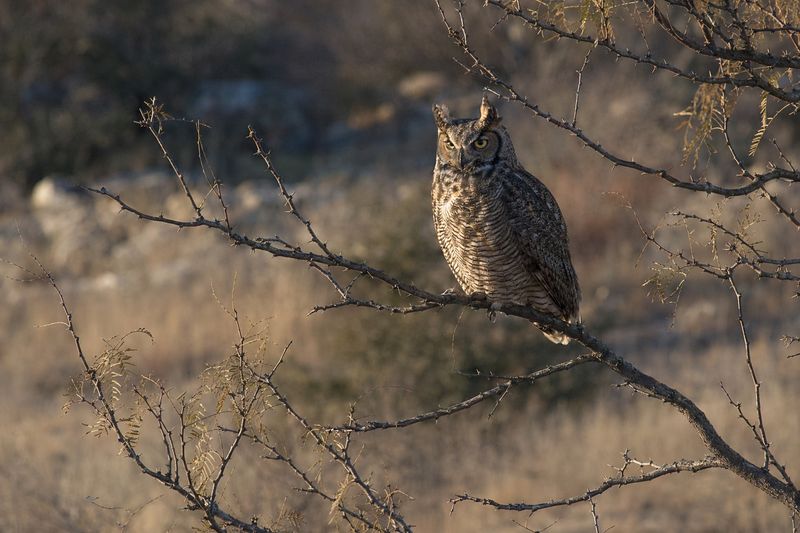
Most people who see a Great Horned Owl at dusk assume something unusual is happening. In fact, the timing is completely normal.
Cornell Lab of Ornithology’s Great Horned Owl life history describes this species as primarily nocturnal, most active around dusk and before dawn, though it will also hunt during full daylight when conditions call for it. Seeing one at that transitional hour is simply catching the bird at the start of its workday.
Great Horned Owls are also far more common across Texas than many residents realize. Texas Parks and Wildlife’s species sheet lists the Great Horned Owl as common statewide, with the exception of the Pineywoods region where it is considered uncommon.
The species thrives in a wide range of settings: wooded creek corridors, open ranch land, city parks, suburban neighborhoods, and urban edges. Central Texas, with its mix of live oaks, cedar, open limestone terrain, and spreading suburbs, fits comfortably within that range.
What this means for your backyard sighting is reassuring. A Great Horned Owl appearing at dusk is not a bird in trouble, and it is not a rare event requiring a special explanation.
The bird is simply doing what Great Horned Owls do at that hour. The more interesting question is not whether the timing is strange, but what your yard or the surrounding neighborhood offered that made it worth landing there at all.
That is the ecological clue worth paying attention to.
The Landing Points to a Usable Piece of the Local Landscape
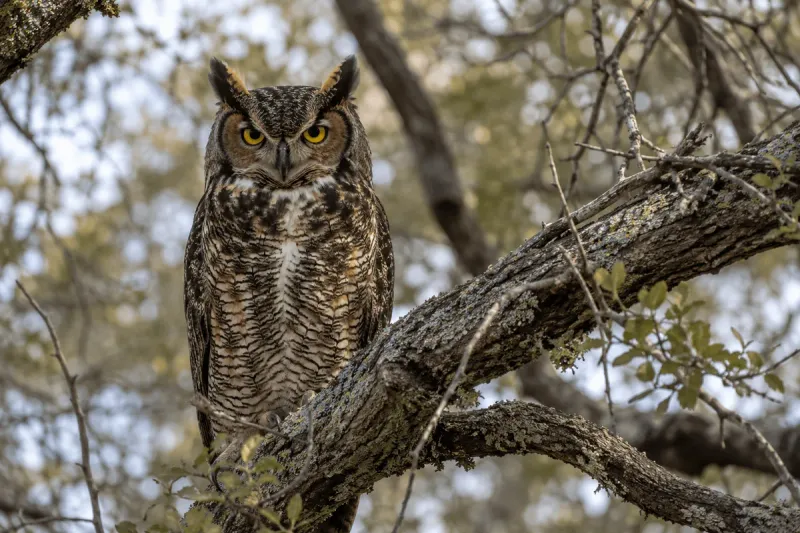
When a Great Horned Owl lands in your yard, the most grounded interpretation is straightforward: the owl found something useful nearby. That useful thing could be a sturdy perch with a clear sightline for hunting, a mature tree offering cover between flights, open ground that makes it easier to spot and catch prey, or simply a convenient waypoint along a route between a roosting area and a hunting zone.
Importantly, the resource the owl was using may not be inside your property line at all. Cornell’s Great Horned Owl nest FAQ notes that there are meaningful differences in movement patterns between territory-holding owls and nonterritorial individuals, called floaters, that range more broadly across the landscape.
An owl that lands on your fence post for a few minutes may be traveling through a much larger area. The yard was simply a useful stop, not necessarily a destination.
Several factors can make a yard or its immediate surroundings attractive to a passing Great Horned Owl. Tall trees, especially live oaks and pecans common in Central Texas, offer elevated perches.
Adjacent open lawn or low-mowed areas give hunting owls a clear view of the ground below. Nearby drainage corridors, creek edges, or undeveloped lots add habitat complexity that benefits both the owl and the prey it pursues.
Any combination of these features can make a neighborhood block worth including in a hunting circuit.
Treating the visit as a signal about the broader landscape, rather than a statement about your yard alone, keeps the interpretation honest. The owl found something usable somewhere in that corner of the neighborhood.
Your yard may have been the center of that, or it may have been one convenient perch along the way.
One Owl Visit Cannot Certify a Healthy Yard
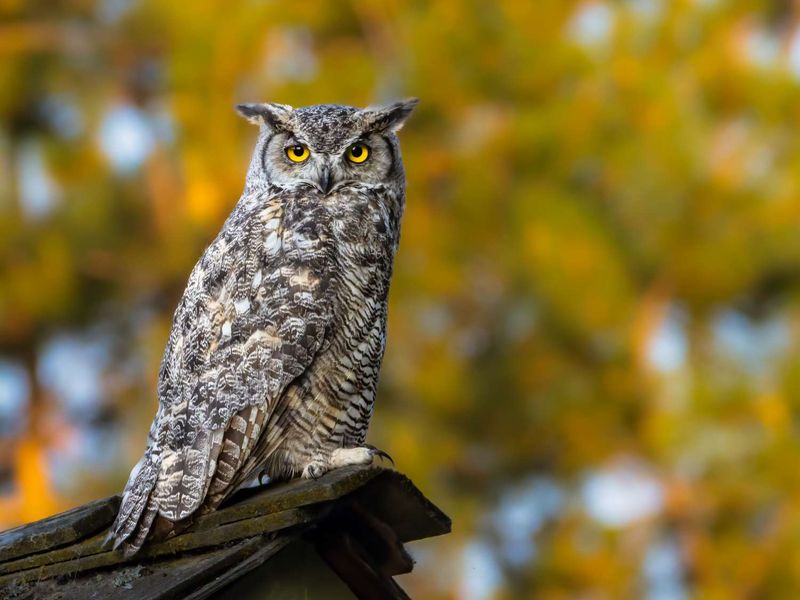
A single owl sighting is a clue about habitat use, not a report card on your yard’s ecological condition. Researchers who study raptors are careful about this distinction.
Raptor Research Foundation literature on habitat assessment makes clear that presence alone provides weak evidence of habitat quality. Drawing stronger conclusions requires repeated observations, information on prey abundance, evidence of reproductive success, or direct habitat measurements, none of which a single dusk landing provides.
The owl’s remarkably broad diet adds another reason to resist overreading the visit. Great Horned Owls eat mammals and birds as core prey, but they also take rabbits, squirrels, rats, mice, reptiles, amphibians, insects, and even scorpions, as documented by both Cornell Lab and the Audubon Society’s Great Horned Owl field guide.
That range of prey means you cannot look at an owl landing in your yard and conclude that you have a mouse problem, a rat infestation, or any particular pest species in abundance. The bird may have been hunting something entirely different, or hunting in the neighboring lot, and only perched on your fence for a better vantage point.
Owl presence also cannot confirm that a yard is free of pesticides, rodenticides, or other hazards. Great Horned Owls move through contaminated landscapes, and exposure to secondary poisoning from rodenticide-laced prey is a documented risk to raptors.
The bird’s willingness to land in your yard says nothing about whether the yard is safe for wildlife. That assessment requires looking at your own practices, not at the owl’s behavior.
Resist the temptation to frame the sighting as a stamp of approval on everything happening in your yard. The owl found something it could use.
That is a positive and interesting observation. Stretching it into a certification of ecosystem health goes further than the evidence supports.
Repeated Signs Offer Better Clues About How the Property Functions
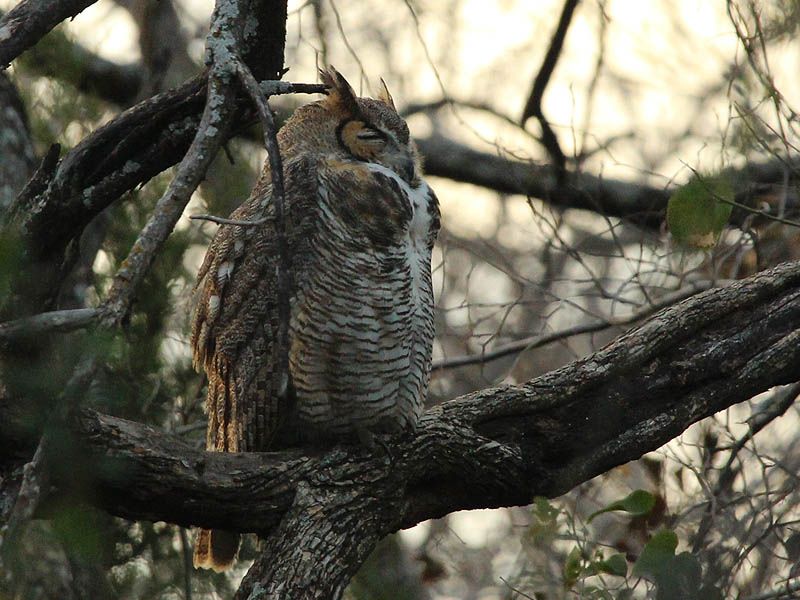
One sighting tells you the owl found your yard or neighborhood useful on one occasion. A pattern of sightings tells you something more.
If you notice the same owl returning to the same branch night after night, or you hear territorial hooting from a consistent location over several weeks, or you find pellets accumulating beneath one particular tree, those repeated signs suggest the property or the land immediately around it may fall within a regularly used part of the owl’s range.
Cornell’s nest cam FAQ for Great Horned Owls explains that territory-holding pairs behave differently from wide-ranging floaters, so consistent hooting from one area, or the presence of a pair together, can be a stronger behavioral indicator than a single visit. Even so, repeated use does not measure prey abundance or verify that the yard meets any particular standard of habitat quality, as the Raptor Research Foundation’s habitat literature cautions.
It simply means the owl is using that part of the landscape with some regularity.
When observing these patterns, keep your distance. Audubon’s ethical bird photography guidance recommends backing away if the bird shifts its posture or changes its behavior, and advises against repeated close approaches to suspected nests or roosts.
Watching from inside through a window or from a quiet spot across the yard gives you useful information without stressing the bird.
If you find pellets beneath a consistent perch, handle them carefully. CDC guidance on owl pellet sanitation recommends treating pellets as a potential source of Salmonella, avoiding contact where food is prepared or eaten, cleaning any contaminated surfaces, and washing hands thoroughly after handling.
Pellets can be interesting evidence of what the owl has been eating, but they deserve the same basic hygiene precautions as other wildlife materials.
Improve Habitat Without Trying to Lure the Owl
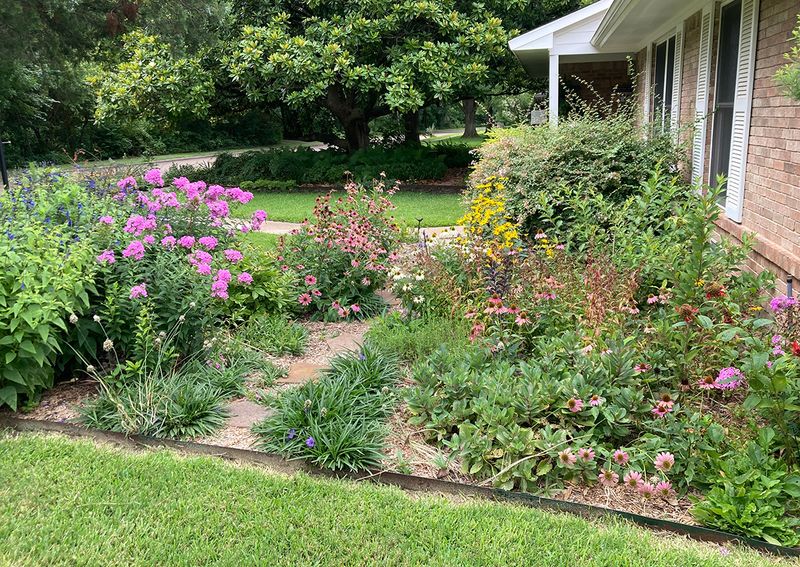
Watching an owl land in your yard naturally makes you wonder whether you can encourage more wildlife visits. The healthier framing is to focus on making the yard a better place for the whole community of creatures that share your neighborhood, rather than designing every decision around attracting one specific bird.
That approach produces more durable results and avoids the risks that come with trying to manage a wild predator’s behavior.
Texas Wildscapes habitat guidance from Texas Parks and Wildlife recommends layered vegetation, natural cavities, snags, and structural diversity as features that support wildlife broadly. In practical terms for a Central Texas yard, that can mean retaining a mature live oak or cedar elm that is structurally sound rather than removing it for convenience, allowing some areas of the yard to stay a little rough around the edges instead of keeping everything clipped, and reducing unnecessary outdoor lighting that disrupts nocturnal activity patterns.
Hazard removal matters as much as habitat addition. Unsecured bird netting draped over garden beds or fruit trees can trap owls and other birds.
Exposed wire fencing with loops or sharp ends creates collision and entanglement risks. Removing or securing these features reduces danger for any bird moving through the yard after dark.
Pest control choices have direct consequences for owls. Texas Parks and Wildlife’s owl resource page advises using traps instead of poisons for rodents and reducing insecticide use because an owl that eats contaminated prey can be poisoned itself.
EPA documentation on rodenticide secondary poisoning confirms that raptors are among the species at risk when rodenticides move through the food chain. Switching to snap traps and disposing of carcasses promptly eliminates that pathway.
Keeping cats and very small pets indoors after dark is a reasonable precaution worth mentioning here. Cornell Lab notes that Great Horned Owls are powerful enough to take prey of substantial size, and house cats appear among recorded prey items.
Attacks on pets are not a routine occurrence, but the precaution is simple and sensible given the owl’s capabilities.
Watch Quietly and Leave the Owl in Control of the Encounter
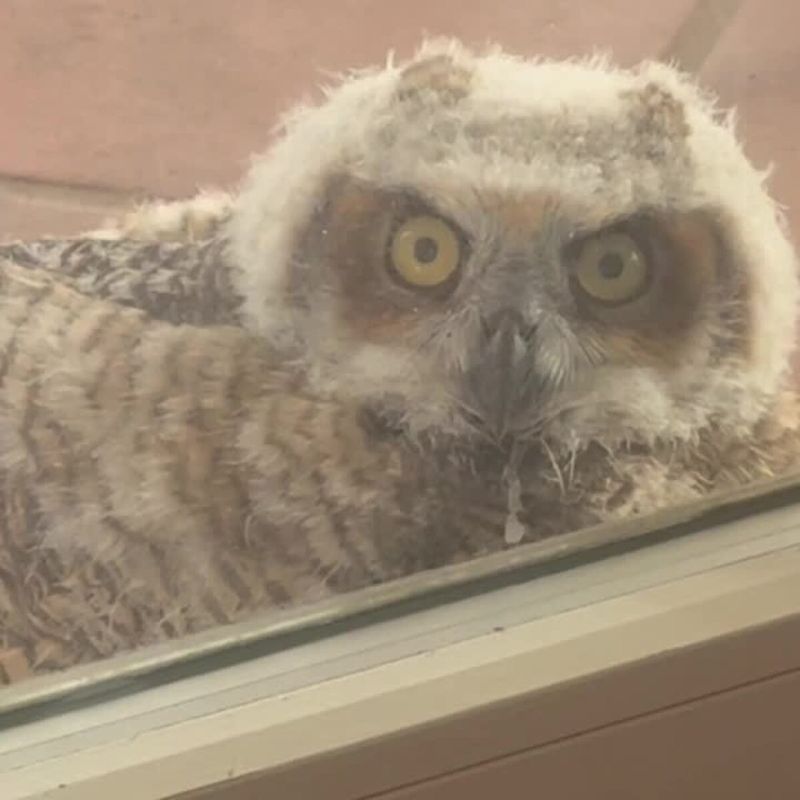
When an owl lands in your yard, the best response is also the simplest: watch from a comfortable distance and let the bird decide how long it stays. Viewing from indoors through a window is ideal.
If you go outside, move slowly, avoid shining flashlights or phone screens toward the bird, and stay far enough away that the owl does not change its posture or shift its attention to you. Audubon’s ethical bird photography guidance is explicit: back away if the bird reacts to your presence, and avoid using flash on nocturnal birds, which can temporarily impair their night vision.
Two specific actions are worth ruling out directly. Do not play recorded owl calls to draw the bird closer.
Audubon’s reporting on audio playback in the field explains that call playback can provoke territorial responses, pull adults away from nest duties, and disrupt feeding or resting, especially during breeding season. Do not put out food, bait, or live prey to encourage a return visit.
U.S. Fish and Wildlife Service guidance on feeding wildlife describes how baiting can alter predator behavior, create dangerous habituation, and expose the bird to unsafe food or human conflict.
There are also firm legal boundaries that apply here. The Migratory Bird Treaty Act prohibits unauthorized killing, capture, possession, transport, or other take of protected native migratory birds.
The Great Horned Owl is included on the federal list of protected migratory birds, and Texas Parks and Wildlife confirms that owls are protected under both state and federal law. You may not capture, possess, injure, kill, collect, or handle the bird, and you may not deliberately disturb an active nest.
If you have questions about a nest on your property or suspect a legal violation, contact Texas Parks and Wildlife or the U.S. Fish and Wildlife Service rather than trying to resolve it independently.
A Grounded Young Owl Is Not Always an Emergency
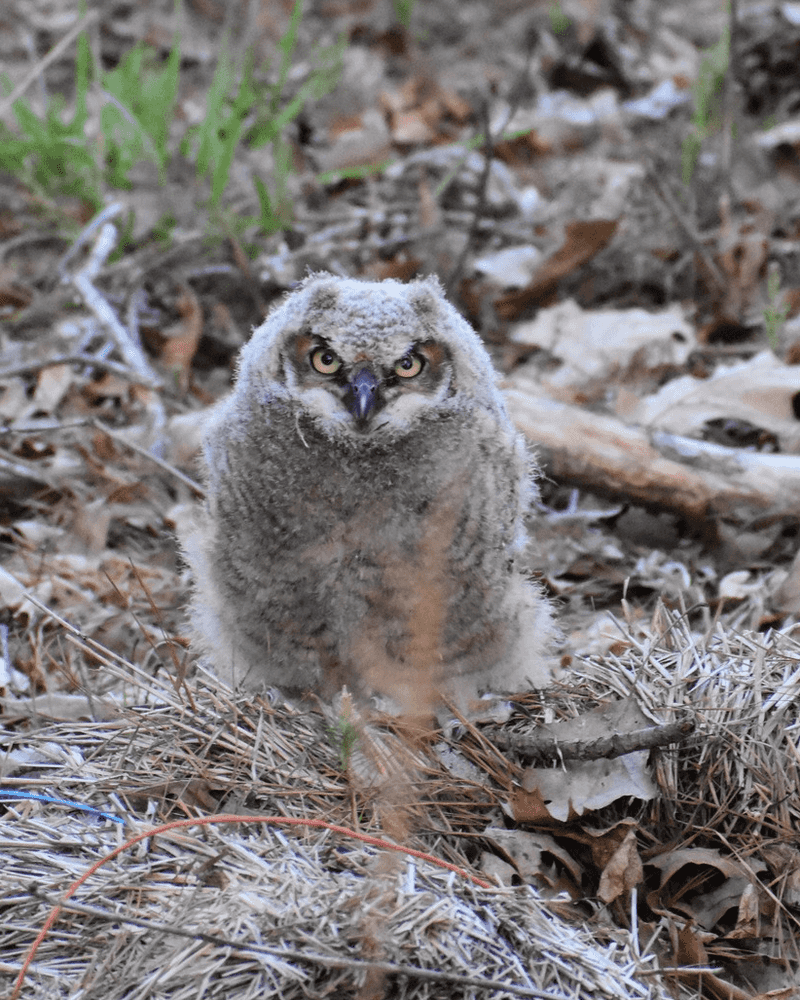
Finding a young owl on or near the ground is a different situation from watching an adult land in the yard, and it tends to trigger alarm faster than it should. Before reaching for a box or calling for help, take a moment to assess what you are actually seeing.
A fully feathered, alert juvenile that is hopping between branches or climbing awkwardly up a trunk is very likely a fledgling in the middle of a normal developmental stage. Cornell Lab’s life history account notes that young Great Horned Owls may remain dependent on their parents for months after leaving the nest, and the parents are often nearby even when they are not visible.
Cornell’s nest FAQ also points out that Great Horned Owls often use nests borrowed from hawks, crows, or squirrels, and young birds may branch, meaning they climb and perch in surrounding vegetation before they can fly reliably. Inability to fly by itself is not a trigger for intervention.
The bird may simply be at an early fledging stage that looks alarming to a human observer but is biologically normal.
Contact a permitted wildlife rehabilitator when the bird shows visible injury, appears ill, is tangled in netting or wire, seems weak or unresponsive, is in immediate physical danger such as a road or active predator zone, or appears unusually young and is not yet fully feathered. Texas Parks and Wildlife’s wildlife rehabilitator directory can help you find a licensed professional in your area.
If you suspect a bird has been abandoned, consult a rehabilitator rather than trying to make that determination yourself, since adults often stay out of sight to avoid drawing attention to their young.
A brief note on pellets applies here as well. If you find owl pellets near a grounding site or under a regular perch, treat them with basic caution.
CDC sanitation recommendations advise assuming pellets may carry Salmonella, keeping them away from food preparation areas, cleaning any surfaces they contact, and washing hands carefully after handling.
Read the Visit as a Clue, Not a Verdict
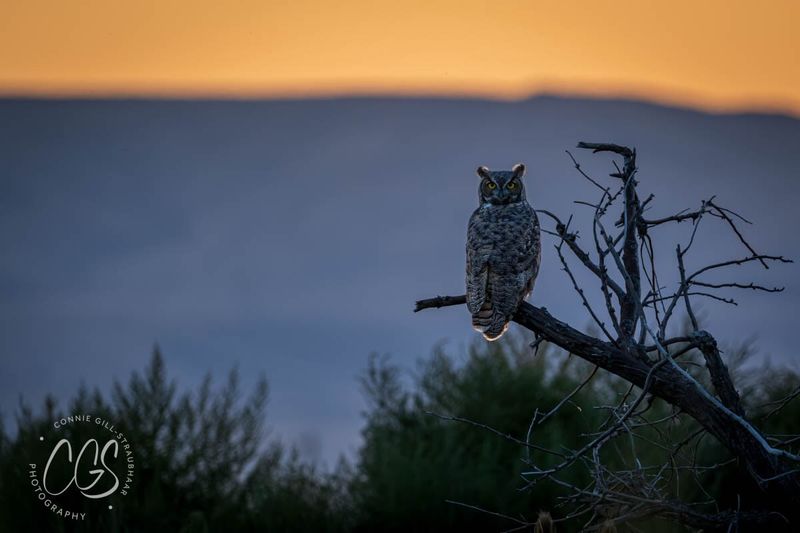
A Great Horned Owl landing in your yard at dusk is genuinely worth noticing. It tells you that the owl found at least one useful resource in your yard or the surrounding neighborhood, whether that was a perch, tree cover, open hunting ground, nearby prey, or a convenient stop along a larger route.
That is a meaningful observation about how a highly adaptable predator is using the local landscape.
What the visit does not tell you is whether your yard is exceptionally healthy, pest-free, or ecologically superior to your neighbors’ properties. As both Cornell Lab’s life history data and raptor habitat research make clear, a single presence event is a weak measure of habitat quality.
Let the sighting prompt you to remove avoidable hazards, reconsider rodenticide use, and observe more carefully over time, rather than treating it as a final grade.
The practical takeaway from a dusk owl visit is simple: protect what made the yard usable, keep an eye out for patterns over coming weeks, and watch quietly without interference. Texas Parks and Wildlife’s owl guidance puts it well: the best thing you can do for these birds is make the landscape a little safer and then step back.
A yard that gets a second visit has already done something right.