
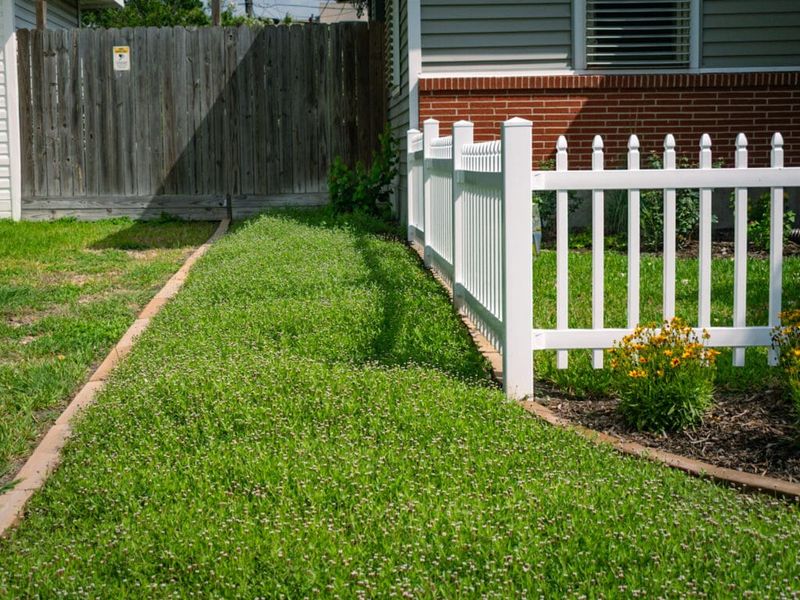
Every spring, bags of mulch pile up on driveways across Texas and Florida, and homeowners haul them out to beds that will need the same treatment again next year. There is a low-growing native plant called frogfruit that can cover bare soil in sunny and partly shaded spots, flower for months, and skip the annual refill cycle that mulch demands.
It is not a perfect fix for every yard or every bed, but for the right site, it offers a practical, living alternative worth knowing about.
Frogfruit offers a living alternative to repeated mulch top-dressing
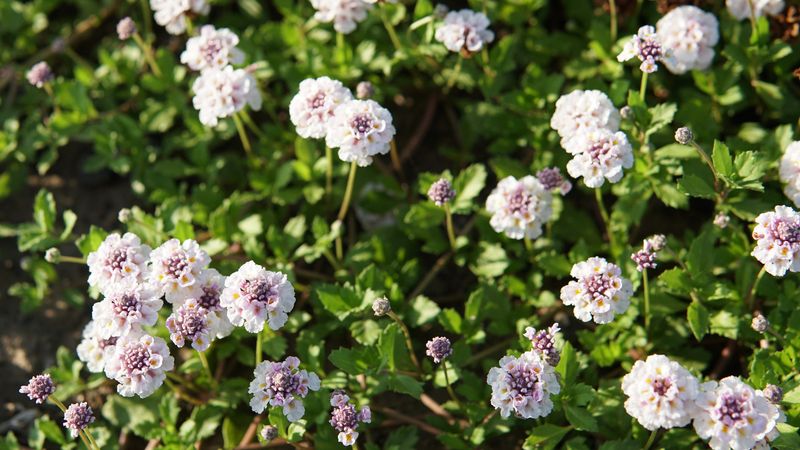
Frogfruit, known botanically as Phyla nodiflora, goes by several common names including turkey-tangle fogfruit and Texas frogfruit. It is a low, spreading perennial that roots along its stems as it grows, gradually knitting together into a mat that covers open ground.
Austin’s plant guide lists a typical height of about 6 to 8 inches and a spread of roughly 1.5 to 2 feet, with flowering from spring through fall.
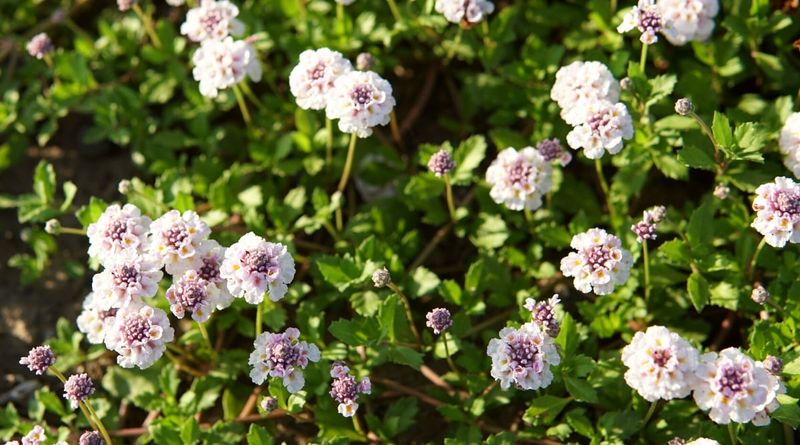
The flowers are small and clustered, shifting from white to pale purple as they age. They sit close to the ground on a plant that stays flat enough to walk around without dominating a bed.
For homeowners who find a bed of bare soil or faded organic mulch visually dull, a mat of frogfruit in bloom can feel like a genuine upgrade, though how good it looks is a matter of personal preference.
The living-cover advantage over mulch comes down to one practical difference: frogfruit does not decompose. Organic mulch breaks down over time, which is why beds need to be topped off each year.
A rooted groundcover replenishes itself instead. That said, frogfruit does not replicate everything mulch does.
UF/IFAS describes it as a fast-spreading native suitable as a companion or alternative to turfgrass, but extension guidance consistently notes that it still needs watering during establishment, occasional trimming, and edging to stay where you want it.
A Harris County Master Gardener resource lists frogfruit among native groundcovers suited to Texas landscapes, reinforcing its standing as a well-supported option rather than a fringe curiosity. The plant fits a specific niche: sunny or partly shaded beds and bare-soil areas where a homeowner wants a flowering cover and is willing to manage it through establishment.
Match frogfruit to the right Texas or Florida site
Before buying a single plug, check whether your planting site actually suits this plant. Frogfruit performs best in full sun to partial shade.
Shaded beds under dense tree canopies are not reliable locations, and UF/IFAS extension guidance consistently describes it as a sun-loving plant that tolerates partial shade rather than one that thrives in low-light conditions.
Soil flexibility is one of frogfruit’s genuine strengths. It can handle a range of textures, from sandy coastal soils to heavier clay, and it tolerates poor drainage better than many groundcovers.
Archived UF/IFAS research notes drought tolerance after establishment, but also flags that extended dry periods can cause decline or dieback, so calling it drought-proof would be misleading. Sites that stay extremely dry without any supplemental irrigation are risky choices.
Geography matters more than many homeowners expect. Texas contains dramatically different climates, from the humid Gulf Coast to the arid Trans-Pecos, and frogfruit is not equally reliable across all of them.
The Texas A&M Earth-Kind plant selector recommends choosing plants by specific region rather than assuming statewide suitability. Frogfruit is best supported for warm, humid, coastal, central, and southern parts of Texas.
In colder or much drier areas, performance may be more variable and harder to predict.
For Florida readers, Texas Master Gardener guidance parallels what UF/IFAS reports for Florida: the plant is native throughout much of the state, adapted to USDA Zones 8a through 11, and well suited to warm, humid conditions. Checking with your county’s cooperative extension office or a regional native-plant nursery is the most reliable way to confirm whether frogfruit is a good fit for your specific zip code.
Commercial availability can be limited, so native-plant nurseries and plant swaps are often better sources than big-box garden centers.
Understand what frogfruit can—and cannot—replace
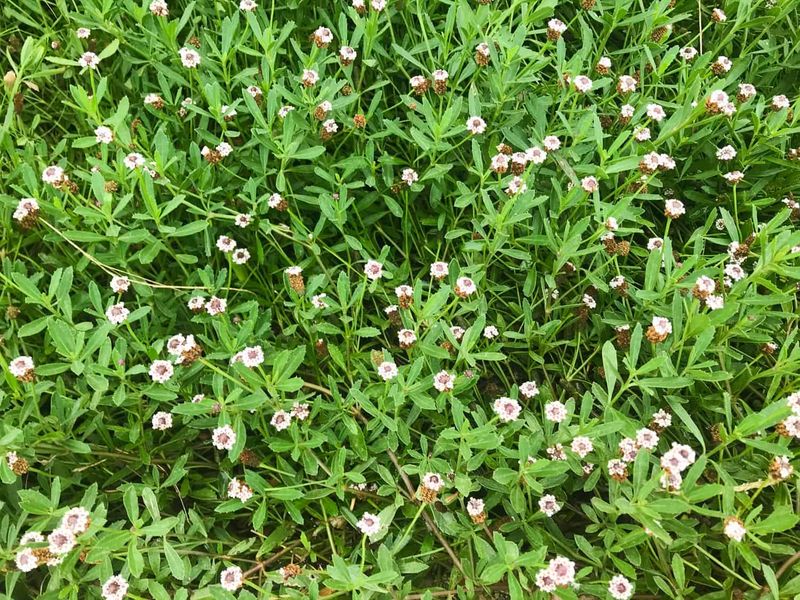
A rooted groundcover reduces the need for mulch refills in a specific and honest way: living stems do not decompose the way shredded bark or wood chips do, so the cover does not thin out and disappear over a season. Once frogfruit fills in a bed, the soil beneath stays covered without an annual top-dressing trip to the garden center.
That is a real, practical benefit for beds where the plant is well established and the site conditions fit.
Organic mulch, though, does several things a living groundcover cannot always match. Colorado State Extension’s mulch guidance explains that a proper mulch layer conserves soil moisture, moderates soil temperature, suppresses weeds, protects surface roots, and cushions against damage from mowers and string trimmers.
A plant mat provides some of those functions once it is dense and established, but it takes weeks or months to fill in, and during that window bare soil remains exposed.
Weed suppression is another area where expectations need calibrating. UF/IFAS mulch guidance notes that mulch reduces weed germination immediately after application.
Frogfruit, by contrast, starts as widely spaced plugs with open soil between them. Weeds can and do establish in those gaps during the fill-in period, requiring hand-pulling or careful spot treatment until the mat closes.
The most practical framing is selective use rather than full replacement. University of Maine Extension describes groundcovers as useful for large open areas, slopes, and spots where mowing is difficult, while noting that they work best as part of a broader landscape plan rather than as a one-size answer.
Frogfruit fits beds, borders, and open sunny areas where a flowering living cover is the goal. Mulch remains the faster, lower-risk choice around newly planted trees, in shaded spots, and anywhere immediate root protection matters more than long-term aesthetics.
Install plugs or rooted cuttings and let the mat fill in
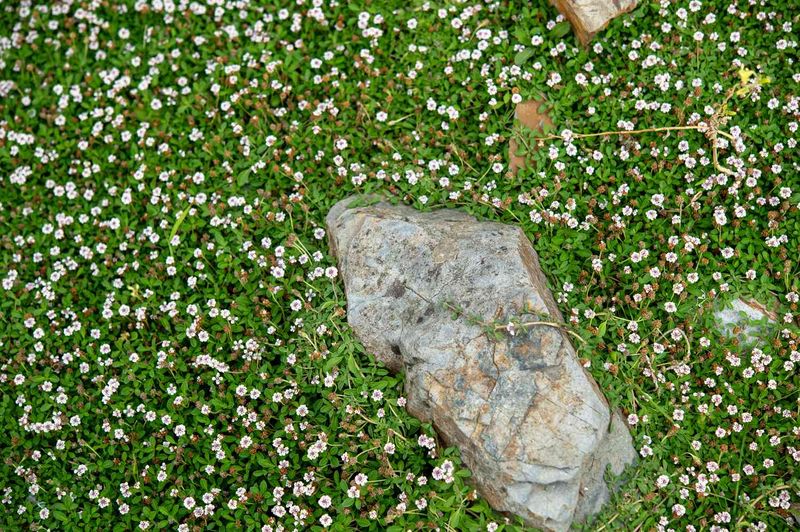
Good installation starts before the first plug goes in the ground. Clear the planting area of existing grass and weeds as thoroughly as possible, because anything left behind will compete with young plants during the fill-in period.
If the soil is compacted, loosen it with a fork or tiller and work in a small amount of compost if the area drains poorly. Frogfruit tolerates a range of soils, but giving plugs a reasonable start reduces the time it takes for them to root and spread.
UF/IFAS recommends planting plugs or rooted cuttings and notes that the plant spreads rapidly once established. Set plugs at even spacing, typically 12 to 18 inches apart depending on how quickly you want coverage, and firm the soil around each one so the roots make good contact.
Frogfruit spreads through prostrate stems that root at their nodes as they creep across the soil, so each plug eventually becomes a source point for multiple rooting sites.
Watering during establishment is non-negotiable. Monroe County UF/IFAS extension material on frogfruit emphasizes consistent moisture while plugs root in.
As a general reference point, LSU AgCenter plug-establishment guidance recommends routine irrigation during the first 10 to 14 days after planting and limiting foot traffic until plugs have rooted. Treat that window as a starting point rather than a fixed schedule, and adjust frequency based on your soil type, the season, recent rainfall, and how hot and dry conditions are at the time of planting.
Expect the mat to take several weeks to several months to fill in, depending on plug spacing, weather, and soil conditions. During that period, the planting will not look like a finished carpet, and open soil between plugs can catch weed seeds.
Pull weeds by hand as they appear rather than letting them get established alongside the frogfruit. Traffic across the planting area should stay low until the stems have spread and rooted enough to handle regular use.
Maintain the cover through growth, drought, and dormancy
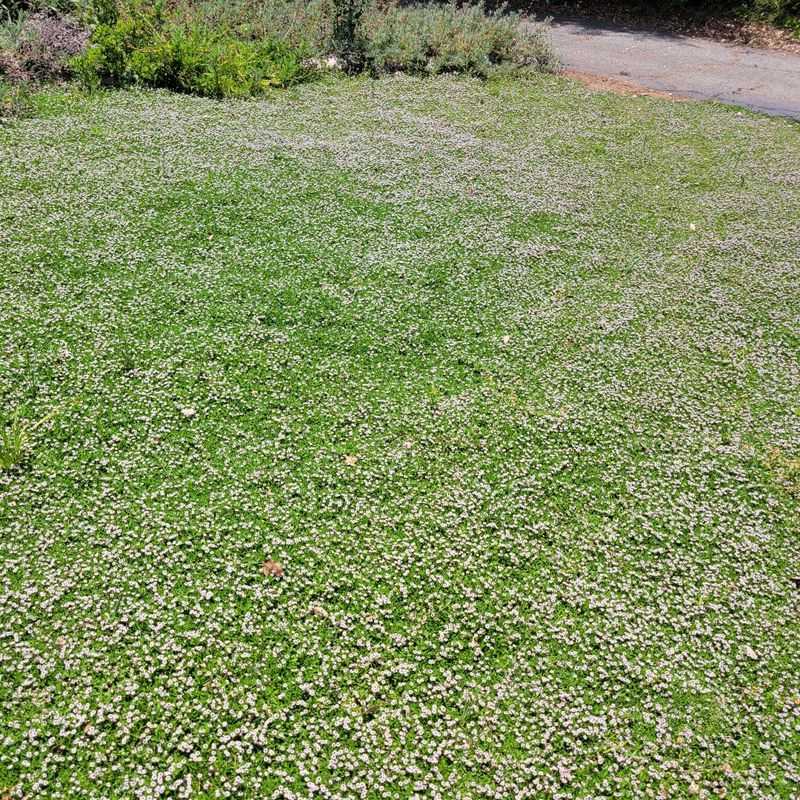
Once frogfruit fills in, the maintenance picture changes but does not disappear. Edging becomes a recurring task because the plant spreads by rooting along its stems, and without a physical barrier or regular trimming it will creep into lawn areas, adjacent beds, or cracks in pavement.
Plan to edge the planting every few weeks during the growing season, or install a solid border that the stems cannot easily cross.
Trimming or mowing keeps the mat looking tidy and can encourage denser growth. Regional guidance differs on the right height.
UF/IFAS recommends mowing at 4 inches or higher in Florida to avoid scalping the low stems. Austin’s plant guide recommends cutting back to about 3 inches in winter to remove dead or tired growth and encourage fresh spring coverage.
Follow the guidance that matches your region rather than applying one standard to every climate.
Supplemental irrigation during prolonged drought is still necessary even after the plant is established. Extended dry spells can cause dieback or dormancy, and a stressed mat is slower to recover and more vulnerable to weed invasion.
Water deeply and infrequently during dry stretches rather than relying on shallow daily watering.
Dormancy is part of the honest story. Texas Master Gardener landscape plant guidance lists frogfruit as deciduous, meaning it may lose its foliage after a hard freeze.
In warmer parts of Florida it can stay green through mild winters, but a cold snap changes that. Readers expecting year-round green coverage in central or northern Texas should plan for a dormant period and consider whether bare stems over winter fit their landscape goals.
The plant typically rebounds in spring, but recovery pace depends on the severity of winter conditions and how well established the planting was going into the cold season.
Reserve mulch and avoid risky planting locations
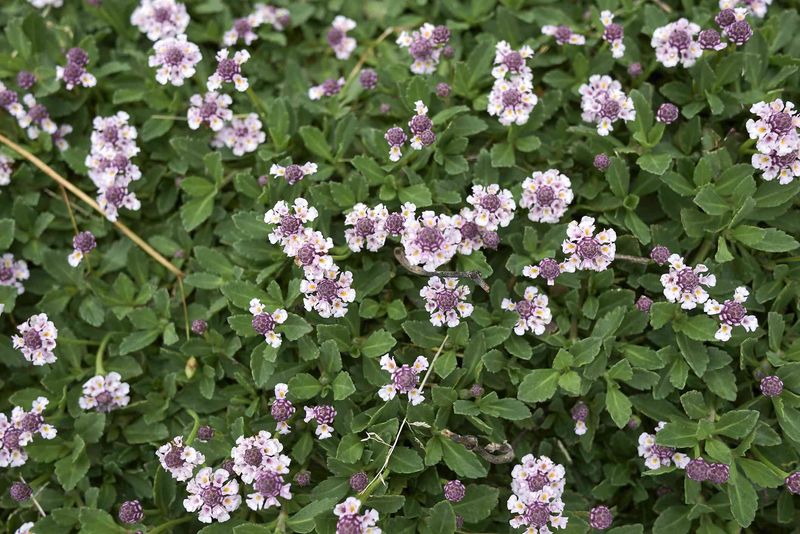
Frogfruit is not the right answer for every spot in the yard, and a few situations call for keeping mulch rather than switching to a living cover. Deep shade is a firm boundary.
Every credible extension source reviewed describes frogfruit as a full-sun to partial-shade plant. UF/IFAS extension guidance does not support frogfruit in low-light conditions, and planting it in dense shade under a heavy canopy is likely to produce a thin, struggling mat rather than the dense cover the premise requires.
Planting beneath trees deserves extra caution. Extension sources offer competing advice on this point.
University of Maine Extension advises keeping vegetation out from under trees because of root competition, while Rutgers Extension discusses compatible groundcovers used as living mulch under certain conditions. The safest homeowner rule is to preserve a vegetation-free or very lightly planted zone around young trees, root flares, and drought-stressed trees.
Ask your local extension office before planting any groundcover beneath a mature tree, since root competition for water and nutrients can stress both the tree and the groundcover.
Product labeling is another area that deserves attention. Frogfruit, Kurapia, and various products sold under the name Lippia are not necessarily the same plant in a practical retail sense.
University of Arizona Extension describes Kurapia as a distinct commercial selection with its own performance characteristics, and UF/IFAS identifies the plant by its scientific name, Phyla nodiflora, to avoid exactly this kind of confusion. When shopping, ask for the botanical name and check whether the cultivar or selection matches your region’s conditions.
Finally, spread management is an ongoing responsibility rather than a one-time concern. Frogfruit’s rooting stems are what make it an effective groundcover, but those same stems will move into lawn areas, neighboring beds, and paved joints if left unchecked.
Physical edging, root barriers, or regular trimming are practical tools for keeping the planting where you want it.
Use frogfruit when the site fits the tradeoff
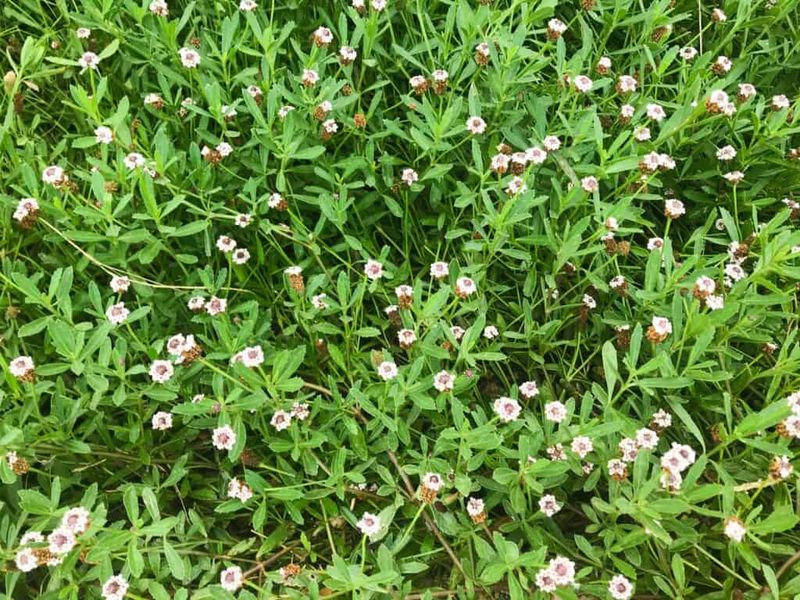
Frogfruit earns a place in the landscape when the conditions line up: a sunny or partly shaded bed, a region where the plant is well supported such as central, coastal, or southern Texas, or most of Florida, and a homeowner who genuinely wants a flowering living cover rather than a uniform bark-mulch look. Austin’s plant guide and UF/IFAS both support it as a practical native option for those conditions, and its documented role as a nectar source and larval host for species like the phaon crescent and white peacock butterfly adds a habitat dimension that a bag of mulch cannot offer.
Stick with mulch where the tradeoffs favor it: around young trees that need immediate root protection, in shaded beds where frogfruit will not thrive, in regions where establishment during drought is unreliable, or anywhere you need weed suppression to start working right away rather than after a fill-in period. Colorado State Extension’s guidance on mulching trees and shrubs is a useful reference for those situations, because it lays out clearly what a proper mulch layer does that a living plant cannot always replicate.
The honest payoff for choosing frogfruit in a suitable bed is real but measured: a flowering mat that covers bare soil, skips the annual refill haul, and brings some pollinator activity to the yard, all while asking for establishment care, regular edging, and occasional supplemental watering in return. A yard that works with its climate rather than against it tends to require less intervention over time, and frogfruit, in the right spot, is a small step in that direction.