
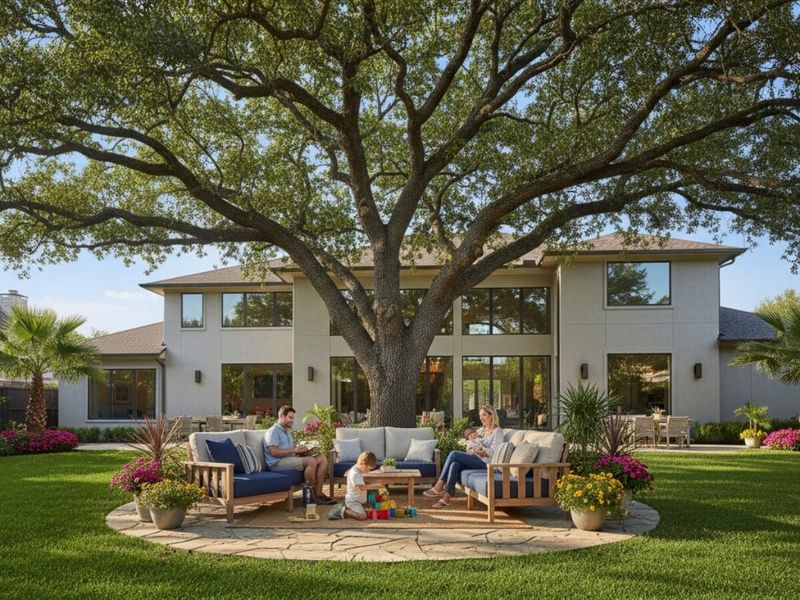
Texas summers test every tree in the yard, and water restrictions can make it even harder to keep new plantings alive. Cedar elm, a native Texas shade tree, has earned a reputation for toughness on sites where other trees struggle.
Knowing when and how to plant it, and what the local watering rules actually allow, is what separates a thriving tree from a stressed one.
Cedar elm is a strong option for many Texas yards
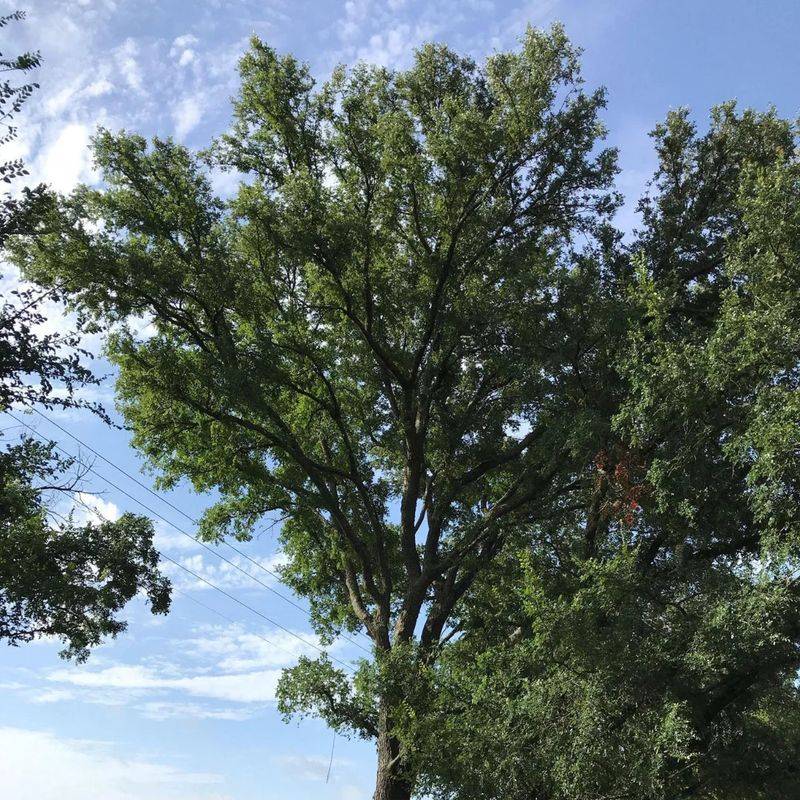
Cedar elm (Ulmus crassifolia) earns its reputation on Texas soil without much drama. Texas A&M’s Texas Tree Selector describes it as a tough, drought-tolerant large tree with tolerance for alkaline soils, poor drainage, salty soil, and a wide range of growing conditions, which is a combination of traits that few shade trees can match in this climate.
The Texas A&M Forest Service has also included cedar elm in its Texas Tested, Texas Tough program, a designation given to trees selected specifically for their proven performance in Texas conditions. That recognition matters because it reflects documented field results, not just catalog claims.
A program profile for cedar elm confirms the tree’s suitability for Texas landscapes where heat and dry spells are the norm rather than the exception.
What makes cedar elm appealing to so many Texas homeowners is its combination of Texas origin, broad site tolerance, and climate-tested performance. It grew here before irrigation existed, and it has adapted to soils and rainfall patterns that challenge imported species.
That history gives it a head start in many yards.
One qualification matters, though, and skipping over it causes real problems. Cedar elm’s drought tolerance applies most meaningfully after the tree is established, which typically takes at least two years after planting.
A newly transplanted nursery tree has a limited root system and cannot pull water from a wide area yet. During that establishment window, supplemental watering is not optional, and it must comply with whatever schedule or method your city or water utility currently allows.
Why cedar elm works on many, not all, Texas sites
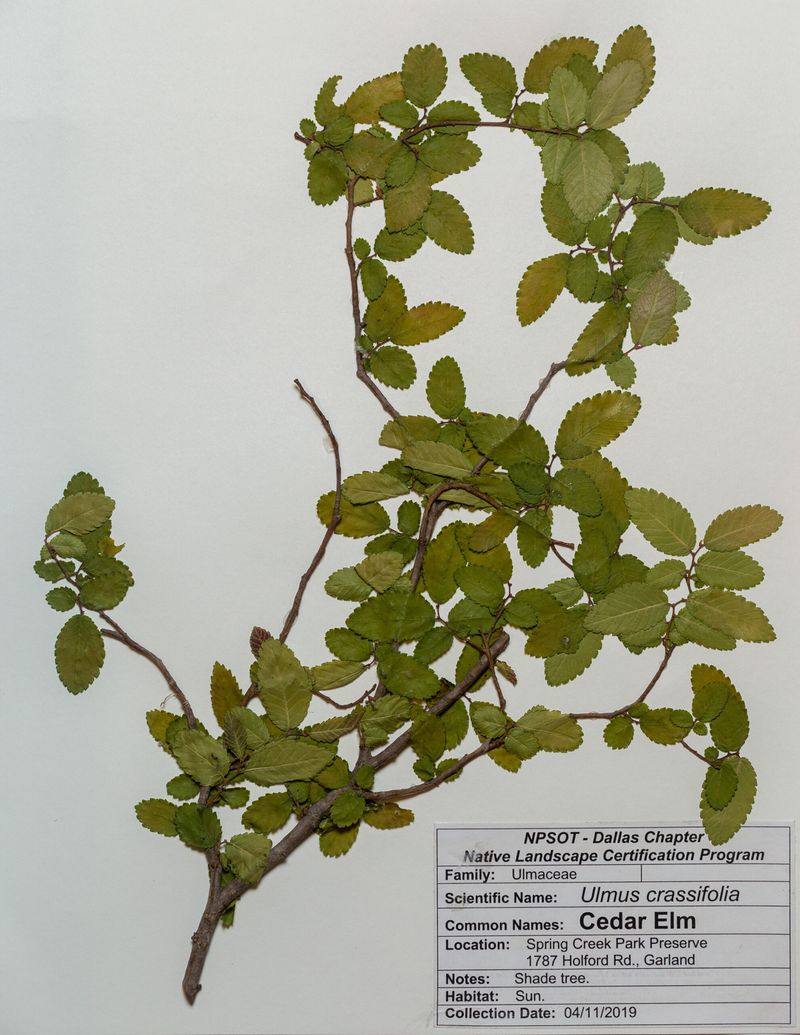
Cedar elm is genuinely native to Texas, and it shows up across a wide range of the state’s ecological regions. Texas A&M Rangeland Plants documentation shows it growing in varied settings, from dry limestone hills in Central Texas to moist bottomlands in East Texas.
That kind of range is unusual and reflects real adaptability across soil types and moisture regimes.
The Texas State Preservation Board’s Trail of Trees guide confirms cedar elm as a native species suited to Texas landscapes, and Texas A&M’s Tree Selector lists its documented tolerances: drought, alkaline soil, poor drainage, salty soil, and sea spray. Those aren’t marketing claims; they reflect the conditions cedar elm has managed in the wild across multiple regions of the state.
Still, native origin and a long tolerance list don’t mean the tree performs equally everywhere or that site conditions stop mattering. Ecoregion, soil depth, drainage patterns, rooting space, and winter exposure all affect how cedar elm grows and how large it eventually gets.
A tree planted in a shallow, compacted parking strip in West Texas faces a very different situation than one planted in a well-drained Central Texas yard with adequate space.
The honest framing is that cedar elm is a reasonable candidate for many Texas landscapes, particularly in Central, North, East, and parts of South Texas, where its native range and documented tolerances overlap with common yard conditions. For homeowners in those regions with suitable soil and enough space, it competes well with non-native alternatives that often need more water and more coaxing to survive a hard summer.
But the tree’s suitability still depends on evaluating the specific site, not just the general region.
Check whether your yard has room for a full-size tree
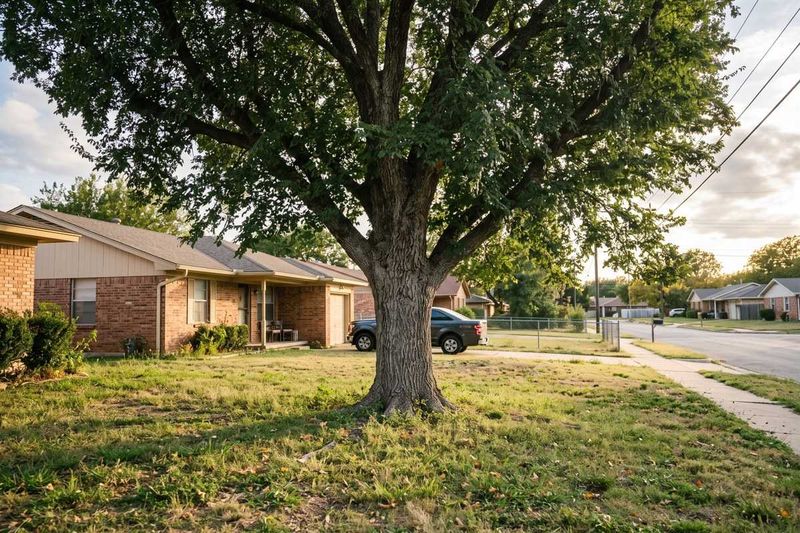
Before purchasing any cedar elm, the first question to answer is whether the yard can actually hold one at full size. The Texas State Preservation Board’s tree guide notes that cedar elm can reach approximately 80 feet tall.
That puts it in the same size class as many forest trees, and planting one without enough clearance creates problems that compound over decades.
Look up before you dig. Overhead utility lines are a common disqualifier for large trees, and cedar elm planted beneath them will eventually require aggressive pruning or removal.
Check horizontal clearance from the house, garage, fence lines, and neighboring structures as well. The canopy of a mature cedar elm spreads wide, and roots extend outward beyond the drip line, which means sidewalks, driveways, and foundation zones all need to be part of the calculation.
A narrow planting strip along a street or a compact urban yard may rule out cedar elm entirely, even in a region where the tree’s drought tolerance otherwise makes it a good fit. The right tree in the wrong spot creates maintenance conflicts, structural damage risk, and utility hazards that cost far more to fix than the tree was worth.
Texas A&M Forest Service guidance on tree placement makes clear that site evaluation should happen before tree selection, not after.
When placement works out, the payoff is real. A cedar elm positioned correctly on the west or southwest side of a house can block afternoon sun during the hottest months, reducing cooling costs and making outdoor spaces more comfortable.
Its canopy also intercepts rainfall and slows runoff, which matters on compacted suburban soils. Texas A&M’s Tree Selector profile confirms it as a large shade tree, and that shade is most valuable when the tree grows where it has room to reach its potential without conflict.
Use late summer to plan, not automatically to plant
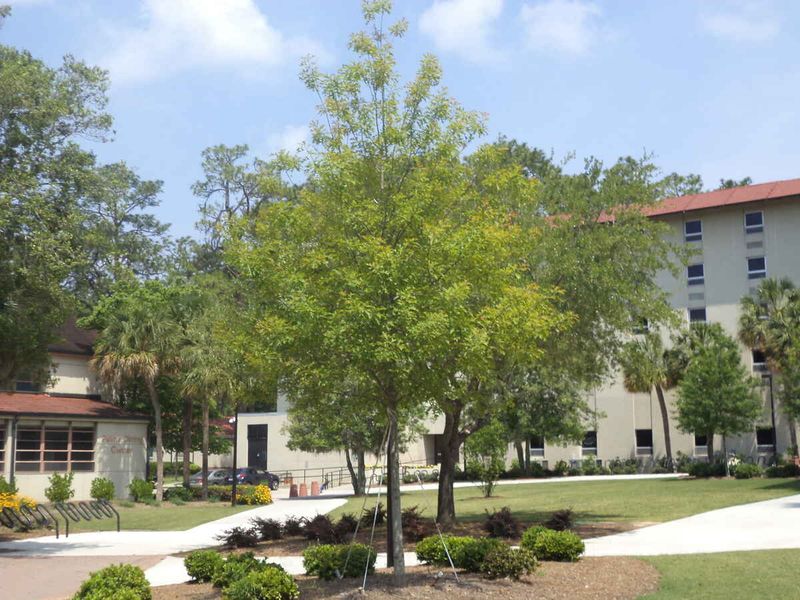
Seeing cedar elm at the nursery in August and feeling the urge to plant it immediately is understandable, but the calendar matters here. Texas A&M Forest Service recommends November through early spring as the preferred Texas tree-planting window.
The reason is straightforward: trees planted during cooler months can develop roots before the heat of the following summer arrives. A tree that goes into the ground in late August has almost no runway before high temperatures and dry conditions begin testing it.
Late-summer planting is not impossible, but it requires reliable, legally permitted follow-up watering and close monitoring throughout the fall. If your city is currently under Stage 2 or Stage 3 water restrictions, or if your water utility limits irrigation to specific days and methods, you need to know exactly what is allowed before a new tree goes into the ground.
Planting without that information and then being unable to water adequately is one of the more preventable ways to lose a tree.
A more practical approach for most Texas homeowners right now is to treat late summer as a planning and purchasing window, not a planting window. Use the time to confirm the site, measure clearance from structures and utility lines, check local water rules, and select a healthy tree from a reputable nursery.
Holding a container-grown cedar elm in partial shade with adequate water until November is far less risky than rushing it into the ground during the hottest part of the year. When the weather cools, the tree goes in with the best possible conditions for root development ahead of its first full summer.
Plant the root system for a stronger start
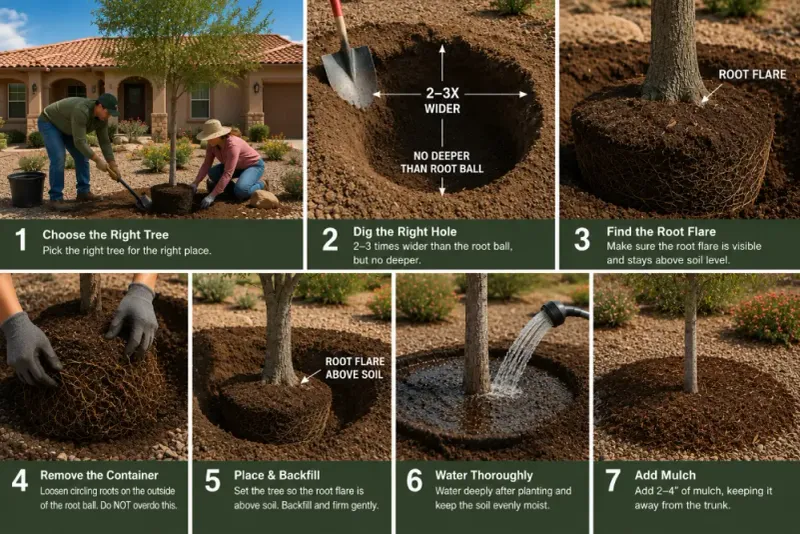
Getting the hole right is where many tree plantings go wrong before the tree even has a chance. The goal is a hole that is wide rather than deep, roughly two to three times the width of the root ball but no deeper than the root ball itself.
Planting too deep is one of the most common mistakes homeowners make, and it can slowly kill a tree over several years by burying the root flare and cutting off oxygen to the roots.
The root flare, which is the point where the trunk begins to widen and transition to roots, belongs at or slightly above the surrounding grade. If it ends up below ground, the bark at the base stays moist and begins to deteriorate.
Setting the tree slightly high, with the flare just visible above the soil surface, is better than planting it too deep. Texas A&M Forest Service planting guidance recommends backfilling with the native soil that came out of the hole rather than amended or imported fill.
Amended backfill can create a moisture boundary that discourages roots from expanding outward into the surrounding soil.
Skip fertilizer during the first growing season. The tree’s energy during establishment should go toward root development, not top growth, and fertilizer can push foliage at the expense of the root system the tree needs most.
After backfilling, apply two to three inches of mulch extending out toward the drip line of the canopy. Mulch holds moisture, moderates soil temperature, and reduces competition from grass and weeds.
Keep mulch at least a few inches away from the trunk itself. Mulch piled against the bark traps moisture and creates conditions for rot and pest problems at the base of the tree.
A wide, flat mulch ring with a gap around the trunk is the correct shape, and it makes a visible difference in how well the tree handles its first Texas summer.
Follow local rules while watering a new cedar elm
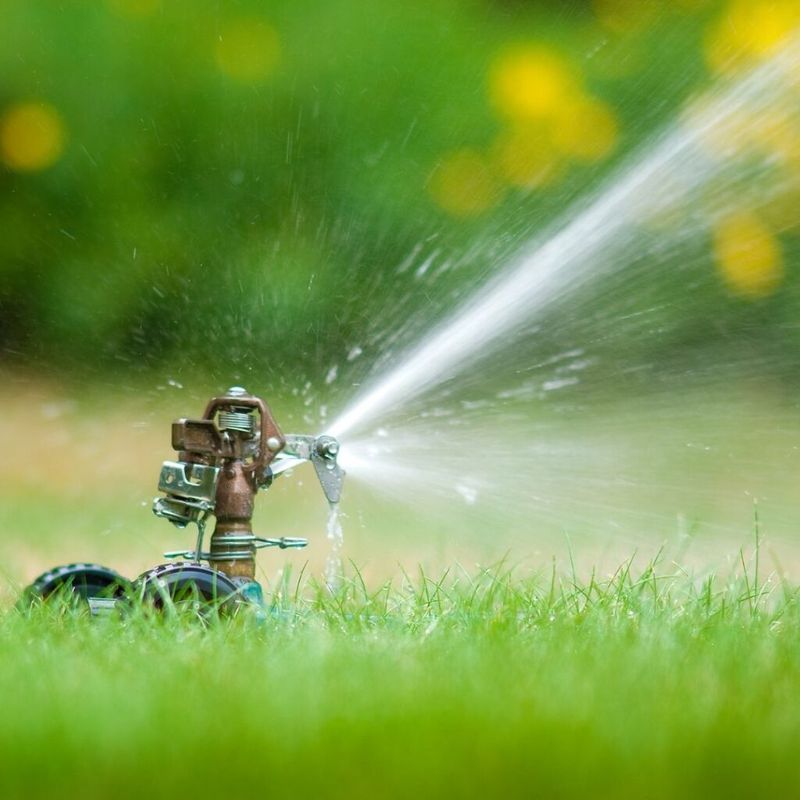
Watering a newly planted tree in Texas is not as simple as turning on the sprinklers. Texas A&M Forest Service recommends watering newly planted trees for at least the first two years, with a general guideline of six to eight gallons per inch of trunk diameter per week.
That number adjusts for rainfall, soil type, heat intensity, and local conditions, so it is a starting point rather than a fixed rule. A week with an inch of rain requires less supplemental water than a week with none.
How the water gets to the root zone matters as much as how much you apply. Texas A&M Forest Service drought watering guidance recommends slow, thorough watering that allows moisture to penetrate deeply rather than brief daily sprinkling that wets only the surface.
A soaker hose, bubbler, or drip emitter placed at the root zone works well where local rules allow those methods. EPA WaterSense watering tips also note that morning watering reduces evaporative loss, though your utility’s schedule controls when you can actually run water.
Texas has no single statewide residential watering rule. Restrictions are managed locally by water suppliers and groundwater districts, and the rules can differ by watering method, drought stage, water source, and whether a tree qualifies as a new planting.
The Texas Water Development Board’s drought FAQ explains that conservation measures vary by water provider, and TCEQ guidance on public water systems during drought confirms that restrictions can distinguish between automatic irrigation, hand watering, drip systems, reclaimed water, and private wells.
Before choosing a watering method or schedule for a new cedar elm, contact your city, water utility, or groundwater district directly. Ask whether new-planting exemptions exist, which methods are currently permitted, and how often you can water under the current stage of restrictions.
Getting that information first protects both the tree and your compliance with local rules.
Let an established tree signal when it needs help
Once a cedar elm has been in the ground for two or more years and has developed a substantial root system, its relationship with drought changes noticeably. Texas A&M Forest Service drought guidance notes that established trees showing no heat-stress symptoms generally do not need routine supplemental watering during drought.
Young trees planted within the last few years remain the priority for any available irrigation, not the large cedar elm that has been growing in the yard for a decade.
Knowing what stress looks like helps you respond before damage becomes permanent. Texas A&M’s drought guidance identifies wilting or dropping leaves, unusually small or malformed leaves, yellowing, and browning leaf tips as possible signs of drought stress in trees.
Worth noting: those same symptoms can appear with disease, root damage, compacted soil, or other problems unrelated to water. If the symptoms persist after a good rain or after watering, a closer look at the root zone, trunk base, and overall site conditions is warranted before assuming drought is the only cause.
Cedar elm is resilient rather than maintenance-free, and that distinction matters for long-term planning. Texas A&M’s Tree Selector profile lists drooping branches, aphids, powdery mildew, and mistletoe as potential management concerns.
Additional Texas tree documentation notes susceptibility to Dutch elm disease as a concern worth monitoring. None of these issues are inevitable, and many cedar elms grow for decades without serious problems, but they are real possibilities that a homeowner should know about before planting.
Treating the tree as low-maintenance rather than no-maintenance sets a more realistic expectation. Periodic inspection of the canopy, trunk, and major branches, along with prompt attention to signs of pest activity or disease, keeps small problems from becoming large ones.
A cedar elm that receives reasonable monitoring and occasional care through its life will perform far better than one that is planted and then completely ignored.
Choose cedar elm for seasonal shade, or compare the fit
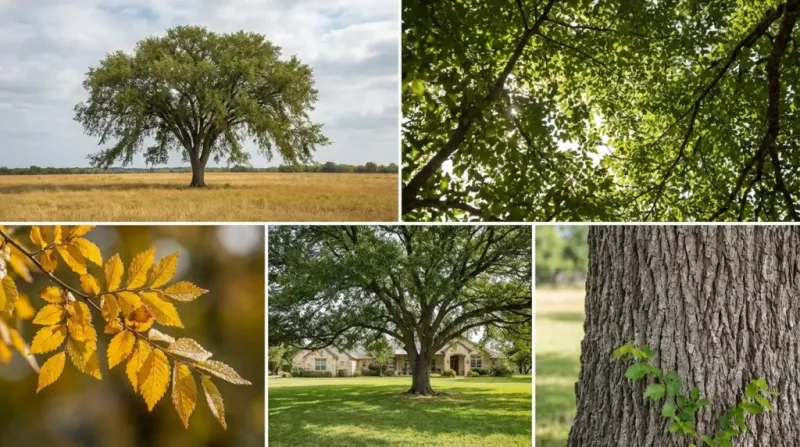
Cedar elm suits homeowners who have space for a large tree, site conditions that align with its tolerances, and the ability to provide permitted establishment watering during the first two years. Those three conditions together describe a lot of Texas yards, particularly in Central, North, and East Texas where the tree’s native range overlaps with suburban and rural residential lots that have room to spare.
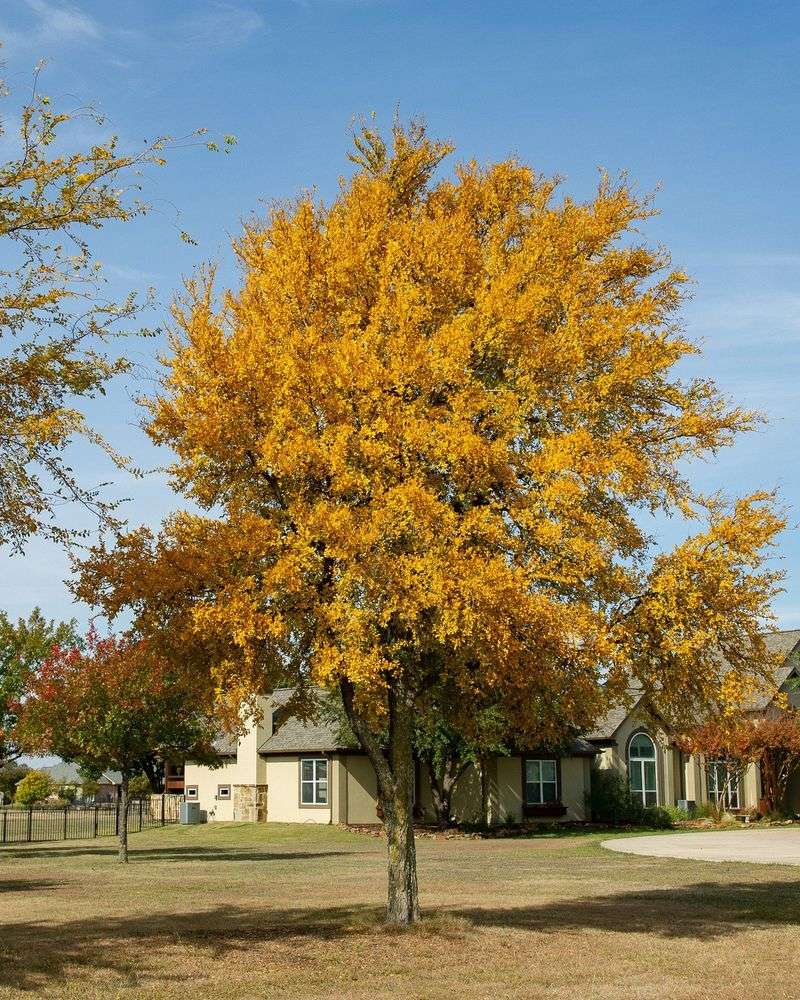
One trait worth understanding before committing is that cedar elm is deciduous. Texas A&M’s Tree Selector profile notes that its small leaves turn yellow in fall before dropping.
That seasonal color is attractive, but it also means the tree provides no shade during winter months. For homeowners who want year-round canopy cover, that gap matters.
Live oak is worth considering as a comparison. Texas A&M’s profile for live oak describes it as drought-tolerant and native, with evergreen foliage that holds through winter.
The trade-off is that live oak also needs substantial space, can develop surface roots that disrupt paving, and carries risk from oak wilt, a serious disease that can spread through root grafts between neighboring trees. Neither tree is a simple choice, and both reward careful site evaluation.
The practical next step is to match the tree to the site rather than the site to the tree. Confirm the available space, check local watering rules, and plan to plant during the cooler window from November through early spring.
A cedar elm placed well and established carefully will shade that yard for generations.