
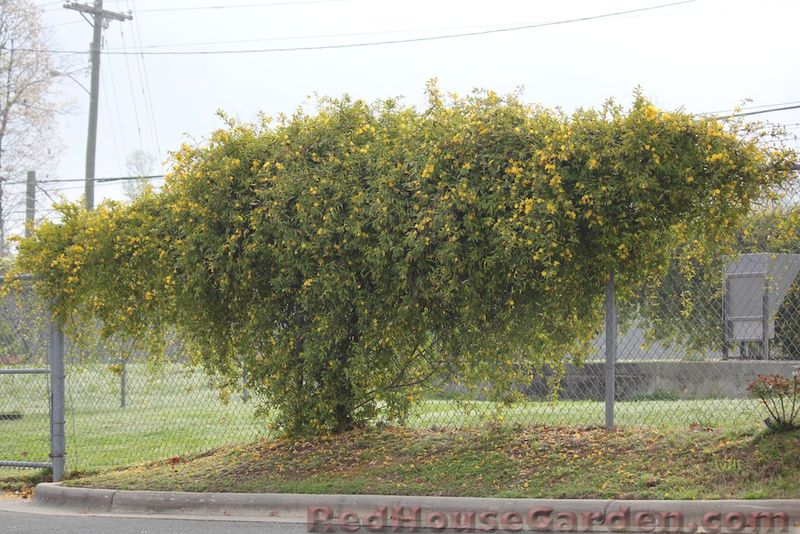
A bare chain-link fence is one of the least attractive features a yard can have, and most homeowners want it gone without replacing the whole structure. Carolina jessamine, a native woody vine that twines through fence openings and builds a leafy screen over several growing seasons, offers a real path forward.
Getting there takes more than dropping a plant in the ground, but with the right site conditions and a little ongoing care, this perennial vine can soften that fence for years to come.
Carolina jessamine offers a credible path to a softer fence
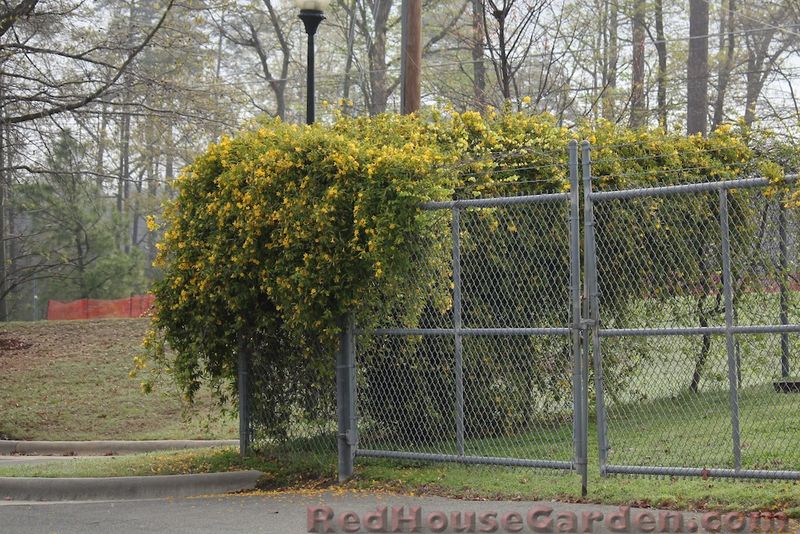
Carolina jessamine (Gelsemium sempervirens) is a woody, perennial, twining vine native to the southeastern United States, and it is one of the few plants that NC State Extension specifically recommends for fences, trellises, screens, and arbors. That combination of traits makes it a genuinely strong candidate for covering a bare chain-link fence.
A trained plant can reach roughly 12 to 20 feet according to NC State’s plant toolbox, which is enough height to fill a standard residential fence panel once the vine matures.
Perennial is the key word here. Unlike an annual vine that dies at the end of the season and forces you to start over, Carolina jessamine comes back from its woody root system each year.
That is the honest version of the “plant once” promise: you plant a permanent vine rather than a temporary one, not a vine that covers your fence automatically and never needs attention again.
The twining habit means the plant wraps its stems around whatever support it contacts. Chain-link is a good structural match because the small openings give young stems plenty of places to grip.
However, the vine does not attach to surfaces the way ivy does with adhesive pads or rootlets. Young stems need to be physically guided into the fence openings, especially in the first season or two, or they will pile up at the base rather than spreading across the fence.
Coverage also builds gradually. A newly planted jessamine looks modest for the first year or so while it focuses energy on establishing roots.
The visual payoff comes later, typically over several growing seasons, and the final result depends heavily on site conditions, how well the fence holds up, and whether the homeowner keeps up with training and pruning. A perennial vine with good site conditions and consistent care can develop into a long-lasting screen, but that outcome is earned, not automatic.
Match the vine to North Carolina’s regional conditions
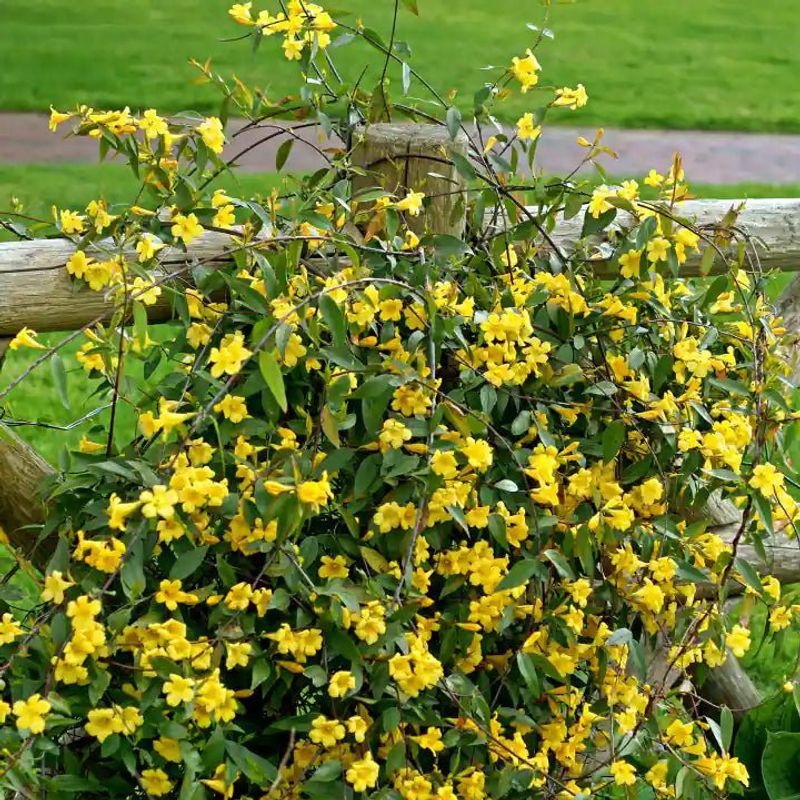
Carolina jessamine does not grow wild in equal abundance across every corner of North Carolina. The state’s Vascular Plants account reports it as common through the Coastal Plain and eastern and southern Piedmont, but largely absent from the Mountains and northwestern Piedmont in its natural range.
That distinction matters because a plant growing in conditions close to its native habitat tends to establish faster and stay healthier with less intervention than one pushed into marginal territory.
Homeowners in the Coastal Plain and eastern Piedmont are working with the vine’s home turf, which gives them a head start. Gardeners in the Mountains or northwestern Piedmont can still grow Carolina jessamine successfully as a cultivated plant, but they should expect to pay closer attention to site selection and winter performance, since the vine will be operating outside its natural comfort zone.
Wherever you garden in North Carolina, the site conditions you provide matter more than your zip code. Full sun is where Carolina jessamine performs best, producing the densest growth and the most abundant flowers.
NC State’s plant toolbox confirms that the vine tolerates light shade, but reduced light cuts both flowering and overall vigor. Severe shade is a real problem: a jessamine planted along a fence that sits in deep shadow most of the day may produce a thin, spindly vine that never fills in the way you want.
Soil quality rounds out the site picture. Moist, organically rich, well-drained soil supports stronger root development and faster canopy growth.
Heavy clay that holds standing water, or dry sandy soil with no organic matter, will slow the vine down and make it harder to establish. Amending the planting area with compost before installing the plant is a practical step that pays dividends across the first few growing seasons.
Use the chain-link as a framework, not as a guarantee of coverage
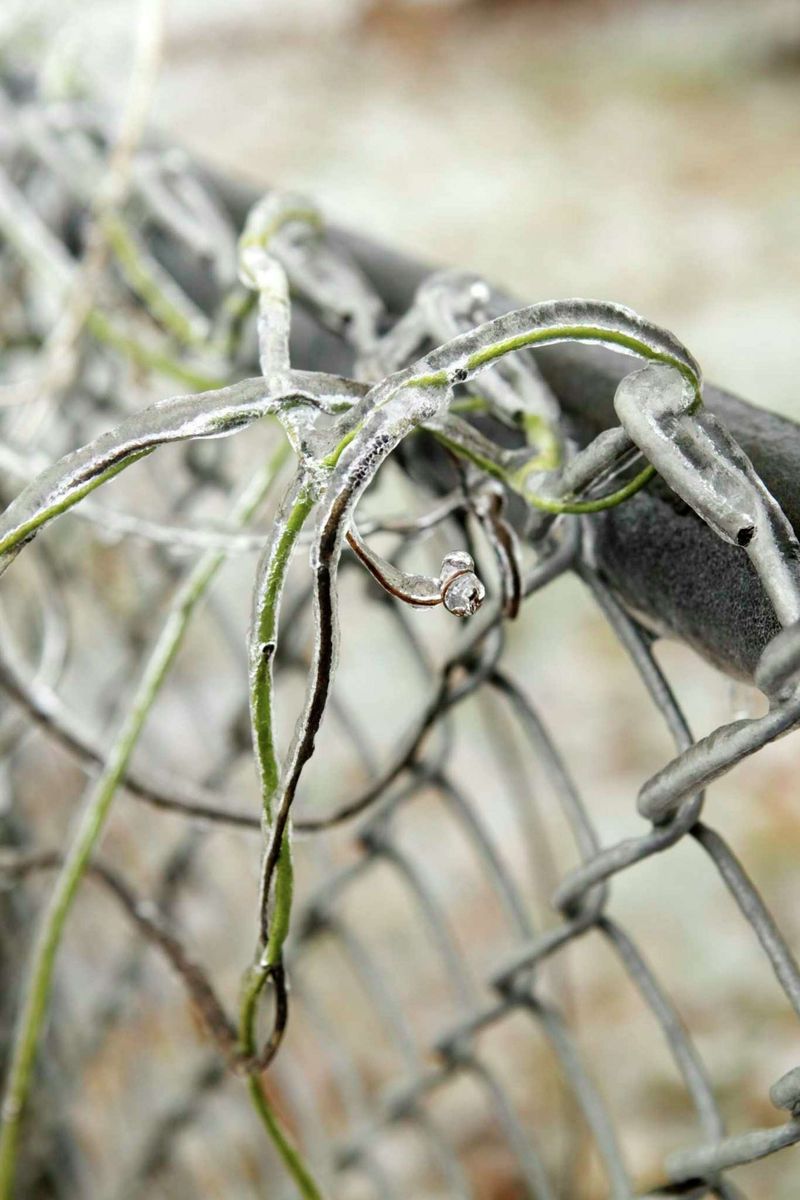
Chain-link fencing works well as a vine support precisely because of its open grid structure. A twining vine can weave its stems through the diamond-shaped openings and lock itself in place without any additional fasteners.
That physical relationship is real and useful, but it does not mean the vine will spread evenly across the fence on its own.
Before planting anything, walk the fence line and check its condition. A vine that adds weight and wind resistance over several years will stress a fence that is already leaning, rusting at the posts, or missing tension wire.
NC State’s Extension Gardener Handbook on woody ornamentals warns that twining vines can become difficult to manage when they reach nearby small trees and shrubs, which is a useful reminder that the vine will eventually move beyond the fence if it is not kept in check. Repair any structural problems before planting, and plan the vine’s location so its mature spread will not block gate hardware, cover utility meters, reach roof overhangs, or engulf shrubs growing close to the fence line.
Placement relative to structures also carries a safety dimension that gets its own section later in this article. For now, the practical point is that the fence needs to be sturdy enough to hold a mature vine through wind and rain, and clear enough of obstacles that the vine has a defined corridor to fill rather than an open invitation to spread in every direction.
One additional note on what chain-link cannot do: it will not pull the vine upward or sideways by itself. The vine climbs by twining, which means it wraps around whatever it contacts.
If young stems fall away from the fence or curl back on themselves, they need a hand to redirect them into the grid openings. Getting that early guidance right is what separates a vine that covers the fence from one that forms a pile at the base.
Train young stems across the lower fence
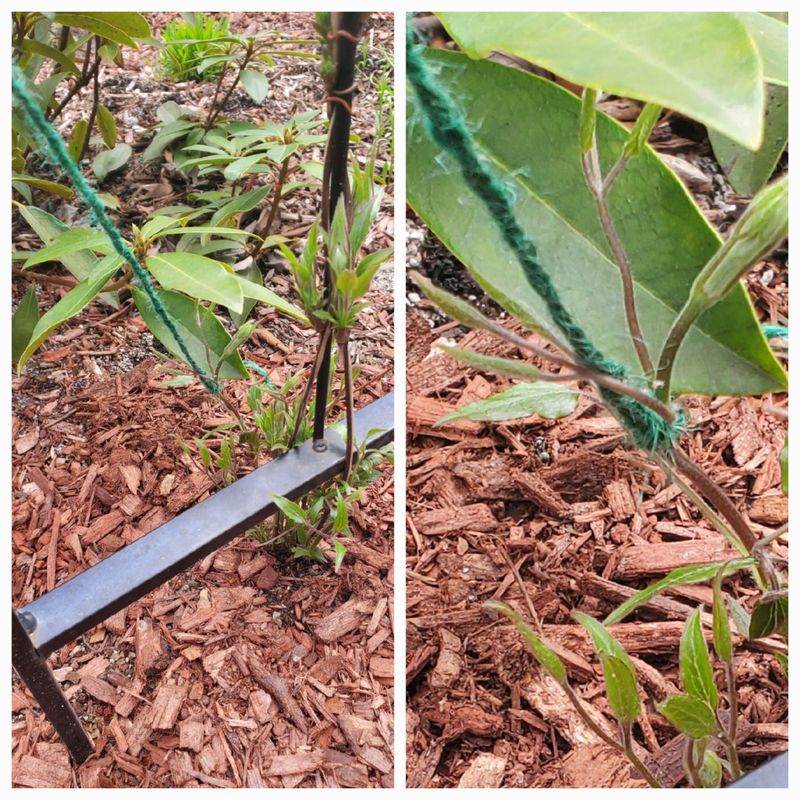
The most common mistake with a new fence vine is letting it climb straight up before the lower sections of the fence have any coverage. A stem that races to the top leaves the bottom half bare, and correcting that later is harder than preventing it from the start.
Training young stems to grow horizontally along the bottom two or three feet of the fence first encourages branching and fills in the gaps that matter most for ground-level privacy.
String, soft garden twine, or flexible plant ties work well for this job. Thread young stems through the chain-link openings and secure them loosely to the fence wire in the direction you want them to travel.
Netting laid against the lower fence section can also give stems more contact points to grip before they are strong enough to anchor themselves. The goal is to spread the vine laterally before letting it climb vertically, so the coverage pattern stays even rather than top-heavy.
Watering during establishment is not optional. A newly planted jessamine is investing most of its energy in root development during the first season, and consistent moisture helps that process along.
Deep watering two or three times per week during dry stretches in the first growing season is more effective than light daily sprinkles that only wet the surface. NC State’s woody ornamentals guidance and the NC State plant toolbox entry for Carolina jessamine both treat establishment care as a necessary part of the installation process, not an afterthought.
Weed control around the base of the plant also matters more than most homeowners expect. Weeds compete directly with a young vine for moisture and nutrients, and a thick mat of grass or aggressive weeds around the planting hole can noticeably slow establishment.
A layer of mulch two to three inches deep, kept a few inches away from the stem, suppresses weeds and holds soil moisture through dry spells. These are not complicated steps, but skipping them during the first season often means a slower-developing vine and thinner coverage later on.
Expect a gradual screen and schedule regular pruning
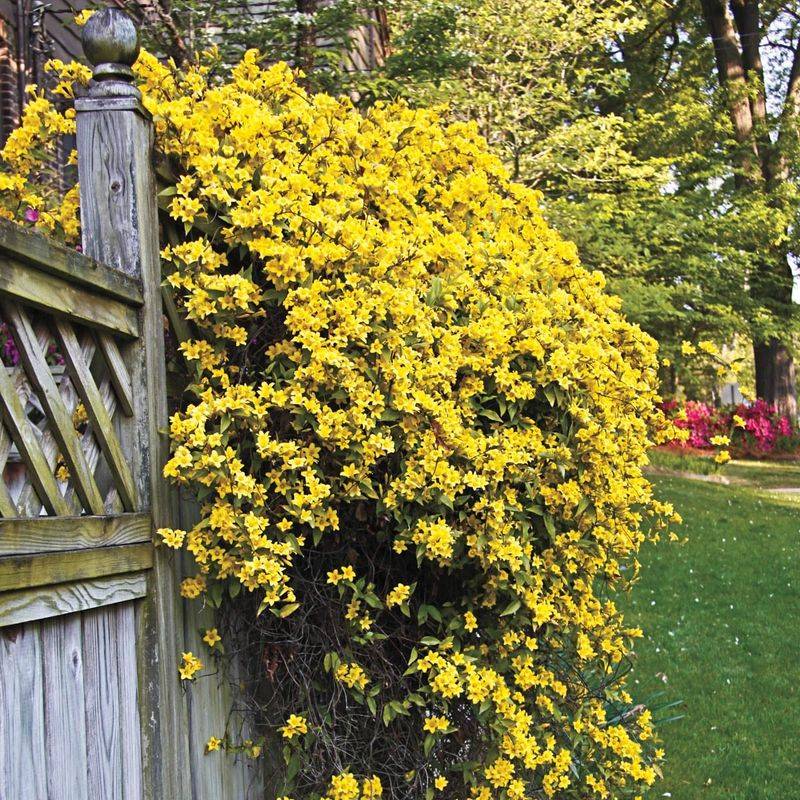
Patience is part of the deal with Carolina jessamine. NC State’s plant toolbox describes a timeline of approximately three to four growing seasons for a trained vine to reach 12 to 20 feet.
That means the fence will not look transformed in the first summer. Year one is mostly about root development, year two brings noticeably faster stem growth, and by years three and four a well-trained plant on a sunny fence can start delivering real coverage and privacy.
The visual reward, when it arrives, is genuine. Carolina jessamine produces fragrant yellow flowers that generally appear from late winter into spring, often blooming before most other plants in the yard have woken up.
The foliage is generally evergreen to semi-evergreen, which means the fence screen persists through winter in many North Carolina locations. That said, winter foliage may bronze or look less vibrant in colder conditions, and coverage can remain uneven in spots where the vine was slower to fill in.
Pruning is the maintenance task that keeps the vine working as a screen rather than a sprawling tangle. The standard recommendation is to prune after flowering, which avoids cutting off next season’s buds while still giving you a chance to shape the vine and remove stems that have moved beyond the fence line.
Vigorous shoots that push into neighboring shrubs, across a gate, or toward a roof overhang should be redirected or removed as soon as you notice them.
NC State’s Extension Gardener Handbook notes that vigorous growth may require shearing and retraining several times a year, not just once after flowering. A jessamine on a long, sunny fence in good soil can put on a lot of new growth during the warm season, and a single annual pruning may not be enough to keep it contained.
Building a habit of checking the vine every month or two during the growing season and redirecting or trimming where needed will keep the screen looking intentional rather than overgrown.
Resolve toxicity, fire, and bee concerns before planting
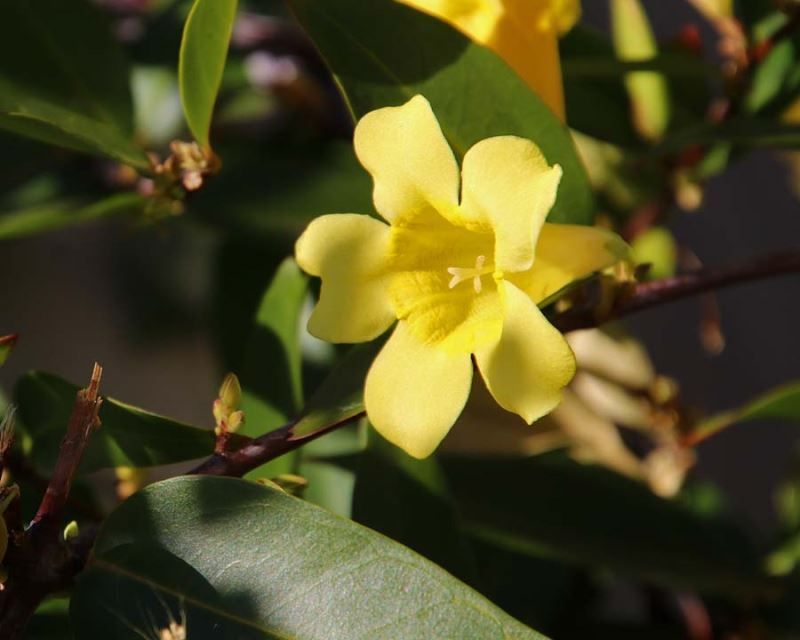
Carolina jessamine’s native status does not make it safe to eat, touch carelessly, or plant without thinking about who and what shares the yard. UF/IFAS Extension’s guide to highly toxic landscape plants is explicit: every part of Carolina jessamine is highly poisonous if ingested, including the leaves, flowers, fruit, roots, stems, bark, and sap.
This is not a minor caution that applies only to large quantities. Households with young children who explore by tasting, or with dogs that chew on yard plants, need to place this vine where access is limited or supervised, and everyone in the household should be able to identify it by sight.
The sap can also irritate sensitive skin during pruning, so wearing gloves when you work with the plant is a straightforward precaution worth building into your routine from the start. Accurate plant identification matters year-round because the vine stays on the fence through winter when other visual cues are gone.
NC State’s plant toolbox assigns Carolina jessamine a high flammability rating. Homes in wildfire-prone areas, or where a fence runs along the side or back of a structure, should factor this in before planting.
A dense, dry vine on a fence that adjoins a house, deck, or garage is a fire pathway in the wrong conditions. The vine is better suited to a fence that runs along a property boundary away from structures than to one that directly borders a home’s defensible space.
The pollinator picture is more complicated than the yellow flowers suggest. Carolina jessamine does attract some early-season pollinators, but NC State specifically warns that its pollen can be harmful to honeybee colonies and considers the plant unsuitable for beekeepers.
Homeowners who keep bees or live near neighbors who do should weigh that risk carefully. The vine supports certain butterflies and other insects, but it is not a universally safe pollinator plant, and presenting it that way would be inaccurate.
Consider coral honeysuckle when the site or wildlife goal changes
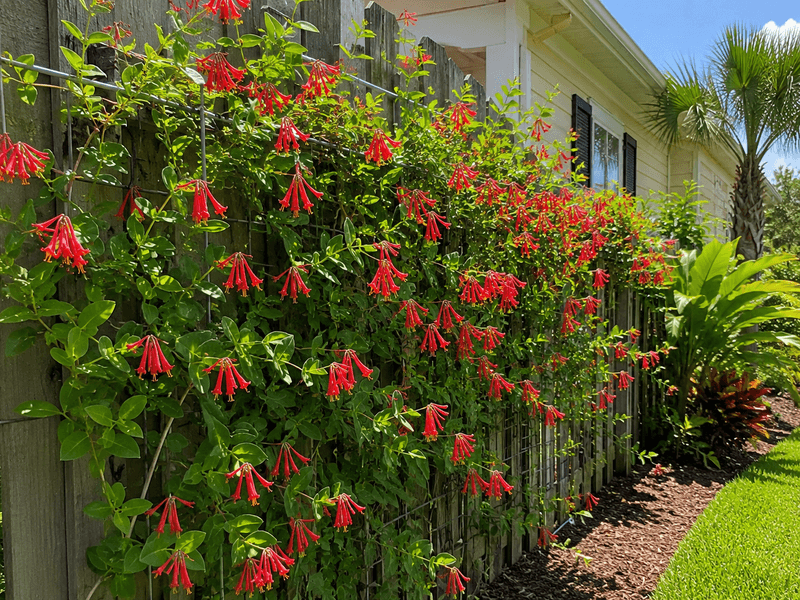
Coral honeysuckle (Lonicera sempervirens) is worth serious consideration when the site conditions or the wildlife goals pull in a different direction than Carolina jessamine’s strengths. Unlike jessamine, which is most common in the Coastal Plain and eastern Piedmont in its natural range, coral honeysuckle grows across all three North Carolina regions, from the coast to the mountains.
That broader regional adaptability makes it a more flexible choice for homeowners in the Piedmont foothills or western counties where jessamine may be less at home.
NC State’s plant toolbox entry for coral honeysuckle confirms that it performs in partial shade to full sun, with heavier flowering in sunnier spots. That shade tolerance opens up fence locations that would leave a jessamine thin and spindly, such as a north-facing fence or one shaded by a neighboring structure for part of the day.
Both vines reach roughly 10 to 20 feet at maturity, so the structural fence-covering potential is comparable.
The wildlife value is where coral honeysuckle genuinely pulls ahead. The North Carolina Wildlife Federation’s native pollinator vine resources highlight coral honeysuckle’s nectar and fruit as resources used by hummingbirds, butterflies, moths, and birds.
For homeowners whose primary goal is building a wildlife-friendly fence planting rather than just hiding the metal, coral honeysuckle delivers more ecological function.
The trade-off is winter foliage. Carolina jessamine tends to hold its leaves in most of North Carolina’s climate zones, giving it an edge as a year-round screen.
Coral honeysuckle is reliably evergreen in the warmer Deep South but behaves as semi-evergreen or deciduous in cooler North Carolina winters, particularly in the Piedmont and Mountains. If a persistent winter screen is the priority and the site is sunny, jessamine is the stronger pick.
If partial shade, mountain adaptability, or hummingbird habitat tips the balance, coral honeysuckle earns its place on the fence.
Choose a long-term screen, not a set-and-forget fix
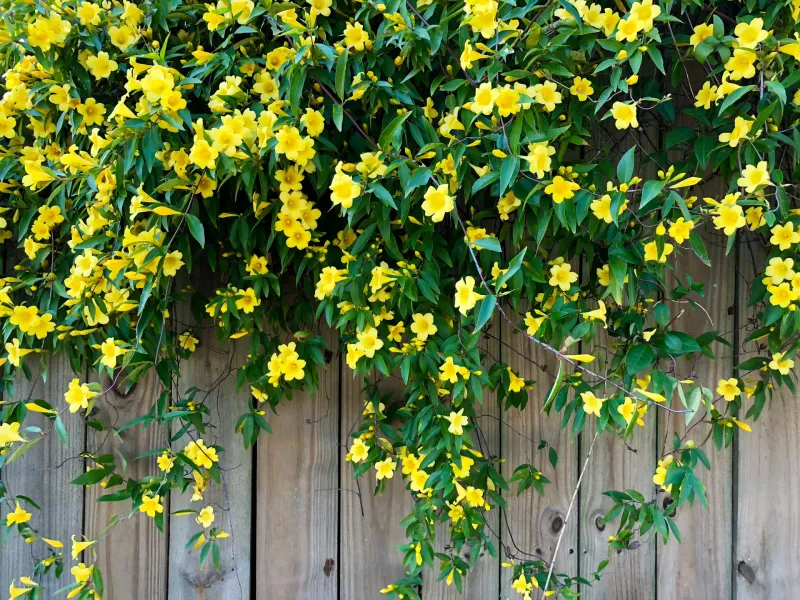
The right vine for your fence comes down to an honest look at your site and your willingness to stay involved. Carolina jessamine fits a sturdy chain-link fence with adequate sun, decent soil, and a homeowner who will water it through establishment, guide the stems in the early seasons, prune after flowering, and manage vigorous growth when it pushes beyond the fence line.
NC State’s Carolina jessamine profile and the Extension Gardener Handbook’s woody ornamentals chapter together make clear that a long-lasting screen is a realistic goal, not a guaranteed outcome, and that continuing care is part of the deal from planting day forward.
Households with children, pets, or beekeeping neighbors nearby need to factor in the toxicity and pollinator concerns before committing to jessamine. In those situations, or where the fence sits in partial shade or spans a wildlife-priority area, coral honeysuckle offers a better fit without asking you to manage the same safety trade-offs.
Neither vine will cover every fence, and neither one eliminates the need for seasonal attention. What both vines offer is a perennial framework that builds on itself year after year, gradually replacing bare metal with living foliage.
A fence that looks softened and intentional after four or five seasons of steady care is a genuinely satisfying result – and one that a well-chosen native vine, matched to the right site, is fully capable of delivering.