
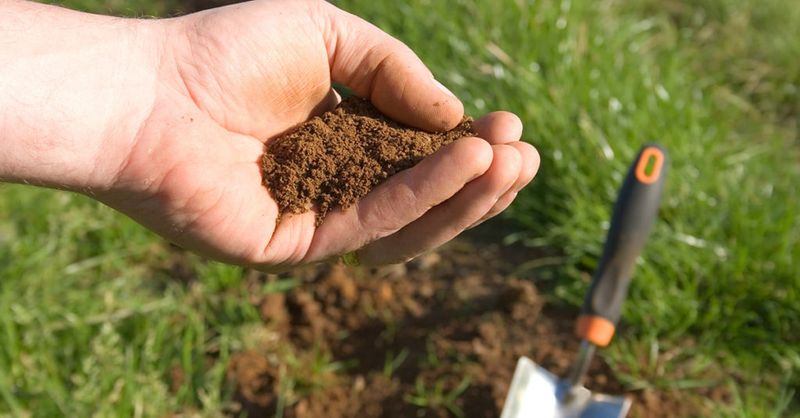
Plenty of North Carolina gardeners add lime and fertilizer every season out of habit, crossing their fingers and hoping the tomatoes or zoysia respond. There is a better approach, and it costs less than a bag of fertilizer.
The NCDA&CS Agronomic Services soil test gives homeowners a crop-specific, lab-backed plan for exactly what their beds need before the next growing season, replacing routine guessing with a clear set of numbers and recommendations.
The NCDA&CS soil test turns a hunch into a planting plan
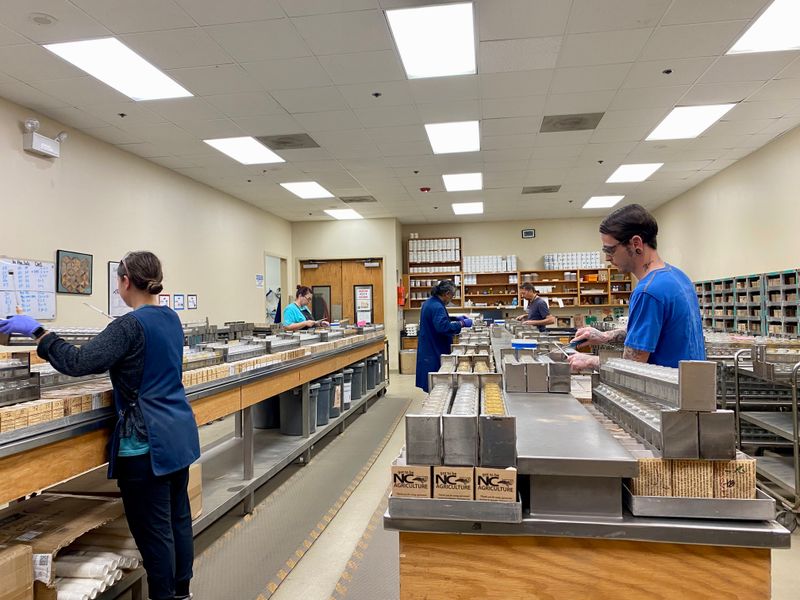
Guessing whether a vegetable bed needs lime or whether a shrub border has enough potassium is a costly habit. The NCDA&CS Agronomic Services predictive soil test for homeowners replaces that guesswork with a laboratory-backed plan tailored to the crop you intend to grow.
Submit a properly collected sample, identify your planting use, and the report returns lime and fertilizer recommendations in pounds per 1,000 square feet, matched to your specific soil readings.
The laboratory measures plant-available phosphorus, potassium, calcium, magnesium, sodium, sulfur, manganese, copper, and zinc, along with soil pH, humic matter, and exchangeable acidity. Results are reported as low, optimum, or excessive for each measured factor, so you know whether you are adding nutrients a bed already has in abundance or correcting a genuine gap.
According to NCDA&CS frequently asked questions, the test is designed to guide soil-fertility management, not to diagnose every possible cause of poor plant growth.
That distinction matters. The test can tell you whether lime is needed and how much, whether phosphorus is low or already excessive, and whether potassium is at the level your intended crop requires.
What it cannot do is explain a drainage problem, reveal soil compaction, detect disease or nematodes, or account for all of your nitrogen needs. The NCDA&CS Orange Book on soil fertility frames the agency’s goal as preventing fertility from being a yield-limiting factor, not guaranteeing a particular outcome.
Treating the test as a fertility planning tool rather than a complete soil diagnosis keeps expectations accurate and helps you use the results well.
Plan months ahead when lime needs time to work
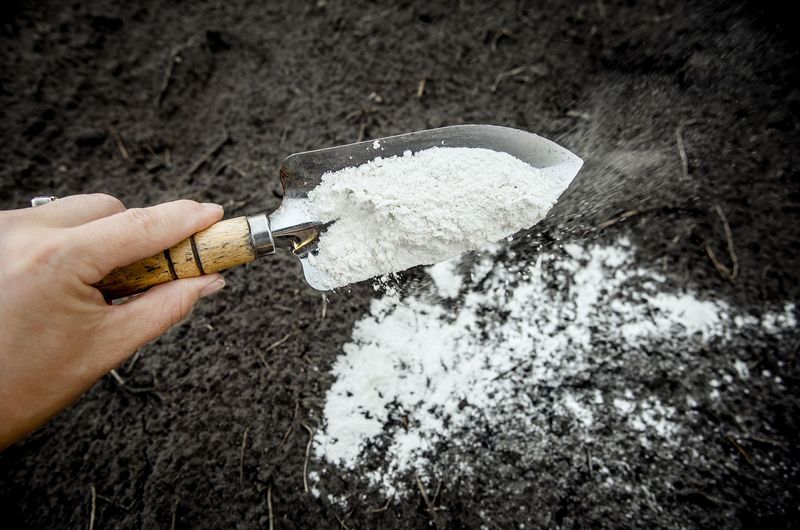
Lime does not work overnight. Once you spread it and mix it into the soil, it begins neutralizing acidity slowly, and that reaction can take weeks to months before it fully shifts the pH toward your crop’s target.
That slow timeline is exactly why NCDA&CS identifies late summer or early fall as a strong sampling window for most planting situations.
NC State recommends collecting samples three to six months before planting when the crop and planting date are known. A gardener who pulls samples in August or September after a summer harvest, submits them promptly, and receives results by mid-fall has enough time to apply recommended lime, incorporate it into the bed, and let it react before spring transplants go in.
That lead time is the practical payoff of testing early.
A test taken a few days or weeks before an immediate fall planting is still worth doing, but the lime timing calculus changes. The report can still guide fertilizer decisions for that bed, and it sets up a correction plan for the season after.
What it cannot do is create the reaction time that lime requires before seeds or transplants go in the ground within the next week or two. NC State’s vegetable gardening guidance confirms that a fall lime application is most beneficial when it precedes spring planting, giving the material time to work through the soil profile.
Testing after harvest, with a future planting window in mind, is the timing that delivers the full benefit of the process.
A reliable report starts with a representative sample
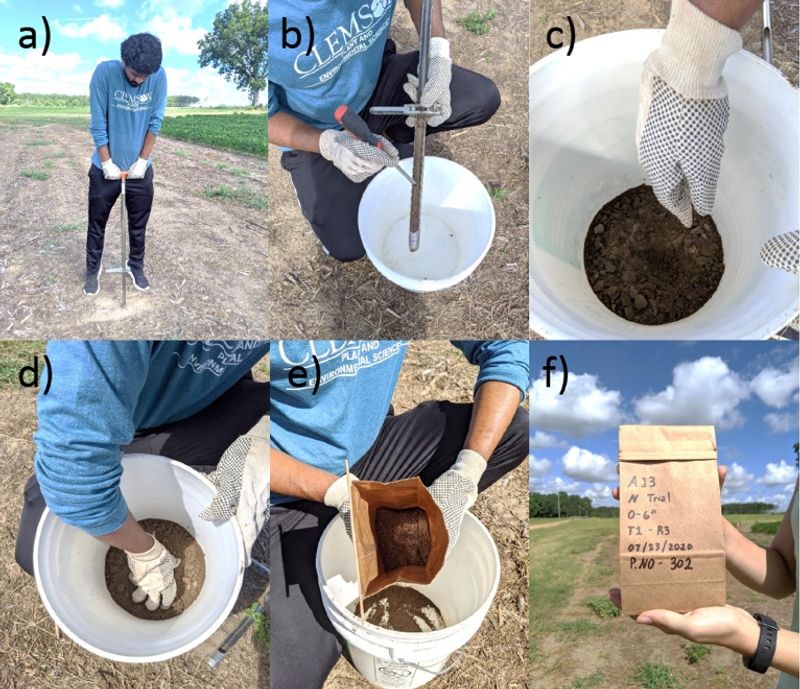
The most sophisticated laboratory analysis in the state cannot rescue a poorly collected sample. If the soil you send in does not reflect what is actually happening across your bed, the recommendations that come back will be calibrated for soil that does not exist.
Getting the collection right is the most controllable part of the entire process.
NC State’s guidance on careful soil sampling calls for using a clean plastic bucket and a clean stainless-steel or chrome-plated probe, spade, or trowel. Galvanized or brass tools can introduce trace metals that skew the results, so tool choice matters.
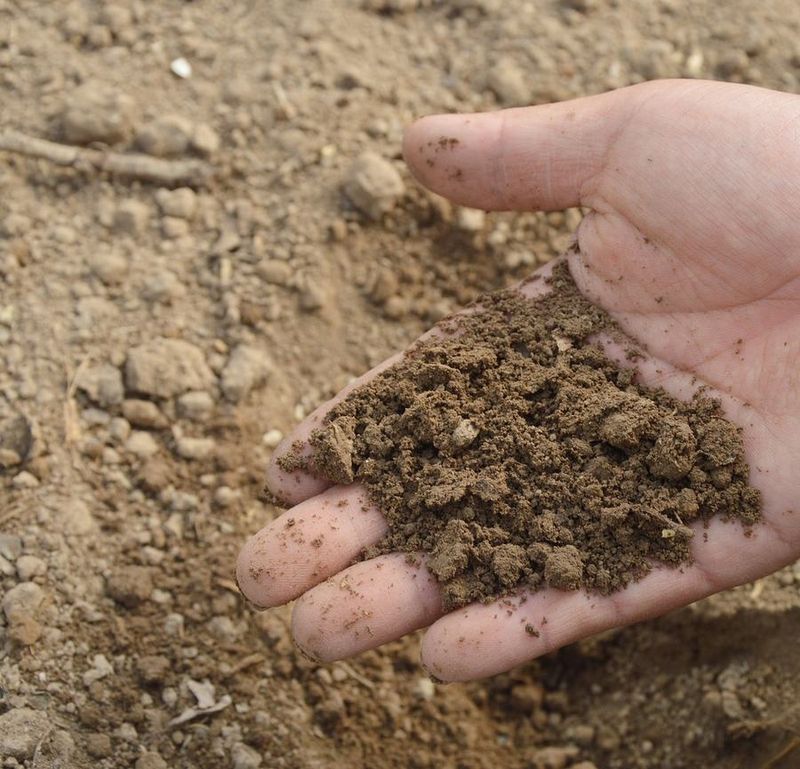
Collect roughly 15 to 20 cores from random locations spread across the bed, not just from the corner nearest the hose bib or the spot that looks most productive. According to the NCDA&CS sampling instructions, sample to a depth of 0 to 8 inches for plowed or tilled garden areas.
Mix all the cores together thoroughly in the bucket, then pull out the required amount to submit.
One composite sample represents one uniform area. That rule has a practical consequence: your vegetable bed, your front lawn, your shrub border, and a recently renovated flower bed should not automatically be combined into a single sample.
NC State’s guidance on modifying soil for plant growth reinforces keeping areas with different soil types, fertilizer histories, drainage conditions, or intended crops separate. A lawn that received heavy potassium applications last year and a new raised bed filled with purchased mix have different histories, and a blended sample from both areas will produce a recommendation that fits neither accurately.
Treating each distinct bed or use area as its own sample takes a little extra time but produces recommendations you can actually act on.
The crop code determines what the recommendation means
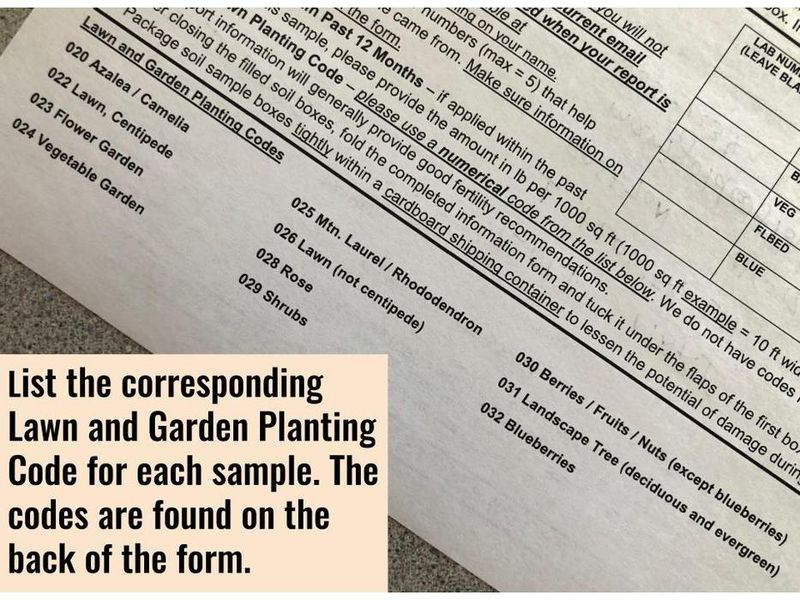
Submitting a sample without identifying the intended crop is like asking for driving directions without giving a destination. The NCDA&CS homeowner process requires a crop code because the laboratory uses your planting type to set the target pH and calculate the lime and fertilizer rates on your report.
Entering the wrong use, or leaving it vague, can produce recommendations built around the wrong plant entirely.
The NCDA&CS homeowner submission page lists planting categories including vegetable garden, flower garden, lawn, shrubs, and blueberries, among others. The NCDA&CS homeowner sample form walks through how to identify your crop code before submitting.
Choosing accurately is especially important when your intended plants have significantly different pH preferences than the average bed.
Most vegetables thrive in a pH range of roughly 6.0 to 6.5, according to NC State’s vegetable gardening handbook. Blueberries, azaleas, and camellias prefer substantially lower pH, often in the 4.5 to 5.5 range.
A lime recommendation calibrated for tomatoes would be damaging to a blueberry planting, and a report built around shrubs may not reflect what your centipedegrass lawn actually needs. NC State’s soil acidity and liming resource explains that North Carolina soils are frequently acidic because the warm, humid climate promotes leaching of basic cations, which makes lime a common recommendation across the state.
That regional pattern is useful context, but it is not a reason to add lime automatically. The report tells you whether your specific bed, at its current pH, with its specific exchangeable acidity reading, and for your specific crop, actually needs lime at all.
Following the report rather than a statewide habit is what makes the test worth doing.
Read lime and fertilizer recommendations as separate decisions
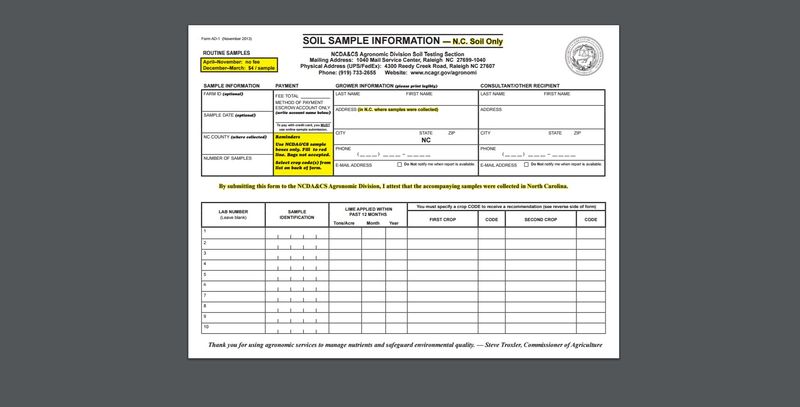
Receiving a soil test report with lime and fertilizer recommendations on the same page can make it tempting to treat them as a single to-do list with the same deadline. They are not.
Lime and fertilizer behave differently in soil, and applying them on the wrong schedule can waste money or delay the correction you actually need.
Lime is slow. Once spread and incorporated, it begins reacting with soil acidity gradually, and that process works best when the material has time to move through the soil before roots arrive.
NCDA&CS advises applying and mixing lime into the soil before planting when the report calls for it, precisely because the reaction is not immediate. Apply it when the report recommends it, incorporate it well, and let time do the chemistry.
Fertilizer timing is a separate question. NCDA&CS specifically notes that some late-fall fertilizer recommendations, such as those for shrubbery tested in November, are intended for spring application rather than winter.
Applying nitrogen-containing fertilizer to dormant or near-dormant plants in late fall can result in nutrient loss before roots are active enough to use it.
Two common shortcuts are worth avoiding. A handheld pH meter or inexpensive test kit may give you a rough pH reading, but NC State’s liming guidance explains that pH alone is not sufficient for an accurate lime recommendation.
Exchangeable acidity and the crop’s target pH both factor into the correct lime rate, and a single meter reading cannot capture either. Gypsum is another product sometimes suggested as a lime alternative.
NC State’s vegetable handbook and NCDA&CS both clarify that gypsum supplies calcium and sulfate, which can be useful in specific situations, but it does not neutralize soil acidity and cannot substitute for lime when the report calls for a pH correction. Follow the report’s timing guidance for each amendment type, and you will get the correction the test was designed to deliver.
What the soil test cannot tell you
Knowing the limits of the test is as useful as knowing what it measures. Gardeners who expect a soil test to explain every case of poor plant performance will sometimes be disappointed, and understanding where the test’s reach ends helps you look in the right direction when fertility is not the problem.
Standard NCDA&CS agronomic testing does not measure plant-available nitrogen as a complete seasonal management answer, because nitrogen moves and changes in soil too quickly for a single snapshot to capture the full seasonal picture. NCDA&CS describes the test as a fertility management tool, not a whole-garden diagnostic.
A 2024 NCDA&CS press release on soil sampling reinforces that the agronomic soil test does not screen for pesticides or other contaminants. The NCDA&CS Orange Book identifies physical conditions, drainage, compaction, diseases, insects, nematodes, weather, and other factors as separate limits on plant performance that soil fertility data cannot address.
Organic matter is a related area worth treating carefully. Adding well-rotted compost or leaves to sandy or heavy clay soil can improve structure, water retention, and biological activity over time.
NC State’s organic gardening handbook supports repeated organic matter additions as a long-term soil improvement strategy. But compost is not a universal fix.
NC State’s soil modification guidance notes that organic materials vary in nutrient content and do not automatically correct pH, excess phosphorus, drainage problems, or compaction. NC State’s nutrient management best practices further caution that compost and manure can add phosphorus to soils that already have enough.
If your beds show satisfactory fertility on the report but plants still struggle, the next logical step is to look at drainage, root space, pest pressure, or disease rather than adding more amendments.
Use the report again instead of restarting the guesswork
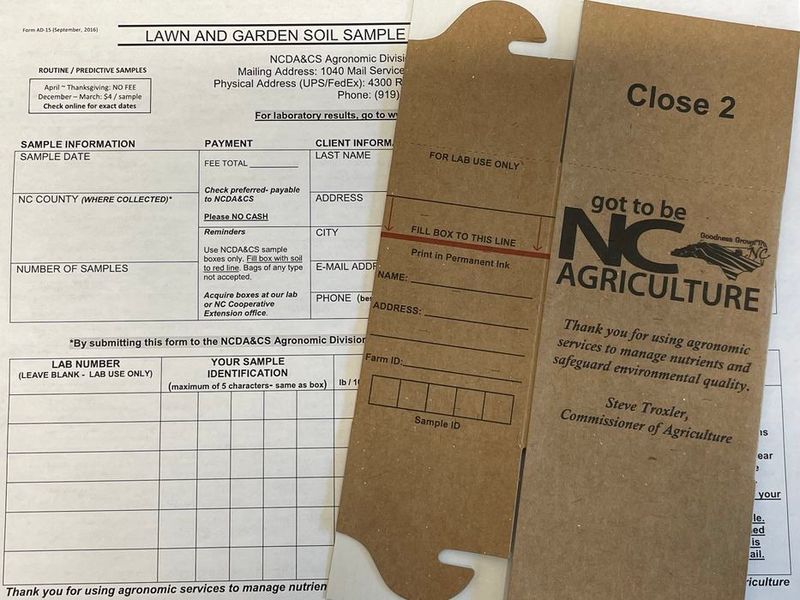
A soil test works best when it becomes part of a repeatable habit rather than a one-time fix. The process is straightforward each time: separate unlike areas into their own samples, collect 15 to 20 representative cores from each, submit with the correct crop code, and wait for the NCDA&CS recommendations before reaching for lime or fertilizer.
When the report arrives, apply lime only when it is recommended and early enough for the material to react before planting. Follow crop-specific fertilizer timing rather than applying everything immediately.
NCDA&CS gives a general retesting interval of every two to three years for sandy soils and every three to four years for clay soils, though additional tests make sense after major amendments or when something unexpected happens in a bed. NC State’s soils and plant nutrients handbook similarly recommends retesting every two to three years for home gardens.
These are general guidelines, not fixed rules for every situation.
NC State’s sampling guidance is a useful reference to revisit before each round of testing, especially if bed boundaries or planting uses have changed since the last submission. The test does not promise a perfect garden or solve an imminent fall planting deadline where lime has no time to react.
What it reliably delivers is a clear answer on fertility, so that when plants still struggle after the numbers look right, you know exactly where to look next.