
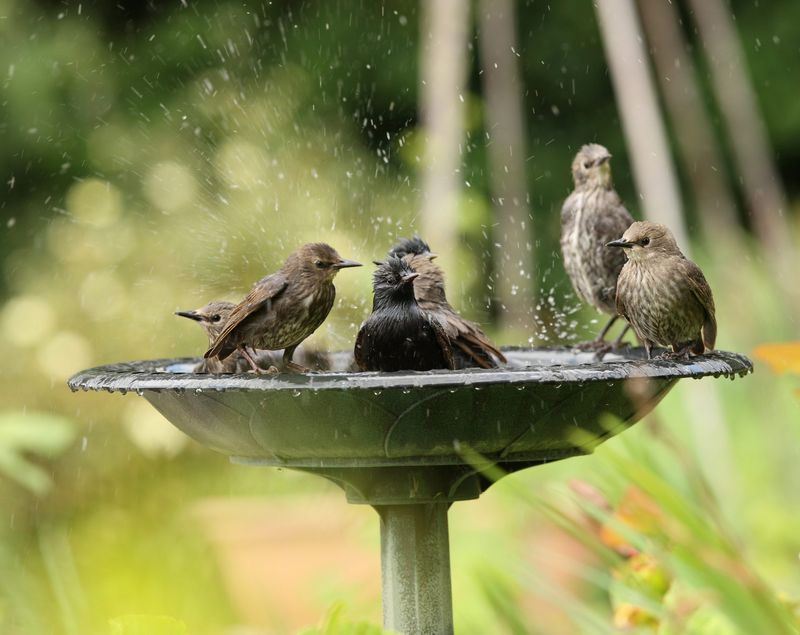
Late summer in California can push daytime temperatures well past 100 degrees for days at a stretch, and the birds visiting your yard feel every degree of it. A carefully maintained, shallow water source can help some species drink, bathe, and stay active when natural water becomes hard to find, though it is not a guaranteed fix and is not appropriate for every yard.
Knowing how to set one up, where to place it, and when to skip it altogether is what separates a genuinely useful addition from one that creates new problems.
Why dependable water can matter during California’s dry heat
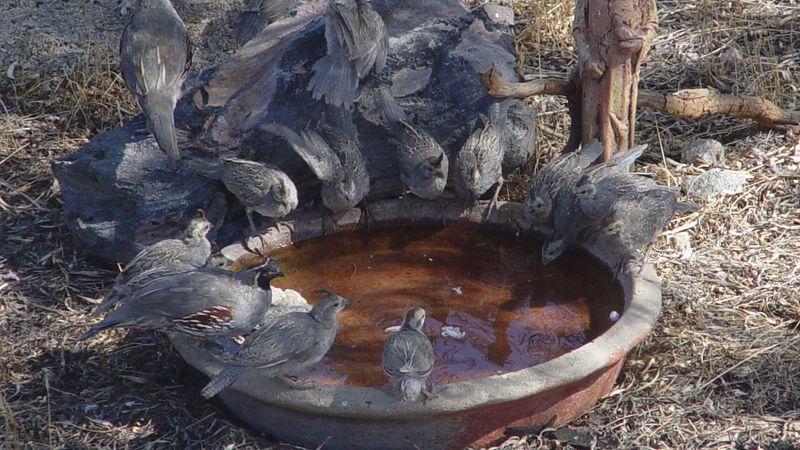
California’s late-summer heat does not affect all birds equally, and it does not affect all yards the same way either. Temperatures that exceed 100 degrees Fahrenheit for several consecutive days are common across inland valleys, the Central Valley, and parts of Southern California, and Audubon’s overview of heat waves and birds notes that extreme heat can push species to seek water and shade more urgently than usual.
That urgency matters most when the landscape around your home has already dried out.
Streams, vernal pools, and seasonal wetlands that hold water in spring often shrink or disappear by August. USGS projections on water management and wetland loss indicate that urban development and prolonged drought are already reducing freshwater availability across parts of the state.
For birds that rely on those sources, the gap between what the landscape once offered and what it offers in a dry August can be significant.
That said, suburban yards are not uniformly water-free. Irrigation runoff, decorative ponds, swimming pools, and roof gutters can all hold water, but most of those sources are not clean, shallow, or accessible in ways that serve small birds safely.
A pool edge is slippery and steep. A gutter holds standing water that quickly becomes foul.
Research on bird water use in hot environments suggests that what matters is not just the presence of water but whether it is reliably available, shallow enough to wade, and clean enough to use without risk. Some landscaped yards may lack that kind of dependable, accessible source, which is a narrower and more accurate claim than saying most yards are missing water altogether.
Bird species also vary considerably in how much water they need and where they get it. Seed eaters tend to drink more than insect eaters, which obtain moisture from their food.
Hummingbirds get water from nectar. Published research on avian heat tolerance confirms that water needs differ by species, body size, diet, and the temperatures a bird is already adapted to.
No single intervention, including a birdbath, addresses all of those variables at once.
How drinking and bathing can help birds handle heat
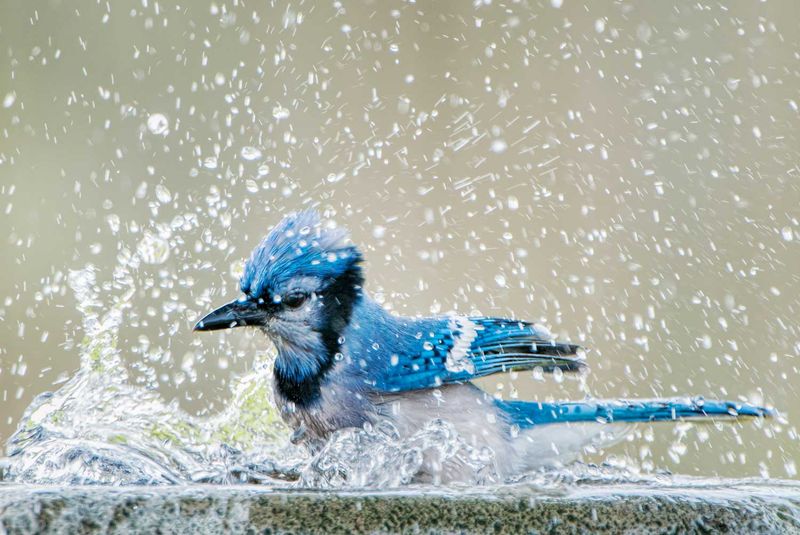
Birds do not sweat, so they manage heat through a combination of behaviors and physiological responses that look quite different from how humans cool down. On a hot afternoon, you might spot a bird panting rapidly with its bill open, holding its wings slightly away from its body, or seeking shade under a dense shrub.
These are not signs of distress alone; they are active cooling strategies. Audubon’s explanation of bird cooling behavior describes how rapid breathing, called gular fluttering in some species, moves air across moist tissue in the throat and helps release heat through evaporation.
Water plays a supporting role in several of these strategies. Drinking replaces fluids lost through panting and normal activity.
Bathing wets the feathers and skin, which can increase evaporative cooling when a bird returns to the shade and preens. Splashing and wing spreading in shallow water may help transfer heat away from the body surface more quickly than shade alone.
Audubon’s heat-wave guidance for bird supporters recommends keeping birdbaths filled and clean precisely because bathing and drinking together may help birds cope during periods of extreme heat.
Peer-reviewed work adds useful context. A review of bird responses to thermal stress found that access to water can help some species maintain body temperature and continue foraging during hot conditions, though the benefit varied considerably by species and habitat.
Birds that already live in hot, arid regions are often better physiologically equipped to manage heat than species from cooler coastal zones suddenly exposed to an inland heat event. A scrub-jay in a Sacramento suburb during a heat dome and a lesser goldfinch on the coast during a mild August warm spell are not in the same situation.
Additional research on shade and thermal load in birds indicates that shade reduces the amount of radiant heat a bird absorbs, which lowers the cooling work the bird’s body must do. Water and shade together offer more relief than either does alone.
What the research does not support is a claim that a backyard birdbath prevents heat deaths or guarantees that birds visiting it will survive a multi-day heat wave. The benefit is real for some birds in some circumstances, and that is a meaningful reason to offer a well-maintained source while being honest about its limits.
Build a shallow basin birds can use safely
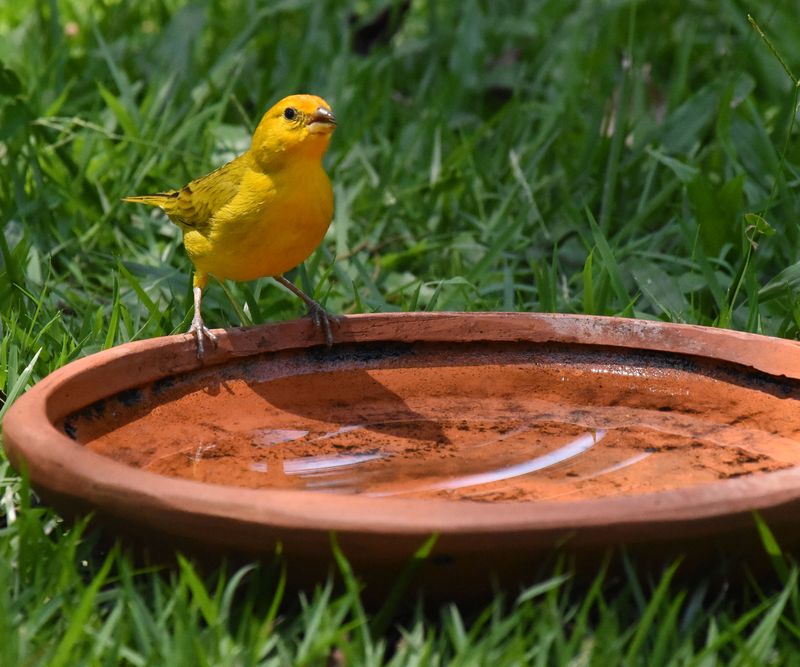
The most common mistake with birdbaths is choosing one that looks attractive to humans but works poorly for birds. Deep, steep-sided basins are the main culprit.
A small bird like a white-crowned sparrow or a house finch cannot safely enter water that is three or four inches deep, and a slippery glazed surface gives it nowhere to grip. The result is a basin that birds approach, hesitate at, and leave without bathing or drinking.
Cornell Lab’s birdbath guidance recommends keeping water about 1 inch deep at the edges and no more than roughly 2 inches in the center. Audubon’s instructions for building a birdbath suggest a pan or tray no deeper than 2 inches, with water sitting around 1 to 1.5 inches deep.
Both organizations point out that the slope matters as much as the depth: a gently sloping basin lets birds wade in from the shallow edge and stop when the water reaches a comfortable level, rather than stepping off a ledge into water that is suddenly too deep.
If your existing basin is deeper than that, flat stones, smooth river pebbles, or short sections of branch placed inside can raise the floor and give birds a stable landing surface. Aim for footing that does not shift or roll when a bird lands on it.
Textured ceramic, rough concrete, or a basin with a naturally pebbled bottom all work better than smooth glazed finishes that become slippery when wet.
Drippers, misters, and small recirculating pumps are worth considering because moving water attracts birds more reliably than still water. The sound of dripping carries further than a silent basin, and the movement on the surface catches light in ways that stationary water does not.
These additions do not change the depth and footing requirements, though. A dripper over a steep-sided, slippery basin is still a basin that most small birds cannot use safely.
Get the container right first, then add movement if you want to.
Any shallow dish, terracotta plant saucer, or purpose-built pan can work as long as it meets the depth and footing requirements. Expensive decorative baths are not necessary.
What matters is that a bird can stand in the water, find stable footing at the edge, and leave the basin without struggling.
Choose a shaded site with clear escape routes
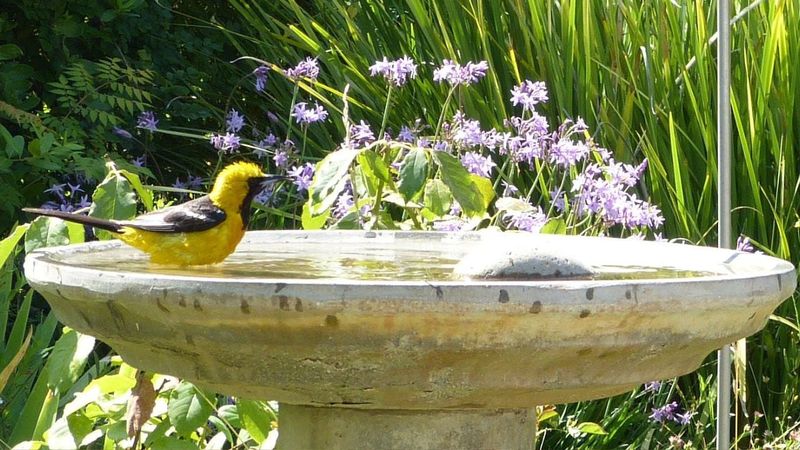
Placement decisions affect whether birds actually use a basin and whether using it puts them at risk. Shade is the first priority during a California heat wave.
A basin sitting in full afternoon sun in July can warm to temperatures that are uncomfortable or even harmful for birds to bathe in, and the water evaporates fast enough that a basin filled in the morning may be nearly empty by noon. Partial or full shade from a tree, an eave, or a pergola slows both problems without eliminating them.
Cornell Lab’s placement advice and BirdNote’s supplemental water guidance both emphasize that shade should come from overhead or from the east and west rather than from dense shrubs at ground level. That distinction matters because dense shrubs at ground level are exactly where cats and other predators wait.
A bird focused on bathing is distracted and slower to react than one that is simply foraging. If a cat can crouch within a foot or two of the basin, concealed by thick vegetation, the bath becomes a trap rather than a resource.
Leave open ground between the basin and any dense cover. Cornell specifically recommends positioning a birdbath so that birds have a clear view in multiple directions and can fly to safety quickly if something approaches.
A distance of at least several feet between the basin and the nearest shrub or fence line gives birds time to detect and respond to a threat. Nearby branches, fence rails, or open shrubs that offer perching without concealment are fine and actually useful, since birds often wait their turn or preen after bathing from a low perch close to the water.
Audubon’s heat-wave bird support guidance also notes that nearby vegetation can provide shelter and shade, reinforcing that the goal is open-canopy shade rather than dense ground-level cover. A basin under a native oak or a deciduous fruit tree, set back from the fence line and visible from a kitchen window, hits most of these requirements at once and gives you an easy way to monitor whether it is being used and whether it needs refilling.
Regular upkeep keeps the basin usable and lowers avoidable risks
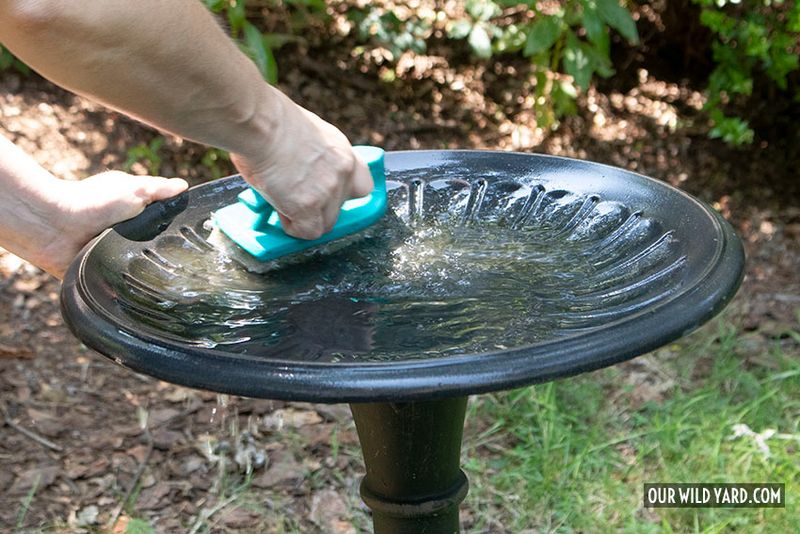
A birdbath that is not actively maintained creates its own set of problems. Standing water in a warm basin can become a mosquito breeding site within days.
Droppings, algae, and feather debris foul the water quickly when a basin is heavily used, and a bird that drinks from fouled water faces a different kind of risk than one that goes without. Maintenance is not optional; it is the part of the recommendation that determines whether the basin actually helps.
During a heat wave, the most conservative routine is to empty and refill the basin every day, especially after heavy bird activity or visible contamination. California Native Plant Society’s biodiversity garden guidance recommends daily emptying and refilling as standard practice for hot-weather birdbaths.
Cornell Lab suggests changing the water every day or two, while Audubon’s general guidance allows every two or three days under cooler or lower-use conditions. For late-summer California heat, daily replacement is the more appropriate target.
Emptying the water is not the same as cleaning the basin. Scrubbing matters separately.
CDFW’s wildlife disease guidance recommends cleaning birdbaths outdoors at least once a week and more often when use is heavy, and it advises wearing gloves and washing hands thoroughly afterward. When a basin develops a slimy film, visible algae, or droppings on the surface or edges, scrub it immediately rather than waiting for the scheduled cleaning day.
A stiff brush, water, and thorough rinsing remove most biological material without leaving chemical residue that could harm birds.
Some sources suggest a diluted vinegar solution as a scrubbing aid. Vinegar can help loosen mineral deposits and organic buildup, but CDFW’s Wildlife Health Lab cautions that rigorous cleaning reduces but cannot guarantee elimination of all pathogen transmission at shared water sources.
Treat regular scrubbing as a meaningful risk-reduction step, not a complete disinfection solution.
Mosquito risk is a related concern. CDC guidance on home mosquito control recommends emptying and scrubbing birdbaths and other water-holding containers at least once a week, and CDC West Nile virus surveillance guidelines identify standing water in containers as a primary mosquito breeding environment.
Daily water changes during hot weather are more protective than weekly ones because mosquitoes can complete early larval development in less than a week under warm conditions. Dumping and refilling breaks that cycle before it completes.
California health guidance makes birdbaths a conditional choice
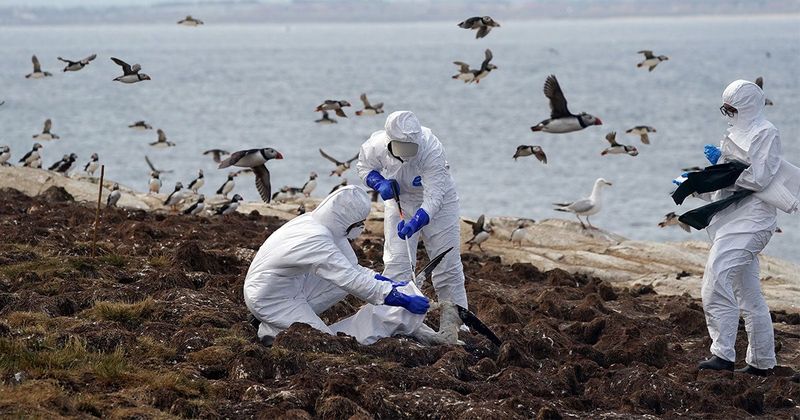
General bird-feeding and birdbath advice written for national audiences does not always account for California’s specific public-health context. The California Department of Fish and Wildlife takes a more cautious position than most birding organizations, and that position deserves direct attention rather than a footnote.
CDFW’s Wildlife Health Lab currently advises against providing artificial food or water to wild birds because shared baths and feeders can concentrate birds, fecal material, and pathogens in one location. When many birds use the same water source, the risk of pathogen transfer between individuals increases, even when the basin looks clean.
Diseases including trichomonosis, pigeon paramyxovirus, and others can persist in water, soil, or on basin surfaces for hours to days. Cleaning and daily water changes reduce that risk meaningfully, but they do not eliminate it entirely.
The caution becomes a firm recommendation for anyone with backyard poultry or captive birds. CDFW’s highly pathogenic avian influenza monitoring guidance discourages birdbaths and feeders at properties where chickens, ducks, geese, pigeons, doves, parrots, or other captive birds are kept.
Wild birds visiting a shared water source can carry pathogens that captive birds have no immunity to, and the consequences can be severe. If you have backyard poultry or pet birds that spend time outdoors, remove or avoid installing a shared birdbath, and take active steps to prevent wild birds from reaching your domestic birds’ food and water.
For homeowners without captive birds, the decision still requires honest self-assessment. CDFW’s additional wildlife disease resource page frames shared water sources as a conditional tool rather than a universal good.
Ask yourself whether you can realistically maintain daily water changes during a heat wave, whether your yard currently has a predator or disease concern that makes concentrating birds inadvisable, and whether local wildlife health alerts suggest pausing supplemental feeding or water. A birdbath that receives inconsistent maintenance or sits in a yard with active disease pressure is not a neutral choice; it can make conditions worse for the birds it is meant to help.
None of this means a well-maintained birdbath is dangerous in every California yard. It means the decision should be made deliberately, with the CDFW’s current guidance in view, rather than assumed to be universally beneficial.
Pair water with shade, native plants, and natural habitat
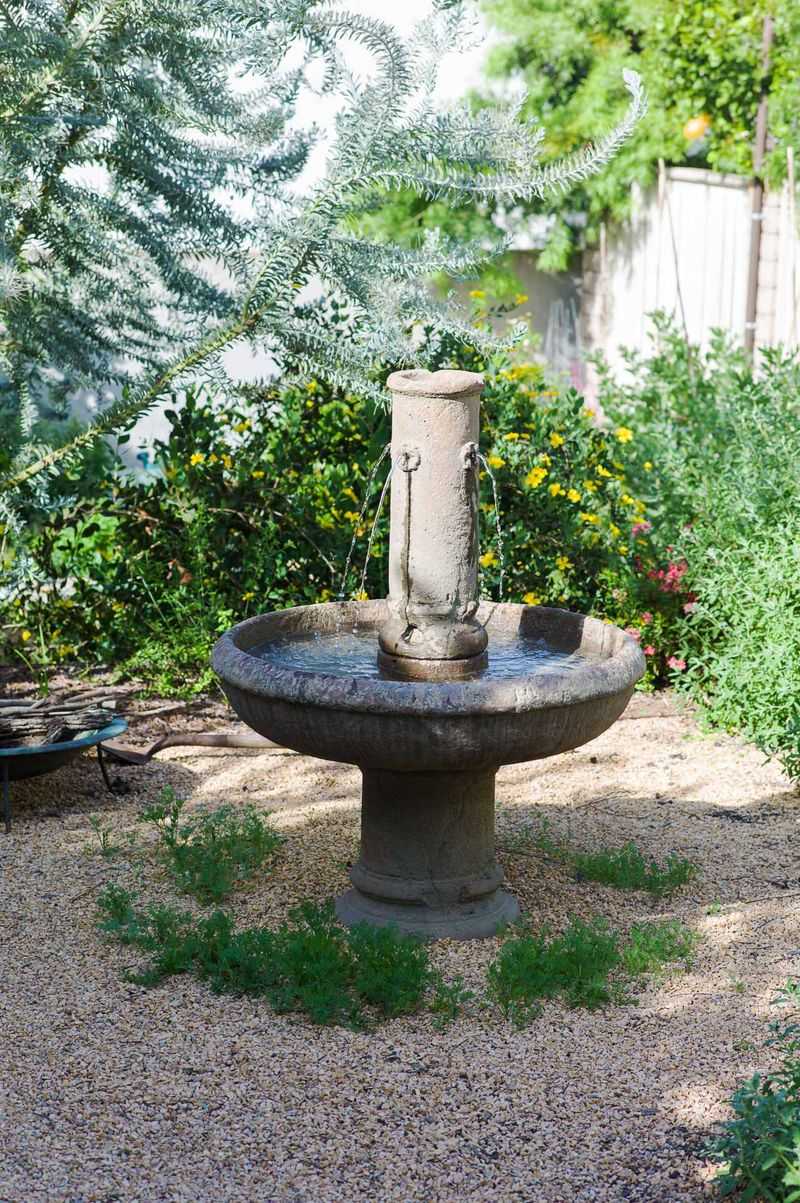
A birdbath does one thing well: it offers a spot to drink and bathe. Birds need considerably more than that to thrive through a long California summer, and a basin sitting in an otherwise bare or heavily manicured yard will attract far fewer birds and provide far less value than one surrounded by appropriate habitat.
Native trees and shrubs are the foundation that water alone cannot replace. California Native Plant Society’s habitat gardening guidance explains that locally native plants provide nesting structure, insect food sources, and seasonal fruits and seeds that a birdbath simply cannot offer.
A coast live oak, a toyon, or a native elderberry supports dozens of insect species that in turn feed nestlings and adults. Audubon California’s wildlife-friendly garden recommendations reinforce that the combination of native plants, water, and shelter creates habitat, while any single element in isolation produces limited results.
Shade from established native trees also does something a birdbath cannot: it reduces the air and surface temperature in the immediate area, which lowers the thermal burden on birds resting or foraging nearby. Research on shade and thermal load in birds found that canopy shade meaningfully reduces the radiant heat a bird absorbs, which reduces the amount of cooling work the bird’s physiology must perform.
A birdbath in a shaded native garden gives birds both a resource and a cooler microclimate to recover in.
CNPS plant-selection guidance notes that native species suited to your local climate zone generally require less irrigation once established, which matters for California homeowners navigating water restrictions. Choosing plants that serve birds and fit your water budget is not a compromise; it is the most practical version of a wildlife-friendly yard.
Water from a birdbath complements that landscape rather than substituting for it.
Use this checklist to decide whether a birdbath fits your yard
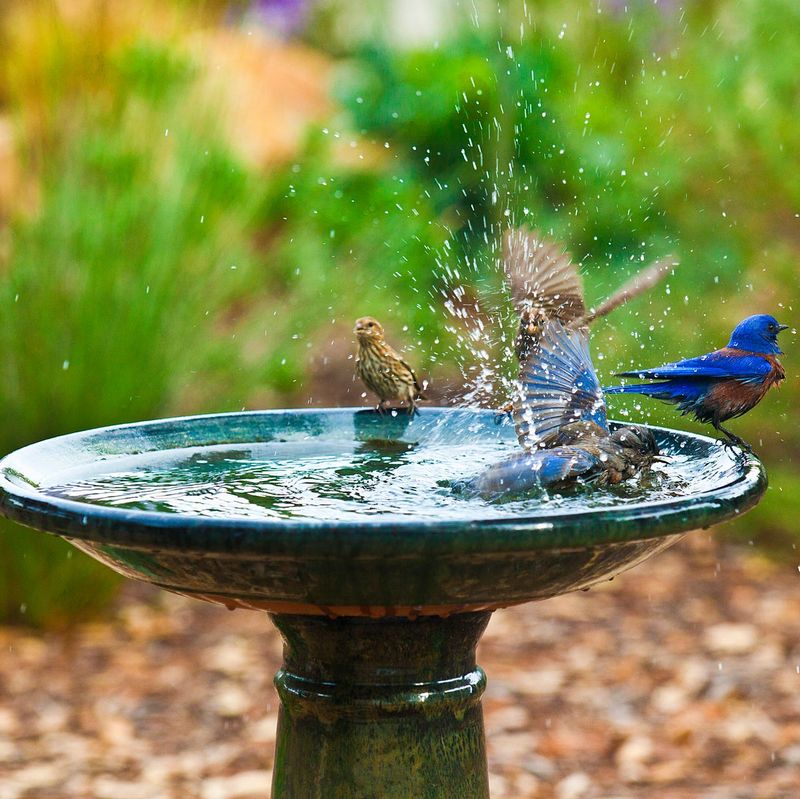
Before adding a shared water source, run through these questions. Each one corresponds to a real condition that affects whether a birdbath helps or creates a new problem.
Choose a basin that is shallow enough for small birds to use: about 1 inch deep at the edges and no more than roughly 2 inches in the center. Add flat stones or pebbles for stable footing.
Cornell Lab’s birdbath setup guidance covers both requirements clearly. Place the basin in shade with open ground around it so birds can see approaching threats and escape.
During a heat wave, empty and refill the water every day, scrub the basin at least weekly, and clean it immediately any time it becomes slimy or fouled.
If you have chickens, ducks, pigeons, parrots, or any other captive birds on your property, skip the shared birdbath. CDFW’s Wildlife Health Lab guidance is direct on this point, and the risk to domestic birds is not worth the benefit to wild visitors.
If you cannot commit to daily water changes during hot stretches, remove the basin rather than leaving stale water out. A neglected birdbath is worse than none at all.
A well-chosen, well-placed, and well-maintained water source may support some birds through California’s harshest late-summer heat, but it works best as part of a yard that already offers shade, native plants, and safe cover. Audubon’s heat-wave bird guidance frames it the same way: water is one useful piece, not the whole answer.
The most durable thing you can do for backyard birds is build the habitat around the basin, not just fill the basin.