

If you’ve heard that crape myrtles need a hard cutback before fall to bloom well next year, that advice is worth a second look. North Carolina homeowners can actually do more harm than good by reaching for the pruning saw in late summer.
The safe move right now is a quick inspection and light cleanup, not a dramatic reduction. Understanding the difference between what helps and what hurts will keep your crape myrtle healthy all the way through next summer’s bloom season.
The Pre-Fall Pruning Deadline Is a Myth
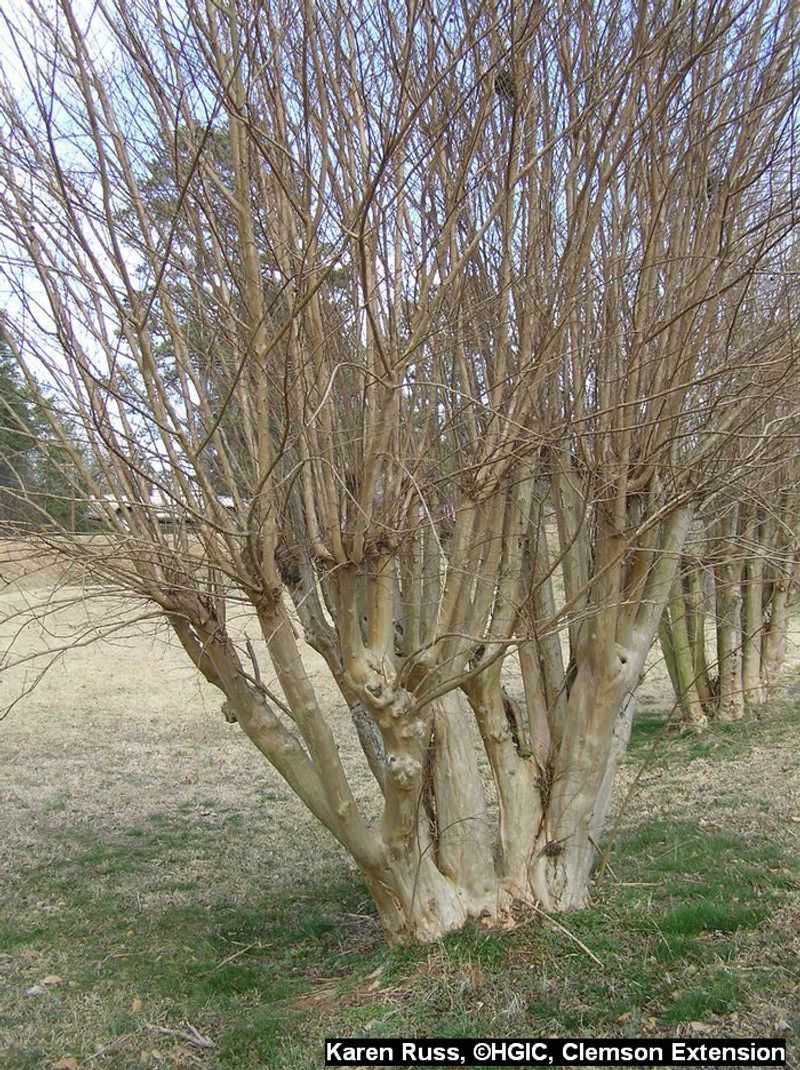
Crape myrtles are tough, adaptable plants, but one of the most persistent pieces of bad advice surrounding them is the idea that you must cut them back before fall arrives or next year’s flowers will suffer. That claim does not hold up.
NC State Extension guidance on woody ornamentals lists crape myrtle among plants best pruned before spring growth resumes, pointing to late winter rather than late summer as the practical window for structural cuts.
The reason the fall deadline feels urgent is a misunderstanding of how crape myrtles flower. These plants produce blooms on new growth that develops each spring and summer, which means the plant does not need pruning to generate flowering wood.
An unpruned or lightly pruned crape myrtle growing in good conditions will bloom on its own. Missing a supposed August cutback is not itself a demonstrated cause of reduced flowers.
What heavy late-summer or early-fall pruning can do is push the plant in the wrong direction. Aggressive cuts in August can stimulate a flush of soft, tender new growth at a time when the plant should be gradually preparing for cooler temperatures.
NC State guidance on preparing plants for winter explains that late-season growth stimulation can delay dormancy and leave new shoots more vulnerable to frost damage. That is the real risk, not a missed pruning deadline.
The right response in late summer is an inspection paired with targeted cleanup. Remove only what is clearly dead, damaged, diseased, or structurally problematic, and leave healthy growth alone.
UGA Cooperative Extension’s crape myrtle culture guide confirms that pruning is not required for flowering and that plants can bloom normally when growing conditions are suitable. That is reassuring news for anyone who has worried about missing a window that was never real to begin with.
What to Remove During a Late-Summer Inspection
Late summer is a good time to walk around your crape myrtle and look carefully at what is actually there. You are not trying to reshape the plant or reduce its size.
The goal is to find and remove a short list of specific problems before the season ends.
Start with dead or broken wood. A branch that snapped in a summer storm or dried out weeks ago is not going to recover, and removing it now is straightforward and low-risk.
Next, look for branches that rub against each other or cross through the canopy in ways that create friction wounds. UGA Extension’s crape myrtle culture guide includes rubbing and crossing branches, along with inward-growing wood, on the list of candidates for removal during a corrective inspection.
Inward-growing branches push against the natural canopy structure and can crowd airflow over time.
Check the base of the plant for suckers, which are vigorous shoots sprouting from the roots or the lower trunk below the main branching structure. Suckers compete with the main plant for resources and, if left alone, can muddy the plant’s form over several seasons.
Removing them now while they are young takes only a snip. NC State’s general pruning techniques guidance supports removing this type of unwanted basal growth as part of routine corrective care.
Leave everything else alone. Healthy branches, ordinary seedheads, and green foliage that looks fine should stay right where they are.
UGA Extension’s “Crape Murder” article draws a clear line between targeted corrective removal and wholesale canopy reduction. Removing a damaged limb or a cluster of suckers is a different action entirely from reshaping or cutting back the entire plant, and keeping that distinction in mind will protect you from doing more than the plant actually needs right now.
How to Make Safe Corrective Cuts
Good technique matters even when you are only making a few small cuts. Sharp, clean tools are the starting point.
A dull blade tears plant tissue instead of cutting cleanly, and rough wounds take longer to close. Bypass pruners work well for smaller branches, while a pruning saw handles anything thicker than your thumb comfortably.
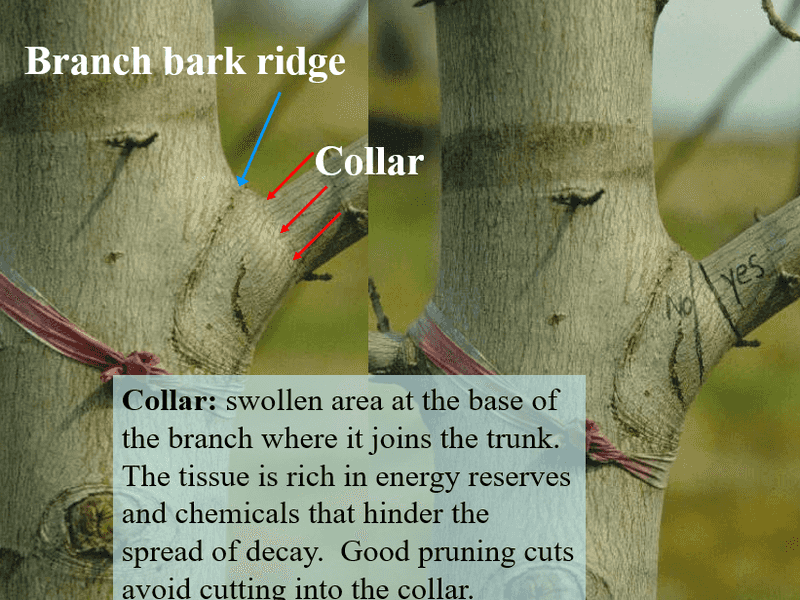
Every removal cut should land just outside the branch collar, which is the slightly swollen ring of tissue where a branch meets the trunk or a larger limb. NC State’s general pruning techniques guide explains that the collar contains protective tissue that helps the wound seal over time.
Cutting flush against the trunk removes that tissue and slows the plant’s natural response. Leaving a long stub past the collar creates a dead zone that can dry out, invite decay, and linger without closing properly.
The cut itself should be clean and angled slightly so water sheds away from the wound rather than pooling on a flat surface. You do not need to apply wound sealant or pruning paint.
NC State’s woody ornamentals handbook does not recommend wound dressings as a standard practice, and current guidance generally holds that they do not improve healing and can sometimes trap moisture.
When you are removing material that shows signs of disease, tool sanitation becomes important. Wipe or dip your blades between cuts using a disinfectant solution, or switch to a clean pair of pruners between plants.
UGA Extension pruning guidance and UGA’s Shades of Green newsletter both note that disinfecting tools helps prevent spreading pathogens from one cut or plant to the next. A quick wipe takes seconds and can prevent a localized problem from traveling through the rest of your yard.
Use Disease Cleanup Only When Disease Is Present
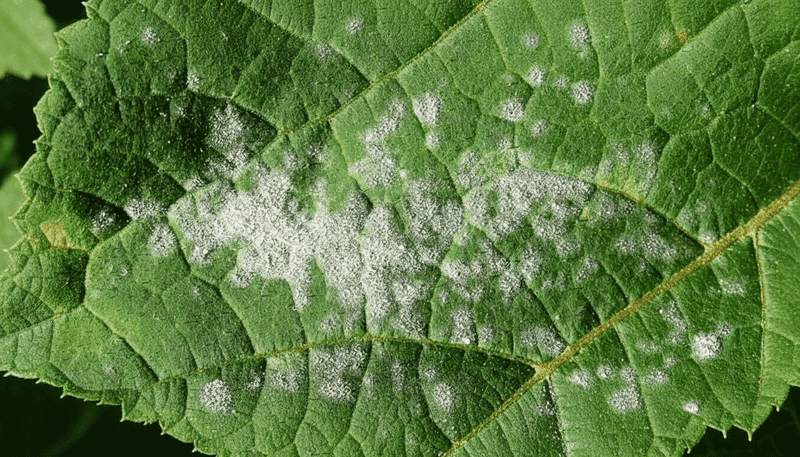
Raking up fallen foliage and removing affected branches makes sense when you can actually see a disease problem. Powdery mildew is one of the more common fungal issues on crape myrtles, showing up as a white or grayish coating on leaves, young shoots, and flower buds during warm, humid weather.
UGA Extension’s guidance on powdery mildew on ornamentals recommends removing affected plant material when appropriate and cleaning up fallen diseased litter to reduce the spore load that can carry over to the following season.
That is legitimate disease management, but notice what it is not. Removing diseased foliage addresses a fungal pressure that is already present.
It does not guarantee a stronger bloom display next year, and it is not a substitute for the other factors that affect flowering, including sunlight, water, and overall plant health. If your crape myrtle does not have visible signs of powdery mildew or another foliage disease, routine fall leaf cleanup is not a required bloom-protection step.
A separate and distinct problem is crape myrtle bark scale, an invasive insect pest that attaches to bark and produces sticky honeydew. That honeydew feeds a black sooty mold that can coat branches and leaves and give the plant a grimy, darkened appearance.
NC State Extension’s bark scale management guide for homeowners makes clear that this is a pest identification and treatment situation, not a pruning situation. Cutting the plant back does not resolve a bark scale infestation.
If you notice white waxy masses on the bark combined with black sooty mold, identify the pest correctly and follow appropriate management steps rather than reaching for the pruning saw.
Why Topping Creates More Work
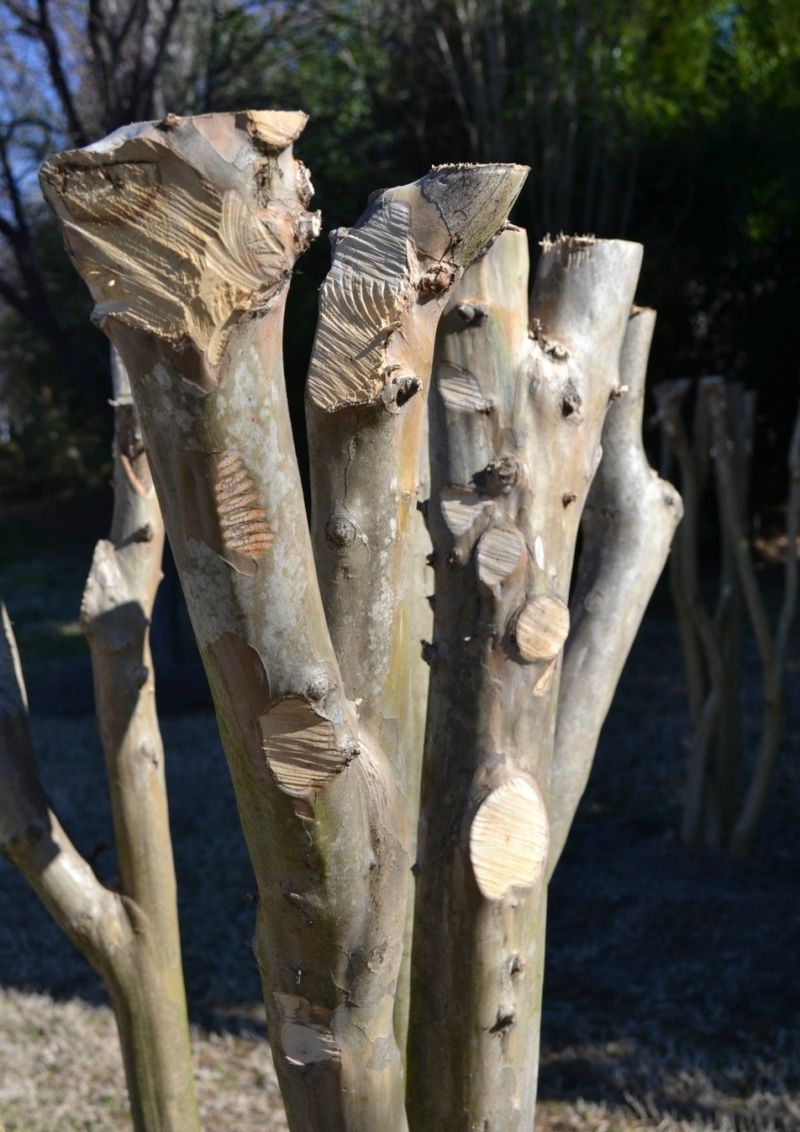
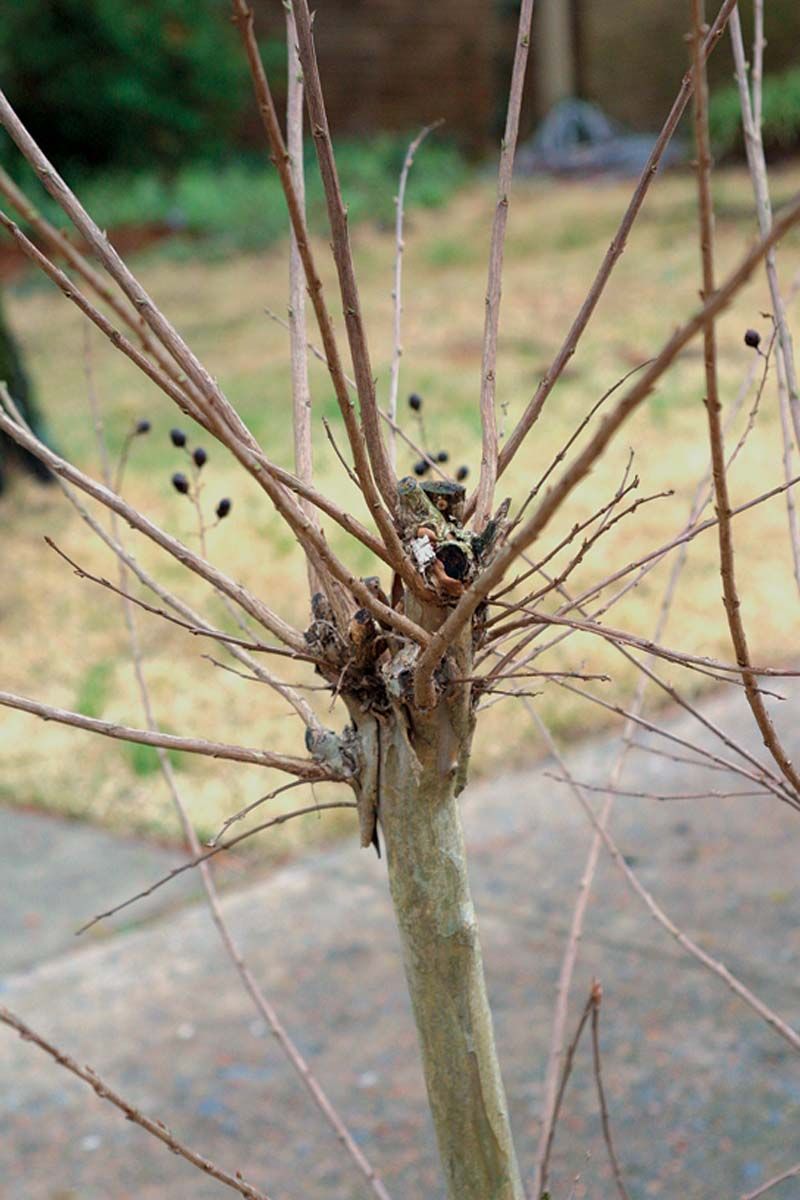
Topping, which means cutting major stems back to uniform stubs several feet above the ground, is one of the most common crape myrtle mistakes in North Carolina neighborhoods. The results are familiar: thick, rounded knobs at the cut points, a ring of fast-growing but weakly attached shoots sprouting from each stub every spring, and a plant that looks unnatural for most of the year.
Many homeowners top their crape myrtles annually, not realizing the practice creates the very maintenance problem they are trying to solve.
The structural consequences go beyond appearance. UGA Extension’s crape myrtle culture guide links topping to large wounds, decay risk, and vigorous sucker and water-sprout growth that must be managed repeatedly.
The shoots that emerge from the stubs grow quickly but attach weakly, making them more likely to break in storms than branches that developed naturally from the plant’s framework. Over time, the knobby stubs enlarge with each year’s regrowth, and the plant never regains a clean form.
NC State’s pruning techniques guidance distinguishes this kind of severe reduction from selective removal of a single damaged or badly placed branch. Those are not the same action, and the outcomes are not comparable.
Removing one crossing branch that is rubbing against a healthy limb is a targeted correction. Cutting every major stem to the same height is a wholesale reset with documented downsides.
Crape myrtles are tough plants and most topped specimens continue to bloom, which is part of why the practice persists. UGA Extension’s “Crape Murder” piece notes that toughness does not make topping sound horticultural practice.
A plant that blooms despite repeated topping would likely bloom just as well, with far less maintenance and a much better natural form, if left to grow with only the selective corrections it actually needs.
Schedule Structural Pruning for Late Winter
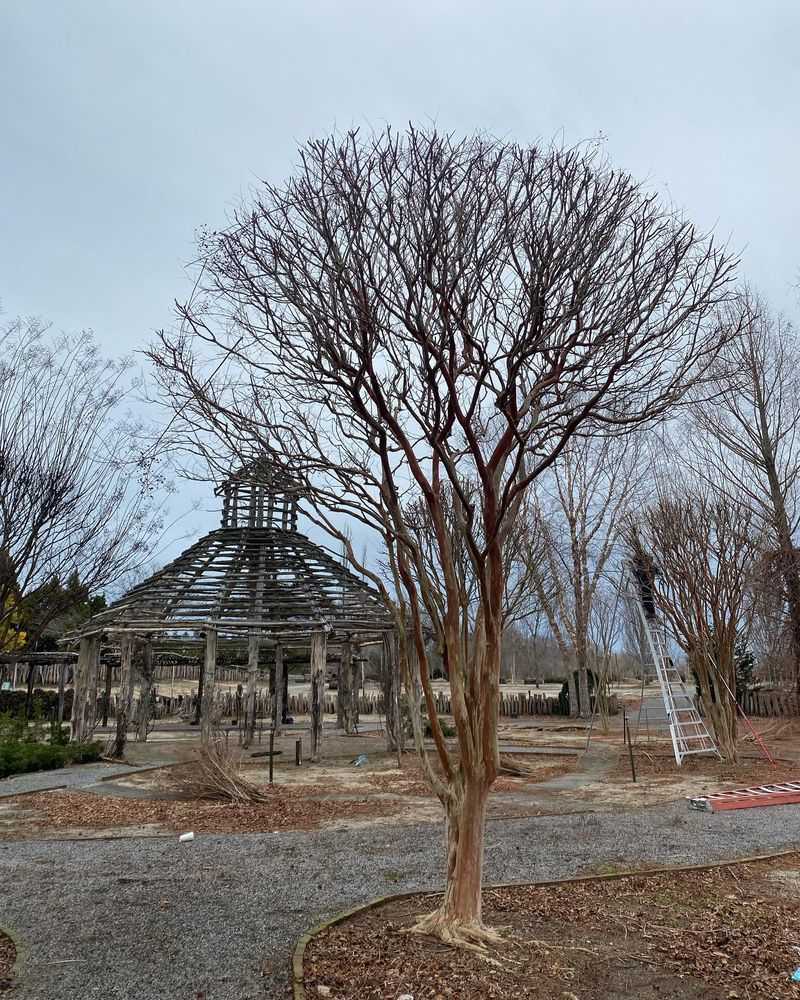
Some crape myrtles genuinely need structural work, whether to remove a branch growing in the wrong direction, to open up the canopy, or to address a size problem that light cleanup cannot solve. The right time for that work is late winter, after the coldest weather has passed but before bud break or new growth begins.
That window gives the plant a chance to respond to pruning cuts as it moves into the active growing season rather than heading into dormancy with fresh wounds and, potentially, stimulated new growth.
NC State Extension’s woody ornamentals handbook lists crape myrtle among plants to prune before spring growth resumes, and UGA Extension’s guide to pruning ornamental plants aligns with late winter or early spring as the preferred period for summer-flowering shrubs and trees when pruning is needed for size or structure.
North Carolina does not have a single universal late-winter date that works from the mountains to the Coastal Plain. A homeowner in Asheville faces meaningfully different frost risk and spring onset timing than a homeowner in Wilmington.
NC State’s winter preparation guidance acknowledges that elevation and local weather create real differences across the state. In the mountains, late-season pruning is especially risky because frost can arrive earlier and linger longer, making the case for waiting until late winter even stronger.
The practical rule across all three regions is the same: wait until the coldest weather is behind you and prune before new growth starts.
NC State’s general pruning techniques resource reinforces that selective structural cuts, not a default severe reduction, are the goal. Identify the specific branches that are causing a real problem, remove only those, and let the rest of the plant’s natural structure stand.
That approach protects the plant’s form and keeps maintenance demands low season after season.
Look Beyond the Pruning Saw for Bloom Problems

Pruning gets most of the attention in crape myrtle conversations, but the saw is not what drives a strong bloom display. UGA Extension’s crape myrtle culture guide identifies sunlight as one of the most important factors: crape myrtles perform best with full sun, and plants growing in significant shade typically produce fewer flowers regardless of how or when they are pruned.
If your plant is sitting under a dense tree canopy or crowded by structures that block afternoon light, that is a more likely explanation for thin flowering than a missed pruning date.
Adequate moisture during the growing season also matters. Drought stress during bud development and flowering can reduce bloom quantity and cause early flower drop.
Cultivar selection plays a role too, since some varieties are naturally heavier bloomers than others, and a cultivar that has outgrown its space may struggle in ways that pruning alone cannot fix.
Spent seedheads are another area where homeowners sometimes feel pressure to act. Those dried seed clusters at the ends of branches are harmless.
UGA Extension’s ornamental pruning guide notes that removing spent flower clusters after they fade can sometimes encourage a second flush of blooms in late summer, but the response depends on the cultivar and on timing. Cultivars that finish flowering after mid-July are less likely to rebloom even with deadheading.
Seedheads that remain on the plant through fall are considered an ornamental feature by some extension specialists, and they generally drop away as spring growth develops. Leaving them alone is a perfectly reasonable choice.
The seasonal sequence that actually protects next year’s display is straightforward: inspect and clean up only what needs attention now, support the plant with appropriate water and sunlight through the remainder of the season, and reassess structure in late winter before new growth begins.
The Safe North Carolina Plan
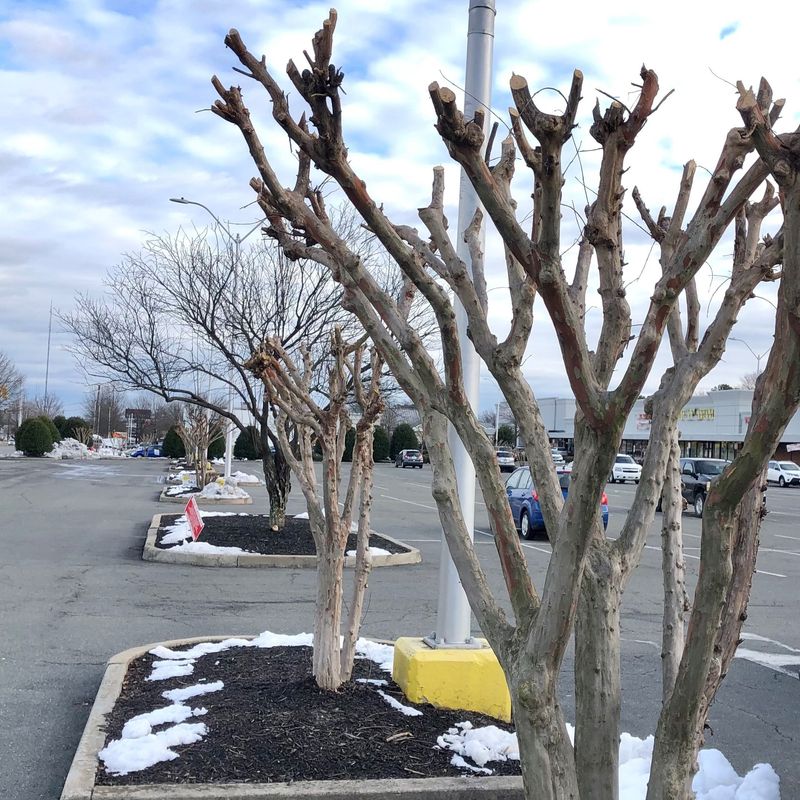
Putting this all together gives you a simple two-part seasonal plan. Right now, in late summer, walk around your crape myrtle and look for dead or broken wood, rubbing or crossing branches, inward-growing shoots, and unwanted suckers at the base.
Remove only those specific problems using sharp, clean tools and proper collar cuts. Leave healthy growth and ordinary seedheads alone.
If you see signs of powdery mildew or another disease, remove affected material and clean up fallen diseased litter as a targeted response to what you actually observe.
When late winter arrives, after the coldest weather has passed but before new growth begins, that is the time to address any structural issues that need a more significant cut. NC State Extension and UGA Extension both point to that window as the practical period for selective structural pruning, with NC State’s pruning guidance emphasizing selective cuts over a default severe reduction.
Missing a supposed fall cutback deadline will not automatically cost next year’s flowers, but following that deadline with a heavy cut can create real problems, including stimulated tender growth, delayed dormancy, and increased frost risk. A crape myrtle that gets the right care at the right time, light cleanup now and selective structural work in late winter if needed, will take care of the blooms on its own.