
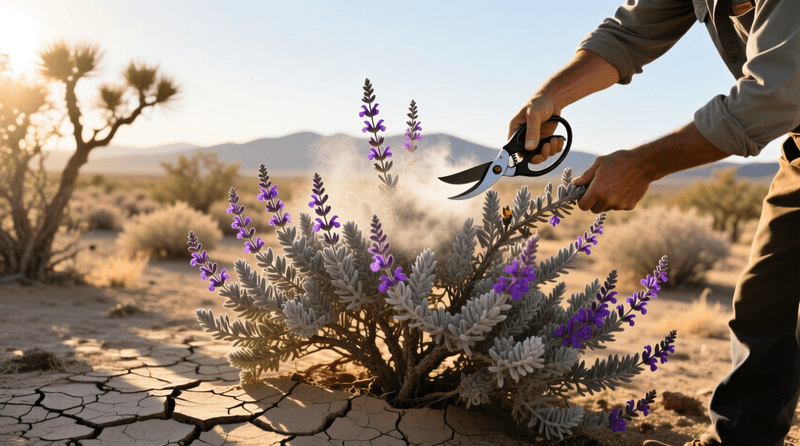
Texas sage is one of the toughest shrubs growing in Texas yards, but a few wrong cuts can set it back for an entire season. Known botanically as Leucophyllum frutescens, this silvery-leaved native earns its keep with bursts of purple blooms that appear in flushes through summer and fall. Getting the pruning right protects those blooms and keeps the plant looking its natural best, whether you garden in dry West Texas or along the humid Gulf Coast.
Identify Texas sage before you prune
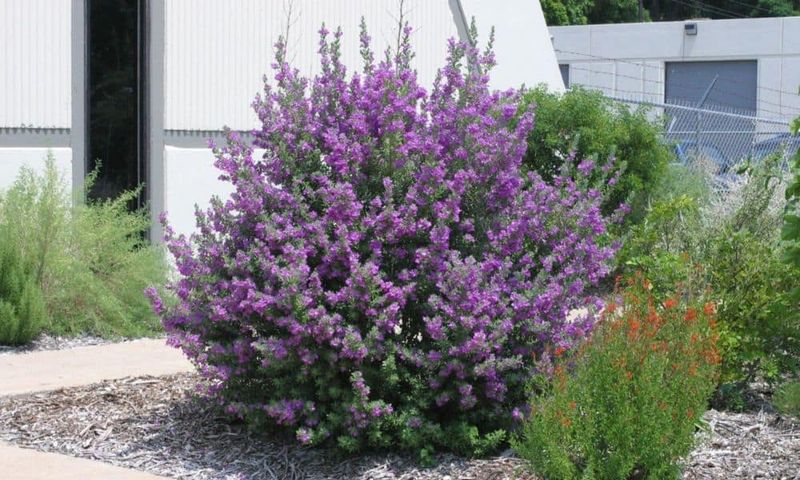
Before picking up a pair of pruners, confirm you are working with Leucophyllum frutescens, known by NC State Extension as purple sage, Texas ranger, cenizo, Texas silverleaf, or barometer bush. Those common names all point to the same plant, a native Chihuahuan Desert shrub with small, silvery or gray-green leaves, a woolly or fuzzy texture, and tubular flowers that range from lavender to deep purple. Culinary sage belongs to the genus Salvia, and autumn sage is a different species altogether; pruning rules that work for either of those do not apply here.
A healthy, established Texas sage naturally grows into a rounded mound. Left alone in good conditions, it rarely needs heavy intervention. The University of Arizona Campus Arboretum notes that Leucophyllum frutescens generally does not require pruning when it has enough space to reach its natural size. That observation matters for Texas gardeners who may feel pressure to keep every shrub tightly clipped.
Texas A&M Extension Bexar County describes light pruning to preserve the plant’s natural shape as the right approach, not shearing it into a formal hedge. The goal when you do pick up pruners is modest: remove branches that are dead, broken, crossing, or crowding the center, and nudge the outline back toward its rounded profile if it has grown lopsided. Turning a cenizo into a boxy evergreen hedge is possible, but it works against the plant’s structure and can reduce flowering wood over time. Know what you have, know what it wants to look like, and let that guide every cut.
Light pruning supports flowering, but weather sets the rhythm
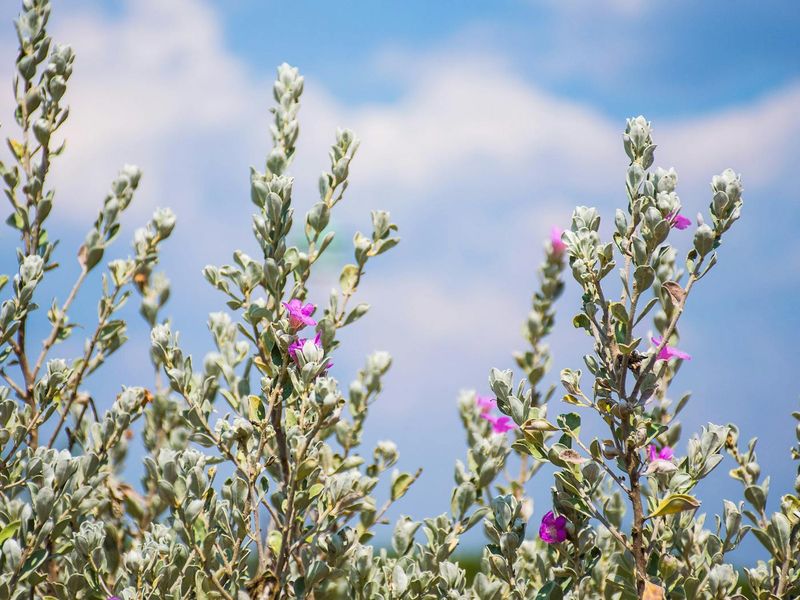
Texas sage flowers on current-season wood, meaning the new growth that pushes out in spring and early summer carries the buds for the season’s first bloom flush. A modest haircut in late winter removes older, woodier stems without stripping away the branches that will produce flowers in the months ahead. That is the real connection between pruning and blooming: keep the canopy healthy and well-lit, and the plant has the structure it needs to flower when conditions are right.
The phrase “when conditions are right” carries real weight here. NC State Extension describes Texas sage as a seasonal bloomer that typically flowers in episodes or flushes rather than continuously. Gardeners across Texas have long noticed that cenizo seems to burst into bloom after a summer rain or a stretch of humid weather, which is why the plant earned the nickname barometer bush. Rainfall, humidity, sunlight, drainage, cultivar, plant health, and regional climate all shape when those flushes appear and how full they look.
Pruning cannot manufacture rain or humidity. What it can do is remove obstacles: dense, crossing branches that shade the interior, dead wood that harbors disease, and stems that push the shrub out of its natural form. Texas A&M Extension Bexar County emphasizes light pruning for shape, not aggressive cutting to force blooms. Think of proper pruning as clearing the runway so the plant can respond fully when a summer storm rolls through, rather than as a direct trigger for every purple display your yard produces.
Prune in late winter or early spring
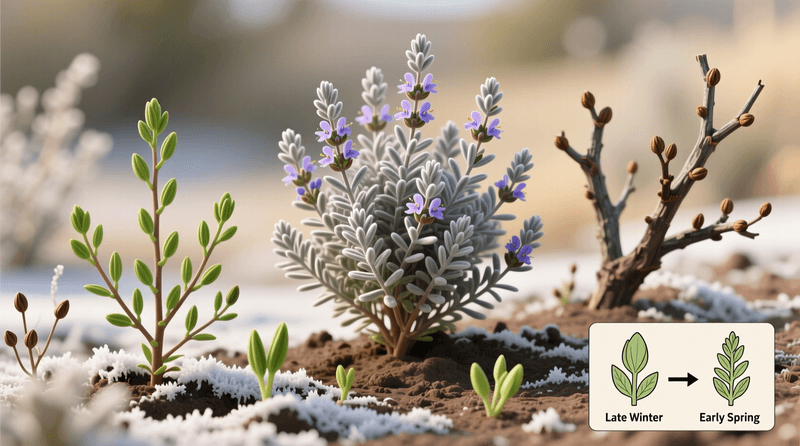
The clearest seasonal window for routine shaping is late winter or early spring, just before new growth begins to push. Cutting at this point lets you see the branch structure without a full canopy in the way, and it means the plant can direct energy into fresh growth rather than spending weeks recovering from a mid-season cut. Texas A&M Extension Bexar County recommends late winter or early spring as the right pruning window for Texas sage, and that timing aligns with the plant’s natural growth rhythm across most of the state.
UF/IFAS Extension confirms late winter as an appropriate time for light shaping, with the option of a light early-summer cleanup if the plant looks straggly after the first growth flush. Neither source recommends pruning on a rigid calendar date. Texas is a big state, and growing conditions shift considerably from the Panhandle to the Rio Grande Valley. A gardener in San Antonio may see new growth in February, while someone in the Hill Country might not notice bud swell until March.
Watch the plant, not the calendar.
Before making any cut, walk around the shrub and look at the whole shape. Identify which branches are dead, which are crossing into the center, and where the outline has grown uneven. The University of Arizona notes that Leucophyllum frutescens is well suited to its natural form, so the inspection should confirm whether pruning is genuinely needed rather than treating it as a scheduled chore. If the shrub looks balanced and healthy, a very light pass or no pruning at all may be the right call that year.
Make selective cuts instead of shaving the canopy
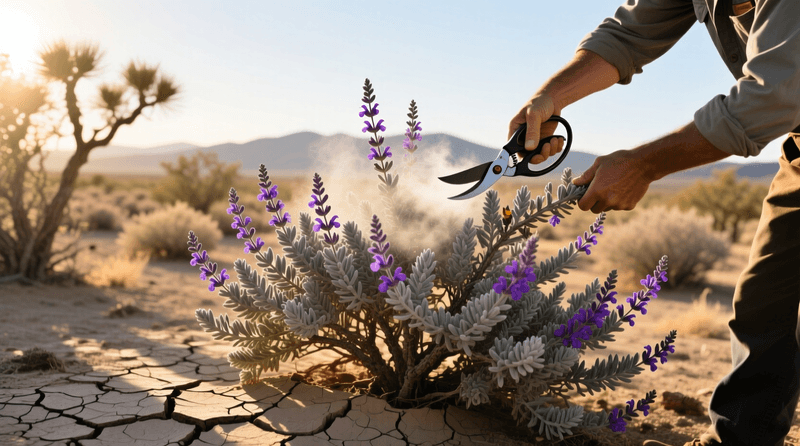
Reach for bypass hand pruners or loppers, not hedge shears. Texas A&M AgriLife Extension’s Earth-Kind pruning guidance emphasizes selective, purpose-driven cuts over mechanical passes across the outer surface. For each cut, find a dead stem, a broken branch, a limb rubbing against another, or a shoot that juts awkwardly out of the rounded outline. Cut that branch back to the point where it meets a healthy lateral branch, or trace it all the way to its origin at a larger stem if removing it entirely makes sense.
Leave a clean cut flush with the lateral or parent branch; do not leave a stub, because stubs invite disease and die back further.
Running hedge shears across the outside of a Texas sage can look tidy for a few weeks, but it creates problems that build over time. Texas A&M’s “Pruning with a Purpose” guide explains that repeated shearing produces a dense outer shell of foliage while the interior becomes progressively woodier and more sparse. Sunlight cannot reach the center, interior branches die back, and the shrub ends up dependent on that outer shell to look full. When disease, drought stress, or a hard freeze damages that shell, the plant has very little healthy interior structure left to recover from.
Selective cuts preserve the branching framework that gives Texas sage its natural rounded silhouette. Texas A&M Extension Bexar County notes that the ‘Silverado’ cultivar naturally forms a dense, rounded mound, and the same holds true for most Leucophyllum frutescens selections: the shape is already there. Your job with each cut is to support that form, remove what does not belong, and step back. A well-executed selective pruning session may remove only a handful of branches, but those cuts keep light moving through the canopy and maintain the structural integrity that supports new flowering wood season after season.
Keep early-summer cleanup light
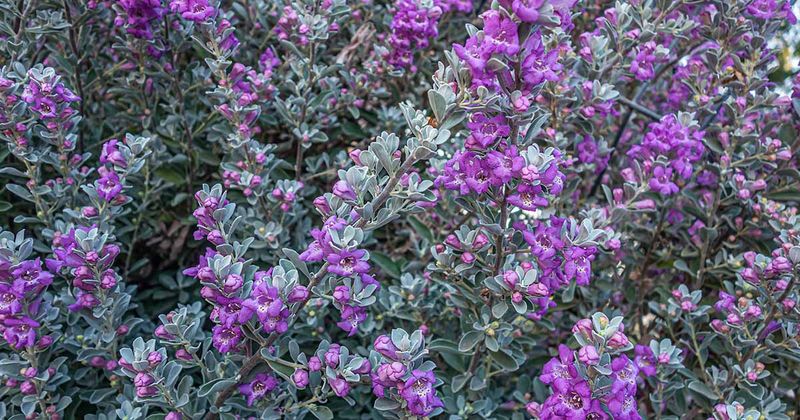
After the first growth flush of spring, some Texas sage plants develop a few shoots that push well beyond the rounded outline or look rangy compared to the rest of the canopy. An occasional early-summer cleanup can correct that without disrupting the shrub. UF/IFAS Extension notes that a light early-summer trim is appropriate if the plant has become straggly, but this is a one-time correction, not the start of a repeated shearing schedule through July and August.
The distinction matters because Texas sage blooms on current-season wood, and that new growth is actively developing during the summer months. Clipping the shrub repeatedly through the hottest part of the year means cutting off the very branches that are forming flower buds, and it forces the plant to spend energy on recovery rather than reproduction. NC State Extension describes Texas sage’s flowering as episodic, tied to weather patterns rather than to a pruning schedule. Frequent clipping does not change the weather, and it does not reliably produce more bloom flushes.
Some gardeners wonder whether removing spent flowers will trigger a fresh round of blooming. The sources reviewed for this article do not establish deadheading as a reliable technique for Texas sage. Texas A&M’s pruning guidance focuses on structural and health-based cuts rather than flower removal as a bloom-forcing strategy. If the plant looks tidy and the weather cooperates, another flush will come on its own terms.
Trust the process, make only the cuts that are genuinely needed, and resist the urge to reach for the hedge shears every time a branch looks slightly out of place.
Treat overgrown shrubs and freeze damage differently
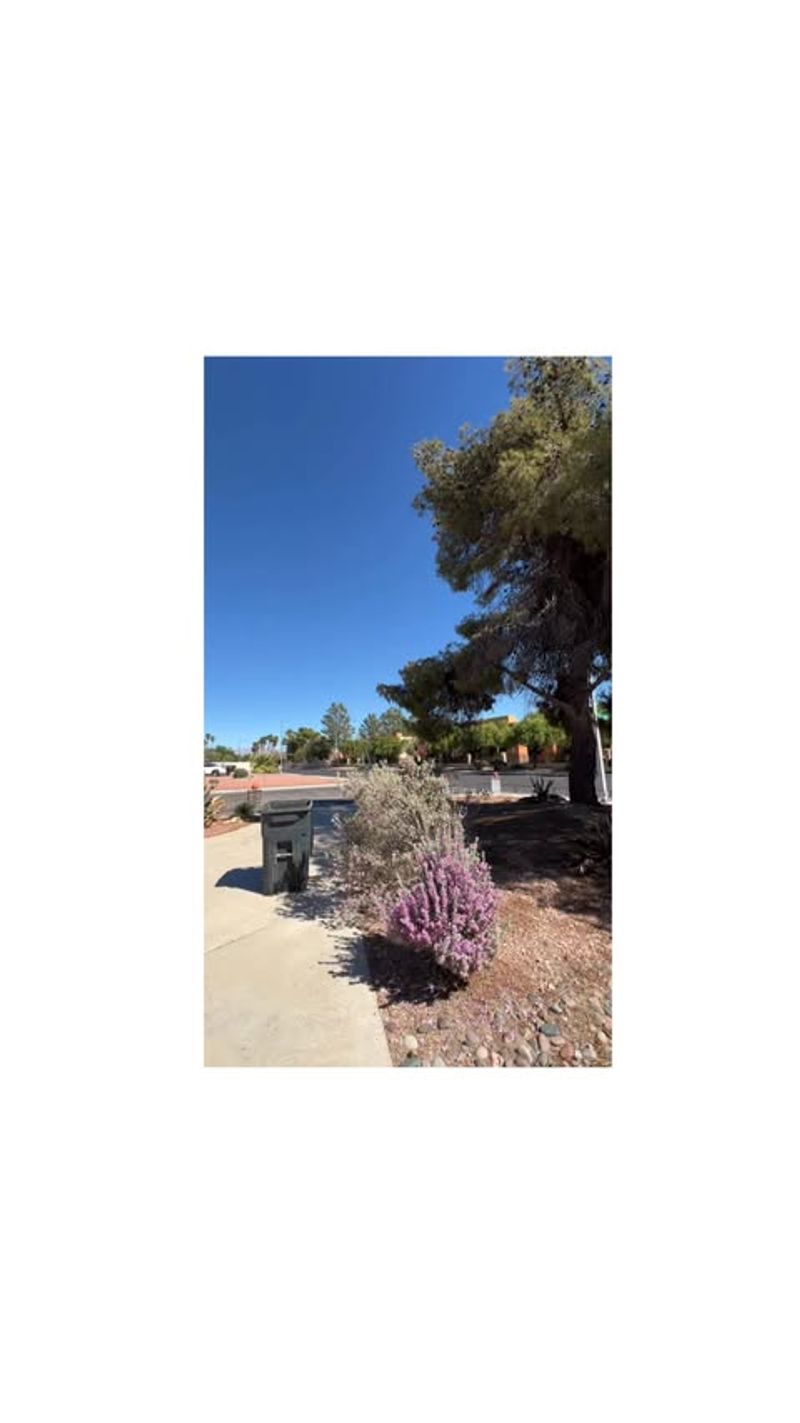
Two situations call for a different approach from routine shaping: a shrub that has grown far beyond its space or developed a hollow, sparse interior, and a plant that took serious freeze damage over winter. Both require more thought before cutting, and both have clear limits on how far a homeowner should go without professional help.
For a genuinely overgrown or neglected cenizo, the University of Arizona recommends early-spring rejuvenation pruning as an option for size control, describing a hard cutback that stimulates a flush of new growth from near the base. This is not a routine annual method. Cutting a shrub very low removes most of its canopy at once and temporarily leaves a stark-looking plant in your yard. Reserve rejuvenation for a shrub that is genuinely failing, one that has become too large for its location, developed a dense outer shell with a dead interior, or simply stopped performing well after years of neglect.
Plan for a recovery period of at least one growing season before the plant looks full again.
Freeze damage presents a different challenge entirely. Brown foliage after a hard freeze does not automatically mean dead wood. Ask Extension guidance on freeze damage recommends assessing live wood before cutting, and Texas A&M has broadly advised gardeners to “learn to live with ugly” through winter rather than cutting too soon. Scratch a small section of bark near the tip of a suspect branch; green or white tissue underneath means the branch is still alive.
Wait until late winter or early spring to remove only the wood that is confirmed dead, and keep the late-winter timing in mind rather than cutting during a cold stretch.
For any work that involves large limbs, branches well above your head, or cuts that would require a ladder, contact a certified arborist. Texas A&M AgriLife Extension cautions that overhead pruning and large-limb removal carry safety risks that go beyond ordinary homeowner work. Keeping your feet on the ground is the right boundary for routine Texas sage maintenance.
Give the shrub the conditions that support bloom flushes
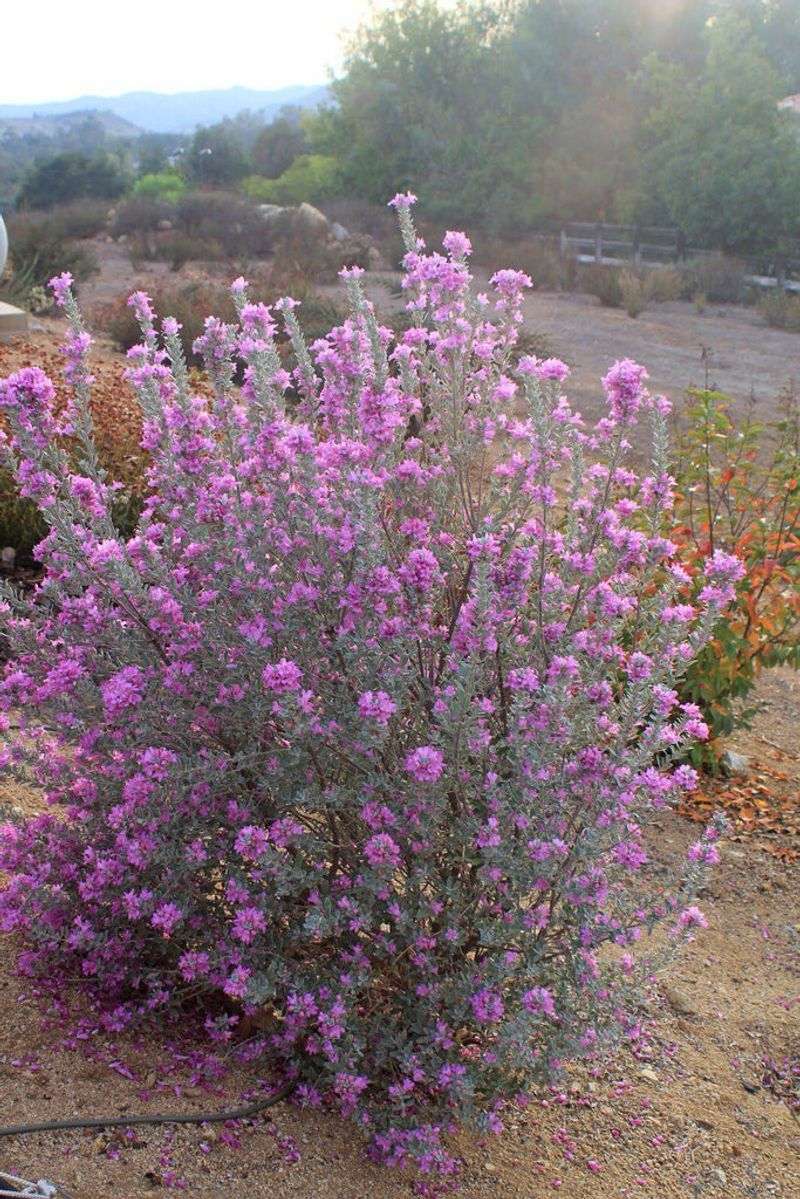
Pruning preserves structure, but the conditions around the plant determine how freely it blooms. Full sun is the most important factor to get right. A cenizo planted in partial shade stretches toward available light, producing long, leggy stems with fewer flowers. NC State Extension lists full sun as a requirement for Leucophyllum frutescens and notes that the plant performs best with at least six hours of direct sunlight daily.
If a nearby tree or structure has grown to shade a previously sunny spot, that change in light may explain a decline in blooming more than any pruning decision.
Drainage is equally critical, and it becomes the defining challenge for gardeners along the Gulf Coast and in East Texas. Texas sage evolved in dry, rocky, well-drained soils, and its roots are poorly suited to standing water or consistently moist ground. UF/IFAS Extension warns that overwatering and poor drainage can quickly damage or kill cenizo, even in areas where the plant is otherwise adapted. In humid parts of the state, raised beds, amended soil, or careful site selection can make the difference between a thriving shrub and one that slowly declines.
Once established, water conservatively; the plant’s drought tolerance is genuine, but that tolerance does not extend to chronically saturated soil.
Bloom cycles also respond to cultivar. Texas A&M Extension Bexar County notes that ‘Silverado’ is denser and more compact than some other selections, and different cultivars vary in mature size, foliage density, and flowering behavior. The Texas A&M Earth-Kind Plant Selector can help you match a cultivar to your specific region and conditions. Skip fertilizer and bloom-booster products; extension guidance consistently says fertilization is unnecessary for Texas sage and may promote weak, leafy growth at the expense of flowers.
Rainfall, humidity, a well-drained sunny site, and a healthy root system are the real drivers of those purple flushes.
Use a careful reset, then let Texas sage grow
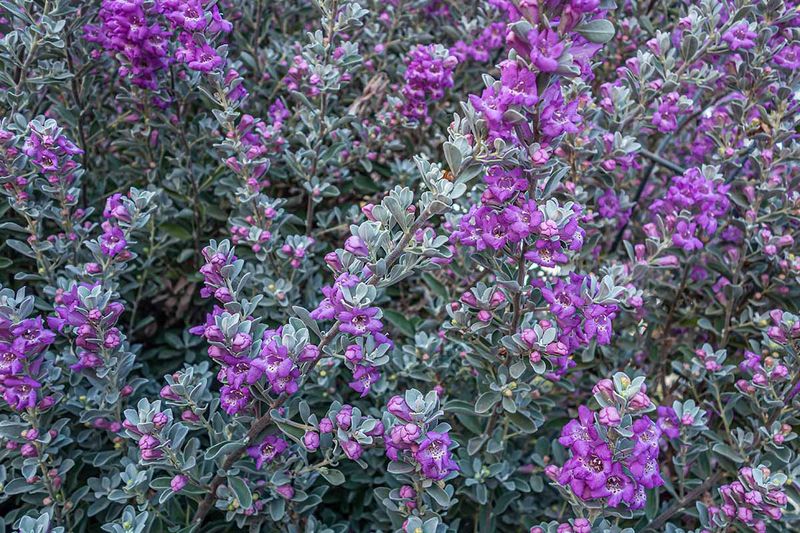
Putting it all together comes down to a short, unhurried sequence. Confirm the species before anything else, because misidentifying the plant leads to mismatched advice. Once you know you have Leucophyllum frutescens, wait for the late-winter or early-spring window and inspect the shrub before making a single cut. Remove dead, broken, crossing, or badly placed branches with hand pruners or loppers, cutting back to a healthy lateral rather than leaving stubs.
Step back, look at the overall shape, and stop when the natural rounded form is restored.
In early summer, reassess rather than automatically shearing again. If a few shoots have grown straggly, clip them selectively. If the shrub looks balanced and healthy, leave it alone. Texas A&M Extension Bexar County consistently frames the goal as preserving natural form, not imposing a clipped shape on a plant that does not need one.
NC State Extension confirms that flowering arrives in weather-linked episodes rather than as a reward for frequent cutting.
What you can control is structure, sunlight, drainage, and conservative watering. The University of Arizona notes that a well-sited Leucophyllum frutescens largely takes care of itself. Rainfall, humidity, cultivar, and regional climate will decide when the purple flushes arrive. A Texas sage that is properly pruned, well-placed, and left to grow on its own terms tends to be the one that stops neighbors in their tracks after the first summer storm.