
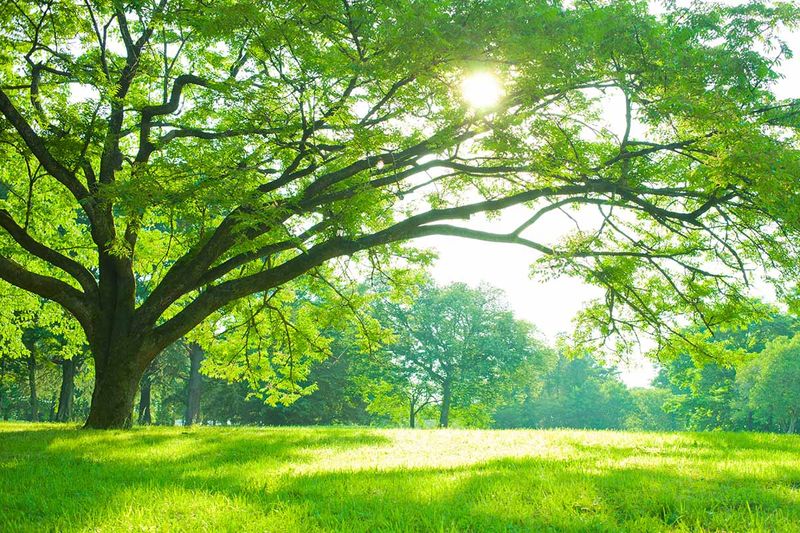
Summer heat in Texas is no joke, and a shady yard can feel like a completely different world from an exposed one. A mature shade tree is one of the most effective long-term tools a Texas homeowner has against triple-digit temperatures.
Before you head to the nursery, though, it helps to understand exactly how tree shade cools your property, which trees work best where, and what it takes to get a young tree established in Texas soil.
What the 20-degree comparison really measures
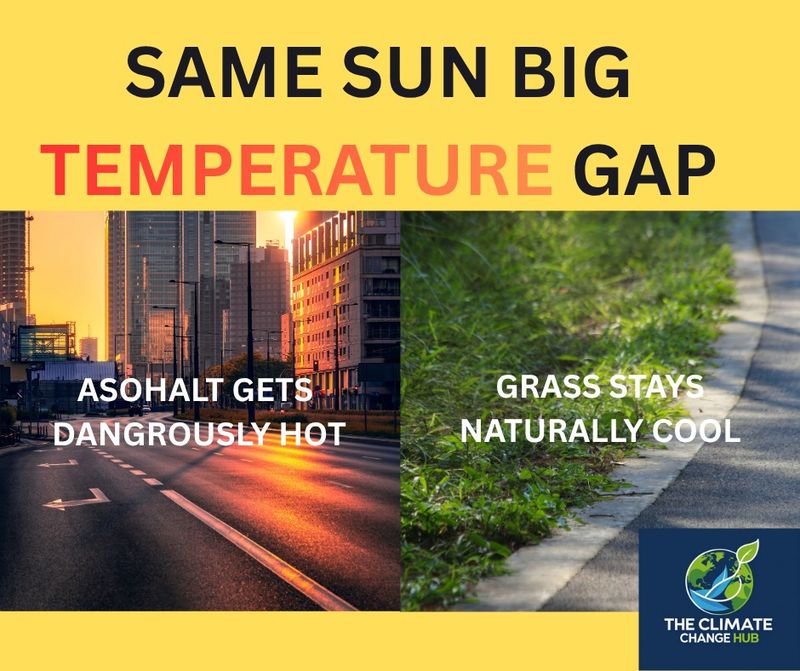
The headline promise of a yard running 20 degrees cooler sounds like exactly what a Texas homeowner needs in July. The number is real, but where it comes from matters: Texas A&M Forest Service research on tree cooling compares shaded areas with exposed pavement or parking lots, not shaded lawn with sunny lawn.
Concrete and asphalt absorb and radiate enormous amounts of heat, so the temperature gap between a shaded sidewalk and a sun-baked parking lot is far larger than the gap between shaded grass and open grass.
Grass already stays considerably cooler than pavement under the same sun, which means borrowing the pavement-versus-shade figure and applying it to a lawn-to-lawn comparison overstates what a homeowner should expect. A peer-reviewed study in the journal Trees found that the cooling effect of shade depended heavily on the surface underneath it, with non-vegetated materials responding more dramatically than grass.
A separate soil-temperature study measured summer maximum soil temperatures under trees averaging about 10.3 degrees Fahrenheit lower than beneath herbaceous vegetation such as lawn, and another grass-specific measurement found a mean cooling of roughly 5.8 degrees Fahrenheit between shaded and sunlit turf. Those are meaningful numbers, but they are study results from specific conditions, not a guaranteed outcome for every Texas yard.
The accurate homeowner takeaway is this: a mature shade tree can create a substantially cooler ground-level microclimate, especially over surfaces that store and radiate heat, such as pavement, bare soil, or exposed hardscaping. The comparison surface determines the magnitude of cooling.
A tree planted over a concrete patio will likely produce a more dramatic surface-temperature drop than one planted over an already-cooler lawn.
Understanding what the 20-degree figure actually measures helps you make smarter decisions about where to position a tree for maximum payoff on your specific property. A tree shading your driveway or a concrete patio does a different job than one shading open turf, and both are worth planning for.
How tree shade cools a Texas yard
Leaves cool surfaces through two separate mechanisms, and knowing both helps you set realistic expectations. The first is simple: a dense canopy blocks solar radiation before it ever reaches the ground, preventing heat from building up in soil, pavement, or grass.
The second is evapotranspiration, the process by which a tree releases water vapor through its leaves, which draws heat out of the surrounding air much like sweat cools skin. Together, these two effects can make shaded ground and the air just above it measurably more comfortable than fully exposed areas.
The cooling is not uniform, though, and several variables shift the result from one yard to the next. Research on urban surface temperatures under tree shade found that canopy density, the type of surface being shaded, and the length of time a surface stays shaded all influence how much cooling actually occurs.
A patchy canopy with gaps lets sunflecks reach the ground and reduces the effect. Sun angle changes throughout the day and across seasons, so a tree that provides deep midday shade in summer may leave long gaps of exposure in the morning and afternoon.
Wind, humidity, soil moisture, and grass height each play a role as well. A well-irrigated lawn under a dense canopy on a humid Gulf Coast afternoon behaves differently from a dry, sparse lawn under a thin canopy in West Texas.
Soil surface temperature research confirms that moisture levels in the soil affect how much cooling trees can deliver, because evapotranspiration slows when soil dries out.
Surface temperature, soil temperature at a given depth, and air temperature near the ground are three distinct measurements. A shaded concrete surface can cool dramatically while the air temperature a few feet away changes only slightly.
Claiming a tree will drop the air temperature in your yard by 20 degrees is a different and much harder-to-support statement than saying the surface beneath a mature canopy will be far cooler than an exposed one. The practical takeaway: the cooling is real, it is meaningful for human comfort, and it is greatest when the canopy is mature, dense, and positioned over a heat-storing surface.
Why live oak deserves consideration
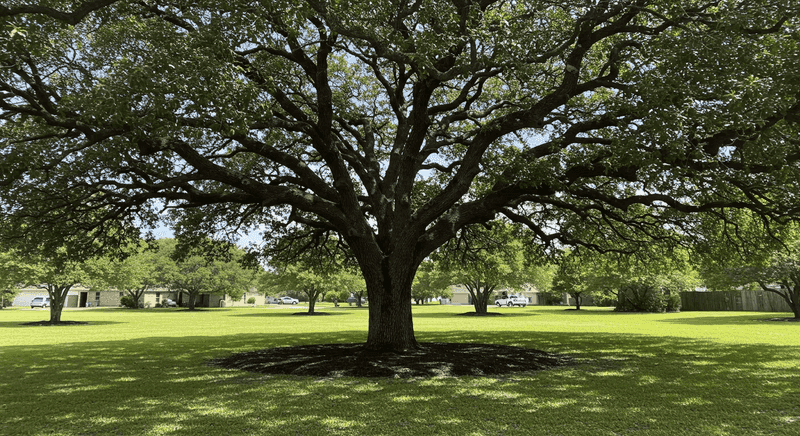
Texas live oak earns a serious look as a long-term shade candidate because of what it becomes at maturity. A healthy specimen can spread 40 to 60 feet across with a dense, persistent canopy that holds most of its leaves through winter, giving it a longer annual shading season than many deciduous alternatives.
That combination of width, density, and longevity makes it one of the more compelling options for a homeowner investing in decades of shade rather than a few seasons of it.
Texas A&M Forest Service’s Texas Tested, Texas Tough program recognizes live oak among trees selected for performance under Texas conditions. That recognition reflects its track record in a state where heat, drought, and soil variability eliminate a lot of species that look fine in a nursery pot but struggle in the ground.
Live oak’s deep root system and drought tolerance once established make it more resilient during the prolonged dry stretches that hit Texas regularly.
Live oak is not the right choice for every Texas property, though. Texas spans several distinct climate zones, from the humid Gulf Coast to the alkaline soils of the Hill Country to the arid conditions of West Texas, and no single species performs equally well across all of them.
The Texas Tree Planting Guide lets you filter by county and size to find trees suited to your specific location.
Other Texas-tested or recommended shade trees worth considering include bur oak, which tolerates alkaline soils and compacted conditions well; cedar elm, a tough native that handles both wet and dry periods; chinkapin oak, which performs well on rocky limestone sites; Shumard oak, a fast-growing option with strong fall color; and baldcypress, suited to low-lying or periodically wet areas. The best tree for your yard depends on your region, available space, drainage pattern, and what the site demands from a root system, not on what is most commonly named in a headline.
Choose the site before you choose the tree
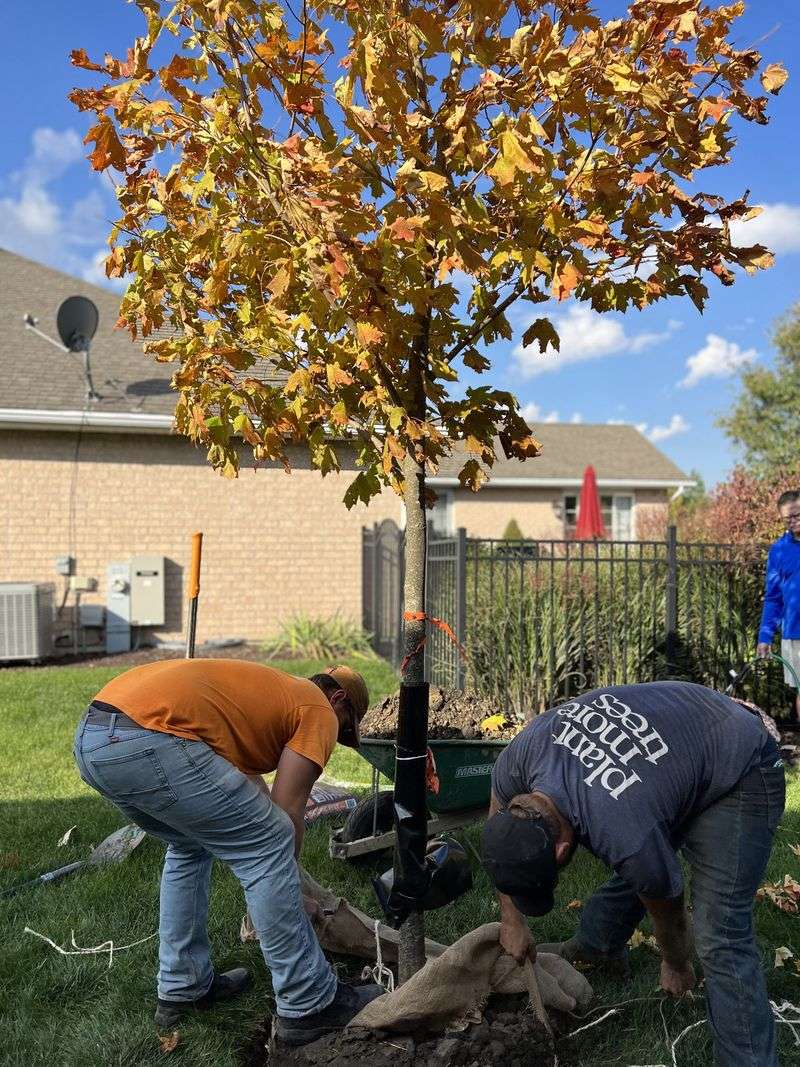
Picking a tree without first reading the site is one of the most common and costly mistakes Texas homeowners make. A live oak that reaches 50 feet tall and 60 feet wide needs room to do that without running into a power line, cracking a foundation, or lifting a sidewalk.
Texas A&M Forest Service guidance on right tree, right place emphasizes evaluating mature canopy height and spread before purchase, because the small tree at the nursery tells you almost nothing about what it will demand from your property in 20 years.
Walk the planting area and check overhead: utility lines, roof overhangs, and neighboring structures all set a ceiling on how tall a tree can safely grow in that spot. Then look underground.
Call 811 before you dig to locate buried utilities, and consider where irrigation lines, septic systems, or drainage pipes run. Large-rooted trees near driveways, sidewalks, or building foundations can cause structural damage that far outweighs the cooling benefit.
Drainage deserves its own check. A site that holds water after rain for more than a day or two can suffocate the root system of a species that prefers well-drained soil.
Wind exposure matters too, especially in areas prone to Gulf Coast storms or severe thunderstorm downbursts; a tree placed without regard to storm loading can become a hazard. The International Society of Arboriculture’s planting guidance recommends accounting for mature size, clearance from structures, and root-zone volume as non-negotiable pre-purchase steps.
Placing a large shade tree as close to the house as possible to maximize cooling is tempting but risky without proper clearance planning. A tree too close to a structure can damage roofing, gutters, and foundations, and large branches over a house create storm-damage exposure.
Use the Texas Tree Planting Guide or your local county Extension office to match tree size and root habit to the available space before you spend money on a tree that will eventually outgrow its spot. The Texas A&M Forest Service planting page also offers species-specific guidance that can help narrow the field once you know your site constraints.
Plant during the cooler Texas season
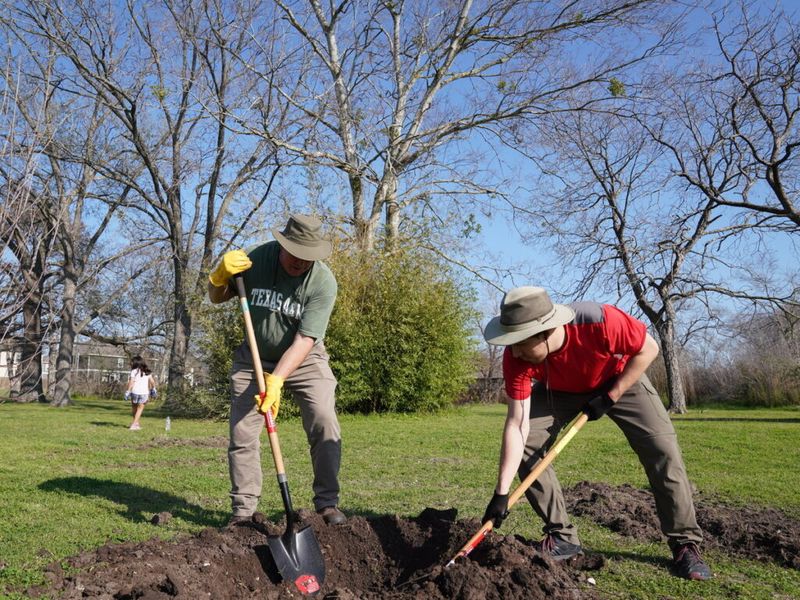
Timing a tree planting around Texas weather gives roots the best possible start. Cooler soil temperatures slow water loss through the leaves and let the root system spread into surrounding soil before summer heat arrives.
For most of Texas, that means targeting November through early spring as the preferred planting window. In Central Texas specifically, Austin’s native tree growing guide identifies October 1 through March 31 as a practical planting season.
That calendar reflects Central Texas conditions and should not be applied unchanged to the Panhandle, South Texas, or the Gulf Coast, where timing may shift based on local frost dates and soil warmth.
Planting too late in spring or during summer is not automatically fatal, but it raises the stakes considerably. A tree going into the ground in June faces immediate heat stress, rapid soil-moisture loss, and a shortened root-establishment window before the hardest weeks of summer.
Texas A&M Forest Service drought guidance notes that drought stress damages feeder roots, the fine roots responsible for water and nutrient uptake, which sets a tree back in ways that may not show up visibly until months later.
Correct planting depth is just as important as timing. Texas A&M Forest Service planting instructions call for keeping the root collar, the point where the trunk meets the root system, flush with or slightly above the surrounding grade.
The planting hole should be no deeper than the root ball itself, which prevents the tree from sinking and suffocating the collar. Width matters more than depth: dig the hole at least twice as wide as the root ball to loosen the surrounding soil and encourage lateral root spread.
Burying the trunk or piling soil against it traps moisture against bark tissue that needs air, which opens the door to decay and fungal problems. Texas A&M Forest Service guidance on tree placement also recommends checking for girdling roots, roots that circle the base of the tree, before backfilling, because girdling roots can slowly strangle a tree over years without obvious early symptoms.
Build the canopy with water and mulch
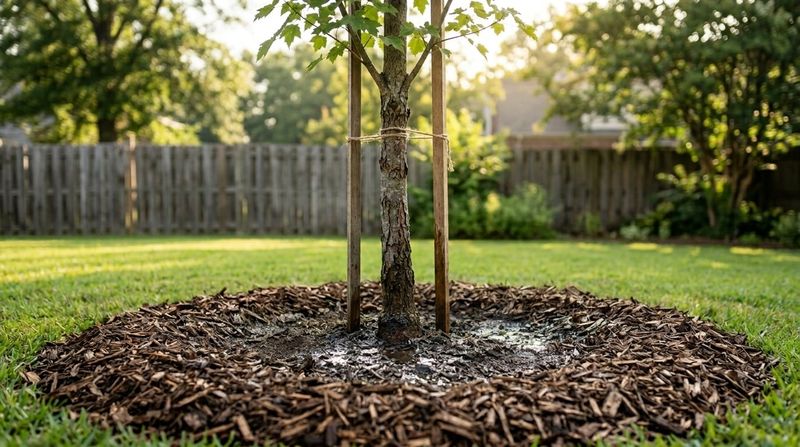
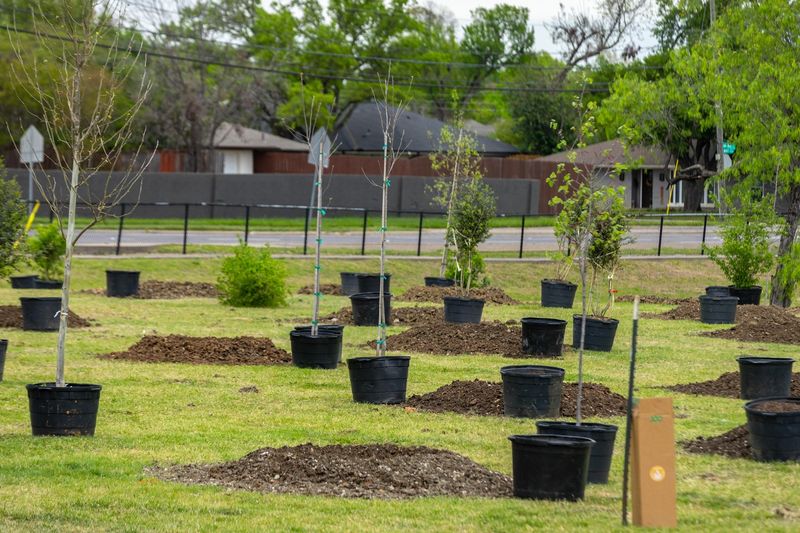
A newly planted tree provides almost no meaningful shade the first summer. The canopy that will eventually cool your yard by blocking solar radiation takes years to develop, and every decision made during the establishment period either accelerates or delays that outcome.
Setting expectations clearly from the start prevents frustration and helps homeowners commit to the care that actually matters.
Water is the single most important establishment input, and how you apply it matters as much as how often. Texas A&M Forest Service planting guidance calls for thorough, deep watering rather than light, frequent applications.
Deep watering encourages roots to follow moisture downward into the soil profile, building a more drought-resilient root system over time. Light sprinkling keeps moisture near the surface and trains roots to stay shallow, which makes the tree more vulnerable during dry stretches.
Monitor the soil moisture at root depth rather than guessing from the surface, and always follow local water restrictions, which can limit watering schedules significantly during drought emergencies.
Texas A&M Forest Service drought effects research warns that drought stress can cause delayed damage, meaning a tree that appears fine in September may show decline the following spring after feeder roots were damaged earlier in the season. Stressed trees also become more susceptible to borers, root rots, and cankers, secondary problems that can kill a weakened tree that might otherwise have survived.
Drought tolerance describes a tree’s ability to survive dry periods once established, not freedom from supplemental watering during the first one to three years in the ground.
Mulch supports everything watering accomplishes. Apply roughly 2 to 3 inches of wood chip mulch in a ring extending toward the drip line of the canopy.
Texas A&M Forest Service watering guidance confirms that mulch slows evaporation, moderates soil temperature, and reduces competition from grass and weeds near the root zone. Keep the mulch several inches away from the trunk itself; mulch piled against bark traps moisture against tissue that needs to stay dry, encouraging decay and pest problems at the base of the tree.
A cooler canopy can change the lawn
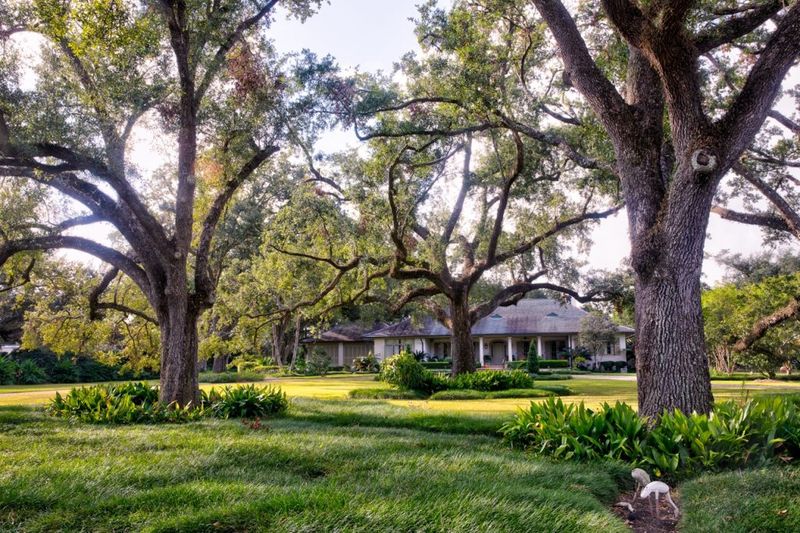
Getting a mature shade tree and a lush, uniform lawn in the same spot is harder than it sounds. Dense canopy shade is exactly what cools a surface most effectively, but that same density reduces the sunlight that turf grasses need to stay thick and healthy.
Promising yourself both a maximum-cooling canopy and a perfect lawn beneath it is setting up a conflict the tree will eventually win.
Travis County Extension guidance on lawns in shade explains that trees and turfgrass compete directly for light, water, and nutrients, and that live oak in particular can cast shade dense enough to prevent quality lawn growth beneath it. Even shade-tolerant grass varieties have a light threshold below which they thin out, go dormant, or die back, leaving bare soil that can erode or compact.
The tradeoff is real but manageable with realistic planning. Some homeowners choose shade-tolerant groundcovers such as native ferns, inland sea oats, or liriope for the area directly under a large canopy, reserving turfgrass for the sunny perimeter where it can thrive.
Others opt for decomposed granite, flagstone, or a permeable patio beneath the tree, which creates a usable outdoor space that also benefits from the dramatic surface-temperature reduction that tree shade delivers over hardscape.
Redesigning the area under a mature canopy is not a compromise; for many Texas properties it is the smarter long-term choice. A shaded patio, a groundcover bed, or a mixed native planting under a live oak can be far more comfortable and lower-maintenance than a struggling lawn that requires constant overseeding, fertilization, and supplemental watering just to stay marginal.
Knowing this tradeoff before you plant lets you design the space around the tree’s eventual canopy rather than fighting it later.
Plan for the mature shade you want
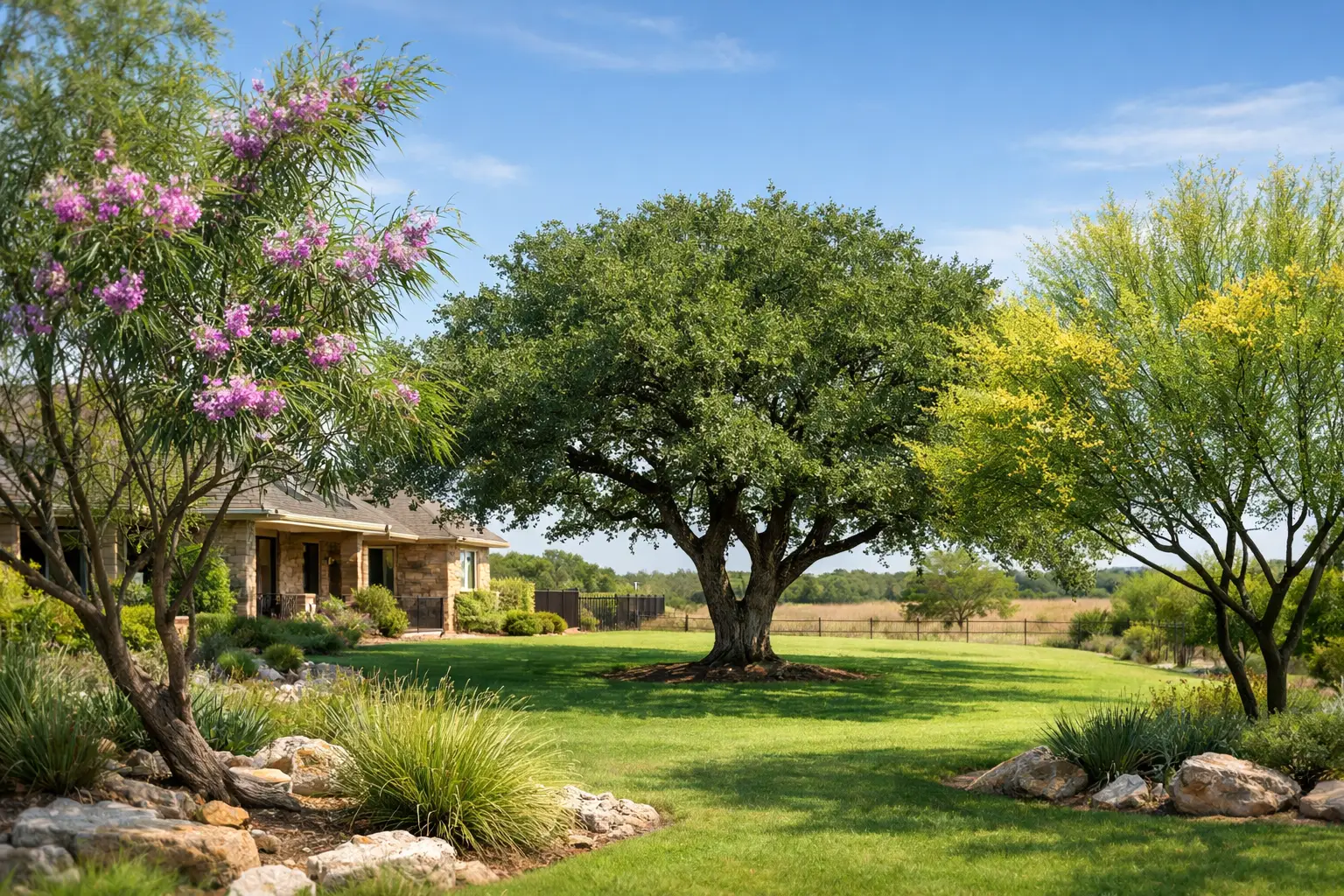
Every good shade decision starts with an honest look at the property. Before purchasing any tree, walk the site and answer three questions: does the mature canopy fit the available space without conflicting with structures, utilities, or neighboring properties; does the species match the regional climate, soil type, and drainage pattern of your specific Texas location; and are you prepared to water consistently through the first few establishment years?
Live oak is a strong candidate for the right site: a location with adequate root-zone volume, no overhead utility conflicts, good drainage, and enough horizontal space for a wide-spreading canopy. Texas A&M Forest Service’s right tree, right place guidance makes clear that species selection and site matching are inseparable decisions.
Plant during the cooler-season window appropriate for your region, follow correct depth and width at planting per Texas A&M Forest Service planting instructions, and commit to thorough watering through establishment.
The compelling cooling benefit comes from a mature, dense canopy positioned over a surface that stores heat, and Texas A&M Forest Service research on tree cooling shows the effect is most dramatic over pavement and exposed hardscape rather than already-cooler open lawn. A newly planted nursery tree will not cool your yard this summer.
What it will do, given the right site and consistent care, is build toward a canopy that makes your property measurably more livable for decades. The best next step is checking your property before you go to the nursery, because the tree that fits your site is always better than the tree that just fits the headline.