
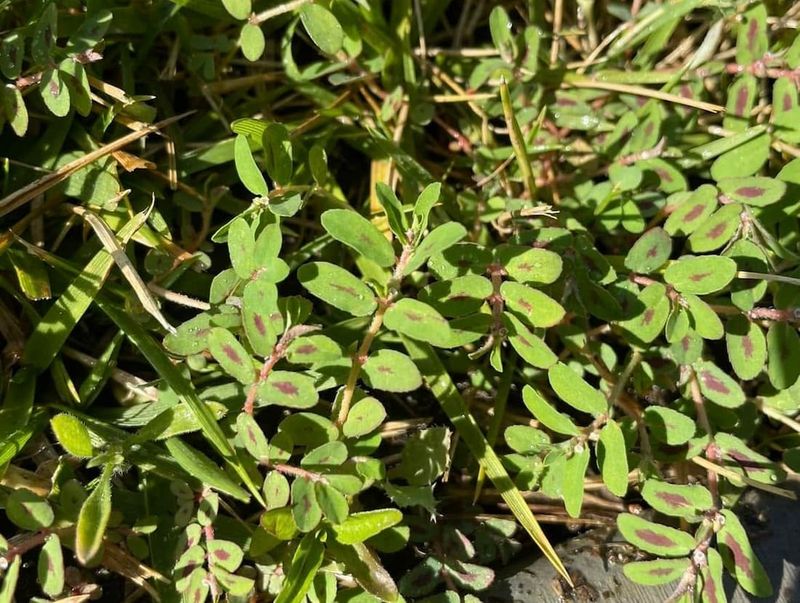
A flat, fast-seeding weed called spotted spurge has been showing up in Texas lawns, garden beds, and sidewalk cracks all summer long, and most homeowners have no idea what it is. By the time you notice it spreading across a bare patch of soil, it may already be producing the thousands of seeds that will fuel next season’s problem.
Catching it early, pulling it out root and all, and closing off the bare soil it loves are the three moves that actually work.
Identify spotted spurge before you treat it
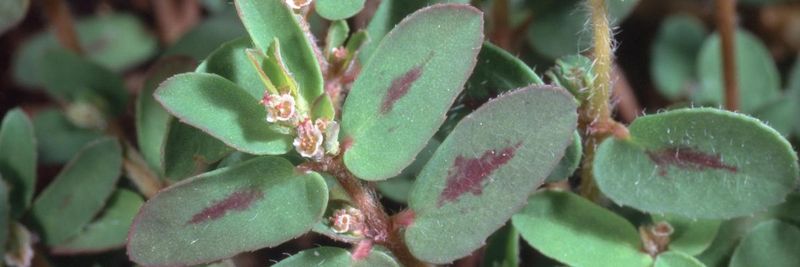
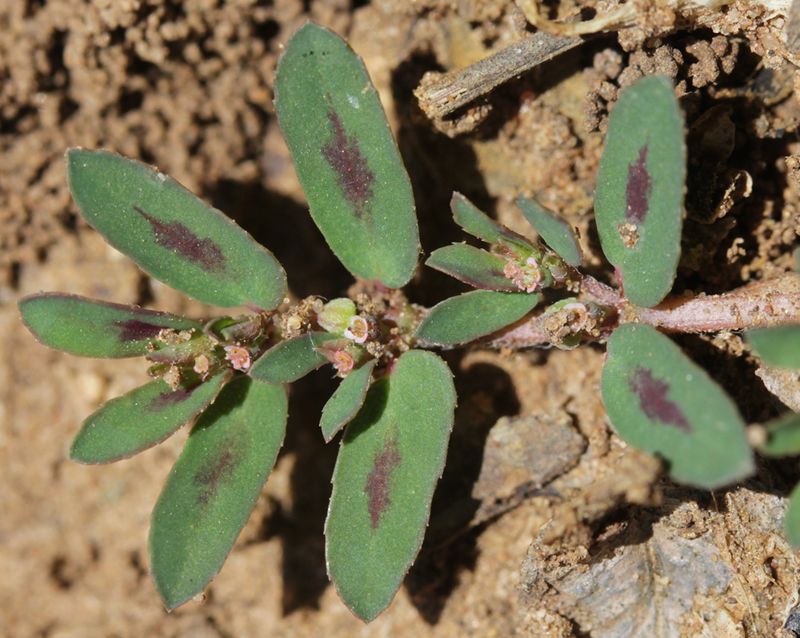
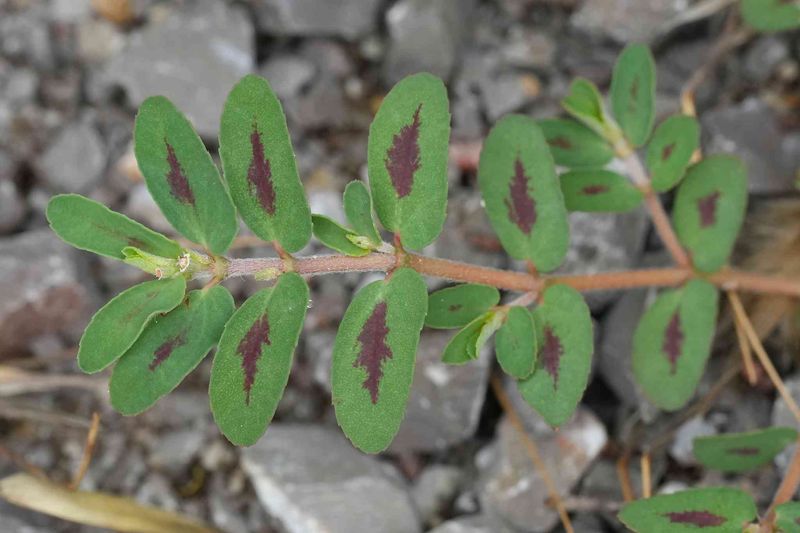
Spotted spurge (Euphorbia maculata) earns its name from the reddish or maroon spot that appears on many of its small, oval leaves, but that marking alone is not enough for a confident identification. UC IPM’s guide to spotted spurge and other spurges notes that the spot is common but not universal, and several related spurge species can look similar enough to cause confusion.
Look for the full picture instead: a prostrate or mat-forming plant that lies flat against the soil, opposite oval leaves on reddish or maroon hairy stems, and tiny inconspicuous flowers tucked into the leaf axils.
The most reliable single test is the milky sap. Break a stem and a white, latex-like liquid appears almost immediately.
That sap is characteristic of the spurge family and separates it from many other low-growing summer weeds you might find in similar spots.
Spotted spurge is a warm-season annual that turns up most often in thin turf, compacted or disturbed soil, the cracks between sidewalk slabs, bare garden beds, and sunny areas where competing plants have been weakened or removed. A single plant can sprawl up to about three feet across under favorable conditions, which is why a patch that seemed small one week can look like a mat the next.
Spurge is not one plant but a group of related species. Wisconsin Extension’s profile of Euphorbia maculata explains that spotted spurge, hyssop spurge, ground spurge, creeping spurge, and garden spurge (Euphorbia hirta) differ in growth habit, rooting, and the details of their management.
If the plant in your yard does not match the full set of features described above, consider contacting your local county extension office for a confirmed identification before choosing a removal strategy.
Rapid seed production explains the urgency
The real reason spotted spurge demands quick action has nothing to do with a speed comparison to fire ants. It comes down to one documented biological fact: under warm, favorable conditions, UC IPM reports that spotted spurge can begin producing seed as soon as five weeks after germination.
Wisconsin Extension puts the window at just over a month. Either way, a plant you overlook in late spring can be seeding your soil before summer really gets going.
Germination itself is temperature-driven. Seeds sprout most readily when soil temperatures hover around 75 to 85 degrees Fahrenheit, which describes a large portion of the Texas growing season from late spring through early fall.
Light also encourages germination, and seeds buried deeper than roughly half an inch germinate poorly, which is one reason bare, exposed soil is such a reliable invitation for this weed.
A single mature plant can produce several thousand seeds, and some of those seeds can lie dormant in the soil until conditions improve. That dormancy is part of why removing plants before they seed matters so much: every plant you pull before it matures is thousands of future seedlings that never get started.
Spotted spurge spreads primarily through seed, not through underground runners or rhizomes. Seeds move when water carries them across bare soil, when mowing equipment flings them to a new spot, or when clothing, footwear, or animal fur picks them up and drops them somewhere else.
Fire ants, by contrast, expand through colony budding, winged reproductive queens, and human-assisted transport, which are entirely different biological mechanisms. University of Texas fire ant research makes clear that comparing the spread rate of a seeding annual weed to a colonial insect requires a shared, defined metric, and none exists in the published literature.
The practical warning about spotted spurge stands on its own: seed production begins fast, and that is reason enough to act early.
Remove the whole plant before it produces seed
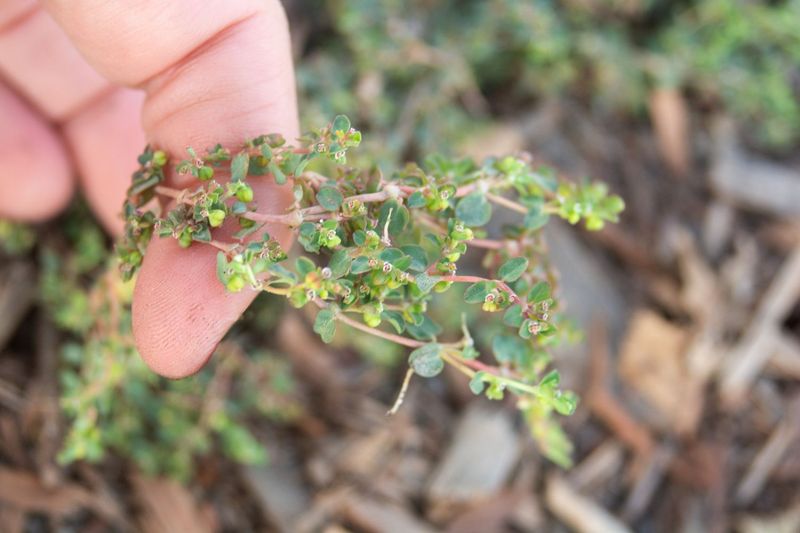
Gloves go on first. The milky sap that oozes from broken spurge stems can irritate skin on contact, and it is particularly hazardous to grazing livestock if consumed.
Once your hands are protected, the removal sequence matters more than speed.
Rather than grabbing the mat and yanking, start by loosening the soil beneath the plant with a hand trowel or hoe. Spotted spurge has a taproot and a crown at the base of the stem, and both need to come out.
UC IPM’s removal guidance is specific on this point: breaking off only the visible stems can leave enough root and crown tissue for the plant to regrow. Work the tool down and under the root before lifting, and check that the crown, the slightly thickened base where stem meets root, comes up with the rest of the plant.
Removing plants before they set seed offers the greatest chance to interrupt the reproductive cycle. If you find plants that are already flowering or showing small seed capsules, handle them carefully to avoid shaking seeds loose.
Placing those plants in a sealed bag before moving them away from the bed is a reasonable precaution, though no species-specific disposal requirement has been established in the literature reviewed here. The goal is simply to avoid scattering seed as you work.
After the initial pull, mark the spot and return in one to two weeks. New seedlings can emerge from seeds already in the soil, and any root fragment left behind may generate regrowth.
A second pass while plants are still tiny costs far less effort than waiting for a new mat to form. Consistent follow-up, not a single removal session, is what keeps spotted spurge from re-establishing in the same location season after season.
Close the bare-soil openings that favor germination
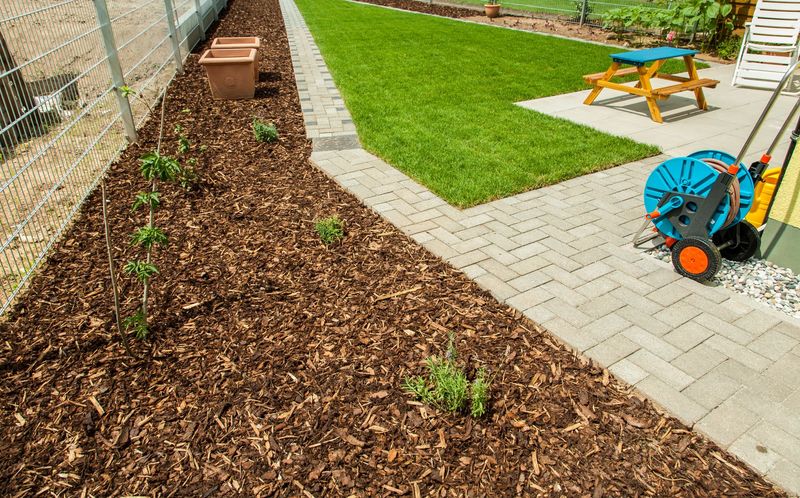
After you pull spotted spurge, bare soil is still sitting there, warmed by the sun and ready to receive the next round of seeds. Covering that soil quickly is the most direct way to reduce repeat infestations in ornamental beds.
UC IPM’s spurge management guidance recommends a mulch layer thick enough to block light from reaching the soil surface. For fine organic mulch, that means at least 2 inches of coverage.
For coarse bark mulch, the recommended depth rises to about 3 to 4 inches. Thinner applications let enough light filter through to encourage germination, so depth matters.
Refresh mulch each season as it breaks down, because a thinning layer loses its light-blocking effect.
In lawn areas, the approach shifts from mulch to turf density. Spotted spurge is strongly associated with thin or stressed grass where sunlight reaches exposed soil between blades.
Repairing bare patches, addressing soil compaction, and maintaining a fertilization and watering schedule appropriate for your grass type all reduce the open germination sites the weed needs. Texas growing conditions vary considerably between North Texas clay soils, the sandy Gulf Coast, and West Texas caliche, so the specific turf management steps that work best depend on your region and grass species.
Sanitation deserves equal attention. Seeds travel on mowing equipment, shoes, garden tools, and clothing.
After working in an area where spotted spurge has been present, cleaning shoes and tools before moving to a clean bed or lawn section reduces the chance of carrying seeds with you. This step will not eliminate dormant seed already in the soil, but it does limit the ongoing introduction of new seed from one part of the yard to another.
Mowing is not a dependable primary treatment
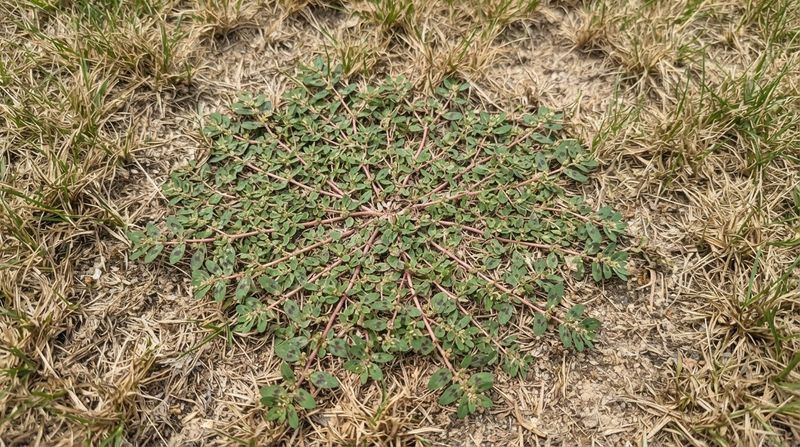
Reaching for the lawn mower when you spot a spreading weed feels like the obvious fix, but spotted spurge grows in a way that makes mowing an unreliable primary control method. The plant is prostrate by nature, meaning its stems radiate outward along the soil surface rather than growing upright.
Much of the plant stays below the effective cutting height of a standard mower, so the blade passes over it without removing the crown or disrupting seed production in flowers tucked close to the ground.
UC IPM’s management guidance is direct on this point: do not rely on mowing as the primary treatment for spotted spurge. Running the mower over an infested patch may also scatter seeds or carry them to other parts of the lawn on the deck and blades, which is the opposite of the outcome you want.
That limitation does not mean mowing has no role in managing this weed. Maintaining dense, healthy turf through regular mowing at the correct height for your grass species is a genuine preventive practice.
Thick grass shades the soil, reduces bare patches, and creates real competition for light and space that spotted spurge needs to establish. The distinction worth keeping in mind is that mowing supports prevention through turf health, while it fails as a direct control measure against plants already growing flat against the ground.
After routine lawn care, check the edges of beds, bare patches, pavement joints, and areas where grass is thin. Surviving crowns and new seedlings often show up first in those spots.
Catching them at that stage, while they are small and before they seed, is far easier than addressing a full mat later in the summer.
Match any herbicide to the weed, site, and label
For a handful of isolated spotted spurge plants in an ornamental bed, hand removal and mulch are the most straightforward options and carry the fewest risks to surrounding plants. Chemical control becomes worth considering when the weed recurs season after season in the same location or when the scale of the problem makes hand removal impractical.
Pre-emergent herbicides work by preventing seeds from germinating successfully. They must be applied before seeds sprout, which means timing matters.
Wisconsin Extension’s spotted spurge profile notes that pre-emergents labeled for spurge can help where it is a recurring problem, but the product must be labeled for the specific site. A product cleared for ornamental beds may not be permitted in a vegetable garden, and using it in the wrong location violates the label.
Post-emergent choices depend on where the weed is growing. Nonselective products, including those containing glyphosate, can kill larger established spurge plants but will also injure or kill any desirable plant they contact.
Selective broadleaf herbicides are generally more appropriate in established turf, but the right product depends on the grass species in your lawn. Texas A&M AgriLife Extension’s guide to herbicides for home lawns identifies active ingredients used for broadleaf weed control and notes turf-specific restrictions.
Some ingredients should not be applied to St. Augustinegrass or near shallow-rooted trees, so checking the turf species in your yard before selecting a product is not optional.
The pesticide label is the legal document governing how any product may be used. EPA guidance on reading pesticide labels states plainly that the label is legally binding.
Before applying anything, confirm the product is labeled for spotted spurge, confirm it is permitted at your specific site, follow the rate and reentry instructions exactly, and observe all directions related to drift, runoff, and pollinator protection. Treating the entire yard as a precaution conflicts with integrated pest management principles, which favor identification, spot treatment, cultural prevention, and reduced pesticide use where practical.
Interrupt the seed cycle with repeat checks
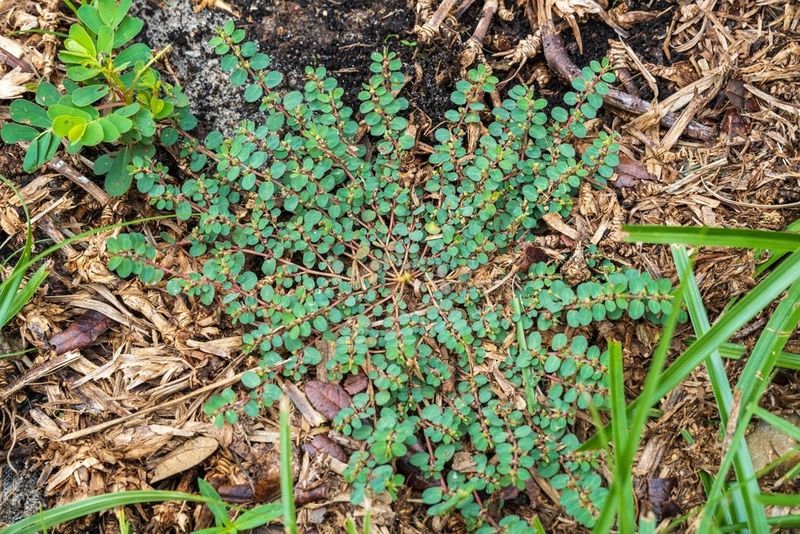
Spotted spurge rarely disappears after a single removal session. Dormant seeds already in the soil can germinate weeks or months later, and any crown tissue left behind during hand-pulling may push out new growth.
Building a short monitoring habit into your summer routine is what separates a weed you manage from one that manages you.
The action sequence is straightforward. Confirm the identification using the full set of features described earlier: prostrate mat growth, opposite oval leaves, reddish hairy stems, flowers in the leaf axils, and milky sap when a stem breaks.
Pull the root and crown before the plant produces seed, using loosened soil and gloves. Return to the same spot one to two weeks later and remove any seedlings or regrowth while they are still small.
Apply mulch at the recommended depth to block light from reaching exposed soil, or address thin turf with the repair steps suited to your grass species and Texas region.
Clean shoes, tools, and mowing equipment when moving between infested and clean areas. If the weed returns to the same site every season despite consistent removal and mulching, a properly labeled pre-emergent applied before the germination window is a reasonable next step, chosen and used according to the current product label and the specific site.
UC IPM and Wisconsin Extension both support this layered approach over any single-treatment solution.
The genuine urgency with spotted spurge is not a comparison to fire ants. It is the five-week window between germination and seed production.
Pull it before that window closes, and next season starts with far fewer seeds in the ground.