
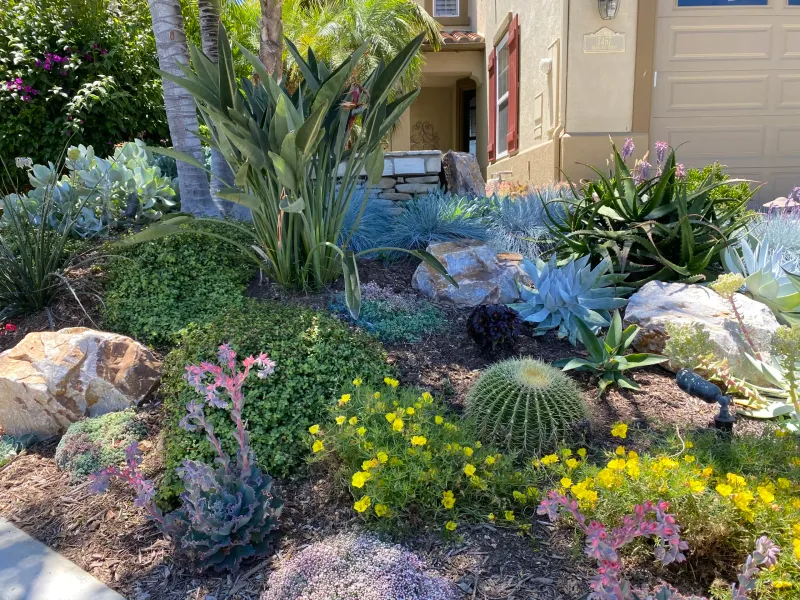
Texas summers punish outdoor spaces with triple-digit heat, blinding sun, and months without meaningful rain, yet the right plants can make a patio landscape look intentional and alive rather than scorched and bare. The key is choosing plants suited to your specific Texas region and placing them in the sunny landscape around your outdoor cooking area, not crowded against the appliance itself.
Every grill and fire feature requires a noncombustible clearance zone that no plant should occupy. Get that separation right, then fill the surrounding space with proven survivors.
The hot planting zone begins outside the safety zone
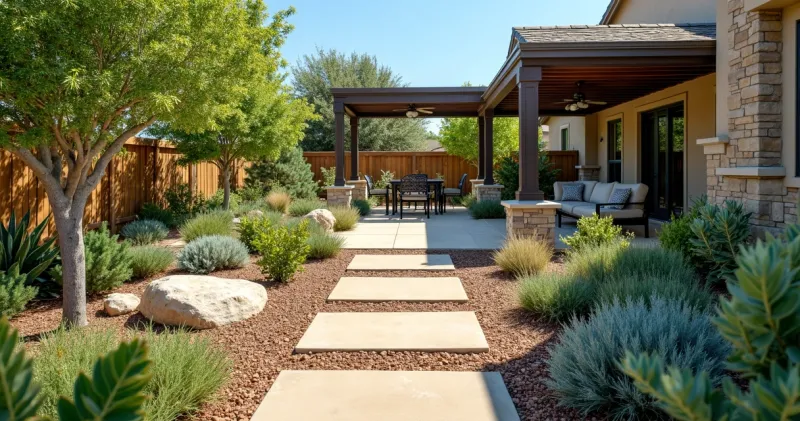
Before selecting a single plant, map out where plants cannot go. Every residential grill carries manufacturer instructions specifying minimum clearance from combustible materials, and those numbers are not suggestions.
CPSC grill safety guidance states that grills should be used outdoors only, in well-ventilated areas, and kept away from combustible surfaces, with older guidance recommending at least 10 feet from a structure. Individual grill models may require more or less clearance at the sides and rear, so the appliance manual controls.
Fire pits add another layer of complexity because the category covers very different products. A propane fire table, an enclosed gas fire pit, a wood-burning bowl, a chiminea, and a masonry fireplace each come with their own installation instructions and local permit requirements.
NFPA outdoor fire guidance recommends keeping chimineas, patio torches, and personal fireplaces at least 10 feet from the home or anything that can burn, but that baseline does not replace the specific instructions for your product.
Texas adds its own layer of rules on top of manufacturer requirements. Texas Department of Insurance outdoor-burning guidance advises checking city and county rules, active burn bans, and local restrictions before lighting any outdoor fire.
County governments can restrict or prohibit outdoor burning during drought or other hazardous conditions, and violations carry real consequences.
Plant selection can make the surrounding landscape more attractive and better matched to the site’s heat and sun. What it cannot do is replace noncombustible separation, proper appliance placement, or attentive supervision.
Treat the clearance zone as fixed, then work outward from there.
Match each plant to its Texas region and site
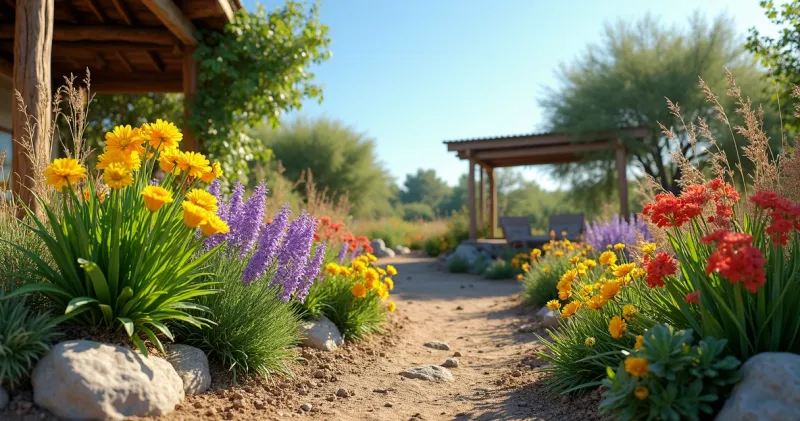
Texas is not one gardening region, and treating it as one is the fastest way to end up with dead plants and wasted water. The Gulf Coast, the Piney Woods, the Hill Country, the Blackland Prairie, West Texas, and the Panhandle have meaningfully different soils, rainfall patterns, freeze exposure, and humidity levels.
A plant that thrives in a San Antonio courtyard may sulk in Houston’s clay or fail entirely in an El Paso summer without supplemental irrigation.
Texas A&M’s Earth-Kind Plant Selector evaluates candidates by region for heat tolerance, drought tolerance, pest tolerance, soil requirements, and fertility needs. Plants scoring an Earth-Kind Index of 8 or higher are considered highly resource-efficient for the selected region, which makes the selector a useful first filter rather than a blanket endorsement.
Run your county or zip code through it before committing to any plant on this list.
Texas SmartScape defines full sun as at least six hours of direct sunlight per day and recommends grouping plants with similar water needs in the same bed. Its database is organized primarily around North Central Texas, with a smaller West Texas subset, so readers in East Texas or along the coast should cross-reference with local extension resources.
The SmartScape FAQ makes this regional limitation explicit.
Beyond region, evaluate the specific planting site. Check soil texture and drainage, measure how many hours of direct sun the spot receives, and note whether reflected heat from a concrete slab or a light-colored wall amplifies the temperature.
Texas A&M plant-selection guidance notes that newly installed plants still need establishment watering and gradual acclimation to intense sunlight, even when the mature species is considered heat-tolerant. Match the plant to the actual conditions, not the best-case scenario.
Use flowering plants for color beyond the clearance line
Four flowering plants earn their place in the hot, sunny perimeter around an outdoor cooking area, each for documented reasons rather than general reputation. Matching those reasons to your site is what makes the difference between a thriving bed and a replacement bill.
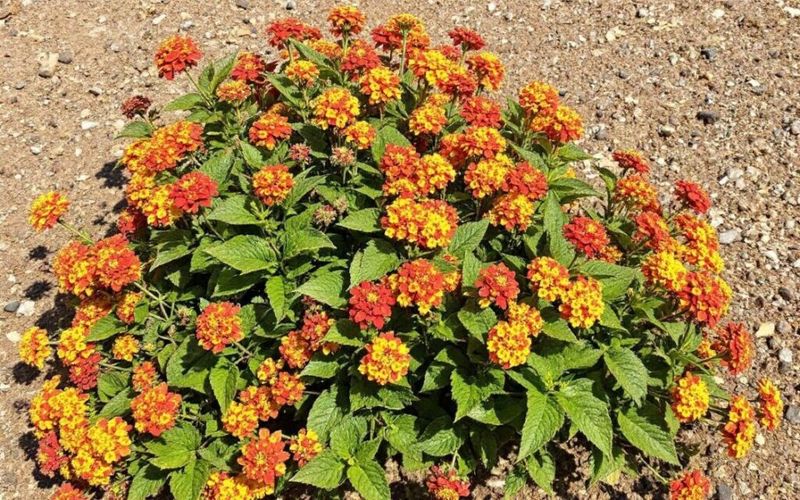
Texas lantana (Lantana urticoides) is native to the state and listed by Texas SmartScape as suited to full sun or partial shade, low-water, and salt-tolerant conditions. Its bloom production actually increases as heat intensifies, which makes it well matched to a south- or west-facing patio edge.
The same profile documents attraction for bees, butterflies, hummingbirds, and birds, though which species visit depends on what lives in your neighborhood.
Autumn sage (Salvia greggii), esperanza (Tecoma stans), and cenizo or Texas sage (Leucophyllum frutescens) round out the flowering group. Texas A&M’s Central Texas bee-friendly plant list includes autumn sage, esperanza, and Texas lantana, supporting their use in wildlife-conscious plantings where regional conditions are appropriate.
Cenizo handles reflected heat and alkaline soils in many parts of Central and West Texas, but it needs excellent drainage and may not perform well in heavy clay or high-humidity Gulf Coast conditions.
Texas A&M Earth-Kind deer guidance lists cenizo, esperanza, autumn sage, and lantana among plants deer often pass over, but explicitly cautions that deer preferences shift under hunger pressure. Treat deer avoidance as a tendency, not a guarantee.
Plant these species in open, separated groupings rather than a continuous hedge near the cooking area. Dense plantings trap heat, accumulate leaf litter, and can block access to appliance controls.
Space individual plants according to their mature spread, keep the bed tidy, and remove spent flower stalks before they dry and add fuel volume near an open flame.
Choose red yucca and prickly pear for structure, not flame contact
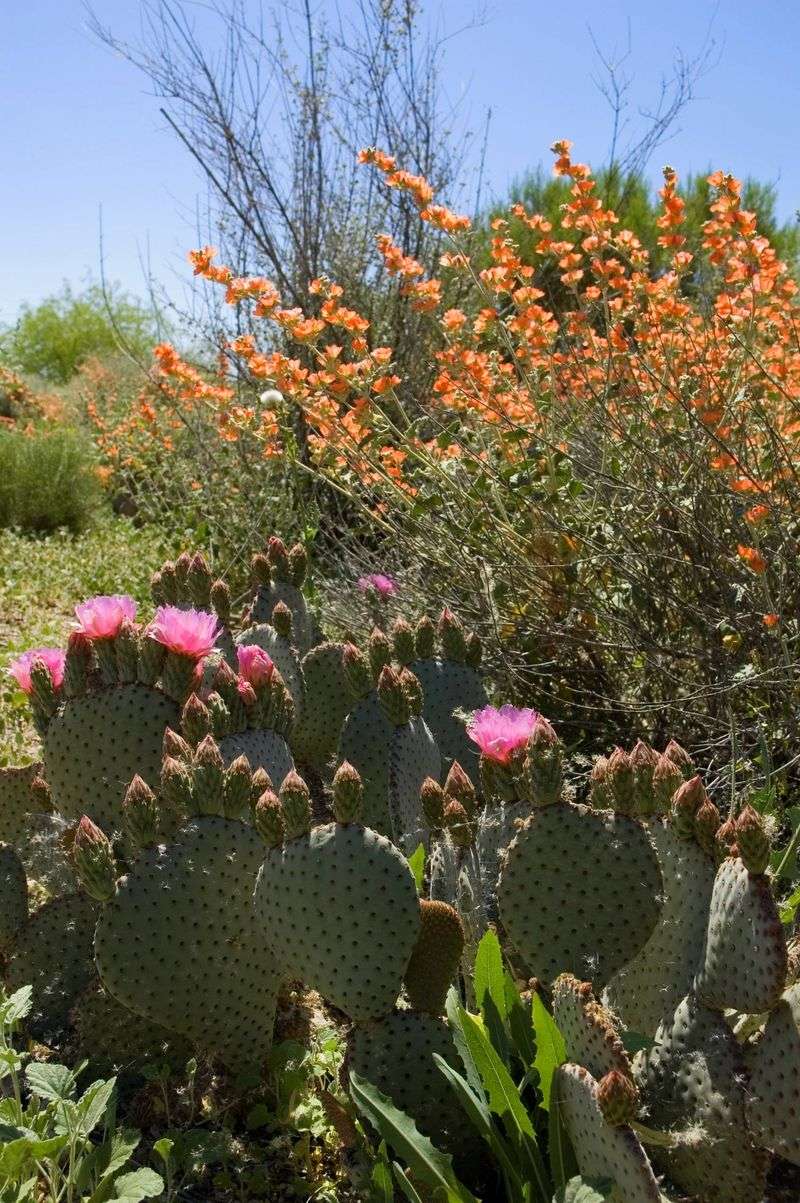
Structural plants anchor a patio landscape visually and handle conditions that would stress most ornamentals. Red yucca and prickly pear both qualify for that role on appropriate Texas sites, but each comes with placement considerations that matter more beside a fire feature than in an ordinary garden bed.
Red yucca (Hesperaloe parviflora) is documented by Texas SmartScape as a native, evergreen, low- or very-low-water plant for full sun or partial shade. Its arching foliage and tall flower stalks attract hummingbirds, birds, and butterflies, and it requires minimal maintenance once established.
Mature plants can spread several feet wide and send flower stalks several feet upward, so placement needs to account for that volume before installation, not after.
The structural appeal of red yucca does not make it safe beside an operating appliance. Its foliage is fibrous, its dry flower stalks are combustible, and Texas A&M’s native and adapted plant materials confirm red yucca and prickly pear as hot, dry, or xeric options without establishing fire safety near an open flame.
Prickly pear adds the complication of spines, which create a hazard along any path used to reach the grill, adjust a valve, or carry food.
Place both plants outside the appliance’s required clearance and away from walking paths and fuel-line access. Ready for Wildfire fire-smart landscaping guidance is consistent on this point: all vegetation can burn under the right conditions, and succulent or drought-tolerant plants are not exempt.
Remove dry flower stalks from red yucca regularly, and keep the area around prickly pear free of accumulated leaf litter and fallen pads.
Let blackfoot daisy fill a low, dry edge
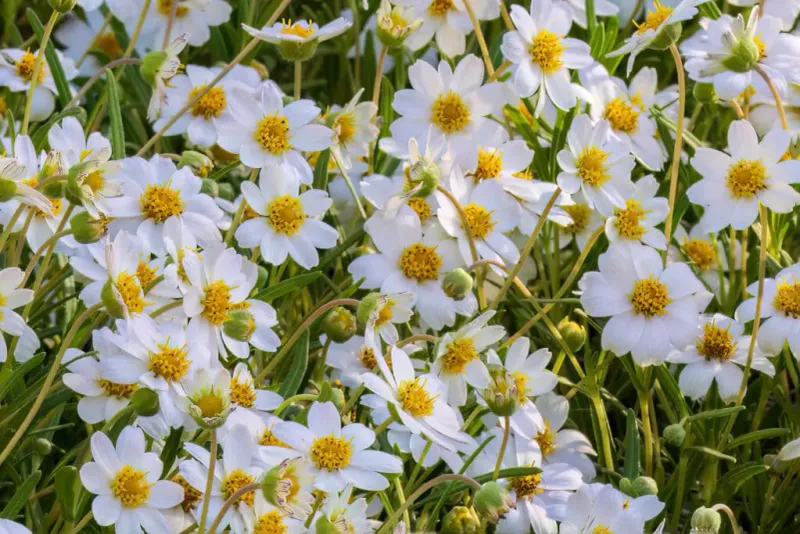
Blackfoot daisy (Melampodium leucanthum) earns a specific role in the hot-patio landscape rather than a general one. Texas SmartScape lists it as a full-sun, very-low-water perennial suited to North Central Texas, with a clear preference for rocky or gravelly, well-drained soil.
Overwatering causes rot, and heavy clay without amendment is a poor match regardless of how attractive the plant looks at the nursery.
Its low, mounding habit, typically under a foot tall, makes it useful for softening the transition between a hardscape edge and a planting bed without blocking sightlines or appliance access. Texas A&M’s native and adapted plant materials confirm its very-low-water classification alongside other xeric candidates, reinforcing that this is a plant for genuinely lean, fast-draining conditions rather than average garden beds.
Low-growing plants near a patio still require the same care as taller specimens. Texas A&M plant-care guidance notes that new transplants need establishment watering and careful acclimation to intense sun, even when the mature species handles harsh conditions without supplemental irrigation.
Space individual plants according to their mature spread, remove spent blooms and dried stems before they accumulate near a fire feature, and check drainage after heavy rain to confirm water is moving through the bed rather than pooling at the crown.
Use muhly sparingly when dry fuel can accumulate
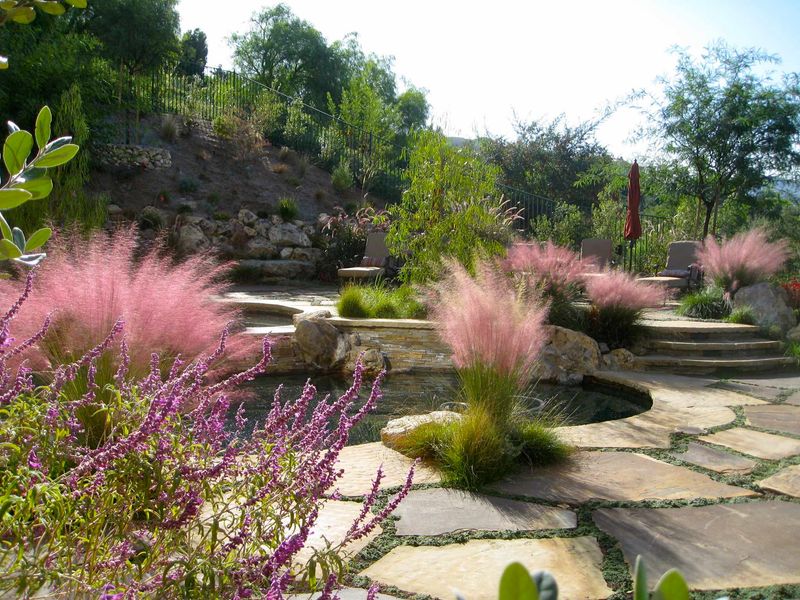
Muhly grass earns admiration every fall when its pink or reddish plumes catch afternoon light, and Texas A&M materials identify big muhly among hot, dry, or xeric plant choices suited to lean conditions. That landscape value is real.
The fire-safety concern that travels with any ornamental grass near a cooking or fire feature is equally real and should not be treated as a minor footnote.
University of Arizona Cooperative Extension firewise guidance recommends using ornamental grasses sparingly near structures because cured foliage and dry flower stalks can become highly flammable. When a grass retains its dried plumes through winter and into the following spring, the accumulated fuel volume near an operating grill or fire pit is a genuine hazard, not a theoretical one.
Texas A&M’s native and adapted plant materials confirm muhly’s xeric suitability without addressing its behavior as a fuel source near open flame.
Fire-resistant landscaping guidance from the University of Arizona reinforces a consistent principle: moisture, low fuel volume, spacing, and maintenance matter more than a plant’s category label. The Ready for Wildfire wildfire action plan identifies continuous fuel beds, including accumulated dry plant material, as a key factor in fire spread.
If muhly fits your region and site conditions, plant it in small, isolated groupings well outside any appliance clearance zone. Cut back dried foliage and flower stalks before each grilling or fire season, and keep the surrounding area clear of fallen stems and loose mulch.
Used with that discipline, muhly can contribute seasonal color without creating a fuel hazard.
Build the layout around clearance, spacing, and cleanup
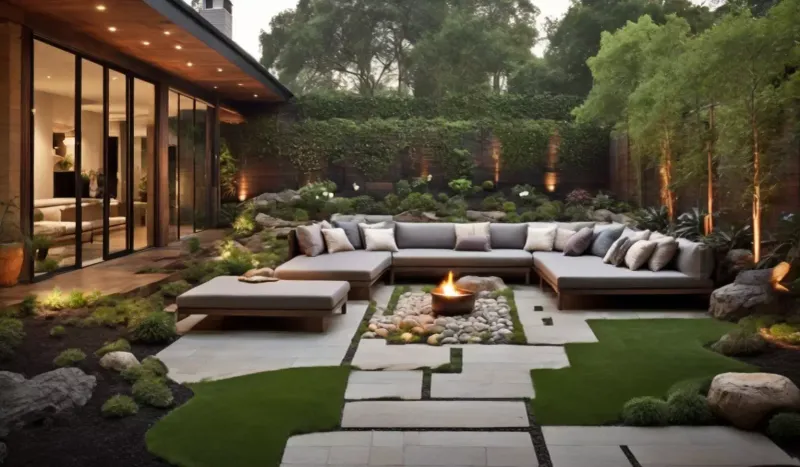
A good plant palette fails quickly without a layout that puts safety first. Start by mapping the appliance’s required clearance on the ground before placing a single plant.
Use noncombustible hardscape, concrete, stone, gravel, or brick, for the area immediately surrounding the grill or fire feature. That surface does double duty: it satisfies clearance requirements and eliminates the combustible mulch and leaf litter that accumulate fastest closest to a heat source.
Plants go into separated groupings beyond that noncombustible boundary. Ready for Wildfire fire-smart landscaping guidance consistently identifies spacing, low fuel volume, and moisture as the factors that matter most in limiting fire spread, not a plant’s species label.
Avoid continuous plant masses that connect the landscape to the appliance; interrupted groupings with noncombustible gaps between them slow the path any ember or flame would need to travel.
Preserve clear access to every appliance control, gas valve, fuel-line connection, and walking path before and after planting. University of Arizona fire-resistant landscaping guidance reinforces that pruning, removal of dead material, and maintenance schedules affect fire behavior more than initial plant selection.
Plan for mature plant sizes at installation, not the size the plant is when you buy it.
Establishment watering is non-negotiable even for drought-tolerant species. Texas A&M plant-care guidance notes that new transplants need appropriate irrigation and acclimation to intense sun before they can perform as described in a mature-plant profile.
Water new plants on a schedule, then taper off as roots establish.
Before every grilling session or fire-pit use, walk the perimeter. Remove fallen leaves, dried stems, and any mulch that has migrated toward the appliance.
CPSC guidance and NFPA fire-safety recommendations both emphasize that outdoor fires and grills should never be left unattended, a rule that applies regardless of how carefully the surrounding landscape was designed.
Choose the right survivor, then protect the separation
Pulling this together comes down to a two-step decision. First, match each candidate to your actual conditions: your Texas region, the site’s sun exposure, soil texture, drainage, mature plant size, and realistic irrigation access.
Texas SmartScape’s regional guidance and the Texas A&M Earth-Kind selector are the right starting filters, not a general list of “tough Texas plants.”
Second, let the appliance manual, local fire rules, and noncombustible separation determine where each plant goes. Fire-smart landscaping principles are consistent: spacing, moisture, low fuel volume, and regular cleanup shape fire behavior far more reliably than any plant’s reputation for toughness.
Check Texas outdoor-burning rules before each use, especially during drought when county burn bans can change quickly.
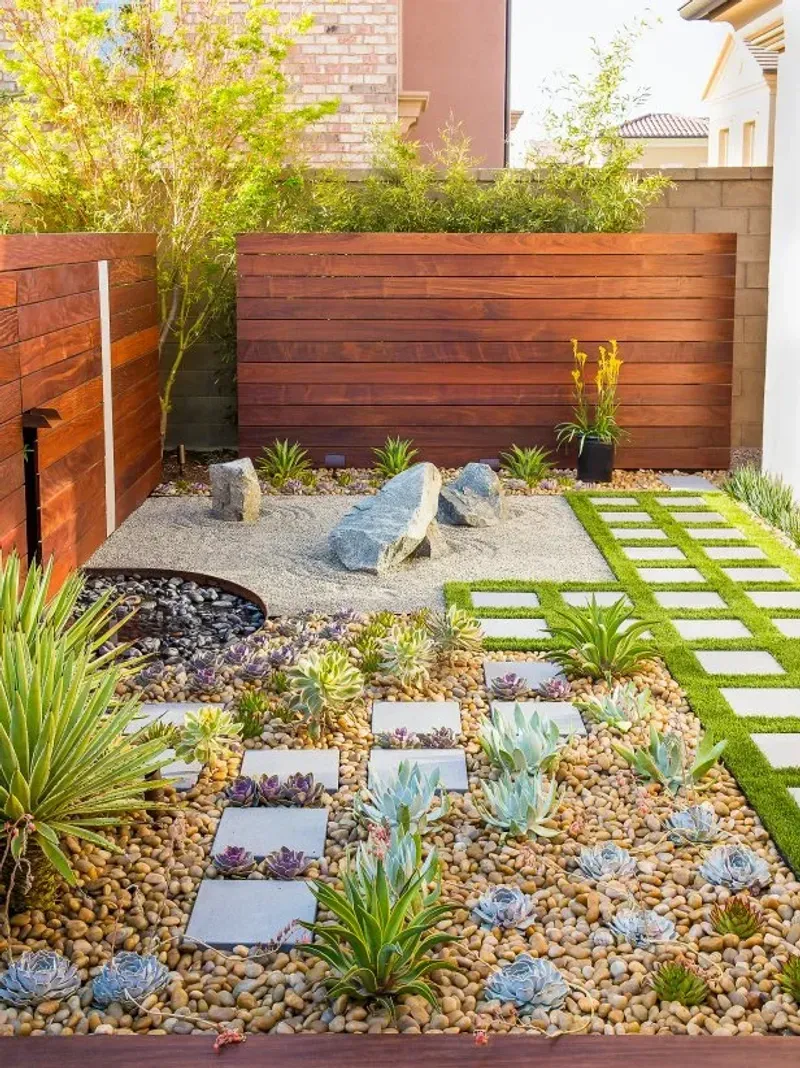
Texas lantana, red yucca, blackfoot daisy, autumn sage, esperanza, cenizo, prickly pear, and muhly can all contribute to a more attractive, regionally appropriate patio landscape. They belong around the outdoor cooking area, outside the clearance zone, in well-maintained, open groupings.
The clearance zone itself stays noncombustible, supervised, and clear of plant material every time the grill or fire feature is in use. A yard that looks good and stays safe is not a compromise; it is just a plan that starts with the right boundaries.