
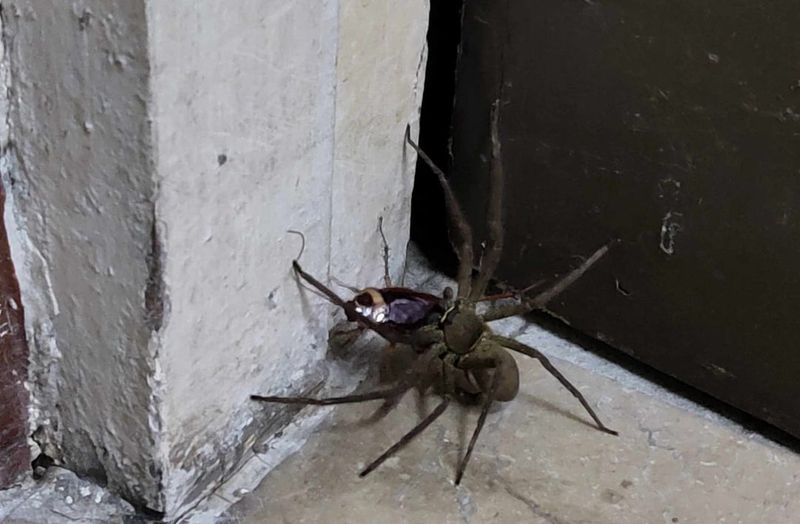
Spotting a large, fast-moving spider inside your Texas home can send anyone scrambling for a shoe. Before you squash it, though, you may want to know what it actually is and what it might be doing.
A big brown spider racing across your kitchen floor could be a pantropical huntsman, a species documented as a cockroach predator, though that does not mean every alarming spider you see is one or that a single spider will solve a roach problem on its own. Understanding what you are looking at, how to handle the situation safely, and what real cockroach control requires will serve you far better than a snap reaction.
The spider may be a cockroach hunter
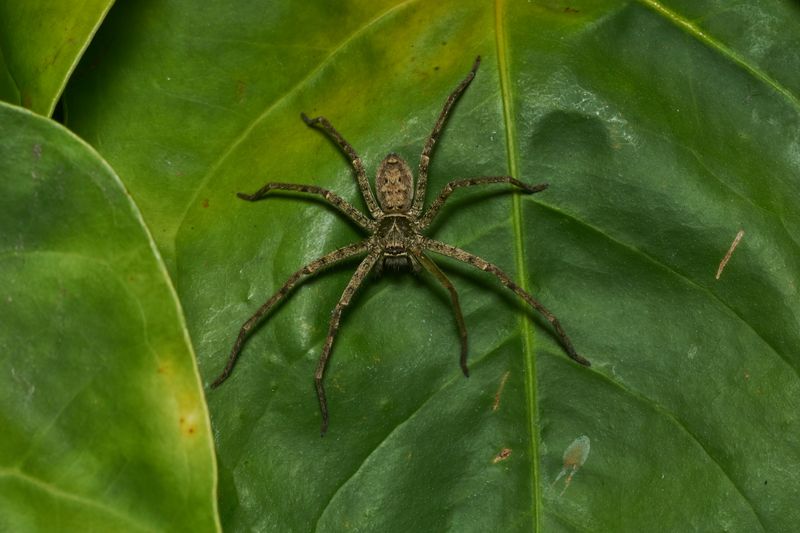
Finding a fast, flat, brown spider inside your home does not automatically mean you have identified a pantropical huntsman, Heteropoda venatoria, but that species is worth knowing about. According to UF/IFAS Extension guidance on the pantropical huntsman spider, H. venatoria is a documented predator of cockroaches and other household insects, making it genuinely useful from a pest-management standpoint.
The catch is that a visual sighting alone, without careful identification, cannot confirm the spider is a huntsman or prove it is actively hunting roaches in your particular home.
The species is sometimes called the giant crab spider or banana spider and is established in subtropical parts of Texas and Florida. It hunts actively without building a prey-catching web, which is one reason homeowners stumble across it in open spaces like kitchens and laundry rooms rather than in corners covered with silk.
That active lifestyle is also what brings it into contact with roaches moving along baseboards and behind appliances.
Even so, the honest answer here is “may be,” not “is.” Texas is home to many large wandering spiders, including wolf spiders, brown recluses, and several huntsman-family relatives, and a vague description or a blurry photo cannot pin down the species. The Texas A&M Spiders of Texas database catalogs dozens of species that share a broadly similar brown-and-flat appearance, which is why confident identification matters before you decide how to respond.
A huntsman found indoors may be feeding on roaches, and that is genuinely good news if it checks out. What the evidence does not support is the idea that one spider will clear, eliminate, or reliably control a household cockroach population.
Think of a confirmed huntsman as a welcome but limited ally, not a replacement for the pest-management steps covered later in this article.
How to recognize a pantropical huntsman
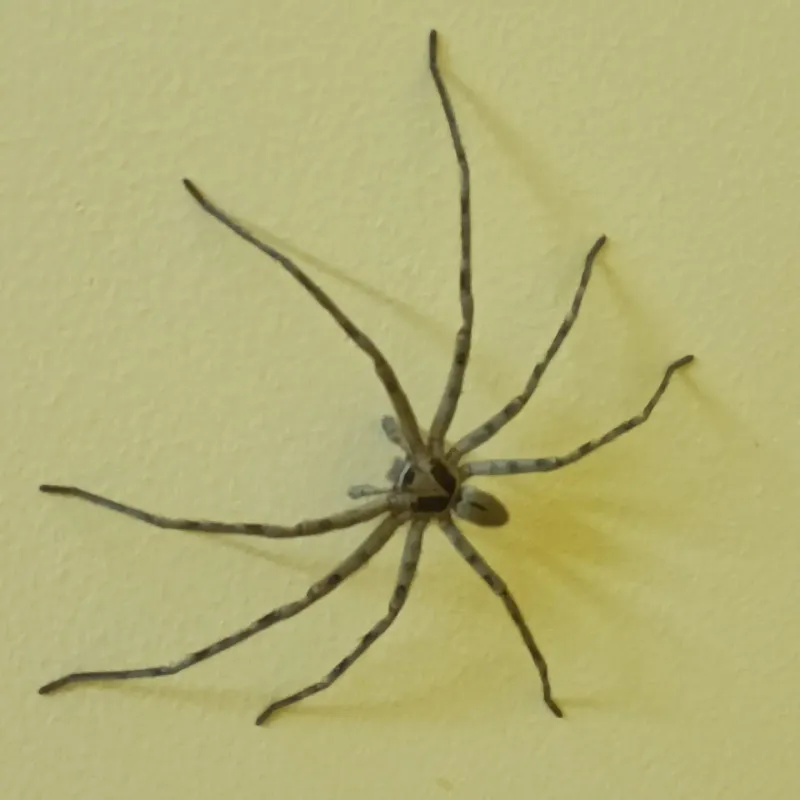
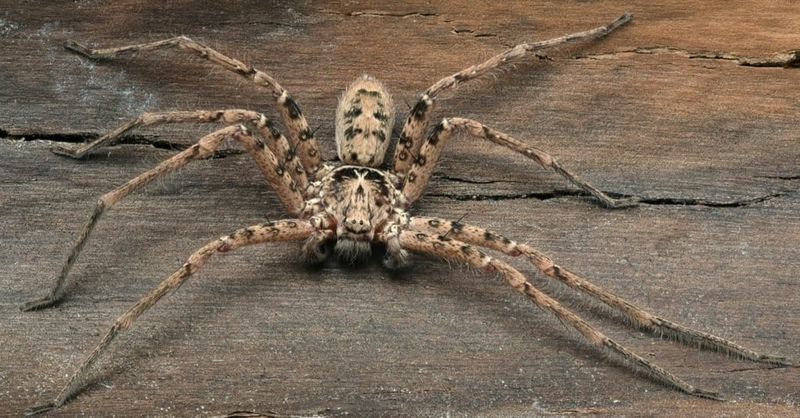
Body shape is the first thing to look at. Pantropical huntsman spiders carry a noticeably flattened profile, almost as if the spider has been pressed thin from top to bottom.
That compressed build lets the animal slip under doors, behind picture frames, and into gaps around plumbing with surprising ease, and it is one reason a huntsman can appear out of nowhere on a wall you thought was solid.
Size is the next clue. UF/IFAS Extension’s huntsman spider profile puts the adult body length at roughly 2.2 to 2.8 centimeters, with a leg span of approximately 7 to 12 centimeters.
That leg span is what shocks most people: the spider looks enormous because its legs extend outward to the sides rather than angling forward and back the way a wolf spider’s legs do. Those side-oriented, crab-like legs are one of the more reliable visual cues that separate a huntsman from other large Texas spiders.
Coloring runs tan to medium brown, sometimes with faint banding or mottling on the legs, but the overall impression is a plain, pale-brown animal without the distinctive fiddle marking of a brown recluse or the rounded, high-bodied silhouette of a wolf spider. The eyes are arranged in two rows, though confirming eye pattern usually requires a close look that most homeowners understandably skip.
Movement is also telling. Huntsman spiders are fast and tend to sprint in short bursts, then freeze.
They do not retreat to a web because they do not build one for catching prey. If the spider you saw bolted across open floor rather than retreating to a corner with silk, that behavior is consistent with huntsman habits, though it also fits wolf spiders and several other active hunters found in Texas homes.
The takeaway is that these traits together – flat body, wide leg span, crab-like leg orientation, plain brown color, no web – support a huntsman identification. None of them individually, and not even all of them combined from memory or a low-quality photo, can guarantee species-level accuracy.
The Spiders of Texas resource from Texas A&M is a useful starting point if you want to compare photographs against a broader set of Texas species before drawing a conclusion.
Why cockroaches may be on its menu
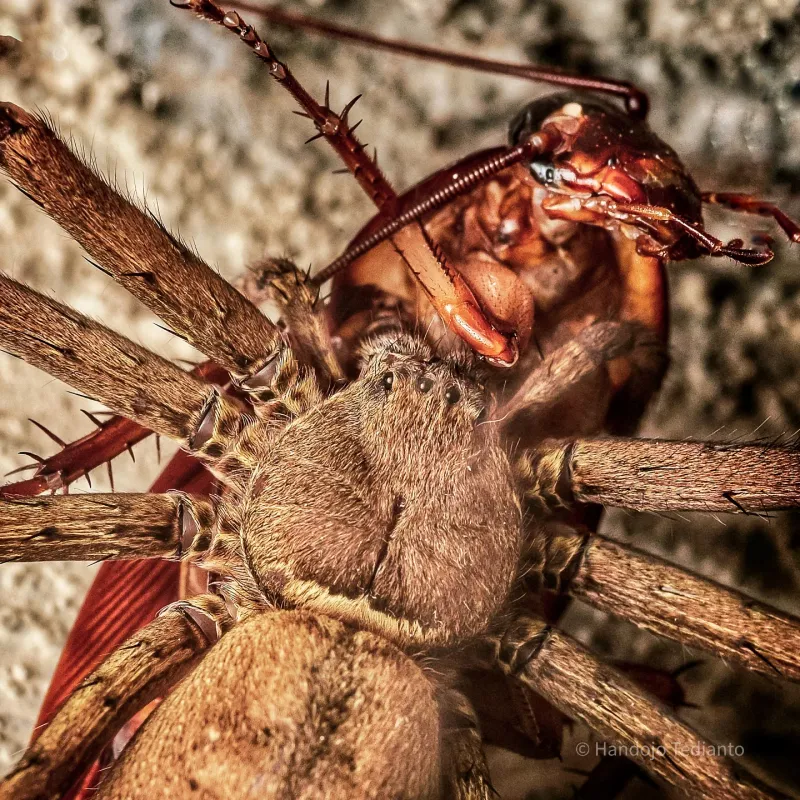
Pantropical huntsman spiders do not sit in a web waiting for prey to blunder in. They actively patrol surfaces, using speed and agility to chase down insects, which puts them in direct competition with the same roaches that slip along your baseboards after dark.
That pursuit-hunting strategy is a practical reason why cockroaches end up on the menu: both animals are active at night, both move along floors and walls, and a huntsman fast enough to catch a fleeing roach has a real nutritional reason to do so.
The predation connection goes beyond behavior. Researchers studying H. venatoria venom found that it contains peptide compounds highly active against voltage-gated sodium channels in insect nervous systems.
That peptide-rich venom study used American cockroach nerve targets specifically, which tells you that the spider’s chemistry is well-suited to subduing exactly the kind of pest Texas homeowners most want gone. This is laboratory evidence of insect-target biology, not a measurement of how many roaches disappear from a particular home, but it does confirm the predator-prey relationship is real and not just folklore.
Field observations and entomological literature also document cockroaches as part of the huntsman’s diet alongside other household insects. The spider will take what it can catch, which can include silverfish, crickets, and other arthropods sharing the same indoor environment.
A home with a roach presence is, from the spider’s perspective, a well-stocked pantry.
Where the evidence stops short is at the household-control claim. One spider hunting at night in a large home cannot reliably reduce a roach population that reproduces quickly, hides in wall voids, and concentrates in areas the spider may never patrol.
Roaches can produce dozens of offspring per egg case, and a single huntsman simply cannot keep pace with that rate of reproduction once an infestation is established. The spider is a natural predator of cockroaches, full stop.
It is not a substitute for the monitoring and control steps that actually move the needle on a real infestation.
Where this spider fits in Texas
Heteropoda venatoria is not a spider that spread across Texas on its own. It arrived through commerce, most likely traveling with tropical plant shipments and cargo, and is now established in the warmer, more humid parts of the state.
The species is most relevant to Gulf Coast communities and southern Texas, where subtropical conditions allow it to survive and reproduce year-round. Homeowners in Houston, Corpus Christi, Brownsville, and similar cities are the most likely to encounter one indoors, particularly in homes with attached garages, greenhouses, or frequent deliveries of tropical plants.
Farther north and inland, where winters are colder and humidity drops, the species becomes far less common. UF/IFAS Extension describes H. venatoria as an introduced species established in subtropical Texas and Florida, which means its range tracks climate rather than state borders.
A homeowner in Amarillo or Lubbock who spots a large brown spider is unlikely to be looking at a huntsman, and applying huntsman-specific guidance to a misidentified spider in a cooler Texas region could lead to poor decisions about how to respond.
Geography also does not resolve the identification problem within the huntsman’s core range. Southern Texas hosts brown recluse spiders, black widows, wolf spiders, and multiple huntsman-family relatives alongside H. venatoria itself.
The Spiders of Texas database documents how many large, wandering, brown-bodied spiders share the same subtropical habitat, which means living in Houston does not make every large indoor spider a pantropical huntsman.
Texas A&M AgriLife Extension guidance on spiders reinforces this point by noting that correct identification is a prerequisite to any informed response. The huntsman is also an introduced species, not native Texas wildlife, so the article’s frame is one of ecological reality rather than conservation advocacy.
Deliberately releasing one into your home or yard is not recommended, and no source supports it as a pest-control strategy.
How to respond without getting bitten
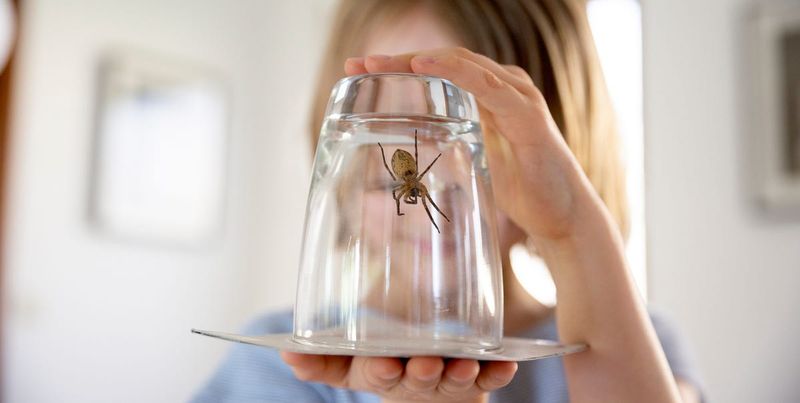
A correctly identified pantropical huntsman is a reasonable spider to leave alone if you can tolerate sharing the space. It poses no web to walk into, hunts pest insects, and will generally move away from people rather than toward them.
That said, “tolerate” is a personal threshold, and removing the spider is a perfectly sensible choice. The question is how to do it without getting hurt.
The jar-and-card method works well and requires nothing special. Place a large jar, bowl, or container over the spider, then slide a stiff piece of cardboard underneath to seal it in.
Carry the container outside and release the spider well away from the entry points you want to protect. A vacuum with a hose attachment is another option if the spider is in a corner or a tight space, though the spider may survive inside the vacuum bag and should be disposed of promptly.
What to avoid is direct hand contact. UF/IFAS Extension notes that huntsman bites are uncommon but can be locally painful and cause noticeable swelling when the spider is grabbed, squeezed, or trapped against skin.
The spider does not go looking for a fight, but a cornered or pinned animal will defend itself. Reaching bare-handed into a pile of laundry, shaking out clothing or footwear without checking first, or trying to pin the spider against a surface are the situations most likely to result in a bite.
Calling the spider harmless would be inaccurate. It is generally not considered dangerous to people in the way that a brown recluse or a black widow is, but “not dangerous” and “harmless” are not the same thing.
The spider uses venom to subdue insect prey, and that same venom can cause a painful local reaction in a person who handles it carelessly. Children and pets are particularly worth keeping away from any unidentified large spider, regardless of how the identification seems to be trending.
Texas A&M AgriLife Extension spider guidance supports a balanced approach: spiders found indoors can be removed rather than killed, but prevention – sealing entry points and reducing clutter – is the more durable answer to repeated indoor sightings. A huntsman inside your home entered through a gap somewhere, and finding that gap is more useful in the long run than managing individual spiders one at a time.
Confirm and reduce the real roach problem
A huntsman sighting does not confirm that cockroaches are present, and it certainly does not mean an infestation is already shrinking. The spider may have wandered in from outside, may be feeding on other insects, or may have arrived in a delivery or potted plant.
Before committing to any cockroach-control plan, verify that roaches are actually there.
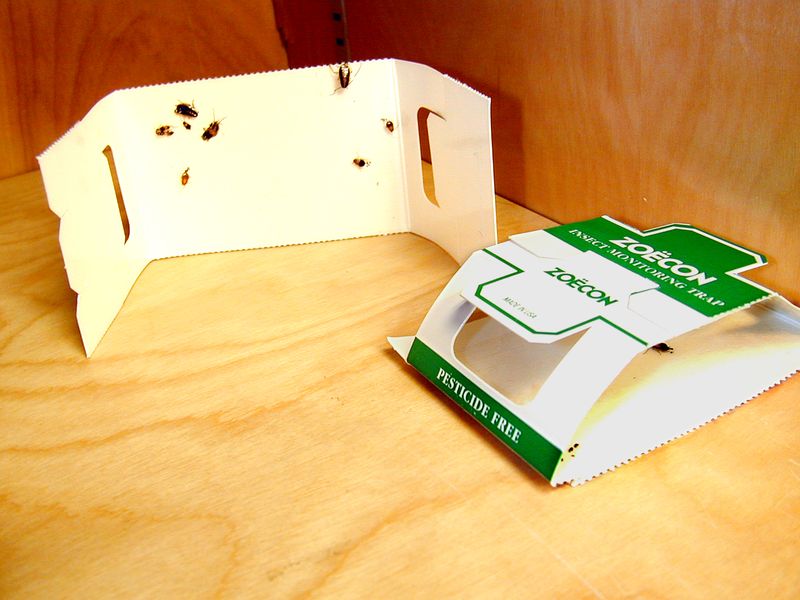
Sticky monitoring traps are the most practical starting tool. University of Minnesota Extension guidance on cockroaches recommends placing sticky traps tight against walls and near sinks, refrigerators, stoves, and cupboards, since roaches prefer to travel along edges and congregate near food, water, and warmth.
Check traps after 24 to 48 hours. Catches near the refrigerator motor or under the sink point to those zones as the primary activity areas, which tells you where to focus control efforts first.
Sanitation and exclusion do more lasting work than any single product. Seal cracks and gaps around baseboards, plumbing penetrations, windows, and door frames with caulk or weatherstripping.
Remove cardboard boxes and paper bags, which roaches use as both shelter and food. Store pantry items in sealed containers, clean up crumbs and spills the same day they happen, and fix any dripping faucets or slow drains that keep surfaces damp.
Roaches need water more urgently than food, so eliminating moisture sources can reduce activity noticeably.
When baiting is needed, EPA smart pest control guidance recommends gel baits or bait stations placed where roach activity is confirmed, paired with sanitation rather than used as a substitute for it. Bait products must be used strictly according to their label and kept completely inaccessible to children and pets, preferably in tamper-resistant stations designed and labeled for that purpose.
Bait stations are not inherently child-safe simply because they are small or enclosed.
EPA guidance on pesticide decision-making also encourages homeowners to exhaust non-chemical options first and to call a licensed pest-control professional when an infestation is established or when over-the-counter products are not working. A professional can access products and application methods not available to the general public and can identify harborage areas that a homeowner might miss entirely.
No amount of spider activity replaces that level of targeted intervention when roaches are genuinely established.
The practical rule for the next sighting
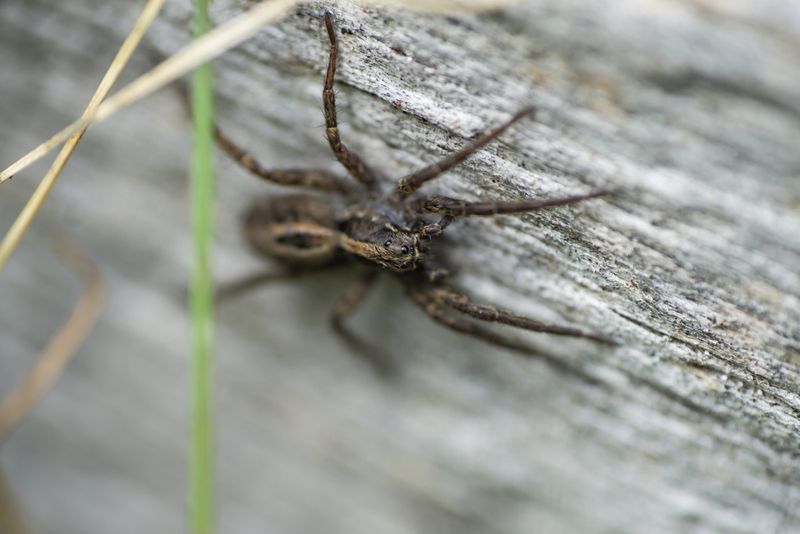
When a large spider turns up indoors, the most useful first step is a calm look rather than an immediate reaction. If the spider is in a warm-climate Texas home, has a flat body, very long crab-like legs, and no web, a pantropical huntsman is a reasonable possibility.
Confirmed or strongly suspected, you have two equally valid options: leave it alone as a natural roach predator, or remove it safely using a jar and card without touching it directly.
UF/IFAS Extension’s huntsman profile supports tolerating the spider if you are comfortable doing so, but comfortable is the operative word. There is no obligation to keep a spider inside your home, and removing it does not undermine your pest-control situation.
What does undermine it is stopping sanitation, exclusion, or monitoring because a spider is present. Roaches reproduce faster than any single predator can manage, so the integrated steps covered in the previous section remain necessary regardless of what the spider is doing.
If any pesticide product is part of your plan, read the label completely before use and follow every instruction. Keep all products, including bait stations, inaccessible to children and pets, and use appropriately labeled tamper-resistant stations wherever bait is placed.
EPA guidance on pesticide use decisions consistently frames the label as the legal and safety baseline, not a suggestion.
One more caution worth holding onto: if you or someone in your household develops a skin lesion or irritation and suspects a spider bite, do not assume the culprit was the huntsman you saw last week. CDC post-travel dermatologic guidance notes that many suspected spider bites are actually other skin conditions or infections, and attribution without reliable identification is unreliable.
A healthcare provider is the right resource for any skin concern, not a guess based on a spider sighting. The spider may well be on your side, but good pest control and good medical judgment are still your most dependable tools.