
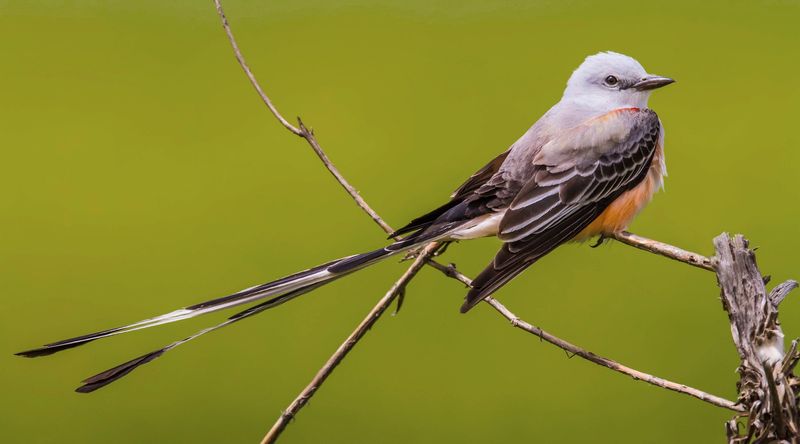
Every summer in Texas, a striking bird with an impossibly long tail shows up on fence lines and power wires, scanning the ground below for its next meal. That bird is the Scissor-tailed Flycatcher, and it has a well-earned reputation as one of the most effective grasshopper hunters in the state.
Knowing what draws it in and what it can realistically do for your garden gives you a smarter approach than any spray bottle. Here is what Texas gardeners actually need to know.
Meet the Texas flycatcher with the unmistakable tail
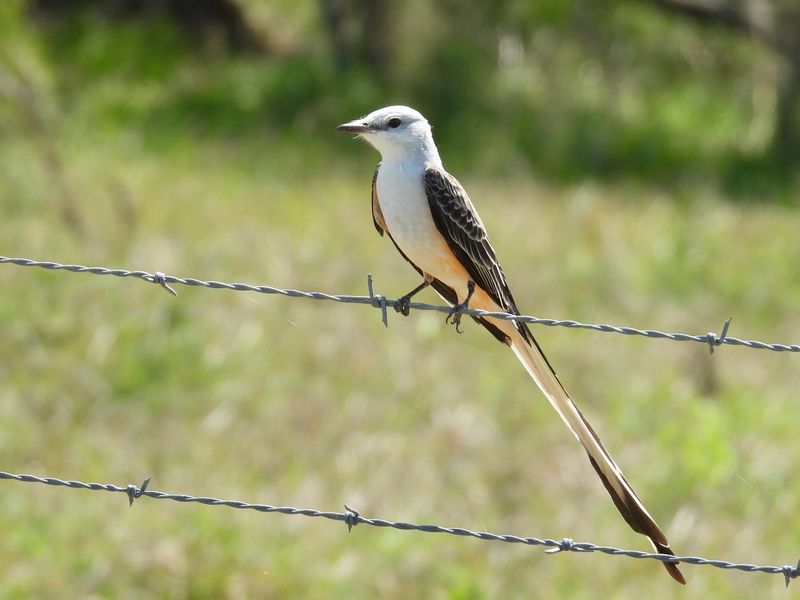
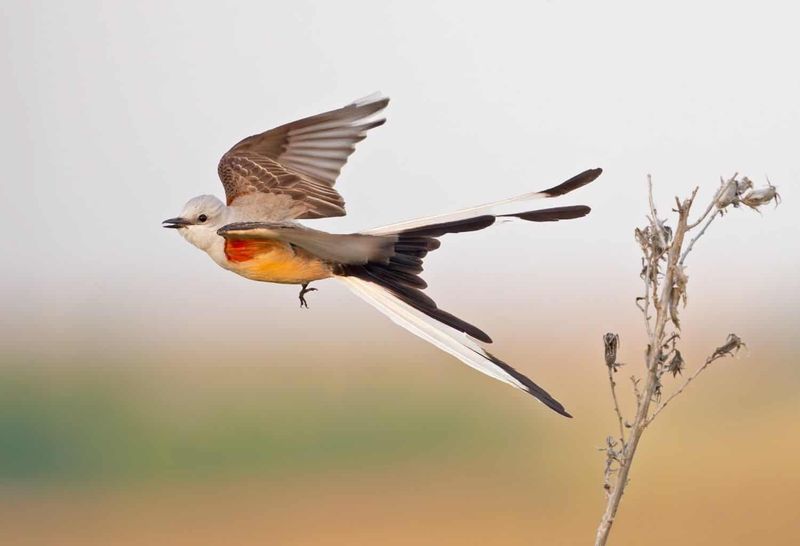
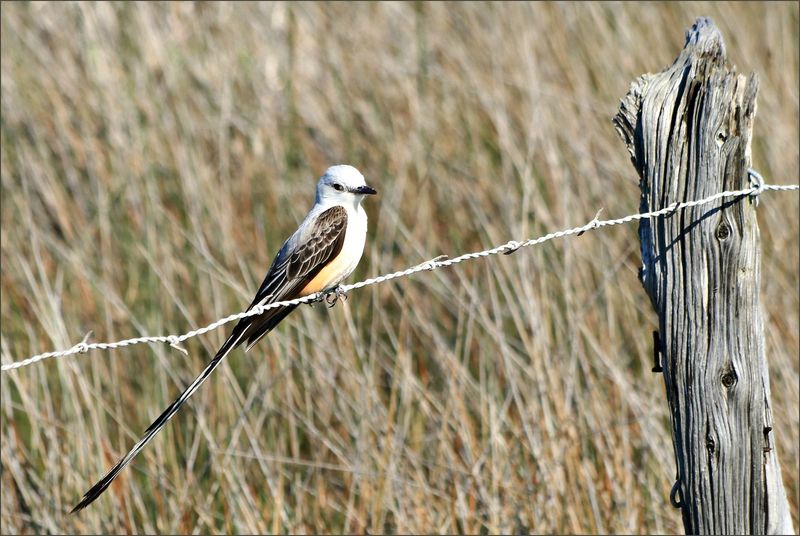
Few Texas birds stop people in their tracks the way the Scissor-tailed Flycatcher does. Adults wear a pale gray head and back, white underparts, and a wash of salmon-pink along the sides and underwings.
The tail is the giveaway: a deeply forked, black-and-white streamer that can stretch longer than the bird’s own body, fanning open in flight like a pair of scissors mid-cut.
According to Texas Parks and Wildlife, this species is closely associated with open habitats across the state, where scattered trees, fence lines, and utility wires give it the elevated vantage points it needs to hunt. You are most likely to spot one sitting upright and alone on a wire or fence post, head swiveling as it watches for movement below.
That posture is not laziness; it is the bird’s primary hunting strategy.
Scissor-tailed Flycatchers are warm-season visitors in Texas, generally arriving in spring and departing by fall. The Audubon Field Guide places their breeding-season presence from roughly April into fall, though exact arrival and departure dates shift by location and year.
A bird may turn up in your neighborhood for a few days, linger through the season, or skip your block entirely depending on territory, prey, and habitat.
Habitat suitability varies across Texas, and local abundance is not uniform. Open Central and South Texas landscapes, where prairie edges and ranch land still exist, tend to support strong numbers.
Heavily wooded yards or dense suburban blocks offer fewer of the open sightlines this species depends on, making visits there less predictable. Spotting one perched outside your window is a genuine treat, but no two summers are exactly alike.
Watch how it hunts from an exposed perch
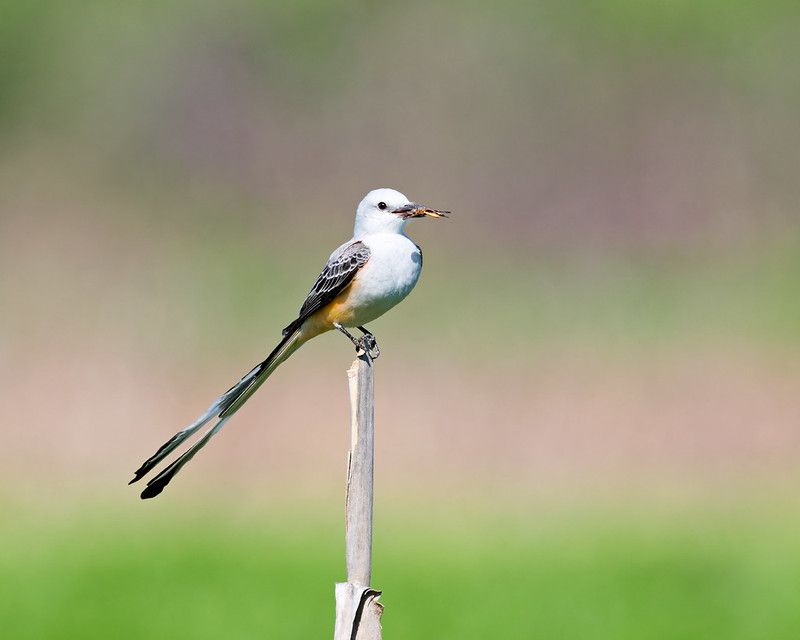
Perch-and-sally hunting is this bird’s signature move. A Scissor-tailed Flycatcher settles on a wire, fence rail, or isolated branch, holds still, and watches.
When an insect moves in the air or on the ground below, the bird launches out, snatches its target, and returns to the same perch or a nearby one to start the process again. Cornell Lab’s life-history account notes that foraging heights range from ground level to roughly 30 feet, and the bird occasionally gleans prey from vegetation or sparsely vegetated ground rather than catching it mid-air.
Grasshoppers rank among the most strongly supported items in this species’ diet. Cornell lists them as particularly common prey, and Audubon describes them as a major part of what the bird eats through the warm season.
If grasshoppers are hopping through your lawn or garden beds, a foraging flycatcher is a plausible, if not guaranteed, visitor.
Cicadas are a different story. Flycatchers and their relatives in the kingbird family are capable of catching large flying insects, so a Scissor-tailed Flycatcher could opportunistically grab a cicada when one buzzes past at the right height and speed.
However, the species-specific sources do not establish cicadas as a regular or major food source for this bird. Treat any cicada benefit as a possible bonus, not a reliable outcome.
Expecting one flycatcher to clear a yard of cicada noise or cicada emergence is not a realistic goal, and no reviewed evidence supports framing it that way.
Open sightlines matter enormously to this hunting style. A yard with low-cut grass, a clear patch of ground, or a meadow edge gives the bird the visibility it needs to spot prey and make a clean intercept.
Dense shrub plantings or tall, tangled vegetation at ground level reduce hunting opportunities, even if a bird occasionally perches nearby.
Bird pest control helps ecosystems, not guarantees
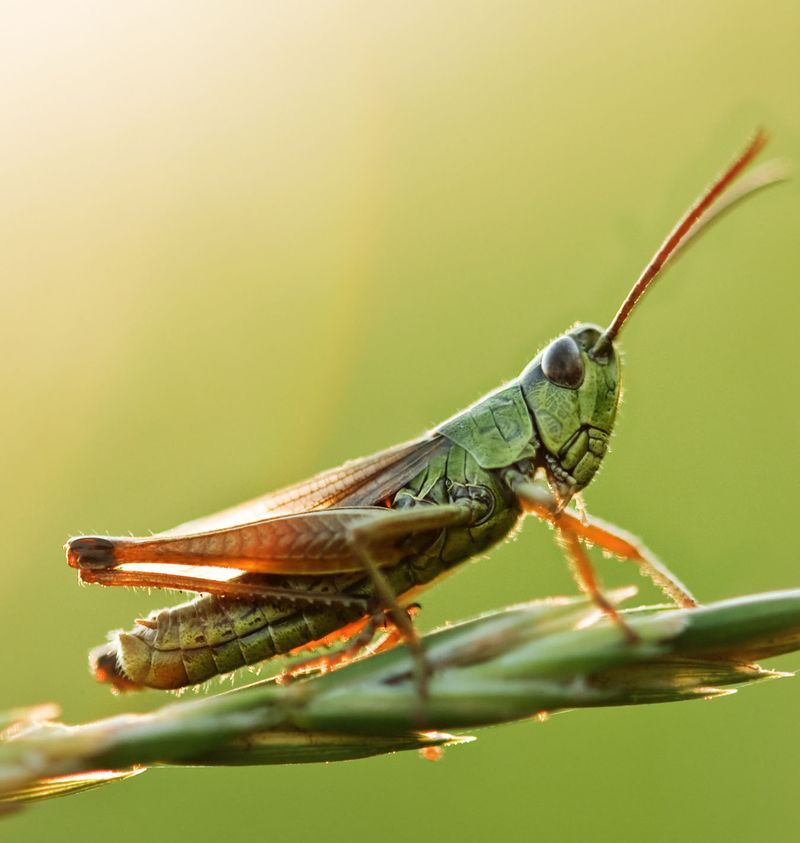
A Scissor-tailed Flycatcher’s menu is impressively varied. Cornell Lab documents grasshoppers, crickets, beetles, wasps, flies, caterpillars, moths, true bugs, and spiders as prey, and Texas Parks and Wildlife notes that the diet includes insects harmful to agriculture.
That breadth is genuinely useful to know, because it means a visiting bird is not narrowly focused on one pest but is actively working through the insect community in its territory.
What that does not mean is dependable, season-long suppression of any particular pest in your home garden. A single bird removes individual insects while foraging.
It hunts to feed itself and, during breeding season, its young. Its territory may overlap your yard partially or not at all, and its foraging routes shift with prey availability, weather, and competing birds.
Removing every grasshopper or cicada from a defined garden space is simply not what the bird is doing.
Broader research on bird pest regulation confirms that the picture is complicated. A 2023 meta-analysis on avian regulation of crop and forest pests found an overall positive pest-reduction effect across studies, but nearly half of recorded observations were neutral and a small share were negative.
Effects varied considerably by crop type, habitat, landscape context, and which bird species were present. Studies on specific crops found benefits in some settings and less predictable or opposing results in others.
For a Texas home gardener, the honest takeaway is that a Scissor-tailed Flycatcher may reduce the number of grasshoppers moving through your yard on a given afternoon, and that is a genuinely useful thing. Treating that contribution as a free substitute for monitoring your plants or managing a serious pest outbreak, however, sets up an expectation the bird cannot meet.
Ecosystem support and guaranteed pest control are not the same thing.
Create the semi-open structure it prefers
Habitat design for this species starts with one counterintuitive principle: do not plant everything. Scissor-tailed Flycatchers need open ground or low-vegetation space to hunt effectively.
A yard converted entirely to dense beds, tall native grasses, or thick shrub layers removes the sightlines and landing zones the bird depends on. Cornell Lab’s life-history page associates the species with open landscapes that include scattered trees, utility lines, and fence rows, not closed-canopy woodland or densely planted suburban lots.
Keeping a section of lawn, a low-mowed prairie strip, or a gravel or mulch path gives a hunting flycatcher the clear view it needs from an elevated perch. Fence lines, wire trellises, isolated trees, and tall shrubs at the edges of that open space serve as ready-made hunting stations.
If your yard has a back fence with a clear view of a grass patch, that combination already resembles the structure this bird uses across Texas ranch and farm country.
Texas Wildscapes guidance from TPWD supports a balanced approach: mix open areas with planted zones rather than committing the entire yard to either extreme. Selective mowing helps too.
Leaving unmowed edges along fences or property lines, then mowing a central patch short, creates a habitat gradient that supports both hunting birds and the insects they eat.
Even thoughtful improvements only increase the chance of a visit, not guarantee one. Territory selection for this species depends on prey availability, nesting sites, competition from other birds, and landscape-level factors that extend well beyond a single yard.
A heavily wooded lot or a yard surrounded by dense tree canopy on all sides may simply offer fewer suitable hunting opportunities regardless of what a gardener does inside the fence line. Realistic expectations make the habitat work more rewarding when a bird does show up.
Support insects without turning the yard into a lure
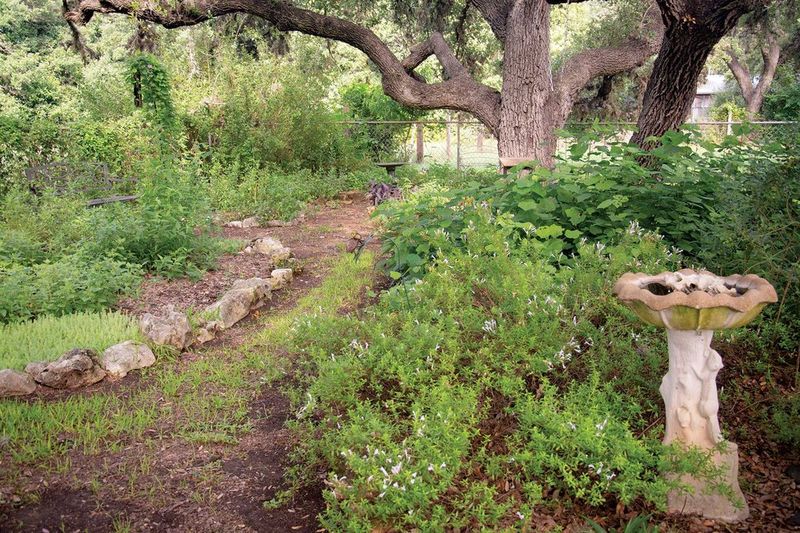
Native Texas plants, grasses, and wildflowers do something specific for insect-eating birds: they feed the insects those birds depend on. Blackfoot daisy, Texas lantana, prairie dropseed, and native sedges support caterpillars, beetles, true bugs, and other invertebrates that work their way up the food chain.
TPWD’s Wildscapes design guidance recommends native vegetation because it is adapted to local soils and climate, supports local insect communities, and reduces the irrigation and chemical inputs that can degrade habitat over time.
What native plants do not do is directly attract or guarantee a Scissor-tailed Flycatcher. No particular flower, shrub, or grass variety has been shown to specifically draw this species to a yard.
The connection is indirect: more native vegetation supports more insects, and more insects may bring more insect-hunting birds into the general area. Retaining leaf litter, standing stems, and slightly less-manicured edges along fences or garden borders adds to that insect base without requiring extra planting.
Clean, shallow water is a useful addition for wildlife broadly. Texas Parks and Wildlife recommends a water depth of no more than about 3 inches, refreshed regularly to prevent algae buildup and mosquito breeding.
A simple ceramic or concrete basin works well. Position it in the open rather than tucked under dense shrubs, where cats can hide nearby.
Seed feeders are worth addressing briefly because they come up often in backyard-bird discussions. A Scissor-tailed Flycatcher is not going to visit a sunflower or safflower feeder.
This species eats insects almost exclusively, so habitat, open foraging space, and perch availability matter far more than any feeder setup. If you enjoy feeding birds, that is fine, but it will not specifically draw a flycatcher to your yard.
Protect visiting birds while managing garden pests
Keeping a yard hospitable to insect-hunting birds and keeping garden plants healthy are not competing goals, but they do require some coordination. Start with monitoring.
Walk your beds regularly and check for chewed leaves, stippled foliage, or egg masses before a pest population gets ahead of you. Catching a grasshopper problem early, when numbers are low, gives physical controls like row covers, hand-picking, and targeted traps a real chance to work.
Texas Partners in Flight warns that birds face direct risk from sprayed chemicals and granular pesticides, and secondary poisoning from eating contaminated insects is also a documented hazard. Broad-spectrum insecticides applied across a yard can remove the very prey base that draws insect-eating birds in.
Pest-specific measures, physical barriers, and integrated pest management practices are better first steps, and they preserve the insect community that supports the broader food web.
That said, tolerating a damaging grasshopper outbreak because you are hoping a flycatcher will handle it is not a sound strategy. TPWD’s Wildscapes design tips support habitat practices that encourage natural predators, but they do not suggest abandoning pest management when plants face real damage.
Monitor, intervene at the appropriate threshold, and favor the least-disruptive effective method.
Outdoor cats are a significant and well-documented threat to ground-foraging and perching birds. Keeping cats indoors or within a contained outdoor enclosure removes one of the most preventable hazards in a backyard bird habitat.
Window collisions are another concern: screens or visual patterns applied to glass that break up reflections help birds avoid strikes more reliably than relying on any single deterrent silhouette. Small steps on both fronts add up to a meaningfully safer yard for any bird that stops in to hunt.
Skip the nest box and leave active nests alone
Standard cavity nest boxes sold at garden centers are built for bluebirds, chickadees, and wrens, all species that naturally use tree cavities. A Scissor-tailed Flycatcher is not one of them.
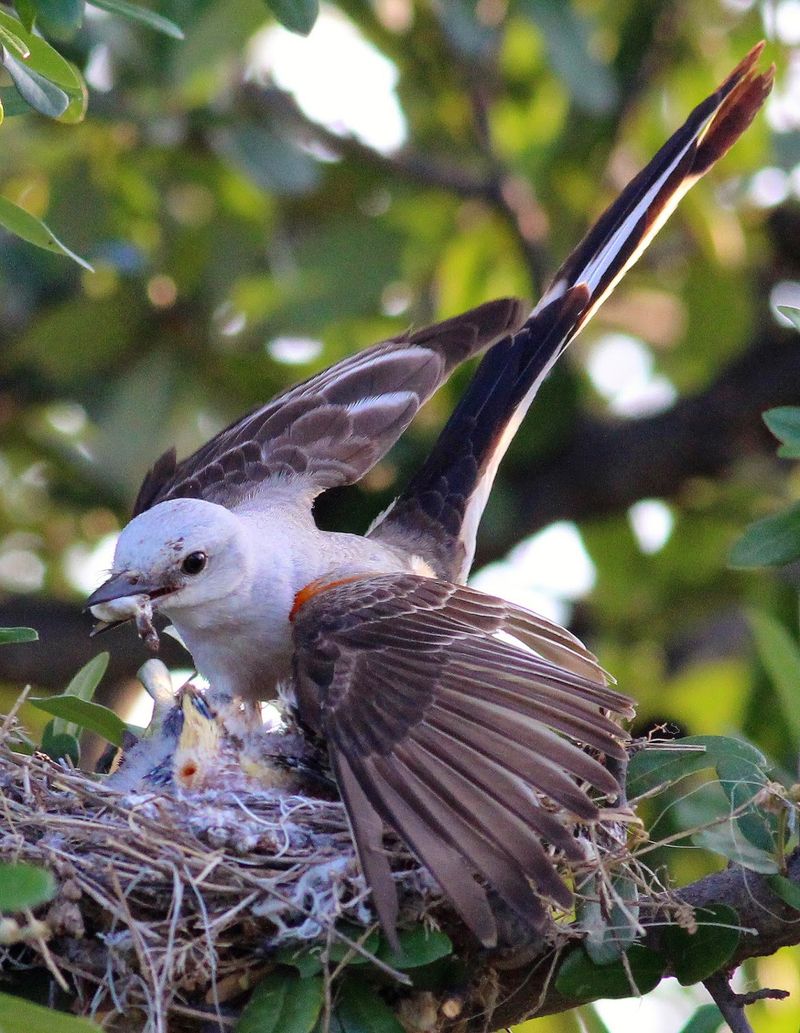
Cornell Lab’s life-history account describes the species as an open-cup nester, building a compact nest of plant fibers, cotton, and similar materials in the fork of an isolated tree or tall shrub. Installing a bluebird box will not attract this bird, and placing boxes in the hope of hosting one is a mismatch between the product and the species.
The bird occasionally uses artificial structures, including utility poles, communication towers, and bridge supports, but those are incidental choices based on available structure, not responses to a box a homeowner puts up. Preserving isolated trees and tall shrubs in an otherwise open yard is far more likely to provide the kind of nesting site the species might actually use.
If you find an active nest on your property, the correct response is to leave it alone. The U.S.
Fish and Wildlife Service notes that most native migratory bird nests, eggs, and young carry federal protections under the Migratory Bird Treaty Act. Moving, disturbing, or removing an active nest without authorization is not a minor yard-maintenance decision.
If a nest location creates a genuine safety concern or the young appear injured or abandoned, contact your local Texas Parks and Wildlife office or a licensed wildlife rehabilitator before taking any action. They can assess the situation and advise on legally appropriate next steps.
Make the yard better habitat, not a guaranteed pest-control system
Pulling the whole article together, the practical goal is straightforward: create a yard where a Scissor-tailed Flycatcher has a reasonable chance to stop, hunt, and possibly stay awhile. That means keeping some open, low-vegetation space for hunting, providing elevated perches along fence lines or isolated trees, supporting native plants that sustain insect prey, offering a clean shallow birdbath, and cutting back on broad-spectrum pesticides that strip the insect base and risk poisoning the birds themselves.
Grasshoppers are the prey claim with the strongest support. Cornell Lab and Audubon both list grasshoppers as a major dietary item, so a yard with active grasshoppers and good sightlines is a genuinely plausible hunting ground.
Cicada control is a softer claim: possible in the way that any large flying insect is fair game for this bird, but not something to count on or plan around. Pest regulation by birds varies by context, and ordinary monitoring plus targeted pest management remain the reliable foundation of a healthy Texas garden.
The bird’s timing, territory, and daily foraging route are its own business. A gardener can improve the odds but cannot schedule a visit or hold a flycatcher to a season-long contract.
What you can do is build a yard that rewards the bird when it arrives, and that is a worthwhile goal on its own terms, with or without a grasshopper in sight.