
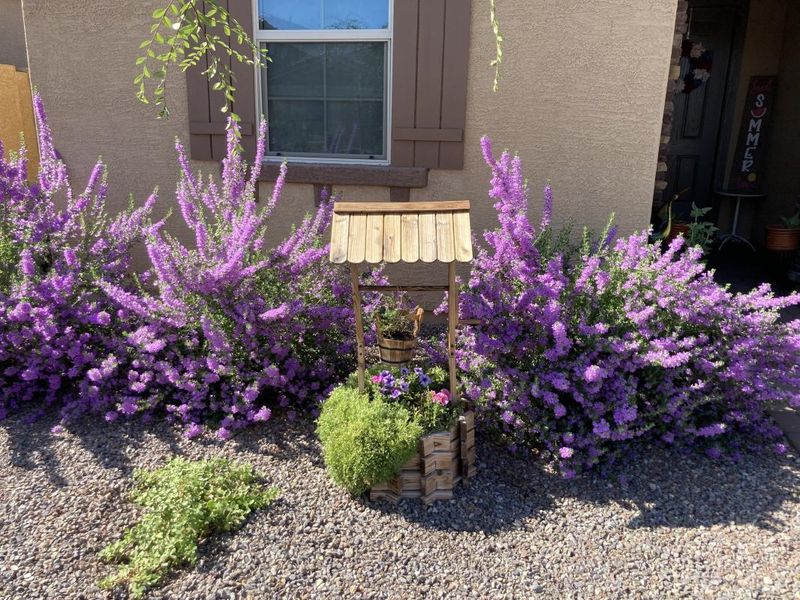
When your city cuts you to one watering day a week, most shrubs start looking ragged fast. But one Texas native has been handling dry spells and thin alkaline soils long before water restrictions were ever written.
Texas sage, also called cenizo or barometer bush, is a low-water shrub that holds its own through brutal summer heat when planted in the right spot. If you have a sunny, well-drained yard in Central, South, or West Texas, this plant deserves a close look.
A Strong Low-Water Option for Suitable Texas Sites
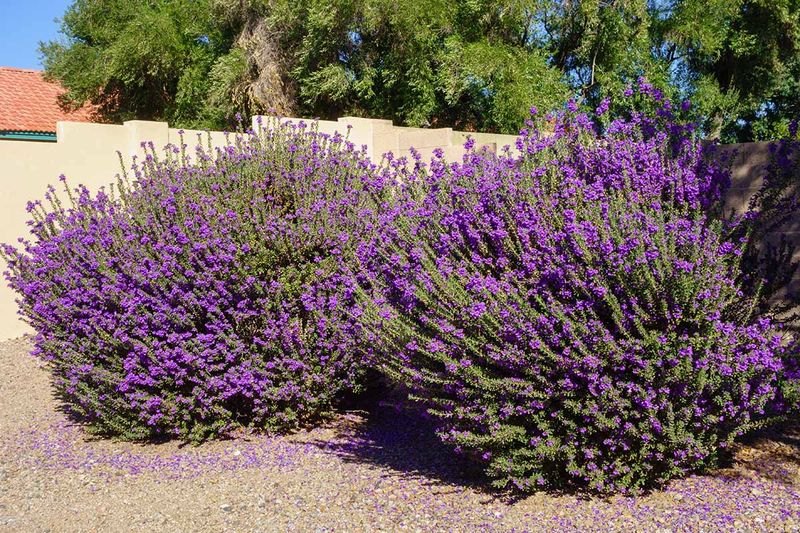
Texas sage, known scientifically as Leucophyllum frutescens, carries several common names depending on where you are in the state. Cenizo, barometer bush, Texas Ranger, and silverleaf sage all refer to the same plant.
Despite sharing “sage” in its name, it is not a culinary herb and does not belong to the genus Salvia. The distinction matters if you are searching for it at a nursery or reading a plant tag.
Three widely used Texas plant resources place it firmly in the low-water category. Texas A&M Extension’s profile of the Silverado cultivar describes it as a very drought-resistant xeriscape plant once it is established.
Texas SmartScape rates its water demand as low and notes that established plants need very little supplemental irrigation. The City of Austin’s plant guide also classifies it as a low-water shrub suited to local conditions.
Those classifications connect directly to a practical concern: when a local utility restricts landscape watering to one designated day per week, an established Texas sage on a suitable site can remain a strong landscape performer. That premise comes with two firm limits, though.
First, the one-day-a-week schedule is not a statewide Stage 2 standard, and your utility may operate differently. Second, the low-water classification applies to an established plant, not to a newly installed shrub still growing its root system.
Both of those points get their own full treatment in later sections.
The Site Determines How Well Texas Sage Handles Drought
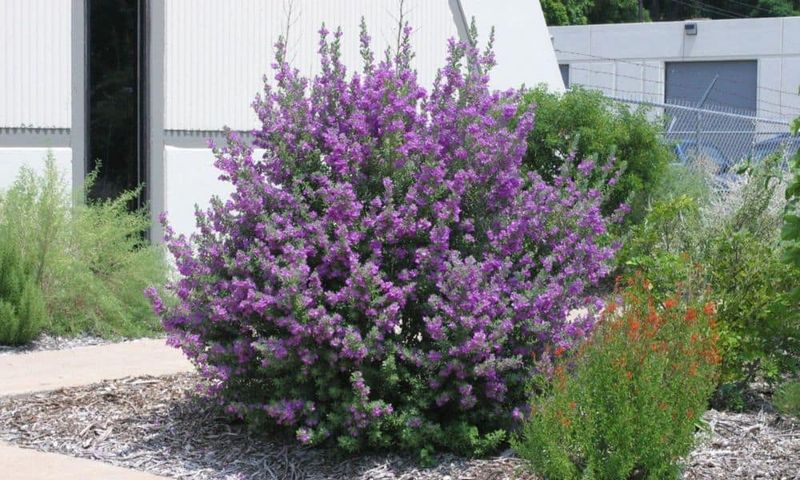
Cutting back irrigation is not the same as creating the conditions Texas sage actually needs. The shrub’s low-water performance is tied to a specific set of site conditions, and when those conditions are missing, reducing water will not make up the difference.
Full sun is the first requirement. Texas sage thrives in open, unshaded exposures and weakens when it is crowded by taller plants or placed under a canopy.
Alongside sun, the soil needs to drain quickly. Missouri Botanical Garden’s plant profile associates it with dry, gravelly, alkaline, and calcareous soils – the kind of ground that sheds water fast rather than holding it.
The UF/IFAS Extension fact sheet on Texas sage emphasizes full sun and very well-drained alkaline soil as the plant’s core requirements. Texas Parks and Wildlife’s South Texas Wildscapes resource places it in dry, rocky terrain where shallow soils and fast drainage are the norm.
What happens when those conditions are absent? A heavy clay bed that stays moist after rain, a low spot in the yard that collects runoff, or a partially shaded planting area can each undermine the plant’s reliability.
Overwatering in poorly drained soil can damage roots and produce symptoms that look exactly like drought stress – yellowing, wilting, and leaf drop – even though the actual problem is too much moisture, not too little.
Low water demand is not the same as tolerance for neglect in every environment. A Texas sage planted in heavy, poorly draining soil and then watered infrequently is not being cared for according to its preferences; it is simply being stressed in two directions at once.
Matching the plant to a genuinely fast-draining, sunny location is what allows it to perform well under restricted irrigation schedules.
Stage 2 Rules Do Not Create One Statewide Watering Schedule
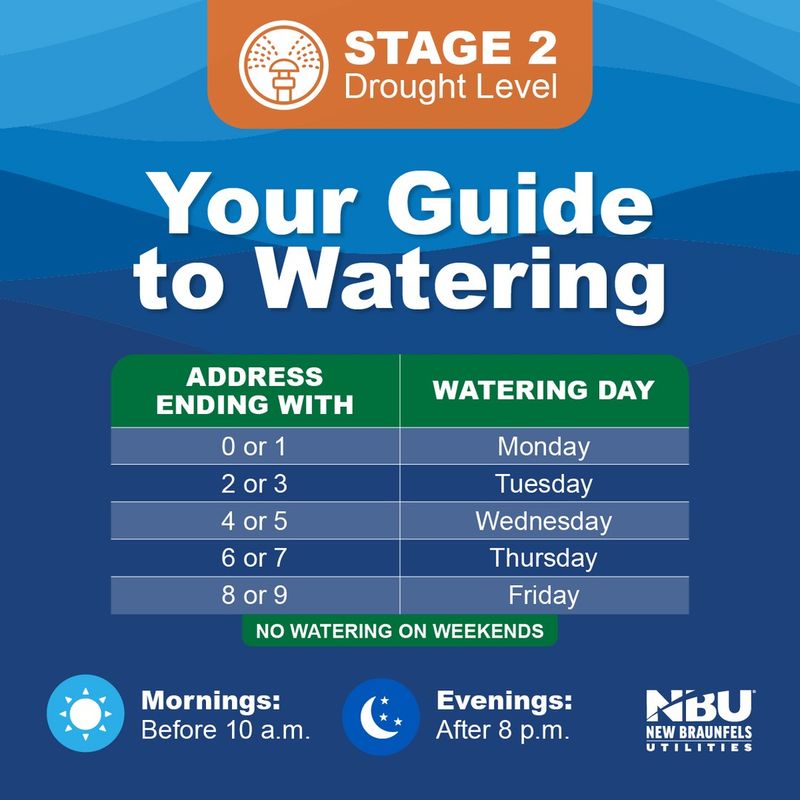
“Stage 2” sounds like a single, clearly defined rule, but it is not. Each water supplier or municipality in Texas writes its own drought contingency plan, sets its own stage definitions, and decides what restrictions apply at each level.
Two Texas cities under Stage 2 at the same time may be operating under entirely different schedules, permitted methods, and exemption categories.
San Antonio’s water utility, SAWS, describes Stage 2 landscape irrigation as once per week on a customer’s designated watering day, with specific rules about hours and permitted methods. Austin’s Stage 2 FAQ outlines a different set of requirements and exemptions that apply to Austin Water customers specifically.
Neither city’s rules apply to a homeowner served by a different utility, a municipal water district, or a private well.
The Texas Commission on Environmental Quality requires water suppliers to develop drought contingency plans, but the specific schedules within those plans are set locally. That means the one-day-per-week premise in this article describes a real restriction some Texas homeowners face, not a uniform statewide standard.
Your utility may permit two days, restrict to certain hours, allow hand watering or drip systems under separate rules, or define exemptions for newly planted vegetation.
Before applying any watering schedule to your Texas sage, check your utility’s current drought stage status and read the actual rules in effect. Look specifically for your designated watering day, the permitted delivery methods (sprinkler, drip, hand-held hose), the allowed hours, any exemptions for new plantings, and the enforcement process.
Rules can change as drought conditions shift, so checking once at the start of summer is not enough if your area moves between stages during the season. Treating one city’s published schedule as a statewide guide is how gardeners end up either violating local rules or underwatering plants that were actually allowed more frequent care.
Match the Watering Method to the Soil and Plant
A permitted watering day tells you when you are allowed to irrigate. It does not tell you how much water every plant in your yard needs on that day.
Those are two different questions, and confusing them leads to either overwatering plants that do not need help or underwatering ones that do.
Several factors affect how much water a given Texas sage actually needs on any particular week. Sandy soil drains faster and dries out sooner than clay-heavy ground, so a plant in sandy soil may need more attention even if it is drought tolerant.
Intense reflected heat from a south-facing wall or a concrete surface increases moisture loss from both the soil and the plant. Recent rainfall reduces or eliminates the need for supplemental irrigation.
Younger roots, nearby competing trees or shrubs, and intense sun exposure all shift how quickly a plant depletes available soil moisture. Texas A&M’s Earth-Kind water efficiency guide recommends checking actual soil moisture before deciding whether to irrigate, rather than watering on a fixed calendar schedule regardless of conditions.
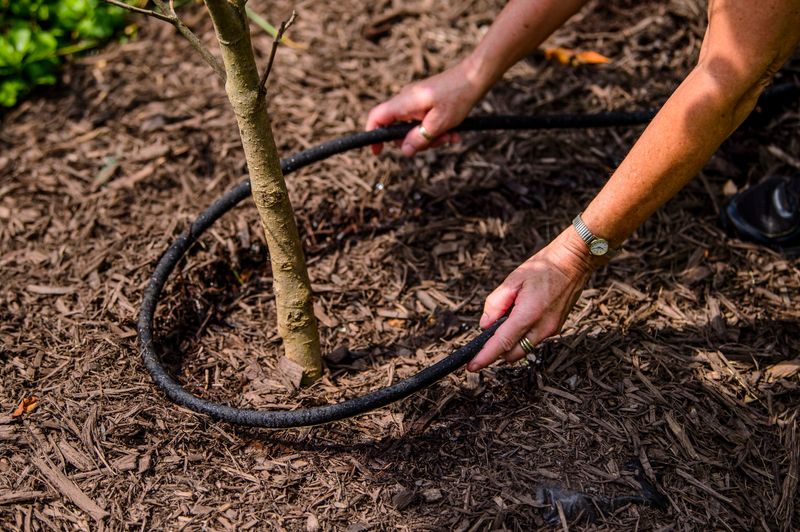
When your Texas sage does need supplemental water and local rules permit it, the method matters. Deep watering that moistens the soil to roughly 5 to 6 inches encourages roots to grow downward, where soil stays cooler and retains moisture longer.
After watering, let the soil dry down before watering again. UGA Extension’s guidance on landscape watering confirms that light, frequent sprinkling encourages shallow roots and leaves plants less able to tolerate dry intervals between permitted watering days.
For an established Texas sage on a well-drained site, the honest answer in many summer weeks is that no supplemental irrigation is needed at all, even when your watering day arrives. Checking the soil before turning on the hose is always worth the thirty seconds it takes.
Give a New Shrub Time to Establish
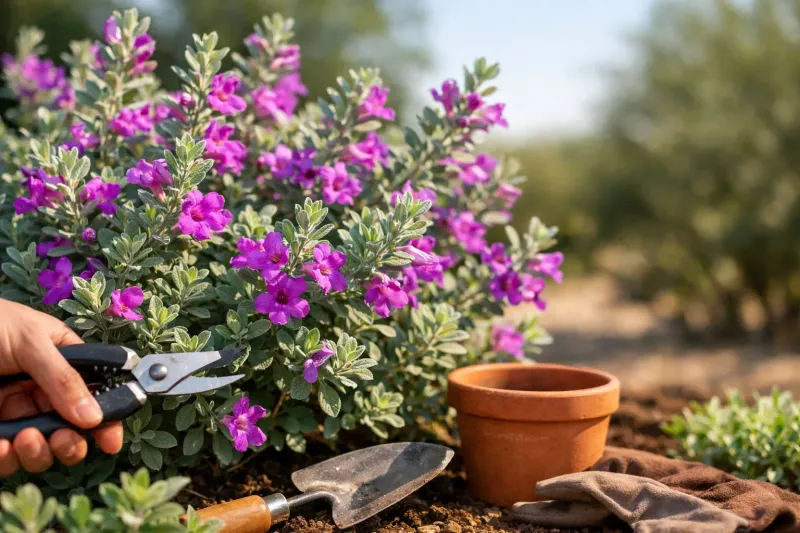
Every claim in this article about Texas sage performing well under a once-weekly watering schedule rests on one key qualifier: the plant must be established. A shrub that went into the ground last month is not the same as one that has been growing in your yard for two or three years, and treating them identically during a hot Texas summer is a reliable way to lose the new one.
Root development takes time. A newly planted Texas sage is working with the root ball it arrived with, which is a fraction of the root spread a mature shrub develops over months and years.
Until those roots extend into surrounding soil and access a wider volume of ground moisture, the plant is far more vulnerable to heat and dry intervals. Texas SmartScape notes that Texas sage may take up to two years to become fully established and bloom reliably, which gives a useful sense of the timeline involved.
Expecting a one-year-old plant to perform like a five-year-old one sets it up for failure.
During the establishment period, newly planted Texas sage needs more frequent attention than the mature-plant care described elsewhere in this article. That does not mean daily soaking – overwatering is still a risk, especially in poorly drained soil.
UGA Extension’s guidance on drought effects in landscapes confirms that new plantings are among the first to show stress during dry periods precisely because their root systems have not yet reached the soil volume they will eventually occupy.
Check your local utility’s current rules for new plantings before assuming that the one-day restriction applies to everything in your yard. Many utilities include exemptions or alternative permitted methods – hand watering, drip lines, or soaker hoses – that allow more frequent irrigation for newly installed vegetation.
Use those options if they are available and apply them carefully, watering deeply and allowing the soil to dry partially between sessions. The goal during establishment is to keep the root zone consistently moist enough for growth without saturating the soil or allowing it to dry out completely for extended stretches.
Plan for Its Mature Size and Natural Shape
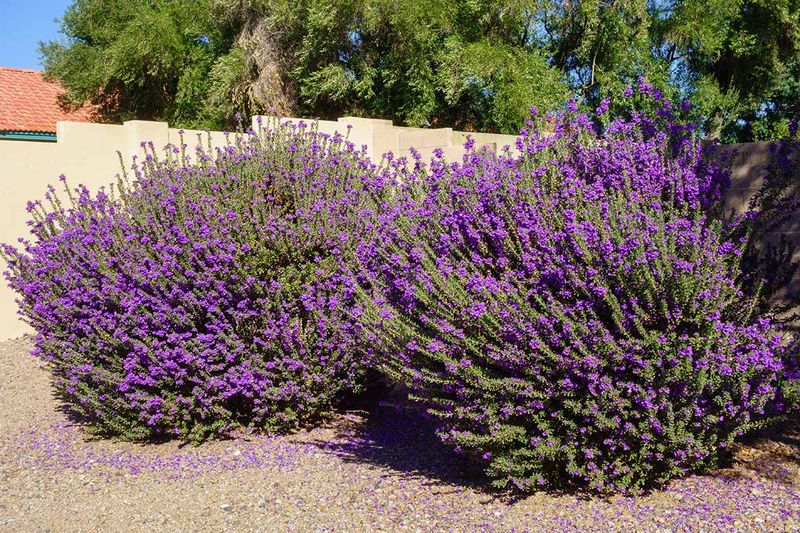
One of the most common mistakes with Texas sage is planting it too close to a walkway, a wall, or another shrub and then spending years fighting to keep it small. The plant has a natural mature size that should guide placement decisions before the shovel goes in the ground.
Typical mature dimensions run approximately 5 to 8 feet tall and 4 to 6 feet wide, though cultivars vary. Missouri Botanical Garden’s profile places it in that size range and notes its naturally rounded, mounding form.
The City of Austin’s plant guide similarly reflects those dimensions for landscape use. Compact cultivars are available and tend to stay smaller, but even those need room to express their natural shape without constant cutting.
Texas sage works well in several landscape roles where its size and form are an asset rather than a problem. As a specimen plant in an open bed, its silvery foliage and purple blooms make it a visual anchor.
Planted in a row with enough spacing, it forms an informal hedge that provides privacy without requiring precise shearing to maintain its effect. Foundation plantings and border positions also suit it, provided there is enough clearance from the structure and from neighboring plants.
Texas A&M Extension advises against routine hedge shearing, which cuts into the plant’s natural rounded form and can stress it over time. Leaving room at planting is far easier than trying to manage a mature shrub that has outgrown its space.
Measure the intended spot, account for the plant’s expected width at maturity, and place it where it can fill out naturally over the years without crowding or requiring repeated heavy cuts to stay in bounds.
Support the Shrub Without Overwatering It
An established Texas sage in the right location does not need much from you, but a small amount of maintenance done correctly makes a meaningful difference in how well it handles summer heat and dry stretches.
Mulch is one of the most practical tools available. A layer roughly 2 to 4 inches deep applied around the base of the shrub, kept a few inches away from the stem itself, helps reduce evaporation from the soil surface, moderates soil temperature during hot stretches, and limits weed competition that would otherwise compete for available moisture.
Texas A&M’s landscape mulch guide supports those benefits and recommends keeping mulch pulled back from the base of woody plants to avoid creating conditions that promote rot or pest problems at the crown.
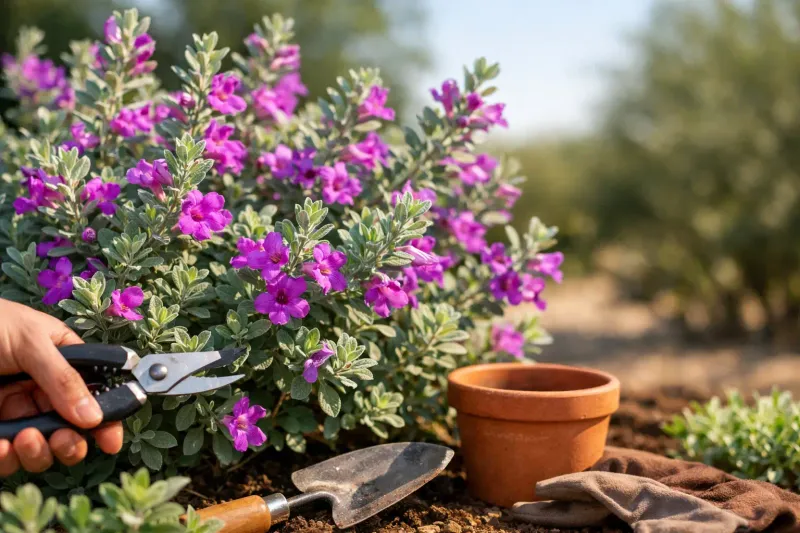
Pruning is worth approaching with restraint. Texas A&M Extension recommends light pruning to maintain the plant’s natural shape rather than routine hedge shearing.
Shearing removes the tips where flowering occurs and forces the plant into a shape it will continually try to grow out of. A few selective cuts to remove dead wood or redirect a wayward branch are generally all that is needed.
The blooming habit deserves a clear explanation. Texas sage earns its “barometer bush” nickname because flowers often appear after rainfall, a rise in humidity, or increased soil moisture.
Texas Master Gardener documentation on the Desperado cultivar reflects this moisture-triggered flowering pattern. That association does not mean irrigation causes blooming or that a plant failing to flower needs more water.
Missouri Botanical Garden’s profile specifically advises against fertilizing Texas sage under its recommended culture, and the sources reviewed do not support the idea that extra nutrients or water reliably increase flower production.
Know When Your Yard Is a Poor Fit
Regional suitability is not a minor footnote. Texas sage has genuine geographic limits within the state, and placing it in the wrong environment produces poor results regardless of how carefully you manage its water schedule.
The plant is most reliably suited to dry and semiarid parts of Central, South, and West Texas, where alkaline or calcareous soils, low rainfall, and strong sun align with its preferences. North Carolina Extension’s plant profile notes that high humidity and elevated night temperatures can be problematic, which is directly relevant to Gulf Coast conditions.
UF/IFAS Extension reinforces the need for very well-drained alkaline soil and full sun, and cautions that high moisture and wet ground undermine the conditions the plant requires.
Within a Texas yard, specific microclimates can create failure conditions even in otherwise suitable regions. A low spot that collects rainwater after storms, a bed amended with heavy organic material that retains moisture, a site shaded by a large oak or covered structure, or a location where irrigation from a nearby lawn system keeps the soil consistently wet – any of these can produce the same outcome as planting in an unsuitable region.
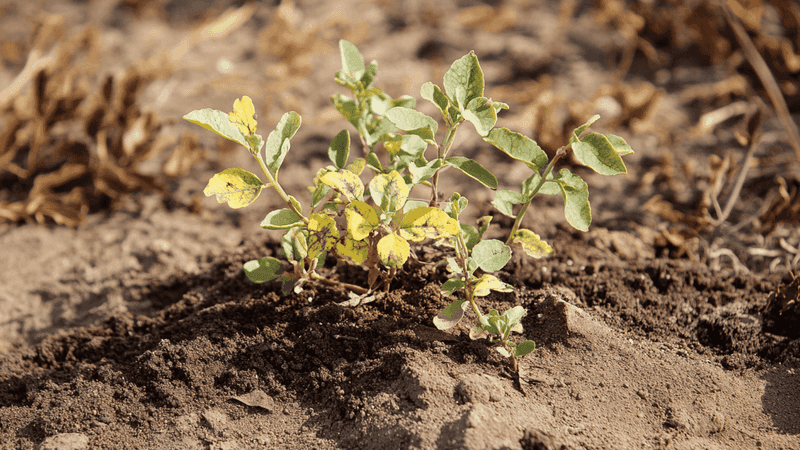
Wet-root damage is worth understanding because its symptoms are easy to misread. When Texas sage sits in persistently moist or waterlogged soil, root function degrades and the plant cannot move water and nutrients effectively.
The result can look like drought stress – yellowing foliage, wilting, or dieback – even though the soil is not dry. Texas A&M’s Earth-Kind guidance on landscape water use highlights the importance of checking actual soil conditions before adding more water, because overwatering is a frequent cause of plant decline that mimics drought symptoms.
If your Texas sage is struggling and the soil stays moist, the answer is almost certainly not more irrigation.
Use This Decision Rule Before You Plant
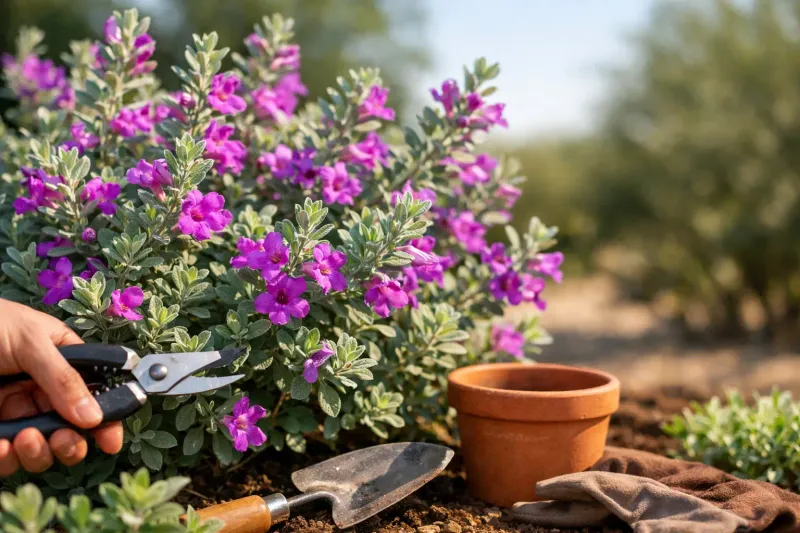
Before buying a Texas sage, run through a short site check. Does the location get full sun for most of the day?
Does the soil drain quickly after rain, or does water pool and linger? Is the space large enough to accommodate a shrub that may reach 6 to 8 feet tall and 5 feet wide without crowding a walkway or wall?
If the answers are yes, yes, and yes, you have a genuinely suitable candidate site.
From there, the watering plan depends on where the plant is in its life. A newly installed shrub needs establishment care, which means more frequent attention and possibly locally permitted hand watering or drip irrigation until roots develop – a process Texas SmartScape suggests may take up to two years.
Once the plant is established on a well-drained, sunny site, it becomes a strong low-water option that can remain a reliable performer even when irrigation is restricted to one permitted day per week.
Check your utility’s current drought stage rules directly before settling on any schedule. Your designated watering day, permitted delivery methods, allowed hours, and any new-planting exemptions are set locally, not statewide.
A plant well-matched to its site and given proper establishment care is the part of this equation you control most directly. Texas sage rewards that upfront investment with years of low-demand performance in the Texas heat.