
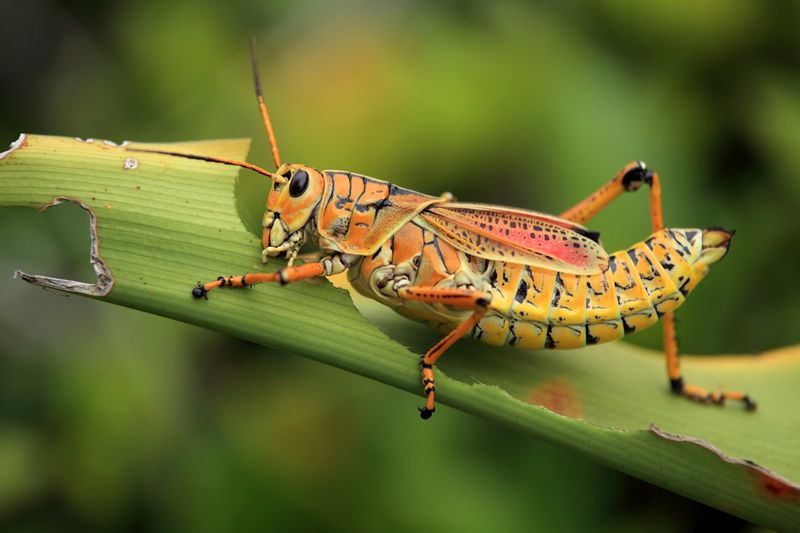
If you have spotted large, slow-moving yellow insects chewing through your garden beds or ornamental plants, you are likely dealing with eastern lubber grasshoppers. These native Florida insects can show up in surprising numbers and leave real damage behind on everything from amaryllis to vegetable rows.
Understanding why they appear and why a quick spray often fails is the first step toward actually getting the upper hand on them.
The yellow adults are often eastern lubbers
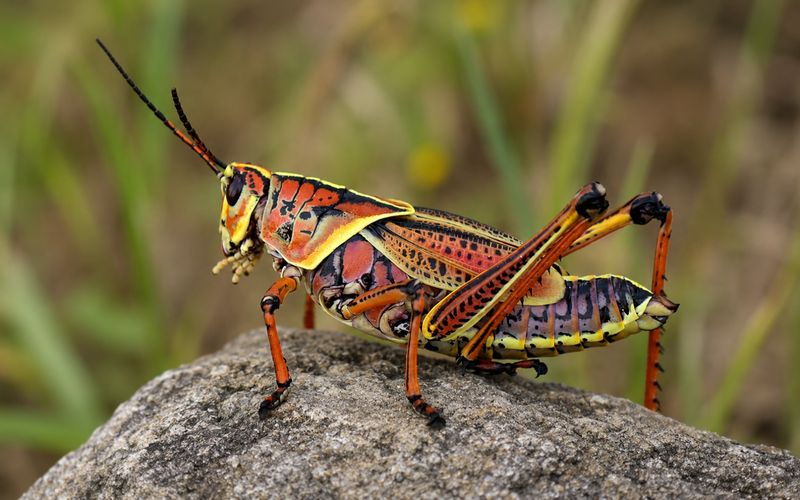
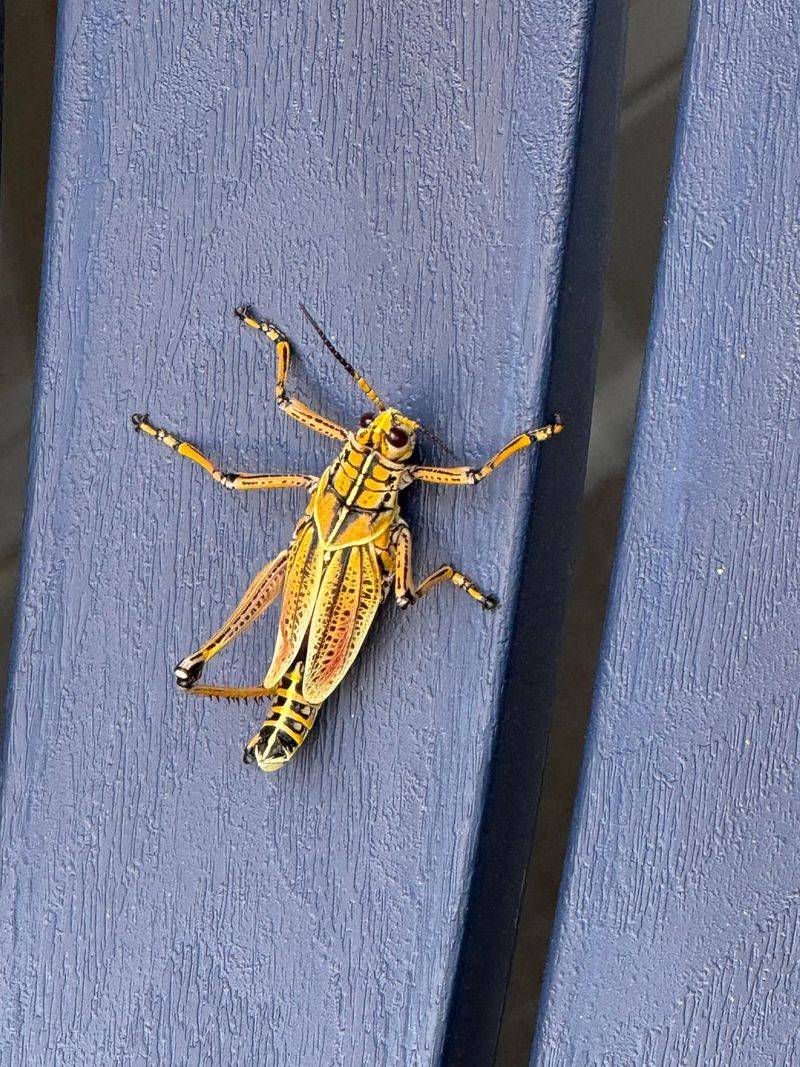
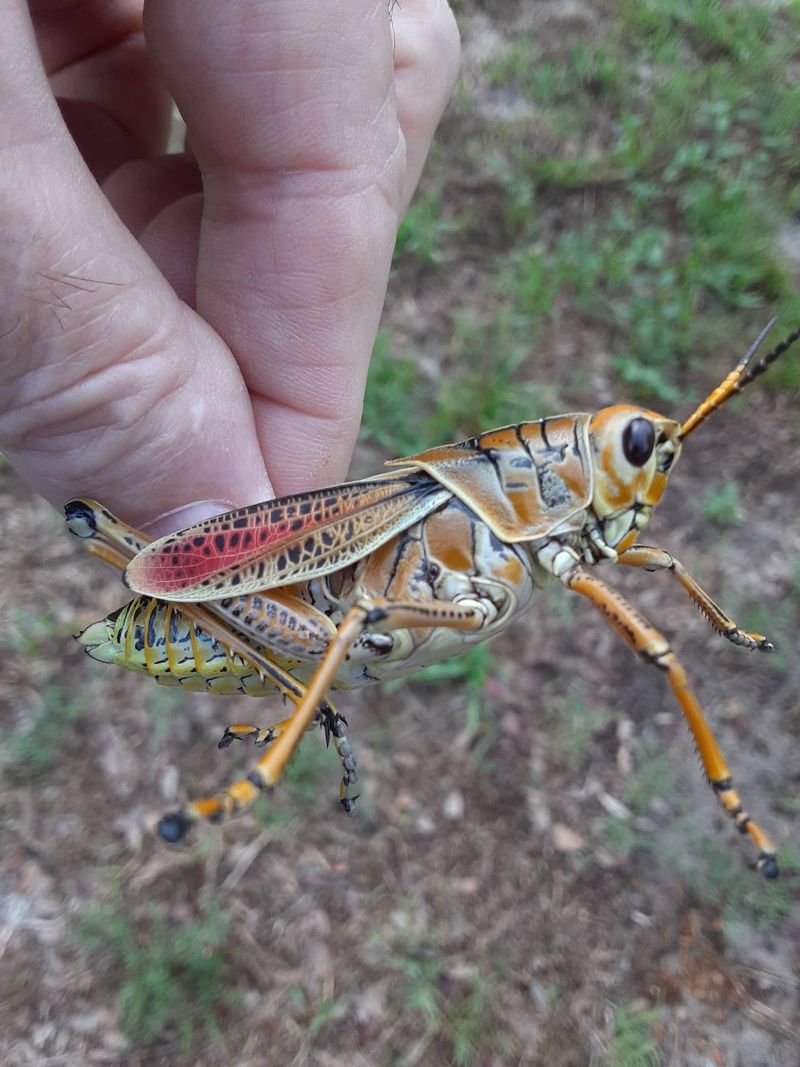
Adult eastern lubber grasshoppers are hard to miss. They are among the largest grasshoppers in North America, with a heavy, wide body that can reach three inches in length, short wings that offer no real flight, and a slow, lumbering walk that gives the species its name.
Most adults display a bold yellow or tawny base color marked with black patterns and, on some individuals, patches of red along the hindwings or abdomen.
Color alone, however, cannot lock down the identification. Florida is home to multiple grasshopper species, some of which can appear yellowish or carry yellow wings.
The full picture matters: very large size, a stocky and heavy body, short non-functional wings, slow movement, and the characteristic yellow-black coloration together point to the eastern lubber. UF/IFAS guidance on common Florida grasshoppers notes that other species behave quite differently and may require separate management approaches.
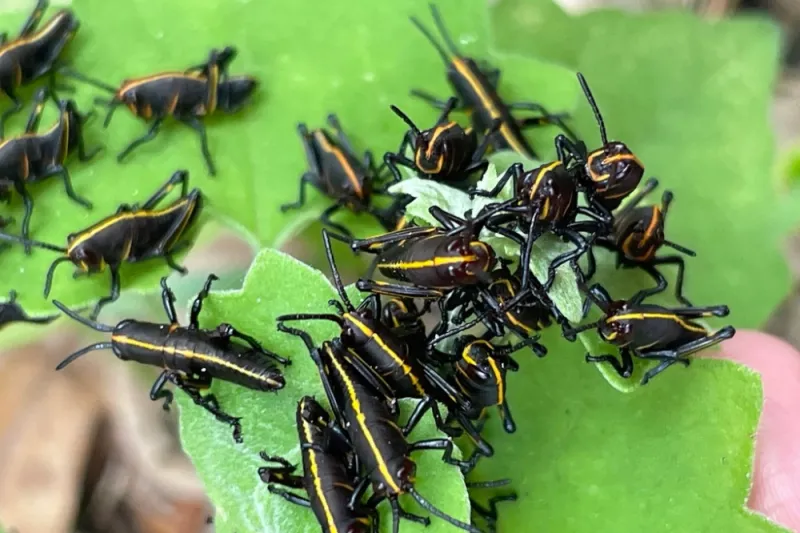
Young lubbers look almost nothing like their parents. Nymphs are usually jet black with yellow or red striping and often gather in tight clusters on plant stems or at the base of clumps of vegetation.
That clustering habit is actually useful, because concentrated groups of small insects are far easier to manage than dispersed adults.
When threatened, adults have a dramatic defense. They may hiss audibly, fan their wings wide to flash bright color, and release a foul-smelling foam from their thorax.
UF/IFAS Featured Creatures documentation for Romalea microptera describes lubbers as essentially harmless to people, but the defensive secretion can irritate eyes or mouth, so handling them without gloves and keeping hands away from the face is a sensible precaution.
Why some Florida yards attract localized surges
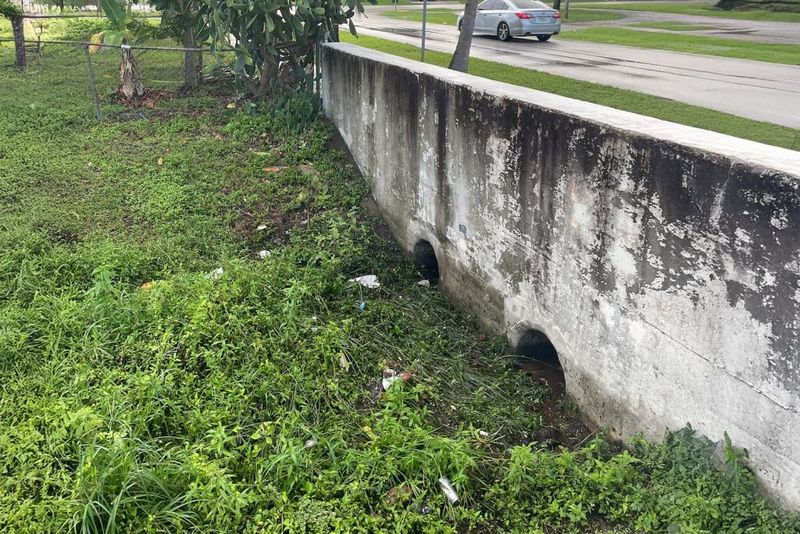
Lubber infestations in Florida yards are not random. The pattern almost always traces back to a nearby source area, usually somewhere low, wet, and densely vegetated.
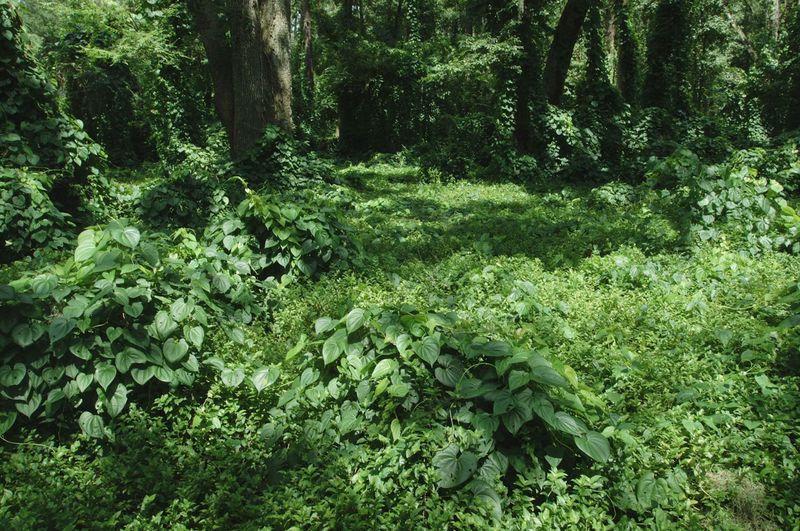
Drainage ditches, swales, pond margins, wet woodland edges, fallow ground, and weedy property borders are the kinds of places where lubbers breed and where nymphs first emerge in spring. From those source areas, the young insects disperse on foot and can cover surprising distances before reaching ornamental beds, vegetable gardens, or citrus plantings.
Seeing adults chewing through an amaryllis bed does not mean they hatched there. UF/IFAS documentation on the eastern lubber makes clear that lubbers regularly move from moist, weedy source areas into residential landscapes as they grow.
A yard with no obvious breeding habitat can still receive a steady stream of wandering adults if suitable vegetation exists nearby, even across a fence line or down a block.
Broader population surges across a wider area can develop when several conditions line up at once. UF/IFAS grasshopper management research indicates that large outbreaks generally require both favorable weather and adequate food: warm, sunny conditions support insect growth and survival, drought can reduce cloud cover and rainfall interference, and abundant plant growth gives grasshoppers the calories they need to reach reproductive maturity.
Two or three years of drought have preceded some broader outbreaks in Florida and the Southeast.
Weather patterns alone, though, cannot explain why one yard fills with lubbers while a neighbor’s stays clear. Proximity to moist source habitat is a stronger predictor for individual properties than any single weather event.
A yard that sits against a weedy swale or backs up to a wet wooded lot simply has a shorter path for nymphs to travel, and that proximity matters more than temperature or rainfall in most localized cases.
The damage follows the plants lubbers can find
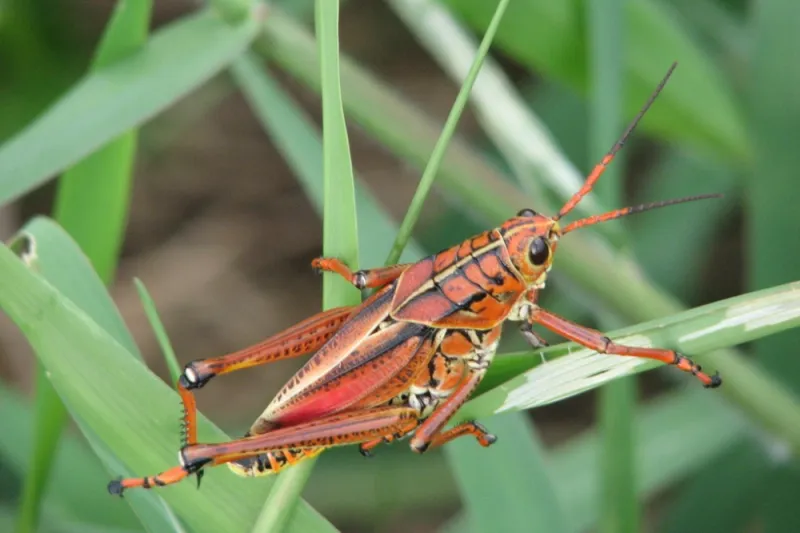
Eastern lubbers are not picky eaters by grasshopper standards. Documented host-range research credits the species with feeding on at least 100 plant species across 38 plant families, which means nearly any planting in a Florida yard could see some level of damage when populations are high.
Ornamental beds tend to catch the worst of it. Amaryllis, crinum, Amazon lily, narcissus, oleander, butterfly weed, cordyline, Mexican petunia, and lantana appear repeatedly in Florida damage reports.
Vegetable gardens are also vulnerable, with peas, lettuce, kale, beans, and cabbage among the more frequently preferred crops. UF/IFAS gardening guidance notes that eggplant, tomato, pepper, celery, okra, fennel, and sweet corn are comparatively less preferred, but that reduced preference is relative, not immunity.
Swapping out heavily damaged ornamentals for less-preferred species can reduce the worst feeding, but it will not remove lubbers from the area. The insects also feed on weeds and grasses, so the population source often persists even after a favorite host plant is pulled.
UF/IFAS Hillsborough County Extension reinforces that the species has a broad enough palate to move through a yard opportunistically rather than fixating on a single crop or bed.
The practical takeaway is to think beyond the plant being eaten. If lubbers are working through a crinum bed today, they may reach the vegetable garden or citrus container tomorrow.
Tracking where insects are moving, rather than only treating the most obviously damaged spot, gives homeowners a clearer picture of where the population is coming from and where it is heading next.
Why a normal yard spray often loses the fight
Reaching for a spray bottle is a natural first reaction when large grasshoppers are visibly destroying plants. The frustration that follows is equally common, because established adult lubbers are genuinely difficult to kill with the products most homeowners have on hand.
Their size alone sets them apart: a large, heavy-bodied insect requires a higher dose to achieve a lethal exposure than a small, soft-bodied pest would, and lubbers have had millions of years of evolutionary practice processing plant toxins.
That detoxification ability is part of why spray results disappoint. Lubbers feed on plants that contain alkaloids and other defensive compounds, and University of Florida research on lubber control methods indicates that the insects can metabolize plant toxins and may also survive exposure to treated foliage rather than ingesting a lethal dose.
Walking across a sprayed leaf is not the same as receiving a direct, full-contact application at the right concentration.
Reinvasion compounds the problem. A homeowner who treats a bed on Monday may eliminate some insects on the plant, but adults arriving from a nearby swale or ditch on Wednesday face no barrier at all.
UF/IFAS pest management guidance identifies insecticides that can kill lubbers under appropriate conditions, but also notes clearly that adults are harder to kill and that treatment works best against young insects. Spraying a visible adult population is therefore a less reliable strategy than locating and acting on clustered nymphs before they disperse.
Timing is the central lesson. Young lubbers are far more vulnerable to both physical removal and chemical treatment than mature adults.
A homeowner who waits until large yellow adults are stripping plants has already passed the window where control is most effective and most efficient. Catching the problem early, in spring, when nymphs are still small and grouped, changes the odds considerably.
Early scouting makes control more manageable
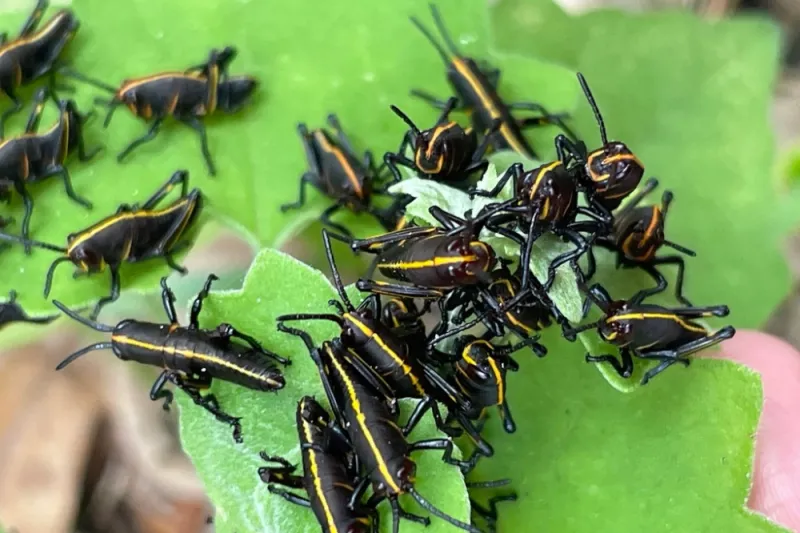
Scouting before the damage starts is the single most effective shift a Florida homeowner can make. Eastern lubber nymphs emerge in early spring, typically between February and April depending on location, and they spend their first weeks clustered tightly on low vegetation, strap-leaved plants, weeds, and bed edges.
That clustering behavior is a window: concentrated insects in a small area are far easier to find and remove than the same number spread across an entire yard as adults.
UF/IFAS Polk County Extension encourages homeowners to check strap-like foliage such as amaryllis, crinum, and ornamental grasses in early spring because nymphs often aggregate at the base of these plants. Scanning bed edges, fence lines, and weedy patches near the yard perimeter can reveal groups of small black, yellow-striped nymphs before they spread.
Hand-picking or dislodging nymphs into a container of soapy water is the most straightforward removal method when numbers are low or the insects are still localized. UF/IFAS gardening solutions recommends physical removal as a practical first step, particularly for small infestations.
Gloves are helpful, both for grip and to keep the insects’ defensive secretion away from skin and eyes.
Do not stop scouting at the damaged plant. UF/IFAS Florida-Friendly Landscaping pest guidance emphasizes inspecting beyond the immediate problem area to find movement routes or source locations.
If lubbers are chewing on a bed near the back fence, checking the weedy strip or swale just outside that fence may reveal where the nymphs originated and whether a larger aggregation is still in place nearby. Treating only the eaten plant while ignoring the source is one of the most common reasons control efforts stall.
Change the conditions around the yard, not just the eaten plant
Mowing the bed that got eaten and calling it done rarely changes what happens next year. A more durable approach targets the conditions that allow lubbers to build up in the first place, starting with the vegetation around the yard rather than inside it.
Dense, low, weedy growth along fence lines, property edges, or drainage features provides the kind of habitat where lubber nymphs aggregate and grow. Keeping that border vegetation shorter and less dense reduces its value as a staging area.
UF/IFAS grasshopper management research notes that shorter, less dense vegetation offers grasshoppers less food, less shelter, and more exposure to environmental stress and natural predators. Regular mowing of weedy borders where it is legally and physically possible can make those edges less hospitable.
The key qualifier is “where appropriate.” Wetlands, drainage features that serve stormwater management functions, conservation areas, and neighboring properties are not yours to alter, and local or county rules may restrict what can be done near water bodies or protected land.
Inside the yard, plant selection can reduce the severity of damage even if it cannot stop lubbers from arriving. UF/IFAS documentation identifies specific ornamentals that lubbers feed on most heavily.
Replacing those plants in high-pressure areas with species that appear less frequently in damage reports is a reasonable risk-reduction step, not a guarantee. Lubbers have a broad enough host range that no ornamental or vegetable can be called completely safe.
Avoiding dense concentrations of highly preferred plants also helps. A single large amaryllis clump next to a swale edge is a more attractive target than a few amaryllis scattered among less-preferred species across a wider bed.
UF/IFAS pest guidance and Florida Citrus Production Guide recommendations both point toward integrated management rather than single-point fixes. Mowing, plant adjustments, and habitat reduction can lower pressure, but eggs already in the soil and adults moving in from nearby land mean that no structural change alone closes the door permanently.
When chemicals make sense—and where they create risks
Chemical control has a role in lubber management, but that role works best when it is narrow and well-timed. The strongest case for insecticide use is a concentrated aggregation of young nymphs that physical removal alone cannot address, or a localized infestation causing serious damage to high-value plants.
Broad calendar-based spraying across an entire yard, applied without scouting or site assessment, is unlikely to break the lubber cycle and carries real risks to non-target organisms.
UF/IFAS pest management guidance lists several active ingredients that can kill lubbers, but stresses that adults are harder to kill than nymphs and that product selection depends on the specific site and the plant being treated. A product labeled for ornamental use may not be legal on edible crops, and a product labeled for lawn use may not be appropriate near a pond or canal.
The label is the legal document that governs every pesticide application. EPA guidance on pesticide labels confirms that using a product inconsistently with its labeling is a federal violation.
That means reading the current label before every application, not relying on memory from a previous season, and following all rate, timing, site, and safety instructions exactly as written.
Safety margins matter especially in Florida yards, which often sit close to ponds, canals, storm drains, or wells. EPA tips for reducing pesticide impacts on wildlife warn that insecticides can harm aquatic organisms, fish, bees, birds, pets, and poultry when products drift, run off, or are applied too close to sensitive areas.
Pollinator plantings deserve the same caution: spraying during bloom or near flowering plants risks exposing bees and other beneficial insects. Products marketed as “natural” or “botanical” are not automatically exempt from these risks; some are acutely toxic to fish or invertebrates regardless of their origin.
Check the label, not just the marketing language, before applying anything near water or wildlife.
Breaking the cycle requires repeated early action
No single treatment, plant swap, or mowing session will make a Florida yard permanently free of lubbers. Females lay egg pods in the soil, each containing roughly 30 to 50 eggs, and those pods can sit through fall and winter before hatching the following spring.
UF/IFAS vegetable pest documentation notes that the egg stage lasts approximately six to eight months, meaning the next generation is already in the ground while this season’s adults are still active.
The practical sequence that gives homeowners the best chance each year runs like this: confirm the identification, scout early in spring for clustered nymphs, remove them physically while numbers are low, inspect and manage weedy source vegetation on accessible property where appropriate, reduce concentrations of highly preferred plants in high-pressure areas, and reserve labeled chemical treatment for damaging populations that physical removal cannot handle. UF/IFAS eastern lubber research and UF/IFAS pest management guidance both support this integrated approach over any single-point fix.
Nearby habitat, neighboring properties, and existing soil egg pods mean that some lubbers may appear in a yard even after a successful season of control. Consistent early action each spring compresses the problem before it expands, and that is a realistic, achievable goal.
A yard that sees fewer lubbers reaching adulthood is a yard where less damage happens, even if a lubber-free guarantee remains out of reach.