
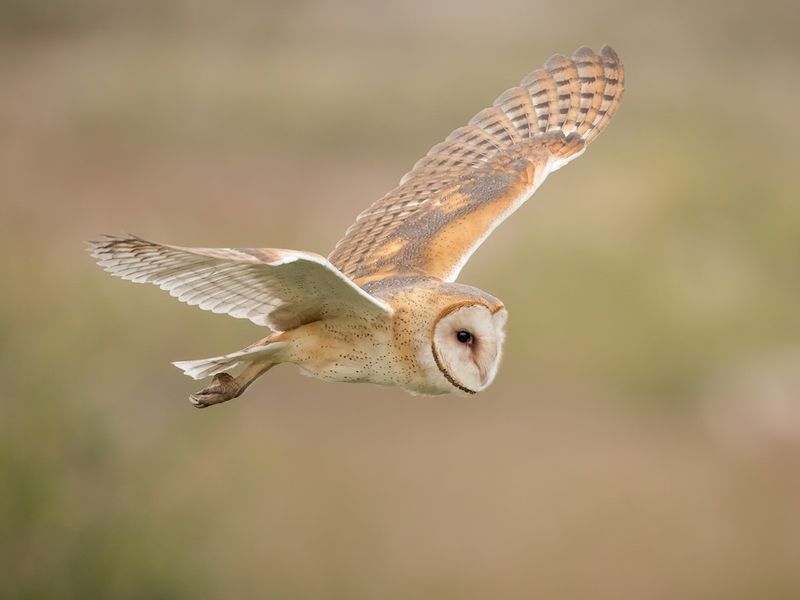
Catching a pale, silent shape gliding low over your yard just after sunset is one of those moments that stops you cold. If it keeps happening, you might be wondering whether your property has a rodent problem, a nesting owl nearby, or something else entirely.
Barn owls are protected wild birds with specific habitat needs, and understanding what their repeated visits actually mean can help you make smarter decisions about your yard, your rodent management, and your role as a Central Texas homeowner. What the bird is telling you is more nuanced than most people expect.
What repeated dusk flights actually suggest
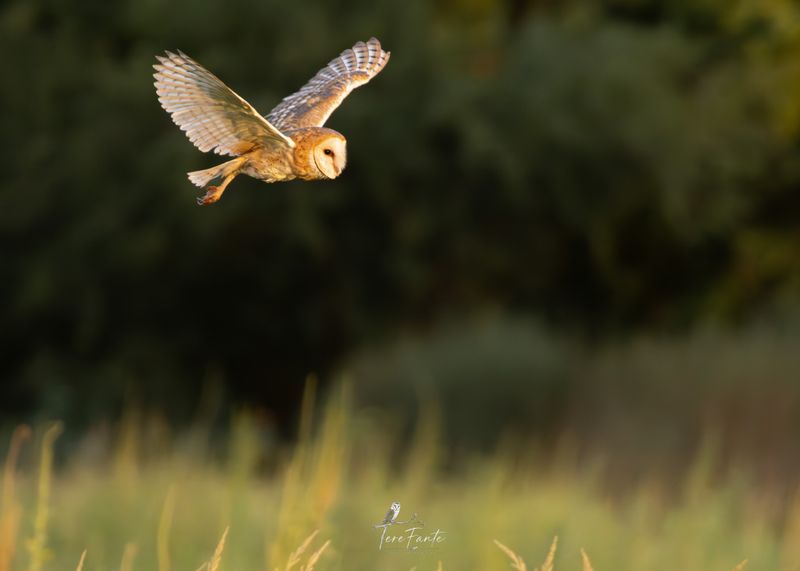
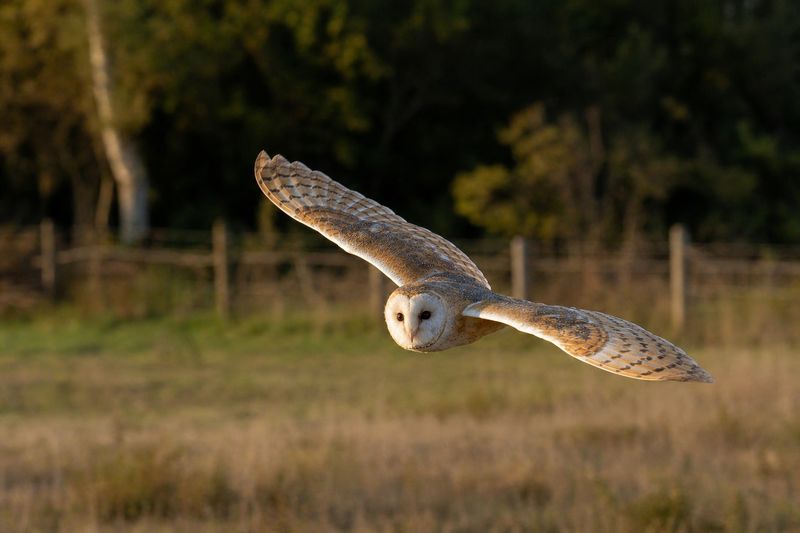
Watching the same pale shape drift low over your backyard evening after evening is genuinely striking. Those slow, buoyant passes over a lawn, drainage corridor, undeveloped strip, or field edge are consistent with barn-owl hunting behavior.
Cornell Lab’s barn owl profile describes the bird as a primarily nocturnal hunter that often begins foraging around dusk, coursing low over open ground using both vision and extraordinarily sensitive hearing to locate prey in dim conditions.
What repeated flights over your property most likely signal is that the surrounding landscape offers a workable combination of open flight space, low-light hunting conditions, and accessible small mammals somewhere in the area. The owl has found a usable corridor.
That does not mean a nest or roost is tucked behind your fence, that your yard is uniquely overrun with rodents, or that the bird lives on your block.
Barn owls can range widely each night, and a bird hunting your yard may be traveling from a roost or nesting site some distance away. Research on barn owl habitat use across rural-to-urban gradients confirms that these birds respond to landscape-scale features, including open flight paths, prey accessibility, and available cover, rather than to conditions in any single backyard.
Seeing the owl repeatedly is reasonable evidence that conditions in your wider neighborhood support the bird, not a diagnosis of what is happening specifically inside your fence line.
Framing the sighting positively makes ecological sense. A hunting barn owl suggests that the local habitat is functional enough to attract a native predator.
Enjoy the observation, note the flight pattern, and resist the urge to draw firm conclusions about nesting or infestation until you have gathered more information.
Confirm the owl before interpreting the behavior
Before drawing any conclusions about what the bird means for your yard, make sure you are actually looking at a barn owl. Central Texas hosts several owl species, and more than one of them becomes active right around dusk.
Treating an eastern screech-owl sighting as a barn owl sighting will send you down the wrong interpretive path entirely.
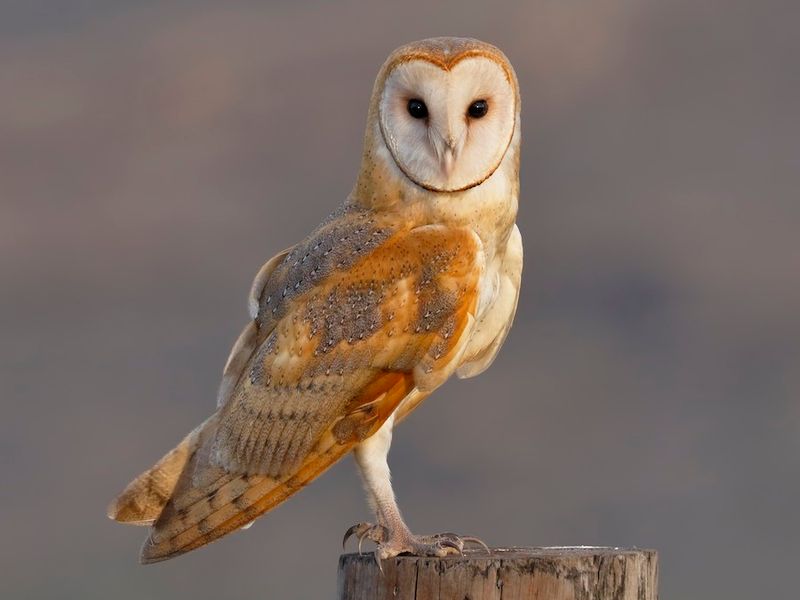
A barn owl has a few unmistakable features. The face is white and distinctly heart-shaped, framed by a pale buff border.
The body is mostly white below and golden-buff above, and the wings are long and narrow relative to the body. In flight, the bird looks surprisingly pale, almost ghostly, and its wingbeats are soft and buoyant rather than stiff or choppy.
Cornell Lab’s identification guide also notes that barn owls do not produce the classic hoot most people associate with owls; their calls are raspy, hissing, or eerie, which can be startling the first time you hear one.
Eastern screech-owls are the owls most Central Texas homeowners are actually watching from their porches. Texas Parks and Wildlife describes the eastern screech-owl as a small, camouflaged bird that roosts in tree cavities and hunts a wide range of prey including insects, small mammals, and even small reptiles.
It is strongly associated with suburban yards and wooded edges, where barn owls are less likely to forage. The two birds look and behave quite differently once you know what to check.
TPWD’s owl overview notes that Texas hosts barred owls and great horned owls as well, both of which are larger and darker than barn owls, with rounded wings and prominent facial discs in shades of brown and gray rather than white. Dusk activity alone does not identify any of these species.
To confirm a barn owl, try getting a clear photograph or video, even a blurry one that captures the face shape and overall color. A silhouette showing the long narrow wings and rounded head is also helpful.
If the bird drops a pellet, collecting it can support identification since barn-owl pellets are dark, compact, and often contain intact small-mammal skulls. Confident identification makes every subsequent step, from habitat decisions to rodent management, more grounded and useful.
Prey availability is possible, but an infestation is not proven
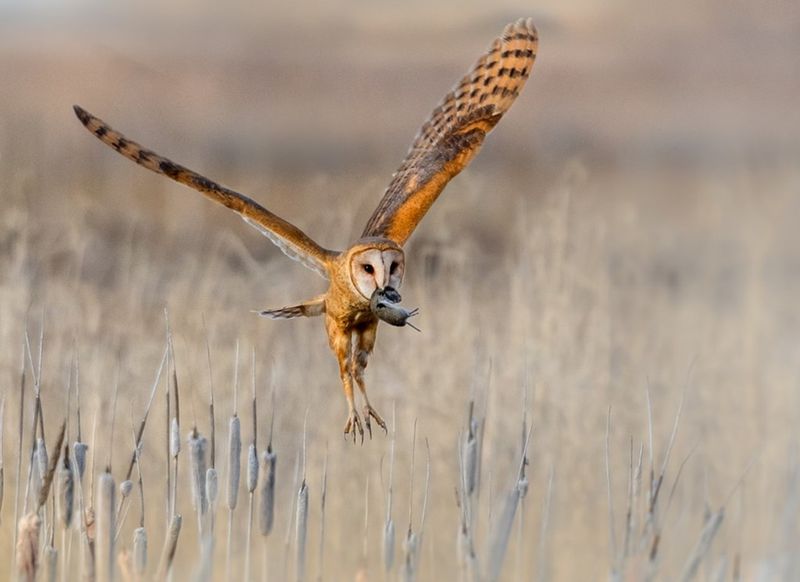
Rodents make up a substantial share of what barn owls eat across much of their range, but their diet is broader than most people assume. Texas Parks and Wildlife’s owl resource lists insects, earthworms, amphibians, small birds, and other animals as part of the wider owl diet, and barn owls can adjust what they take based on what is locally accessible.
Reducing the bird’s presence to a simple “mice detector” misses how opportunistic it actually is.
That said, a barn owl hunting over your yard regularly is reasonable evidence that small mammals are available somewhere in the broader hunting area. The bird would not return repeatedly if prey were not accessible.
The key qualification is “somewhere in the broader hunting area.” The prey source could be a neighbor’s compost pile, a drainage ditch two blocks over, an undeveloped lot nearby, or a grassy corridor between subdivisions.
Habitat studies on barn owls across rural-to-urban gradients show that these birds respond to landscape-level prey availability and open flight conditions rather than to activity in a single property. A barn owl choosing to course over your backyard reflects the flight path and hunting conditions your yard provides, not necessarily a rodent hotspot within your fence line.
Open flight paths, low vegetation structure, and accessible edges all influence where a barn owl hunts on any given night. Cornell Lab notes that barn owls forage over fields, meadows, and grass corridors, favoring open areas where their low-altitude gliding is effective.
Your yard may simply offer the best open glide path in the neighborhood, regardless of whether your specific property has more rodents than your neighbors do. Treat the sighting as a habitat signal, not a verdict about your pest situation.
Natural rodent control has limits
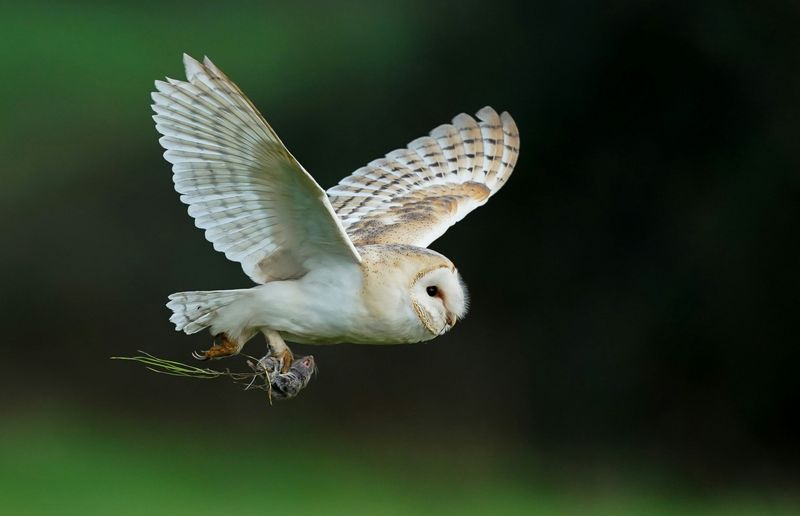
Barn owls genuinely can influence rodent activity in certain settings, and that is worth knowing. A 2026 study published in a peer-reviewed journal and indexed on PubMed reported a 38 to 52 percent reduction in measured rodent abundance across the range of owl hunting pressure observed in monitored Napa Valley vineyards.
That is a meaningful result, but it came from agricultural land with established nest boxes, consistent monitoring, and a prey community dominated by deer mice under vineyard conditions. Translating that figure directly to a Central Texas subdivision would be a significant overreach.
Extension materials reinforce the point that owls work best as one layer of a broader strategy. University of Utah Extension guidance on attracting wildlife for pest control specifically cautions that predators rarely eliminate a pest problem on their own and should be understood as one component of an integrated approach rather than a standalone solution.
Evidence across different settings, including earlier reviews and extension publications, has been variable, with some programs showing meaningful results and others showing limited or inconsistent effects.
A review of barn owl candidacy as a pest-control option, available through the California Department of Food and Agriculture, found that while barn owls can consume large numbers of rodents annually, the relationship between owl presence and measurable population reduction is not consistent enough to substitute for active management. Rodent populations can rebound quickly, and an owl hunting your yard at dusk is not a guarantee that rodent numbers will stay low.
For Central Texas homeowners, the practical takeaway is straightforward. Welcome the owl as a real but limited ecological benefit.
Keep exclusion, sanitation, and mechanical trapping in place as your primary rodent management tools, and let the owl contribute on its own terms without treating its presence as a reason to skip the fundamentals. A barn owl hunting your yard is an asset, not a service contract.
Choose rodent controls that protect predators
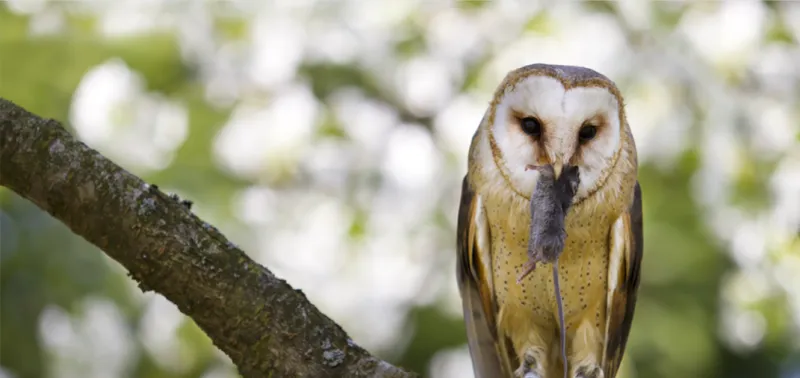
One of the most concrete things a Central Texas homeowner can do after spotting a hunting barn owl is to reconsider any rodenticide use on or near the property. When an owl or other predator eats a rodent that has consumed poison bait, the toxin does not stop at the rodent.
Secondary exposure is a recognized hazard, and the EPA’s rodenticide pesticide safety review identifies birds and other non-target predators as a documented exposure pathway. Barn owls are particularly vulnerable because they consume whole prey, including the digestive system where bait concentrates.
Texas Parks and Wildlife recommends mechanical traps over poisons for rodent control in settings where owls and other predators may be present. That recommendation lines up with what the evidence supports: the risk of harming a protected bird is real, and it is avoidable.
The most effective and predator-safe rodent management steps are also the most durable ones. Start by sealing every gap larger than a quarter inch in your foundation, siding, roofline, and garage.
Secure pet food in airtight containers and bring it inside at night. Store birdseed in metal cans with tight lids.
Remove accessible food waste, fallen fruit, and outdoor compost that is not properly contained. Cut back dense ground-level vegetation immediately around your home’s foundation, since thick cover close to the structure gives rodents easy, sheltered access.
Mechanical snap traps, placed inside tamper-resistant stations where children and pets cannot reach them, are the safest targeted option when active rodent pressure inside or immediately around a structure needs to be addressed. Extension guidance on integrated wildlife and pest management consistently emphasizes that exclusion and sanitation outperform any single control method, including predator attraction, when it comes to long-term results.
If a situation arises where a pesticide seems necessary despite predator access, follow the product label exactly and consult a licensed pest-control professional or your local wildlife management office before proceeding.
Balance open hunting habitat with household protection
Supporting a barn owl’s hunting habitat and keeping your home secure from rodents are not competing goals, but they do require some intentional landscaping choices. The general principle is to keep open, pesticide-free structure where the owl can hunt while eliminating the conditions that let rodents move easily into your buildings.
Texas Parks and Wildlife recommends reducing unnecessary outdoor lighting around owl habitat. Bright floodlights covering an entire yard can suppress normal nocturnal wildlife behavior and make the space less usable for a hunting bird that relies on dim conditions and acute hearing.
Switching to motion-activated or shielded fixtures, or simply turning off lights that serve no security purpose, is a low-effort change that benefits the owl without compromising your yard’s safety.
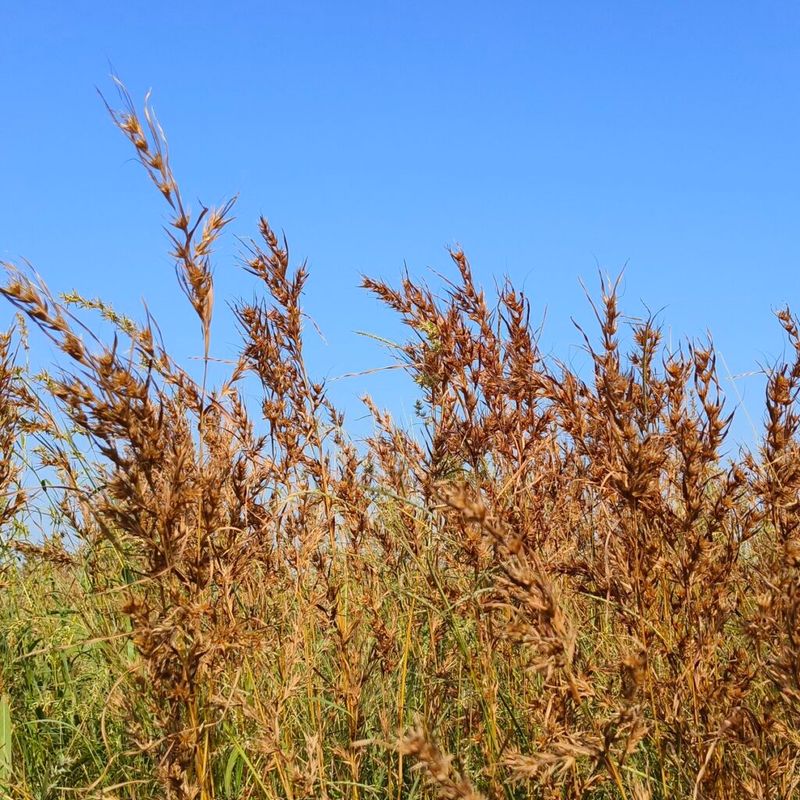
Native grasses, meadow-like strips, or field edges along the back or sides of a property can provide the open structure that barn owls prefer for low-altitude hunting passes. Research from monitored vineyard systems found that vegetation structure influences both owl hunting patterns and rodent activity, though that work was conducted in agricultural settings rather than residential lots.
The practical lesson is that some managed open ground is useful, not that every yard needs to be redesigned to match a farm layout.
The counterbalance is equally important. Dense shrubs, deep mulch beds, stacked lumber, and thick groundcover immediately against your foundation create exactly the harborage that rodents use to stay close to a structure.
Habitat studies on barn owls in human-modified landscapes note that vegetation management affects both predator access and rodent behavior. Keeping a clear, well-maintained buffer around the base of your home removes rodent cover while leaving open hunting space elsewhere on the lot.
Texas Wildscapes habitat guidance supports creating wildlife-friendly yards through thoughtful native plantings, which can be adapted to your specific lot size and layout without following a single prescribed design.
Consider a nest box only when the site can support it
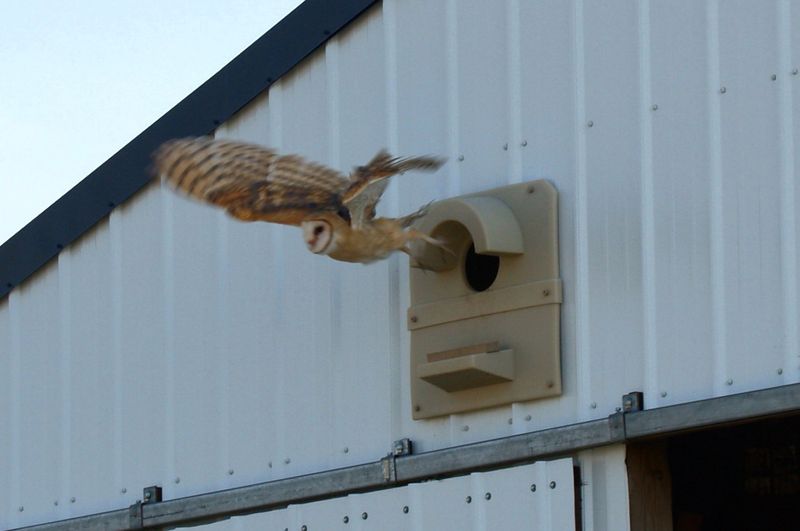
A nest box is sometimes presented as an easy way to get a barn owl family working your property, but that framing sets unrealistic expectations. Installing a box is a habitat project, not a recruitment strategy.
Whether any owl uses it depends on local prey availability, suitable open hunting ground nearby, competition from other cavity-nesting species, and the size of the regional barn-owl population. A box can sit empty for years, and that is a normal outcome rather than a sign of failure.
Texas Parks and Wildlife’s nest box specifications for barn owls call for a floor of approximately 10 by 18 inches, a depth of 15 to 18 inches, a 6-inch entrance hole, and placement 12 to 18 feet above the ground. The box should face away from prevailing weather, be mounted where terrestrial predators cannot easily climb to it, and be located within or adjacent to open hunting habitat rather than in a densely wooded or heavily developed area.
Maintenance matters as much as initial installation. Boxes should be cleaned and inspected outside the nesting season, typically in late winter before egg-laying begins.
Extension guidance on wildlife for pest management recommends avoiding unnecessary disturbance during the nesting period and cautions that boxes may also attract non-target wildlife, including other cavity-nesting birds or even squirrels. An occupied box should not be casually opened to check on the contents.
If you do install a box and it remains unoccupied after a full season or two, consider whether the surrounding landscape genuinely offers enough open hunting space, whether a predator guard is needed on the mounting pole, or whether the box dimensions and entrance size match the specifications. A well-placed, properly built box in suitable habitat is a reasonable long-term contribution to local barn owl populations, even if occupancy is not immediate or guaranteed.
Watch from a distance and know when to seek help
Barn owls are protected under federal law, and that protection shapes how homeowners should respond when one is hunting or potentially nesting nearby. The Migratory Bird Treaty Act prohibits the unauthorized taking, capture, possession, or collection of protected migratory birds, their eggs, and their young.
Handling an owl, relocating a bird you find on the ground, or disturbing an active nest without authorization from qualified wildlife authorities can put you on the wrong side of that law. When in doubt, contact Texas Parks and Wildlife or a licensed wildlife rehabilitator before taking any action involving the bird directly.
The safest and most useful thing most homeowners can do is observe from a comfortable distance. Binoculars or a camera with a zoom lens let you gather the identification details, flight-pattern notes, and behavioral clues that make your sighting genuinely informative without putting any stress on the bird.
Cornell Lab’s barn owl resource includes recordings of the bird’s distinctive raspy calls, which can help you confirm what you are hearing at dusk without needing to approach the roost site.
If you find an owl on the ground, appearing injured or disoriented, do not attempt to handle or feed it. Contact a licensed wildlife rehabilitator or your regional Texas Parks and Wildlife office.
TPWD’s owl guidance and EPA rodenticide safety information both point toward the same concern: a grounded owl that appears lethargic may have been exposed to a poisoned rodent, which is one more reason to keep rodenticides away from areas where predators hunt.
The practical sequence is simple: identify the bird carefully, secure your home against rodent entry, skip the poisons, and treat the owl as a signal about your local habitat rather than a promise about your pest situation. A barn owl hunting your yard at dusk is one of the more rewarding things a Central Texas property can attract, and the best way to keep it coming back is to leave it alone.