
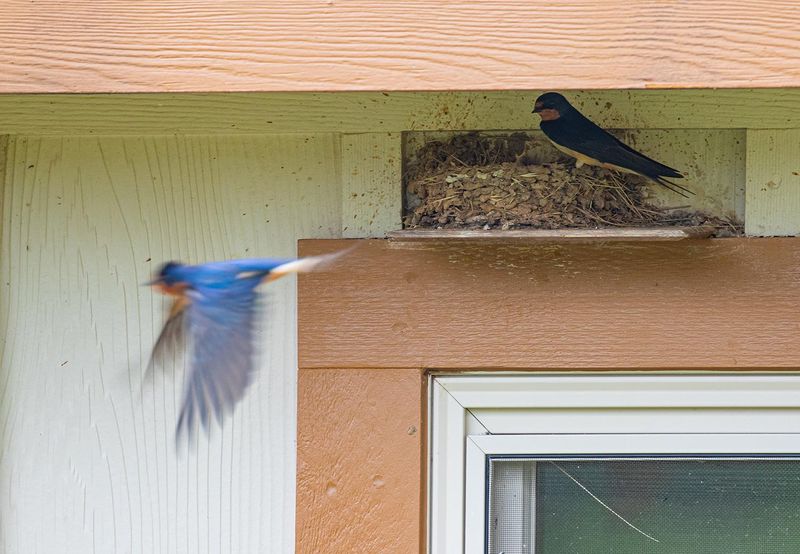
Every fall, some Central Texas homeowners notice swallows swooping low around their eaves and wonder whether the birds have moved in for the season. The answer is more complicated than it looks, and the popular idea that these birds arrive each autumn to nest and eat your mosquitoes needs a closer look.
Understanding what the birds are actually doing, and what they can and cannot do for pest control, helps you respond wisely without running afoul of federal wildlife law.
Fall activity does not automatically mean fall nesting
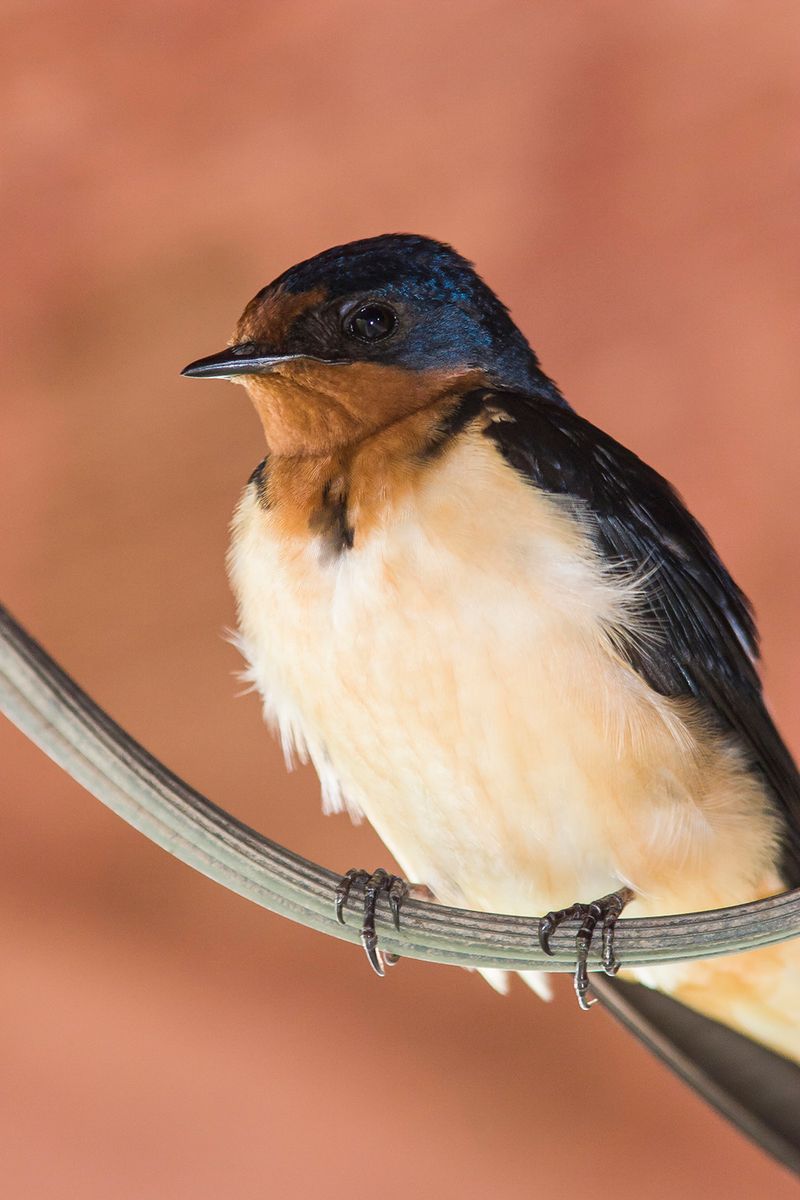
Seeing swallows circling your eaves in September or October feels like an obvious sign that they have chosen your house for a nest. That reading is understandable, but the Texas Breeding Bird Atlas places Barn Swallow egg-laying mainly from late March through mid-August, with one Brazos County study recording no nests containing eggs by August 8.
A bird darting under your overhang in fall is far more likely to be migrating, staging, roosting, or finishing a very late breeding attempt than starting a routine new nest.
Texas records classify Barn Swallows as both summer residents and migrants. Audubon’s field guide confirms that southward migration is well underway by mid-August across much of the species’ range, meaning the birds you see in early fall may simply be passing through your property on their way south.
Your eaves may offer a convenient overnight roost or a sheltered perch while the birds refuel, not a location they have chosen for raising young.
Local conditions can shift timing without rewriting the regional calendar. Weather, latitude, standing water, nearby mowing or livestock activity, and insect availability all influence where swallows pause during migration.
Texas Parks and Wildlife notes that migration timing lists are approximate and not exhaustive, so a late-season observation at your address does not prove that Barn Swallows have adopted a new nesting schedule across Central Texas. Before drawing any conclusion, watch the birds carefully over several days and look for the specific signs described later in this article.
Confirm the bird before you interpret the nest
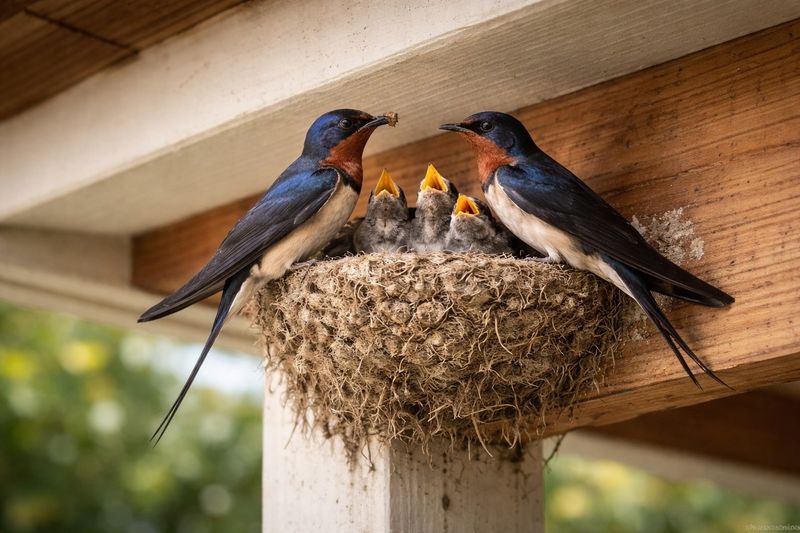
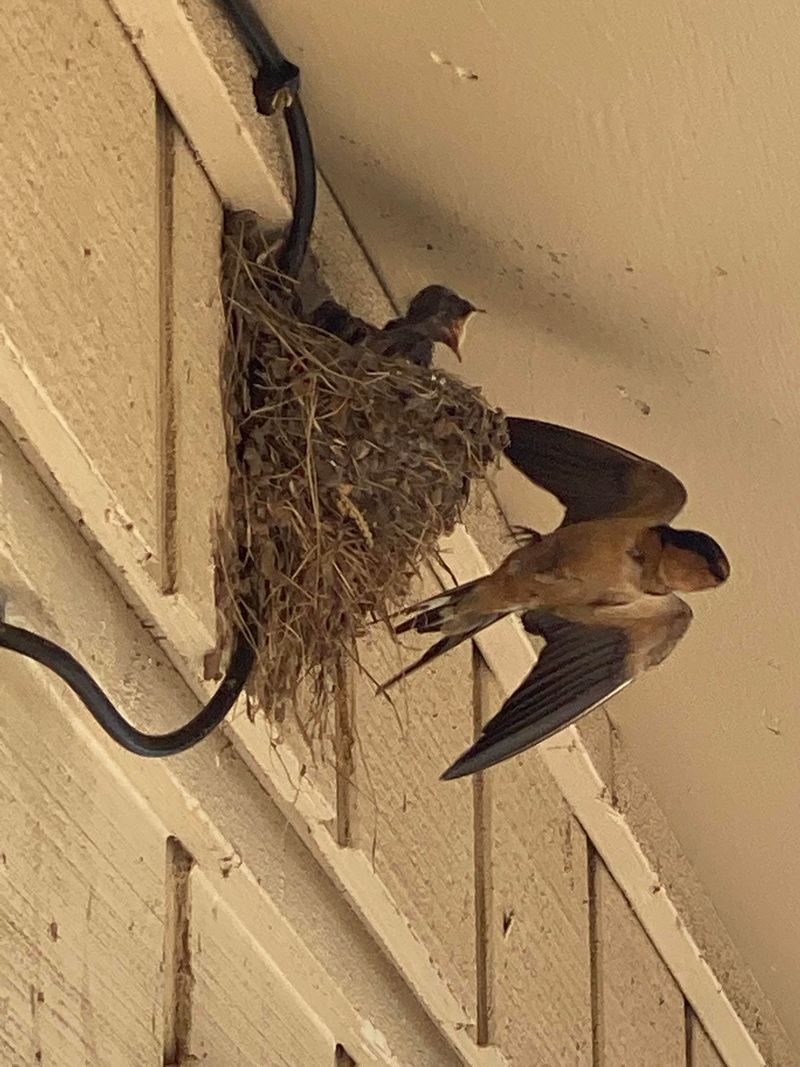
A mud nest tucked under an overhang looks like solid evidence, but the nest alone does not confirm you are dealing with Barn Swallows. Cornell Lab of Ornithology describes the Barn Swallow as a medium-sized bird with a deeply forked tail, dark iridescent blue upperparts, and a rusty or orange-buff throat and forehead.
They typically forage low and fast over open yards, fields, ponds, and roads, which makes them visible when they are actively hunting insects.
The problem is that Cliff Swallows, Cave Swallows, and other Texas swallow species also build mud nests on human structures. A Texas Parks and Wildlife publication on cavity-nesting birds illustrates how multiple swallow species share bridges, culverts, barns, and building eaves across the state.
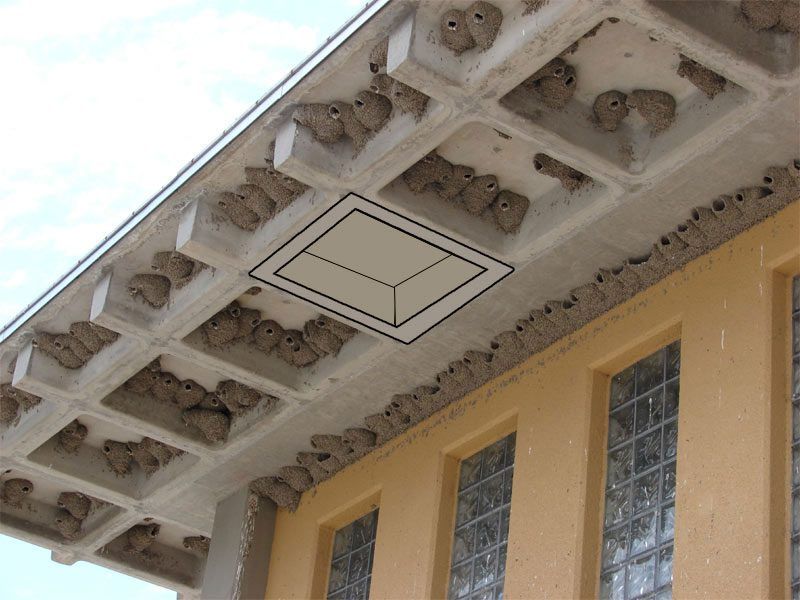
Cliff Swallows, for example, build enclosed gourd-shaped mud nests in colonies, while Barn Swallows build open cup or half-cup nests, often in smaller numbers or as single pairs.
Rely on a combination of clues rather than one feature. Check the tail shape in flight: a deep, symmetrical fork is a strong Barn Swallow indicator.
Look at the throat color, the nest’s open or closed form, the colony size, and where exactly the nest sits on the structure. A Cliff Swallow colony under a highway bridge can number in the hundreds; a pair of Barn Swallows under a porch overhang usually nests alone or with just a few neighbors.
Getting the identification right matters because the species affects how you interpret the nest’s timing, the birds’ behavior, and what management options are appropriate.
Eaves provide shelter and an open flight path
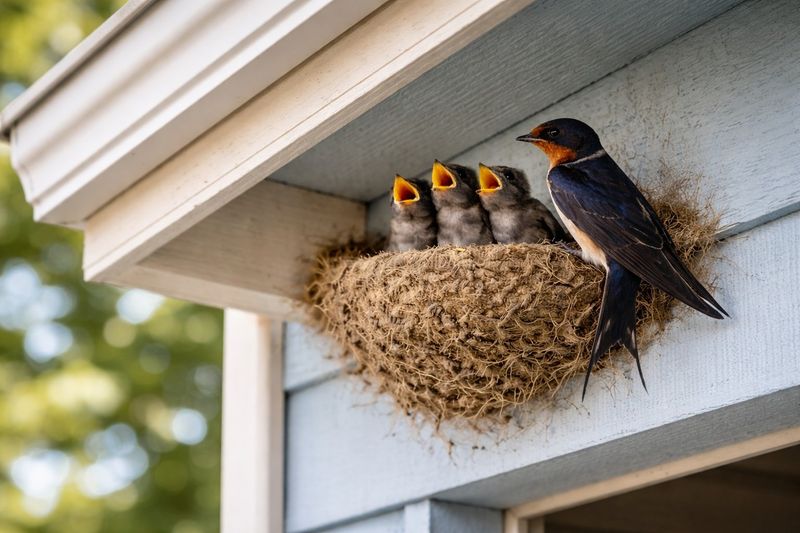
Barn Swallows are aerial hunters, meaning they catch every meal on the wing. A good nesting or roosting site needs two things: protection from rain and predators above, and a clear, unobstructed approach so the birds can dart in and out without clipping a branch or wall.
Cornell Lab notes that eaves, rafters, barns, sheds, bridges, and culverts all meet those criteria, which is why Barn Swallows have been nesting on human-made structures for centuries across their range.
When swallows show up at your house, it signals that your property has something they need: shelter overhead, open space for foraging nearby, and likely water or mowed grass that concentrates flying insects. That ecological signal is real and worth noting.
What it does not tell you is whether mosquitoes specifically are abundant, because swallows respond to many kinds of flying insects, not just biting ones. A pond, a recently irrigated lawn, or even a cattle pasture next door can draw foraging swallows without your yard having any unusual mosquito pressure.
Passing migrants and staging birds use structures opportunistically. A group of swallows that roosts under your eaves for a few nights in September may move on entirely once weather or food conditions shift.
Their temporary presence reflects the landscape’s suitability for a stopover, not a long-term claim on your property. Keeping that distinction clear helps you avoid over-reacting to a brief visit while also staying alert to the signs of genuine nesting activity described in the next sections.
Barn Swallows eat insects, not a guaranteed mosquito problem
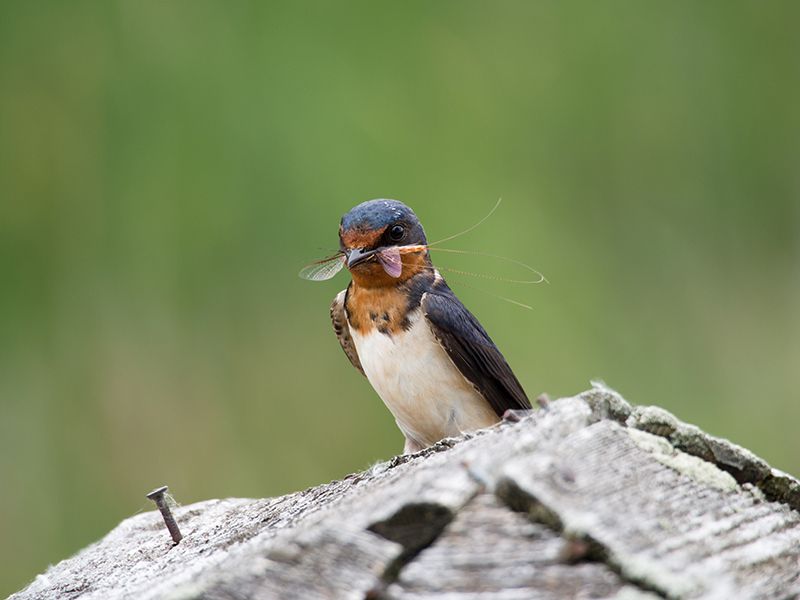
The idea that a pair of Barn Swallows under your eave will clear your patio of mosquitoes is appealing but overstated. Cornell Lab’s life-history account describes a wide and flexible diet that includes many fly families and other Diptera, as well as beetles, wasps, ants, moths, butterflies, and other appropriately sized flying prey.
The birds eat what is available and abundant at a given site and season, not what homeowners most want eliminated.
Mosquitoes may appear in that diet, but they are not a dominant or consistent component. A DNA metabarcoding study of aerial insectivore diets found that insectivorous birds, including swallows, consume a broad range of prey, and concluded that mosquitoes are generally a small part of the diet rather than a primary target.
That finding matters practically: a bird eating mostly larger flies, beetles, and moths during the hours it forages over your yard is not delivering the mosquito suppression the marketing language implies.
Claims that a single swallow eats hundreds or thousands of mosquitoes every day are not supported by field evidence reviewed here. A 2022 evidence synthesis in Pest Management Science distinguished between detecting mosquito DNA in a predator’s diet and demonstrating a measurable reduction in biting mosquito populations around a home.
Those are two very different outcomes. Finding that a swallow occasionally eats a mosquito does not mean a nest will noticeably protect your back porch on a humid August evening.
Swallows are still worth having around. They consume real quantities of flying insects and contribute to the local food web.
The honest framing is that they are useful, flexible insect eaters whose diet overlaps with mosquitoes only partially and unpredictably, not a substitute for the mosquito-control measures that actually work.
Determine whether the nest is actually active
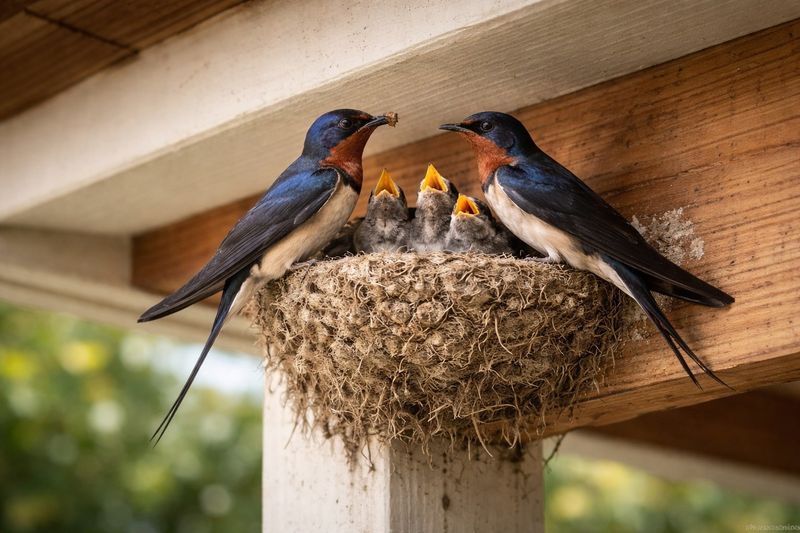
Before deciding what to do about a nest under your eave, you need to know whether it is genuinely in use. A quiet mud cup with no birds nearby could be last season’s abandoned structure, a temporary perch, or an active nest during a normal adult absence.
Watching from a comfortable distance, without approaching or touching anything, is the right first step.
Look for specific signs of activity over several visits. Eggs or nestlings visible inside the cup are definitive.
Adults carrying mud to repair or extend the nest, or adults arriving repeatedly with insects in their bills, indicate active breeding. Sustained attendance, where at least one adult returns reliably within a reasonable observation window, also points to an active nest.
Texas Parks and Wildlife describes nest building as taking under two weeks, with roughly two weeks of incubation following and about 18 days to fledging, though actual timing varies with weather and food availability. That sequence gives you a rough window to watch if you suspect nesting is underway.
Adults do leave the nest regularly to forage, so a brief period of quiet does not mean the nest is abandoned. Watch for at least an hour across two or three different times of day before concluding nothing is happening.
Avoid blocking the birds’ flight path to the nest, moving ladders or equipment close to the structure, or touching the nest to check for eggs. Disturbance during incubation or early nestling stages can cause adults to abandon young.
The U.S. Fish and Wildlife Service confirms that active nests and eggs of federally protected migratory bird species generally require special caution.
Nest status, meaning active or inactive, is the decision point for every management step that follows. Getting that determination right before taking any action protects both the birds and you.
Manage an inactive nest without creating a new conflict
Droppings below a nest, dried mud on siding, noise during the breeding cycle, and the prospect of birds returning year after year are legitimate homeowner concerns. The practical answer is to act during the window when the nest is genuinely inactive, use nonlethal methods, and set things up before the next breeding season begins rather than scrambling while birds are present.
Start by confirming the nest is empty and that no eggs or young remain. Federal guidance from the U.S.
Fish and Wildlife Service makes clear that active nests and eggs of migratory bird species covered by the Migratory Bird Treaty Act generally require special caution before any disturbance. The rule sometimes referenced about birds in buildings, 50 CFR § 21.14, applies specifically to the interior of human-occupied structures and does not automatically extend to exterior nests attached to eaves.
If you are uncertain whether a nest qualifies, contact the U.S. Fish and Wildlife Service, Texas Parks and Wildlife, or a qualified wildlife professional before removing anything.
Once the nest is confirmed inactive and applicable rules are checked, clean the area carefully, remove the mud structure, and sanitize the surface. Then install exclusion before next spring.
Penn State Extension recommends properly fitted netting or screening angled out from the eave, which blocks birds from reaching the wall surface without injuring them. Sloping ledge covers or redesigned overhangs that eliminate the flat attachment surface also work well.
If you want swallows nearby without the mess, Texas Parks and Wildlife suggests placing a separate nesting platform in a location where droppings are acceptable, such as over bare ground or a storage area.
One edge-case concern worth mentioning: after birds leave a nest, bird mites that lived on the nestlings may seek a new host and occasionally wander into adjacent living spaces. University of Minnesota Extension notes that bird mites cannot reproduce on human blood and are a short-lived nuisance rather than a health threat.
Handle abandoned nesting material with gloves and dispose of it in a sealed bag. This is a reason to clean up carefully after the birds leave, not a reason to treat ordinary swallow nesting as dangerous.
Control mosquitoes with water and screens, not swallows
Counting on swallows to protect your outdoor space from mosquitoes sets up an expectation the birds cannot reliably meet. Mosquito control requires targeting the places where mosquitoes breed and the entry points they use to reach you, and those are things you can manage directly.
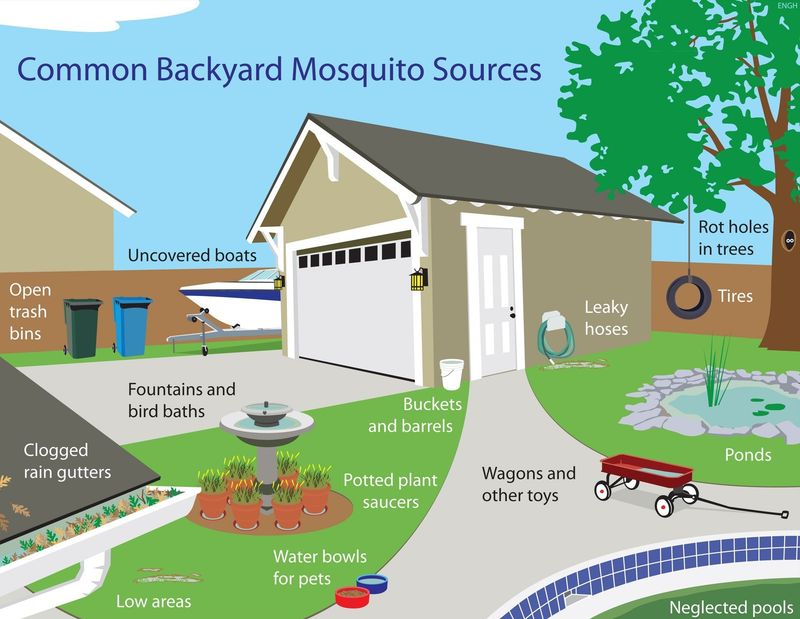
CDC guidance on home mosquito control puts standing-water elimination at the top of the list: empty or cover containers, birdbaths, gutters, saucers, and any other spot that holds still water for more than a week. Female mosquitoes need only a bottle cap’s worth of water to lay eggs, so small sources matter as much as large ones.
For water you cannot eliminate, such as a rain barrel, a stock tank, or an ornamental pond, CDC larvicide guidance recommends treating with products labeled for that use, such as Bacillus thuringiensis israelensis (Bti) dunks, applied strictly according to label directions. Repairing torn or ill-fitting window and door screens keeps adults from entering the house.
Wearing long sleeves and using EPA-registered repellents during peak mosquito hours adds another layer of personal protection.
Two approaches worth avoiding: spraying insecticide around eaves to drive swallows away, and installing residential mosquito-misting systems. The first can expose non-target wildlife and create chemical residues near a potential nest.
CDC does not recommend residential misting systems because of potential harm to beneficial insects, environmental exposure risks, and a lack of reliable effectiveness data. Neither approach addresses the breeding sites where mosquito populations actually grow, so neither delivers dependable results.
A methodical water-source audit combined with properly fitted screens will do more for your comfort on the porch than any number of swallows overhead.
Treat fall swallows as wildlife neighbors, not a mosquito forecast
When swallows appear around your eaves in fall, a short, practical sequence gets you to the right answer. Identify the birds first, using tail shape, plumage, and foraging behavior together.
Then separate fall presence from active nesting: Texas breeding records support spring-to-summer nesting as the norm, so a September or October sighting most likely reflects migration, staging, or roosting rather than a new nest.
If a mud cup is present, observe it over several days before drawing conclusions. Look for eggs, nestlings, adults carrying mud or food, and sustained attendance.
If the nest appears active, give the birds space and time. If it is inactive, verify applicable rules before removal, then install exclusion before next spring.
For mosquitoes, act on standing water and screens rather than waiting for birds to solve the problem. Cornell Lab’s life-history account and CDC home mosquito guidance point in the same direction: understand what the animal can realistically do, then fill the gap with direct action.
Fall swallow activity around your property says something real about your landscape. You have open foraging space, probably some water nearby, and the kind of flying insect abundance that sustains aerial hunters on a long migration south.
That is a healthy yard signal worth appreciating. Barn Swallows are genuine insect-eating neighbors whose diet overlaps with mosquitoes in a limited and unpredictable way, which makes them useful wildlife to welcome without overpromising what they will deliver on a muggy Texas evening.