
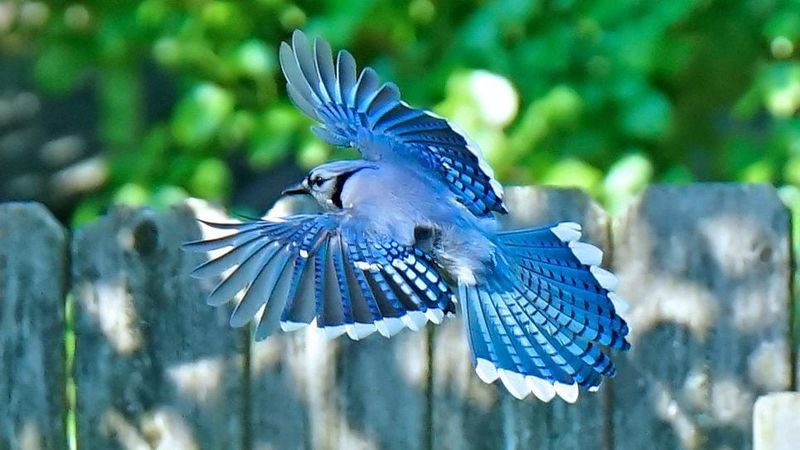
Something catches your eye on the back fence again, that flash of electric blue and bold black, and you start to wonder if the same bird keeps choosing your yard on purpose. Blue Jays are hard to ignore, and when one keeps showing up through a Texas summer, the visits feel like they mean something. They do, just not in the way folklore might suggest. The real story is grounded in what your yard offers and what the bird needs during one of the most active seasons in its life.
First, make sure the visitor is actually a Blue Jay
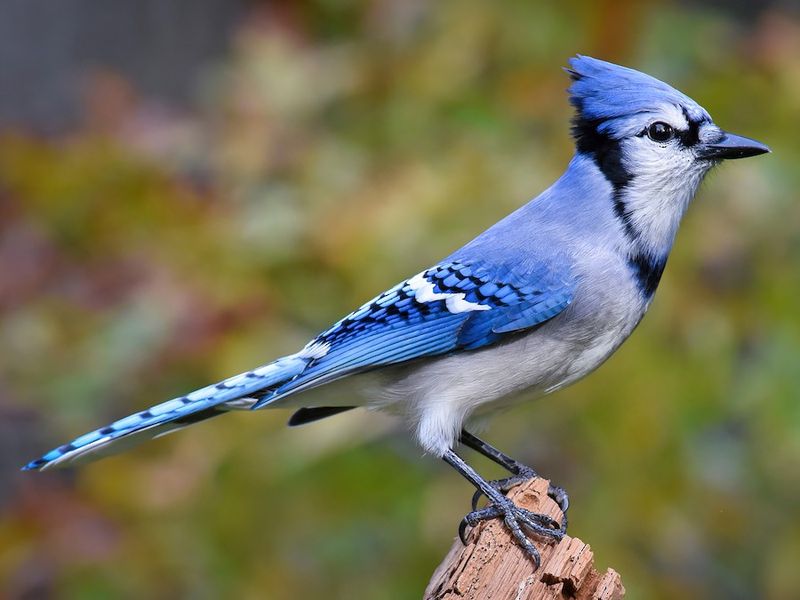
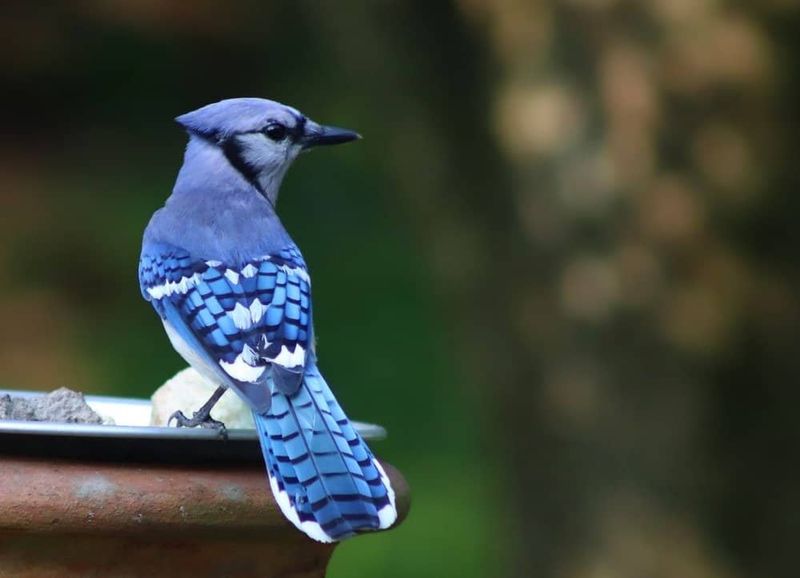
Before reading anything into a repeat visitor, it helps to confirm you are looking at the right bird. The Blue Jay, known scientifically as Cyanocitta cristata, carries a set of field marks that set it apart from every other jay in Texas. Look for a bright blue crest on top of the head, a clean white face, a bold black necklace that wraps around the throat and neck, and wings that show crisp blue-and-white barring. The body is blue above and pale gray to white below, and the tail is long and fan-shaped with white corners visible in flight.
The overall size is noticeably larger than a sparrow, roughly comparable to a robin.
Texas is home to other jay species, and a quick glance at color alone can lead to a mistaken identification. Texas Parks and Wildlife’s guide to Texas jays points out that the Green Jay, found in the brushlands of South Texas, wears a vivid green back and yellow underparts with blue facial markings, while Woodhouse’s Scrub-Jay, present in the Hill Country and Trans-Pecos, is a flat blue-gray without the crest or the crisp barring of a Blue Jay. Confusing one of these for a Blue Jay would change the interpretation entirely.
Location within the state matters too. Texas Parks and Wildlife describes Blue Jays as generally associated with the eastern half of Texas, where wooded edges, oak trees, and suburban neighborhoods provide the habitat they prefer. Readers in the Piney Woods, the Dallas-Fort Worth area, Houston, or along the Gulf Coast are far more likely to host regular Blue Jay visitors than those in the Trans-Pecos or the far western reaches of the state. If you are in West Texas and spot a blue bird, it is worth taking a second look before assuming the Blue Jay is your repeat guest.
A summer pattern usually points to a useful yard
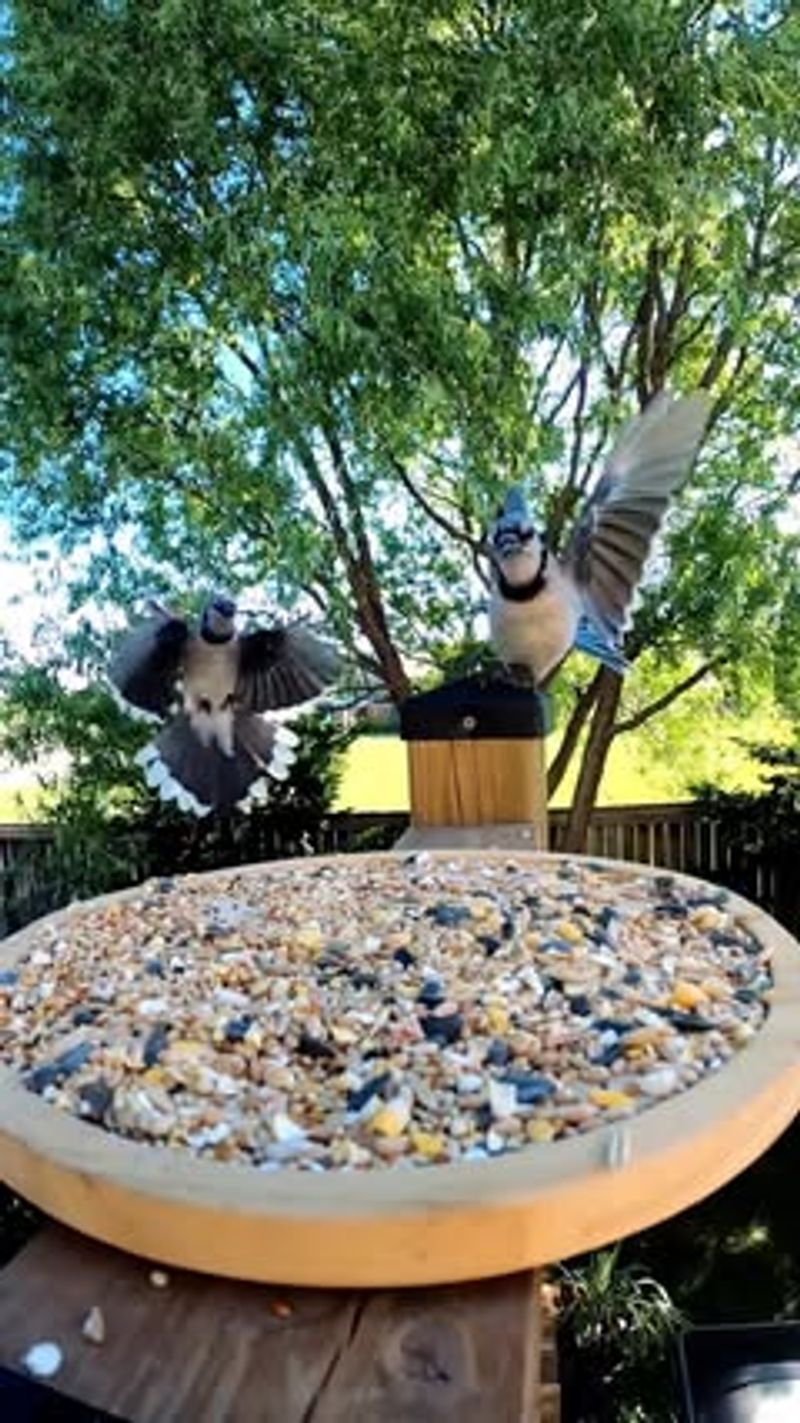
When a Blue Jay keeps appearing in your yard week after week through a Texas summer, the most grounded explanation is also the most straightforward: your property is giving the bird something it needs. That resource could be a feeder stocked with peanuts or sunflower seeds, a birdbath that stays filled through the heat, a stand of mature oaks, dense shrubs that offer shade and cover, or proximity to a nesting territory on or near your lot. Jays are practical birds, and a yard that reliably delivers what they require earns repeat visits the same way a good taco truck earns a lunch crowd.
One thing worth keeping in mind is that “all summer” does not necessarily mean the same individual bird returns every single day. Cornell Lab of Ornithology’s Blue Jay life history notes that Blue Jay movement varies by individual, with some birds remaining year-round in one area while others shift seasonally. Several different jays may be sharing the same resource on your property, each arriving at different times, which can create the impression of a single persistent visitor when the reality is a rotating cast of birds drawn to the same reliable spot.
Repeated sightings also do not prove that a nest is located in your yard specifically. A jay could be foraging at your feeder while nesting on a neighboring property, passing through a corridor between wooded lots, or traveling with a loose family group that ranges across several backyards. According to Texas Parks and Wildlife, Blue Jays thrive in wooded suburban environments, and a connected neighborhood with mature trees can support multiple birds moving through overlapping home ranges.
The practical takeaway is to look at what your yard actually provides rather than trying to assign a personal meaning to the timing of the visits. A yard with food, water, shade, and tree cover is speaking a language Blue Jays understand. The bird keeps showing up because the address keeps delivering.
The place where the jay lands reveals its most likely reason
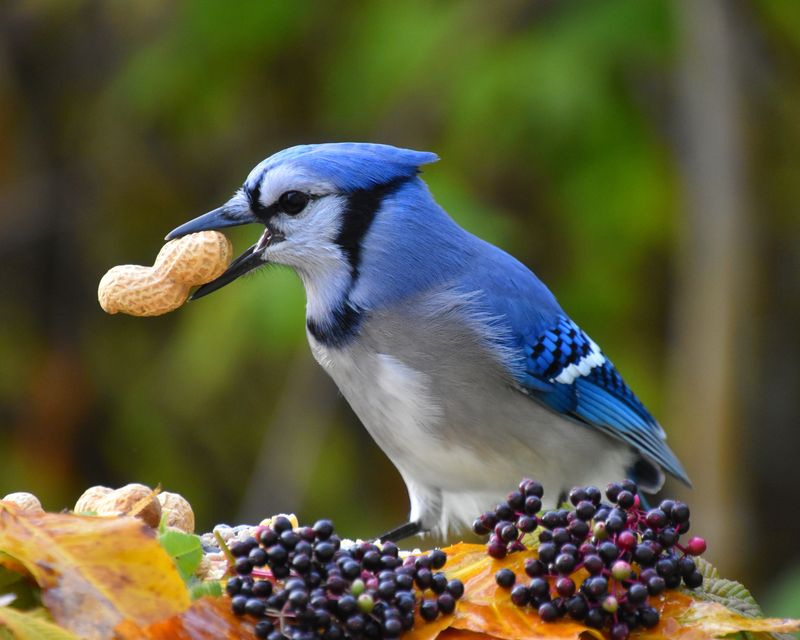
Watching exactly where the bird goes when it arrives can tell you more than any amount of speculation about its motives. A jay that drops straight to a tray feeder or roots around in the spilled seed beneath it is almost certainly there for food. Blue Jays are well-known feeder visitors that favor peanuts in the shell, sunflower seeds, and suet. They will also work over the ground beneath a feeder, picking through hulls and fallen seed with the same focused energy they bring to foraging in the wild.
If the jay heads to the feeder first every single time, food is the answer, and there is nothing more complicated to decode.
A jay that bypasses the feeder and goes straight to the birdbath is communicating something different. Water is a genuine draw during a Texas summer, when temperatures push well past 90 degrees and natural water sources can dry up or grow stagnant. A clean, reliably refilled bath can pull birds from a wider area than most homeowners expect, and a Blue Jay that returns to drink and splash on hot afternoons is simply making use of one of the best resources your yard offers.
Jays that linger near dense shrubs, thick hedgerows, or a canopy of close-growing trees may be using that cover for shade, roosting, or as a buffer zone near a nesting site. Cornell’s life history account describes Blue Jays nesting in a variety of trees and shrubs, often at a height that gives them a clear view of the surrounding area. Proximity to cover does not confirm a nest on your property, but it does suggest the bird values the structural complexity your yard provides.
Oaks deserve a mention on their own. A jay that works methodically through an oak, hopping from branch to branch and probing at acorns, is almost certainly caching food. Blue Jays carry acorns and other nuts in an expandable throat pouch and bury them for later retrieval, a behavior that has helped spread oak trees across large distances. Noticing a jay in your oak does not mean the bird planted your tree, but it does confirm that the tree is functioning as a genuine food resource rather than just a perch.
Noisy groups can mark the family season
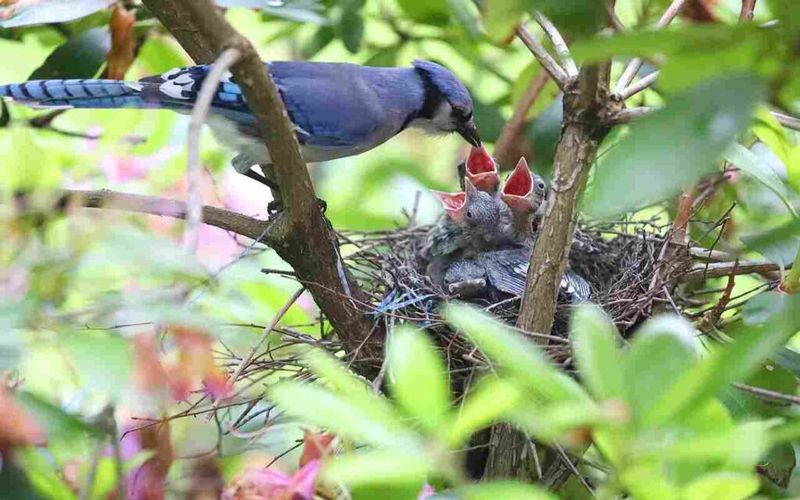
Summer in Texas has a way of making Blue Jay activity feel especially loud and persistent, and there is a biological reason for that. Spring and early summer mark the Blue Jay’s nesting period, when pairs establish territories and raise young in tree nests built from twigs, bark strips, and sometimes mud. Texas Parks and Wildlife’s urban wildlife fact sheet notes that Blue Jays nest in spring and summer, and once the young birds fledge, the family does not immediately scatter. Young jays may remain dependent on their parents for several weeks after fledging, following adults around and calling persistently for food while they develop the foraging skills they will need on their own.
That post-fledging period is often when a Texas homeowner notices a sudden uptick in jay traffic. What looks like a single bird that will not leave might actually be a pair of adults with two or three vocal youngsters trailing behind them. Cornell’s account of Blue Jay family behavior describes young birds continuing to beg for food from adults even after they are capable of short flights, which means a yard with a feeder or a productive oak can become a regular family stop during this period.
By late summer, family groups may also be joined by neighboring birds as territorial boundaries relax slightly and jays begin to move in loose flocks. A cluster of noisy jays working through the same corner of your yard is consistent with social contact, competition over a food patch, or early signs of the seasonal gathering behavior that sometimes leads to fall movement. None of that requires a personal interpretation. Multiple jays at once is more likely a social event than a message directed at the homeowner.
Keeping the interpretation probabilistic matters here. Not every group of jays is a family unit, and not every jay near your yard is connected to a nest on your property. What the noise and numbers do signal reliably is that your yard sits within a productive habitat patch during one of the most socially active stretches of the Blue Jay calendar.
Calls and crests offer clues, not a precise translation
Few backyard birds make themselves heard as insistently as a Blue Jay, and the range of sounds they produce can seem almost conversational. Sharp, repeated calls while the bird scans the treetops may indicate that the jay has spotted something it perceives as a threat, whether a hawk overhead, a cat on the fence, or another jay encroaching on a resource. Research on backyard bird alarm networks shows that Blue Jays do participate in mixed-species alarm communication, and other birds in the yard may go quiet or take cover when a jay calls sharply. That responsiveness is real, but it does not mean the jay is issuing a warning intended for you personally.
Blue Jays are also capable mimics, and one of their most frequently noted impressions is the call of the Red-shouldered Hawk. Cornell Lab notes this mimicry behavior and points out that its precise function is not fully settled. One possibility is that the hawk call communicates danger to other birds; another is that it causes nearby birds to scatter, giving the jay better access to a feeder or food source. Hearing what sounds like a hawk from your backyard and then seeing a Blue Jay fly off may simply mean you witnessed this mimicry in action rather than an actual hawk visit.
Crest position adds a layer of visual information, though it should be treated as a rough guide rather than a precise emotional read. Audubon notes that crest position in Blue Jays reflects mood, with a fully raised crest commonly accompanying alarm, aggression, or competitive tension and a flattened or sleeked crest more typical of relaxed social or family interactions. A jay sitting quietly at a feeder with its crest down is probably comfortable with its surroundings. One arriving with crest fully up and calling repeatedly is likely responding to something it perceives as a challenge or a threat.
Cornell’s life history account also notes that Blue Jays produce a wide variety of other sounds beyond the classic jay call, including soft whistles and clicks used in close social contact. Hearing one of these quieter sounds near a nest or a family group is consistent with normal communication between adults and young birds. The practical rule is to read calls and crest position alongside the setting: where the bird is, what it appears to be looking at, and whether other birds in the yard are reacting. No single call or posture translates cleanly into a confirmed threat or a specific message.
Texas Parks and Wildlife reinforces that Blue Jays are vocal and expressive birds whose sounds serve multiple functions in their social world.
Support the habitat without turning the yard into a health risk
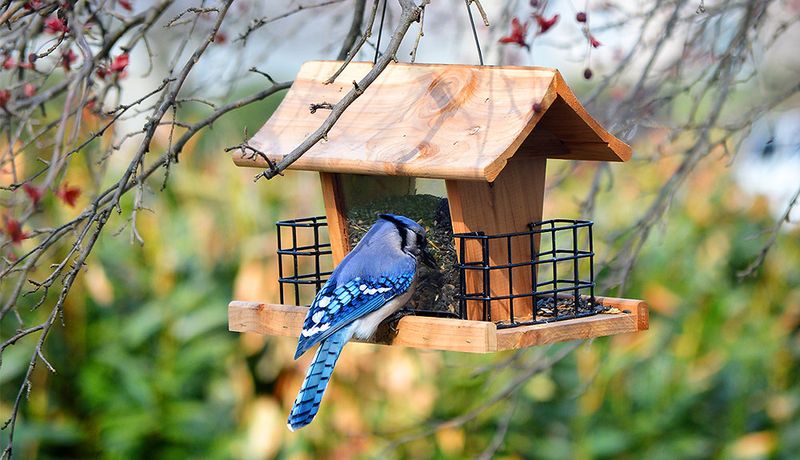
Attracting Blue Jays through a Texas summer is straightforward, but doing it responsibly requires a little attention to sanitation. Tray feeders or hopper feeders stocked with peanuts in the shell, sunflower seeds, or suet can draw jays reliably. A birdbath filled with clean, fresh water may be even more effective during triple-digit Texas heat, when natural water is scarce. Neither a feeder nor a bath is required to have Blue Jays visit your yard, but both can make a property more consistently attractive if that is your goal.
The risk that most homeowners underestimate is what happens when feeding stations are not kept clean. CDC investigations into Salmonella transmission linked to wild songbirds have documented cases where contaminated feeders and indirect contact through pets contributed to human illness. Birds congregating at soiled seed or fouled water can spread pathogens among themselves and into the surrounding environment. The problem is not the jay specifically; it is the concentration of multiple birds at a single spot that does not get cleaned often enough.
A published study in Emerging Infectious Diseases found that pets can serve as a bridge between contaminated wildlife environments and people, picking up Salmonella from spilled seed or soiled areas and carrying it indoors. Keeping cats and dogs away from heavily used feeding areas, spilled seed, and any sick or dead birds is a practical step that protects the whole household, not just the birds.
The routine is simple: refill water daily during summer heat, scrub the birdbath basin every few days, clean feeders with a dilute bleach solution every one to two weeks, and remove spilled or spoiled seed from the ground beneath feeders. Wash hands after handling any feeder or bath equipment. CDC guidance for bird hobbyists advises avoiding bare-handed contact with sick or dead wild birds and using gloves when cleaning feeders or baths. If you notice multiple sick or dead birds around a feeding station, pause feeding temporarily, clean everything thoroughly, and allow the remaining birds to disperse before resuming.
A grounded youngster or a window strike needs a different response
Two situations that show up more often during summer than any other time of year can catch Texas homeowners off guard: a young jay sitting on the ground and a jay repeatedly flying into a window. Both look alarming at first, but neither is usually what it seems.
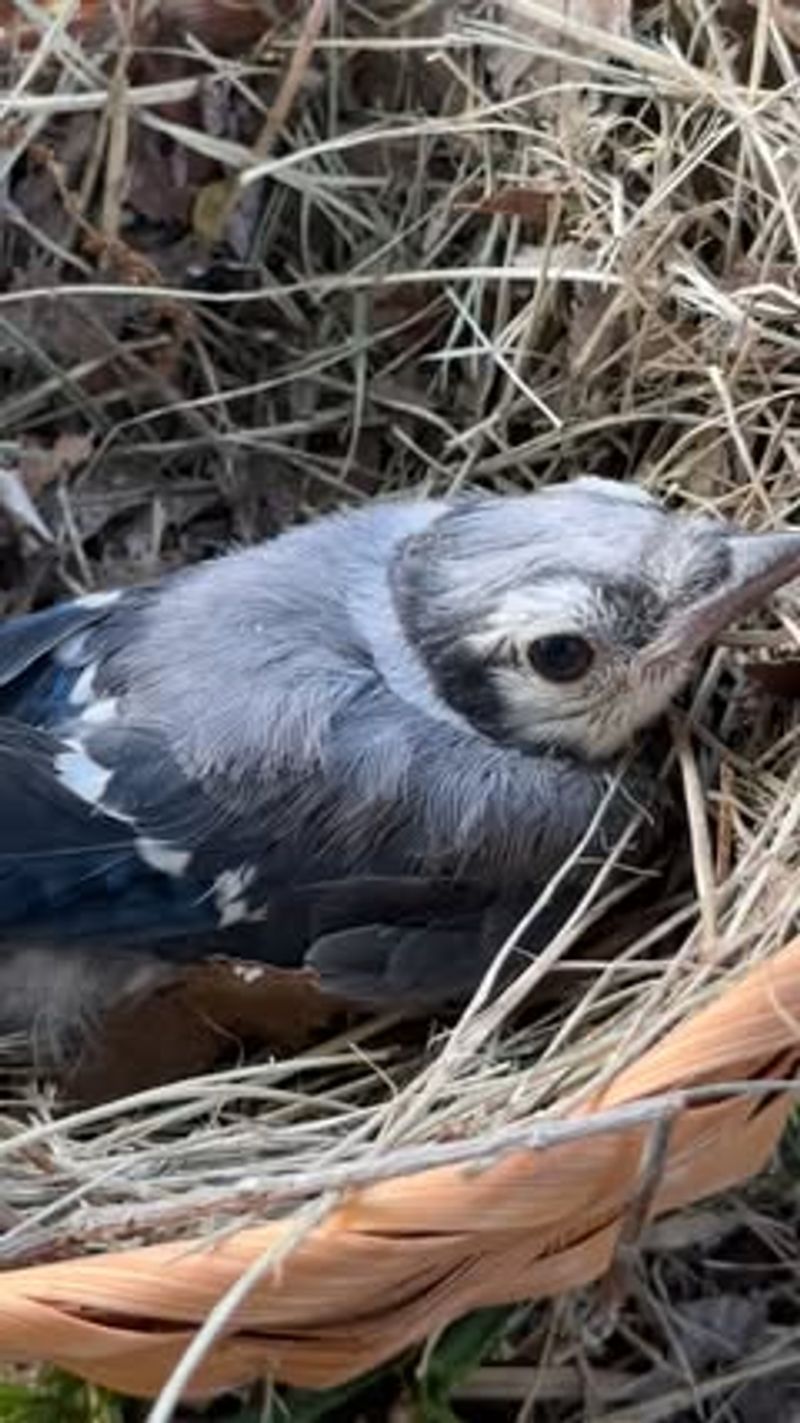
A feathered young bird that hops around on the ground, holds its head up, and watches its surroundings with alert eyes is very likely a fledgling rather than an abandoned or injured bird. Cornell’s life history account explains that Blue Jay fledglings commonly spend time on the ground while their flight feathers finish developing, and adult birds continue feeding them during this period even when the young bird is no longer in the nest. The parents are usually close by, watching from a branch or nearby shrub, and they will resume feeding as soon as people and pets move away from the area. The right response is to keep dogs and cats indoors, observe from a distance, and leave the bird where it is.
Moving a healthy fledgling away from the spot where its parents last saw it can do more harm than leaving it alone.
If a young bird is clearly injured, unable to right itself, or in immediate danger from a predator with no cover nearby, contact a licensed wildlife rehabilitator for guidance before attempting to handle the bird. CDC guidance advises against handling wild birds with bare hands regardless of how the bird appears.
Window strikes are a separate issue. A jay that repeatedly hits the same window is almost certainly responding to its own reflection, mistaking the image for a rival bird encroaching on its territory during breeding season. The window is not a target chosen because of the homeowner inside. Cornell’s window-strike guidance recommends comprehensive bird-safe treatment, such as exterior tape patterns, screens, or frosted film applied across the full pane, rather than a single decal or two, which leaves too much clear glass to effectively break up the reflection.
The real signal is what your Texas yard supplies
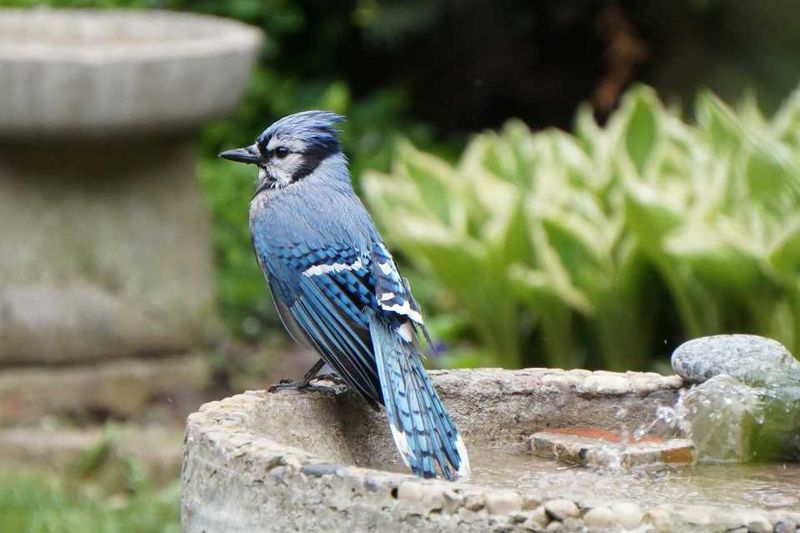
Putting it all together comes down to a simple four-part check. Confirm the species using the blue crest, black necklace, white face, and barred wings. Note the yard feature the bird goes to first, whether that is the feeder, the birdbath, the oak, or the shrub line. Watch whether it arrives alone or with other jays.
Then read any calls or posture alongside the setting and season rather than in isolation. Texas Parks and Wildlife and Cornell Lab’s life history account both point toward habitat and behavior as the foundation for any accurate interpretation.
A Blue Jay that keeps returning to your Texas yard through the summer is not delivering a fixed omen or a personal message. The bird is a living indicator that your property offers something real and useful during one of the most demanding seasons on the Texas calendar. Clean water, a safe feeding station, and mature trees do more for understanding and supporting these visits than any symbolic framework ever could. The most interesting thing a recurring Blue Jay can tell you is that your yard has become part of its world.