
Spotting large bees circling your porch on a hot North Carolina afternoon can feel alarming, especially when you notice fresh sawdust beneath a rail or eave. Before you reach for a can of spray, it helps to understand what that activity actually signals about your wood and your structure.
Carpenter bees are native pollinators with a specific nesting habit, and reading the clues they leave behind can tell you a lot more about your porch’s condition than the bees themselves do.
Summer Carpenter-Bee Activity Does Not Prove New Porch Damage
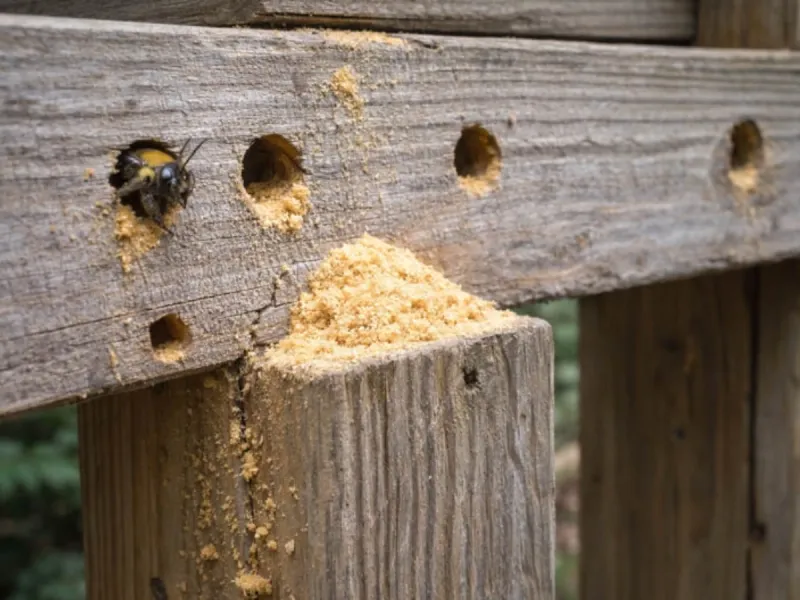
Seeing a large bee circling your porch in July or August does not mean that bee started drilling a new tunnel last week. In North Carolina, NC State Extension’s guide to non-honey bee stinging insects notes that adult carpenter bees typically emerge in April and May.
By mid-summer, the bees you observe may be newly emerged adults exploring their surroundings, foragers visiting flowers, or bees returning to clean and reuse tunnels that were excavated in a previous season.
The distinction matters because the common assumption, that summer sightings equal fresh structural damage, can send homeowners straight to an aggressive response when a measured inspection would serve them better. A bee hovering near the fascia board is not, by itself, evidence that a new hole appeared overnight.
It is, however, a reasonable prompt to walk over and look at the wood more carefully.
What carpenter bees actually tell you is that your porch offers wood they find suitable for nesting. They target bare, unpainted, weathered, or relatively soft wood, and their presence is a maintenance signal rather than a verdict on the structure’s safety.
Unlike termites, carpenter bees do not consume wood; they excavate galleries to raise their young. A single tunnel causes limited damage, though repeated nesting in the same boards over multiple years can enlarge galleries, allow moisture in, and attract woodpeckers that compound the problem.
The practical takeaway is straightforward: treat a carpenter-bee sighting as a prompt to inspect the porch, not as confirmation that the structure is failing. The sections that follow will walk you through identification, wood inspection, moisture issues, nest decisions, and prevention so you can respond based on what you actually find rather than what you assumed.
Confirm That the Insect Is a Large Carpenter Bee
Treating a porch for carpenter bees before confirming the insect is actually a large carpenter bee wastes time and may harm the wrong species entirely. Two very different insects carry the “carpenter bee” label, and only one of them damages porch lumber.
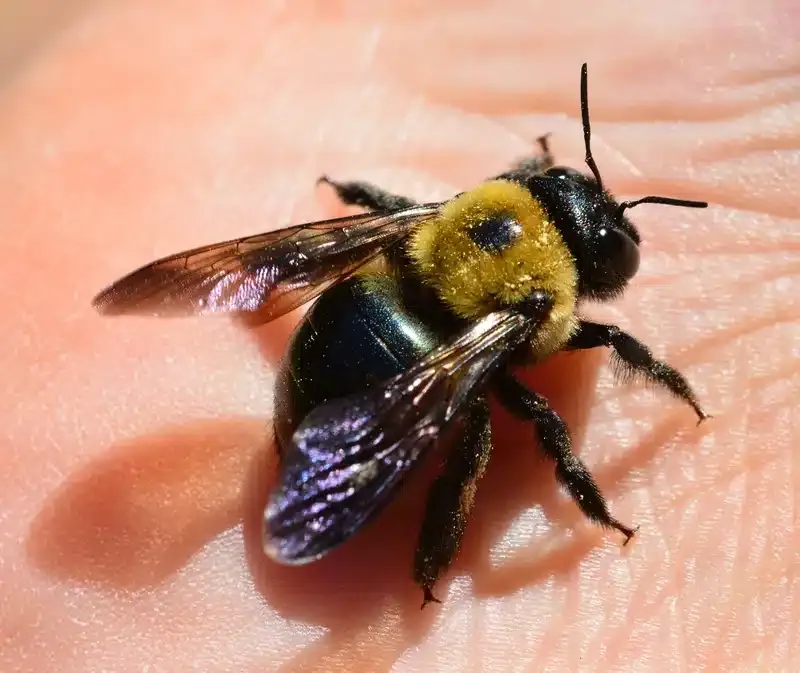
Large carpenter bees in the genus Xylocopa are the ones responsible for the round holes in your rails and eaves. They look similar to bumblebees at first glance, but a key difference sets them apart: the abdomen of a large carpenter bee is shiny and relatively hairless rather than fuzzy.
The Bees of North Carolina identification guide lists two Xylocopa species present in the state, and both are robust, dark-bodied bees that are easy to spot when they hover near wooden surfaces.
Small carpenter bees in the genus Ceratina are a completely different story. They are much smaller, often with a metallic blue-green sheen, and they nest in the pithy stems of dead plants rather than in porch lumber.
Finding a small, iridescent bee near your garden is not a sign that your deck boards are at risk.
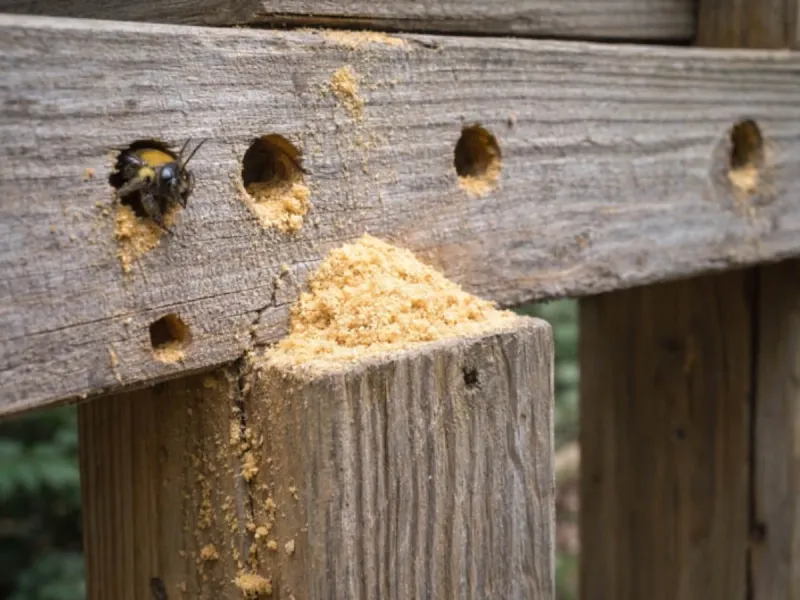
Beyond the bee’s appearance, look at the wood itself for confirmation. Large carpenter bees make entrance holes that are nearly round and about one-half inch wide.
Fresh sawdust or wood particles scattered below the hole, yellowish fecal staining on the wood surface near the entrance, and activity concentrated around exposed porch rails, eaves, fascia boards, or unpainted deck furniture all support the diagnosis. A hovering bee alone is not enough to confirm active nesting; the physical evidence at the hole is what ties the identification together and justifies any further action.
Read the Tunnel and the Wood Together
Finding a carpenter-bee hole is the beginning of the inspection, not the end of it. The hole tells you the bees found that board attractive; the condition of the surrounding wood tells you whether the board can handle it or whether a larger maintenance problem is already underway.
Start by looking at the finish on the targeted surface. Bare, cracked, or peeling wood invites excavation because it offers exposed grain that bees can work easily.
Check for multiple holes in the same board or cluster of boards, and look inside or around the entrance for branching galleries, which develop when bees extend existing tunnels over multiple seasons. NC State’s preventative home maintenance guidance recommends using a screwdriver or pocketknife to probe accessible wood: sound wood resists the point, while soft or spongy wood that yields easily signals decay that may be independent of the bee activity.
Pay closer attention when holes appear in load-bearing components. Porch columns, beams, joists, rail posts, stair stringers, and the connections between those members deserve a more thorough look than a decorative fascia board would.
Push on connections, check for movement or wobble, and look for gaps where pieces should be tight. NC State’s carpenter-bee resource describes serious structural concern as a product of repeated tunneling over years, concentration of holes in a single member, thin or deteriorated wood, and moisture intrusion rather than any fixed hole count.
There is no magic number of holes that automatically means danger.
Also scan for signs of other problems sharing the same space: active leaks from above, standing water near the base of posts, discoloration that suggests fungal growth, or evidence of other wood-destroying insects. Utah State University Extension’s carpenter-bee fact sheet notes that holes can allow moisture into wood, but rot and decay require sustained moisture conditions.
The bees may have opened a door to a problem that moisture was already creating nearby.
Fix Moisture and Decay Before Blaming the Bees
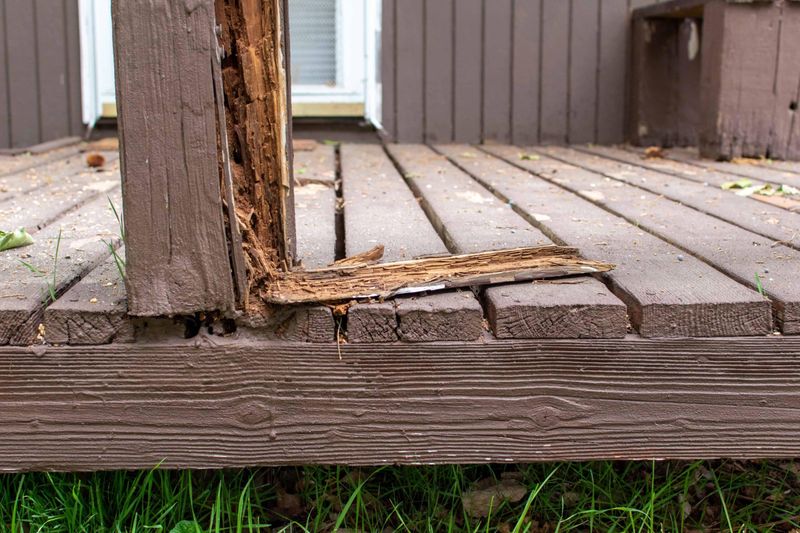
Carpenter bees may be the most visible thing happening on your porch, but they are rarely the only thing. Wood-decay fungi are responsible for a significant share of structural deterioration in porches across North Carolina, and they operate independently of any bee activity.
NC State’s resource on wood-inhabiting fungi explains that fungal decay requires sustained moisture and that eliminating the moisture source is the most effective long-term control.
Common sources of that moisture include roof or gutter leaks that drip onto framing, inadequate slope that lets water pool on decking, poor ventilation beneath a covered porch, and posts or stair stringers in direct contact with soil or concrete that stays wet. Correcting those conditions matters more than any surface treatment, because paint applied over persistently damp wood will not stop fungal decay from progressing underneath.
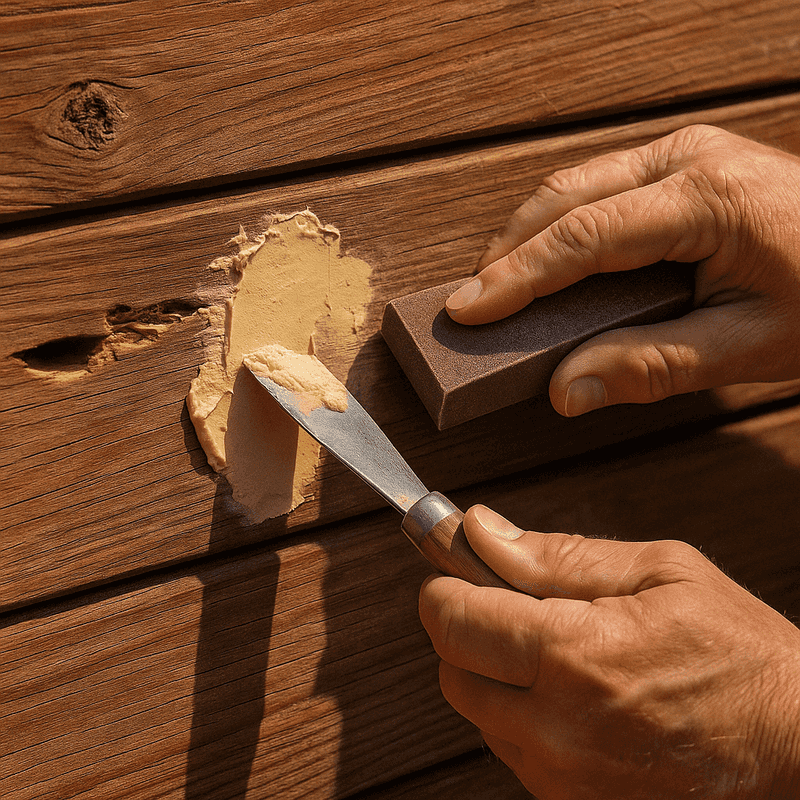
When you find wood that is soft, spongy, or crumbling, a cosmetic repair will not restore its strength. That material needs to come out and be replaced with sound lumber that is then properly finished.
NC State’s home maintenance guidance recommends getting a qualified assessment for any structural member or connection where decay is present or where you are uncertain about the remaining load capacity. A general contractor or licensed inspector can evaluate columns, beams, and ledger connections that are difficult to assess from the outside.
The connection between moisture control and carpenter-bee prevention is direct: dry, solid, well-finished wood is less attractive to bees and more resistant to the damage caused by localized tunneling. Fixing a dripping gutter or improving drainage away from a post base accomplishes two things at once.
Address the moisture first, replace any compromised wood, and then move on to finishing and nest decisions with a structure that is actually sound.
Choose Whether an Active Nest Needs Intervention
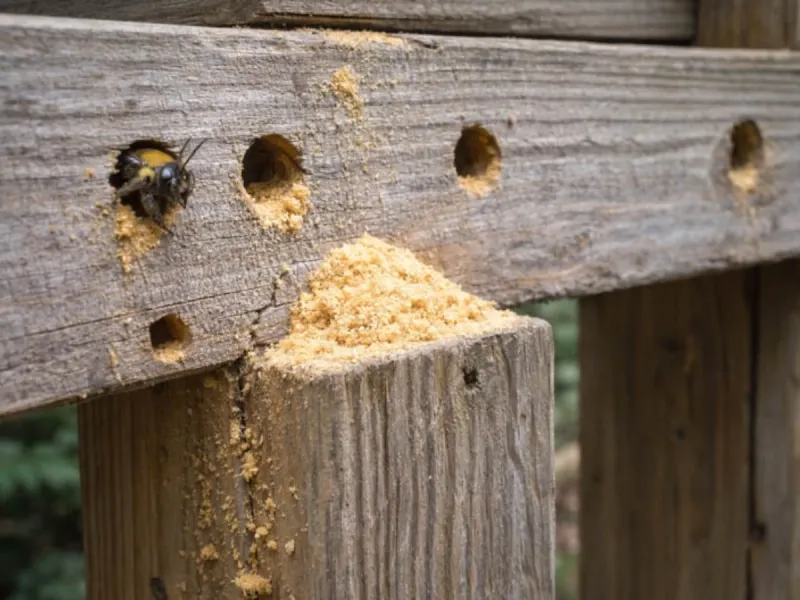
Not every carpenter-bee nest demands immediate treatment. A nest tucked into a decorative rail on sound, dry wood that shows no sign of structural concern may be reasonable to monitor through the season, especially given that carpenter bees are native pollinators that contribute to local gardens and landscapes.
The question to ask is whether the nest creates a genuine safety or structural problem, not simply whether it exists.
When the location does justify action, the target is the individual nest hole rather than the bees in the air around it. NC State Extension describes treatment directed into entrance holes and warns that spraying hovering bees is both impractical and an unsafe use of pesticide.
Avoid disturbing the female directly; males are the conspicuous hoverers and cannot sting, but females can sting when handled or directly threatened at the nest entrance.
For elevated or difficult-to-reach locations, such as eaves, soffits, high porch components, or any load-bearing member that requires ladder work, the fall risk, sting risk, and pesticide-exposure risk combine to make professional help the sensible choice. Penn State Extension specifically notes that homeowners often hire a licensed pest-control company for hazardous or hard-to-access locations.
If you choose a product-based treatment, use one that is currently registered and specifically labeled for carpenter bees at your intended site and application method. The 2026 North Carolina Agricultural Chemicals Manual lists products and directions for carpenter-bee nest treatment, and the EPA’s pesticide label guidance makes clear that using any product inconsistently with its label violates federal law.
Do not plug an active entrance immediately after treatment; sealing too soon can trap bees or leave developing offspring unaddressed. Wait until activity has stopped, then permanently close the hole.
Penn State’s Eastern carpenter bee article reinforces that surface treatments do not affect bees already occupying established galleries, so a coat of paint over an active hole is not a substitute for a deliberate nest-management decision.
Finish Vulnerable Wood to Discourage Repeat Excavation
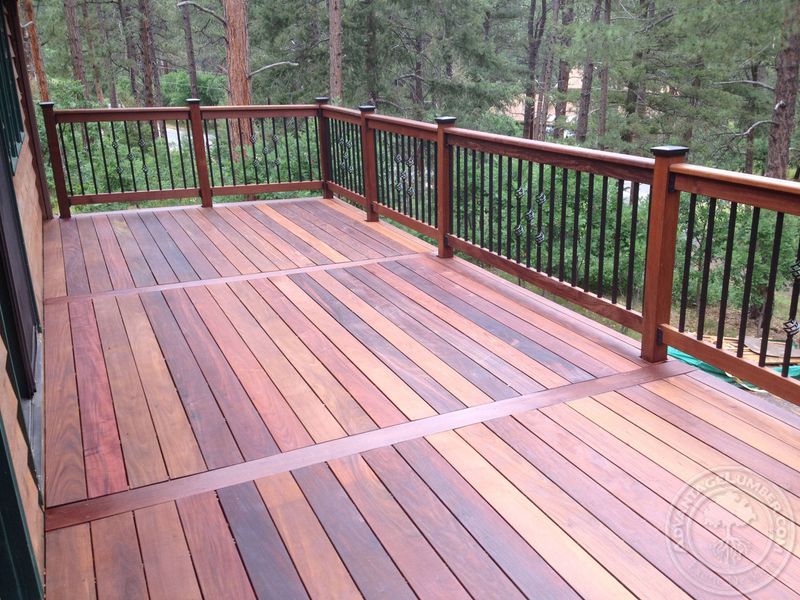
Once active nests have been addressed and any damaged or decayed wood has been replaced, the next priority is making the porch less inviting for future excavation. The most reliable way to do that is to eliminate bare, exposed wood surfaces, because finished wood is consistently less attractive to carpenter bees than raw or weathered wood.
Painting or staining every exposed surface is the starting point, but the spots homeowners most often miss are the ones bees most often target: end grain at the cut ends of boards, fresh cuts made during repairs, the undersides of rails and eaves, and any holes that have been treated and are ready to be permanently sealed. NC State Extension is consistent on this point: paint, stain, varnish, and treated wood make surfaces less attractive to carpenter bees, but they do not make wood bee-proof.
Weathering reduces that protection over time, so the finish needs to be maintained, not applied once and forgotten.
When repairs require replacing boards, composite decking or trim materials with a durable exterior finish can reduce future risk in those sections. Composite materials give bees less of the fibrous, workable grain they prefer.
That said, existing tunnels in adjacent boards remain available unless they have been properly treated and sealed; new material next to an open gallery does not eliminate the gallery.
Some homeowners interested in supporting native bees experiment with placing an untreated wood block or a “bee hotel” at the edge of the yard as an alternative nesting site. Penn State Extension notes that large carpenter bees prefer spacious porch and deck lumber, and there is no reliable evidence that substitute nesting wood draws them away from a structure they already find suitable.
Treat any such experiment as an optional habitat gesture rather than a prevention strategy, and keep the focus on finishing the porch wood itself.
Use Carpenter Bees as a Maintenance Prompt
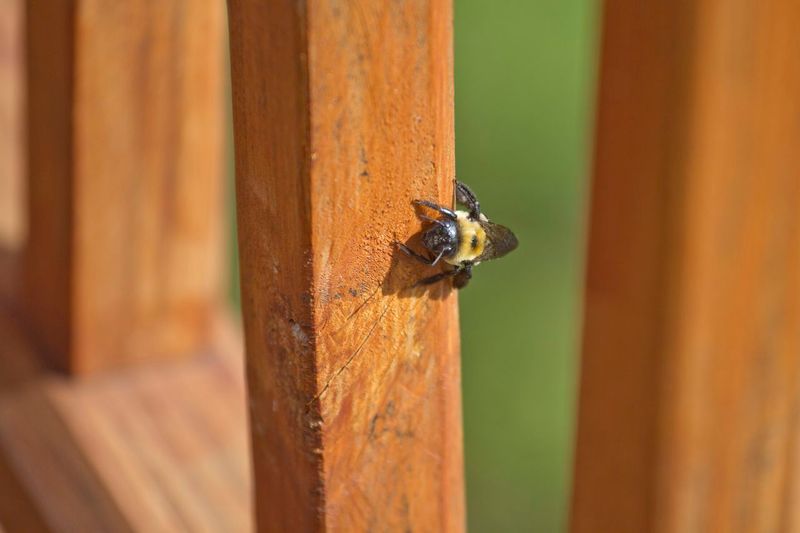
Carpenter bees circling a North Carolina porch are not announcing that the structure is failing or that new tunnels appeared overnight. They are pointing at wood that suits their nesting needs, and that is useful information.
NC State Extension frames their activity as a maintenance signal, and that framing holds up across every scenario this article covers.
The decision path is straightforward. Confirm the insect is a large carpenter bee by checking both the bee’s appearance and the physical evidence at the hole.
Inspect the targeted wood and the surrounding structure for weathering, exposed grain, moisture, decay, and any signs of concentrated or repeated tunneling in load-bearing members. Correct moisture problems and replace decayed wood before applying any surface finish.
Choose a nest response, whether monitoring or targeted treatment, based on the wood’s condition, the nest’s location, and whether any genuine safety concern exists. Then finish all vulnerable surfaces after repairs are complete.
NC State’s home maintenance guidance supports this sequence as sound practice for any wood structure.
A nest in sound, noncritical wood that creates no safety problem does not always require eradication. Protecting the porch where damage or safety warrants it, while leaving a harmless nest alone when monitoring is reasonable, reflects the kind of balanced stewardship that keeps both the structure and the local pollinator community in good shape.
The bees flagged the wood; what you do with that information is the part that matters.