
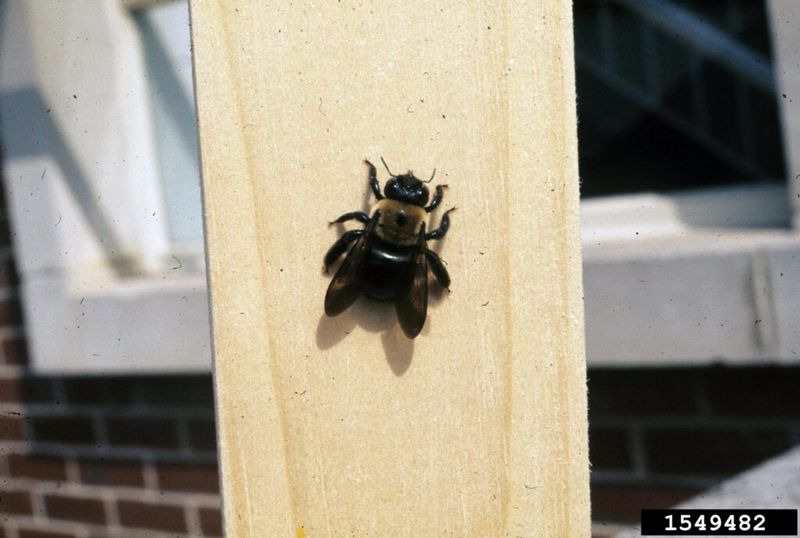
Walk out to your North Carolina porch on a warm summer morning and you might spot a large, hovering bee and a suspicious round hole in the railing that was not there last season. That hole is worth understanding before you reach for a spray can or a caulk gun.
Knowing what made it, why the wood was chosen, and how much it actually matters can save you money, protect your porch, and keep a useful native pollinator from getting caught in the crossfire.
A Half-Inch Circle Usually Points to a Large Carpenter Bee
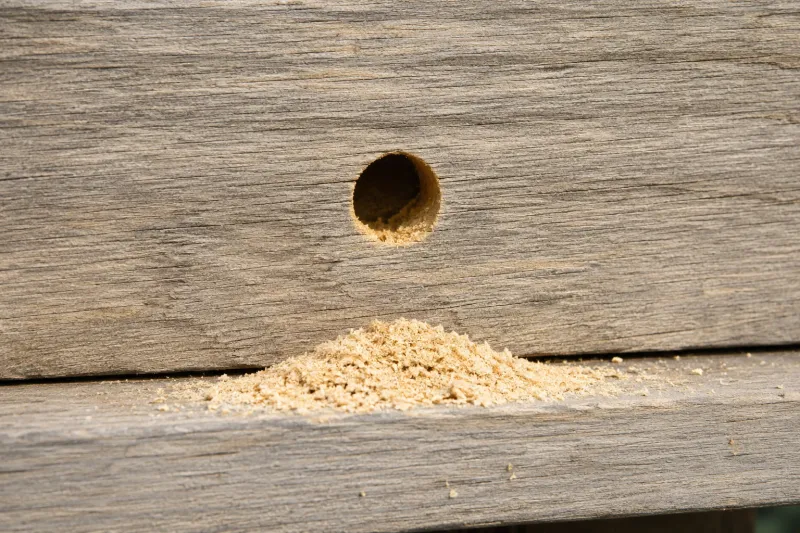
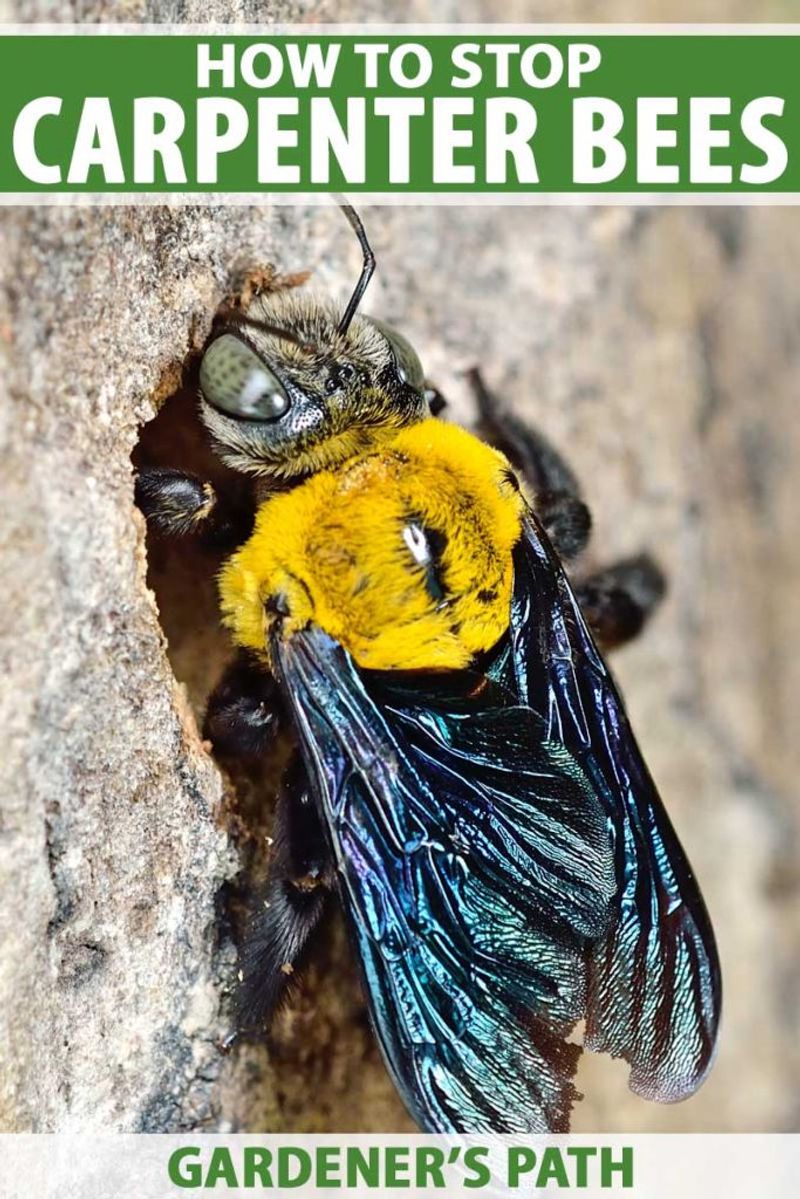
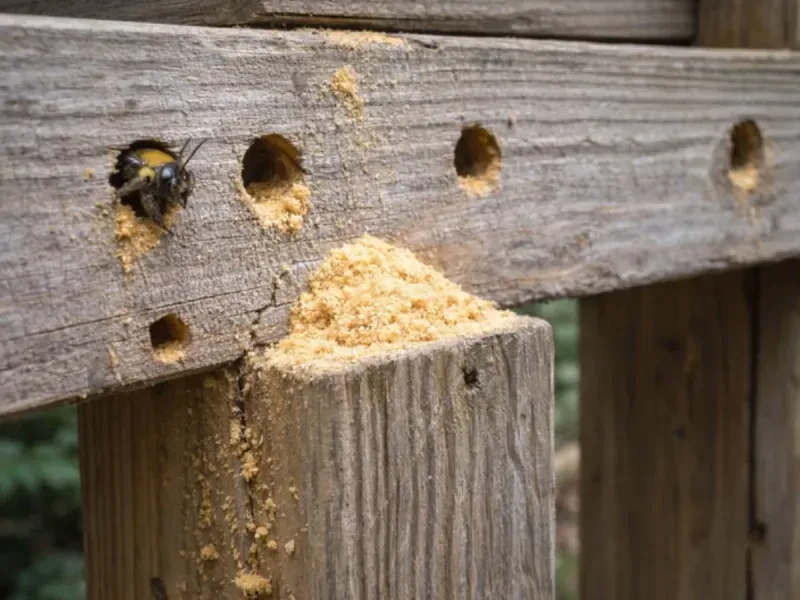
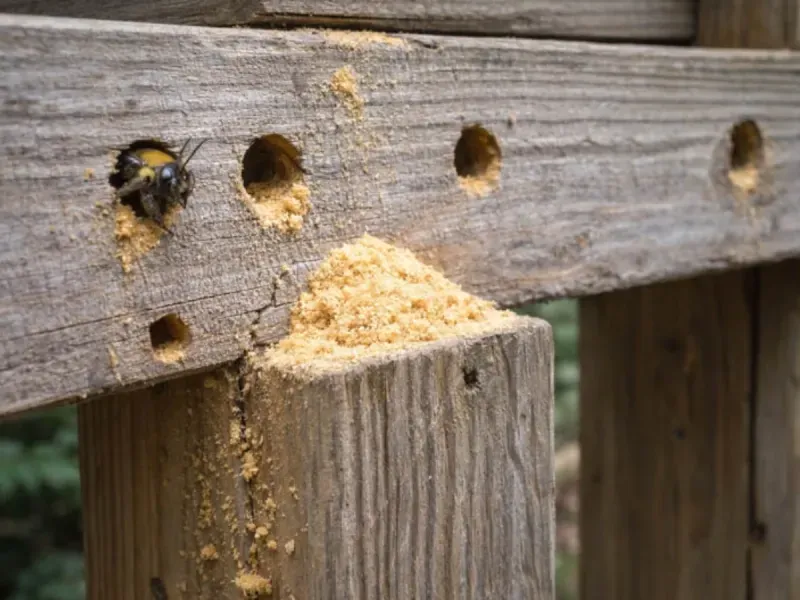
Finding a nearly perfect circle bored into your porch railing is startling, but the opening itself carries useful information. NC State Extension guidance on non-honey bee stinging insects describes large carpenter bees as the likely culprit when that entrance measures roughly one-half inch across and a large bee with a fuzzy, yellowish thorax and a shiny, relatively hairless black abdomen is present nearby.
Look below the opening for coarse sawdust and check the surrounding wood surface for yellowish staining, both of which strengthen the identification.
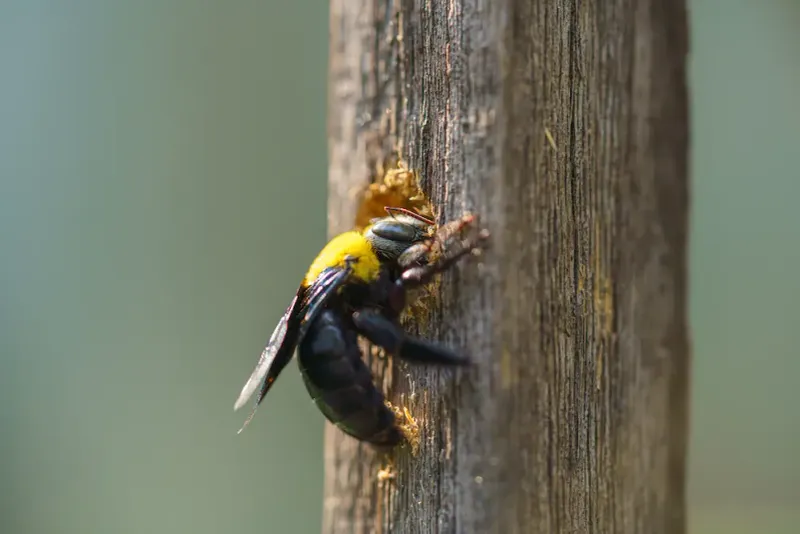
The insect itself is the most important piece of the puzzle. Large carpenter bees – species in the genus Xylocopa – run about one-half to one inch long.
The fuzzy, often yellow or golden thorax combined with a smooth, black, almost bald abdomen sets them apart from bumble bees, which carry dense hair across the entire body and live in social colonies. A carpenter bee working a porch railing is almost always acting alone, since the species is generally solitary.
North Carolina also hosts small carpenter bees in the genus Ceratina. These are noticeably smaller, often metallic blue or green, and NC State’s bee hotel resident guide notes they typically nest in pithy plant stems rather than structural lumber.
A Ceratina bee is not responsible for a half-inch hole in your deck post.
Even with all the right clues present, the hole alone does not deliver a guaranteed verdict. University of Maryland Extension’s household pest identification resource points out that other wood-boring insects can produce holes of varying sizes.
Use the combination of hole diameter, sawdust, staining, tunnel direction, and the actual bee’s appearance together before drawing a conclusion. One clue in isolation leaves room for error; the full picture narrows it considerably.
The Bee Is Excavating a Nest, Not Eating the Railing
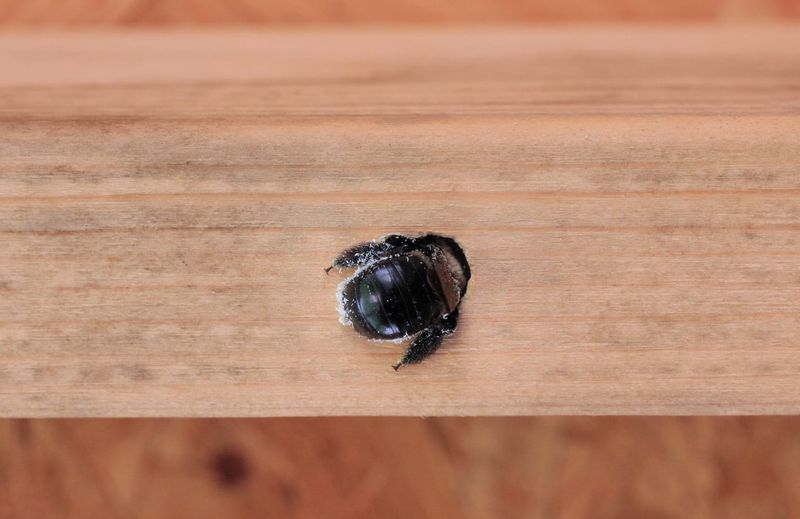
Carpenter bees are builders, not consumers. A female bee chews into the wood and then turns sharply to follow the grain, carving out a tunnel that can extend several inches.
She provisions each chamber with a ball of pollen and nectar, lays an egg on it, seals the cell, and repeats the process. The wood chips she removes fall away as sawdust – she is not digesting the railing for nutrition.
That distinction matters when you are deciding how alarmed to be. NC State Extension makes clear that carpenter bees excavate nesting galleries rather than consuming wood as food, which separates them from termites entirely.
Termites eat cellulose; carpenter bees hollow out chambers for reproduction. The damage mechanism and the scale of concern are genuinely different.
A single nest in sound wood usually causes limited structural harm. The gallery is roughly the diameter of the bee, and one season of use rarely threatens a well-built porch rail or deck post.
Penn State Extension’s carpenter bee guide explains that the real concern builds over time: repeated use, annual expansion, and multiple tunnels running through the same piece of lumber can gradually hollow it out and weaken the wood. Fascia boards, porch eaves, and railings with thin cross-sections are more vulnerable to that cumulative effect than thick structural posts.
Woodpeckers can accelerate the problem. They learn to probe carpenter bee tunnels for larvae, and their excavation can open up galleries far wider than the original bee entrance.
If you notice ragged, splintered holes alongside the neat round ones, woodpecker activity may be compounding the damage. That combined scenario warrants a closer inspection of the wood’s remaining thickness and strength rather than a simple patch-and-paint response.
Accessible Wood Makes a Better Nesting Site
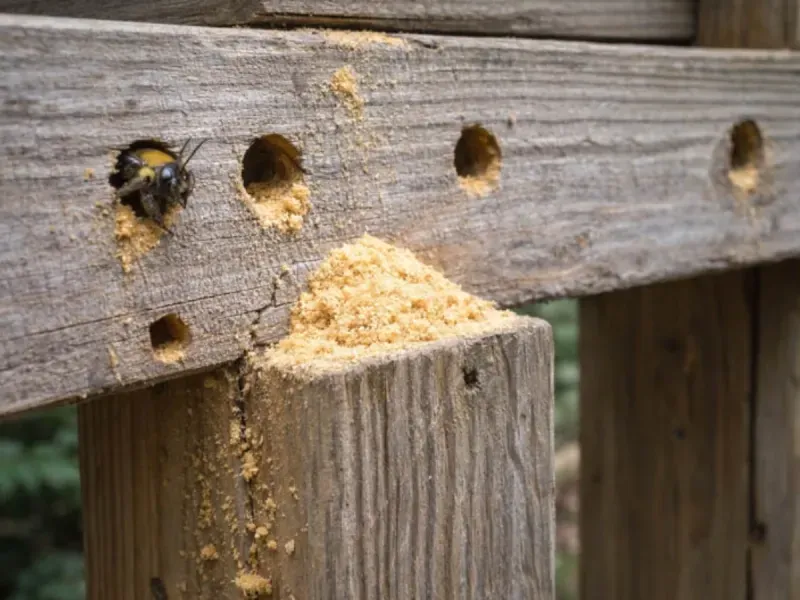
Bare, unfinished, or weathered wood is the common thread running through most carpenter bee nesting sites. University of Maryland Extension’s carpenter bee resource describes unfinished and weathered wood as generally more vulnerable than sound, well-maintained painted surfaces.
The reasoning is practical: a bee starting a gallery needs to cut through the outermost layer of wood, and softened, cracked, or unprotected surfaces require less effort to penetrate than a hard, intact paint film.
Pine and cedar show up repeatedly in extension literature as commonly used nesting substrates. Both are softwoods with relatively open grain, and pine in particular is widely used in North Carolina porch construction.
Exposed end grain – the cut face at the top of a post or the end of a railing board – offers an especially easy entry point because the grain runs directly into the wood rather than across it. Cracks, splinters, nail holes, and rough-cut edges serve a similar function by giving the bee a mechanical head start.
Paint or a durable exterior finish generally discourages new excavation, but it does not make wood completely off-limits. NC State Extension notes that finished wood is less attractive, not immune.
A bee determined to reuse a familiar site or working in an area with limited alternatives can still work through a maintained surface. That qualification matters: do not assume a single coat of paint applied years ago provides reliable protection if the finish has cracked, faded, or worn through.
Moisture and decay are separate concerns that deserve their own inspection. Carpenter bees do not require rotten wood to start a gallery, but soft or punky wood from moisture damage is easier to excavate.
If you probe an area around an active hole and find the wood compresses or crumbles, that softness points to a moisture problem that needs attention on its own terms, independent of what the bee is doing.
Summer Sightings Do Not Prove Summer Drilling
Spotting a large carpenter bee circling your porch in July does not automatically mean fresh tunneling is underway. NC State Extension places the main emergence and nesting period for large carpenter bees in North Carolina during April and May, when females excavate or expand galleries and lay their eggs.
Spring is the primary construction season, not summer.
By midsummer, the bees you observe are more likely newly emerged adults that hatched from eggs laid earlier in the year. These young bees may linger near the nest site, feed on nectar from nearby flowers, and eventually move toward overwintering sites.
Some adults also return to clean, inspect, or prepare older galleries for reuse the following spring. That activity can look identical to fresh nesting from a distance, which is part of why summer sightings create confusion.
NC State guidance does not support the idea that carpenter bees routinely start new tunnels throughout the summer months as a general North Carolina pattern. A fresh-looking entrance discovered in July may well have been excavated in April and simply gone unnoticed until summer yard work or painting brought it to attention.
Weather, proximity to the nest, and how much time you spend on the porch all influence when a homeowner first notices activity that may have begun weeks earlier.
Use the timing as context rather than as the deciding clue. A summer observation tells you that bees are present and active near your porch wood, which is useful information.
It does not, by itself, tell you whether the gallery is new, reused, or recently abandoned. Combine the timing with the physical evidence – hole freshness, sawdust quantity, staining, and the wood’s condition – to get a more complete picture before deciding how to respond.
Inspect the Wood Before Calling It a Safety Problem
Before deciding on any response, walk the entire porch and look carefully at every exposed wood surface. Check railings, posts, fascia boards, eaves, window trim, and the underside of deck boards.
You are looking for active entrances with fresh sawdust below them, older holes with yellowish staining, soft or spongy spots when you press the wood firmly, and any sign of multiple galleries running close together through the same board or post.
NC State Extension scales structural concern to the actual evidence rather than treating any hole as an automatic emergency. A few holes in thick, sound lumber that does not carry load is a maintenance issue, not a crisis.
The concern rises meaningfully when you find numerous tunnels concentrated in a single piece of wood, thin boards with galleries running nearly the full width, damage close to joinery or load-bearing connections, or evidence that the same sites have been reused over several years.
Staining below an entrance is worth noting but should not be misread. That discoloration can come from carpenter bee waste and does not by itself confirm rot or termite activity.
University of Maryland Extension recommends inspecting moisture and decay separately. Press a screwdriver or awl into the wood around the stained area: sound wood resists; soft, punky wood that gives way easily suggests moisture damage that needs its own repair regardless of what the bee did.
Penn State Extension notes that woodpecker excavation around carpenter bee galleries can dramatically increase the visible damage and the rate at which wood is weakened. Ragged, splintered openings surrounding the original round entry holes are a sign that birds have been working the site.
When that combination appears near a structural connection – where a post meets a beam, for example – a professional evaluation of the wood’s load-bearing capacity makes sense before you simply fill and paint.
Coexistence Can Make Sense When the Wood Is Sound
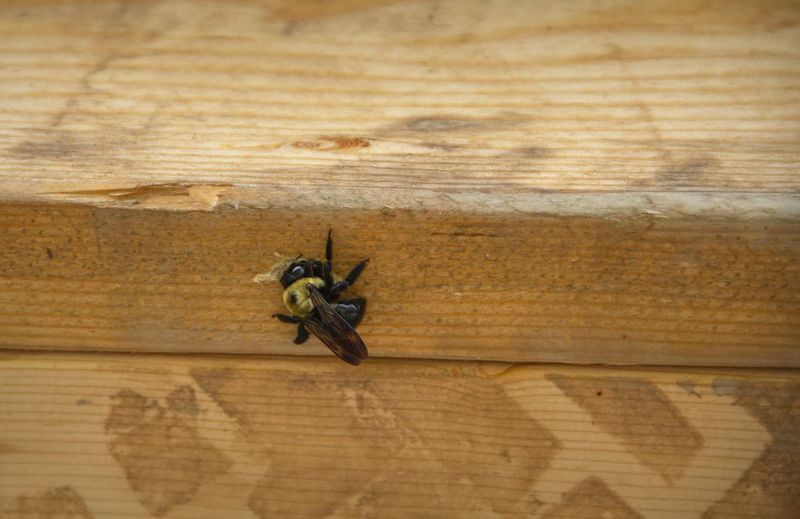
Carpenter bees are native pollinators with a genuine role in North Carolina ecosystems, and a small nest in a noncritical piece of wood does not automatically require a chemical response. Leaving minor activity alone is a reasonable, wildlife-aware choice when the gallery is in thick, sound lumber away from high-traffic areas and there is no evidence of recurring or expanding damage.
The bees’ reputation for aggression is largely undeserved. Penn State Extension explains that male carpenter bees cannot sting at all – they lack a stinger.
Their habit of hovering close to people near a nest site is territorial display, not an attack. Females can sting, but they are generally reluctant to do so unless directly handled or trapped against the skin.
Watching a male carpenter bee hover and dart around your porch railing is startling the first time; knowing what the behavior actually means makes it considerably less alarming.
Penn State’s eastern carpenter bee profile describes the species as an effective pollinator, particularly for open-faced flowers. In North Carolina’s warm months, these bees visit a wide range of garden plants and native species, contributing to pollination that benefits the broader yard.
That ecological value is worth factoring into your response, especially when the structural situation does not demand immediate intervention.
Coexistence has practical limits, and NC State Extension is clear that some situations call for action. Exercise more caution when the nest is directly overhead a frequently used seating area, when children play regularly near the site, when a household member has a known allergy to bee stings, or when the gallery is in a structurally important piece of wood.
In those cases, tolerating the activity is a less defensible choice, and a targeted response becomes more appropriate.
Repair and Finish Vulnerable Wood After Nesting
Durable maintenance is the most reliable long-term answer to recurring carpenter bee activity. Once active nesting has concluded for the season, fill old galleries with an appropriate wood filler, seal any cracks, splinters, and exposed end grain, and apply a quality exterior paint or finish to every surface that was previously bare or worn.
University of Maryland Extension recommends this sequence as the core prevention strategy because it addresses the wood conditions that made the site attractive in the first place.
Pay particular attention to end grain on posts and railings, rough-cut edges on fascia boards, and any spot where the finish has cracked or peeled away. These are the areas most likely to invite a returning bee the following spring.
A thin or aging paint coat that looks intact from a distance may have lost its protective value at corners and edges where moisture and sun exposure cause the earliest deterioration.
When a board or section of railing has sustained extensive tunneling, replacing it outright often works better than filling and repainting the original. Penn State Extension points out that swapping heavily damaged lumber for painted wood, composite decking material, or another less attractive surface tends to produce a more lasting outcome than repeatedly treating individual bees in the same location year after year.
Composite materials in particular offer no suitable nesting substrate.
Some extension sources mention almond oil as a deterrent option that can be applied to wood surfaces. Present it as one possibility among several prevention measures rather than a guaranteed solution.
It will not resolve an established gallery, and it should not substitute for the physical repairs and finish work that address the underlying vulnerability. NC State Extension also notes that large carpenter bees are unlikely to be drawn away from spacious porch lumber by a standard bee hotel, so that option should not be presented as a reliable redirection strategy.
A finished, well-maintained porch is a more dependable deterrent than any supplemental structure placed nearby.
Treat Active Galleries Carefully and Follow the Label
Chemical treatment is sometimes necessary, but the approach matters as much as the decision to treat. Spraying bees as they fly past, or broadly applying insecticide to porch flowers and the surrounding vegetation, can harm beneficial pollinators and is unlikely to stop nesting.
The target is the gallery itself, not the bee in the open air.
Extension guidance consistently describes a targeted approach: apply a legally labeled product directed into the nest entrance, observe all protective equipment and pollinator precautions required by the label, and seal the gallery only after activity inside has ceased according to the product’s current directions. The exact timing between treatment and sealing varies by product and situation, so no single universal waiting period applies across all cases.
Follow what the current product label specifies rather than a general rule of thumb.
The 2026 North Carolina Agricultural Chemicals Manual lists carpenter bee uses for certain products and notes that some applications require a North Carolina Structural Pest Control license along with manufacturer-specific training. That requirement makes professional treatment the safer and more legally appropriate choice for galleries located overhead, in high or hard-to-reach spots, at sites with extensive tunneling, or anywhere near load-bearing structural wood.
Pollinator protection requirements apply regardless of who does the work. EPA pollinator protection guidance advises reading and following the pesticide label fully, avoiding applications when pollinators are actively foraging, and observing any product-specific restrictions on timing, drift, blooming plants, and non-target organisms.
EPA’s label compliance resource reinforces that the label is a legal document, not a suggestion.
Penn State Extension’s eastern carpenter bee guide frames targeted prevention and wood repair as better long-term strategies than repeated chemical treatment of individual bees, a position consistent with the practical reality that killing one season’s bees does not prevent the next generation from finding the same unprotected wood the following spring.
Treat the Hole as a Manageable Clue
A round hole in the railing is a signal worth reading, not a verdict. Start with identification: look at the bee, the opening size, the sawdust, and the surrounding wood together.
NC State Extension provides the clearest regional reference for confirming large carpenter bees and understanding their seasonal pattern, which keeps spring – not summer – as the main excavation period.
From there, inspect the wood honestly. A few holes in thick, sound, noncritical lumber call for monitoring and maintenance.
Extensive tunneling, repeated annual activity, soft or weakened wood, or damage near a load-bearing connection calls for repair, replacement, or a licensed professional. University of Maryland Extension and the 2026 NC Agricultural Chemicals Manual together support that scaled response – match the intervention to what the evidence actually shows rather than the worst-case interpretation of a single hole.
Protecting your porch and protecting a native pollinator are not competing goals. Fill and finish the wood, address the conditions that made it accessible, and bring in professional help when the situation exceeds a straightforward maintenance fix.
A well-maintained porch is the most durable answer – and a carpenter bee that finds no foothold simply moves on.