
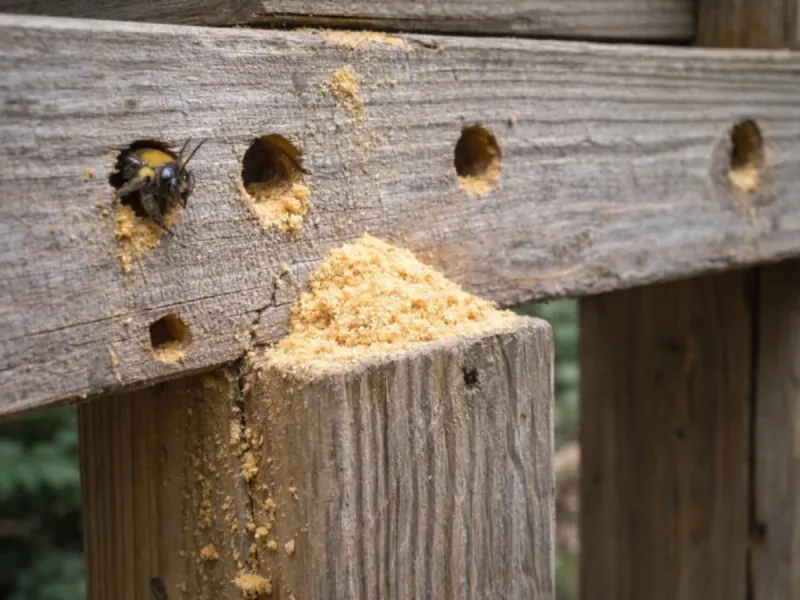
Spotting a large bee hovering near your porch rail or finding a perfectly round hole in a beam can set off alarm bells for any homeowner. Before you reach for a spray can, though, the evidence is worth reading carefully because the hole tells a story about your wood, not a mysterious yard problem.
Carpenter bees are native pollinators that excavate nesting galleries in exposed wood, and understanding what they need helps you protect your porch without causing unnecessary harm. A measured look at the signs, the wood condition, and the timing puts you in a much better position than a quick chemical fix.
A Summer Sighting Does Not Prove New Drilling
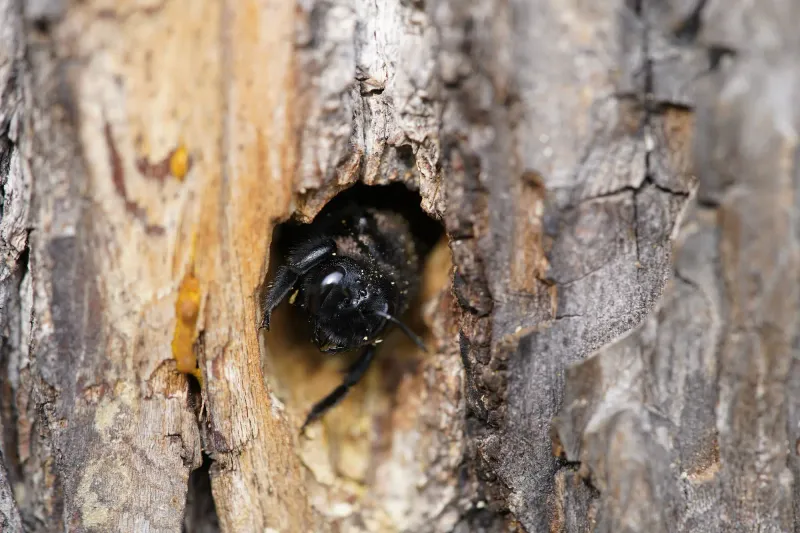
Finding a round hole in your porch beam during July or August does not mean a carpenter bee drilled it last Tuesday. NC State Extension guidance on non-honeybee stinging insects notes that adult carpenter bees in North Carolina typically emerge in April and May, which is the main period of active nest excavation.
By midsummer, that work is largely done for the season.
Late-summer activity looks different from spring nesting. New adults emerge toward the end of summer, and rather than drilling fresh galleries, they tend to feed on nectar and pollen to build energy reserves.
Bertie County Cooperative Extension explains that these late-season adults often return to existing tunnels for shelter as temperatures cool, preparing to overwinter inside the wood rather than creating a new generation of holes.
Seeing a bee hovering near an old entrance in August, then, does not confirm that excavation is happening right now. The hole could have been created months earlier, and the bee you are watching may simply be a newly emerged adult checking out inherited real estate.
The practical takeaway is to investigate the evidence before drawing conclusions. NC State News coverage of carpenter bee protection reinforces that the right response starts with reading the wood and the signs rather than assuming an urgent infestation is underway.
Fresh sawdust directly below a hole suggests recent activity; dry, weathered staining around an old entrance suggests the opposite. That distinction shapes every decision that follows.
The Hole Has a Carpenter-Bee Pattern—but It Is Not Proof
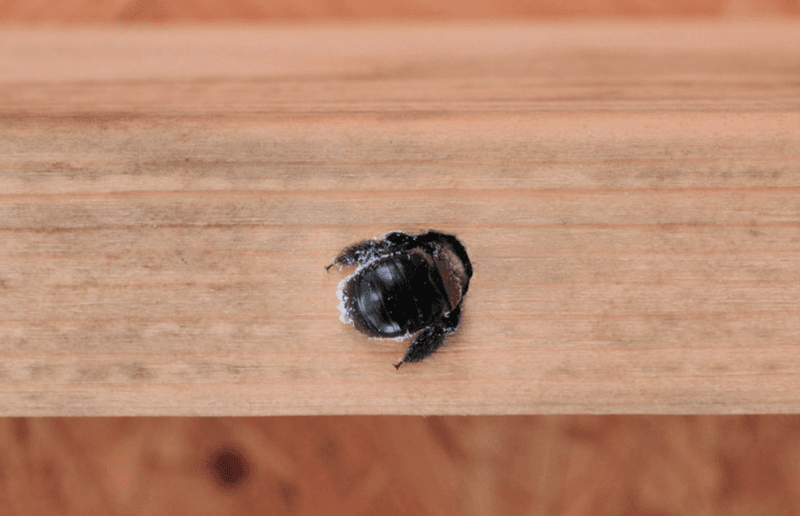
A round opening roughly half an inch across, with coarse sawdust or frass scattered beneath it and a yellowish smear below the hole, is the pattern most consistent with a large carpenter bee entrance. University of Maryland Extension’s carpenter bee resource describes this combination of clues as useful diagnostic evidence, but clues are not the same as a confirmed identification.
Treat the physical signs as a strong starting hypothesis, not a closed case.
Seeing the bee itself sharpens the picture considerably. Large carpenter bees resemble bumble bees in size, but the abdomen is the key: NC State’s guide to non-honeybee stinging insects describes the carpenter bee’s abdomen as shiny and mostly hairless, while a bumble bee’s abdomen is fuzzy and typically banded with yellow.
Both North Carolina species, the eastern carpenter bee and the southern carpenter bee, share this shiny abdomen trait, and the hole alone cannot tell you which one is responsible.
Small carpenter bees in the genus Ceratina are a separate group entirely. NC State’s pollinator garden guidance notes that these much smaller bees tunnel into the soft pithy centers of damaged or dead plant stems, not into structural wood.
If the damage is in a porch beam, Ceratina is not the culprit.
Other possibilities are worth ruling out before applying any pesticide. Virginia Cooperative Extension’s wood pest guide points out that wood-boring beetles, carpenter ants, and woodpeckers can all create or enlarge damage in ways that might be mistaken for a bee entrance at first glance.
The Porch, Not the Flower Bed, Explains the Nest Site
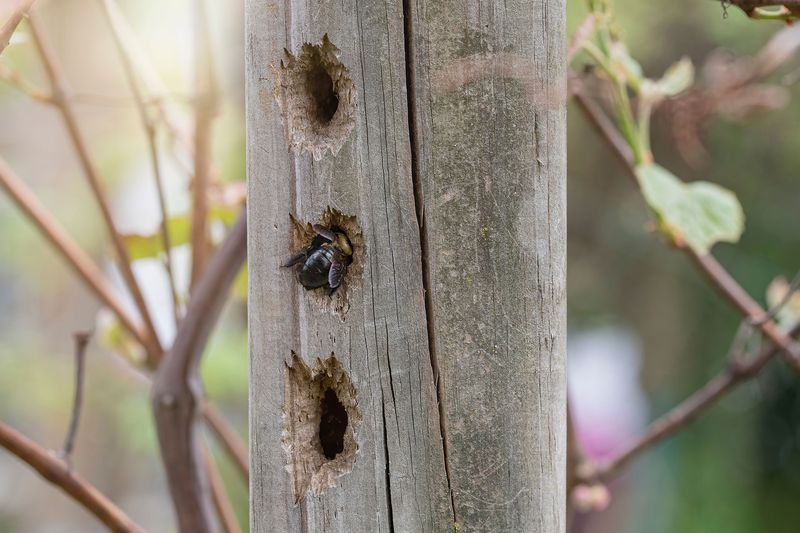
When carpenter bees choose a nesting site, they are responding to the wood in front of them, not to the roses planted nearby. University of Maryland Extension explains that raw, unfinished, weathered, cracked, or lightly protected wood is far more attractive to excavating females than well-maintained painted surfaces.
The porch beam with peeling finish, exposed end grain, or a network of surface checks is essentially advertising vacancy.
Specific features make wood easier to start in. Exposed nail holes give a bee a ready-made crack to work from.
Saw cuts along end grain leave the softest, most accessible wood fibers at the surface. Surface cracks from seasonal expansion and contraction provide a foothold before any drilling begins.
Penn State Extension’s eastern carpenter bee overview notes that these structural details in the wood, not anything happening in the surrounding landscape, are the primary triggers for nest selection.
Flower beds near the porch can supply nectar and pollen, which helps explain why bees are present in the yard at all. UC ANR’s integrated pest management resource on carpenter bees makes clear that foraging habitat and nesting habitat are separate considerations: a bee feeds where flowers are available but nests where suitable wood exists.
The presence of holes does not mean the garden has too many blooms, too much moisture, or a landscaping problem that needs fixing.
The productive inspection, then, starts at the wood itself. Walk the porch and look for soft spots, peeling or missing finish, open end grain, and cracks wide enough to admit a thumbnail.
Those are the conditions worth addressing, and correcting them does more to protect the structure than any change to the surrounding planting beds.
Inside the Wood, a Short Tunnel Can Become a Reused Gallery
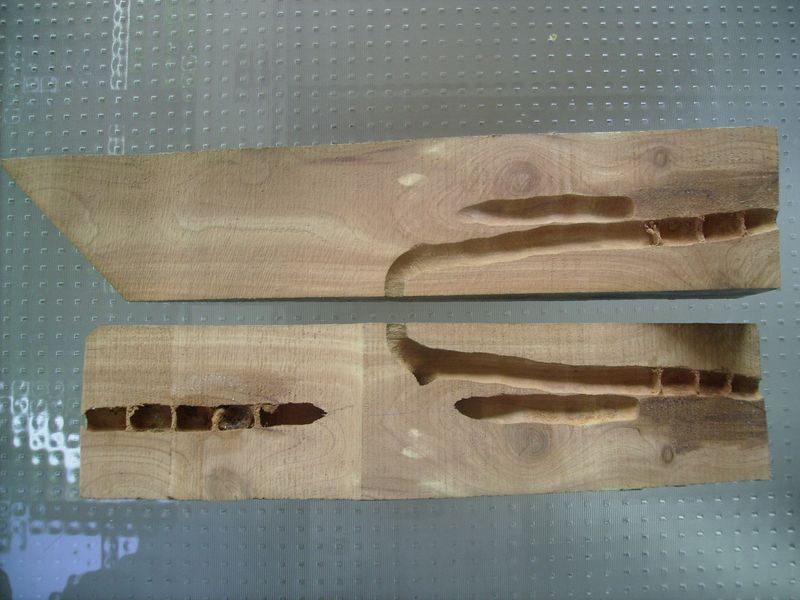
The entrance hole is only the beginning of what a carpenter bee actually builds. After drilling straight in for a short distance, the female turns and excavates a gallery running parallel to the wood grain, often extending several inches into the beam.
NC State Extension describes how she then creates a series of brood chambers inside this gallery, stocking each one with a ball of pollen and nectar before laying a single egg and sealing the chamber with a plug of wood fiber.
What makes an old gallery more than a historical artifact is the way carpenter bees treat it over time. NC State News notes that galleries may be lengthened or reused across multiple years, meaning a tunnel that started as four inches can grow considerably longer as successive bees extend it each spring.
Adults also use existing tunnels for overwintering shelter, returning to familiar galleries rather than excavating new ones every season.
This life cycle explains why a quiet hole in August is not necessarily an inactive one. University of Maryland Extension points out that no bee visible at the entrance does not mean the gallery is empty or abandoned.
Late-summer adults may be inside resting, and brood from the spring nesting cycle may still be developing in sealed chambers deeper in the wood.
Understanding this pattern changes how you approach an old hole. Sealing it without verifying occupancy can trap bees inside or cause them to create a new exit elsewhere.
The gallery’s continued use over years also means that the structural impact compounds over time, which is why repeated nesting in the same area deserves more attention than a single isolated hole from one season.
When Carpenter-Bee Damage Deserves More Than Cosmetic Repair
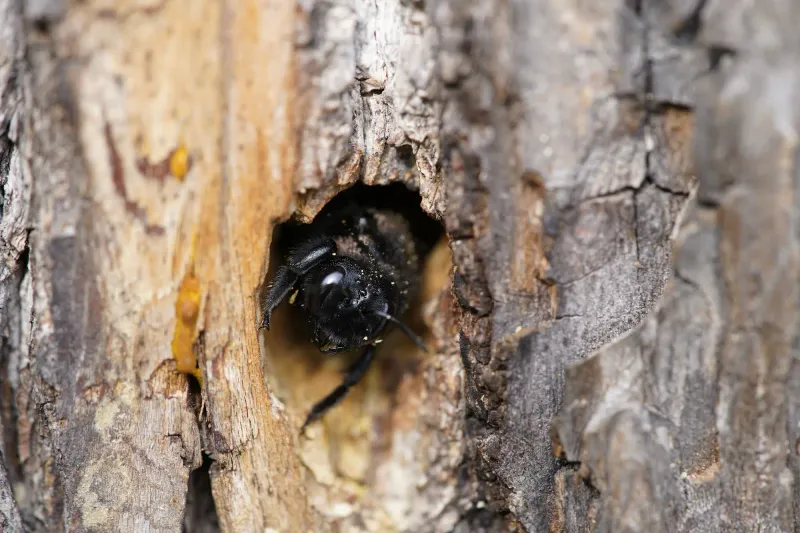
One nest in a porch rail is rarely a structural emergency. A single gallery excavated by a carpenter bee typically removes a limited amount of wood, and the visible hole is often the most alarming part of an otherwise modest situation.
The calculus changes, however, when multiple conditions stack up together.
University of Maryland Extension identifies repeated nesting, numerous entrances in the same member, and years of gallery reuse as the factors most likely to cause meaningful weakening. Open holes compound the problem by admitting moisture, which accelerates wood decay around and beyond the tunnel itself.
UC ANR’s carpenter bee management guidance also notes that woodpeckers searching for bee larvae can enlarge holes dramatically, turning a half-inch entrance into a jagged, wider cavity that lets in far more water.
Thin boards, fascia, and shingles are more vulnerable than thick structural timbers because a gallery that would be minor in a 4×6 post can consume a significant fraction of a 1-inch board’s cross section. Penn State Extension’s carpenter bee page and Virginia Cooperative Extension both flag load-bearing beams, posts, joists, and railings as locations where tunneling warrants closer attention rather than a wait-and-see approach.
A practical inspection looks for soft or spongy wood around the holes, visible rot, multiple entrances clustered in one area, staining that suggests moisture infiltration, and any sign of woodpecker activity. When those conditions appear together, especially in a structurally important member or at height where a ladder is required, a professional evaluation makes more sense than a cosmetic patch.
Catching compounding damage early is almost always cheaper than repairing a beam that has been shared by bees, moisture, and woodpeckers for several seasons.
These Bees Are Native Pollinators, and Their Threat Is Often Misread
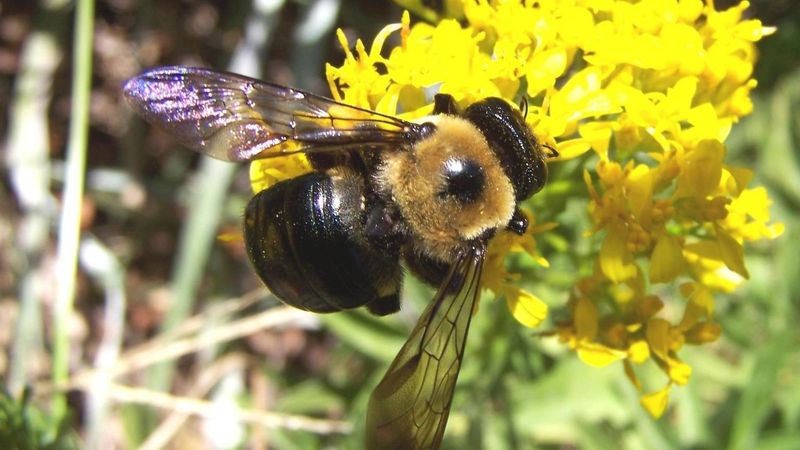
The large bee hovering at eye level near your porch entrance is almost certainly a male, and males cannot sting. NC State Extension explains that male carpenter bees may patrol nest sites in a conspicuous, territorial way that reads as aggression, but without a stinger, the display is entirely harmless.
Females do have a stinger and can use it, but Penn State Extension notes they generally sting only when handled, touched directly, or seriously provoked.
Beyond the porch, these bees carry real ecological value. University of Maryland Extension’s pollinator profile describes carpenter bees as capable buzz pollinators, using vibration to release pollen from flowers in a way that many other bees cannot.
That trait makes them effective on crops and native plants that require sonication for full pollen release.
NC State’s pollinator program encourages homeowners to consider whether bees present a real structural or safety problem before taking action, pointing out that the yard benefits of native pollinators are worth factoring into the decision. That does not mean accepting unlimited damage to a structural post, but it does mean that a single male hovering near a decorative rail does not justify an emergency response.
Keeping the actual risk in proportion makes it easier to choose a measured response. Protect the porch where the wood is genuinely vulnerable or the nesting is extensive, and give the bees room where the stakes are low.
That balance serves both the structure and the yard.
Repair and Refinish the Wood Before Reaching for Spray
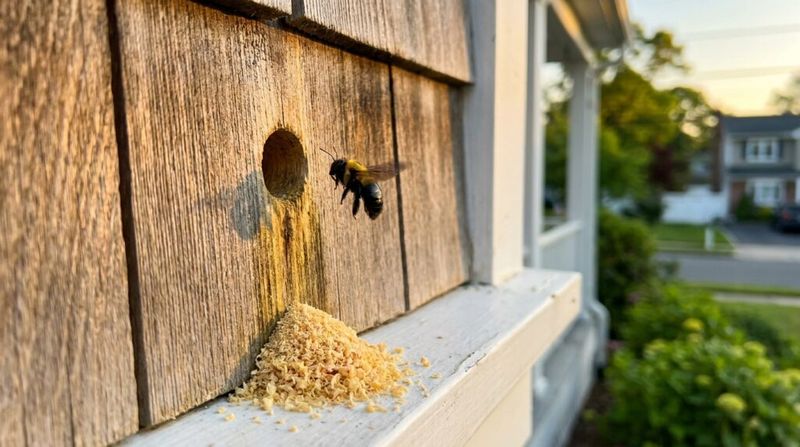
The most effective first step against carpenter bee nesting costs far less than a pest-control visit and improves the porch at the same time. Start by walking every exposed surface and probing for soft spots, open cracks, exposed nail holes, and any area where the finish has peeled or worn thin.
End grain at the tops of posts and the cut ends of rails deserves particular attention because it is the softest, most accessible wood on the structure.
University of Maryland Extension recommends filling cracks and exposed openings with exterior wood filler or caulk, repairing any damaged sections, and then applying a quality paint, varnish, or exterior finish to all sound, bare surfaces. A sealed surface is less attractive to an excavating female because she prefers wood she can grip and work without fighting through a hard finish layer.
The protection a good finish provides is real but not absolute. Penn State Extension notes that carpenter bees may still attack weathered, cracked, or otherwise compromised surfaces even on painted wood, so maintenance needs to be ongoing rather than a one-time fix.
Pressure-treated lumber and harder wood species reduce nesting risk compared to soft, unfinished pine, but neither is a guaranteed barrier once surfaces begin to age. UC ANR’s integrated pest management guidance frames the goal as reducing attractiveness rather than achieving total exclusion.
For isolated nests in non-structural wood where the bees are causing no meaningful damage, leaving the nest alone is a reasonable, wildlife-friendly option. Some homeowners place an untreated scrap of wood away from the porch as an alternative nesting spot, but this is an informal experiment rather than a proven diversion method, and it could attract additional bees rather than redirect existing ones.
Repair and refinishing remain the more reliable investment.
If Treatment Is Necessary, Target the Entrance and Follow the Label
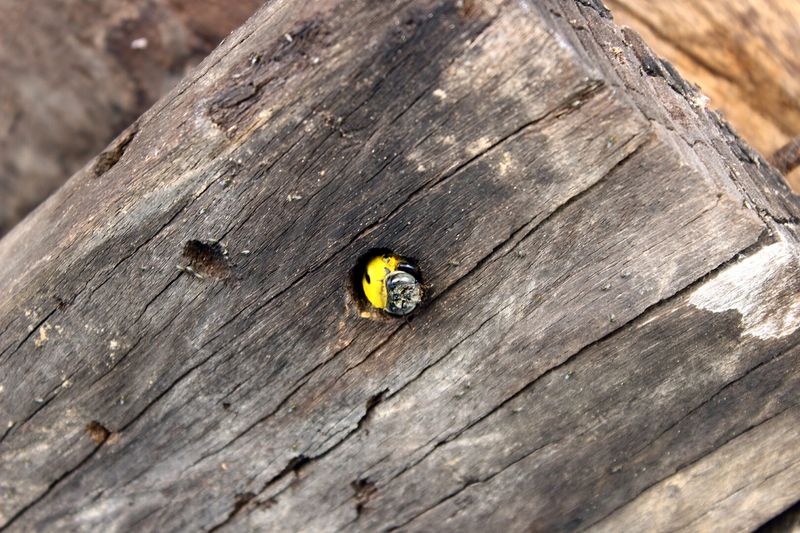
Spraying the yard, the flower beds, or the entire porch surface is not the right approach for carpenter bees. Treatment that makes sense is targeted at the nest entrance or gallery itself, applied at a time when it can actually reach the bees rather than just coating wood they may never contact.
UC ANR’s carpenter bee management resource explains that treating directly into the entrance or gallery is more relevant than broad surface application, and it reduces exposure to pollinators foraging on nearby plants.
Timing matters for the same reason it does with any gallery-nesting insect. Early spring, before females begin excavating in earnest, is one window extension programs commonly recommend.
Late summer or fall, after new adults have emerged and before they settle in for winter, is another. NC State Extension notes that during active nesting, wooden partitions sealing individual brood chambers can physically block a treatment from reaching bees deeper in the gallery, which is why timing affects whether treatment accomplishes anything at all.
Do not plug an active or freshly treated hole right away. University of Maryland Extension advises allowing returning adults to contact the treatment before sealing, and guidance commonly suggests waiting roughly 24 to 72 hours, though the specific product label controls that interval.
Sealing should follow confirmed treatment success and reliable evidence that the gallery is no longer occupied, not simply a moment when no bee happens to be visible at the entrance.
Only use a product currently labeled for carpenter bees and structural wood use in North Carolina. NC State’s Agricultural Chemicals Manual and the 2026 insect control chapter both emphasize that registrations and permitted uses change, making the current product label legally and practically controlling.
EPA pollinator protection guidance reinforces avoiding contamination of blooming plants, water sources, and children’s play areas. For any application involving a ladder, overhead work, respirator-dependent dust formulations, or a structurally critical location, hiring a licensed pest professional is the safer choice.
Read the Hole as a Wood Warning, Not a Yard Verdict
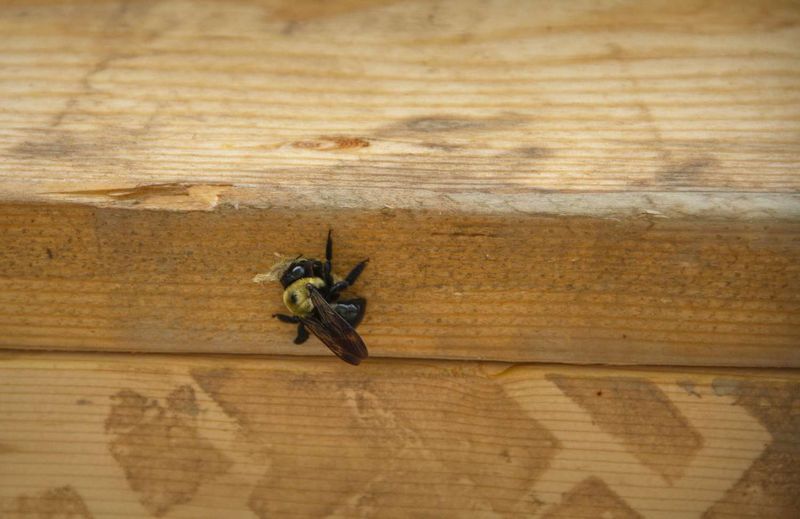
A round half-inch hole in your porch beam is most consistently a signal about the wood, not an indictment of your yard or your gardening habits. NC State Extension and NC State News both frame the issue the same way: carpenter bees select exposed, vulnerable wood for nesting, and the hole tells you where the porch needs attention.
Confirm the signs before acting. Fresh sawdust below the entrance, a shiny-abdomen bee near the hole, and yellow waste or staining together make a carpenter bee identification reasonable.
University of Maryland Extension recommends verifying the insect before applying any pesticide, since other wood-damaging organisms can produce similar-looking damage. From there, assess the wood and the location: repair and refinish sound wood, leave truly isolated nests alone when they pose little risk, and seek targeted or professional treatment when activity is extensive or the location is structurally critical.
The porch and the native pollinators sharing your yard are not in fundamental conflict. Most carpenter bee situations resolve with good wood maintenance, and the bees carrying on in your garden beds are doing quiet, useful work.
Protecting the structure where it matters and letting the rest be is usually the right call.