
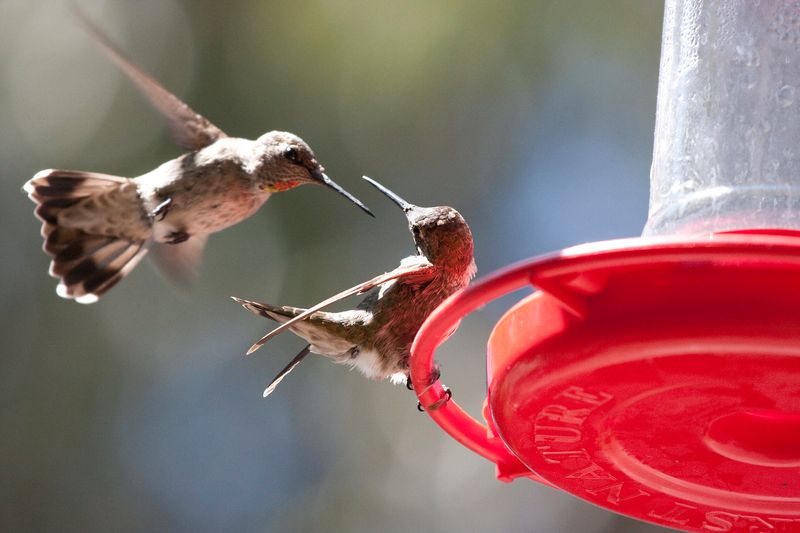
If you have ever watched one tiny hummingbird sit guard over your feeder and chase away every other bird that dares to approach, you are not alone. Across California suburbs, this feeder drama plays out dozens of times a day, and most homeowners assume they have done something wrong.
The chasing is actually normal territorial behavior, and understanding why it happens is the first step toward getting more birds fed safely in your yard.
The Chases Usually Mean One Bird Is Defending a Resource
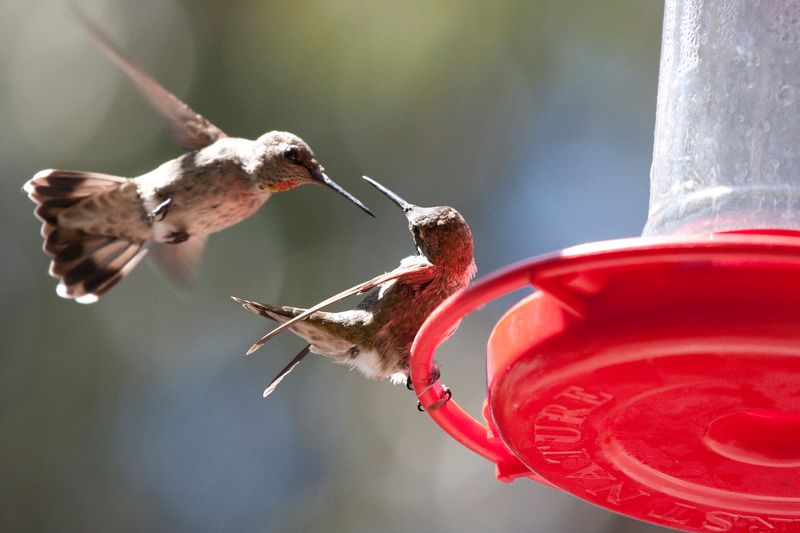
Watch a backyard feeder long enough and you will likely see the same scene repeat itself: one hummingbird arrives, settles near the feeding ports, and within seconds launches itself at any other bird that approaches. The chasing, diving, and sharp chittering sounds are not signs that the feeder is broken or that the birds are confused.
Cornell Lab of Ornithology explains that hummingbirds are wired to defend concentrated nectar sources the same way they defend patches of flowers in the wild, and a feeder full of sugar water is about as concentrated as a resource gets.
A dominant bird may perch on a nearby branch or wire and treat the whole feeder as its personal territory, chasing away competitors even when there is plenty of nectar to go around. Adult males are often the most aggressive defenders, but females and juveniles can and do claim feeding spots too.
The behavior includes aerial chases, steep dives toward intruders, loud vocalizations, and wing posturing, and while most encounters end with one bird retreating, occasional physical contact does happen. Audubon notes that these clashes are a normal part of hummingbird social life rather than evidence that something has gone wrong at your feeder.
That said, not every encounter is entirely harmless. Birds can collide mid-chase or slam into nearby surfaces, and injuries are possible even when the confrontation looks brief.
The practical goal for a homeowner is not to eliminate chasing entirely, which is not realistic, but to reduce one bird’s ability to control every feeding opportunity in the yard. Cornell’s feeder guidance frames this as an access problem rather than a behavior problem, which points toward solutions rooted in feeder placement and number rather than hoping the birds will eventually agree to share.
In California, the Feeder May Not Be the Whole Territory
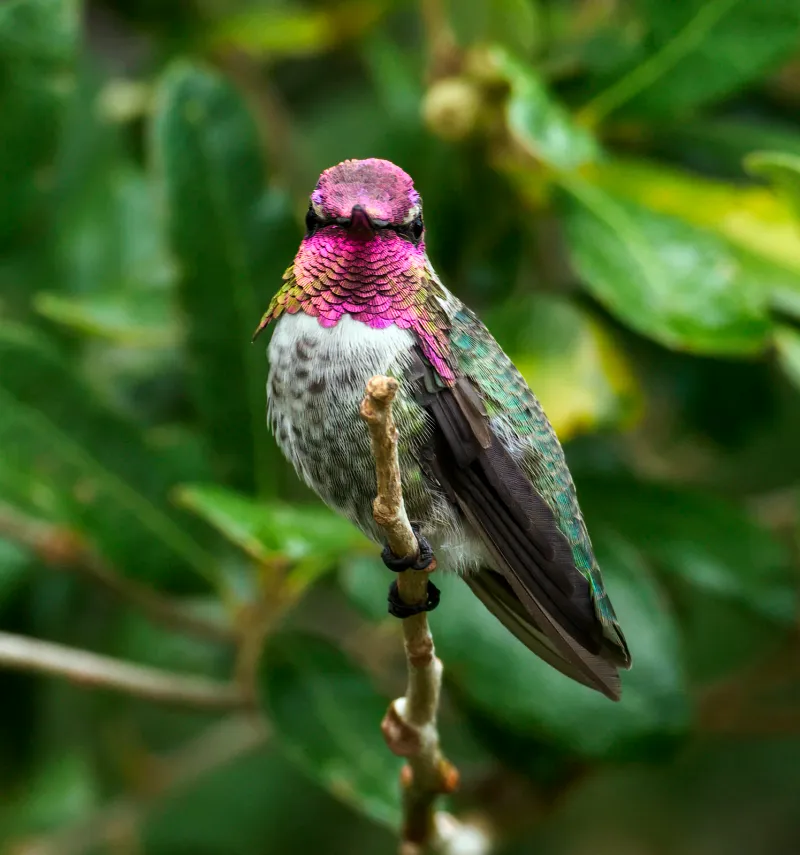
Most California homeowners picture feeder aggression as a simple argument over sugar water, but the full picture is more layered than that. Anna’s Hummingbirds, the small green-and-rose birds common in urban and suburban yards across much of the state, are present year-round in many California communities.
Cornell’s species account for Anna’s Hummingbird describes them as one of the most abundant hummingbirds on the West Coast, which means a California yard is likely hosting a resident bird with a long-term stake in the neighborhood, not just a seasonal visitor passing through.
Male Anna’s do not defend territory purely for food. Research published in Behavioral Ecology found that male Anna’s maintained breeding territories even when the quality of an experimental food source changed, suggesting that mate attraction and breeding site defense can drive aggression independently of how much nectar is available.
A male hovering over your feeder may be defending a courtship zone, not just a meal ticket, and moving the feeder a few feet will not dissolve that motivation.
Other species add further complexity. California yards can host Allen’s, Rufous, Black-chinned, and Costa’s Hummingbirds depending on location and time of year.
UC Master Gardener notes on California hummingbirds point out that Rufous and Allen’s can be notably aggressive even toward larger birds, while Anna’s tends to be the familiar year-round suburban presence. Age and sex also matter: a young bird testing its boundaries behaves differently than a seasoned male in peak breeding condition.
Experimental work on hummingbird territory size shows that food distribution affects how large a territory a bird tries to hold, but individual temperament, season, and species all shape what you actually see in your yard. Placement changes can influence access without explaining every chase you witness.
One Prominent Feeder Creates a Site That Is Easy to Guard
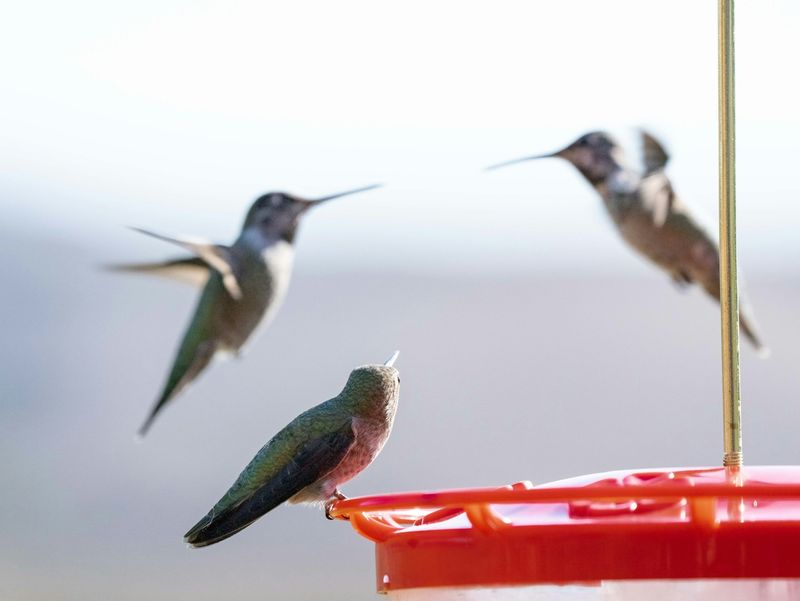
Picture your feeder from a hummingbird’s point of view. One large feeder hanging in an open spot is essentially a single flower patch concentrated into one easy-to-monitor location.
A dominant bird can perch on a fence post or a bare branch a few feet away and keep the entire feeding area in view without moving. That setup is almost perfectly designed for one bird to exclude everyone else.
Cornell Lab specifically notes that several small feeders may serve more hummingbirds than one large feeder, because hummingbirds do not naturally treat a shared feeder like a cooperative buffet. Adding more ports to a single feeder does not change the fact that one bird can still sit in a central spot and defend the whole unit.
The extra ports just give the dominant bird more reason to stay, not more reason to share.
Research on territory size and food density found that when flower density decreased, Rufous Hummingbirds expanded their territories to defend a similar number of flowers rather than giving up. The takeaway for feeder placement is that food distribution shapes how much space a bird tries to control, but adding resources in one spot does not automatically produce peaceful sharing.
A useful diagnostic: if you can stand at one point in your yard and see every feeder port without turning your head, a dominant hummingbird almost certainly can too. Audubon’s guidance on feeder conflict reinforces that the shape of the feeding area matters as much as how much nectar it contains.
Several Smaller Feeders Can Spread Out Access
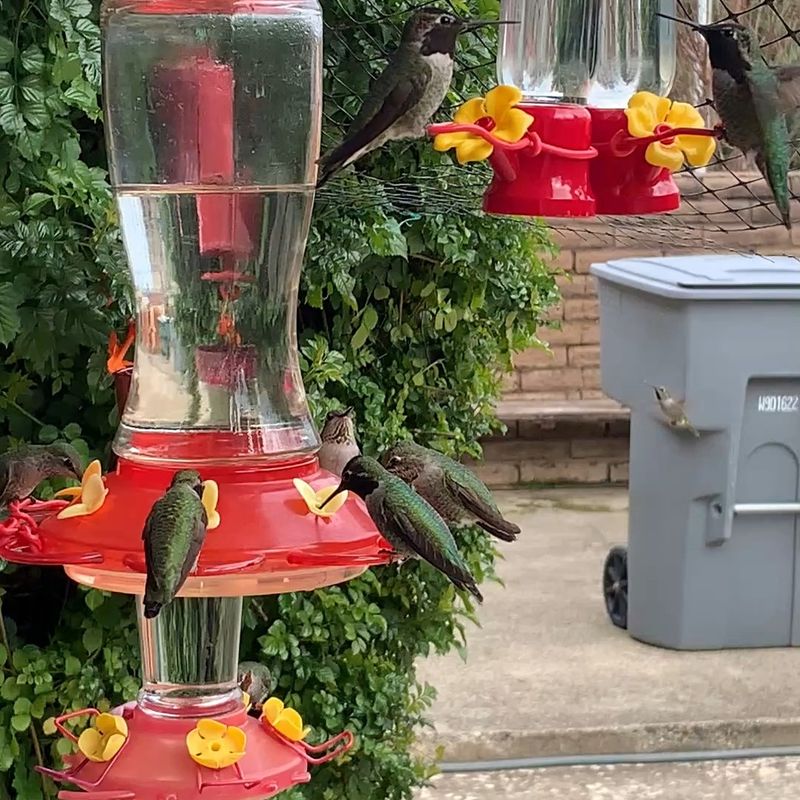
Switching from one large feeder to several smaller ones is the most practical step a California homeowner can take toward getting more birds fed. The logic is straightforward: a single dominant bird has a harder time monitoring three or four separate feeding points scattered around the yard than it does watching one central feeder.
Cornell Lab recommends this approach specifically for reducing the advantage a territorial bird gains from a single concentrated nectar source.
Placement matters as much as quantity. Feeders placed where a bird cannot see all of them from one perch are harder to defend collectively.
Hanging one feeder on the front porch, another around the back corner of the house, and a third near a side fence gives subordinate birds windows of opportunity when the dominant bird is occupied elsewhere. Audubon echoes this strategy, noting that more feeding opportunities can sometimes exceed a single bird’s ability to patrol them all.
A BirdNote guide on attracting hummingbirds similarly supports spreading feeders across different areas of the yard rather than clustering them together.
Honest expectations are worth setting here. More feeders do not guarantee peace.
In some yards, a particularly assertive bird will patrol multiple feeders in rotation, and in others a second dominant bird may claim each new feeder as its own territory, which redistributes the conflict rather than removing it. The realistic benefit is improved access for subordinate birds and less concentrated chasing, not a yard full of hummingbirds feeding side by side in harmony.
If you add three feeders and each one ends up with its own guard, you have still given more birds a chance to feed than they had before. That counts as progress, even if the yard never goes completely quiet.
Break the Sightline Without Turning the Feeder Into a Trap
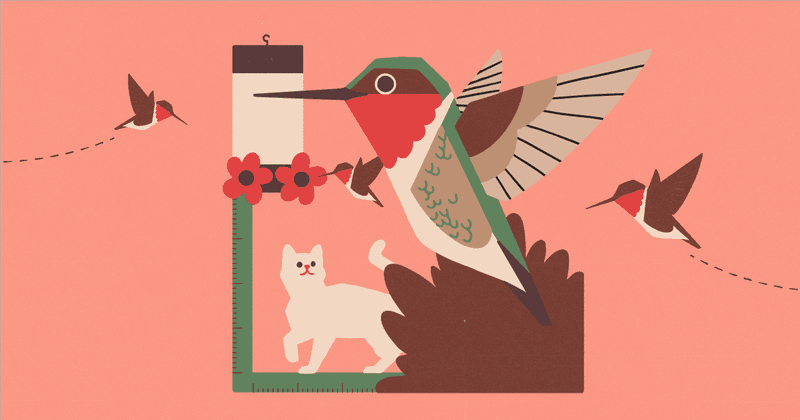
Separating feeders only works if each one is placed where a dominant bird genuinely cannot see it from its favorite perch. A house corner is one of the easiest sightline breaks available in a typical California yard: hang one feeder on the east side of the house and another on the west, and a bird guarding one cannot monitor the other without flying around the building.
A solid fence, a trellis with climbing plants, or a mature shrub can serve the same purpose on a smaller scale. Cornell’s feeder placement guidance supports using physical barriers to interrupt a dominant bird’s line of sight.
There is no magic distance that works in every yard. The emphasis belongs on genuine visual separation and open flight space rather than any specific number of feet between feeders.
Each feeder still needs to be discoverable from a passing bird’s flight path, protected from strong wind, and positioned where hummingbirds have room to approach and retreat quickly. UC Cooperative Extension placement advice cautions against tucking feeders into dense vegetation where cats or other predators can hide and ambush birds.
A feeder hidden in a thicket may be out of a dominant bird’s sight, but it can also become a trap.
Windows add another layer of risk. Cornell’s classroom feeder guidelines recommend placing feeders either within 3 feet of a window or more than 30 feet away.
The intermediate zone, roughly 3 to 30 feet from glass, gives a bird enough speed to hit the window with serious force after a startled takeoff. When a feeder must go near glass, Cornell’s window-safety recommendations call for exterior treatments spaced closely enough to break up reflections.
A bird that strikes a window and flies away is not necessarily unharmed; internal injuries can follow even a collision that looks minor from the outside.
Fresh Nectar and Living Habitat Keep the New Setup Safe
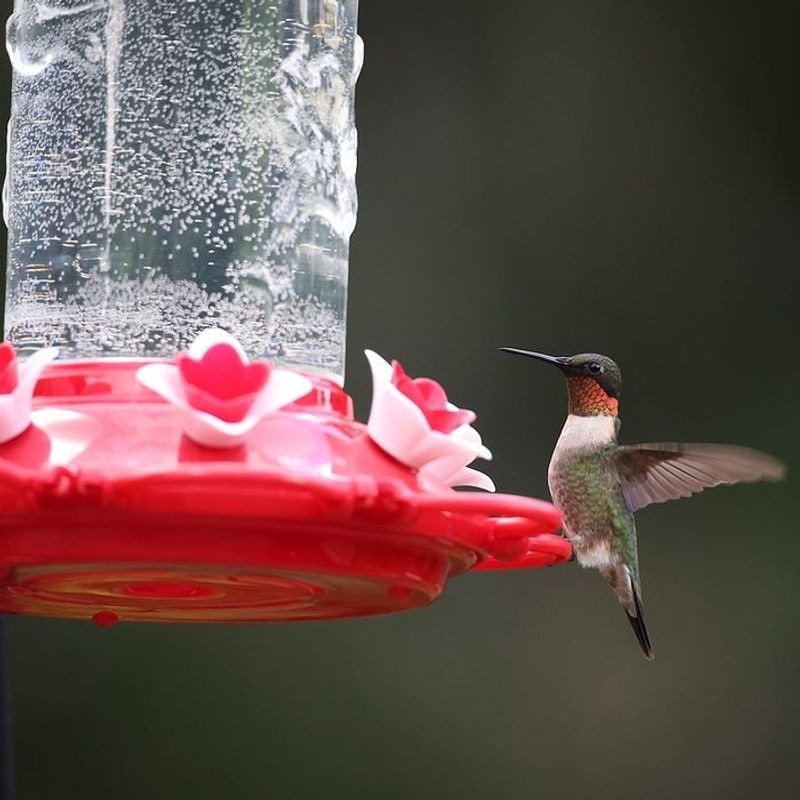
Adding more feeders increases your maintenance workload, and in California’s warm climate that workload is not optional. Sugar water spoils faster than most homeowners expect, especially during inland heat waves or the long dry stretch from late spring through early fall.
UC Davis researchers found that feeder sugar water can accumulate substantial microbial communities, which is a practical argument for keeping batches small, inspecting feeders frequently, and cleaning each feeder before refilling rather than topping it off. During very hot weather, checking every day or every other day is reasonable; in cooler conditions, every two to three days is a commonly cited interval, though the safest approach is to let what you see in the feeder guide you rather than following a fixed schedule regardless of temperature.
The recipe is straightforward and should not be varied. Audubon’s hummingbird feeding FAQ specifies one part refined white sugar dissolved in four parts water, cooled before filling the feeder.
Honey ferments quickly and can cause a fatal fungal infection. Brown sugar, molasses, agave, artificial sweeteners, and nutritional supplements are all unsuitable.
Red food coloring is unnecessary and UC Cooperative Extension guidance for Ventura County advises against adding any dye to the nectar solution. The red parts of the feeder itself are enough to attract birds.
Feeders supply sugar water, not a complete diet. Cornell’s life history account for hummingbirds notes that small insects and other arthropods form a critical part of their nutrition, providing protein that sugar water cannot replace.
UC Master Gardener advice on hummingbird-friendly gardens encourages planting native flowering species and supporting insect habitat alongside feeders. A yard with diverse plants, minimal pesticide use, and shelter options gives hummingbirds resources that no feeder can replicate.
A Calmer Feeder Means Better Access, Not No Chasing
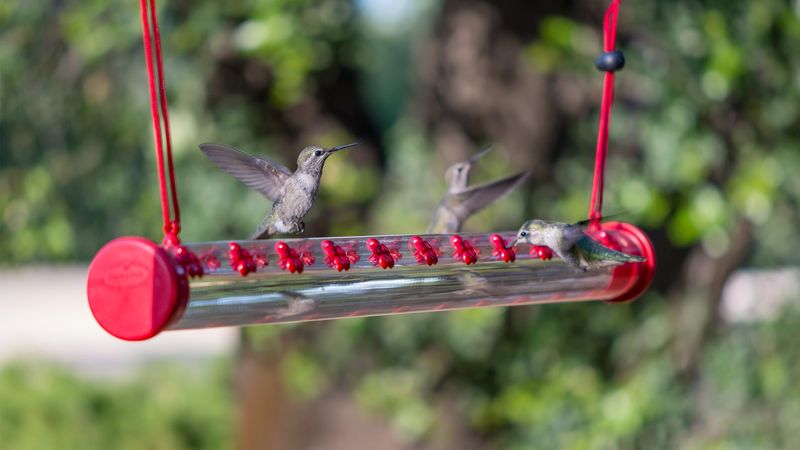
Put the full strategy together and the sequence is manageable. Replace one large feeder with several smaller ones, place each in a spot that breaks the sightline from the others, keep every feeder visible to passing birds with open flight space around it, stay on top of nectar freshness especially during California’s hot months, and watch over the next few weeks to see which birds are gaining access.
Cornell’s feeder conflict guidance frames this kind of monitoring as useful because every yard is different, and what works well in one layout may need adjustment in another.
Expect redistribution, not silence. Audubon’s coverage of feeder aggression is clear that territorial behavior is part of hummingbird social and breeding life, and no placement strategy removes that drive entirely.
A yard that ends up with two or three birds each guarding a separate feeder has still improved on a yard where one bird controlled everything. Success looks like more birds feeding safely, fresher nectar reaching more visitors, and a yard that supports hummingbirds with flowers and insects as well as sugar water.
The chases may continue, but a feeder that fewer birds can fully monopolize is already doing its job.