
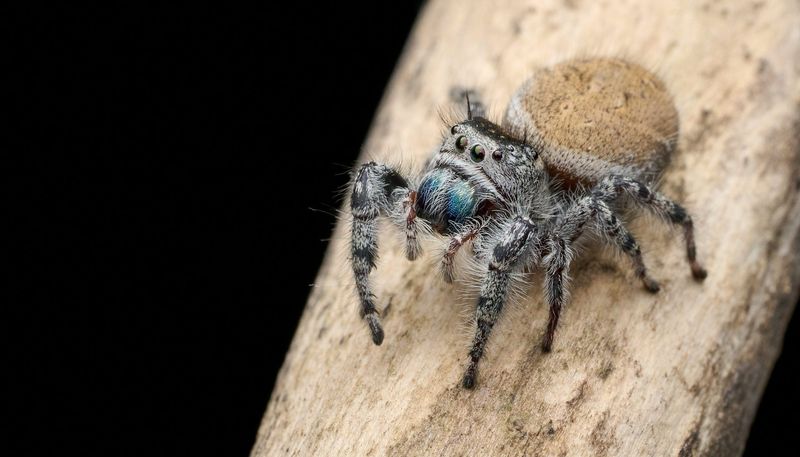
Spot a small, quick spider darting across your tomato leaves or crouching on a sun-warmed garden wall, and your first instinct might be to brush it away. Before you do, it may be worth a second look.
A spider in that spot could be a jumping spider, a family of agile, daylight-active hunters that feed on the kinds of small insects that damage garden plants. Understanding what you are actually seeing, and what it may or may not mean for your garden, can change how you respond to it.
What You May Be Seeing in the Garden Bed
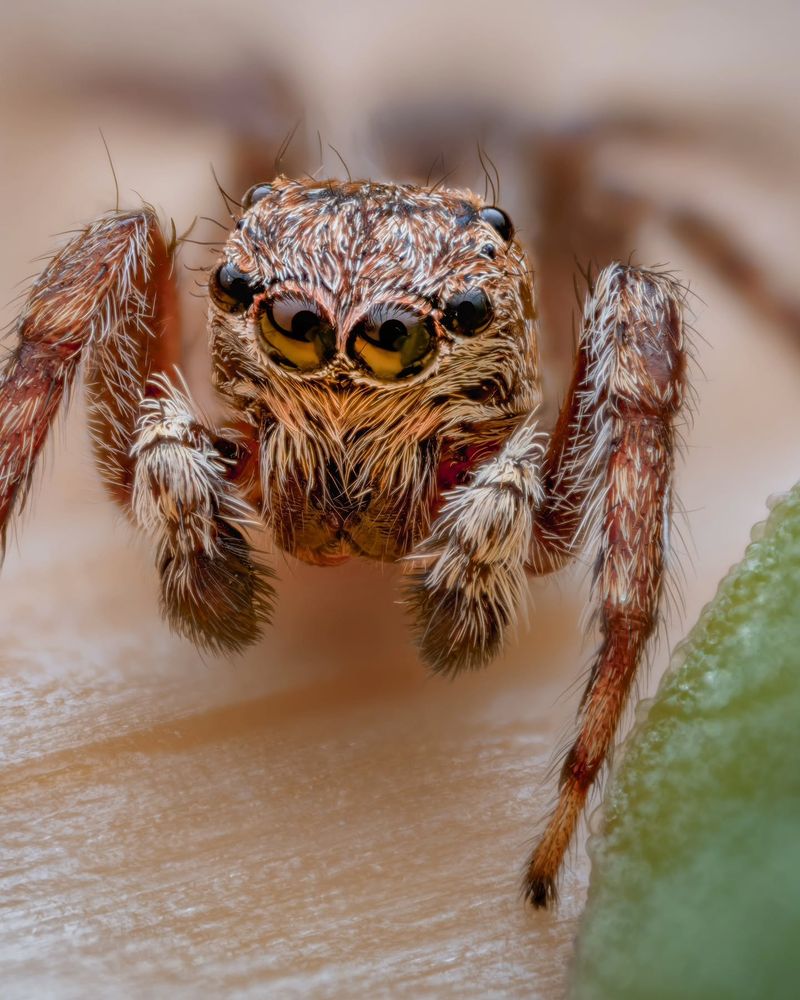
A small spider moving in quick bursts across your garden bed, pausing to look around before jumping to a new spot, could belong to the family Salticidae, the jumping spiders. That said, spotting one does not confirm the family, and it certainly does not establish that jumping spiders have staged a seasonal arrival into your beds.
What it does mean is that you have a fast-moving, daylight-active spider worth paying attention to.
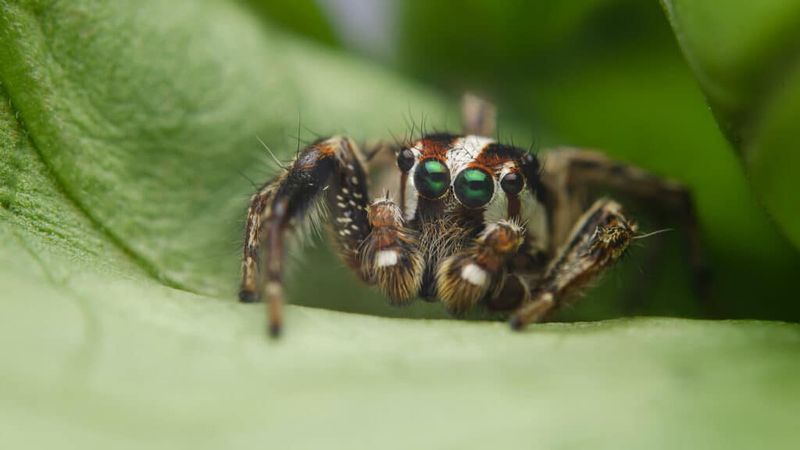
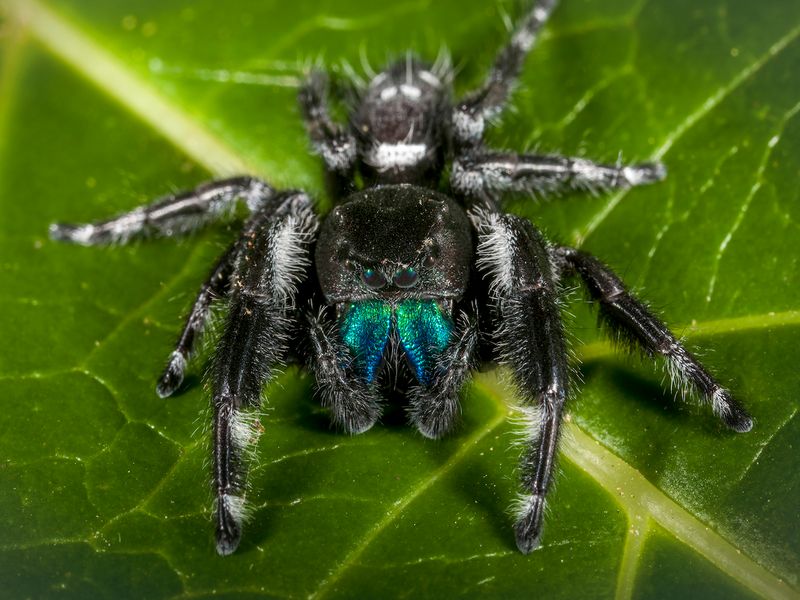
Jumping spiders have a recognizable profile once you know what to look for. UC IPM’s spider guidance describes them as small, compact, and often hairy or iridescent, with a distinctive eye arrangement that includes a prominent front-facing pair that gives them an alert, almost curious appearance.
They move in short, confident runs and jumps rather than retreating to a corner or scrambling erratically. You are most likely to see them on sunny foliage, bare soil, garden walls, fences, or window frames during the day.
Not every small, fast-moving spider you encounter belongs to this family. Wolf spiders, crab spiders, and small ground spiders also hunt without webs and can look superficially similar at a glance.
California DPR’s spider identification guidance notes that jumping spiders are among the common garden spider groups in the state, but identification still requires looking carefully at body shape, eye pattern, and behavior. The prominent forward-facing eyes and stocky, agile build are useful starting clues, though definitive identification to species often requires an expert.
Photographs can support a family-level call in many cases. iNaturalist’s California arachnid guide shows how variable Salticidae look across the state by region, age, sex, and species. A clear photo submitted there can get community input.
What a photo usually cannot do is confirm the exact species with certainty, and the article’s title premise, that jumping spiders broadly move into California garden beds each summer, is not an established biological rule. Think of a summer sighting as plausible and worth noting, not as part of a predictable annual migration.
How Jumping Spiders Hunt Without Capture Webs
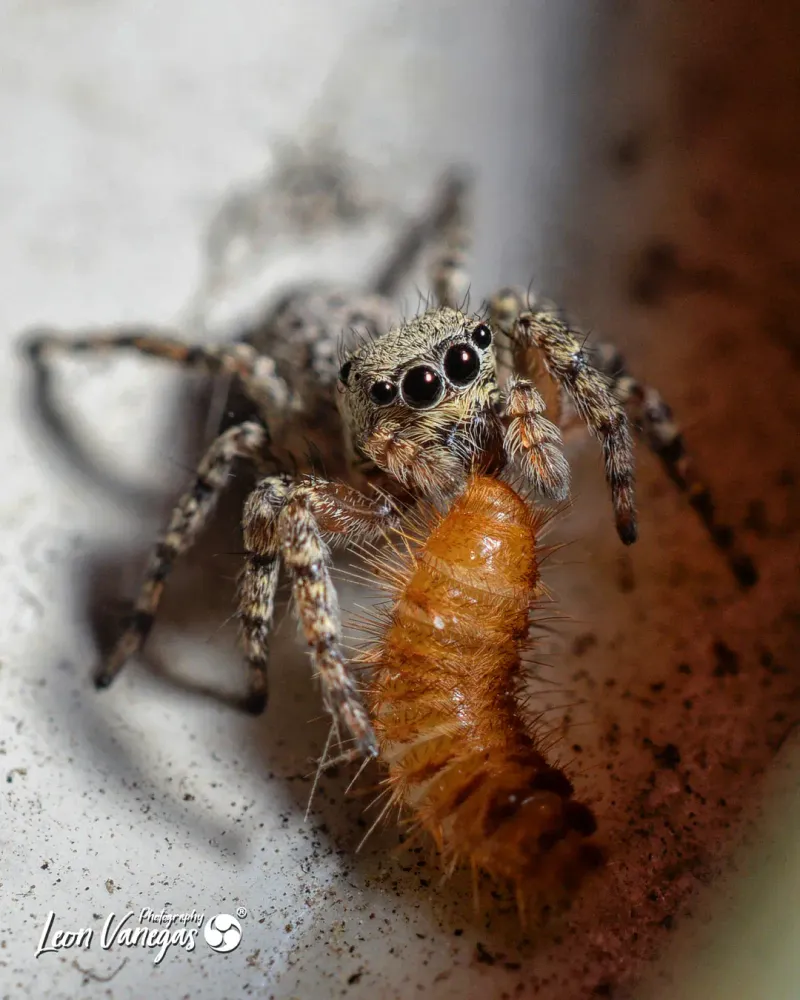
Web-building spiders wait. Jumping spiders go looking.
That behavioral difference is one of the clearest ways to separate this family from the orb weavers and cobweb builders you may be more familiar with in your yard. Rather than stringing a sticky trap between branches and sitting back, a jumping spider uses its exceptional eyesight to locate, stalk, and then pounce on prey – sometimes from several body lengths away.
Their vision is genuinely unusual for an arthropod. USU Extension’s jumping spider profile explains that the large anterior median eyes provide sharp forward focus, while the smaller side eyes give wide-angle peripheral awareness.
This combination lets them track moving insects with a precision that most spiders lack. During the hunt, a jumping spider will often turn to face a potential target, lower its body, and creep forward before launching its attack.
The whole sequence happens in daylight, which is why you are far more likely to spot one on a warm afternoon than after dark.
Silk still plays a role in their lives, just not for catching food. USU Extension’s general spider fact sheet notes that jumping spiders construct small silk retreats used for shelter overnight, during molting, for mating, and for protecting egg sacs.
You might find one of these flat, papery pouches tucked under a leaf or in a sheltered gap in the garden. Seeing silk of that type does not mean you have a web-building spider nearby – it is simply the jumping spider’s version of a safe house.
The daylight hunting habit also explains why these spiders show up on open garden surfaces rather than in hidden corners. A jumping spider on a sun-warmed tomato leaf or fence post is actively working, not lost or out of place.
The Garden Pests They May Eat
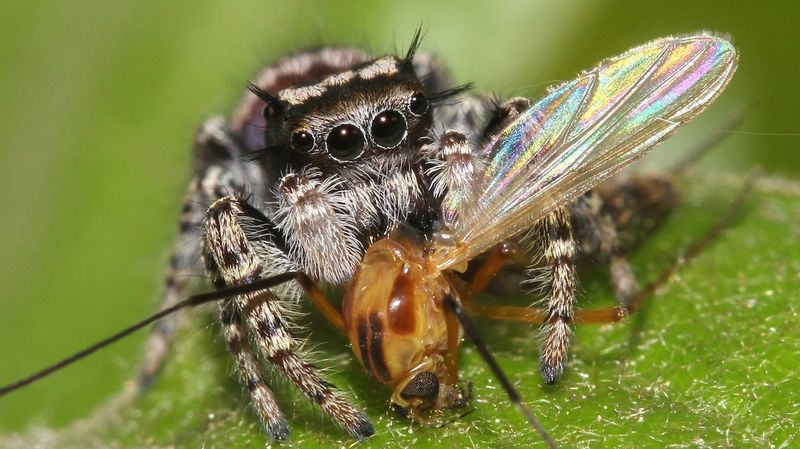
Jumping spiders are generalist predators, meaning they eat what is available and catchable rather than targeting one specific pest. That breadth is both their strength and their limitation as garden allies.
On any given day, a jumping spider patrolling your beds might take an aphid, a small fly, a leafhopper, a thrips, a plant bug, or a caterpillar. University of Wisconsin Horticulture’s garden spider overview lists this wide range of prey types as characteristic of garden spiders generally, with the exact menu depending on the spider’s size, the species, and what happens to be moving nearby.
Body size matters quite a bit in determining what a particular spider can overpower. A small juvenile jumping spider will take very small soft-bodied prey.
A larger adult may handle sturdier insects. Neither will reliably pursue everything on the pest list above in equal measure, and neither will ignore prey that is not technically a garden pest.
Research on prey taken by Phidippus johnsoni, one of California’s more recognizable jumping spider species, shows a diet that includes other spiders as well as insects – a reminder that generalist predators do not distinguish between pest and beneficial when hunger and opportunity align.
That last point deserves some weight. A jumping spider may occasionally eat a predatory mite, a parasitoid wasp, or another spider that was itself hunting pests.
The Phidippus clarus biocontrol study acknowledges this generalist reality even while documenting pest reduction in controlled conditions. Their presence in a garden bed is genuinely useful on balance, but it does not mean every pest problem resolves itself or that you can skip monitoring your plants for damage.
Think of a jumping spider as one helpful participant in a larger predator community rather than a single solution.
What the Pest-Control Research Actually Shows
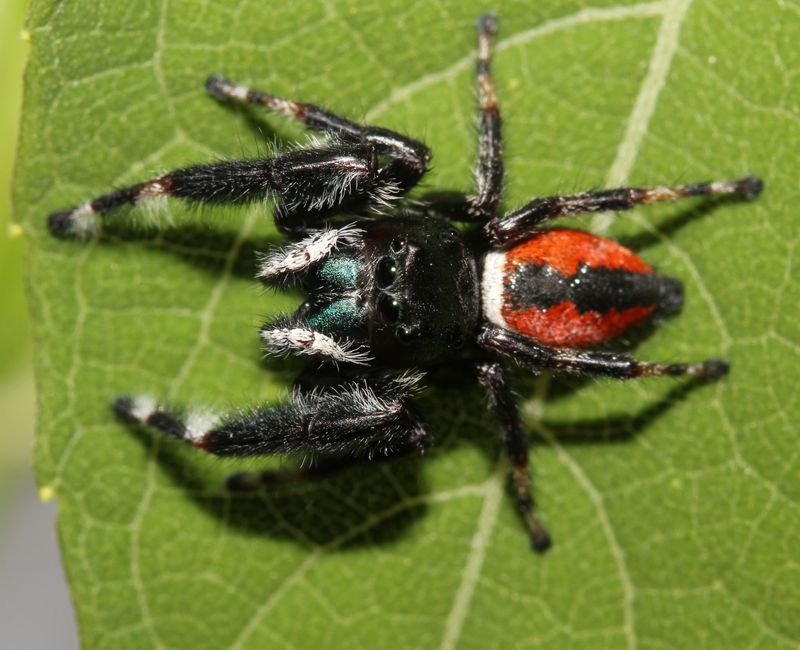
The strongest controlled evidence for jumping spiders as pest suppressors comes from a single greenhouse experiment, and understanding its scope matters before drawing conclusions about your garden beds. The Phidippus clarus biocontrol study published in the Journal of Economic Entomology found that when this jumping spider species was present on basil plants, populations of fourlined plant bugs dropped and visible plant damage was reduced compared to plants without spiders.
Those are meaningful results in a research context.
The conditions, however, were narrow. One spider species.
One pest species. Basil as the host plant.
A controlled greenhouse setting where the spiders could not leave and other predators were not in the picture. None of those conditions replicate a California residential garden bed, where dozens of plant species grow together, predator communities are mixed, pest pressure varies by season and neighborhood, and spiders can move freely in and out of the space.
Translating that study directly into a promise for your tomatoes or roses is a stretch the data does not support.
Jumping spiders belong to a broader group of natural enemies that UC IPM’s biological control guidance describes as an important part of keeping pest populations in check over time. That group also includes predatory bugs, lacewings, lady beetles, parasitoid wasps, and other spider families.
No single predator in that community guarantees an outcome, and jumping spiders are no exception.
The practical takeaway from the research is modest but real: a jumping spider in your garden has a demonstrated capacity to reduce certain pest insects under the right conditions. Protecting that spider costs you nothing, and it may contribute to the kind of balanced predator community that makes pest outbreaks less likely.
Just do not expect a spider on your basil to replace scouting, watering discipline, or targeted pest management when a genuine problem develops.
Why Summer Sightings Are Plausible but Not Guaranteed
Summer is a reasonable time to spot a jumping spider in a California garden, but that observation comes with some important nuance. Warm, sunny conditions suit the daylight-active hunting style of this family well, and longer days mean more hours when these spiders are on the move.
Beyond general biology, though, the claim that jumping spiders specifically migrate into residential garden beds every summer is not backed by solid statewide evidence.
A study on spider dispersal in California vineyards found that aerial movement among spiders generally peaked in midsummer, suggesting that warm-season dispersal is a real phenomenon for the broader spider community in California agricultural settings. Vineyards, however, are not suburban garden beds.
The plant structure, surrounding habitat, irrigation practices, and predator community all differ. A midsummer dispersal peak in wine-country vineyards does not translate cleanly into a rule about jumping spiders arriving in your raised beds in July.
Different jumping spider species also follow different seasonal patterns depending on their life cycle, local climate zone, and available prey. A spider active in a coastal garden in June may be a different species behaving differently than one you see in an inland valley garden in August.
California’s range of microclimates, from the cool and foggy coast to the hot interior valleys, means that broad seasonal generalizations break down quickly.
A summer sighting is worth paying attention to and worth noting with a photo if you want to track what lives in your garden. Frame it as a plausible warm-weather encounter rather than evidence of an annual pattern.
If you see jumping spiders regularly across multiple seasons, that is more informative than one summer appearance, and it suggests your garden may be providing the kind of open, sunny, insect-rich habitat these spiders seek out on their own terms.
Leave a Likely Jumping Spider Alone
The default response to a jumping spider in your garden bed is straightforward: leave it where it is. UC IPM’s common garden spider guidance recommends protecting spiders in the garden because they prey on insects and other pests, and it notes that outdoor pesticide treatment of spiders is generally unnecessary and usually only temporary even when applied.
A spider you remove or kill today will likely be replaced by another once conditions that attracted it remain unchanged.
Routine broad-spectrum insecticide sprays are one of the clearest ways to undermine the natural enemy community in your yard. California DPR’s backyard garden IPM factsheet specifically advises homeowners to encourage beneficial visitors such as spiders and to avoid broad insecticide sprays that can harm them.
UC IPM’s biological control guidance adds that broad-spectrum, persistent pesticides can disrupt natural enemies and sometimes trigger secondary pest outbreaks by removing the predators that kept secondary pests in check.
When a genuine pest problem does require treatment, the sequence matters. Identify the pest first so you know what you are actually dealing with.
Then choose the least disruptive effective method for that specific pest. A product that carries a plant-safe label is not automatically harmless to spiders or other beneficial arthropods, so read the full product label before applying anything.
UC IPM’s insectary plant guidance reinforces this point: protecting the habitat and food sources that support natural enemies is part of responsible pest management, not separate from it.
For a jumping spider that wanders indoors, UC IPM’s spider guidance suggests capturing it with a jar and a piece of cardboard, then releasing it outside. That approach is faster, less disruptive, and far more practical than treating an entire room.
A spider inside the house is usually a temporary visitor rather than a sign of an infestation, and mechanical removal handles the situation without affecting anything else in the garden.
Protect Spiders Without Creating a Safety Problem
Welcoming spiders into your garden does not mean abandoning common sense about handling them or about how you manage vegetation near your home. A few qualifications belong alongside any encouragement to leave spiders in place, and they are practical enough to make a real difference.
First, do not handle an unidentified spider with bare hands. Most jumping spiders you encounter in a California garden are active in the open during daylight and are unlikely to bite unprovoked, but UC IPM notes that Phidippus johnsoni, a common California jumping spider with red coloring on its abdomen, may bite when disturbed.
Bites from this species are generally not serious, but they are not pleasant either. The rule of thumb is simple: observe, photograph, and appreciate from a short distance rather than picking up any spider you cannot confidently identify.
A word on color and markings: if you see a shiny, smooth-bodied black spider with a red or orange marking and it is tucked into a sheltered, undisturbed spot rather than hunting openly in daylight, do not assume it is a jumping spider. UC IPM’s widow spider guidance describes western black widows as smooth-bodied spiders that prefer dark, protected locations and carry a red or orange marking on the underside of the abdomen.
Their body shape, eye pattern, and habitat preferences are quite different from jumping spiders, which are hairy, stocky, and active in sunlit open spaces.
On the habitat side, some ground cover and low vegetation can support spider populations by providing shelter and hunting corridors. Organic mulch can serve that purpose in parts of the garden.
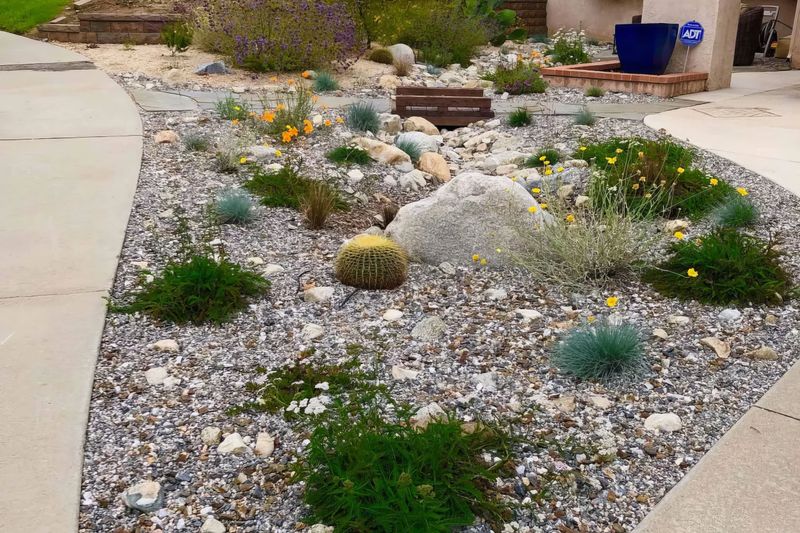
However, CAL FIRE’s defensible space guidance is clear that combustible materials should not be placed within the first five feet of a structure. UC ANR’s mulch and fire guidance recommends noncombustible materials such as gravel, concrete, or pavers in that zone.
Local fire agencies may apply stricter rules depending on your community’s fire hazard severity zone, so check with your local authority before making changes near the foundation. You can support spiders and stay fire-safe by placing organic mulch and denser plantings further from the house, where they do not conflict with defensible-space requirements.
Use Observation Instead of a Garden Guarantee
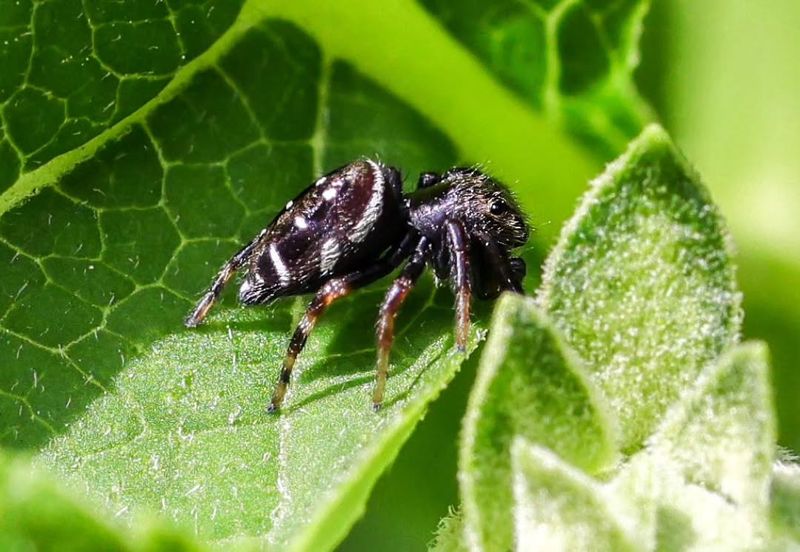
A likely jumping spider in your California garden bed is generally worth tolerating. It hunts small arthropods during daylight hours, asks nothing from you, and may contribute to the kind of natural pest suppression that makes a garden easier to manage over time.
That is a reasonable basis for leaving it alone, and it costs you nothing to do so.
Tolerating a spider is not the same as counting on it. Generalist behavior means the spider eats what is available, not necessarily what you most want controlled.
Species identification from a garden sighting is often uncertain, even with a clear photograph. UC IPM’s natural enemies guidance places jumping spiders within a broader predator community that also includes lady beetles, lacewings, parasitoid wasps, and other spiders – none of which works in isolation.
Protect the community rather than betting everything on one member of it.
The practical rules from this article hold together as a short checklist: do not handle unidentified spiders bare-handed, keep pesticide use targeted and label-compliant, place combustible mulch away from structures, and distinguish open daylight hunters from spiders in sheltered dark spots. UC IPM’s spider overview puts it plainly: outdoor spider treatment is generally unnecessary, and protecting garden spiders supports the natural balance that keeps many pest populations manageable.
A garden watched carefully tends to need fewer interventions than one managed by reflex. A jumping spider pausing on a leaf to study you back is a small sign that your yard is alive in the right ways.