
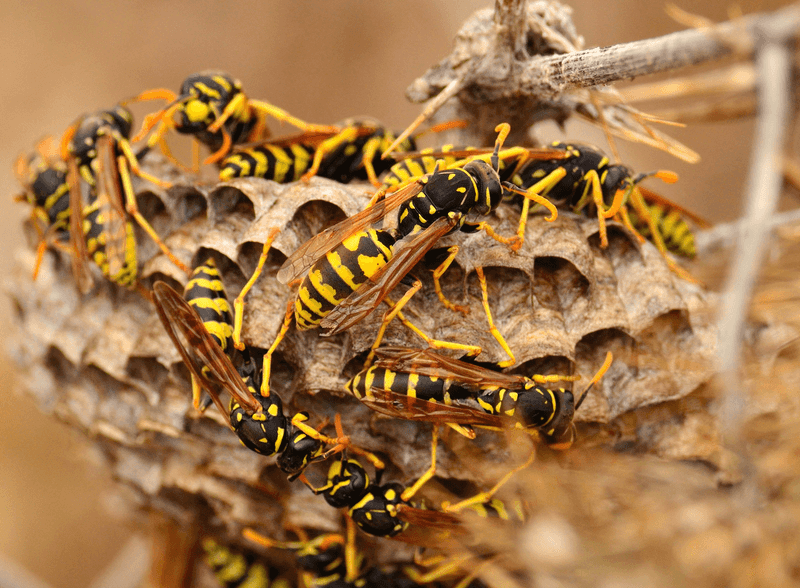
By late summer, many North Carolina homeowners start noticing wasps everywhere, around the porch railing, hovering over the trash can, and cruising through the garden beds. That sudden visibility can feel alarming, but it usually has a straightforward biological explanation rather than a sign that something has gone wrong with your yard.
Knowing why certain wasps become conspicuous, and how to tell a harmless forager from a nest near your back door, puts you in a much better position to protect your family without wiping out insects that are actually working in your favor.
Why some wasps become conspicuous in late summer
Every yellowjacket colony starts the same way: a single overwintered queen emerges in spring, finds a suitable cavity, and begins building a nest on her own. She raises the first batch of workers, and from that point the colony grows steadily through summer.
By late summer or early fall, what began as one insect working alone may have expanded into a colony of hundreds or even thousands of adults.
That population growth is the most straightforward reason a nest that nobody noticed in May becomes hard to ignore in August. More workers means more foraging flights, more wasps near food and garbage, and more activity around the yard in general.
NC State Extension guidance on arthropod pests identifies late summer and fall as the period of peak yellowjacket activity, which matches what most homeowners experience firsthand.
Late-season foragers also shift their diet. Early in the season, workers focus on protein to feed developing larvae.
As the colony matures, the demand for protein drops and workers increasingly seek out sugars, which is why they turn up around sweet drinks, ripe fruit, and outdoor meals in late summer. University of Georgia Cooperative Extension research on neighborhood insect pests explains this seasonal dietary shift in detail.
One more detail worth knowing: annual social-wasp colonies, including most yellowjacket colonies in North Carolina, do not survive the winter or reuse the same nest. New queens overwinter alone and start fresh each spring.
So a nest that caused problems last August will not reactivate in the same spot next year, though a new queen could establish one nearby. This pattern applies most clearly to social yellowjackets and some hornets.
Solitary wasps and paper wasps follow somewhat different schedules and present a different kind of activity altogether.
Identify the wasp before interpreting the activity
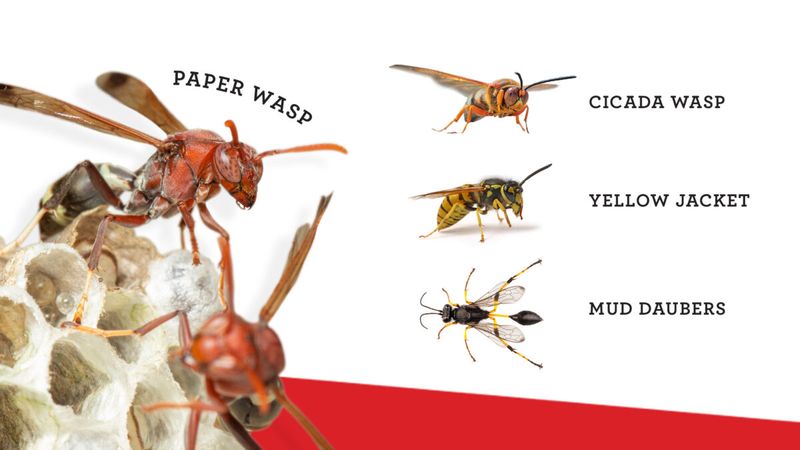
Not every wasp buzzing through a North Carolina yard in August belongs to the same group, and that distinction matters a great deal before drawing any conclusions about risk. Treating a solitary digger wasp the same way you would treat an underground yellowjacket colony would be both unnecessary and counterproductive.
Yellowjackets are the wasps most likely to cause the late-summer surge that homeowners notice. They are compact, smooth-bodied insects with bold black-and-yellow banding.
Unlike bees, they are not fuzzy. They may nest underground in turf cavities, old rodent burrows, wall voids, attics, or other enclosed spaces, and their workers can sting repeatedly.
UC IPM guidance on social wasps notes that yellowjacket colonies are the ones most commonly involved in sting incidents involving people.
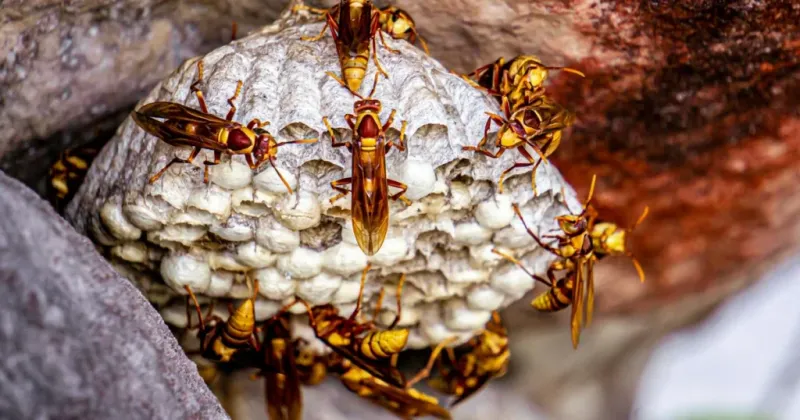
Paper wasps look noticeably different. They are more slender, with longer legs that dangle visibly during flight.
Their nests are the open, umbrella-shaped structures you might find tucked under an eave, inside a porch railing, or along a fence line. The cells are exposed rather than enclosed in a papery envelope.
Paper wasps can sting when their nest is threatened, but they are generally less aggressive than yellowjackets away from the nest itself.
Solitary wasps are a different category entirely. University of Minnesota Extension on solitary wasps explains that species like cicada killers or digger wasps may create individual burrows in bare or sandy soil, and several females may nest in the same general area, giving the impression of a large colony.
Each female, however, tends her own nest and is not defending a shared colony. Most solitary wasps rarely sting people unless physically handled.
Getting a reasonable identification before deciding on a response helps you match the actual risk to an appropriate reaction. University of Minnesota Extension guidance on wasps and bees reinforces that identification is the logical first step, because the species determines the nesting habit, the defensiveness, and the right management approach.
Use flight paths to look for a nearby nest
Counting wasps across your entire yard tells you very little. A more useful observation is watching where they are going.
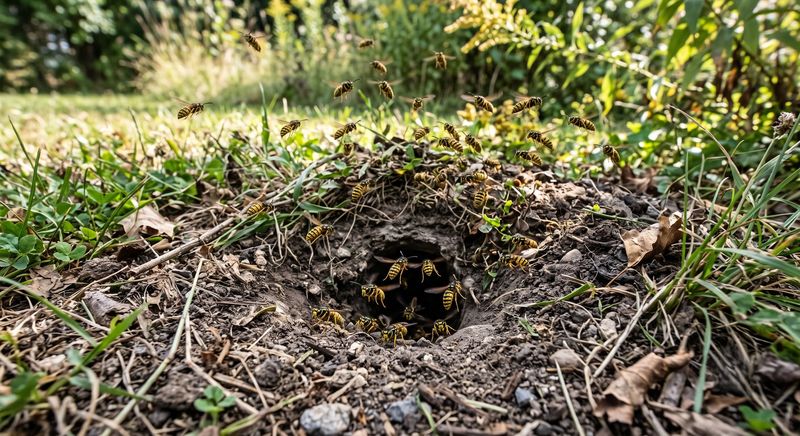
Wasps with a nest nearby tend to follow consistent flight lines back to a single entry point, and that repeated traffic pattern is one of the clearest signs that a colony is established close by.
For yellowjackets, the entry point is often a small hole in the turf, especially in exposed or sandy areas. NC State Extension on yellowjackets in turf notes that ground nests frequently occupy old rodent burrows or other existing cavities beneath the lawn surface.
The opening may look unremarkable, sometimes just an inch or two wide, but workers will enter and exit it steadily throughout the day. A nest can also be located inside a wall void, behind siding, in an attic, near an eave, or inside another enclosed cavity that wasps have found accessible.
Watch from a comfortable, undisturbed distance for several minutes. If you see wasps repeatedly converging on one spot rather than moving randomly across the yard, that is meaningful information.
A handful of yellowjackets using one opening is more concerning from a safety standpoint than dozens of solitary wasps scattered across flower beds, even though the second scenario looks busier at first glance.
What you should not do after spotting a suspected entry point is attempt to investigate it physically. UC IPM social wasp guidance is clear that disturbing a ground nest can trigger a rapid, intense defensive response from the entire colony.
Probing the hole, mowing directly over it, pouring water into it, trying to seal it, or digging around it are all actions that put you in serious danger. The appropriate next step after locating a nest is to assess its position relative to where people and pets spend time, which determines how urgently it needs to be addressed.
Food and trash can draw foragers toward people
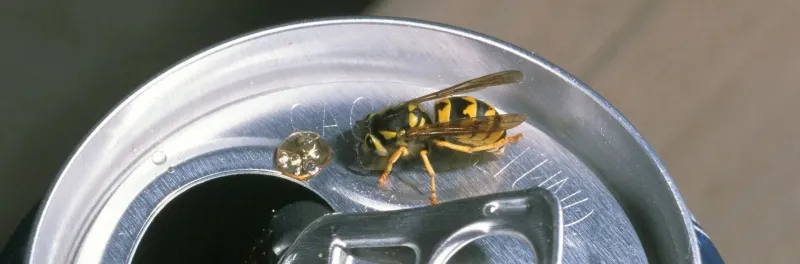
Late-season yellowjackets have a well-documented sweet tooth, and anything sugary or protein-rich left out in the open becomes a magnet. Garbage cans without tight lids, half-eaten fruit on the ground, pet food bowls, uncovered drinks, and spills on patio surfaces can all draw foragers away from their nest and directly toward people.
The key point to hold onto here is that wasps gathering around your outdoor meal are not necessarily nesting in your yard at all. UC IPM guidance on yellowjackets and social wasps notes that foragers can travel considerable distances from their nest to find food, so the wasps circling your picnic table may have originated from a colony in a neighboring property, a wooded edge, or a spot well outside your fence line.
Reducing available food sources is one of the most practical steps a homeowner can take to lower the number of close encounters. Keep garbage cans fitted with tight-closing lids and rinse them periodically to reduce residue and odor.
Clean food and drink spills from patio surfaces promptly. Remove outdoor pet food bowls as soon as pets have finished eating.
Cover sweet drinks and food when eating outside, since yellowjackets are attracted to both sugar and protein. Collect fallen or damaged fruit from beneath trees regularly, because fermenting fruit is particularly attractive in late summer.
These habits reduce foraging activity around high-use areas and make your porch and patio less rewarding as a food destination. University of Minnesota Extension on wasps and bees supports attractant management as a practical first-line response.
Keep in mind, though, that cleaning up food sources will not eliminate a colony that is already established somewhere on or near your property. A nest requires a different response entirely.
Flowers and mulch do not explain every surge
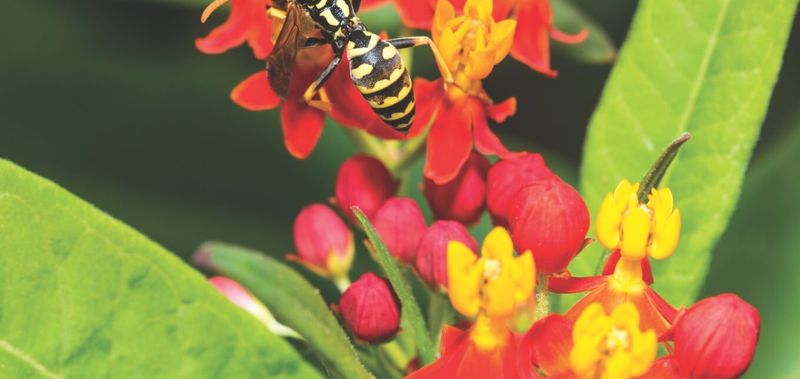
When wasps become more visible in summer, it is tempting to point to something that recently changed in the yard, whether that is a new flower bed, a fresh layer of mulch, or a dry spell that stressed the lawn. Those connections feel logical, but they rarely hold up as explanations for a broad wasp surge.
Wasps do visit flowers, and certain species use soil or wood cavities for nesting. But the presence of wasps near flower beds usually reflects ordinary foraging rather than a landscape problem.
University of Minnesota Extension on wasps as a gardener’s friend explains that many wasp species are beneficial predators that feed on caterpillars, aphids, and other insects that damage plants. A paper wasp working a flower bed may actually be hunting pest insects rather than causing any harm.
Mulch, native plants, drought conditions, and particular yard styles have not been established as reliable predictors of dangerous wasp activity. University of Minnesota Extension on solitary wasps points out that many species prefer bare or compacted soil for nesting rather than mulched beds, but even that is species-specific and does not explain every situation.
Seasonal colony growth in social yellowjackets and some hornets is a far better-supported explanation for late-summer increases than any particular landscape feature.
The more useful question to ask is not “what did I plant or change that caused this” but rather “is there a defensive social-wasp nest located close to a place people use regularly?” NC State Extension on yellowjackets in turf frames management in terms of nest proximity to human activity, not landscape style. Reframing the question that way directs attention toward the factors that actually determine risk.
Judge the risk by location and disturbance
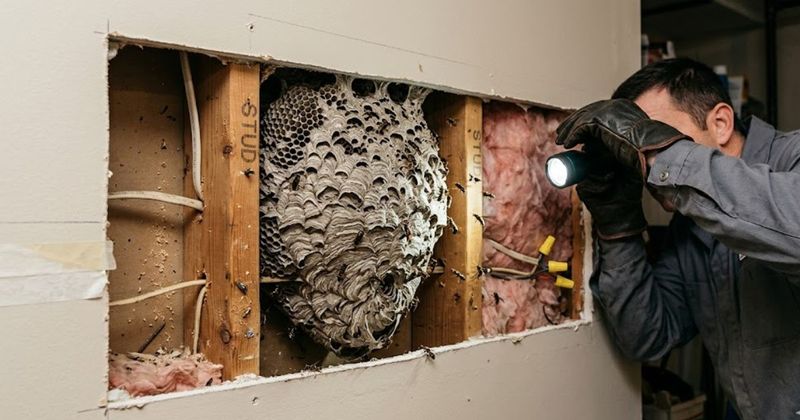
Two yards can each have an active wasp nest and face completely different levels of risk, depending entirely on where the nest sits and how often people pass by it. Location and the likelihood of accidental disturbance are the factors that should drive any management decision, not the number of wasps visible in the yard at any given moment.
A nest tucked inside a hollow tree at the far edge of a large property, away from foot traffic and play areas, presents a very different situation from a nest built inside a wall void beside the back door, beneath the porch steps, or in the ground next to a mowing route. NC State Extension on yellowjackets in turf supports leaving nests alone when they are not near human activity, recognizing the pest-control value these insects provide.
Extension guidance from the University of Georgia Cooperative Extension similarly frames tolerance as reasonable when a nest is genuinely out of the way.
Higher-concern locations include nests beside doorways, under decks or play equipment, along walkways, near seating areas, or anywhere a person or pet might stumble into it without warning. Ground nests and nests inside walls or attics carry added risk because the colony is enclosed, disturbance can be accidental, and the defensive response can be intense and fast.
Those situations generally call for professional help rather than a homeowner attempt.
There is no fixed number of wasps that automatically triggers treatment. UC IPM guidance on social wasps frames control decisions around risk, proximity to people, and the accessibility of the nest rather than any wasp count.
One additional factor overrides the usual calculus: if anyone in the household has a documented history of severe sting reactions, the threshold for seeking professional removal drops significantly, regardless of nest location. NC State Extension guidance on stinging insects supports this more cautious approach for households with allergy history.
Choose the safest response to a genuine hazard
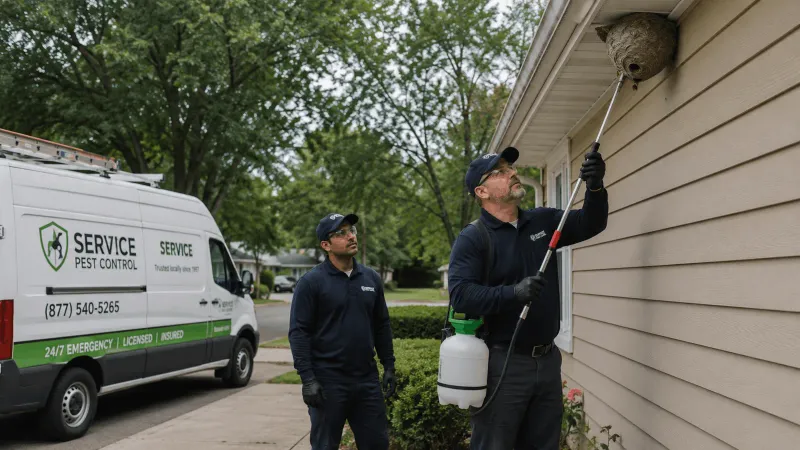
Once a nest is confirmed near a high-use area, the response sequence matters. Start by keeping people and pets away from the area around the nest opening.
Remove any nearby food attractants that might bring people or pets closer. Avoid any action that disturbs the nest directly, including mowing over it, spraying it with a hose, or blocking the entrance.
Broad landscape spraying is not an appropriate response to wasp activity. Yellowjackets, paper wasps, and many other wasps prey on insects that damage plants, and indiscriminate insecticide use removes that benefit while rarely addressing the actual colony.
Treatment should be focused on the nest itself and only when it genuinely threatens people or pets in a high-use area.
For nests inside walls, attics, roofs, dense vegetation, or immediately beside heavily used spaces, a licensed pest management professional is the safer and more reliable option. NC State Extension arthropod pest guidance supports professional treatment for difficult or high-risk nests.
This recommendation becomes especially firm when anyone in the household has a history of severe allergic reactions to stings.
If a homeowner chooses to attempt treatment of an accessible, exposed nest, the pesticide label is the legal and practical authority on every aspect of that application. EPA guidance on pesticide labels states that labels are legally enforceable documents.
The product must be registered for the specific pest and application site, applied only under appropriate weather and wind conditions, and used in a way that protects people, pets, food, and water. The user must also be able to retreat quickly and safely.
Night application is sometimes referenced in extension guidance because wasps are less active then, but it is not a universal safety guarantee and does not substitute for full label compliance.
Sting symptoms that go beyond local swelling and pain require immediate attention. CDC guidance on outdoor stinging insects identifies difficulty breathing, swelling of the lips, tongue, or throat, dizziness, and rapid or progressing symptoms as signs of a potential anaphylactic reaction requiring emergency care.
Anyone with a known severe sting allergy should follow their clinician’s emergency plan and carry prescribed epinephrine.
Read the seasonal signal without overreacting
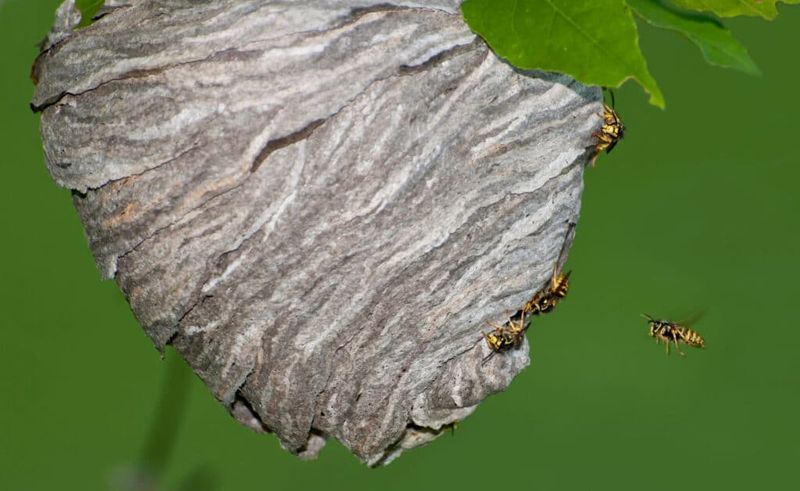
Seasonal colony growth is the most straightforward explanation for why social yellowjackets become more visible in late summer across North Carolina. A colony that quietly built through spring and early summer simply has far more workers by August, and those workers need more food.
That pattern is normal and does not by itself mean something has gone wrong in your yard.
What the wasps’ behavior can tell you is more specific. Species, flight path, nest location, and nearby food sources together reveal whether your yard contains a condition worth addressing.
UC IPM social wasp guidance and NC State Extension on yellowjackets in turf both frame management around those specific factors rather than wasp counts or general landscape conditions.
The practical action plan holds together across the whole article: observe flight patterns safely from a distance, remove exposed food attractants around patios and porches, protect high-use areas from accidental nest disturbance, tolerate wasps that are foraging harmlessly away from people, and call a professional for nests that are inaccessible or sit too close to family activity. NC State Extension arthropod pest guidance supports this risk-based, targeted approach over broad elimination efforts.
A yard full of wasps in August is not automatically a yard in trouble.
Knowing the difference is what makes the response useful.