
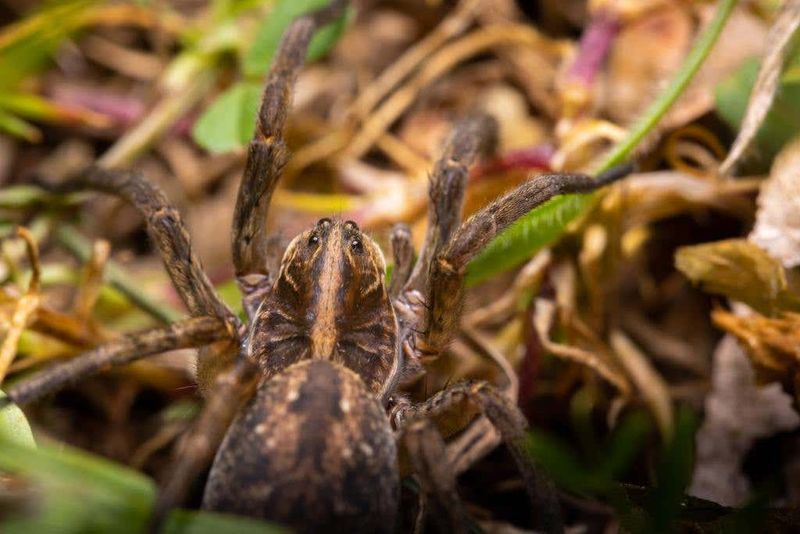
Spotting a large, fast-moving spider bolting across your patio or disappearing under the mulch can stop you cold, especially when it looks big enough to have its own zip code. Wolf spiders are showing up in yards across North Carolina right now, and most homeowners want to know whether that means something is wrong.
The short answer is that a wolf spider sighting may offer a limited clue about your yard’s habitat and arthropod activity, but it does not prove there is a pest problem, and reaching for the spray can is usually the wrong move.
A late-summer sighting may reflect several yard conditions
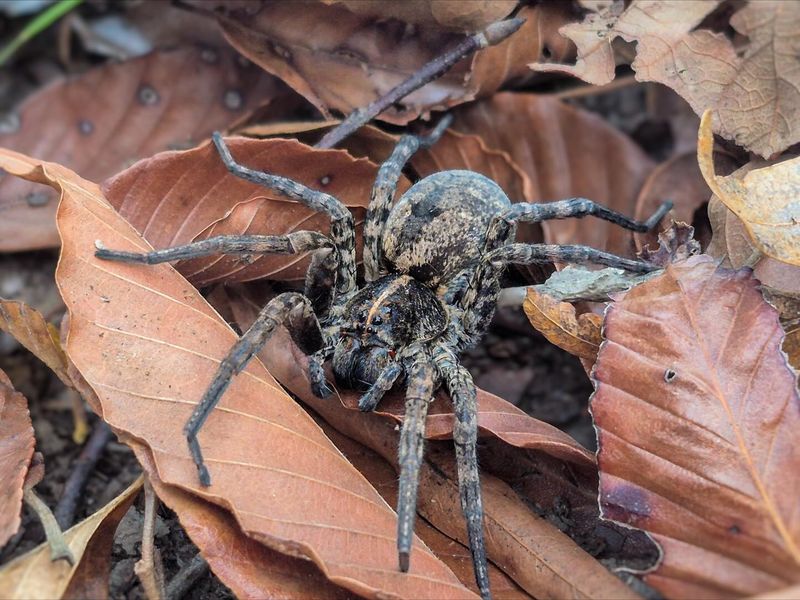
Seeing a wolf spider cross your yard or foundation edge this time of year is not automatically a warning sign. Wolf spiders are ground-hunting predators that patrol soil, grass, and leaf litter rather than building the large, sticky webs people usually picture.
NC State Extension’s guide to fishing spiders and wolf spiders describes them as among the state’s largest non-web-building spiders, active hunters that eat insects and other arthropods they encounter rather than anything rooted in the ground.
Their appearance in late summer may coincide with several overlapping factors. Warm temperatures keep arthropod activity high, which can keep hunting spiders active as well.
Females that carried egg sacs through summer may have recently released spiderlings, adding young spiders to the landscape. Some individuals may also be moving from nearby natural areas, neighboring properties, or field edges as vegetation shifts with the season.
Penn State Extension’s wolf spider profile notes that these spiders often make retreats in soil, under stones, boards, firewood, or siding, so yards with those features can provide ready shelter. Weather can also push them toward structures when conditions change.
None of these factors operate in isolation, and the mix of causes varies from yard to yard.
What a sighting cannot do is diagnose why the spider is there or confirm that the yard has a damaging pest infestation. NC State’s spiders-in-and-around-homes publication is clear that spider presence reflects available habitat and prey broadly, not a specific pest emergency.
Late summer is a common period for homeowners in the South to notice more spider activity, but that pattern is an observation, not a fixed biological rule that applies uniformly across every part of North Carolina.
What the yard may provide beneath the spider
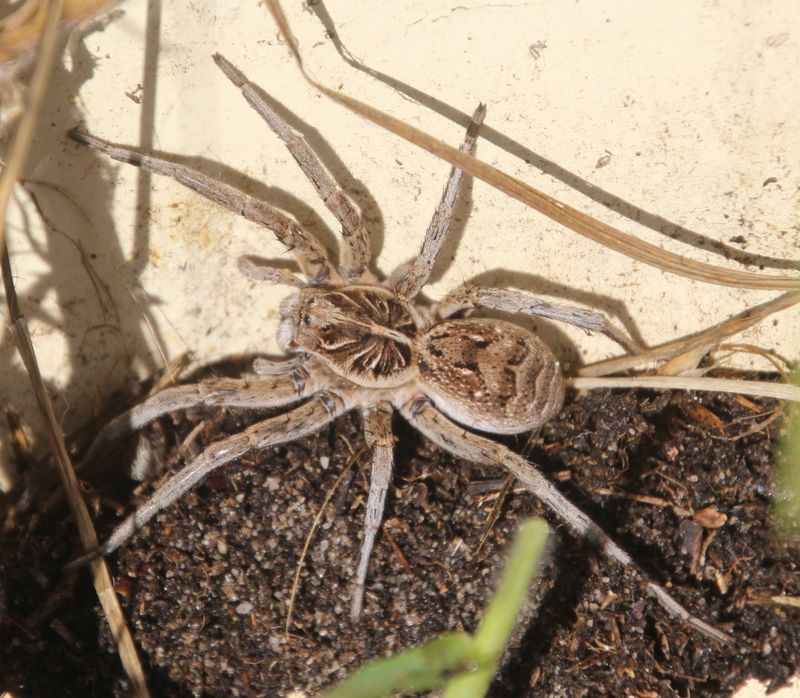
Before assuming the spider arrived without reason, look at what the yard is offering at ground level. Mulch layers, fallen leaves, dense low plantings, boards left on the soil, stacked firewood, flat stones, and damp spots near downspouts all create the kind of sheltered microhabitats that ground-dwelling arthropods use.
A wolf spider patrolling those areas is responding to what is already there.
Penn State Extension confirms that wolf spiders commonly shelter under stones, boards, firewood piles, siding, and similar protected spots. When those retreats are near a foundation or garden edge, the spider ends up exactly where homeowners notice it most.
The spider is not attracted to the house itself; it is attracted to the cover and the prey that cover provides.
Ground-level plantings and leaf litter can also support a variety of insects and other small arthropods by providing stable moisture, organic matter, and hiding places. NC State’s native plants handbook describes fallen leaves and ground-layer plantings as habitat for insects and other organisms, which is part of why diverse ground-cover areas tend to support a broader range of small creatures generally.
Wolf spiders do not feed on plants, damage turf by chewing it, or harm garden vegetables by eating them. Their presence in a lawn, bed, or naturalized edge means they are hunting other arthropods in that space, not causing the damage themselves.
Foundation edges with accumulated debris, deep mulch pushed against siding, or boards that have sat undisturbed for a season are the features most worth noting, because they serve both as spider shelter and as habitat for the insects and other small organisms the spider may be hunting.
A wolf spider can suggest prey activity without diagnosing a pest
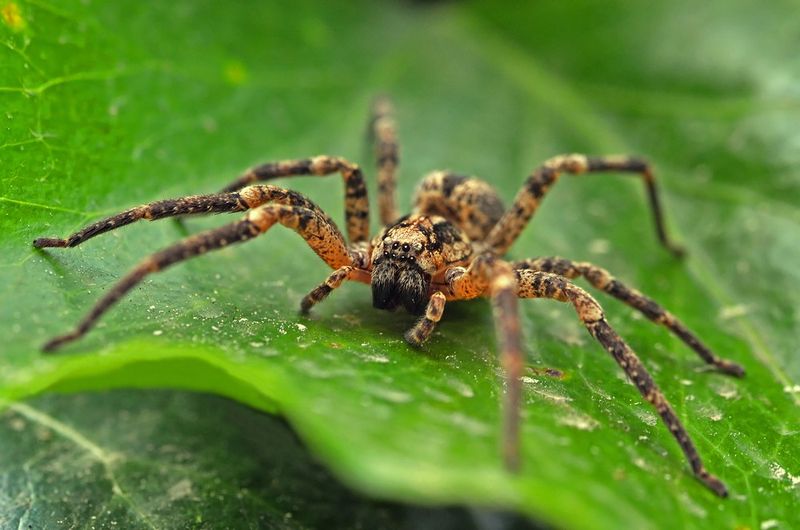
Finding a wolf spider in the yard tells you that something edible is probably nearby. These spiders are generalist predators, meaning they eat whatever ground-level arthropods they encounter, from beetles and crickets to other small invertebrates.
NC State’s wolf and fishing spider guide describes them as hunters that consume insects and other arthropods they come across, not specialists locked onto one prey type.
That generalist diet is what limits how much a sighting can tell you. The spider’s presence is consistent with available prey, but it does not identify which prey species are present, how many there are, or whether any of them are damaging turf, ornamentals, or vegetables.
A wolf spider hunting near your lawn edge may be eating ground beetles, pillbugs, or small crickets, none of which cause plant damage. Or it may be finding something more consequential.
The sighting alone cannot sort that out.
Research on habitat complexity and predator-prey relationships in urban settings reinforces that spider abundance reflects local arthropod communities broadly, not a reliable signal of any one damaging species. Treating spider numbers as an infestation meter skips the step that actually matters: looking for evidence of pest damage.
A practical next step is to shift focus from the spider to the plants. Check turf for thinning patches, discoloration, or root damage that lifts when you tug.
Look at ornamentals for chewed foliage, stippling, or sticky residue. NC State’s turf arthropod guide recommends monitoring and correct identification before deciding whether any intervention is needed.
A wolf spider in a healthy-looking yard is more likely a sign of an active yard food web than a warning of impending plant damage.
Ground cover affects spider habitat in different ways
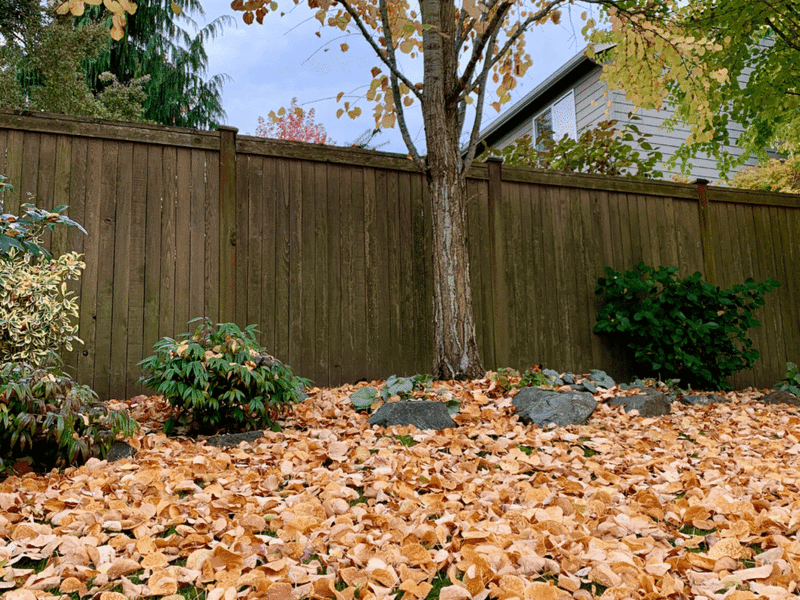
Mulch and leaf litter do not function as a simple wolf-spider dial you can turn up or down. The relationship between ground cover and spider presence is real in some settings, but it is not uniform across all spider types or all landscapes.
Treating more mulch as automatically meaning more wolf spiders, or a tidy yard as meaning fewer, oversimplifies what actually happens at ground level.
A study on ground cover and spider populations in a table grape vineyard found that ground-cover plots supported greater overall spider diversity compared to bare-soil plots, but the effects were limited when researchers looked specifically at spider abundance on the vines themselves. Results like that show the relationship between vegetation and spiders is real but context-dependent, varying by spider group, habitat type, and landscape setting.
A vineyard is not a residential backyard, and different spider species respond to structure differently.
Research on habitat complexity in urban agroecosystems similarly found that local habitat features influence both herbivore and predator communities, but the effects are shaped by surrounding landscape conditions, not just by what one homeowner does in one bed. Some ground-hunting spiders actually prefer more open ground with less litter, while others benefit from denser cover.
The practical takeaway is that you do not need to choose between a wildlife-supportive yard and a functional one. NC State’s native plants handbook describes combining ground-layer plantings with maintained paths, which lets you retain areas of leaf litter and plant structure in selected beds while keeping walkways, play spaces, seating areas, and foundation edges clear and usable.
That balance serves both the yard’s ecology and the people who use it, without requiring you to manage the entire property as a nature preserve or a sterile lawn.
Inspect for an actual problem before changing the yard

A wolf spider crossing the patio is a startling encounter, but it is not a pest-management emergency. Before pulling up mulch, raking out beds, or calling a spray service, spend twenty minutes walking the yard with the specific goal of finding damage rather than spiders.
The two questions worth answering are: what is actually wrong with the plants, and is there an identified pest causing it?
Start at the foundation edge and check mulch depth. Mulch pushed tight against siding or more than three inches deep creates the kind of persistently damp, sheltered zone that attracts a wide range of arthropods, including the insects a wolf spider might hunt.
Move to garden beds and check leaf-litter accumulation, boards or pavers sitting flat on soil, stones, and any debris that has not been moved recently. These are the spots where both spiders and their prey concentrate.
Then shift to the plants themselves. NC State’s turf arthropod guide recommends monitoring for actual damage symptoms before deciding whether treatment is warranted.
Pull back a section of turf in any thin or discolored area to check for grubs or root damage. Look at ornamental foliage for chew patterns, stippling, or honeydew residue that would point to a specific pest.
Check damp spots and standing water near downspouts, which attract insects and can draw hunting spiders to those zones.
Also note porch lights left on through the night, pet food left outside, and indoor-outdoor transitions like gaps under doors or unscreened vents. NC State’s integrated pest management handbook frames monitoring and correct identification as the foundation of any rational response.
NC State’s home spider guide adds that most outdoor spider encounters do not require any intervention at all. If the inspection turns up no plant damage, no identified pest, and no unusual insect numbers, the spider is likely passing through a yard that suits it, not signaling a problem that needs fixing.
Identify a large spider before assuming it is harmless or dangerous
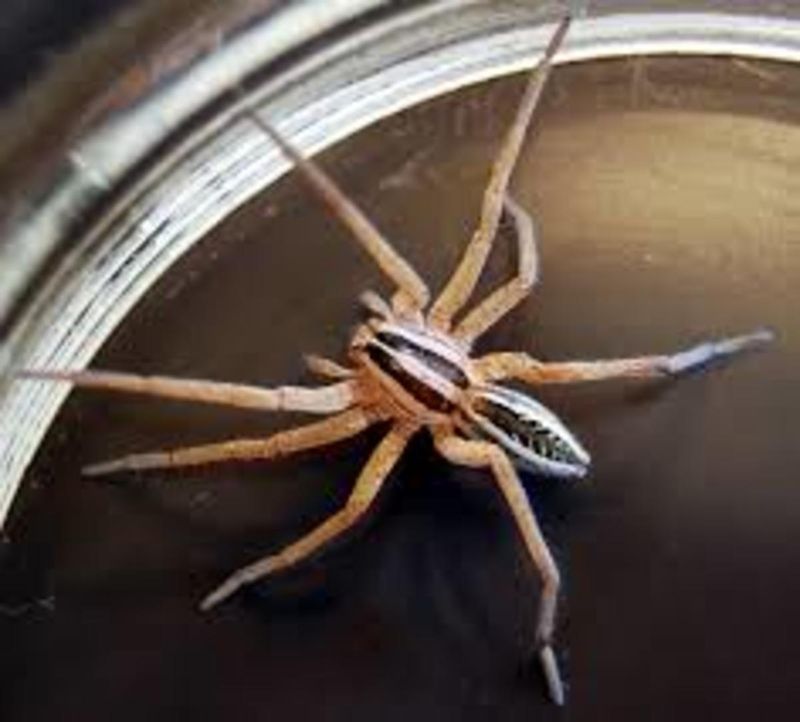
Not every large, fast, brown spider in a North Carolina yard is a wolf spider. Size and color alone are not enough to make a reliable identification, and casual photographs taken from a distance or at poor angles can easily mislead.
NC State’s Extension Gardener Handbook on insects specifically warns that wolf spiders and other hunting spiders are frequently confused with brown recluses, which is a meaningful concern because the two require very different responses.
Wolf spiders are heavy-bodied, often patterned with brown or gray stripes, and carry their eyes in a distinctive arrangement of three rows, with two large middle eyes that reflect light well. Brown recluses are smaller, uniformly tan to brown, and carry a violin-shaped mark behind the head, though that mark can be hard to see without a close look.
Black widows are glossy black with the well-known red hourglass on the underside of the abdomen. Neither black widows nor brown recluses should be handled, and both warrant more caution than an ordinary wolf spider encounter.
NC State’s wolf and fishing spider guide notes that wolf spiders are not considered dangerously venomous, but that does not mean they should be picked up bare-handed. Any spider may bite if it feels trapped or disturbed, and individual reactions to a bite vary.
The safer approach for any large spider indoors is to place a jar over it, slide a stiff card underneath, and release it outside. That method works for wolf spiders in garages, basements, or living areas without requiring you to touch the spider or identify it with certainty first.
One more caution worth stating clearly: a skin lesion should never be diagnosed from the presence of a spider. NC State’s home spider resource and medical guidance both emphasize that many conditions mimic spider bites, and a doctor, not a yard sighting, is the right source for a skin-wound diagnosis.
Reduce indoor encounters without spraying the whole property

Keeping wolf spiders outside is a reasonable goal, and it does not require treating the lawn, beds, or foundation perimeter with pesticides. The most reliable approach focuses on the building itself rather than on the yard population, because a spider that cannot find a way in simply stays outside.
Start with the gaps that matter most. Door sweeps that do not seal fully against the threshold, weather stripping that has compressed or cracked over time, and torn or ill-fitting window screens are the most common entry points for ground-level spiders.
Fixing those features costs far less than repeated pesticide applications and does not affect the outdoor arthropod community at all. Foundation cracks, utility penetrations, and gaps around pipe entries are worth sealing with caulk or expanding foam where accessible.
NC State’s home spider guide recommends reducing indoor insect prey as a companion step, because a spider that enters and finds nothing to eat is less likely to stay. Reducing insects indoors means turning off or redirecting porch lights that draw moths and other insects toward entry points, keeping food stored in sealed containers, and fixing any moisture issues that attract small flies or other insects.
Clutter near entry points, including stacked boxes, firewood brought inside, and piles of bags near the garage door, can shelter a spider that has already made it through the gap.
Clear, maintained space around the foundation serves both the home and the yard. Pulling mulch a few inches back from siding, removing boards or debris that sit flush against the foundation, and trimming vegetation that touches the exterior wall all reduce the bridge between outdoor habitat and indoor space.
The goal is not to eliminate ground cover from the entire yard but to create a transition zone at the foundation edge that gives spiders fewer reasons to cross from outside to inside.
Target an identified pest instead of reacting to the spider

Broad outdoor spraying triggered by a wolf spider sighting is one of the least proportionate responses available, and it carries real costs. NC State’s home spider guide states directly that outdoor pesticide applications for spiders are generally unnecessary and warns that killing spiders and other predatory arthropods with pesticides can remove natural controls, potentially allowing pest numbers to increase rather than decline.
If an inspection from the previous section turned up an actual pest, the sequence that follows is straightforward. First, confirm the identification of the pest, not just the spider.
Second, determine whether the numbers or the damage level actually justify intervention. Many arthropod populations fluctuate naturally and do not reach a threshold where treatment produces a measurable benefit.
Third, try physical or cultural changes first: adjust irrigation, improve drainage, remove affected plant material, or use row covers or sticky traps where appropriate. NC State’s integrated pest management handbook frames this sequence as the foundation of rational pest response, with a labeled chemical product as the last step rather than the first.
When a pesticide is genuinely warranted, the label is the legal document that governs its use. Apply the product only where the label permits, at the rate specified, and only for the pest listed.
EPA pesticide safety guidance requires removing children, pets, and toys from the treatment area before application and keeping them away for the period the label specifies. Prevent drift onto neighboring properties, water features, or vegetable gardens, and prevent runoff into storm drains.
The EPA’s label-reading guidance also cautions that organic or natural-ingredient products are not automatically safer for children, pets, pollinators, or aquatic life. Every pesticide product, regardless of its source, carries label requirements that exist for a reason.
A wolf spider crossing your yard in late August may be part of the local yard food web, hunting prey that is already there and using shelter that already exists. Its presence alone is not a command to eliminate habitat or treat the property.
The spider is reading the yard; the better move is to read it too, and respond only to what the evidence actually shows.