
Spotting a hawk gliding over your North Carolina yard is one of those moments that stops you mid-task. Whether it circles once and drifts off or keeps coming back to the same oak tree, most homeowners want to know what it means and whether they should do anything about it.
The answer depends less on the fact that a hawk showed up and more on what it does when it gets there. Learning to read those details will tell you far more than the bird’s presence alone ever could.
A returning hawk signals opportunity, not a diagnosis
Seeing a hawk once is an event. Seeing the same bird return to the same corner of your yard, day after day, is a pattern worth reading carefully.
The key word is “pattern” because a single flyover tells you almost nothing, while repeated low-level visits, regular use of a particular tree, or perching near a specific spot suggest that something about your yard or the land around it rewards the bird’s effort.
Hawks respond to prey, perches, tree cover, open edges, wetlands, woodlands, and feeders at a scale that extends well beyond your property line. University of Florida Extension research on hawk habitat use emphasizes that raptors evaluate conditions across the yard, the neighborhood, and even the broader town, not just the lot where you happen to be watching.
A hawk that crosses your yard may be responding to a brushy corridor two streets over, a creek behind a neighbor’s fence, or a weedy lot at the end of the block.
That distinction matters before you do anything to your yard. A hawk is better understood as an observation cue than as a verdict on what changed inside your property.
The strongest evidence for a food-related explanation involves Cooper’s and Sharp-shinned Hawks near bird feeders. Cornell Lab reporting on urban hawk presence connects feeder-area hawk activity to prey-bird concentration, and a 21-year Chicago metropolitan study found that Cooper’s and Sharp-shinned Hawks persisted in highly urbanized areas wherever prey birds remained abundant.
That research points to feeders as a possible factor, but it does not mean every hawk visit traces back to a feeder in your yard.
Treat the bird as a signal that hunting conditions exist somewhere nearby. Where exactly, and for what prey, depends on what the hawk does next.
First, separate soaring from hunting
Before changing anything in your yard, watch what the hawk actually does. Altitude and flight style are your first two clues, and they matter more than the simple fact that a bird is circling overhead.
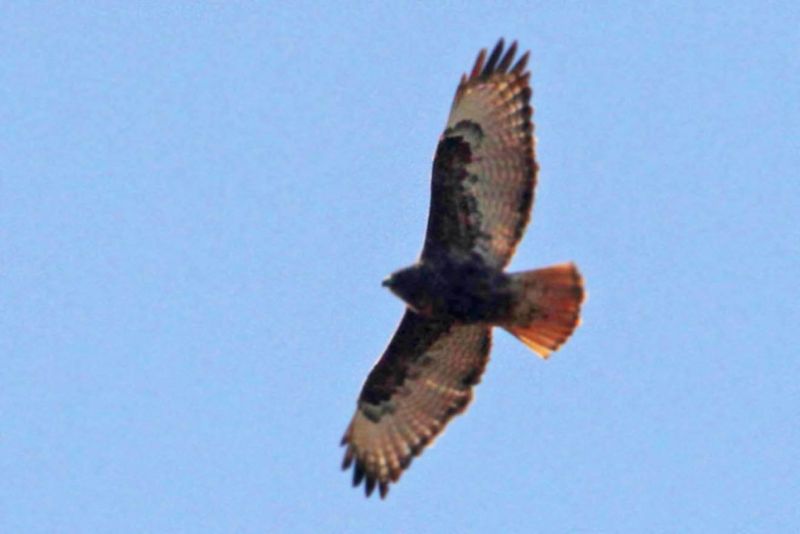
High, broad circles most often reflect thermal soaring rather than active hunting. Warm air rises from sun-heated pavement, rooftops, and open ground, and hawks ride those invisible columns to gain altitude with very little effort.
Cornell Lab’s explanation of raptor soaring behavior notes that migrating hawks and resident birds alike use thermals to travel and move across territories, and groups of circling raptors are often using the same thermal column rather than hunting the same patch of ground together.
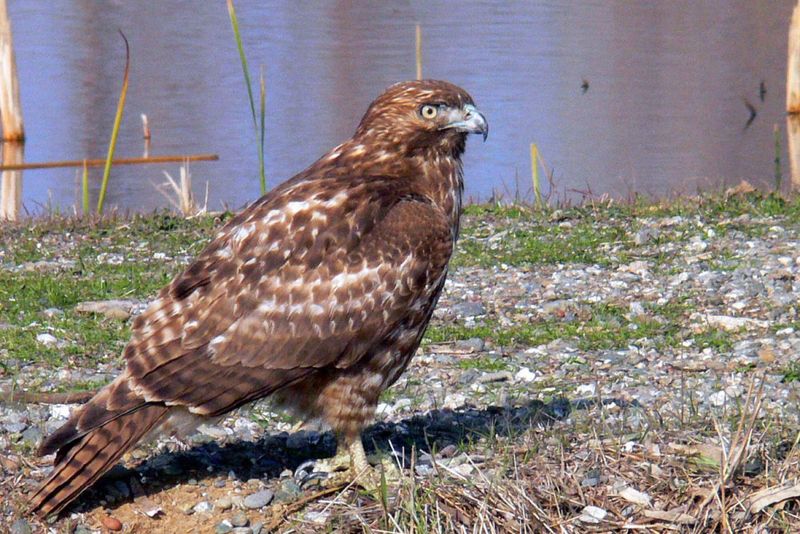
Red-tailed Hawks, one of North Carolina’s most familiar and widely distributed raptors, are especially comfortable soaring. North Carolina Wildlife Resources Commission documentation on Red-tailed Hawks describes them as birds that commonly use open sky and elevated perches.
A Red-tailed Hawk drifting in lazy circles several hundred feet up is probably traveling or scanning a broad area, not locked onto your vegetable bed.
Active hunting looks different. A hawk that is working your yard will more likely drop to a low glide, thread through tree branches, hover briefly above a patch of grass, or suddenly stoop toward the ground.
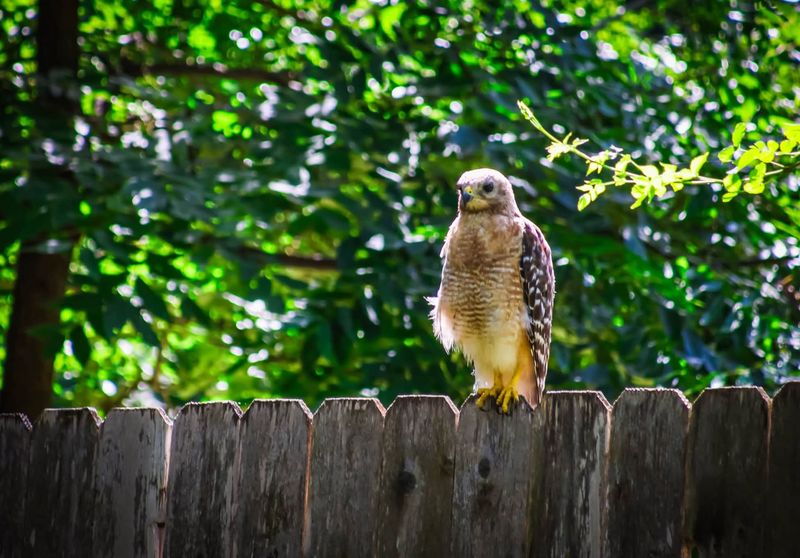
Red-shouldered Hawk life history notes from Cornell Lab describe hunting behavior that involves sitting quietly in mid-canopy and watching below, not circling continuously overhead.
The behavior after the circle is what tells you whether the bird found something worth pursuing. If it drifts away without dropping, the most likely explanation is soaring or travel, not a meal in your yard.
The hawk’s identity changes what the visit may mean
Not every hawk hunting your yard is after the same thing. Identifying the species before drawing conclusions is one of the most useful steps a homeowner can take, because the three hawks most likely to show up in a North Carolina yard have genuinely different prey preferences and habitat associations.
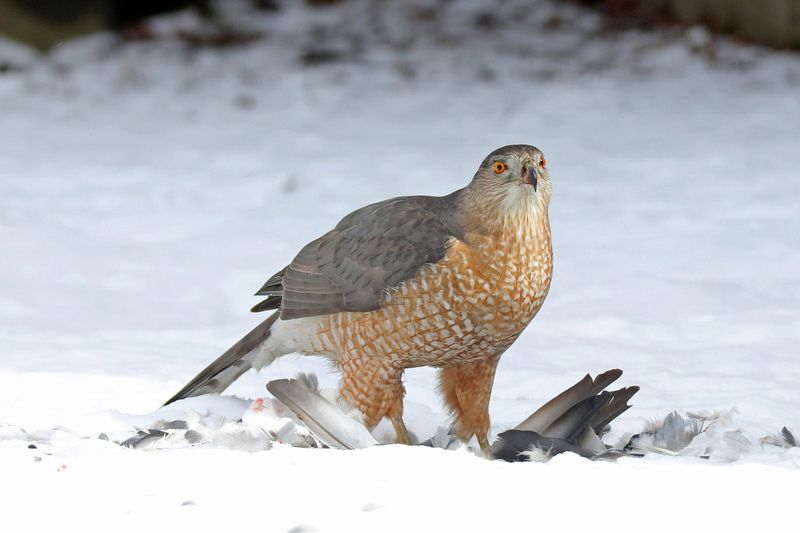
Cooper’s Hawks are built for suburban and woodland environments. Compact and fast, with rounded wings and a long tail that helps them steer through trees, they are the hawk most likely to appear suddenly near a bird feeder.
Cornell Lab’s Cooper’s Hawk life history describes a diet centered on medium-sized birds such as doves, starlings, robins, and jays, though they also take mice, squirrels, chipmunks, and other small mammals. A Cooper’s Hawk perching in a shrubby tree close to your feeders and making short, fast bursts through the branches is almost certainly after songbirds rather than rodents under your shed.
The Cornell Lab overview for the species emphasizes their agility in wooded cover as their defining hunting adaptation.
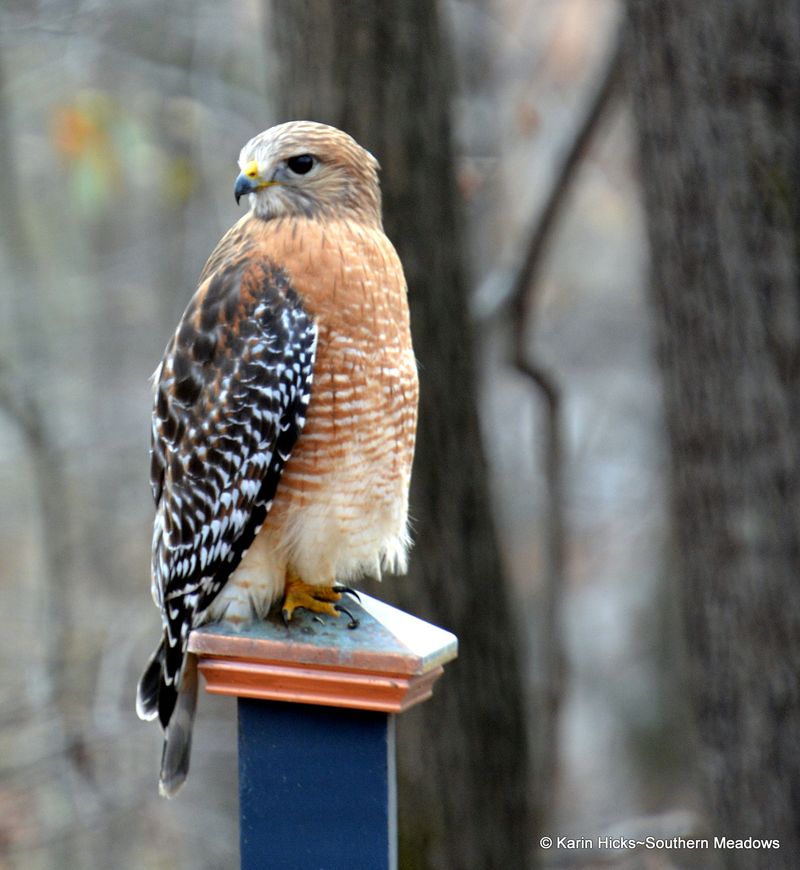
Red-shouldered Hawks occupy a different niche. They favor forests, wetland edges, stream corridors, and wooded suburbs where they hunt small mammals, frogs, lizards, snakes, and occasionally birds.
Cornell Lab’s Red-shouldered Hawk life history describes a diet that leans heavily on amphibians and reptiles in many regions. If you live near a creek, a low-lying wooded area, or a neighborhood pond in the Piedmont or coastal plain, a Red-shouldered Hawk visiting your yard likely reflects the habitat surrounding your property as much as anything in your yard itself.
North Carolina Wildlife’s Red-shouldered Hawk profile documents this species as closely tied to wooded wetland corridors across the state.
Red-tailed Hawks are the largest and most commonly seen hawk across North Carolina. Open areas, field edges, exposed fence posts, and utility poles are their preferred hunting stations.
The North Carolina Wildlife profile for Red-tailed Hawks notes that they favor rodents and other small animals, and they hunt by watching from an elevated perch rather than threading through trees. Spotting one on a pole at the edge of your lawn tells a different story than a Cooper’s Hawk flashing through a hedge.
Inspect the habitat below the flight path
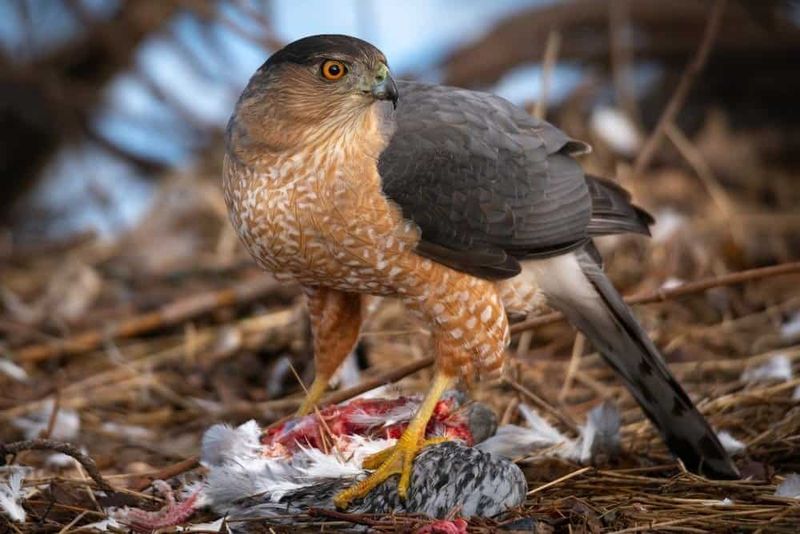
Once you know which hawk you are dealing with and whether it is actually hunting rather than soaring, the next step is a slow walk around your yard to look for the features that may be concentrating prey at or near ground level.
Bird feeders are the most common attractant to check first. Feeders pull songbirds into a tight space, and where songbirds gather, bird-hunting hawks often follow.
A Frontiers in Ecology and Evolution study examining urban wildlife feeding in Raleigh, North Carolina found that intentional feeding substantially increased local wildlife activity and that predator abundance tracked prey abundance. That connection does not mean your feeder created a hawk problem, but it does make feeders a logical first place to look when hawk visits become frequent.
Beyond feeders, scan for spilled seed on the ground, unsecured pet food left outside, open compost bins, trash that is not tightly sealed, overgrown brush piles, and weedy edges where small rodents can move freely. Each of those features can concentrate the prey that draws rodent-hunting hawks such as Red-tailed Hawks, which commonly use fence posts, utility poles, and exposed branches to survey open lawns.
North Carolina Wildlife’s Red-tailed Hawk documentation describes exactly this perch-and-watch hunting style over open ground.
Also look at the land beyond your fence. A wooded corridor, stream bank, open field, or brushy easement nearby can funnel prey and hawks alike through your property without anything in your yard being the cause.
Pay attention to the songbirds themselves. Small birds repeatedly diving at, chasing, or calling loudly around a larger bird are mobbing it, a defensive behavior that Cornell Lab explains as a response to a perceived predator near a nest, territory, or feeding area.
Mobbing behavior near your feeders is a strong signal that a bird-hunting hawk, most likely a Cooper’s Hawk given its adaptation to pursuing birds through wooded and suburban cover, is working that spot actively.
Summer visibility reflects more than a new food source
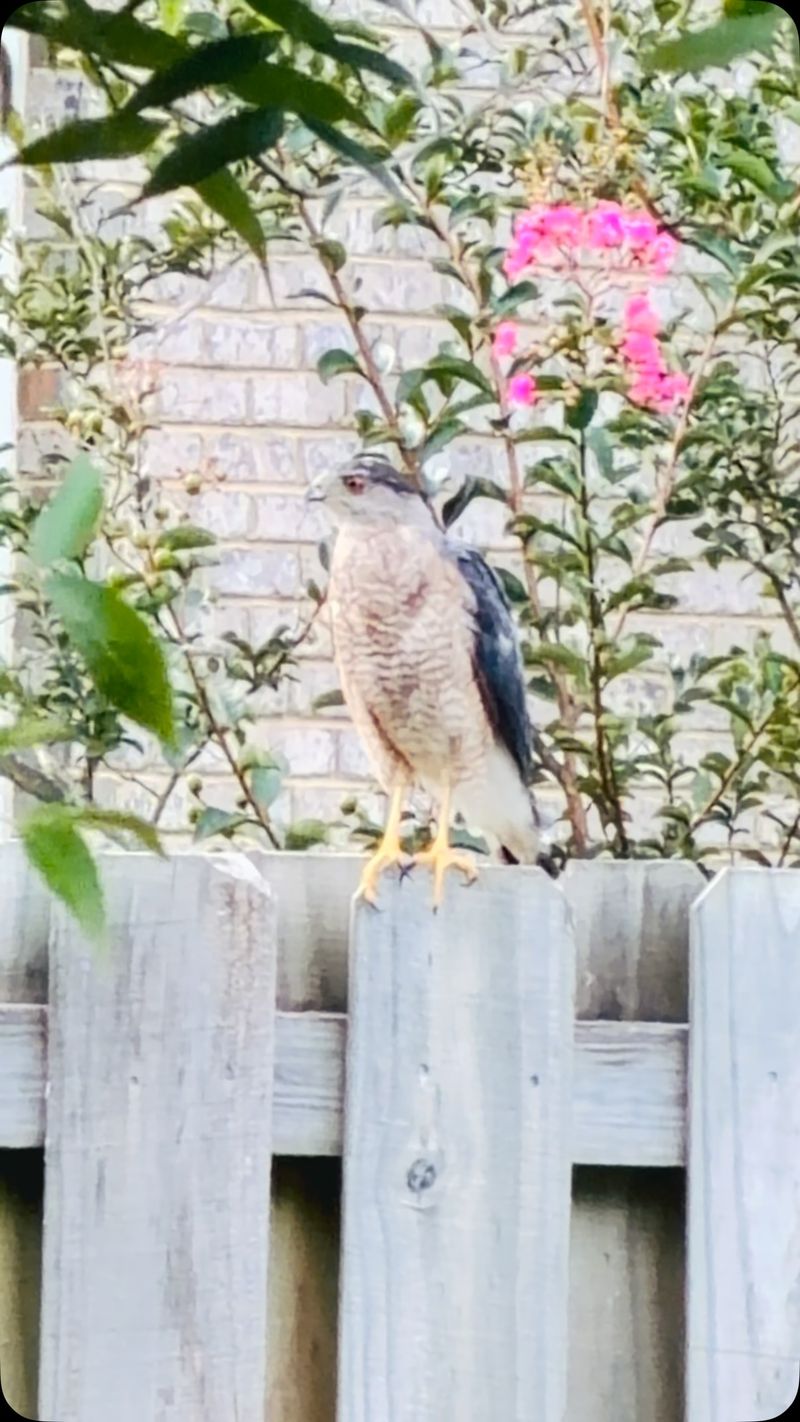
A noticeable increase in hawk activity during summer does not automatically mean your yard recently became richer in prey. Several things happen during warm months in North Carolina that put more hawks in front of more homeowners without any change in the yard itself.
Resident breeding pairs are active and visible through the warm season. Both Cooper’s Hawks and Red-shouldered Hawks nest well into summer, and Cornell Lab’s Cooper’s Hawk life history documents suburban nesting as increasingly common as the species has adapted to leafy neighborhoods.
A pair feeding nestlings or recently fledged young will cover more ground and make more hunting passes than a solitary bird in winter.
Fledglings add to the count. Young hawks leave the nest still learning to hunt, and they are often less efficient and more visible than adults.
They may perch in odd spots, make clumsy attempts at prey, and linger near yards longer than an experienced bird would. Red-shouldered Hawk nesting and dispersal timing from Cornell Lab shows that juveniles begin moving through the landscape in mid-to-late summer, which aligns with the window when many North Carolina homeowners report a spike in hawk sightings.
Geography shapes what you are likely to see. If your yard backs up to a wooded wetland, creek, or drainage corridor, a Red-shouldered Hawk is a reasonable expectation.
North Carolina Wildlife’s Red-shouldered Hawk profile ties this species closely to those riparian and bottomland habitats across the state. Open Piedmont neighborhoods with large lawns and scattered trees lean more toward Red-tailed Hawks, while leafy, tree-canopied suburbs anywhere in the state can host Cooper’s Hawks year-round.
These are tendencies, not rules, but they give you a starting point for interpretation before you even reach for a field guide.
Protect feeder birds by changing concentration, not chasing the hawk
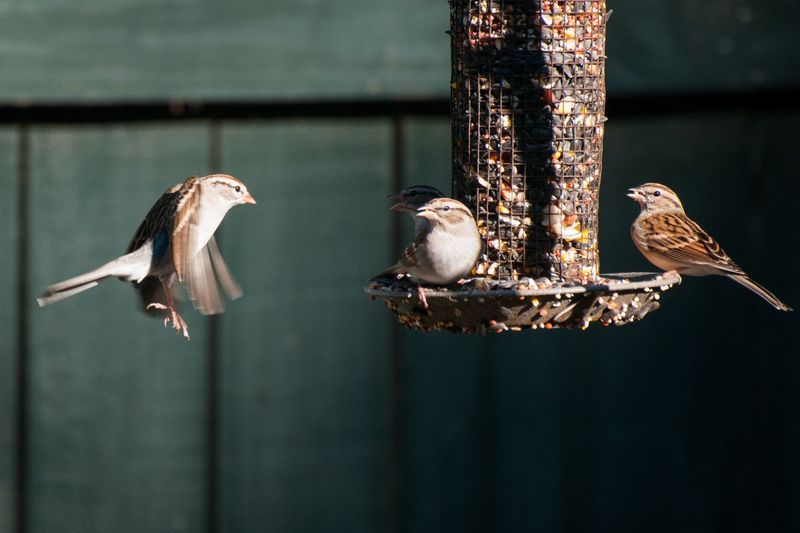
Watching a Cooper’s Hawk pick off a cardinal at your feeder is upsetting, especially if you have spent months attracting songbirds to your yard. The response that actually helps, though, is not about the hawk.
It is about the concentration of birds the feeder creates.
Both Cornell Lab of Ornithology guidance on feeder hawk activity and Penn State Extension’s advice for feeder-side hawk encounters recommend the same practical first step: temporarily remove or stop filling feeders for several days to a couple of weeks. When songbirds disperse, the hawk loses the reliable hunting spot.
This is not a permanent solution and it does not remove the hawk from your neighborhood, but it breaks the pattern at that specific location.
Dense planted cover is the second tool. Penn State Extension specifically recommends well-planted native shrubs and thickets near feeders because small birds can dart into that cover when a hawk appears.
Removing plants to make the yard look less attractive to hawks is the wrong move: open ground actually makes songbirds easier to catch, not harder. Brambles, native hollies, viburnums, and dense ornamental grasses give sparrows, finches, and chickadees somewhere to go in a hurry.
When you reintroduce feeders, bring them back gradually and keep them clean to avoid drawing rodents that might attract a second type of predator. University of Florida Extension’s habitat-scale hawk research reinforces that reducing prey concentration at one location shifts conditions locally without eliminating hawks from the broader area.
That is a realistic and proportionate goal: making your feeder less productive for a hunting hawk, not making your yard hawk-free.
Secure poultry and keep rodent conclusions grounded
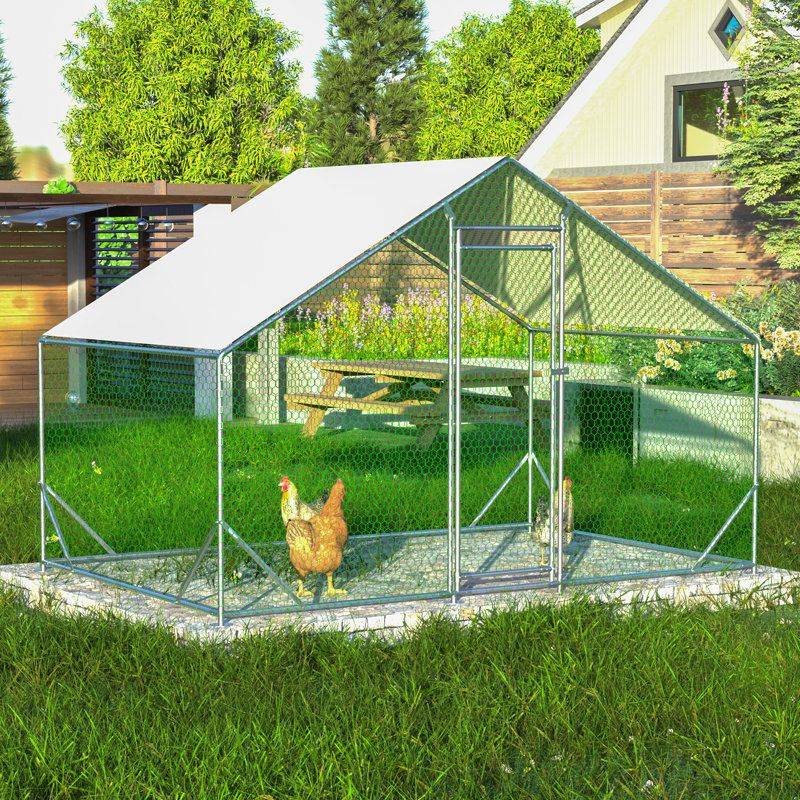
Two concerns make hawk sightings feel genuinely urgent for some North Carolina homeowners: backyard chickens and household rodents. Both deserve a practical, grounded response rather than an alarmed one.
For backyard poultry, overhead protection is the most reliable defense. North Carolina Wildlife notes that even the largest North Carolina hawks weigh only about 3 pounds, so claims about hawks carrying off adult chickens or large birds are almost always exaggerated.
Small bantams, young chicks, and ducklings in exposed areas face a more realistic risk. A covered run or secure overhead netting addresses that risk more dependably than visual scare devices, which hawks tend to habituate to quickly.
Extension Foundation guidance on poultry predator management also cautions against assuming a missing bird was taken by a hawk. Daytime attacks and cleanly plucked breast feathers can be consistent with raptor predation, but foxes, raccoons, and neighborhood dogs produce overlapping evidence.
Investigate before concluding.
On the rodent question, a hawk may catch mice, voles, or rats in your yard, but it cannot provide dependable household pest control. Oregon State University Extension’s guide to attracting birds of prey for rodent control presents raptor predation as variable ecological pressure that depends on species, prey availability, habitat, and landscape.
A peer-reviewed assessment of birds of prey as biological pest control reaches a similar conclusion: raptors can contribute to natural control, but they are not a substitute for sanitation, sealing entry points, or appropriate pest management when rodents are inside a structure.
Rodenticide use near a yard with hawk activity carries its own risk. USGS research on raptors and rodenticide exposure documents concern about hawks and owls being harmed by eating poisoned prey.
North Carolina Wildlife also warns that hawks can be harmed by consuming prey exposed to pesticides. If rodenticide use is necessary, follow the label precisely and consider the full range of animals that might encounter treated rodents.
Keep your distance and know when to seek help
Hawks are protected under federal and state law, and that protection shapes what homeowners can and cannot do when a conflict feels real. Killing, injuring, or harassing a hawk, or harming or removing an active nest, may violate the Migratory Bird Treaty Act and parallel state statutes.
Do not approach, handle, interfere with, or attempt to relocate a hawk or an active nest on your property. If a hawk’s activity is causing a documented conflict you cannot resolve through habitat or husbandry changes, contact North Carolina Wildlife Resources Commission for guidance specific to your situation.
A hawk sitting on the ground is not automatically injured. Hawks routinely land to eat prey or scavenge roadkill, and a bird that is feeding may stay in one spot for a long time.
Give it space and watch from a distance. Contact a licensed wildlife rehabilitator only when you observe clear signs of injury, illness, or a situation of immediate danger.
North Carolina Wildlife’s injured and orphaned wildlife resource can help you find the appropriate contact in your area.
The most useful thing you can do when hawks become a recurring presence is apply the same method every time: identify the species, watch what the bird actually does, inspect the surrounding habitat for features that concentrate prey or offer hunting structure, and respond only when there is a demonstrated conflict with feeder birds or poultry. High circles overhead may be nothing more than a hawk riding a summer thermal on its way somewhere else.
The bird that keeps coming back to the same perch above your garden, on the other hand, is telling you something specific, and now you have the tools to figure out what.