
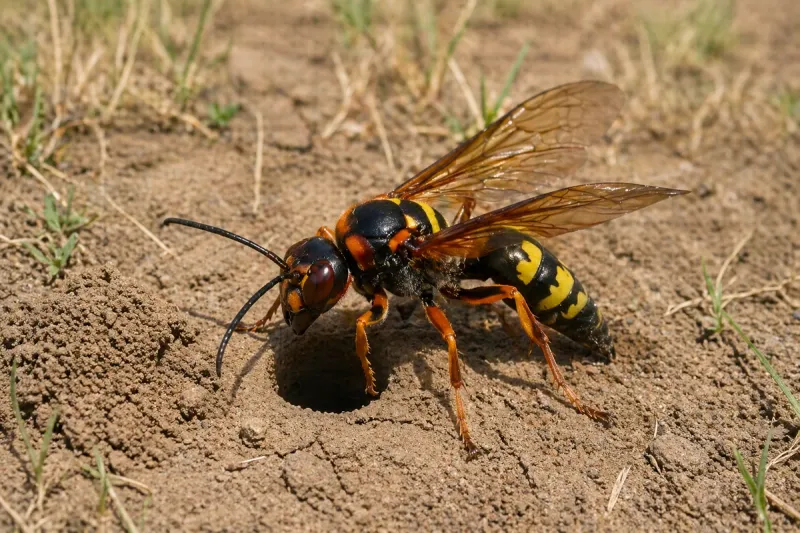
Every summer, Central Texas homeowners spot enormous wasps cruising low over their lawns and wonder whether something has gone seriously wrong. Those big flyers are most likely cicada killer wasps, a solitary species that shows up when a yard offers the right combination of sunlight, open soil, and nearby cicadas.
Understanding what they are, why they chose your yard, and how to respond calmly can save you a lot of unnecessary worry and a wasted trip to the garden center.
Those big lawn flyers may be cicada killers
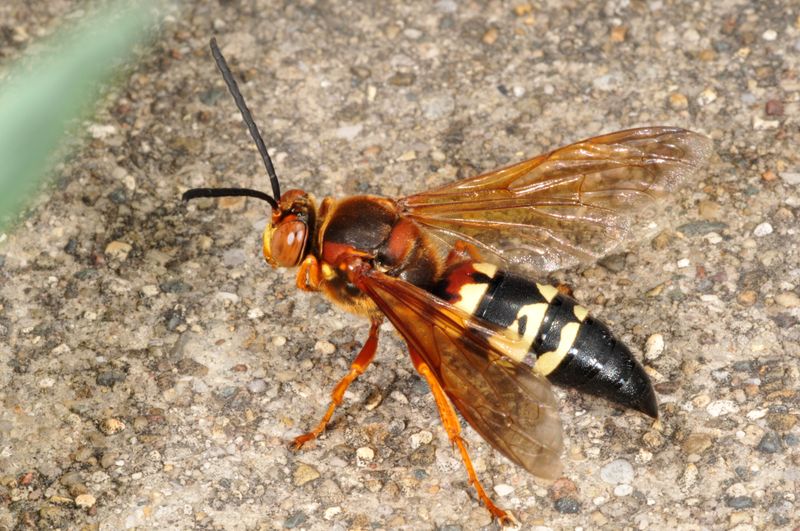
Spotting a wasp the size of your thumb hovering just above the grass is enough to make anyone back away fast. The insect most likely responsible for that Central Texas sighting is the eastern cicada killer, Sphecius speciosus, one of the largest wasps found across the region.
According to Texas A&M AgriLife Extension guidance on venomous Texas insects, adults typically measure roughly one to two inches in length, with females running larger than males.
The coloring is distinctive once you know what to look for. The head and thorax tend to be reddish or rust-colored, the wings carry an amber or russet tint, and the abdomen is black with pale yellow or cream-colored bands.
Soil mounds and individual round openings may appear in nearby exposed ground, often with a small fan of loose dirt pushed out from the entrance.
That said, “big wasp in my yard” is not a guaranteed identification by itself. Tarantula hawks, European hornets, and a few other species share a similar body plan and can draw the same alarmed reaction from homeowners.
A clear, close photograph or an actual specimen may be needed to confirm the species with confidence. The Oklahoma State University Extension cicada killer guide notes that this species is among the largest wasps in North America, which makes the initial sighting feel more dramatic than the actual risk usually warrants.
Replacing a vague fear of a “giant killer wasp” with a qualified identification is the first step toward a practical response.
The apparent swarm is actually a collection of solitary nests
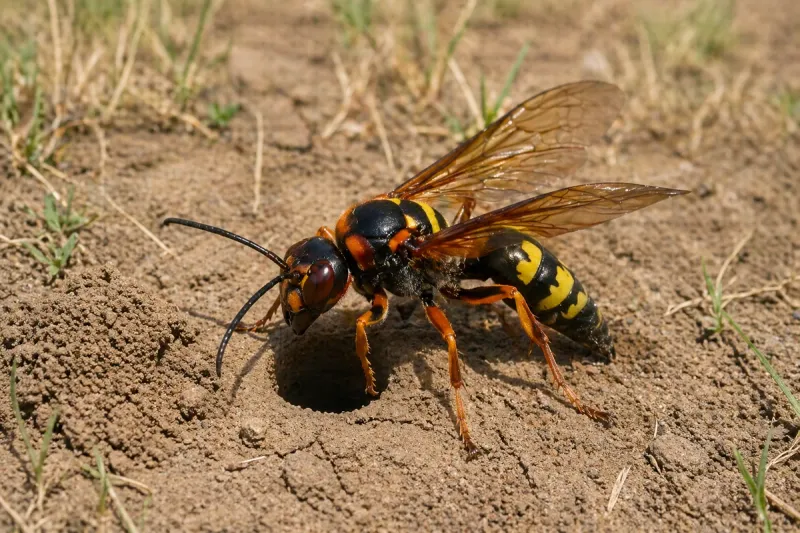
A yard with a dozen wasps zigzagging in different directions can look exactly like a colony under attack mode. The reality is far less coordinated.
Cicada killers are solitary wasps, meaning each female builds and provisions her own nest without any help from workers or direction from a queen. Penn State Extension’s cicada killer overview explains that when many females choose the same favorable patch of soil, the result resembles a colony from a distance, but there is no shared brood chamber and no collective defense system.
Much of the intimidating flight activity visible over a lawn actually comes from males. Male cicada killers patrol territories aggressively, hovering near people, chasing other insects, and occasionally flying straight at a person’s face.
That behavior can feel threatening, but males have no stinger. They are physically incapable of delivering a sting.
Purdue University Extension’s cicada killer publication confirms that the dive-bombing patrol is territory defense and mate-seeking behavior, not a coordinated attack on the homeowner.
The practical distinction matters because it changes how you read the yard. A group of males performing aerial acrobatics near the lawn surface is very different from a colony of social wasps defending a central nest with hundreds of workers.
Yellowjackets and hornets operate with that colony-defense instinct and will mobilize quickly if their nest is disturbed. Cicada killers do not share that structure.
Understanding that the “swarm” is really a loose collection of independent nesters gives you a more accurate picture of what you are actually dealing with.
What the lawn reveals is a nesting condition, not a soil diagnosis
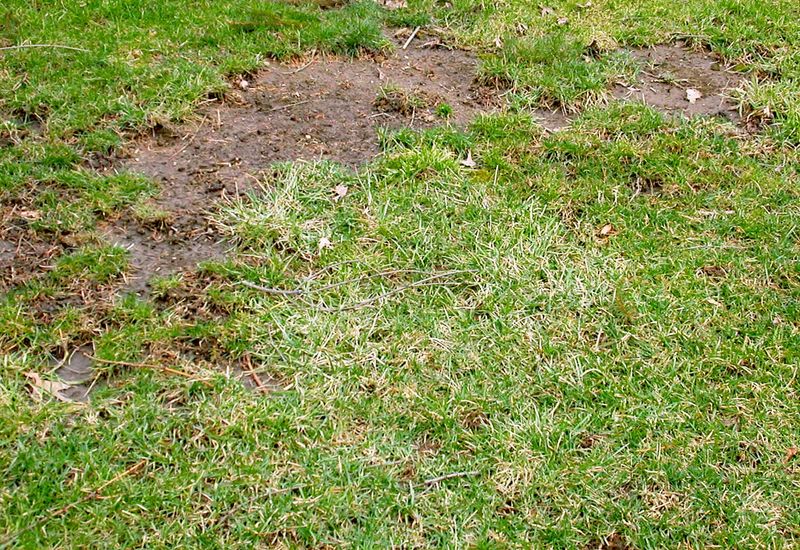
Seeing cicada killers in a yard raises a natural question: does this mean something is wrong with the soil? The short answer is that their presence points to a nesting condition, not a soil-health verdict.
Penn State Extension’s research on cicada killer nesting habits identifies the key attractants as sunlight, loose or light-textured soil, good drainage, and sparse vegetation cover. A site that checks those boxes is simply a convenient place to dig a burrow.
That can mean exposed soil around thin turf, sandy patches near ornamental beds, bare ground beneath trees, or any area where foot traffic or shade has thinned the grass enough to leave open soil. None of those conditions translates directly into a statement about soil fertility, biological quality, or contamination.
A yard with rich, productive soil can still have thin turf in a sunny corner, and a yard with depleted soil may have dense enough groundcover to discourage nesting entirely.
The boundary around the evidence is firm. Wasp activity does not confirm that the soil is fertile.
It also does not confirm that the soil is poor, compacted, or in need of amendment. The only things it reliably signals are texture, drainage, sun exposure, and the amount of vegetation covering the surface at that location.
Homeowners who want a real picture of soil quality should run a soil test through a county extension office and observe how water moves through the site after rain. Those tools give actual data.
Watching where a wasp lands gives you information about nesting preference, which is a much narrower and more specific thing.
Cicadas explain the summer mission, not a lawn infestation
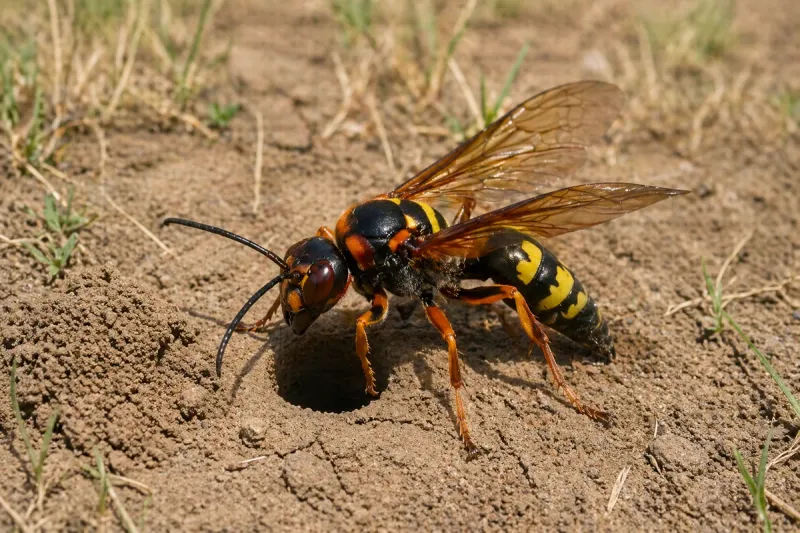
Once a female cicada killer has dug her burrow, her main job is provisioning it with food for her offspring. She hunts cicadas, paralyzes them with a sting, then carries or drags them underground into individual chambers.
Each chamber receives one or more paralyzed cicadas, and a single egg is laid on the prey before the chamber is sealed. The larvae hatch and feed on the stored cicadas while they develop.
Oklahoma State University Extension’s turfgrass cicada killer resource notes that adults themselves feed on nectar and plant fluids, not on turfgrass tissue.
That last point is worth holding onto: cicada killers do not chew, clip, or feed on lawn grass at any life stage. The localized mounds of loose soil pushed up around burrow entrances can smother small areas of turf or create an uneven surface, and that is a real aesthetic inconvenience.
But the wasps themselves are not turf-feeding insects, and their presence is not the same as a chinch bug infestation or grub problem that directly damages grass roots.
Their appearance in summer also does not mean cicadas are unusually abundant that year. Cicadas are part of the food supply, but the number of nesting wasps in a yard depends at least as much on available nesting sites and the wasps’ own reproductive cycle as on cicada population levels.
Adult activity is concentrated during the warm season, with peak visibility typically falling in midsummer, but the exact timing shifts from year to year depending on local temperatures and conditions. Activity normally winds down after breeding and provisioning are complete, so the season has a natural endpoint even without any intervention.
Most homeowners can give them space and keep using the yard
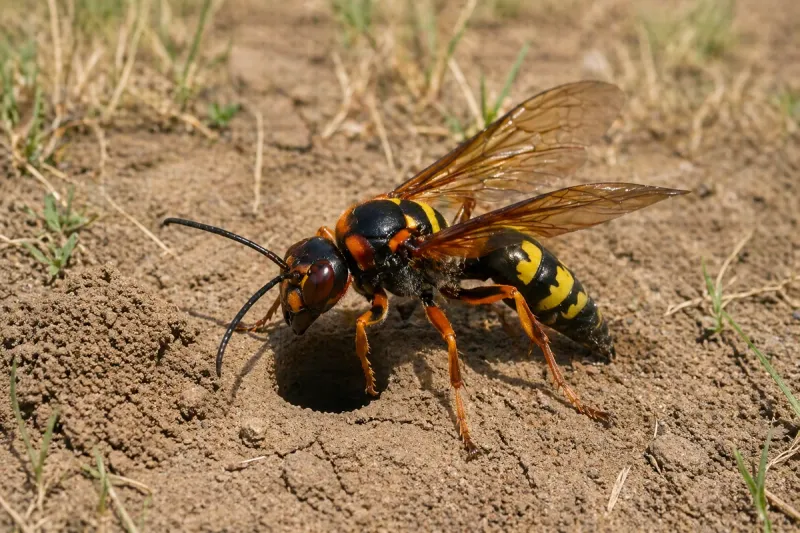
Knowing what the wasps are doing makes the behavioral guidance much easier to follow. The most important rules are straightforward: do not grab or handle females, do not block active burrow openings, do not swat at wasps in flight, and avoid walking barefoot through an area where nesting is concentrated.
Texas A&M AgriLife Extension’s venomous animals guidance recommends moving away calmly when a wasp hovers nearby rather than reacting with sudden movement.
That calm-exit advice matters more than it might seem. A person startled by a hovering male may swat, lurch, or step backward into a nesting area, accidentally encountering a female in the process.
Purdue Extension’s cicada killer fact sheet points out that the male’s intimidating flight pattern leads people to react abruptly, and those abrupt reactions carry more risk than the male’s actual behavior does, since he cannot sting.
Females can sting, and that distinction deserves a clear statement rather than a footnote. The sting is generally described as painful.
Females rarely sting unless they are handled, stepped on, trapped, or otherwise directly provoked, but “rarely” is not the same as “never.” Coexistence is the practical default when nesting is located away from spots people use constantly, such as a back corner of the yard or a sunny bed along the fence line. When the burrows are concentrated somewhere that cannot be avoided, the calculus shifts, and that is the subject of the next section.
Management makes sense when nesting creates a real conflict
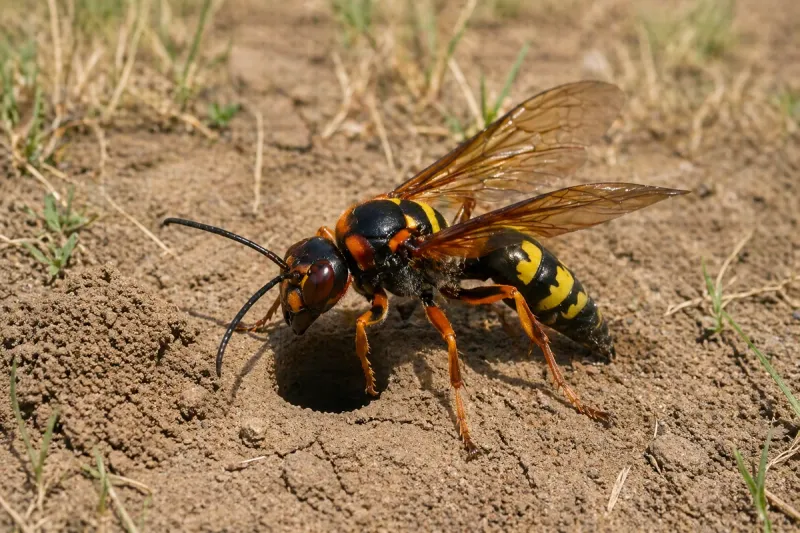
Tolerance is the right starting point, but it is not the only option. Concentrated burrows beside a doorway, patio, pool, play area, or frequently used walkway create a genuine conflict because people and pets cannot realistically avoid the nesting zone.
Soil mounds near a fragile surface, such as a decomposed granite path or a sand-based play surface, can also cause enough disruption to justify action. And any household with a member who carries a prescription epinephrine auto-injector for insect venom allergy should take that factor seriously when deciding how much proximity is acceptable.
For future seasons, University of Kentucky Entomology’s cicada killer fact sheet describes site modification as the most durable approach. Improving turf density, reducing exposed bare soil, adding an appropriate mulch or groundcover layer, and altering shade or moisture conditions in a problem area may make that spot less attractive to nesting females in subsequent years.
These measures can shift where wasps choose to nest; they are not guaranteed to eliminate activity from a property, and they will not end the current season’s nesting once it is underway.
When pesticide treatment is unavoidable, Penn State Extension’s guidance on cicada killers favors targeted application at individual burrow openings rather than broadcast treatment across the entire lawn. UC IPM’s lawn insect management resource reinforces that indiscriminate spraying is generally unnecessary for a solitary wasp that does not damage turf and can harm non-target insects.
Any product used must currently be labeled for the specific site and pest, and the label is the legal document governing application rate, timing, and method. Older publications referencing specific chemical names and rates, including some legacy Texas recommendations, may describe products or uses that are no longer registered.
Consult a currently labeled product or a licensed pest management professional rather than following outdated instructions. The Texas A&M AgriLife ornamental and lawn pest control bulletin is one resource to check for current regional guidance, keeping in mind that registrations change and the label always takes precedence.
A sting changes the response from yard management to medical safety
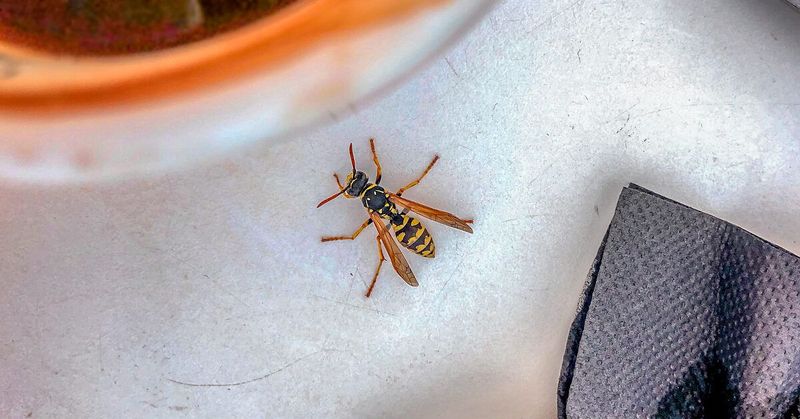
A sting from a female cicada killer calls for a different kind of response than the general yard-management advice covered so far. For a mild local reaction, the steps are straightforward: move away from the area to avoid additional stings, wash the sting site with soap and water, and apply a cold pack wrapped in a cloth to reduce pain and swelling.
Mayo Clinic’s insect sting first aid guidance supports this approach for localized reactions and notes that over-the-counter pain relievers and antihistamines may help manage discomfort.
Certain symptoms after a sting require emergency care, not home treatment. Call 911 or get to an emergency room immediately if you or someone nearby experiences trouble breathing, swelling of the throat or face, dizziness, fainting, widespread hives, or a rapid drop in alertness.
These are signs of anaphylaxis, a potentially life-threatening allergic response that can develop quickly. Texas A&M AgriLife’s venomous animals resource emphasizes that individual reactions to insect venom vary and that a severe response can occur even in someone without a prior history of serious allergy.
Anyone in the household with a known venom allergy and a prescribed epinephrine auto-injector should follow their emergency action plan, use the auto-injector as directed, and seek emergency care even if symptoms seem to improve after the injection. The sting itself is rare under normal yard conditions, but when it happens, the response should be medical rather than a return to mound inspection or pest identification.
Read the site, not the soil’s health
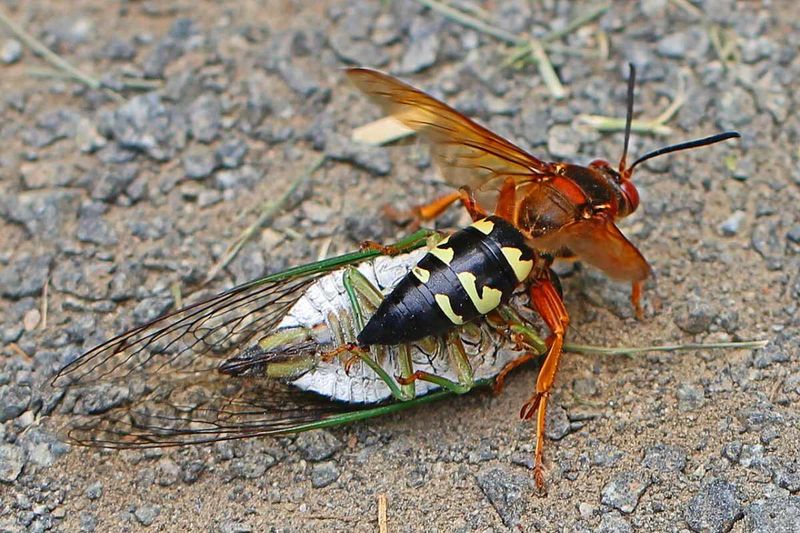
Large, low-flying wasps appearing over a Central Texas lawn during summer are most likely there because the yard offers sunlight, exposed or well-drained soil, and access to cicadas nearby. That combination describes a nesting opportunity, not a fertility report.
Texas A&M AgriLife, Penn State Extension, and Oklahoma State University Extension all frame the sighting as a site-condition signal rather than evidence of broad soil problems or a call for lawn-wide pesticide treatment.
The practical sequence is simple. Identify the wasps carefully before assuming the worst.
Give them space, especially in areas away from regular foot traffic. Check whether the nesting location creates a real safety or surface conflict, and choose targeted action only when it does.
A yard that hosts cicada killers for a season is telling you something specific about one corner of its soil, not issuing a distress call about the whole lawn.