
Finding a brightly colored, spiny caterpillar on your backyard shrubs can stop a gardening session cold, especially when you are not sure what you are looking at. Late summer and fall bring more caterpillar activity to Central Texas yards, and some of those visitors can deliver a genuinely painful sting.
Knowing how to recognize a possible saddleback caterpillar, keep your family safe, and respond if someone gets stung will make a real difference the next time you spot something unusual on your ornamental plants.
A possible saddleback has a distinctive but not conclusive pattern
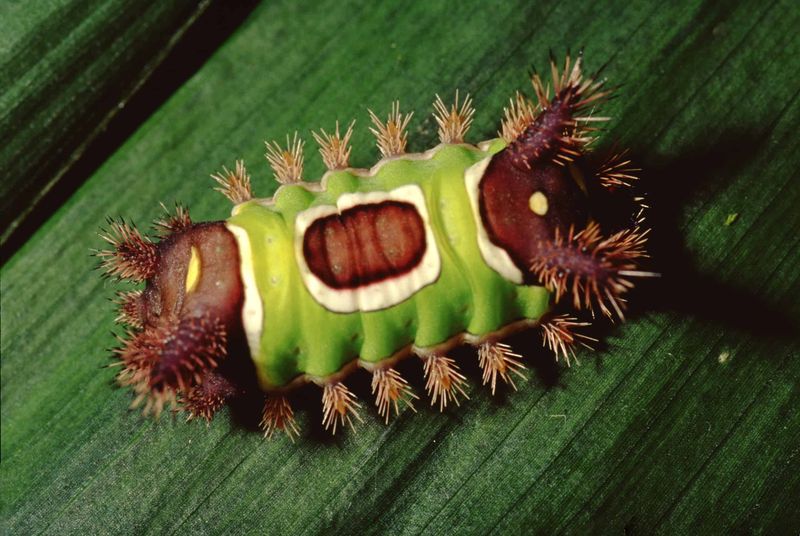
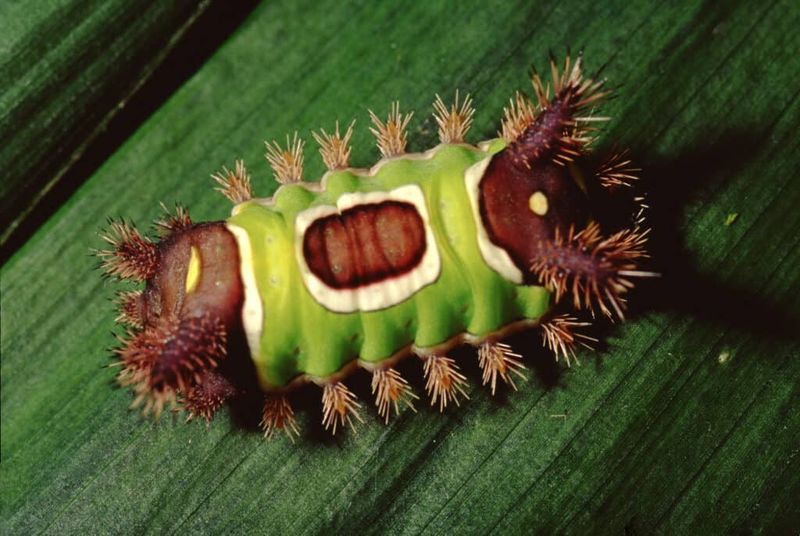
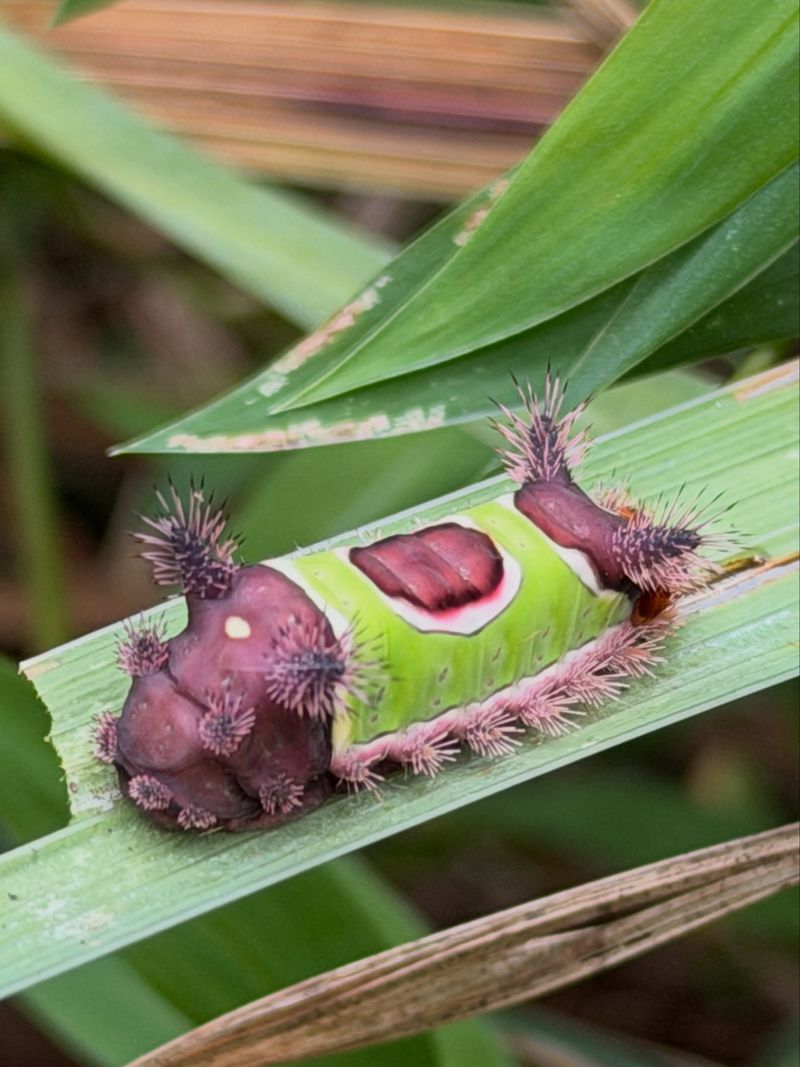
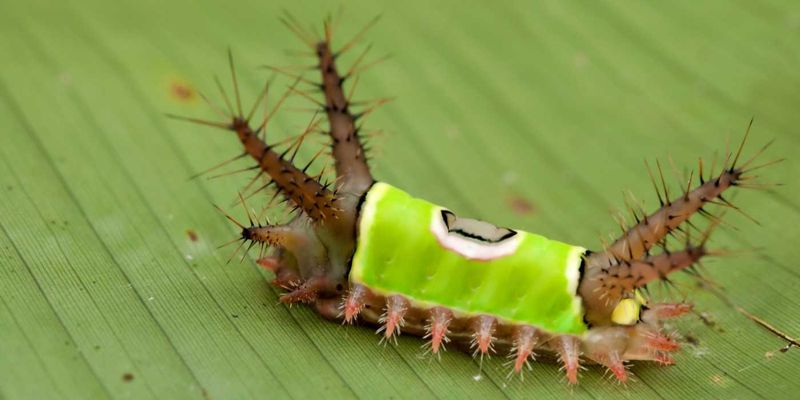
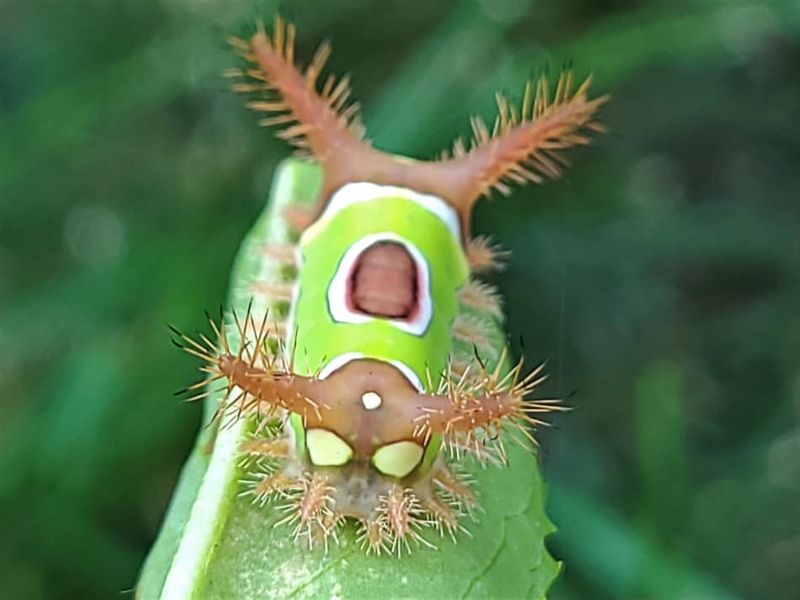
Mature saddleback caterpillars are sluglike and roughly three-quarters to one inch long. UF/IFAS Extension’s saddleback caterpillar fact sheet describes them as having brown front and rear sections, a green central area, and a brown oval marking bordered in white that resembles a saddle sitting on the caterpillar’s back.
Prominent tubercles, or fleshy projections, grow at the front and rear and along the sides, and these structures are armed with hollow, breakable spines connected to venom glands.
Contact with those spines delivers a sting, not a bite. The spines can break off and stay embedded in skin even after the caterpillar moves on, which is one reason why handling or brushing them off with a bare hand is a bad idea from the start.
The current accepted scientific name is Acharia stimulea. Older Texas extension materials and field guides sometimes use Sibine stimulea, which is a former synonym still in circulation, so do not be surprised if you see both names while searching for information.
Spotting this caterpillar in late summer or fall is plausible. BugGuide’s species account for Acharia stimulea and related sources note activity ranging from July through October, but timing shifts with local climate, so fall sightings are possible rather than guaranteed in any given year.
The visual pattern is a helpful starting point, but it cannot confirm the species on its own. Saddlebacks feed on a wide range of host plants, including oak, maple, elm, holly, viburnum, hibiscus, crape myrtle, pecan, citrus, rose, and many others, so the shrub type alone tells you very little.
Photograph the caterpillar from a safe distance or submit the photo to a local extension office or a verified identification platform before drawing any firm conclusions.
Central Texas has other stinging caterpillars
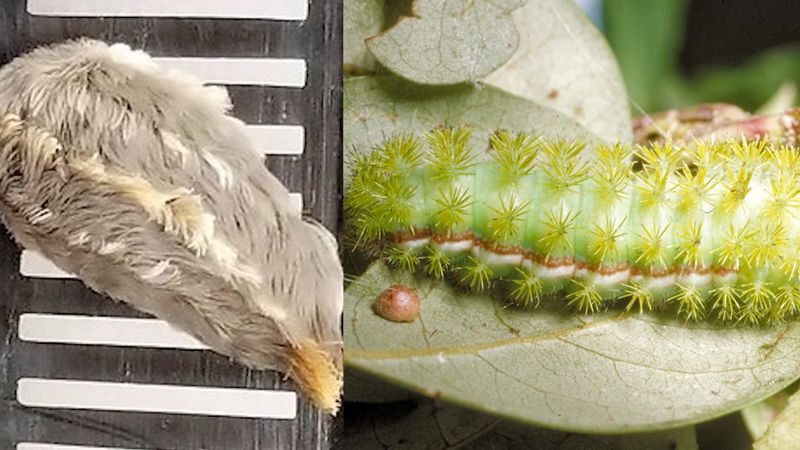
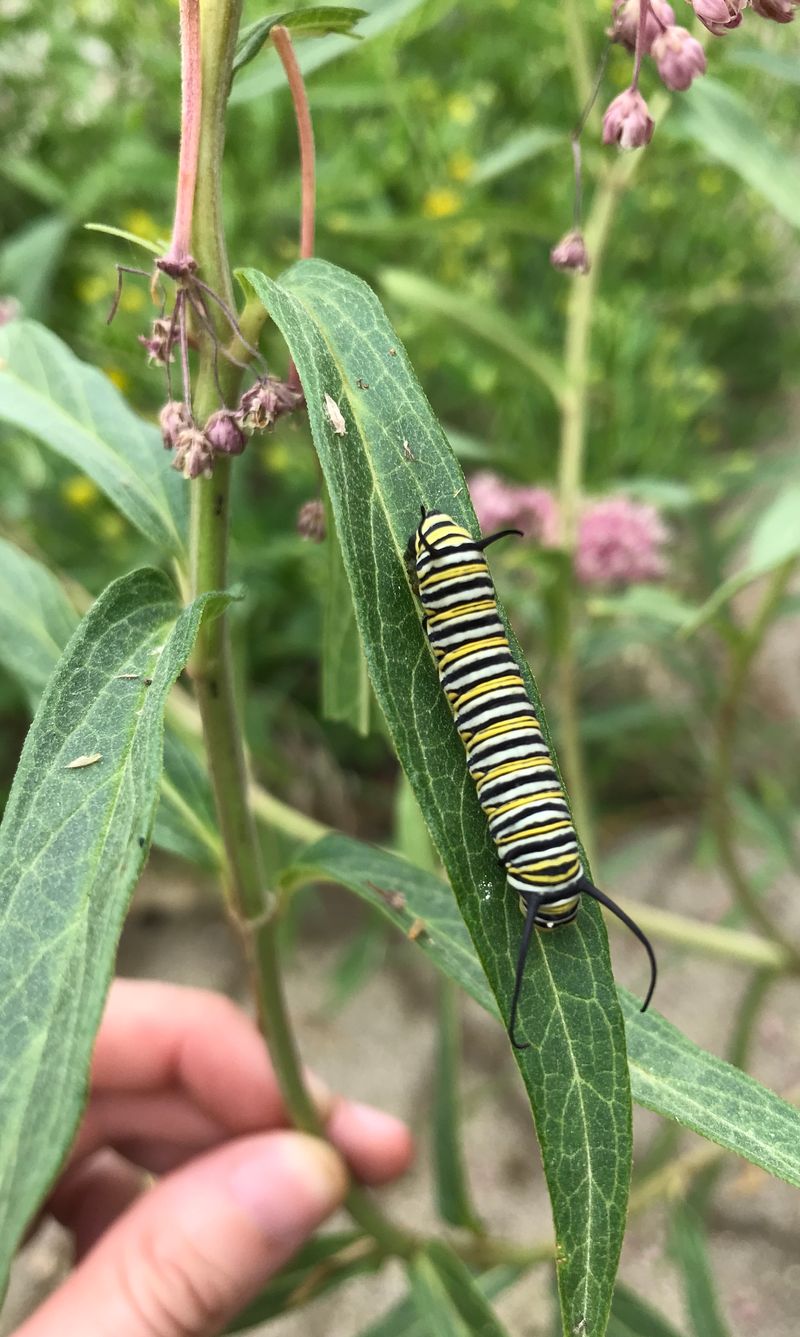
Before treating any spiny caterpillar as a confirmed saddleback, consider that Central Texas is home to several other species capable of causing painful contact reactions. Texas A&M AgriLife Extension’s horticulture newsletter specifically highlights the asp, also called the southern flannel moth caterpillar, as perhaps the most common stinging caterpillar in Texas, and describes it as capable of producing severe reactions in some individuals.
Io moth caterpillars are bright green with red and white side stripes and clusters of branching spines that can cause skin irritation on contact. Buck moth caterpillars are dark-colored with branching spiny tubercles and tend to move in groups on oak trees, which means an encounter can involve multiple larvae at once.
The practical takeaway is straightforward: an unfamiliar caterpillar with spines, bristles, or unusual coloring should be treated as a potential contact hazard regardless of whether it matches the saddleback pattern. Williamson County AgriLife Extension’s guide to stinging caterpillars reinforces this point, noting that several Texas species can cause reactions and that none should be handled without protection.
Resist the urge to pick it up for a closer look, even if you are fairly confident about the species. Keeping your distance until you have a reliable identification protects you whether the caterpillar turns out to be a saddleback, an asp, or something else entirely.
Stop work and create a no-touch zone
The moment you spot an unfamiliar spiny caterpillar, set down whatever tool you are holding and step back. Stop any pruning, hand-weeding, or foliage-handling immediately, because disturbing nearby leaves can bring you into accidental contact with a larva you have not yet seen.
Children and pets should be steered away from the affected shrub right away. Curious kids and dogs are especially likely to touch or mouth a brightly colored caterpillar, and a sting on the face or inside the mouth adds complications that a hand sting does not.
A temporary physical barrier, such as a tomato cage or a few garden stakes with flagging tape, can mark the area clearly while you decide on next steps.
If yard work around that shrub genuinely cannot wait, Poison Control’s guidance on caterpillar stings and Texas A&M AgriLife Extension’s stinging caterpillar guidance both support wearing gloves, long sleeves, long pants, a hat, and eye protection to reduce skin and eye exposure. Protective clothing lowers your risk during nearby tasks, but it is not a reason to handle the caterpillar directly or to push through foliage where larvae may be resting.
A solitary caterpillar sitting on a shrub away from foot traffic and play areas does not require immediate action. Leaving it alone while you gather information is a completely reasonable first response, and it avoids the contact risk that comes with any attempt at removal.
Use distance and a long-handled tool if removal is necessary
Sometimes leaving the caterpillar alone is not practical. A larva on a shrub beside the front walkway, in a children’s play area, or near a spot where pets rest regularly creates a genuine contact risk that warrants action.
Williamson County AgriLife Extension and UGA Cooperative Extension’s guide to stinging and biting pests both support using a long-handled tool, such as a stick, trowel, or folded cardboard, to relocate the caterpillar without any skin contact. Wearing full protective clothing during this process adds a layer of insurance, but the goal is always to keep your body as far from the larva as possible, not to get close enough to grab it.
Do not crush, swat, or sweep the caterpillar with an unprotected hand. The spines can break off during that kind of contact and embed in your skin just as effectively as a direct touch would.
Placing the caterpillar into a sealed container, such as a lidded jar or a zip-close bag, and disposing of it away from high-traffic areas is a clean solution that eliminates the hazard without creating a new one.
Dead or apparently motionless caterpillars deserve the same caution. Spines remain capable of causing painful contact after the larva has died, and a caterpillar that looks still may simply be resting.
Treat any fallen larvae on the soil beneath the shrub the same way: use a tool, not your fingers. Protective gear makes the task safer, but it does not make direct handling an acceptable option.
Remove spines with tape and watch for emergency symptoms
If contact happens, resist the urge to rub or scratch the affected area. Rubbing drives broken spines deeper into the skin and spreads any venom already released.
Instead, press a piece of fresh adhesive tape firmly over the area, then pull it straight off. Repeat with new pieces of tape until you have removed as many visible spines or hairs as possible.
After the tape step, wash the area gently with soap and water. Poison Control’s caterpillar sting guidance and MedlinePlus’s caterpillar article both describe applying a wrapped ice pack intermittently to ease discomfort.
A baking-soda paste or a labeled low-strength hydrocortisone cream may help with itching or irritation when appropriate for the person being treated, but these are comfort measures, not substitutes for medical care when symptoms are serious.
Call Poison Help at 1-800-222-1222 for case-specific advice. The specialists there can help you assess severity and decide whether a clinic visit is necessary based on the actual situation.
Certain symptoms require urgent medical attention and should not be managed at home. Flush eye exposure immediately with plenty of clean water and get medical help right away.
CDC reporting on caterpillar-associated reactions and Poison Control guidance both identify the following as reasons to seek urgent care: breathing difficulty or wheezing, trouble swallowing, swelling of the face or mouth, faintness, widespread hives, severe or persistent pain, or significant blistering. These symptoms can signal a serious allergic or respiratory reaction that home care cannot address.
One caterpillar usually does not justify spraying
Once the immediate safety concern is handled, the question shifts to whether the shrub itself needs treatment. For most homeowners, the honest answer is probably not, at least not right away.
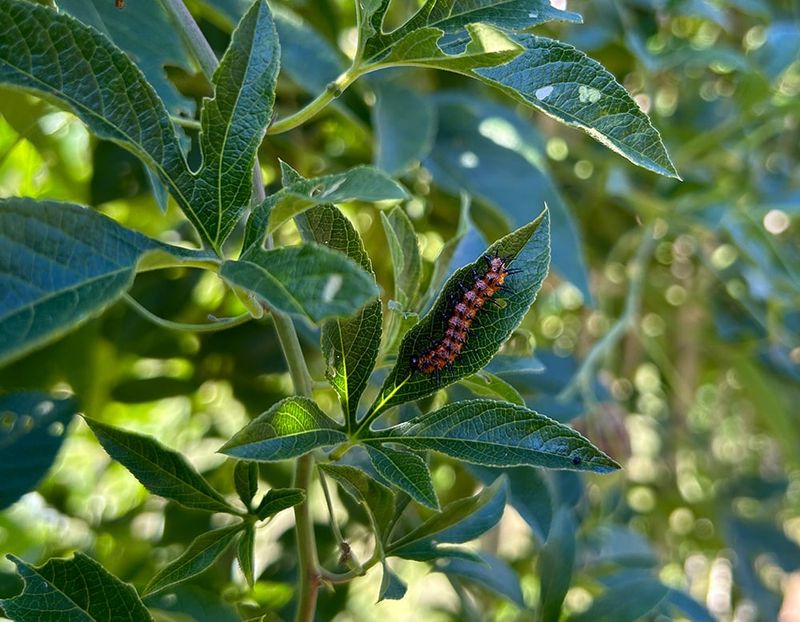
LSU AgCenter’s saddleback caterpillar profile and UF/IFAS Extension’s species fact sheet both note that saddlebacks are generally solitary and are not considered serious defoliators. An established ornamental shrub can typically tolerate the feeding damage from one or a few caterpillars without lasting harm, and the larva will eventually pupate and move on.
The calculus changes when caterpillars are concentrated in a spot where children or pets spend time regularly, or when feeding damage is heavy enough to threaten the plant. In those situations, a targeted response may be reasonable.
UGA Cooperative Extension’s guide to stinging and biting pests recommends using only a pesticide with a label that specifically covers the plant and pest combination you are dealing with, and applying it exactly according to that label. No pesticide should be applied broadly or preventively just because one caterpillar was spotted.
Unnecessary spraying carries real costs. Pesticides can harm beneficial insects, pollinators, birds, and other wildlife that share the yard.
Fort Bend AgriLife Extension’s coverage of caterpillar management underscores this point in the context of yard pest control. After any pesticide application, do not handle caterpillar remains or treated foliage without protective gear, because spines can still cause contact reactions after treatment.
Distance comes before identification
Every part of the response described in this article flows from one starting position: step back and keep people and pets away before doing anything else. Identification, removal decisions, and treatment choices all follow from that first move.
A caterpillar that matches the saddleback pattern deserves calm attention, not panic. Photograph it from a safe distance, leave a solitary individual alone when the location allows it, and reach for a long-handled tool and physical barrier only when removal is genuinely necessary.
Match first aid to the actual symptoms rather than the worst-case scenario, and call Poison Help at 1-800-222-1222 when you are unsure how serious a reaction is.
Williamson County AgriLife Extension and Poison Control both point to the same core rule: do not touch an unfamiliar caterpillar. That single habit protects you whether the larva turns out to be a saddleback, an asp, an Io moth caterpillar, or any other Texas species.
The caterpillar’s identity matters less in the moment than the distance you keep from it.