
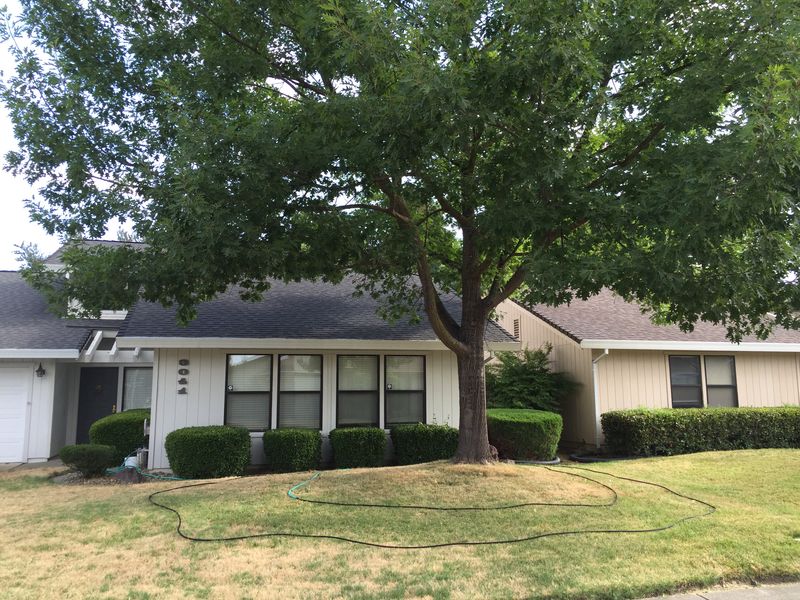
Late summer in California can be brutal on landscape trees, and the weeks before a heat spike are often the last clear chance to top off soil moisture before stress sets in. But not every tree in your yard needs a long drink right now, and watering the wrong ones at the wrong time can cause just as much harm as drought.
The smarter move is to check your local forecast, test the soil, and water only where it is genuinely needed, starting with the trees that can least afford to miss a cycle.
Let the forecast and soil decide whether a tree needs water
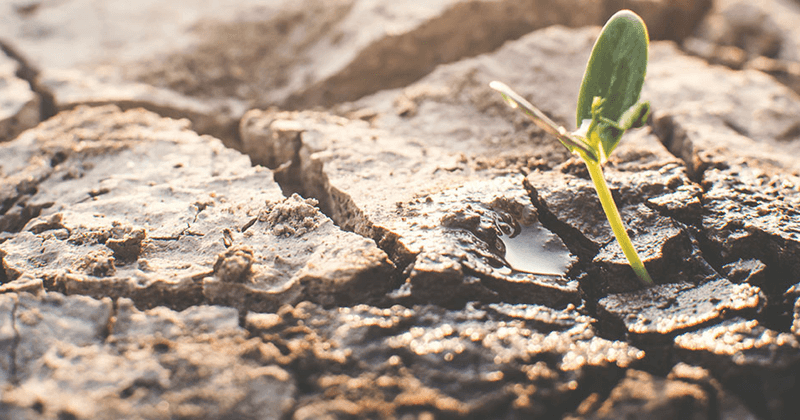
Watering decisions should follow your local forecast and what you find in the ground, not the calendar. California’s long, dry summer does push many landscape trees toward moisture stress, and hot, sunny, windy weather raises water demand considerably.
Pre-irrigating before a multi-day heat event can help maintain moisture in the active root zone, particularly when that zone is already becoming dry. But September does not flip a switch that makes deep watering urgent for every yard in the state.
California’s climates vary too much for a single statewide rule. A coastal garden in Half Moon Bay faces a very different September than a yard in Fresno or Palm Springs.
UC ANR monthly gardening guidance reflects those regional differences and consistently ties irrigation advice to local conditions rather than a fixed date. What matters is whether your specific trees are under stress, what your forecast shows for the coming days, and what the soil moisture tells you right now.
A practical starting point: check your local weather service for any forecast calling for several consecutive days of high heat. For Central Valley homeowners, UC ANR recommends beginning deep irrigation at least one day before a forecast multi-day event above roughly 95 to 100 degrees Fahrenheit.
That is a regional example, not a universal California threshold. Coastal gardeners may rarely see those temperatures, while high-desert yards might exceed them regularly.
Before you move any hose or adjust any timer, also check your local water agency’s current restrictions. California Water Watch provides statewide water-condition information, but it does not replace your city’s or water supplier’s specific watering ordinance.
Combine your forecast, a quick soil check, your tree’s condition, and your local rules, and let those four factors together drive the decision.
Prioritize trees that cannot tolerate missed moisture
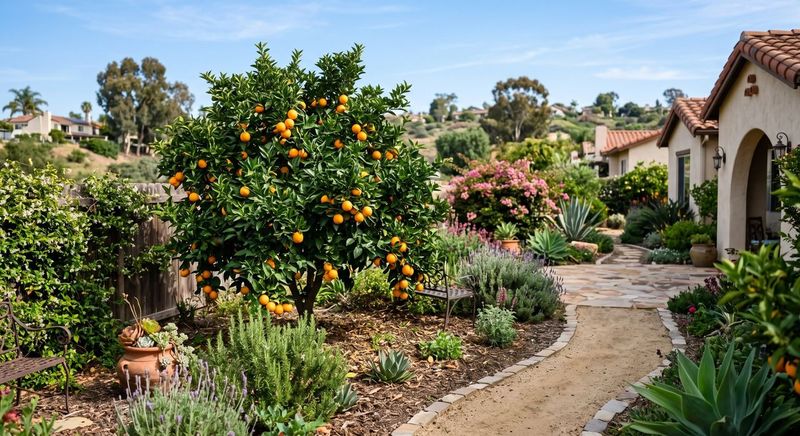
When water is limited and heat is building, the most useful question is not “do I need to water my trees” but “which trees can least afford to skip a cycle right now.” Some trees have a genuine cushion built up through years of deep rooting and drought adaptation. Others are barely holding on, and a missed irrigation before a heat spike can tip them into decline that shows up weeks or months later.
Young and recently planted trees are the highest-priority group. UC ANR’s landscape tree irrigation guidance notes that newly planted trees often have roots concentrated largely within the original root ball during the establishment period.
The surrounding soil can appear moist while that smaller volume dries out quickly, so these trees need more frequent monitoring and irrigation than established trees, regardless of species.
Citrus and other fruit trees also deserve close attention. Water stress during summer can affect fruit size, fruit retention, and overall production.
Trees growing in compacted soil or inside lawn areas face an added challenge: compaction limits water infiltration and root expansion, while lawn irrigation schedules are rarely calibrated for tree needs. UC ANR’s Fresno heat-spike guidance specifically calls out citrus and fruit trees as needing consistent summer moisture, with timing adjusted to soil moisture and weather rather than a fixed schedule.
Trees already showing signs of stress, such as wilting, yellowing, or sparse canopy, move up the priority list, though those symptoms alone do not confirm drought. Species that are poorly matched to California’s dry summer climate also need closer attention than well-adapted ornamentals.
On the other end of the spectrum, UC ANR water management guidance for home gardeners advises prioritizing trees over expendable annuals or dormant turf during drought, because trees take years to replace and provide shade, habitat, and other lasting benefits. Many established California natives adapted to dry summers, however, may need little or no supplemental summer water and can actually suffer from excess irrigation during their natural dry-season dormancy.
Those trees generally sit at the bottom of the priority list unless they were planted recently.
Probe the soil before turning on the irrigation
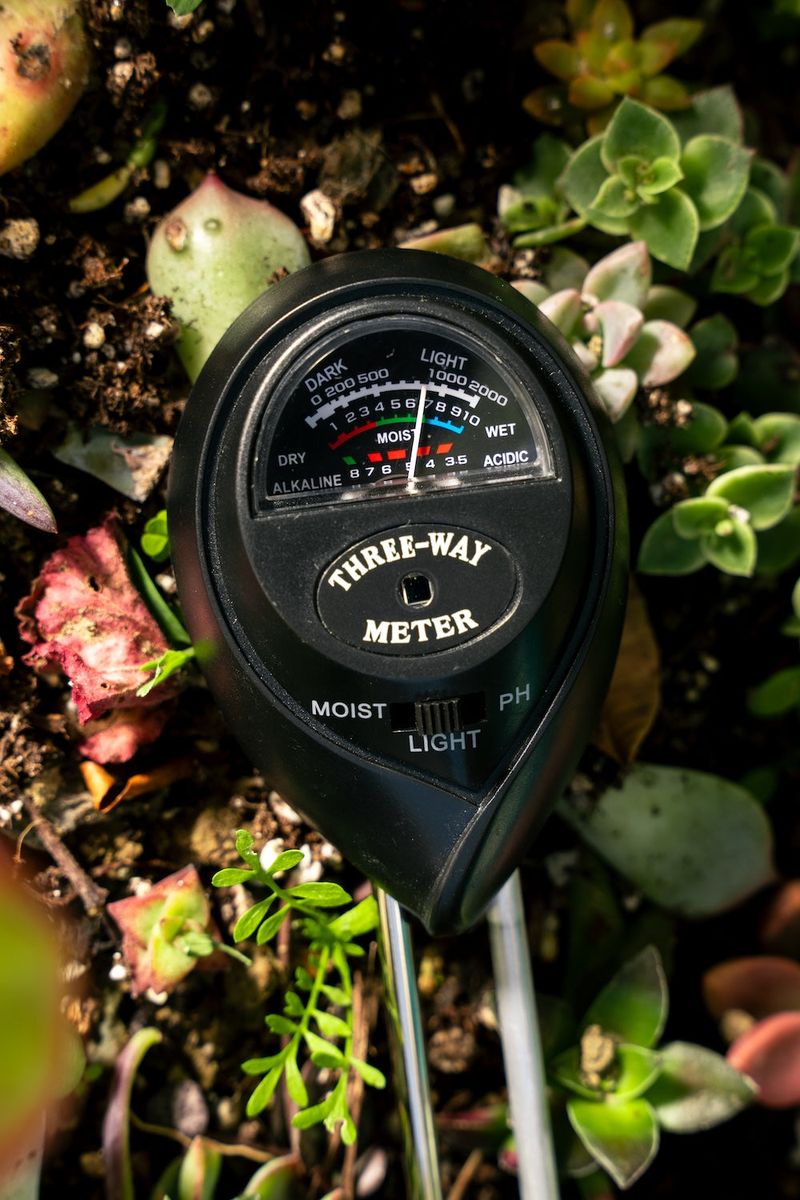
Turning on the irrigation without checking the soil first is a bit like refilling a glass without knowing whether it is already full. The only reliable way to know whether a tree needs water is to find out what the soil is actually doing at root depth, and that takes about two minutes with a tool most homeowners already own.
Push a screwdriver, metal rod, or soil probe into the ground at several spots beneath the canopy and farther out toward and beyond the drip line. Notice how easily it moves and whether the tip comes back moist or dry.
UC Marin Master Gardeners’ irrigation guidance recommends comparing moisture at roughly 6 to 12 inches and deeper in the root zone, using the probe at multiple locations rather than one spot. A single test near the trunk often misses the zone where most absorbing roots are actually active.
Think of those depths as observation points rather than fixed targets. Actual root distribution varies with species, soil texture, compaction, irrigation history, and site conditions.
UC IPM’s tree and shrub irrigation resource explains that many landscape-tree roots are concentrated in the upper soil profile and spread laterally, so probing only directly beside the trunk gives an incomplete picture.
Use the same probe after you irrigate to confirm that water actually penetrated to root depth rather than stopping at the surface or running off. Dry or hydrophobic soil can shed water initially, leaving deeper layers untouched even after a long run time.
One caution worth keeping in mind: wilting, yellowing, poor growth, and early leaf drop are not reliable indicators of drought on their own. UC ANR’s landscape tree irrigation overview points out that overwatering, poor drainage, and oxygen-starved roots can produce the same visible symptoms as underwatering.
Probe the soil and look for signs of excess moisture, such as algae, mushrooms, or standing water, before concluding that drought is the problem.
Spread water across the active root zone, not against the trunk
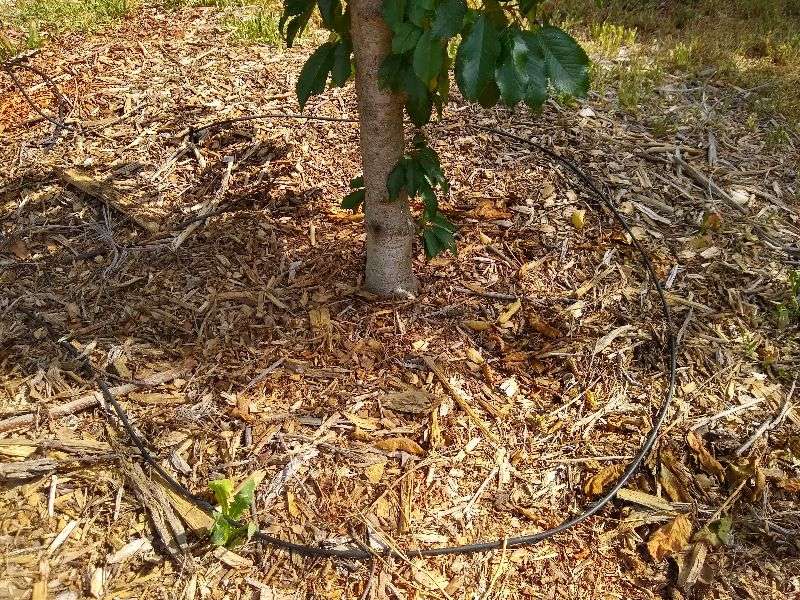
Where you put the water matters as much as how much you apply. Many homeowners instinctively water at the base of the trunk because that is where the tree visibly begins, but the roots that absorb moisture are rarely concentrated there.
For most broadleaf landscape trees, the most active absorbing roots spread laterally through the upper soil profile, often reaching to and beyond the drip line, which is the outer edge of the canopy.
UC ANR’s drought-priority tree guidance for Southern California recommends placing soaker hoses or drip tubing in broad rings from the mid-canopy area outward toward and slightly beyond the drip line for mature trees. Watering only at the trunk concentrates moisture in a zone where fewer absorbing roots are active and can promote rot or pest problems at the root flare.
Deep watering means slow, even wetting through the active root zone without creating runoff, pooling, or standing water. UC IPM’s irrigation guidance for trees and shrubs describes the goal as getting water to penetrate through the depth where absorbing roots are active, not simply saturating the surface.
Many landscape-tree roots are concentrated in the upper 1 to 3 feet of soil, though actual depth depends on species, soil conditions, compaction, and irrigation history.
How long to run the water is a question with no universal answer. Flow rate, soil texture, slope, compaction, root-zone depth, tree size, and existing moisture all affect how quickly water infiltrates and how far it travels.
University of Arizona Cooperative Extension guidance on watering trees and shrubs explicitly cautions against fixed-duration recommendations, noting that a two-hour run time may be appropriate for one setup and cause runoff or saturation in another. The probe test after irrigation, not a timer, tells you whether water reached root depth.
One additional note: palms are an exception to the broad-ring guidance described above. Their fibrous root systems are distributed differently from most broadleaf trees, so palm irrigation placement and frequency should follow species-specific recommendations rather than the lateral-root logic that applies to oaks, citrus, and ornamental shade trees.
Prepare the root zone before extreme heat arrives
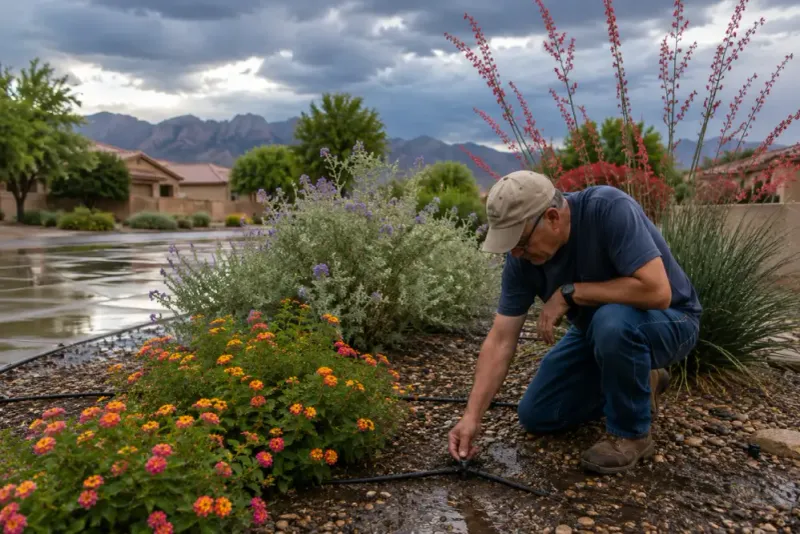
Timing matters more than most homeowners realize. Watering during the peak of a heat event is less effective than getting moisture into the root zone before the worst days hit, because soil needs time to distribute water evenly and roots need time to access it.
A tree drawing on adequately moist soil going into a heat spike handles the stress better than one that gets a large drink on day two of a triple-digit stretch.
For Central Valley homeowners facing a forecast of several consecutive days above roughly 95 to 100 degrees Fahrenheit, UC ANR recommends beginning deep irrigation at least one day before the event. Some UC Master Gardener sources suggest watering an extra day or two before forecast heat or wind.
Treat those as regional planning examples rather than a universal California rule. Check your own local forecast, confirm the root zone is actually dry, and irrigate early enough that water has time to infiltrate before temperatures climb.
Early morning, around dawn when practical, is the preferred window. UC IPM’s irrigation resource notes that morning application generally reduces evaporation and wind loss and limits the time foliage stays wet.
Drip or soaker systems outperform overhead sprinkling for most tree situations because they deliver water slowly and directly to the root zone with less waste.
Clay, compacted, or sloped sites often cannot absorb a large volume of water in a single pass. UC Master Gardeners of the Lake Tahoe Basin describe cycle-and-soak irrigation as a practical fix: run the water for a shorter period, pause long enough for it to infiltrate, then run again.
Multiple slow cycles allow water to move deeper without generating runoff or pooling on the surface. Severely dry or hydrophobic soil may need three or more cycles before moisture begins penetrating to root depth.
Mulch is a useful companion to pre-heat irrigation. UC ANR water-wise gardening guidance recommends applying a layer of mulch around the root zone to reduce evaporation and moderate soil temperature.
Keep mulch a few inches away from the trunk and root flare to avoid creating conditions that promote rot, bark damage, or pest activity.
Recognize when extra water could harm the tree
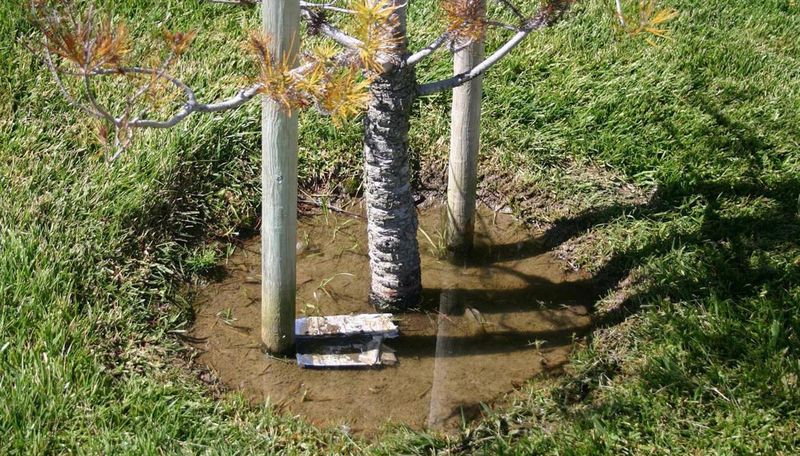
More water is not always the right response to heat stress, and some of the signs that prompt homeowners to irrigate are actually signs that the soil already has too much moisture. Saturated soil drives oxygen out of the root zone, and tree roots that cannot breathe begin to fail even when the ground looks wet.
Algae growing on the soil surface, mushrooms appearing around the base, poor drainage after irrigation, and leaves that are brittle but still green can all point toward excess water rather than drought.
UC ANR’s landscape tree irrigation overview warns that overwatering and underwatering can produce nearly identical visible symptoms, including yellowing, wilting, and leaf drop. Probing the soil, as described earlier, is the only reliable way to separate the two.
If the soil is already moist at root depth, hold off and recheck in a few days rather than adding more water automatically.
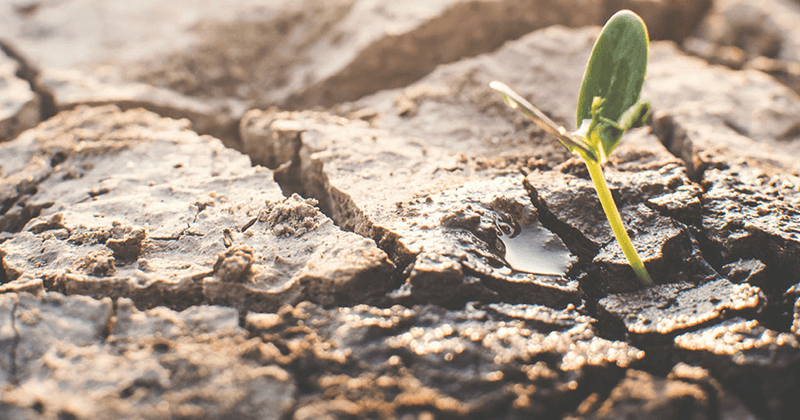
Severely dry soil presents its own challenge. Hydrophobic or very dry soil often repels water initially, so a heavy application runs off the surface or channels through cracks without reaching roots.
The cycle-and-soak approach described in the previous section applies here too: gradual rehydration through slow, repeated cycles is safer than a single long flood. UC Marin Master Gardeners’ irrigation guidance reinforces that the goal is even wetting through the root zone, not surface saturation or standing water.
Established California natives are a particularly important exception. Many species adapted to the state’s dry-summer Mediterranean climate can be harmed by frequent summer irrigation once they are established.
Watering them on the same schedule as a citrus or a recently planted ornamental can promote root rot and other disease problems. Newly planted natives, however, still need regular water through their establishment period, which can span one to three years depending on species and conditions.
University of Arizona Cooperative Extension guidance on drought and extreme heat flags palms again as a group that should not be irrigated on the same schedule or placement logic as broadleaf trees. For regional plant-water classifications that reflect California’s varied climates, the California Department of Water Resources directs homeowners to WUCOLS, a resource that categorizes plants by water need across different California regions.
Check your local water agency before changing your irrigation schedule, and use California Water Watch to stay informed about current statewide water conditions alongside your local ordinance.
Use a conditional checklist after the heat passes
Once a heat event passes, resist the impulse to either walk away or immediately add more water. The days after extreme heat are a good time to reassess, because some stress symptoms appear immediately while others develop over the following weeks or even into the next season.
Work through the process in order. Start with your local forecast and any current water restrictions, then identify which trees on your property fall into the high-priority groups: young or recently planted, fruiting, drought-stressed, growing in compacted or lawn soil, or poorly climate-matched.
Probe the soil at several locations beneath the canopy and beyond the drip line before making any irrigation decision. University of Arizona Cooperative Extension guidance on drought and heat responses notes that damage can be delayed, so a tree that looks acceptable immediately after a heat event may still show dieback in the weeks ahead.
If the root zone is dry, irrigate slowly and broadly across the active root zone, pause to allow infiltration, and probe again to confirm penetration. If the soil is already moist, hold off and recheck in a few days.
When symptoms appear after the heat, probe before adding water, because waterlogged roots and drought-stressed roots can look similar from the outside.
The goal throughout is adequate moisture in the root zone, not a saturated soil profile, a rigid weekly schedule, or a guarantee against heat injury. UC ANR’s heat-spike guidance frames pre-heat irrigation as a way to reduce drought stress going into extreme conditions, not as a complete shield against all forms of heat damage.
Trees that go into a heat event with adequate root-zone moisture simply have more to work with, and that advantage starts with checking the soil before you ever turn on the water.