
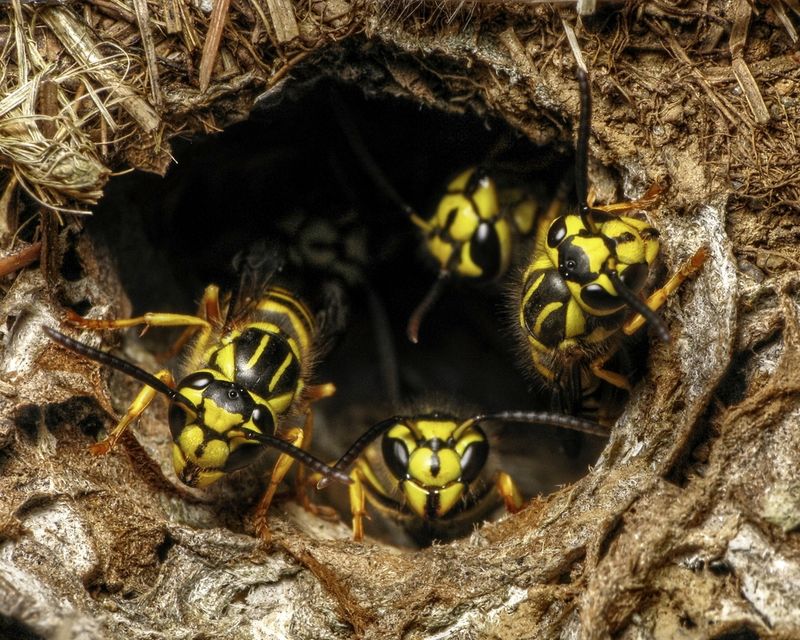
Late summer and early fall bring a hidden hazard to many North Carolina lawns: a possible underground yellowjacket colony tucked beneath the turf where you least expect it. One pass with the mower over the wrong patch of ground can disturb the colony and trigger a defensive response from dozens of workers at once.
Knowing where to look and what to watch for before you start the engine is the simplest way to protect yourself, your kids, and your pets from an unpleasant surprise.
A possible underground colony is the fall lawn hazard to watch for
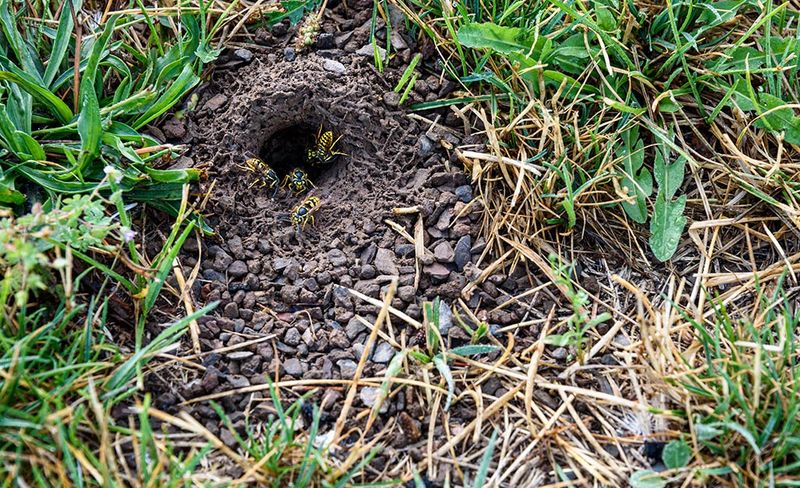
Underground yellowjacket colonies are a well-documented late-summer and early-fall lawn hazard in North Carolina, though that does not mean every yard has one right now. NC State Extension guidance on turf arthropod pests notes that yellowjackets commonly nest in lawns, in sandy or exposed soil, and at the bases of trees and shrubs, and that their activity and nuisance potential often become more pronounced as summer winds down.
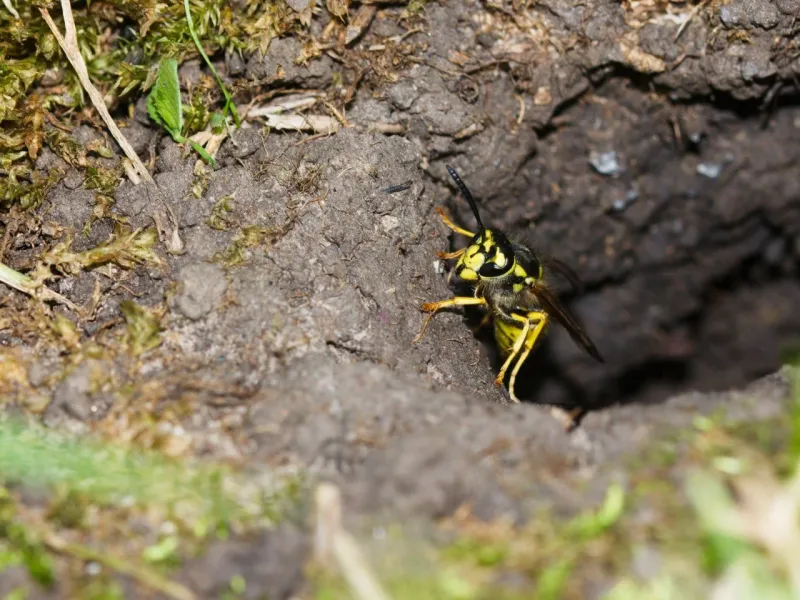
The colony itself can be several inches or more below the surface, leaving only a small entrance opening visible at ground level.
That concealment is what makes the hazard easy to miss. You may not see any sign of a nest until wasps are already flying, and the entrance hole can be partly hidden by grass, loose soil, or leaf debris.
The practical goal before mowing is not to find or confirm the nest below ground but to spot warning signs at the surface that suggest a colony may be present nearby.
Mower vibration can disturb an underground colony and may trigger defensive activity from the workers inside. Penn State Extension IPM guidance specifically identifies mowing during late summer, when colonies have grown large, as a period of elevated risk.
That does not mean every mower pass will set off every colony, but it does mean a quick pre-mow check of likely spots is worth the few minutes it takes.
Where to inspect before starting the mower
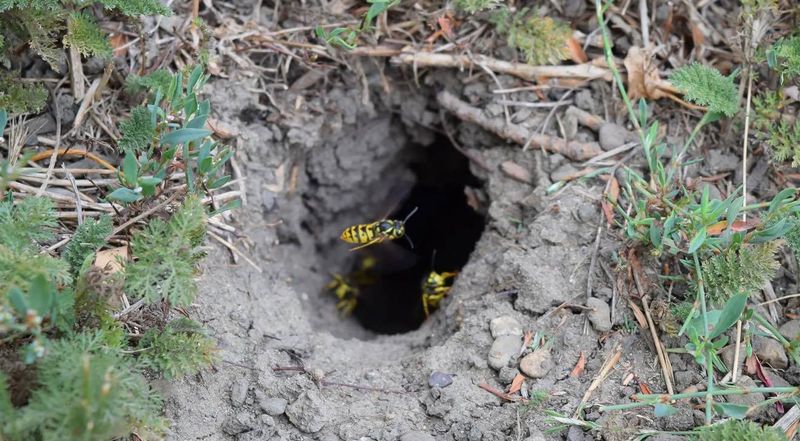
Rather than scanning the entire yard at once, focus your pre-mow walk on the spots where underground colonies are most likely to become established. NC State Extension points to exposed or sandy soil, thin turf, small cavities or abandoned animal burrows, pathway edges, and the bases of trees and shrubs as locations worth closer attention.
These are places where the ground already offers natural voids or softer soil that a colony can expand into.
Pay extra attention to sections of the yard where people and pets spend time regularly. A colony near a swing set, a garden path, a gate, or a frequently used side yard presents a higher risk than one tucked against a back fence that nobody walks near.
High-use areas are worth checking first and most carefully.
Move through the inspection at a calm, unhurried pace and keep a comfortable distance from anything that looks like a ground opening. The point is to observe, not to get close enough to peer into a hole.
Checking these locations does not guarantee you will find a colony, and not finding obvious activity in them does not guarantee the yard is clear. Think of it as a focused risk-reduction step rather than a complete survey.
Never disturb soil, kick a suspicious spot, or stick anything into a hole to investigate further.
Repeated traffic to one opening is the strongest visible clue
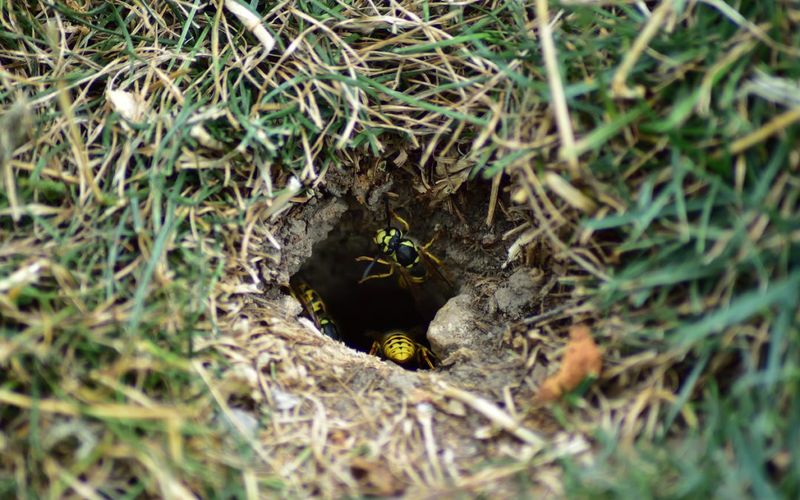
Once you have identified a spot worth watching, the most useful thing you can do is stand back at a safe distance and observe it for several minutes. What you are looking for is a pattern: yellowjackets repeatedly entering and leaving the same small opening in the ground.
That kind of steady, focused two-way traffic is a much stronger sign of a possible social colony than a single wasp passing through the area.
A lone yellowjacket foraging near flowers, a trash can, a fallen apple, or an outdoor drink does not tell you much about a nearby nest. Penn State Extension notes that foraging workers away from the colony are generally less defensive than workers actively guarding a nest entrance, so a single wasp in the garden is not the same signal as a busy ground entrance.
Keep the two situations separate in your mind.
NC State Extension describes an underground entrance of approximately half an inch as a useful identifying clue, but entrance size can vary and may be partly obscured by grass or debris, so hole diameter alone is not a reliable confirmation. If you spot what looks like a possible entrance, photograph it from where you are standing or place a visible marker nearby, like a stick or a small flag, so nobody accidentally walks up to it.
Do not approach the opening to measure it, look into it, or touch the surrounding soil.
Postpone mowing when activity suggests a colony
Turning observation into a concrete pre-mow routine is straightforward. Walk the property before each mowing session, starting with the areas that see the most foot traffic and the spots you identified during earlier inspections.
If you notice repeated yellowjacket activity at one ground opening, stop the inspection from that distance, do not go closer, and postpone mowing that section of the lawn until the situation is resolved.
Keep children and pets out of the area around a suspected entrance. Mark the location visibly from a distance so that no one accidentally wanders into it while you are figuring out next steps.
A simple stick, a lawn flag, or even a cone from the garage can serve that purpose without requiring you to get near the spot.
A quiet-looking entrance does not confirm the colony is gone. Penn State Extension guidance on stinging insects makes clear that colonies can be active even when surface traffic is temporarily low.
Penn State IPM guidance supports treating mower vibration as a possible disturbance mechanism regardless of what the entrance looks like at the moment you check. Never test a quiet hole by kicking it, probing it with a stick, flooding it with a hose, or driving the mower slowly over it to see what happens.
The colony below ground may be larger and more active than anything visible at the surface suggests, and disturbing it from any direction can provoke a defensive response quickly.
A ground hole does not confirm a yellowjacket nest
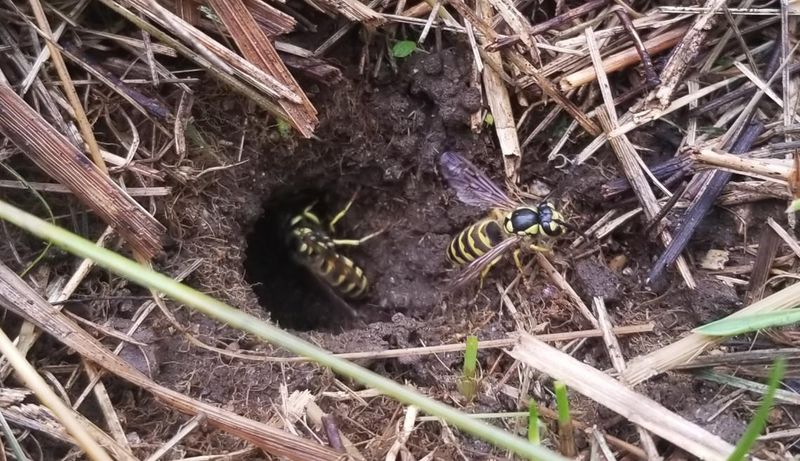
Seeing a hole in the lawn and a yellow-and-black insect nearby is not enough information to confirm a yellowjacket colony. North Carolina is home to multiple yellowjacket species and related social wasps, and a black-and-yellow insect near a ground opening could belong to any number of species.
NC State Extension’s guide to non-honey bee stinging insects notes this diversity and cautions against assuming a single sighting confirms an identification.
Solitary ground-nesting wasps are a common source of confusion. University of Minnesota Extension explains that solitary wasps may create clusters of individual nest holes in sandy or bare soil, with each hole belonging to a single female rather than a shared colony.
These wasps are generally not defensive about a central entrance the way social yellowjackets are, so the behavioral pattern at the hole matters as much as the hole itself. Scattered openings with individual insects coming and going on their own schedules look quite different from one busy entrance with many workers moving in and out together.
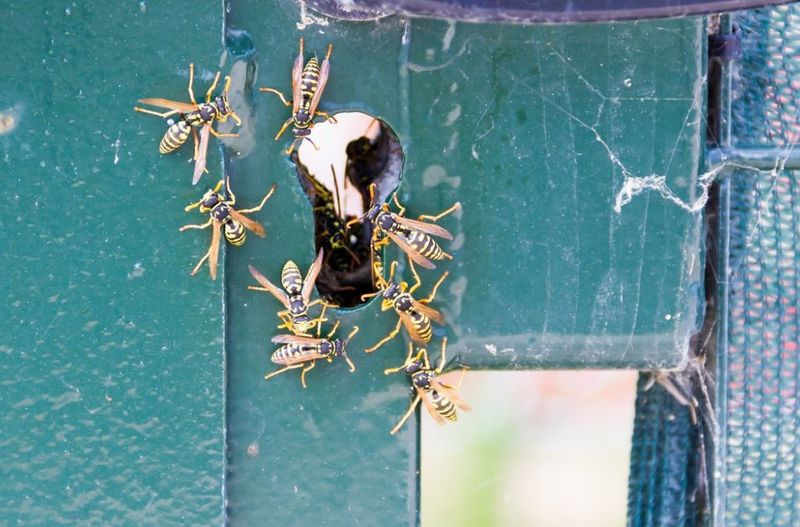
Not every yellowjacket nest is underground, either. Some yellowjacket species build paper nests in shrubs, under eaves, or inside wall voids and attics.
Underground nesting is a common lawn hazard, but it is not the only nesting pattern. Rodents, ants, and other insects also create ground openings that have nothing to do with wasps.
The combination of repeated two-way traffic by multiple insects at one consistent opening remains the most useful behavioral clue, and even then, the identification should stay cautious. Closer investigation to confirm the species is not worth the risk.
Decide whether to leave the colony alone or arrange control
Once you have observed what looks like a possible colony, the next decision depends on where the nest is located relative to daily life. An entrance tucked against a back fence line that no one walks near, with no children’s play equipment, paths, or doors within the colony’s defensive range, may be a reasonable candidate for leaving alone until cold weather.
Yellowjacket colonies are annual: the workers and queens produced during the season die off over winter, and the underground nest is not reused the following year. NC State Extension supports this wait-and-monitor approach for truly isolated colonies.
That option disappears when the suspected entrance is near a door, a play area, a heavily used path, a pet run, or a mowing route. In those situations, a mature fall colony presents a real short-term sting risk even though it will eventually die on its own.
A professional pest control service is the safest choice for anyone with a sting allergy in the household, for nests near buildings or high-use areas, or when the nest location is uncertain. University of Minnesota Extension recommends professional treatment for yellowjacket colonies that pose a genuine risk to people nearby.
If you choose to handle it yourself, use only a product whose current EPA-approved label specifically permits yellowjacket treatment at the intended site. EPA pesticide label guidance makes clear that the label is a legally controlling document that governs permitted sites, target pests, application timing, equipment, and required protective gear.
Many labels direct treatment during lower-activity periods like evening or early morning, but product directions differ, so read the current label for the specific product you have before doing anything.
Several approaches are not safe and should not be attempted. Penn State Extension warns against sealing the entrance of an active colony, which can force workers to find another exit, potentially into a living space.
NC State specifically cautions that pouring gasoline into a ground nest is extremely dangerous and environmentally damaging. Homemade mixtures and improvised application rates are similarly off the table.
Traps and cleanup of sugary attractants can reduce how many foraging workers visit your patio or trash area, but neither eliminates an established colony or makes mowing safe near a suspected entrance.
Treat serious sting symptoms as an emergency
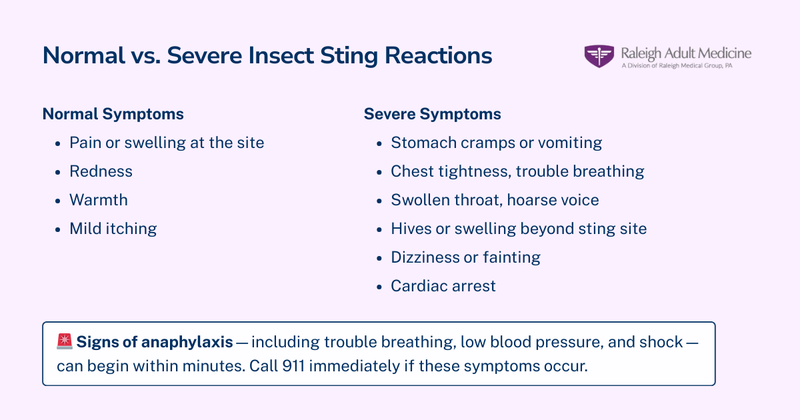
Most yellowjacket stings cause localized pain, redness, and swelling that resolves on its own, but some reactions require immediate emergency care. Poison Control guidance on allergic reactions to stings identifies the warning signs that call for 911: trouble breathing, swelling of the throat or face, dizziness, fainting, widespread hives across the body, or gastrointestinal symptoms such as nausea and vomiting after a sting.
These are signs of anaphylaxis, a serious and potentially life-threatening response that requires medical treatment, not a wait-and-see approach.
Anyone who has been prescribed an epinephrine autoinjector should use it as directed when these symptoms appear, then call 911 regardless of whether the symptoms seem to ease after the injection. The autoinjector buys time; it does not replace emergency medical evaluation.
Keep this guidance separate from nest-management decisions. A serious sting reaction is a medical emergency that requires calling for help immediately, not a reason to go back outside and investigate where the colony is located.
Address the medical situation first, and handle the yard question only after everyone involved has been evaluated and is safe.
Make a distance-based inspection part of fall mowing
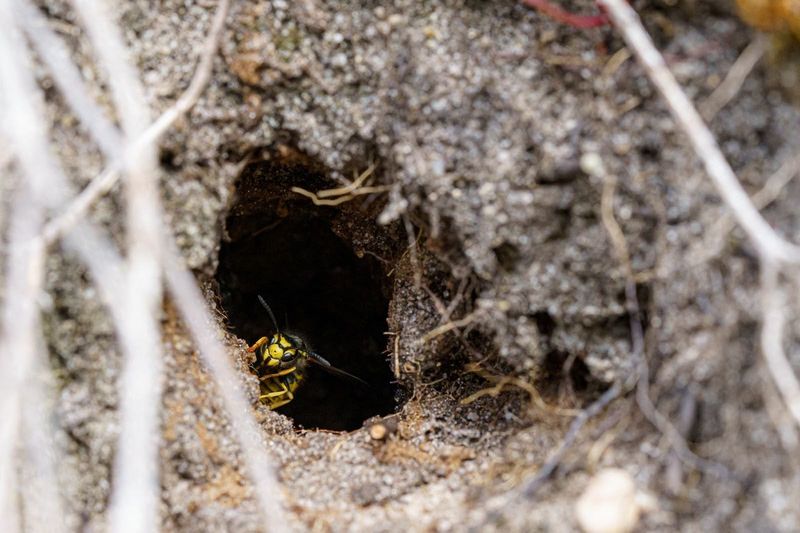
Building a short inspection into the start of every fall mowing session costs a few minutes and can prevent a painful encounter. Walk the lawn edges, check spots with thin or sandy turf, look near the bases of shrubs and trees, and scan any area with small ground openings.
Do all of this from a comfortable distance, watching for yellowjackets moving steadily in and out of one consistent spot rather than wandering individually across the yard. NC State Extension turf guidance and Penn State IPM recommendations both support this kind of pre-activity check during the late-summer and fall period when colonies are largest and most noticeable.
When repeated traffic points to a suspected entrance, keep people and pets away, mark the spot from a distance, and postpone mowing that section until you have arranged an appropriate response. The goal is not to eliminate every yellowjacket from the property.
The goal is to avoid unknowingly running a mower over an active colony in a spot where the people and pets you care about spend time. A two-minute walk before you pull the cord is the simplest version of that protection.