
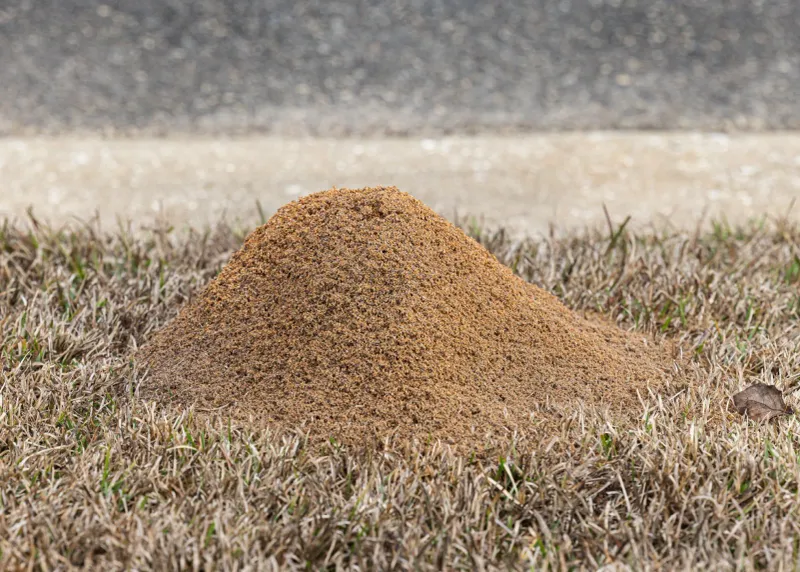
Fire ants have been quietly building their colonies across much of North Carolina, and the mound you do not see before your next step is the one that sends dozens of stinging workers up your leg. These insects can respond to disturbance within seconds, and a healthy colony can deliver hundreds of stings before most people react.
Knowing which parts of your yard carry the highest risk, and how to read the signs from a safe distance, is the most practical protection you can give your family this season.
North Carolina has no current map of the “biggest” fire-ant mounds
Anyone who has searched online for a statewide ranking of North Carolina’s largest fire-ant mounds right now has been looking for something that does not exist. As of September 14, 2026, no authoritative, real-time survey tracks which yards across the state currently hold the biggest colonies or tallest mounds.
The title of this article implied that ranking, and it is worth correcting that before a single step is taken outdoors.
What the evidence does support is a more useful answer. USDA APHIS pest information for North Carolina confirms that imported fire ants are established across a wide portion of the state, with numerous fully regulated counties and portions of Granville and Iredell counties under quarantine.
That broad distribution means a simple Piedmont-versus-Coastal-Plain label will not tell a homeowner much about the risk in their specific yard.
A more reliable inspection strategy comes from yard conditions rather than geography. Sun exposure, soil type, moisture, drainage, disturbance history, and colony age all influence where large or newly visible mounds are most likely to appear.
NC State Extension’s fire-ant turf guidance points to open, sunny, disturbed areas as the highest-probability locations, not a specific county or region.
Shifting from a regional map to a conditions-based checklist gives homeowners a genuinely actionable inspection plan. The sections that follow walk through exactly which yard features to prioritize, what a possible mound looks like from a safe distance, and what to do once you find one.
The hottest, most exposed parts of the yard deserve the first scan

Before mowing, pulling weeds, letting children play, or walking barefoot across the lawn, the logical first stop is the hottest, most open ground in the yard. NC State Extension’s turf guide identifies open, sunny lawn areas and exposed soil as the settings where imported fire-ant mounds are most likely to appear.
These spots warm quickly in the morning and hold heat through the afternoon, conditions that suit colony development and make mounds more visible against bare or closely mowed ground.
Pavement edges deserve particular attention. The strip of soil running beside a sidewalk, driveway, concrete patio, curb, or garden slab absorbs heat from both the sun above and the warm surface beside it.
That combination creates a microclimate that fire ants favor. Scan these borders carefully before any yard task, because the mound can sit flush against the pavement edge where a foot naturally falls during normal foot traffic.
Bare-soil patches, recently graded areas, and the edges where a lawn meets an open field or unmowed strip are also worth checking. Disturbed ground, where the surface has been broken by construction, digging, or heavy foot traffic, gives a colony easier access to build upward.
These are not guarantees that a mound will be present, but they represent the highest-probability locations for a systematic first pass.
Dense shade and mature wooded areas reduce the likelihood of finding a mound, but they do not eliminate the possibility entirely. Disturbed woodland, including areas where trees have recently been cut, roots have been removed, or the ground has been graded, can still support a colony.
The practical rule is to start the scan in the open sun, then extend it toward any recently disturbed ground before assuming a shaded corner is clear.
After heavy rain, a low mound can become a visible warning
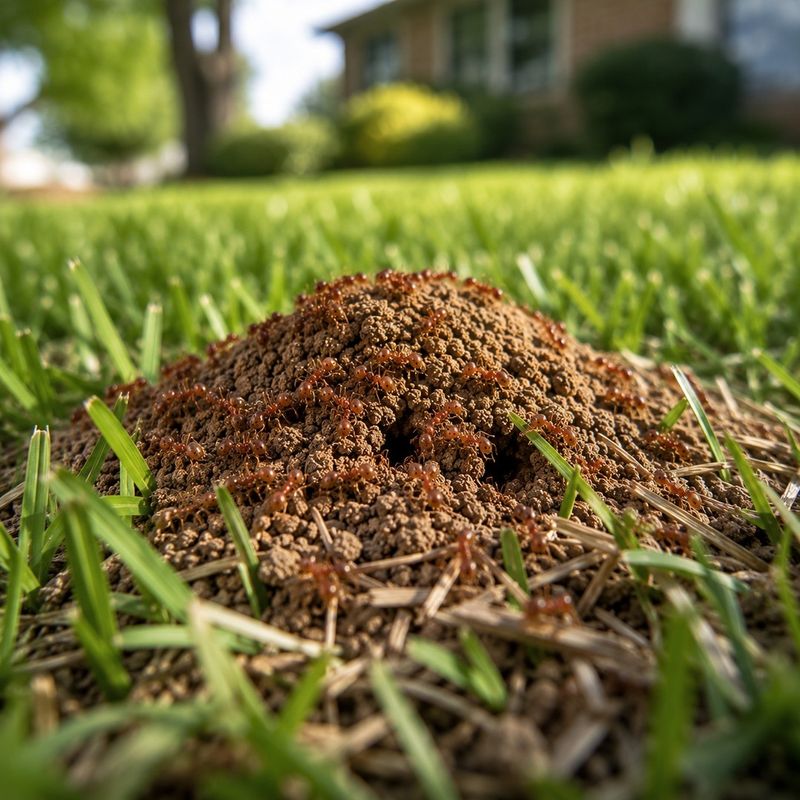
Rain changes the game in ways that catch many homeowners off guard. When heavy rain saturates the soil, a fire-ant colony may respond by pushing soil upward, raising a mound that was previously low or nearly invisible above the waterlogged ground.
NC State Extension’s post-storm fire-ant guidance explains this behavior, noting that flooded colonies can also form floating rafts of ants before finding new ground, which means a rainstorm can shift an established colony to a fresh location in your yard.
The practical timing cue here is straightforward: inspect sunny lawn edges, bare-soil areas, and pavement borders after warm, wet weather, and do that inspection before resuming mowing, gardening, or outdoor play. A mound that was not there last week may now be clearly visible as a fresh dome of loose soil.
Increased visibility after rain does not mean rain created fire ants or that every new dirt pile is a colony, but it does mean the inspection window after a storm is genuinely useful rather than optional.
Hot, dry conditions create a different pattern worth knowing. NC State Extension’s fire-ant management publication notes that during periods of intense heat, workers may forage primarily in the evening rather than during the hottest midday hours, and the colony may remain deeper in the soil during the day.
That means a mound can appear quiet in the afternoon heat yet still be fully active. Weather does not make a mound safe to step near; it only changes when the workers are most visible at the surface.
A likely fire-ant mound is a shape-and-traffic problem, not a size test

Mound size is one of the most common things people try to use as the deciding factor, and it is also one of the least reliable. Soil type, moisture level, mound age, colony structure, and recent disturbance all affect dimensions.
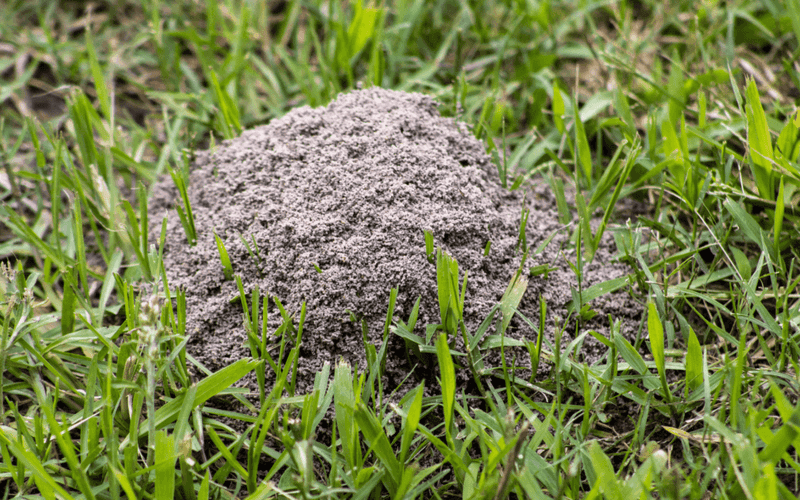
A mound in clay soil may form a fairly symmetrical dome, while the same colony in sandy soil can produce a flatter, more irregular shape. NC State’s integrated pest management guidance notes that fire-ant mounds are generally dome-shaped and typically lack the obvious central opening found in some other ant species, which is a more reliable visual clue than any particular diameter or height.
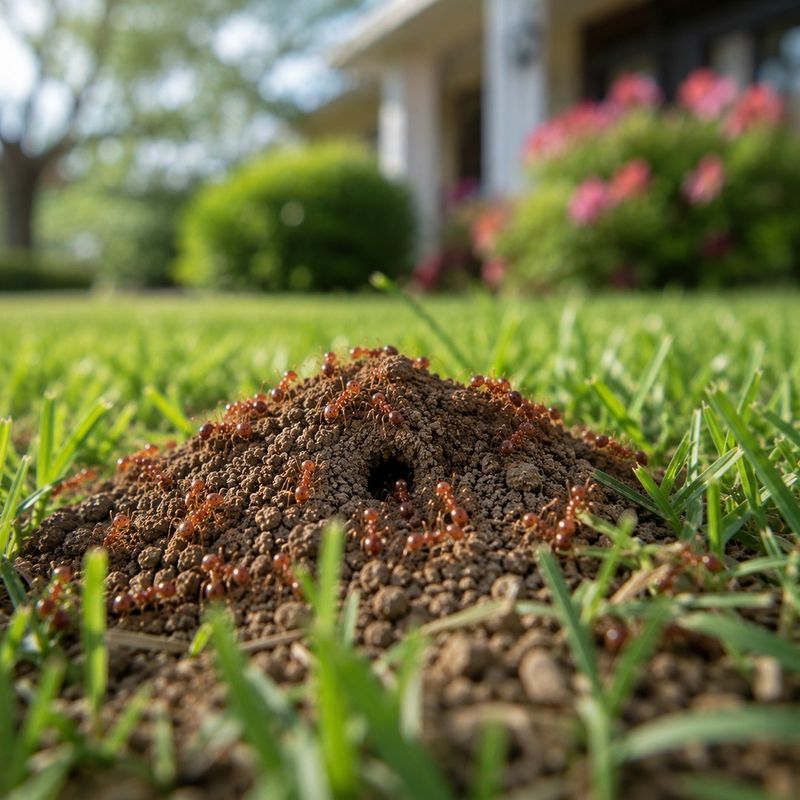
What to look for from a safe standing distance is a combination of shape and worker traffic. A possible fire-ant mound tends to appear as a rounded or irregular dome of loose, freshly worked soil, without a central hole at the top.
Look at the sides of the mound for movement. Workers enter and exit through underground side tunnels rather than through a central entrance, so the traffic pattern runs around the base rather than in and out of the top.
NC State’s arthropod pest guide for North Carolina turf describes fire-ant workers as reddish-brown with darker, shinier abdomens, ranging roughly from one-eighth to one-quarter inch in length. Workers within a single colony vary noticeably in size, so seeing ants of several sizes around the same mound fits the pattern.
Two bumps, called nodes, between the thorax and abdomen are one feature used in identification, but that detail requires close inspection and is not proof of species on its own.
A visible mound does not automatically confirm red imported fire ants. Southern fire ants, tropical fire ants, other ant species, and some solitary ground-nesting insects can produce similar-looking structures.
NC State’s red imported fire-ant publication recommends submitting a specimen to a county Extension center or the NC State Plant Disease and Insect Clinic when positive identification matters for management decisions.
How can you check activity without making the mound boil over?
The most common mistake people make when they suspect a fire-ant mound is testing it with a foot, a stick, or a quick brush of the hand. Kicking, poking, or breaking open the mound can trigger a rapid defensive response, sending workers up the nearest surface before the person has time to move.
The safer approach starts with observation from a standing distance, using eyes rather than contact.
Scan the mound from at least several feet away. Look for worker movement around the base and sides, and check whether the soil appears freshly disturbed or loose.
NC State’s fire-ant biology and behavior publication describes how workers can emerge rapidly when the mound is disturbed, which reinforces why observation from a distance is both the safest and most practical first step. If you want to document the location, photograph it from where you stand and mark it with a small flag or stake so others know to avoid the area.
When visual observation alone leaves you uncertain, an extension-based confirmation method involves placing a small greasy food item, such as a piece of potato chip or hot dog, on the ground near the mound rather than on top of it. NC State’s organic lawn care guidance suggests observing for five to ten minutes from a safe position.
If fire ants are actively foraging, workers will typically investigate the food source within that window. Keep children and pets away from the area during this observation period.
One visual check is not a clean bill of health. Young colonies may not yet have produced a visible mound, and an established colony can relocate or create satellite mounds nearby.
A yard that looked clear last month may have new activity this week, especially after weather shifts or soil disturbance. Routine scanning before yard tasks is more reliable than a single inspection.
Treat a high-traffic mound only after you make it safe to manage

Finding a mound beside a walkway, play area, garden path, or frequently used gate means the hazard needs to be addressed rather than left for later. The first step before any product touches the ground is marking the mound from a safe distance, either with a flag, a ring of rocks placed carefully without approaching the mound, or a photograph with a clear reference point.
That marker keeps family members and pets away while you plan the treatment.
NC State Extension’s fire-ant management publication recommends using a product specifically labeled for fire ants and following the label exactly, including reentry intervals, watering requirements, edible-garden restrictions, and any precautions for aquatic life near drainage areas. The label is the legal document that governs how the product must be used, and departing from it can reduce effectiveness while increasing risk to people, pets, and surrounding wildlife.
For a single mound in a high-use location, individual mound treatment uses less insecticide than a broadcast application across the whole yard. That reduction matters for native ants and beneficial insects that share the soil.
The trade-off is that individual treatment can miss a satellite mound nearby or a young colony that has not yet built a visible structure. NC State’s landscape fire-ant guide describes management as the realistic homeowner goal, not permanent elimination, because colonies can survive incomplete treatments, relocate, or reinvade from adjacent properties.
Baits labeled for fire ants are generally scattered around the mound rather than on top, because workers leave through underground side tunnels and pick up bait while foraging. Baits work only when ants are actively foraging, so they should be applied fresh and kept dry.
Late spring and early fall are effective treatment periods, and late September through early October is specifically cited by NC State as a useful window. During hot weather, evening application may align better with foraging activity.
Follow-up inspection in the weeks after treatment is as important as the treatment itself.
The fastest-looking home remedies can create a bigger yard problem
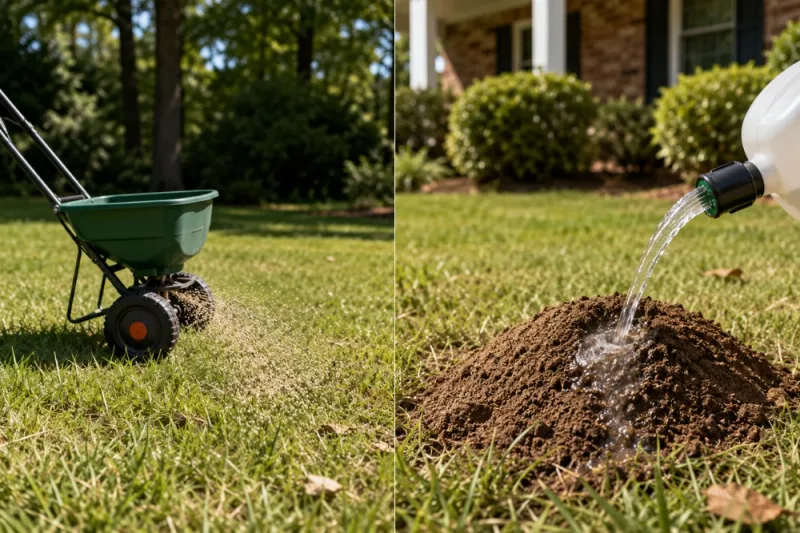
When a mound appears beside the back door, the instinct to reach for something quick from the garage or kitchen is understandable. That instinct is also one of the most reliable ways to make the situation worse.
Gasoline, diesel, bleach, ammonia, chlorine, and similar household chemicals should never be poured on a fire-ant mound. These substances endanger the person applying them, can injure children or pets who later contact the treated soil, and can contaminate groundwater.
NC State Extension’s fire-ant publication explicitly warns against these chemical home remedies.
Folk remedies fare no better on effectiveness. Grits, molasses, aspartame, and club soda are all documented as ineffective by NC State, despite their persistence as yard-management folklore.
None of these substances eliminates a colony or reliably suppresses activity, and time spent on them is time the colony uses to spread.
Hot water is sometimes presented as a more natural option, but it carries real risks. Boiling water can burn the person carrying it to the mound, damage desirable plants in the surrounding soil, and fail to reach the queen or the deepest portions of the colony.
Partial suppression without killing the queen typically results in the colony rebuilding or relocating within a short period.
The stewardship consideration matters here too. NC State’s arthropod pest guide notes that broad or indiscriminate pesticide applications can harm native ants and other beneficial insects that help decompose organic matter, aerate soil, and control other pests.
Confirming the species and using a labeled product targeted at fire ants protects the rest of the yard’s insect community while addressing the actual problem.
A sting becomes an emergency when the reaction spreads beyond the skin
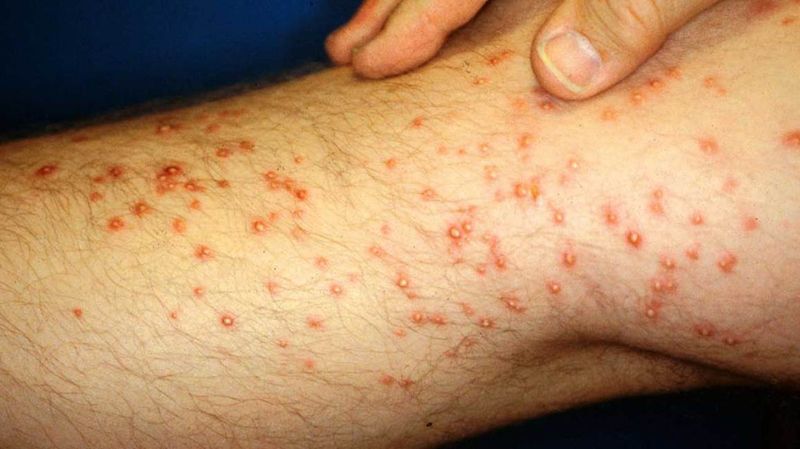
Fire ants both bite and sting, and they frequently remain attached to the skin while delivering repeated stings. The bite is the grip; the venom comes from the stinger.
A person who steps into a mound or brushes against a disturbed colony may receive dozens of stings before realizing what has happened.
The correct immediate response is to brush the ants off promptly without crushing them against the skin. Crushing can increase venom exposure.
After removing the ants, wash the area with soap and water, then apply a cool compress for a mild local reaction. MedlinePlus guidance on fire-ant stings describes the typical local reaction as a raised, burning welt that often develops a white pustule within hours.
That pustule should be left intact to reduce infection risk.
Most healthy adults experience only local discomfort, but some people develop a serious allergic reaction. Difficulty breathing, tightening or swelling in the throat, widespread hives or swelling beyond the sting site, chest symptoms, vomiting, faintness, or any sign of shock are emergency warning signs.
Call 911 or get to an emergency room immediately if these symptoms appear. People who already know they have a severe insect-sting allergy should follow their physician’s emergency plan and carry prescribed epinephrine at all times when outdoors.
Find the mound before the foot finds it
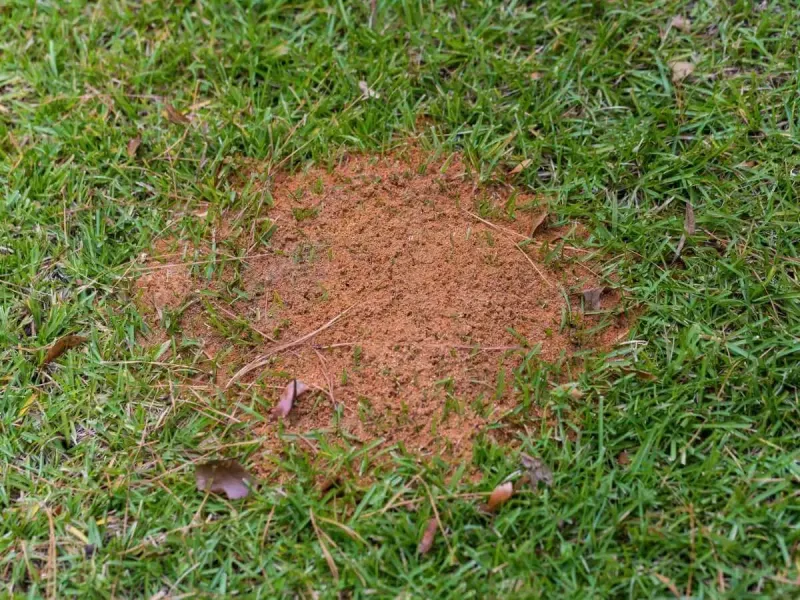
The most effective protection against a fire-ant encounter is a habit rather than a product: scan the yard before you work in it. Check sunny, open lawn areas, bare-soil patches, and the edges beside driveways, sidewalks, and patios, especially after warm, wet weather when colonies may have raised new mounds above saturated soil.
NC State Extension’s turf fire-ant guidance supports this conditions-first approach as the most practical inspection framework for homeowners.
When you find a suspected mound, observe it from a distance, photograph it, and mark it before deciding on a response. Manage confirmed high-traffic hazards with a product labeled for fire ants, follow the label exactly, and return to inspect the area in the weeks after treatment.
NC State’s landscape management guide frames the realistic goal as reduction and monitoring, not permanent elimination, because satellite mounds and reinvasion from neighboring properties are both documented outcomes. NC State’s fire-ant biology publication also reminds readers that a mound-free inspection does not guarantee a fire-ant-free yard, since young colonies may not yet have a visible structure.
The yard that gets a two-minute scan before every mowing session is the yard where bare feet and unexpected stings are far less likely to share the same afternoon.